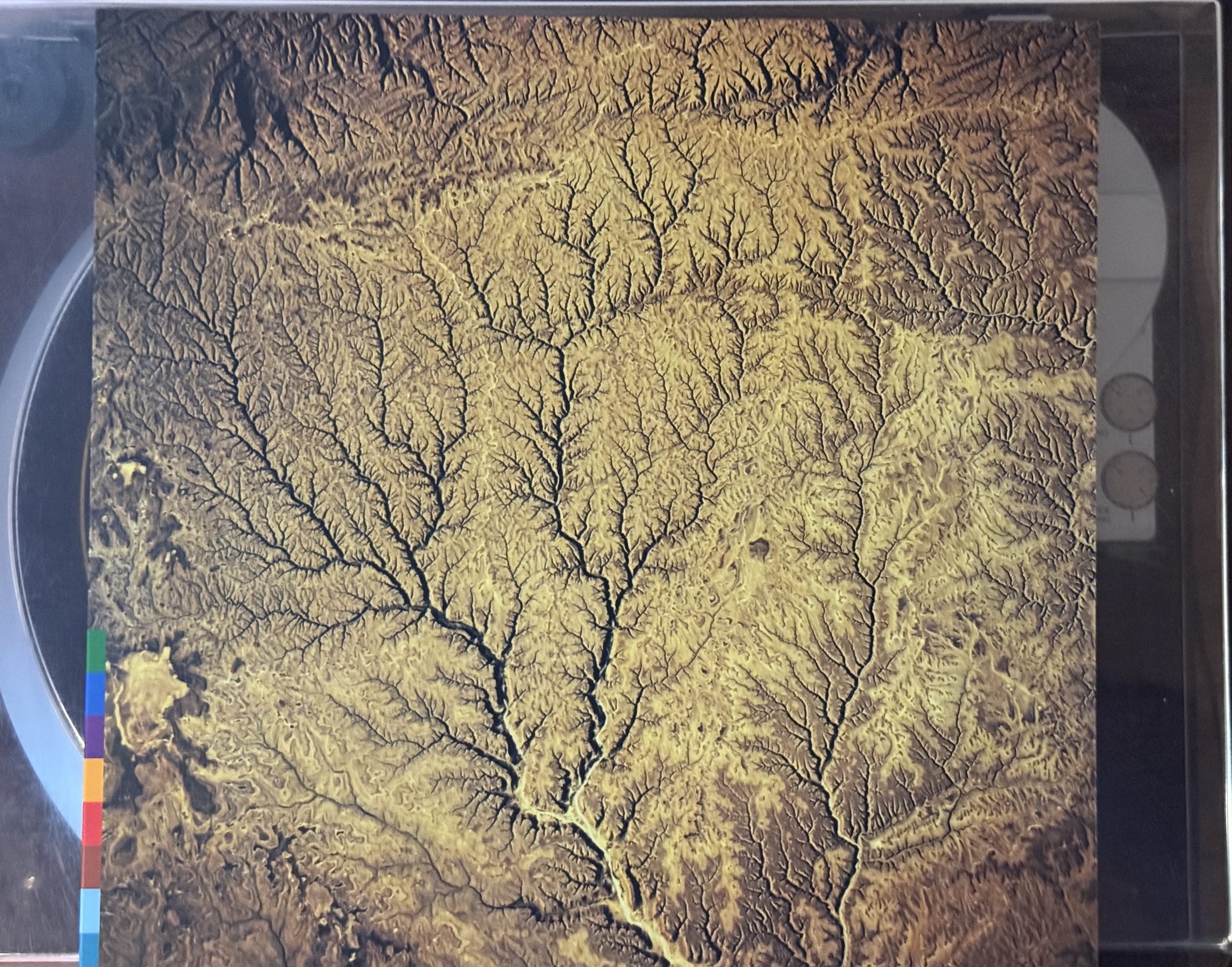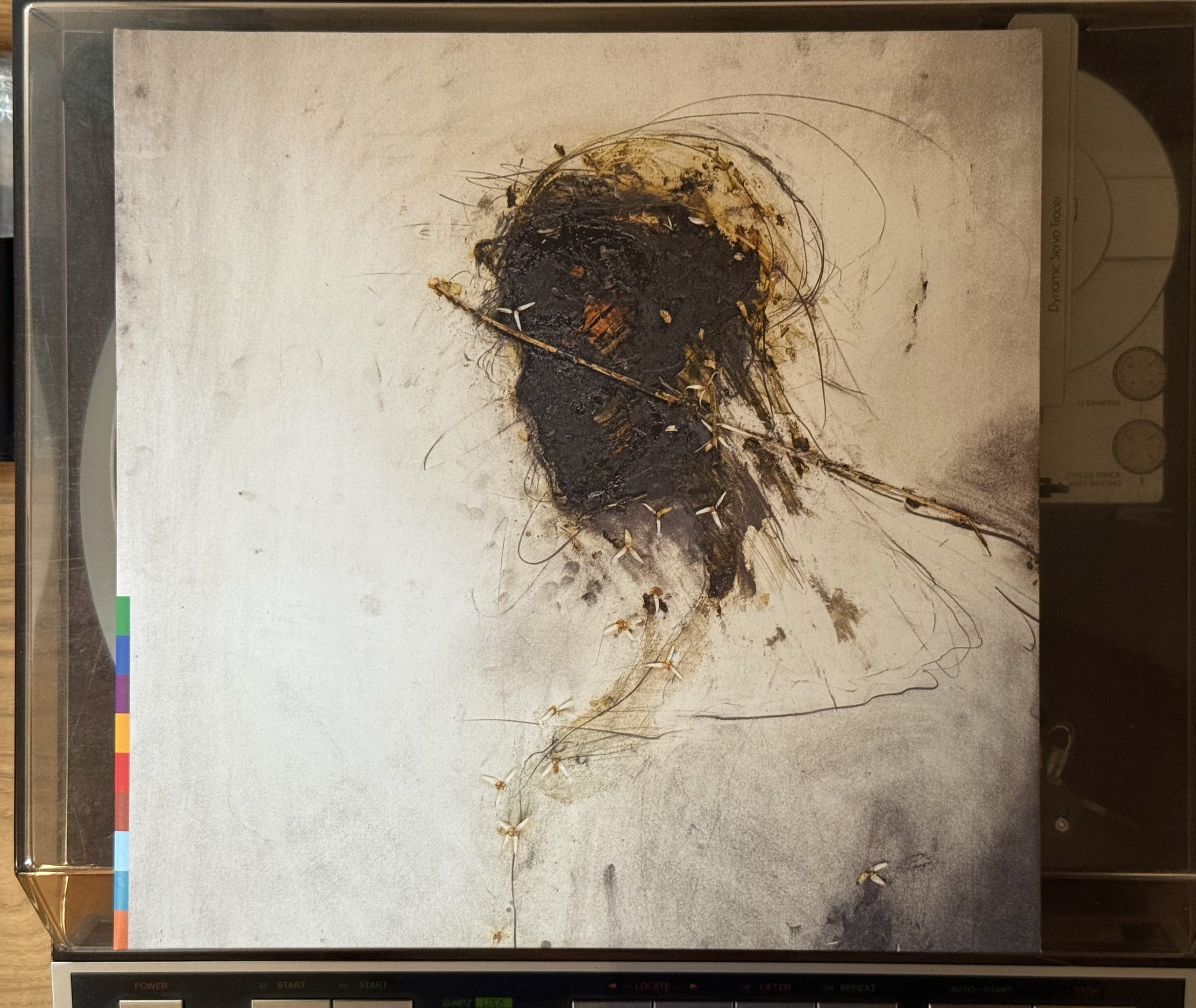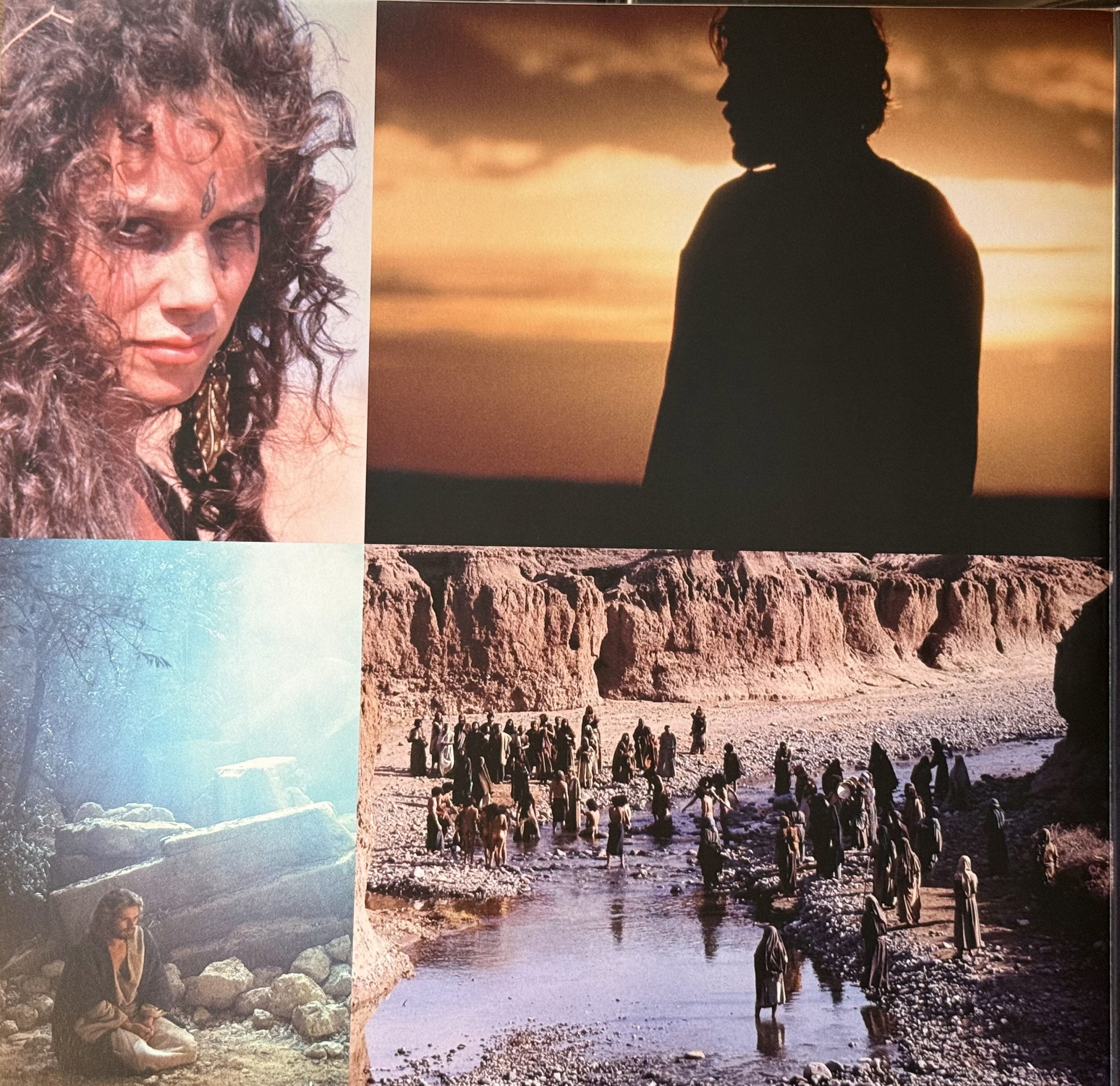
Peter Gabriel, OVO

An unlikely source for the great musician’s most personal song, in a cast album for a musical that had 999 performances in the Millennium Dome.

Album of the Week, October 10, 2026

Even in the moment, in the mid-1990s following the release of Us, it seemed like Peter Gabriel was all over the place while simultaneously being invisible. Interactive computer entertainment via the then-new medium of the CD-ROM? He was there, with XPlora 1: Peter Gabriel’s Secret World (reviews now differ: was it a computer game or an extended advertising campaign? Having played it back in the day, I can say with confidence: it was slow) and Eve. There were talks about a theme park. But new music under his name was slow to appear, until in 2000 an odd album appeared. A soundtrack, but for a live show rather than a movie; a concept album with an impossible-to-describe concept; and a Peter Gabriel album with almost everyone except Peter Gabriel on lead vocals. What, exactly, was OVO?

First of all, it was the soundtrack to the Millennium Dome Show, intended as a massive multimedia event but remembered today mostly as an expensive flop. The show, built inside a massive dome on London’s Greenwich Peninsula near Canary Wharf that now houses the O2 Arena, was meant to commemorate the Millennium and, not coincidentally, to announce to the world that Tony Blair’s New Labour was creating fabulous things in Great Britain. Ultimately the show, which ran for a year, did not draw the crowds the organizers anticipated; though the 6.5 million visitors who saw one of the 999 shows were reportedly happy with the experience, organizers had planned for more than 10 million.

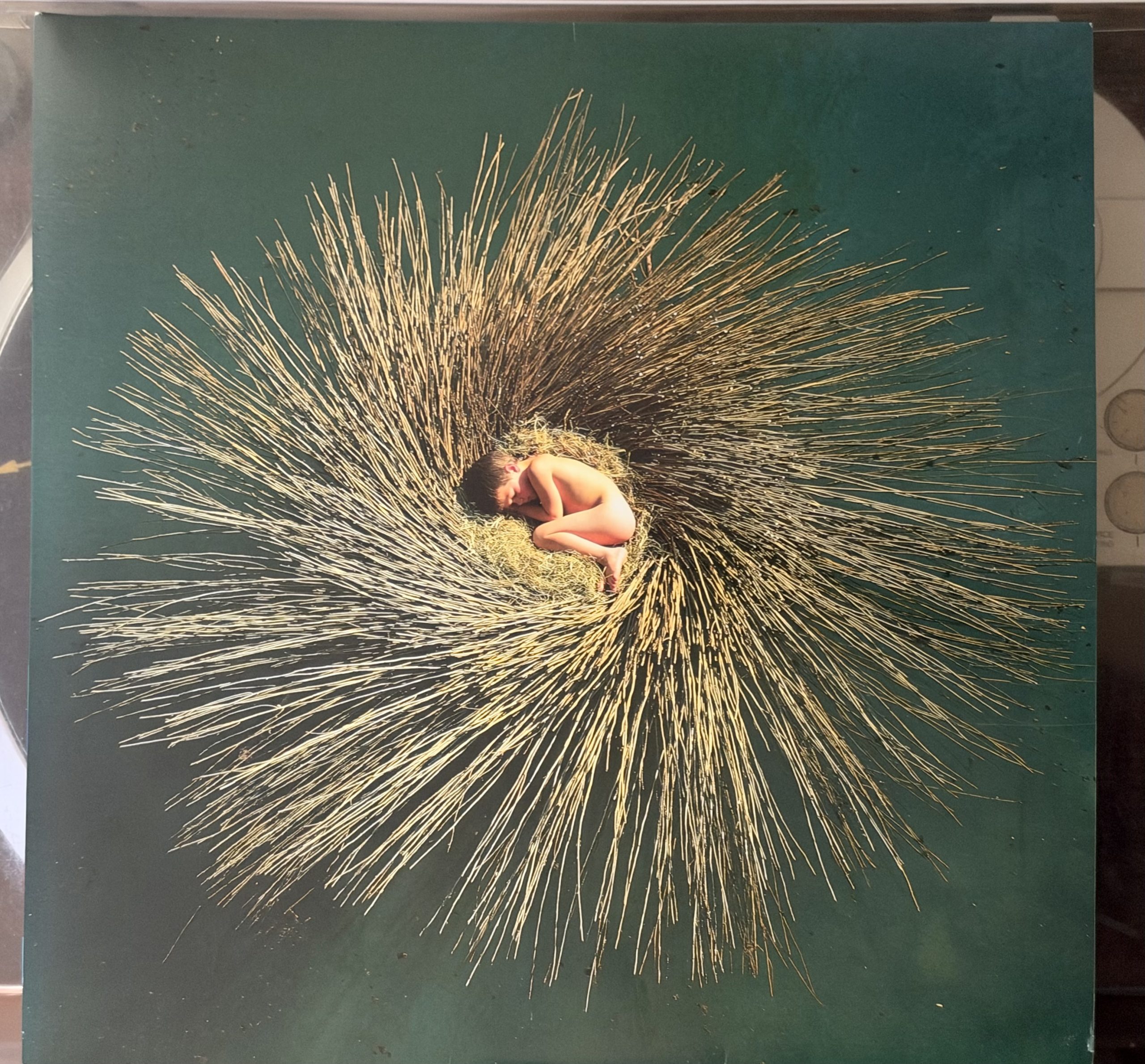
Second, it was a concept album, but a meandering one. The Skypeople live in the trees, while the Earth People were originally agrarian but develop iron technology, creating alienating cities in towers, such as the Tower That Ate People. Sofia of the Earth People nevertheless falls in love with Skyboy of the Skypeople. Sofia’s brother, who built the tower, grows paranoid about the Skypeople and jealous of Skyboy, and imprisons him in the tower. The desperate Skypeople attack the tower and free Skyboy; Sofia’s brother, understanding at last his folly, dies atop the tower, and the Skypeople bring it down, killing Sofia’s mother in the rubble. Sofia, bereft, finally finds Skyboy again and goes with him above the clouds, ultimately bearing his child, a boy named OVO (the caps are in the score); at his birth a tree springs from his grandmother’s grave, rapidly growing into a giant oak. When catastrophic rains come and endanger earth and Skypeople alike, Sofia has a dream that the world is upside down and that one can sail away to safety into the sky. Inspired by the dream, she places OVO in a nest and sends him sailing into the sky to find hope and a safer place. While the story has deeper emotional resonance than Mozo’s radio-born revolution, it’s plenty bonkers.

But last, OVO contains some of Peter’s most personal writing, with some melodies dating back to So, and some truly gorgeous sonic landscapes, even if he doesn’t sing most of it. It’s all delivered in something that’s more musical theater than rock album, complete with recurring themes, big set numbers, and a broad cast of characters.

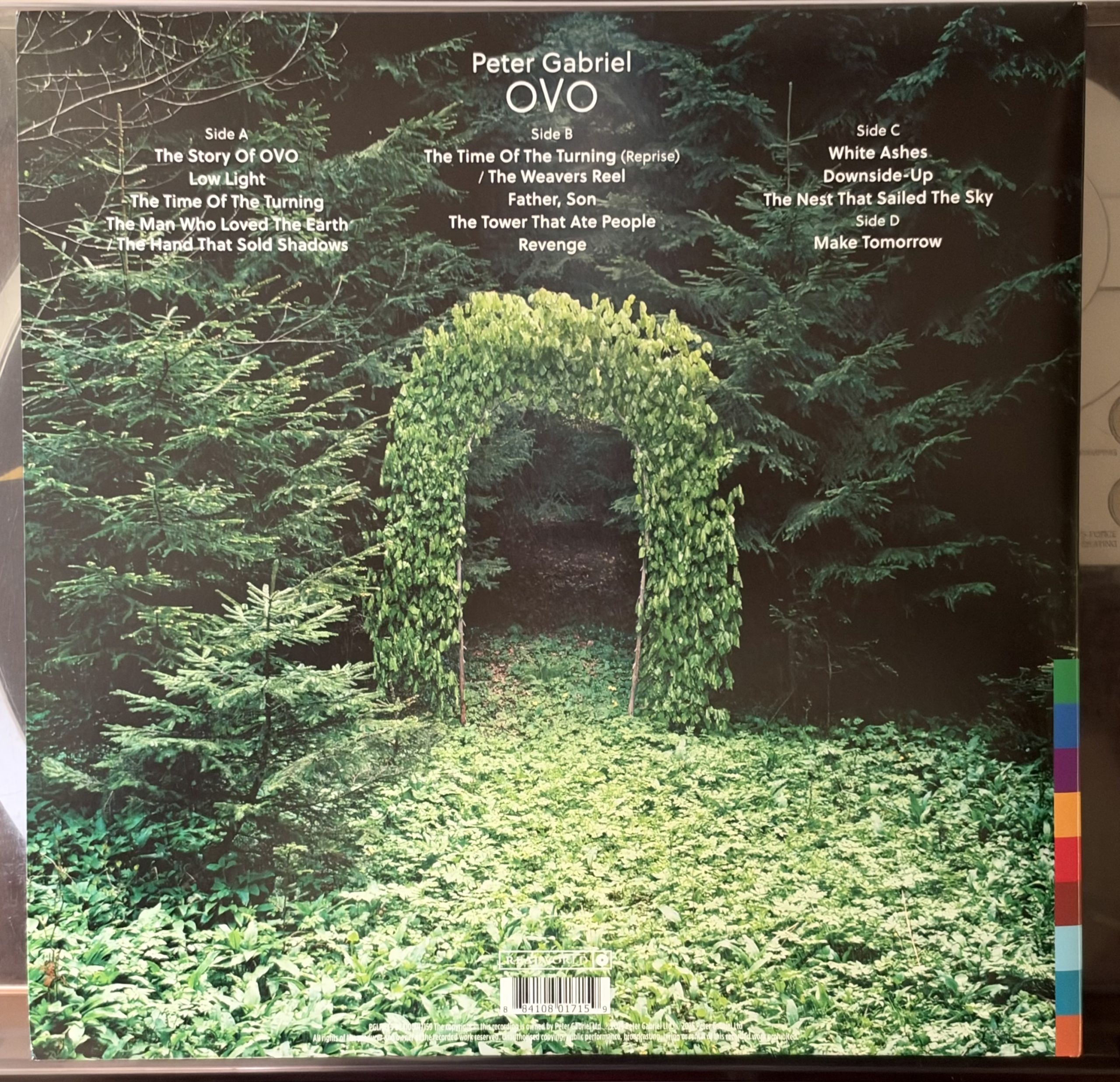
“The Story of OVO” opens with a grimy groove which immediately subverts the listener’s expectation: yes, that’s rap, and yes, that’s Neneh Cherry, alongside American rapper Rasco. Gabriel apparently chose this approach because he wanted to interest a broader range of listeners in the material, and he knew “kids listened to rap.” Hamilton it ain’t, but the track does what it needs to do, which is to move the plot along atop the deepest beats on the album.

We subvert expectations once again with “Low Light,” which immediately turns aside from the groove into an ambient soundscape that wouldn’t have been out of place on Passion but is even deeper and more enveloping. The stunning Irish voice on the latter half of the track belongs to Iarla Ó Lionáird, a sean–nós singer who had released his first solo album on Real World in 1997 and was also a member of the beat-driven Irish and West African crossover ensemble, the Afro Celt Sound System. There are undercurrents throughout the work of musical themes that will appear later in the album, including the “Downside-Up” theme.

“The Time of the Turning” is something else again, an acoustic ballad with vocals by electronica singer Alison Goldfrapp, a few years away from her star turns on the album Black Cherry and the hit single “Ooh La La.” Alongside Goldfrapp is none other than singer-songwriter Richie Havens, voicing the perspective of Sofia’s father and his traditional agrarian ways. But Goldfrapp warns us, “It’s the time of the turning/And we’d better learn to say our goodbyes.”

“The Man Who Loved the Earth/The Hand That Sold Shadows” revisits the groove from the opening track as an instrumental, so you can hear the play of the buzzing didgeridoo against the bass line and thundering drums. The only problem with the arrangement is the odd interjections from the villagers as they build their constructions of iron, which sounds like something in between the didgeridoo and scratching. In the last minute and 30 seconds there’s a hard cut to a more ominous percussive rhythm, driven forward by a hooky, whistling synth and David Rhodes’ monster guitar.

“The Time of the Turning (Reprise)/The Weaver’s Reel” brings Goldfrapp back for one more chorus, accompanied by a brass band, before we abruptly transition into a frantic Celtic dance, anchored by the redoubtable Richard Evans but also by the Dhol Foundation (a South Asian drumming ensemble based in London), Johnny Kalsi and James McNally (members of the Afro Celt Sound System), and a host of Celtic musicians. The net effect is a thesis statement that will be familiar to listeners of Sheila Chandra: that there is a through-line among the music of the Irish, the South Asians, and West African cultures. It’s the adrenaline climax of the album, and it pointed the way to where the Afro Celts and others were heading in blending these musics into something you’d want to dance to.

“Father, Son” is a rare introspective moment, and a rare instance of Gabriel’s vocals on the record. As the industrialist Ion mourns the death of his father, he reflects on their relationship in a piano-driven ballad. It stands completely apart from the rest of the material, and was written earlier. The lyrics, as the two men have an emotional breakthrough while doing yoga together, are both concrete (“spine against spine”) and incredibly moving. Emotionally it feels of a piece with other introspective Gabriel songs like “I Grieve,” which had appeared on the soundtrack to the movie Philadelphia some years prior, and it continued in Gabriel’s set lists for years after; I remember being struck by its impact at Gabriel’s 2001 WOMAD performance in Redmond, Washington.

“The Tower That Ate People” introduces a new theme driven by snarling guitars courtesy of David Rhodes and tight drums from Manu Katché. Gabriel’s vocals here are treated and, in his own words, influenced by Dr. John as he snarls out his paranoia in the role of Ion. The music would fit well alongside earlier songs like “Steam” and some of Gabriel’s forthcoming projects, which we’ll hear more of later.

“Revenge,” as the Skypeople attack the Tower, is a massive drum number with the Dhol Foundation playing alongside programmed drums and a thrumming keyboard line. It’s brief and leads into the grief-filled “White Ashes,” anchored by vocals from Omi Hall as the villagers sort through the rubble of the Tower.

“Downside-Up” opens the third act with one of the most thoroughly realized and dramatic tracks on the album, a duet between the Cocteau Twins’ Elizabeth Fraser and the Blue Nile’s Paul Buchanan. Fraser doesn’t get the opportunity to do much of her trademark vocal acrobatics here, but Skyboy’s part was written for Buchanan’s haunted baritone and he sounds fantastic here. It’s a full-blown PG song, with his full band joined by former Super Étoile de Dakar members Assane Thiam and Babacar Faye—in fact it’s really two PG songs in one, with the gentle “Downside-Up” theme grafted to the more rhythmic “Ovo” theme in the second half as they celebrate the infant’s arrival.

“The Nest That Sailed the Sky” gives us one last instrumental, with the brass band joined by Shankar and a string and synth-driven soundscape for another track that wouldn’t have been out of place on Passion. It leads into the cast finale, “Make Tomorrow,” as we hear from Buchanan, Fraser, Richie Havens and Gabriel in their grief and hope as they send OVO into the sky, and snippets of the “Downside-Up” and “Ovo” themes blend into moments of percussion that recall the more conflict-driven moments of the album. When the percussion and growling didgeridoo re-emerge to underpin the “Make Tomorrow” theme, we get a sort of synthesis moment that gives us hope that all the forces can actually work together, which one suspects was the narrative point.
Gabriel’s grand musical may not have ultimately congealed into a fully coherent statement, but it still stands as a unique point in his repertoire as the only musical theatre in his solo repertoire and his first major concept album since Genesis’ The Lamb Lies Down on Broadway. Gabriel would make more soundtrack albums following this, including The Long Walk Home (soundtrack to The Rabbit-Proof Fence), but he would also finally release more original songs. In fact, simultaneously with OVO he was working on another album, a proper sequel to Us, which would finally be released two years after the ambitious concept. We’ll hear that one next week.

You can listen to this week’s album here:

BONUS: Peter performed some of the music live with the musicians on the project on the promotional circuit. Here he is with Fraser and Buchanan on the Jools Holland show a few weeks before the album was released:

BONUS BONUS: Peter took the material from OVO into live performances through the 2000s, and in his 2010 orchestral project New Blood. Here’s a performance from his “Growing Up” tour, and from the New Blood concert film Taking the Pulse:

BONUS BONUS BONUS: This wouldn’t be Peter’s last collaboration with the Afro Celt Sound System. It was with delighted disbelief that I heard his voice on their song “When You’re Falling” on the air in 2003. Here’s a live version of the song from an unspecified television program:

Peter Gabriel, Us

The artist’s most emotionally direct album digs in the dirt to yield a richly organic collaboration featuring some of his most enduring songs.

Album of the Week, August 15, 2026

When Peter Gabriel released his new album Us on September 28, 1992, it seemed like an eternity had passed since his last pop album, So, in 1986. (How little we knew!) Over the past weeks we’ve looked into some of what he was doing during the period—the Passion soundtrack and sister album Passion – Sources, massive world tour, WOMAD, and starting the Real World label and launching the western careers of some of his key contributors. But it has to be said that part of what he was doing was recalibrating. For the former art-pop auteur, life could never be the same after So. He had to find a new way to make music.

He also had to come to terms with himself. His marriage to Jill Gabriel, long strained, ended in divorce in 1987 in the middle of the massive world tour. He was famously linked with actress Rosanna Arquette for some time after his divorce, but the relationship was not long lasting. The dissolution of his marriage resulted in depression and therapy, which continued for six years. The divorce and his therapy both influenced the songwriting on Us, his most personal album to date.

To make the album real, he turned to a group of collaborators both familiar and new, many drawn from the sessions in the massive state-of-the-art studio he built in a former mill building complex in Box, Wiltshire, England. There was the core band, by now familiar: Tony Levin, Manu Katché, David Rhodes, producer Daniel Lanois, engineer David Bottrill; frequent collaborators like Shankar and Peter Hammill; collaborators from Passion including Hossam Ramzy, Doudou N’Diaye Rose, Kudsi Erguner, Assane Thiam, Manny Elias, and the Babacar Faye Drummers; and collaborators drawn from the nascent Real World label including many of the Passion names, the Dmitri Pokrovsky Ensemble, and Ayub Ogada. There were also some brand new faces, including Meters guitarist Leo Nocentelli, Lanois’ producing partner Brian Eno, ascendant electronic producer William Orbit, duduk player Levon Minassian, and incandescent vocalist Sinéad O’Connor.

“Come Talk to Me” begins in a silence that builds to a shout: layers of keyboards crescendo up to a bagpipe solo over the bass, thundering drums courtesy of the combined forces of Katché, the Babacar Faye Drummers, and a 1980 drum loop from Doudou N’Diaye Rose, and a response on the duduk. Peter’s vocals are direct and intimate, reaching out to someone who has been incommunicado, asking for a bridge over which they can rebuild a relationship; he’s subsequently disclosed that the rift was with one of his daughters. The chorus features harmony vocals from Sinéad; Peter had met her doing an Amnesty concert in Santiago, Chile in 1990 and invited her to the studio, and having her very present voice on the opening track effectively signals that this album is about dialog and communication. It’s also a showcase for his collaborative work with the artists of Real World: that choir that enters after the bridge, the storied Dmitri Pokrovsky Ensemble, were recording their album for the label, The Wild Field, at the same time Gabriel was working on Us.

The contrast as the album flows into “Love to Be Loved” is marked. Cool where “Come Talk to Me” is hot, the second track is all about minimal groove, with both the late William Orbit and the legendary Brian Eno contributing programming and keys. Katché’s drum programming and Hossam Ramzy’s tabla (as well as Daryl Johnson’s hand drum) anchor the rhythm along with Tony Levin’s bass. And the lyrics take us on an emotional journey, starting from talking about the need for contact (echoes of “I Have the Touch”) to a startling transition in the bridge in which Peter confesses, “This old familiar craving / I’ve been here before, this way of behaving… Let it pass, let it go, let it leave / From the deepest place I grieve / This time, I believe.” But even that isn’t the end, and we get to the root of it: “Though it takes all the strength in me / And all the world can see / I’m losing such a central part of me / I can let go of it… I recognize how much I’ve lost / And I cannot face the cost / ‘Cause I love to be loved.” The track’s stark honesty about the need for physical relationships and letting go of destructive behaviors, even as other relationships are falling apart, is striking; one really feels those years that Peter spent in therapy at work here. And it’s a jam.

That brings us to “Blood of Eden,” which feels like the most primal, innocent love song Peter has ever written. It comes out of an idyllic opening with the doudouk over layers of keyboards, and Peter sings about the darkness in his heart and the “heated and the holy.” The song is surely one of the best known from the album thanks in no small part to Sinéad O’Connor’s pure vocals in the chorus duet (and the face morphing of the two singers in the video), but the lyrics are a bit of a hodgepodge, with the heated and the holy looking down from on high “so secure with everything they’re buying.” The narrator returns to “the union of the woman and the man” as a retreat to paradise even as he acknowledges the worm at the heart of the apple: “All the while the distance grows between you and me.” There are echoes here of “Don’t Give Up,” both in the duet structure of the song and the plight of the narrator, but the catastrophe seems more emotional than economic here. This was one of the songs that underwent the longest gestation, with multiple versions and arrangements extant; the liner notes hint at this when they credit Richard Chappell for the mix from which the bridge section was drawn, and another version of the song appeared even before the album was released on a soundtrack (see the bonus section below). Other versions have been released to Peter’s fan club on Bandcamp.

“Steam” underwent a similar evolution, with a stunning “Quiet Steam” appearing as a b-side to the album’s first single. But there’s plenty to recommend the released version, starting with the funky guitar of Leo Nocentelli of the Meters. The horns aren’t given quite as much prominence as they are in the song’s spiritual predecessor “Sledgehammer,” but they’re still pretty tasty, and the Babacar Faye Drummers add an edge to the percussive energy that is otherwise all Motown. One fun thing to listen for is Peter’s keys, here easily distinguished because he’s switched from the airy synth sounds of the Prophet to a fairly convincing Hammond organ soundalike, adding to the sweaty funk of the mix.

“Only Us” returns to a more open, idyllic sound, with a duet between Peter and Kenyan musician Ayub Ogada. This is another track with contributions from William Orbit, but here the vibe is organic rather than chill. Shankar and ney flautist Kudsi Erguner contribute to the feeling of limitless nature, and Peter’s lyrics signal the song’s centrality to the album’s overall concept as he refocuses on relationships and people: “Seduced by the noise and the bright things that glisten / I knew all the time I should shut up and listen / And I’m finding my way home from the great escape… Yes I can read you loud and clear … The further on I go, oh the less I know / Friend or foe, there’s only us.” I realized as I was relistening to the album that this was a track that had slipped under my radar, but it repays listening to again.

The second half of the album starts with “Washing of the Water,” easily Peter’s most gospel song starting with just bass, snare and piano accompanying Peter’s unvarnished vocals. This too has echoes of “Don’t Give Up”—we could be over the same river that flowed through the earlier song. But here the protagonist gives in to the lure of the water, choosing to accept the call to immerse himself in grief as he mourns the loss of the relationship. The horns under the bridge as Peter sings “Letting go, it’s so hard / The way it’s hurting now / To get this love untied / So tough to stay with this thing / ‘Cause if I follow through / I face what I’ve denied / I’ll get those hooks out of me / and I’ll take out the hooks that I’ve sunk deep in your side.” The acceptance of the dissolution of the relationship, the unhooking and the desire to finally sleep, feels like a brutally sad step, but also like emotional honesty and progress as the narrator names the pain that is at his core.

The progress of Peter’s emotional journey is most vivid in “Digging in the Dirt,” a metaphor for the hard work of therapy as Peter allows himself to express anger as well as sadness and grief. The rage of the narrator boiling over in the chorus—“Don’t talk back, just drive the car”—is shocking when it comes to the surface, the “something in me / dark and sticky” rising like Sting’s monster crawling to the surface of a dark Scottish loch. Significantly, though, the narrator doesn’t stay stuck in this moment of rage; he takes a step back, asking, “Stay with me, I need support,” and goes digging to “find the places I got hurt.” By the end of the song (a fantastic slow groove built atop Babacar’s djembe, Assane Thiam’s tama, and Hossam Ramzy’s surdu, with Leo Nocentelli joining David Rhodes, Manu Katché, and Tony Levin plus more background vocals from Ogada, this time joined by Peter Hammill and Richard Macphail), the narrator has even opened up his area of concern to “find the places we got hurt,” acknowledging the difficulties he’s caused his partner. I remember watching the video for this song live, introduced by Gabriel on MTV, in a student lounge and thinking, “I guess Peter’s been in therapy”; the vivid claymation of Peter sinking into the grass covered by insects and worms is among the most memorable video images of him in his entire ouevre.

“Fourteen Black Paintings” follows. The longer CD format allowed Gabriel to expand beyond the 45-50 minute limit of an LP, and this composition, which reads like a cross between Passion and “We Do What We’re Told (Milgram’s 37),” is the beneficiary, as it surely would have been cut for time otherwise. Yet it’s significant in its own way; Peter’s only known collaboration with Led Zeppelin’s John Paul Jones, the song is an echo of “Biko” in its call for the people to embrace their power and bring about change. There’s also some vivid percussion from Babacar and Assane Thiam alongside the doudouk and electric violin that build the atmosphere of the song.

All of which makes “Kiss That Frog” even more of a shock. A playful metaphor-song that plays as a straightforward fairy tale, Peter’s lyrics have rarely been so direct, and his singing is unusually free, especially in the scat choruses at the beginning and end of the song. If “Steam” is a lesser shadow of “Sledgehammer,” I’d rate “Kiss That Frog” as a superior successor to “Big Time.” Both more open and more generous in its worldview, it’s also downright funny: “Let him sit beside you / Eat right off your plate / You don’t have to be afraid / There’s nothing here to hate.” When Gabriel shifts perspective from the narrator to the frog, croaking “Kiss that frog / You may get your prince,” it’s a laugh-out-loud moment. When I was a cynical, critical teen I disliked the song for exactly the same characteristics that make it enduring (and endearing) now: the extended metaphor, the straightforward pop, the echoes of gospel and R&B in Peter’s harmonica and “fake organ” and Marylin McFarlane’s backing vocals. This is one of the few songs on the record that doesn’t have an extensive list of guest musicians, just programming by David Bottrill and Richard Blair, a percussion loop from the Adzido Drummers and shakers from Manny Elias, and David Rhodes’ guitar.

The album closes with “Secret World,” another contender for the theme song, as Peter sings with open regret, but “no guilt and no shame, no sorrow, no blame,” about the dissolution of the relationship and about moving on: “All the places we were hiding love / What was it we were thinking of?” The song, again built on a drum loop from Doudou N’Diaye Rose (the album’s secret MVP), is an open ballad sung with regret but also with forgiveness, and with a sort of intimacy not present in the singer’s earlier works: “So I watch you wash your hair / Underwater, unaware / And the plane flies through the air / Did you think you didn’t have to choose it? / That I alone could win or lose it?” After many works berating himself for the dissolution of the relationship, Peter dispassionately observes that it wasn’t only up to him, and allows himself to absolve some of the guilt, shame, sorrow and blame. It’s probably the most mature reflection on the end of a relationship in pop music, certainly in Peter’s work, and it puts truth to Peter’s dedication to Jill and to Rosanna Arquette in the liner notes: “To Jill, for giving up so much in all the time we were growing up together. To Rosanna for all her love and support that I didn’t properly acknowledge.” And it’s all wrapped in a tasty groove, with one of Tony Levin’s most sinuous bass lines as the foundation.

Us in many ways is clearly a direct successor to So in terms of the ambition, artistic scope, and stadium-readiness of its sound. But where its 1986 predecessor is the slickest thing Gabriel has ever recorded, Us embraces the organic, acoustic, and human side of music making. The collaborations from Passion and the experiences producing and recording—and singing alongside—so many great world musicians seem to have opened Peter up to a more human way of making music. It also evolved his songwriting in ways that opened new opportunities in his career; when we check back with some of his later work we’ll explore that thought some more. But first we’ll listen to another voice on his Real World label, one who didn’t participate in the making of Us.

You can listen to this week’s album here:

BONUS: “Blood of Eden” appears in a different version, based on an earlier approach to the song, in Wim Wender’s great 1991 film Until the End of the World, accompanying a scene that hints at nuclear catastrophe — or at least an EMP. Here’s that scene (but you should really watch the whole movie):

BONUS BONUS: “Washing of the Water” would seem to be a non-obvious choice to perform on “The Tonight Show with Jay Leno” to promote this album, but that’s where Peter went in this incredible performance with Shankar, Joy Askew on keyboards, Tony Levin on acoustic bass—and with Branford Marsalis, who was music director for Jay’s band at the time, sitting in on soprano sax:

BONUS BONUS BONUS: Much of the b-side material that came from the Us sessions consists of alternate takes of the album tracks, but “Bashi-Bazouk” is the exception. An instrumental that feels a bit like Passion given a dance floor treatment, it’s got a shocking opening and a mean groove:

BONUS X 4: Just as Passion – Sources served as a Real World sampler for the artists appearing on Passion, so there was Plus From Us. Sadly the compilation has never been released on vinyl, but there’s a lot to like here: Ayub Ogada, the Meters, solo tracks from Rhodes, Levin, and Katché, and more.

Various, Passion – Sources

A musical journey around the world with the collaborators and inspirations for the sounds of Peter Gabriel’s groundbreaking soundtrack.

Album of the Week, June 27, 2026

In the late 1980s, there was an upwelling of interest in world music. We had Paul Simon working with South African musicians on Graceland, Sting incorporating Latin sounds on …Nothing Like the Sun, Talking Heads incorporating Brazilian rhythms and sounds on Naked (followed by an even more direct partnership by frontman David Byrne on his first solo album, Rei Momo), and of course Peter Gabriel working with the likes of Youssou N’Dour and others on So and Passion. For some onlookers it started to have the whiff of exploitation; I distinctly remember a 1990 article in one of the college papers I wrote for that called out the musicians above as “carpetbaggers,” stealing world sounds for pop.

But as we’ve seen, for Peter Gabriel at least the connection to world rhythms and sounds went back further—as far back as 1982, at least, where on the strength of his song “Biko” he started the WOMAD festival to bring these artists to the public, and featured musicians like the Ekome Dance Company, L. Shankar, Manu Katché, and of course Youssou and Nusrat Fateh Ali Khan. He also, notably, launched Passion as the first record on his Real World label and gave many of these musicians record deals that allowed them to get their music in front of Western audiences. And he put out a label sampler, of a sort, in the form of Passion – Sources, a compilation album that gave space for both the musicians who had collaborated live in the studio on the making of Passion, and for some of the archival tracks that served as the foundation for the sonic explorations on the soundtrack.

We’ve written extensively about Nusrat Fateh Ali Khan’s “Shamas-Ud-Doha Bader-Ud-Doja,” from his first Real World album Shahen-Shah; it opens this compilation in edited form, running just a touch over five minutes and fading out in the middle reprise of the verse. It leads into “Call to Prayer,” by Baaba Maal. Like Youssou N’Dour, Maal, who appeared on the Passion track “Of These, Hope (Reprise),” is an incredible vocalist from Senegal; unlike N’Dour, he is a griot, deeply steeped in the traditions of the Pulaar people, who were among the earliest African peoples to embrace Islam. Here he performs a traditional call to prayer as improvised over accompaniment from Lakshminarayana (L.) Shankar and a low drone; the work appeared in the movie The Last Temptation of Christ during its depiction of the Last Supper.

Shankar performs the next track, “Sankarabaranam Pancha Nadai Pallavi,” with his group the Epidemics, consisting of Zakir Hussain on tabla, Viku Vinayakram on ghatam, and British composer and musician Caroline Morgan on tanbura. Here, as in most of his 1980s work, Shankar plays the double violin, also known as the LSD (L. Shankar Double Violin), an electric string instrument of his own design that covers a wide chromatic range. The music here is a traditional southern Indian Carnatic raga.

Turkish master of the ney flute Kudsi Erguner performs the track “Ulvi,” a brief solo work in the Mevlevi Sufi tradition. If you suspect, based on the brief excerpt here, that a longer selection of ney music would be both hypnotic and slightly soporific, you would be correct, at least judging from the excellent German CD of his work I found in college. But this track is delightful and mysterious to listen to, and about as understated an expression of Sufi spirituality as Nusrat’s qawwali is extroverted.

Master Egyptian percussionist Hossam Ramzy multitracks the tabla, dufi, doholla, and tambourine on “Fallahi,” alongside the mazhar tambourine played by Joseph Alexander, building a tight polyrhythmic pattern that is both dance-worthy and trance-inducing. This is followed by two excerpts from earlier compilations, a “Sabahiya” or traditional morning nuptial serenade from an anthology, The Folk Music of Egypt, produced by Tiberiu Alexandra and credited to “Banga (Tanta-Suaag),” and a dervishlike “Tejbeit” by unknown Egyptian musicians, taken from an Ocora Records compilation with overdubbed percussion by Hossam Ramzy and tin whistle by Richard Evans. Here you can feel the slightly frantic atmosphere of the bar in which the original was recorded.

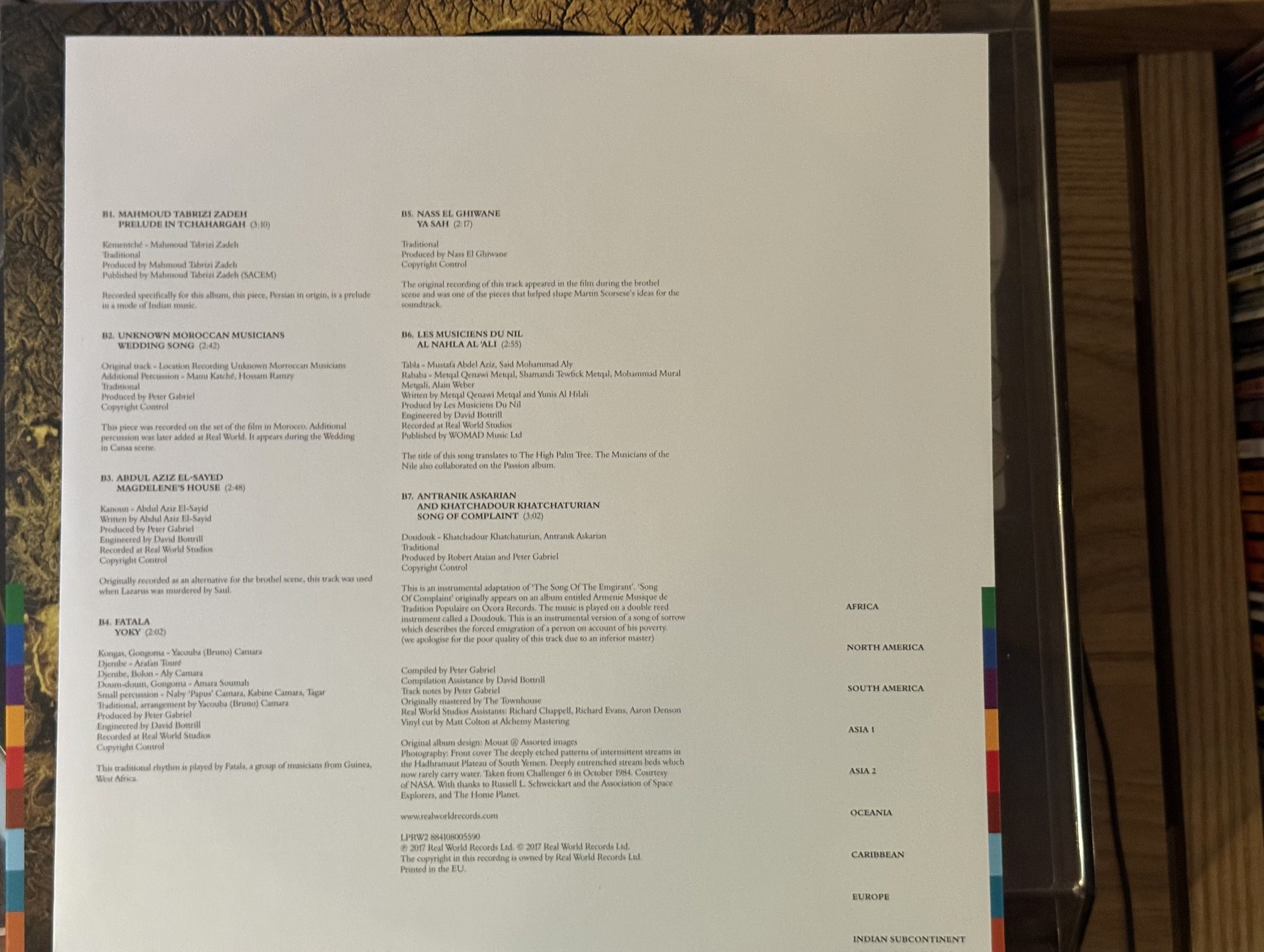
“Prelude in Tchahargah,” recorded by Mahmoud Tabrizi Zadeh on the kementché with tabla accompaniment, is a traditional Persian piece that displays some of the underlying affinities between Persian and Indian music. There’s very much a hybrid of dance and spiritual focus here, particularly in the unaccompanied improvisation that ends the work.

“Wedding Song” is a location recording of unknown Moroccan musicians from the set of the film, with percussion added by Ramzy and Manu Katché, that soundtracks the film’s recreation of the Wedding at Cana. It’s appropriately celebratory and hypnotic, with a repeated ten-bar call and response phrase.

“Magdalene’s House” gives us a listen to a musician whose work did not appear on Passion but did appear on the soundtrack of the movie. Abdul Aziz El-Sayed plays unaccompanied kanoun, a large zither-like instrument that allows the player to sound microtones. Here he plays flourishes and rapid runs in octaves along a modal scale, mostly sticking to a recognizable western mode but here and there throwing in some unusual tones for emphasis. The effect is spellbinding; one regrets the track’s short length, as it seems to end just as he finds a theme that could have made a magnificent Bach fugue.

An all-percussion track from the Guinean drum and dance troupe Fatala, “Yoky,” follows. Led by Yacouba (Bruno) Camara on congas and the gongoma drum (made from saw blades attached to a calabash gourd), the ensemble adds a pair of djembes and more gongoma for a hypnotic polyrhythm. Sadly, the ensemble only seems to have recorded one full album, a self-titled release in 1988.

“Ya Sah” is a trancelike number from Moroccan ensemble Nass El Ghiwane, which uses a Western banjo to produce an unusually disorienting cross-cultural effect — just as you think you’re in a foreign place entirely, suddenly the ring of the banjo places the sound squarely in an Appalachian string band tradition. Another number that doesn’t appear in Passion but does appear in the soundtrack, Gabriel says that its sound, which appears in a brothel scene in the movie, was one of the influences on his and Scorcese’s decision about the sound world of the movie.

Les Musiciens du Nil, who appeared on the Passion album in the track “Wall of Breath,” here play a more traditional Egyptian sound on “Al Nahla Al’Ali,” which features percussion and microtonal melodies in a rondo-like dance form that gradually accelerates into a crescendo then slows to a coda, leading to the slow “Song of Complaint” which is played on the Armenian doudouk by Antranik Askarian and Khatchadour Khatchaturian. Askarian appeared on the original recording on the Ocora Records label that was sampled for the opening track of Passion, “The Feeling Begins.” Without the massive drum hit, the traditional Armenian tune is a meditative reverie that completes the transition to another sound world.

As a “thank you” to the musicians whose work was incorporated into the Passion soundtrack, Passion – Sources can be read as a magnificent gesture. That it also functions as a sort of sampler for the mission of Gabriel’s new Real World label, opening ears to new sounds and new artists, is an intended second mission. As a seventeen-year-old listener newly moving beyond the relatively constrained sound worlds of my upbringing, it was revelatory. We’ll continue to explore the sounds of the world through the lens of Real World in the future. But over the next few weeks we’ll check in on some of Peter’s other collaborators as they make music through the end of the 1980s.

You can listen to this week’s album here:

BONUS: Here’s a live performance, with vocals, from Les Musiciens du Nil which gives you an idea of the traditional instrumentation used.

BONUS BONUS: Here’s a 1983 broadcast of Nass El Ghiwane in concert in Paris, playing for a very enthusiastic dancing crowd.

BONUS BONUS BONUS: Baaba Maal has had a long and fruitful career. Here’s his band from an astonishing 2024 performance that combines traditional and modern instrumentation to bring the crowd into a rhythmic trance:

BONUS x4: Kudsi Erguner has also had a long and vital career. Here’s a performance from 2013 that showcases the hypnotic power of the ney flute:

Peter Gabriel, Passion

A landmark collaboration with a seemingly inexhaustible parade of master musicians creates one of the strongest offerings in Gabriel’s catalog.

Album of the Week, June 6, 2026

Peter Gabriel spent the months following So touring the world; the concert film Live in Athens gives a good idea of what that experience was like. But he was still writing music, and the next thing that came from him was a one-two punch: a soundtrack album to the most controversial film of the late 1980s, and a brand new record label to release it. And Peter being Peter, he released the album in June 1989, almost a full nine months after the theatrical release of the film that inspired it.

The energy that today animates reactionary groups like the Promise Keepers and Christian Nationalist groups was alive and well in the 1980s, in the form of groups like the Moral Majority, TV evangelist fans, and other similar gatherings of extremists. They weren’t happy with Martin Scorsese’s film (though few formed an opinion informed by actually having seen it), which dared to imagine that Jesus might have been human enough to have been tempted by the possibility of family life into abandoning his mission; the idea that Jesus might have in particular entertained sexual thoughts was particularly threatening.1 Some of those who felt so threatened lost the plot badly enough that they firebombed cinemas and made death threats against Scorsese. Plus ça change, plus c’est la même chose…

Gabriel seems to have escaped the threats, possibly because his album came out so much later than the movie’s release and the height of the controversy. Though a version of the music appears in the film, he kept working on it, trying to find the right sounds and textures, through March of 1989. And, thanks to his ongoing work with WOMAD and his previous collaborations, he had the right musicians to work with, many of whom would go on to release albums of their own on his new label, Real World Records. The list was long and included Egyptian percussionist Hossam Ramzy; Indian violinist L. Shankar; Senegalese vocalists Baaba Maal and Youssou N’Dour; Pakistani qawwali singer Nusrat Fateh Ali Khan; Senegalese drummer Doudou N’Daiye Rose; percussionists and string players Massamba Diop, Mahmoud Tabrizi Zadeh, and Fatala; Turkish ney flute master Kudsi Erguner; Brazilian percussionist Djalma Corrêa; Americans Jon Hassell, David Sancious, Billy Cobham, Nathan East and Manny Elias; and Peter’s long-term collaborators David Rhodes and David Bottrill.

All that said, the most notable music performance on the first track is a sample. “The Feeling Begins” opens with a traditional Armenian melody played on doudouks by Vatche Housepian and Antranik Askarian, from a collection of traditional Armenian music released on Ocora Records years before. The doudouk melody forms the backbone of the arrangement, but the massive percussion attack from Manny Elias with Hossam Ramzy is also fairly magnificent and provides our first clue that we’re in for a genre-bending ride throughout the album. As the doudouk melody comes to an end, the drums roar in a crescendo, using the same trick that Peter so memorably deployed in “The Rhythm of the Heat.”

One thing I discovered as a teenager listening to this album (I bought it the first summer I ever lived for myself, during a monthlong science Governor’s School experience at Virginia Tech, so I listened to it a lot) was that I was less engaged by the tracks that featured fewer live instruments. “Gethsemane” is one of those tracks, constructed by Gabriel from samples of flute and voices. But it’s appropriately ominous and ghostly, and does the job of foreshadowing that it’s meant to do.

It’s followed by one of the more spectacular sequences on the album. “Of These, Hope” opens with a fanfare of sorts on the arghul, an ancient reed instrument that here contributes a swirl of crowd noise over an insistent talking drum courtesy of Massamba Diop. Peter has said of So that the groove was the thing that made that album so special; “Of These, Hope” is a classical composition with groove. It also has strong textural interest thanks to the arghul, and from the combination of drone, flute whistle, talking drum, guitar and synths. This leads into “Lazarus Raised” without break via an anticipatory shiver of synths as another doudouk sample — this time an uncredited Kurdish player from a UNESCO collection — gives us a mysterious melody signifying the expression of power leading to the raising of Lazarus from the dead. Peter’s flute whistle leads us into “Of These, Hope (Reprise),” which plays like a further elaboration of the melody. It misses the shock and awe of the arghul chorus from the first repetition, but gains a different sort of shock and awe thanks to the presence of Baaba Maal, a Senegalese vocalist whose speciality was the traditional music of the Pulaar-speaking peoples of the Futa Tooro region of Senegal.

“In Doubt” is another synth-forward groove, given depth by the uncanny sound of the kementché, an Iranian bowed string instrument here played by Mahmoud Tabrizi Zadeh. Peter doesn’t let this groove build for very long before a bigger one takes over , a massive percussion onslaught from Doudou N’Daiye Rose and Fatala signals the arrival of “A Different Drum.” I can almost hear Peter telling Geffen Records, “This is the single.” Between the strong rhythmic intensity, the insistently repetitive melodic theme, the wordless chorus, and above all the presence of the spectacular voice of Youssou N’Dour, this is one of the most accessible and memorable tracks on the album. It has the feeling of one of Peter’s songs-in-progress that never received a proper lyric, but the feeling is there, a stirringly heroic track.

What did get life as an independent single, somewhat surprisingly, is the next track,“Zaar.” A complex track built around a slowed- and pitched-down drum sample, the band, here featuring Hossam Ramzy on percussion, Mahmoud Tabrizi Zadeh‘s kementché, wordless vocals, and an intense series of interjections from L. Shankar’s violin, constructs a striking mood piece whose free interchange of musical ideas and sounds seems to sum up the whole project. “Zaar” was the track Peter chose to represent this project on his first greatest hits album, which would be released two years later, and it feels like a universe of its own.

“Troubled” is built around a mean groove built out of layered drums and percussion, all played by the great Billy Cobham. After we heard him on Champions and on a whole slew of CTI albums, Cobham joined John McLaughlin’s legendary jazz-world-fusion project Mahavishnu Orchestra, and it’s that polyrhythmic intensity that he brings here over a backing of snarling synths and a wordless vocals chorus loop. “Open” breathes more freely, a duet between Peter on the Prophet and Akai S900 and vocals, and L. Shankar’s violin and vocals. It suspends time and, with the echoes of ragas in Shankar’s improvisation, lends an unexpected emotional resonance to the simple melody Concluding the trio of pieces, “Before Night Falls” is a three-way collaboration between Hossam Ramzy, Shankar, and the great Turkish Sufi ney flute legend Kudsi Erguner, with added depth courtesy of one of engineer David Bottrill’s legendary drones. The plaintive melody and fade-out lend the feeling of a sunset over the gates of a desert city.

We leave groove behind for more traditional composition with “With This Love,” a haunting melody played by Robin Canter on the cor Anglais. The melody is gorgeous but the layers of synths detract somewhat from the emotional power of the work. The theme bookends a trio of pieces dealing with the actual crucifixion of Christ, starting with “Sandstorm,” in which Hossam Ramzy, Mahmoud Tabrizi Zadeh, Manu Katché and Shankar build an atmospheric groove over a location recording of Moroccan percussion and vocals. The synths add a blurriness to the overall effect, so when the Moroccan musicians cut through it’s startling and intense.

“Stigmata” is a joint improvisation by Mahmoud Tabrizi Zadeh, Shankar and Gabriel. The instrumental texture is deep and mysterious, but ultimately the tension ebbs away into the fade-out before “Passion.” The redoubtable Shankar, Jon Hassel, and Peter’s Fairlight are the supporting players here for the astonishing vocal improvisations of Youssou N’Dour and Nusrat Fateh Ali Khan, here signifying the suffering of Christ on the cross. Here there is no ebbing of intensity; Nusrat masterfully builds suspense through his sangam improvisation, as Youssou’s interjections cut through to intensify the emotional impact. A devastatingly pure high melody from choirboy Julian Wilkins2 punctuates the rising emotional tide. At the end, everything cuts away but Youssou’s cries and Djalma Corrêa’s percussion.

The choral reprise of “With This Love” is introduced by the cor Anglais melody, but Gabriel wisely leaves the Wells Cathedral Boys Choir (recorded by Richard Evans) totally unaccompanied as they perform a heartwrenching four-part arrangement of the melody. The acoustic of the performance space can be heard—there’s an audible footfall or noise at one point that sounds a bit as though someone has stepped onto an echoing stone floor in one of the transepts and been hastily waved away—adding to the overall timeless resonance of the moment. It’s one of the most stunningly beautiful musical expressions on an album full of remarkable sounds. It’s also one of the most fraught; originally intended to accompany the scene where a devil in the form of a little girl tells Christ that he doesn’t have to suffer, removes the nails from his body, and leads him off the cross, it was nixed from the final film. Scorsese pointed out that the use of a Christian religious signifier like a boys’ choir would further underscore the blasphemy of the moment and pour fuel on the outrage that was already mounting even before the film was released.

“Wall of Breath” leads us into uncertain territory as Christ is tempted to abandon his destiny, with Kudsi Erguner, Shankar, and the Musicians du Nil building an atmosphere based around a shifting tonality. “The Promise of Shadows” takes us to a dark place with Billy Cobham’s drums and a rising chorus contributing to the feeling that something isn’t right. Despite the title, “Disturbed” seems to lead us into a brighter moment, as Shankar’s violin introduces an intense percussion groove built up from Hossam Ramzy’s tabla, African percussion from Fatala, and looped percussion from Mustafa Abdel Aziz and Said Mohammad Aly. Peter’s Prophet and Fairlight provide a simple melodic line to anchor the groove as the percussion fades out.

“It Is Accomplished” is signaled by a fanfare on the arghul followed by an uncanny shimmer of a vocal yell (uncredited on the album, the original location recording has surfaced which is amazing to listen to on its own. You can hear it in one of my Exfiltration Radio mixes). A triumphant melody built around a simple descending four-note pattern gains depth from Billy Cobham’s drumming, David Rhodes’ guitar, and David Sancious’s Hammond organ as the music celebrates Christ overcoming his last temptation and fulfilling his mission. “Bread and Wine” builds a new melody from the echoes of the old, creating something new in remembrance courtesy of a tin whistle performance by Richard Evans.

I cannot overstate the role this album played in furthering my personal musical development and encouraging me to listen to the world with open ears. And Passion marks a significant moment in Peter’s career, as a culmination of his work with WOMAD during the 1980s and a seamless blending of his explorations of synth textures with collaborative compositions from some of the finest non-Western musicians of the moment. It earned a Grammy Award for Best New Age Album3, and helped to further popularize “world music” as a genre in its own right.

It also helped create a vehicle to fuel the demand; as the first release on Gabriel’s new Real World label, it included advertisements for a series of individual recordings from many of the musicians on the record, plus more of Gabriel’s WOMAD collaborators. Real World is still going strong and has reissued many of those pivotal early recordings, some appearing on vinyl for the first time; we’ll check in on those, among other things, starting next week.

You can listen to this week’s album here:

BONUS: This 2021 performance by the Francesco Albano Open Ensemble of the Passion score is impressive. With all the layers in the original recording, it’s hard to imagine someone pulling off one of the songs live; to do the entire thing in a single concert is kind of mind-blowing.

BONUS BONUS: Speaking of live performances, Peter performed “Of These, Hope” live at the 1988 WOMAD Festival in St. Austell, with Nusrat Fateh Ali Khan and Youssou N’Dour. Sadly there’s no video but the audio in this bootleg clip isn’t half bad:

Footnotes

  1. It’s a good thing he didn’t imagine himself dancing. ↩︎
  2. Wilkins is now the conductor of the City of Birmingham Symphony Orchestra’s Youth Chorus. ↩︎
  3. Proof positive that this was something new, as the album bears as much resemblance to “New Age” music as it does to Metal Machine Music. ↩︎