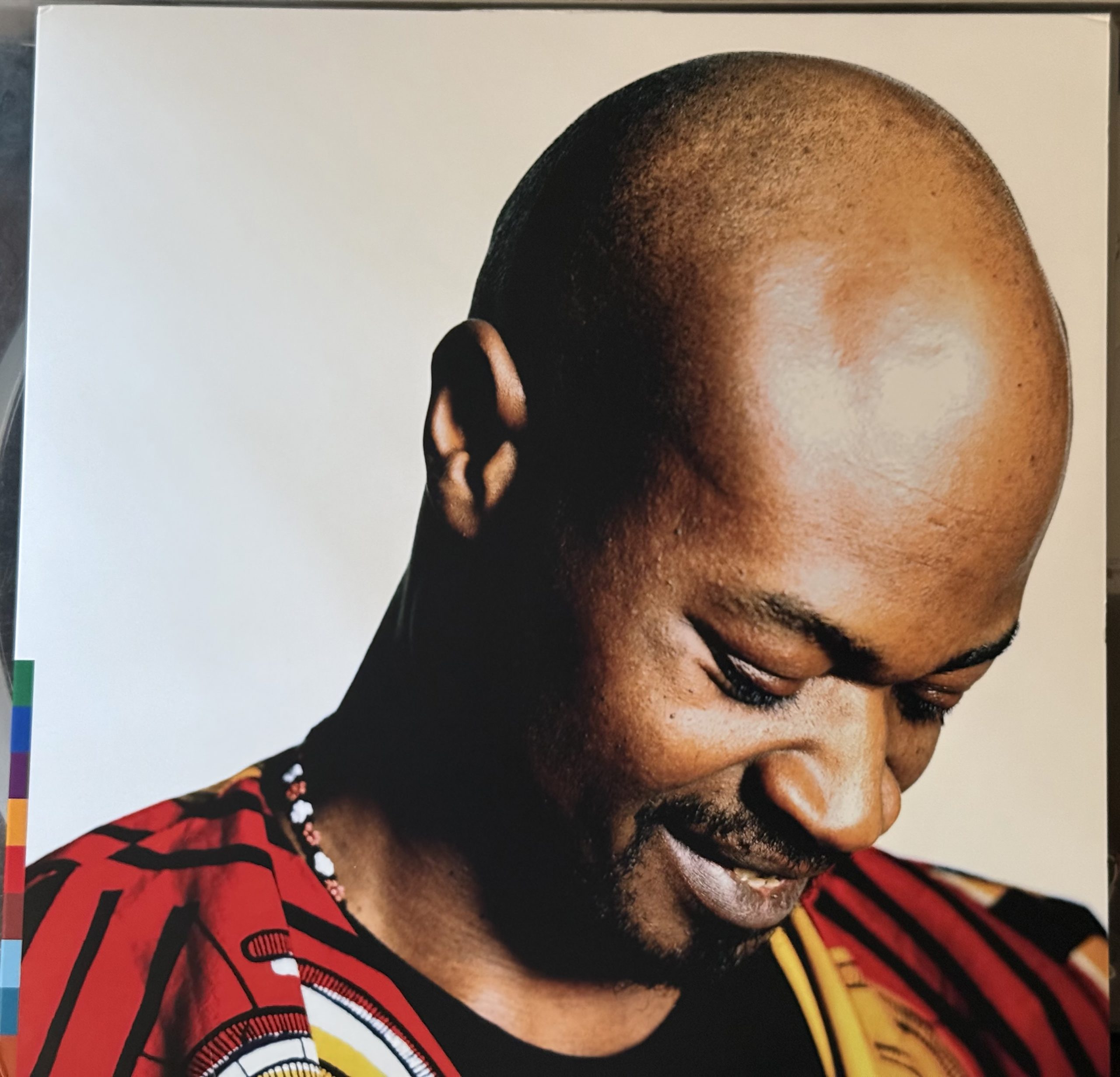
The Kenyan musician’s sole Real World album is a mesmerizing window onto music both specific to the Luo tradition, and universal.
Album of the Week, September 5, 2026
I’ve been reading some things on social media about “Shoot Your Shot September”: making a radical change in your life to do the thing you always wanted to do and the hell with the risk. I suspect that’s what Ayub Ogada’s early life was like. Born Job Seda in Mombasa, Kenya in 1956, he secured a film role in Robert Redford’s Out of Africa under his birth name when he was twenty-nine years old—after playing in a rock band that incorporated musical influences from his native Luo culture for six years previously. He then decided to head to London and see if he could make his fortune; busked on the London streets and in the Underground, scraping by. That bold decision was rewarded when he was invited to play the 1988 WOMAD festival, and rewarded again when another act canceled, stretching his ten-minute performance slot into a full set. Among the impressed onlookers: Peter Gabriel.
Ogada ended up being invited to one of the recording weeks at Real World. There’s no detailed sessionography from the studio, so it’s hard to tell if he recorded his guest appearances on Peter’s Us as well as his guest spot on Geoffrey Oryema’s second album all in the same week as recording his only album for the label. What is clear is that he got a chance to do all three, playing and singing insinuating melodies that sound like sunshine with the combination of his baritone voice and his nyatiti, a traditional 8-stringed lyre of Luo origin.
“Obiero” opens with the nyatiti and Ogada’s voice, an impossibly sunny melody accompanied by subtle percussion and slightly un-subtle Hammond organ (though the single chord played by future Propellerhead Alex Gifford is more subliminal than anything else). I first heard an earlier version of this song on Gabriel’s Plus from Us compilation, which featured tracks from his various collaborators on the Us album, and the version here on Ogada’s own album is positively baroque in comparison to the sparer original.
“Dala” is instrumented even more sparsely, with only nyatiti and small bells (see the bonus videos for an image of them) accompanying Ogada’s multi-tracked vocals as he sings a homecoming song. The liner notes observe: “Home, not as in your house, but as in spiritual home. One person is alone, two people may dance, three people they open the door, four people begin to walk all the way home. Let’s get together and make it like home.”
Sometimes the nyatiti gives a more complex pattern that is itself percussive, as it does on “Wa Winjigo Ero.” The lyre pattern circles over a stretch of about a fourth with octaves, and Ogada’s melody is strongly rhythmic as the song evokes a careless young man leading his herd homeward: “A young man doesn’t look after the cattle, he walks home before them, so he doesn’t even know if all the cattle are behind him. Luckily for him the cattle have all got bells. People say to him, it’s okay, we hear then now.” The percussion gives us the sound of the bells and the overall song has a slight marching cadence.
“Thum Nyatiti” is another circular pattern on the nyatiti, this time accompanied by David Oladunni on the djembe and with the same simple percussion. Ogada emphasizes the driving, percussive nature of the nyatiti on this track, about which he says “the music of the lyre is the voice of the Luo.” A more complex rhythm—triple triplets—underpins “Kronkronhinko,” a paean to the Ghanaian Queen Mother, Yaa Asaantewa, who led the War of the Golden Stool of the Ashanti people against Great Britain. We also get Ogada’s piercing whistle on this track.
“Chiro” sees Geoffrey Oryema return the favor for Ogada’s appearance on his song “Hard Labour,” adding backing vocals alongside Zak Sikobe’s guitar. The vocals are complex but tell a simple story: “Go far, see the world, but don’t forget where you came from.” Sikobe also appears on “10%,” which he co-wrote, a political song responding to the idea that it’s okay if 10% of the population are suffering. Ogada also plays a flute—either an imbele or a wea—alongside the chorus on the latter song; all in all the mix is insinuatingly catchy.
“Ondiek” feels like a more somber version of “Obiero,” as Ogada sings about the dangers of duplicity: “Beware the hand that seems to feed you! A hyena in human form – watch out, where he walks the earth burns.” After two verses and a chorus, Sikobe adds a skittering guitar line, lending a slight feeling of South African mbaqanga (familiar to Western listeners from Paul Simon’s Graceland).
“Kothbiro” opens with the nyatiti playing a pattern like raindrops, setting up a ballad that calls the children and the cattle back to the house. The harmonies of guitar, lute and voice tell a sadder story, as we wonder if the children will ever return. Gifford plays a subtle piano line over the instrumental verse.
The final song, “En Mana Kuoyo,” feels even more strongly like mbaqanga, with Sikobe’s guitar intertwining with the lute and his own overdubbed bass. This is African music for driving down the street with the top down, an indelible feeling of summer.
Ogada only recorded one album for Real World, but he continued to be active musically, recording an album with his band Union Nowhere in the late 1990s and appearing at the Live 8 concert The Eden Project in 2005. He moved back to Kenya and recorded a few more albums with English musician Trevor Warren before his death in 2019. Next week we’ll return to another Real World musician who was intersecting ancient and modern musical styles.
You can listen to this week’s album here:
BONUS: Real World has done a good job of preserving and sharing its performance history. This performance in particular, from 1991, is great because you can not only watch his fingerwork on the nyatiti, you can also see the source of the bells that are the rhythmic accompaniment for so many of his songs, and they’re probably not where you think they’ll be…
BONUS BONUS: Here’s a second live performance of “Obiero” by Ayub Ogada at Real World Studios from 1995:
The artist’s most emotionally direct album digs in the dirt to yield a richly organic collaboration featuring some of his most enduring songs.
Album of the Week, August 15, 2026
When Peter Gabriel released his new album Us on September 28, 1992, it seemed like an eternity had passed since his last pop album, So, in 1986. (How little we knew!) Over the past weeks we’ve looked into some of what he was doing during the period—the Passion soundtrack and sister album Passion – Sources, massive world tour, WOMAD, and starting the Real World label and launching the western careers of some of his key contributors. But it has to be said that part of what he was doing was recalibrating. For the former art-pop auteur, life could never be the same after So. He had to find a new way to make music.
He also had to come to terms with himself. His marriage to Jill Gabriel, long strained, ended in divorce in 1987 in the middle of the massive world tour. He was famously linked with actress Rosanna Arquette for some time after his divorce, but the relationship was not long lasting. The dissolution of his marriage resulted in depression and therapy, which continued for six years. The divorce and his therapy both influenced the songwriting on Us, his most personal album to date.
To make the album real, he turned to a group of collaborators both familiar and new, many drawn from the sessions in the massive state-of-the-art studio he built in a former mill building complex in Box, Wiltshire, England. There was the core band, by now familiar: Tony Levin, Manu Katché, David Rhodes, producer Daniel Lanois, engineer David Bottrill; frequent collaborators like Shankar and Peter Hammill; collaborators from Passion including Hossam Ramzy, Doudou N’Diaye Rose, Kudsi Erguner, Assane Thiam, Manny Elias, and the Babacar Faye Drummers; and collaborators drawn from the nascent Real World label including many of the Passion names, the Dmitri Pokrovsky Ensemble, and Ayub Ogada. There were also some brand new faces, including Meters guitarist Leo Nocentelli, Lanois’ producing partner Brian Eno, ascendant electronic producer William Orbit, duduk player Levon Minassian, and incandescent vocalist Sinéad O’Connor.
“Come Talk to Me” begins in a silence that builds to a shout: layers of keyboards crescendo up to a bagpipe solo over the bass, thundering drums courtesy of the combined forces of Katché, the Babacar Faye Drummers, and a 1980 drum loop from Doudou N’Diaye Rose, and a response on the duduk. Peter’s vocals are direct and intimate, reaching out to someone who has been incommunicado, asking for a bridge over which they can rebuild a relationship; he’s subsequently disclosed that the rift was with one of his daughters. The chorus features harmony vocals from Sinéad; Peter had met her doing an Amnesty concert in Santiago, Chile in 1990 and invited her to the studio, and having her very present voice on the opening track effectively signals that this album is about dialog and communication. It’s also a showcase for his collaborative work with the artists of Real World: that choir that enters after the bridge, the storied Dmitri Pokrovsky Ensemble, were recording their album for the label, The Wild Field, at the same time Gabriel was working on Us.
The contrast as the album flows into “Love to Be Loved” is marked. Cool where “Come Talk to Me” is hot, the second track is all about minimal groove, with both the late William Orbit and the legendary Brian Eno contributing programming and keys. Katché’s drum programming and Hossam Ramzy’s tabla (as well as Daryl Johnson’s hand drum) anchor the rhythm along with Tony Levin’s bass. And the lyrics take us on an emotional journey, starting from talking about the need for contact (echoes of “I Have the Touch”) to a startling transition in the bridge in which Peter confesses, “This old familiar craving / I’ve been here before, this way of behaving… Let it pass, let it go, let it leave / From the deepest place I grieve / This time, I believe.” But even that isn’t the end, and we get to the root of it: “Though it takes all the strength in me / And all the world can see / I’m losing such a central part of me / I can let go of it… I recognize how much I’ve lost / And I cannot face the cost / ‘Cause I love to be loved.” The track’s stark honesty about the need for physical relationships and letting go of destructive behaviors, even as other relationships are falling apart, is striking; one really feels those years that Peter spent in therapy at work here. And it’s a jam.
That brings us to “Blood of Eden,” which feels like the most primal, innocent love song Peter has ever written. It comes out of an idyllic opening with the doudouk over layers of keyboards, and Peter sings about the darkness in his heart and the “heated and the holy.” The song is surely one of the best known from the album thanks in no small part to Sinéad O’Connor’s pure vocals in the chorus duet (and the face morphing of the two singers in the video), but the lyrics are a bit of a hodgepodge, with the heated and the holy looking down from on high “so secure with everything they’re buying.” The narrator returns to “the union of the woman and the man” as a retreat to paradise even as he acknowledges the worm at the heart of the apple: “All the while the distance grows between you and me.” There are echoes here of “Don’t Give Up,” both in the duet structure of the song and the plight of the narrator, but the catastrophe seems more emotional than economic here. This was one of the songs that underwent the longest gestation, with multiple versions and arrangements extant; the liner notes hint at this when they credit Richard Chappell for the mix from which the bridge section was drawn, and another version of the song appeared even before the album was released on a soundtrack (see the bonus section below). Other versions have been released to Peter’s fan club on Bandcamp.
“Steam” underwent a similar evolution, with a stunning “Quiet Steam” appearing as a b-side to the album’s first single. But there’s plenty to recommend the released version, starting with the funky guitar of Leo Nocentelli of the Meters. The horns aren’t given quite as much prominence as they are in the song’s spiritual predecessor “Sledgehammer,” but they’re still pretty tasty, and the Babacar Faye Drummers add an edge to the percussive energy that is otherwise all Motown. One fun thing to listen for is Peter’s keys, here easily distinguished because he’s switched from the airy synth sounds of the Prophet to a fairly convincing Hammond organ soundalike, adding to the sweaty funk of the mix.
“Only Us” returns to a more open, idyllic sound, with a duet between Peter and Kenyan musician Ayub Ogada. This is another track with contributions from William Orbit, but here the vibe is organic rather than chill. Shankar and ney flautist Kudsi Erguner contribute to the feeling of limitless nature, and Peter’s lyrics signal the song’s centrality to the album’s overall concept as he refocuses on relationships and people: “Seduced by the noise and the bright things that glisten / I knew all the time I should shut up and listen / And I’m finding my way home from the great escape… Yes I can read you loud and clear … The further on I go, oh the less I know / Friend or foe, there’s only us.” I realized as I was relistening to the album that this was a track that had slipped under my radar, but it repays listening to again.
The second half of the album starts with “Washing of the Water,” easily Peter’s most gospel song starting with just bass, snare and piano accompanying Peter’s unvarnished vocals. This too has echoes of “Don’t Give Up”—we could be over the same river that flowed through the earlier song. But here the protagonist gives in to the lure of the water, choosing to accept the call to immerse himself in grief as he mourns the loss of the relationship. The horns under the bridge as Peter sings “Letting go, it’s so hard / The way it’s hurting now / To get this love untied / So tough to stay with this thing / ‘Cause if I follow through / I face what I’ve denied / I’ll get those hooks out of me / and I’ll take out the hooks that I’ve sunk deep in your side.” The acceptance of the dissolution of the relationship, the unhooking and the desire to finally sleep, feels like a brutally sad step, but also like emotional honesty and progress as the narrator names the pain that is at his core.
The progress of Peter’s emotional journey is most vivid in “Digging in the Dirt,” a metaphor for the hard work of therapy as Peter allows himself to express anger as well as sadness and grief. The rage of the narrator boiling over in the chorus—“Don’t talk back, just drive the car”—is shocking when it comes to the surface, the “something in me / dark and sticky” rising like Sting’s monster crawling to the surface of a dark Scottish loch. Significantly, though, the narrator doesn’t stay stuck in this moment of rage; he takes a step back, asking, “Stay with me, I need support,” and goes digging to “find the places I got hurt.” By the end of the song (a fantastic slow groove built atop Babacar’s djembe, Assane Thiam’s tama, and Hossam Ramzy’s surdu, with Leo Nocentelli joining David Rhodes, Manu Katché, and Tony Levin plus more background vocals from Ogada, this time joined by Peter Hammill and Richard Macphail), the narrator has even opened up his area of concern to “find the places we got hurt,” acknowledging the difficulties he’s caused his partner. I remember watching the video for this song live, introduced by Gabriel on MTV, in a student lounge and thinking, “I guess Peter’s been in therapy”; the vivid claymation of Peter sinking into the grass covered by insects and worms is among the most memorable video images of him in his entire ouevre.
“Fourteen Black Paintings” follows. The longer CD format allowed Gabriel to expand beyond the 45-50 minute limit of an LP, and this composition, which reads like a cross between Passion and “We Do What We’re Told (Milgram’s 37),” is the beneficiary, as it surely would have been cut for time otherwise. Yet it’s significant in its own way; Peter’s only known collaboration with Led Zeppelin’s John Paul Jones, the song is an echo of “Biko” in its call for the people to embrace their power and bring about change. There’s also some vivid percussion from Babacar and Assane Thiam alongside the doudouk and electric violin that build the atmosphere of the song.
All of which makes “Kiss That Frog” even more of a shock. A playful metaphor-song that plays as a straightforward fairy tale, Peter’s lyrics have rarely been so direct, and his singing is unusually free, especially in the scat choruses at the beginning and end of the song. If “Steam” is a lesser shadow of “Sledgehammer,” I’d rate “Kiss That Frog” as a superior successor to “Big Time.” Both more open and more generous in its worldview, it’s also downright funny: “Let him sit beside you / Eat right off your plate / You don’t have to be afraid / There’s nothing here to hate.” When Gabriel shifts perspective from the narrator to the frog, croaking “Kiss that frog / You may get your prince,” it’s a laugh-out-loud moment. When I was a cynical, critical teen I disliked the song for exactly the same characteristics that make it enduring (and endearing) now: the extended metaphor, the straightforward pop, the echoes of gospel and R&B in Peter’s harmonica and “fake organ” and Marylin McFarlane’s backing vocals. This is one of the few songs on the record that doesn’t have an extensive list of guest musicians, just programming by David Bottrill and Richard Blair, a percussion loop from the Adzido Drummers and shakers from Manny Elias, and David Rhodes’ guitar.
The album closes with “Secret World,” another contender for the theme song, as Peter sings with open regret, but “no guilt and no shame, no sorrow, no blame,” about the dissolution of the relationship and about moving on: “All the places we were hiding love / What was it we were thinking of?” The song, again built on a drum loop from Doudou N’Diaye Rose (the album’s secret MVP), is an open ballad sung with regret but also with forgiveness, and with a sort of intimacy not present in the singer’s earlier works: “So I watch you wash your hair / Underwater, unaware / And the plane flies through the air / Did you think you didn’t have to choose it? / That I alone could win or lose it?” After many works berating himself for the dissolution of the relationship, Peter dispassionately observes that it wasn’t only up to him, and allows himself to absolve some of the guilt, shame, sorrow and blame. It’s probably the most mature reflection on the end of a relationship in pop music, certainly in Peter’s work, and it puts truth to Peter’s dedication to Jill and to Rosanna Arquette in the liner notes: “To Jill, for giving up so much in all the time we were growing up together. To Rosanna for all her love and support that I didn’t properly acknowledge.” And it’s all wrapped in a tasty groove, with one of Tony Levin’s most sinuous bass lines as the foundation.
Us in many ways is clearly a direct successor to So in terms of the ambition, artistic scope, and stadium-readiness of its sound. But where its 1986 predecessor is the slickest thing Gabriel has ever recorded, Us embraces the organic, acoustic, and human side of music making. The collaborations from Passion and the experiences producing and recording—and singing alongside—so many great world musicians seem to have opened Peter up to a more human way of making music. It also evolved his songwriting in ways that opened new opportunities in his career; when we check back with some of his later work we’ll explore that thought some more. But first we’ll listen to another voice on his Real World label, one who didn’t participate in the making of Us.
You can listen to this week’s album here:
BONUS: “Blood of Eden” appears in a different version, based on an earlier approach to the song, in Wim Wender’s great 1991 film Until the End of the World, accompanying a scene that hints at nuclear catastrophe — or at least an EMP. Here’s that scene (but you should really watch the whole movie):
BONUS BONUS: “Washing of the Water” would seem to be a non-obvious choice to perform on “The Tonight Show with Jay Leno” to promote this album, but that’s where Peter went in this incredible performance with Shankar, Joy Askew on keyboards, Tony Levin on acoustic bass—and with Branford Marsalis, who was music director for Jay’s band at the time, sitting in on soprano sax:
BONUS BONUS BONUS: Much of the b-side material that came from the Us sessions consists of alternate takes of the album tracks, but “Bashi-Bazouk” is the exception. An instrumental that feels a bit like Passion given a dance floor treatment, it’s got a shocking opening and a mean groove:
BONUS X 4: Just as Passion – Sources served as a Real World sampler for the artists appearing on Passion, so there was Plus From Us. Sadly the compilation has never been released on vinyl, but there’s a lot to like here: Ayub Ogada, the Meters, solo tracks from Rhodes, Levin, and Katché, and more.
In the summer of 1993, I was on top of the world. Having finished a great Glee Club season and gotten a literary magazine off the ground, I had just gotten a room on the Lawn and was staying in Charlottesville for the summer as an undergraduate assistant in a physics lab. I had just started listening to the funkier side of James Brown and was starting to discover blues, hip-hop and world music. Plus, I now had wheels, in the form of an incredibly fun but unreliable 1977 MGB.
This mixtape, accordingly, was shaped by all these factors, perhaps not least of all by the last. Most of the selections on this mix were chosen because they sounded great in the MGB with the top down. That was certainly true of “Ocean Size,” the opening track. After ignoring Jane’s Addiction for many years, I finally got into them about two years after they had broken up. This was a version of Los Angeles rock I could get behind—something like heavy metal for art students. And the lead-in to Hubert Sumlin’s slashing guitar on the great “Killing Floor” remains a potent link from the first song to the second. I had first picked up the Chess blues sound from a phenomenal box set of Willie Dixon recordings, and then this 1965 Chess anthology of Howlin’ Wolf’s work, which had just been reissued on CD. (It’s with no shame that I note that my first exposure to the title of this track was in William Gibson’s short story “Johnny Mnemonic,” where he borrows the phrase and puts it to an entirely different purpose.)
On the strength of Peter Gabriel’s early Real World compilation Passion Sources, I started to branch out and find other artists on the label. The African artists on the label, such as Geoffrey Oryema and Ayub Ogada. Oryema’s “Piri Wango Iya” is a great introduction to the Ugandan’s sound, featuring only his voice and the traditional Ugandan lukeme (a gourd with plucked resonating metal strips).
I was still working my way through Suzanne Vega’s phenomenal 99.9 Fº, and “Blood Makes Noise” was just the sort of twitchy dance that I could get behind. Likewise PJ Harvey’s “Sheela-Na-Gig,” which even then struck me as a striking reversal of traditional gender politics, with Harvey’s narrator confidently offering herself sexually to a man who flatly rejects her as an exhibitionist and is terrified of being dirtied by her. We hadn’t explicitly covered Freud’s take on what would now be called the Madonna-whore complex when I read him in my first year, but it was a pretty clear illustration.
Then follows, for some reason, “Englishman in New York,” a track which I love by itself but which doesn’t flow very well here. Then “North Dakota.” I never had listened to much country music, but a friend who came to visit that summer left me with an aching heart, and a mixtape featuring this phenomenal Lyle Lovett song. “If you love me, say I love you” sounds like the loneliest thing ever, and it resonates at the heart of this tape once you peel back everything else.
I wasn’t emotionally mature enough to acknowledge or linger in my feelings, but I was more than capable of irony, and PJ Harvey was always there to help, as was the gently mocking narrator of Laurie Anderson’s “Language is a Virus.” Self-mockery always made me feel better, so it was a good transition from there into “What Goes On” and “Numb,” which may have been the first U2 song that made me laugh. Ditto the over-the-top apocalyptic Western of Nick Cave’s track from Until the End of the World, another third-year frequent rotation CD that I was still digesting.
The end of this summer, when I was starting to put this mix together, was a rough one physically, and I was starting to feel ragged and tired around the edges. When I came home at the end of the summer for a few weeks before school started, I realized why — I had contracted mononucleosis, probably as a consequence of the close living quarters in the student apartment that was my home for the summer. (While I was dating someone that summer, we only spent a few days together as she was off doing her own things, so I’m pretty sure I didn’t get the “kissing disease” the fun way.) “Run That Body Down” accordingly became my theme song. It’s a good thing I didn’t know then how rundown a body could actually get…
More feelings avoidance, more loud rock! I still love “Ain’t No Right,” though not as much as I love the downtempo shift that follows it. I listened to For the Beauty of Wynona for the first time with a good friend and neighbor who had good taste in music and confused my feelings (a common theme of my college years). And Lanois’ country-infused guitar had a natural connection, at least in my mind, to the freaked-out electric blues that Miles and his band pulled from thin air on “Honky Tonk.”
My immature late teenage feelings (okay, I was actually 20) loved getting lost in Elvis Costello’s Brodsky Quartet collaboration, and on no track was this more true than on “Who Do You Think You Are?,” a paean for those with a more active imagination than love life. And again, any time I felt actual feelings getting close to the surface, it was time for a shift of gears. I have always loved “Le Bien, Le Mal” ever since borrowing Jazzmatazz Vol. 1 (and the first Digable Planets album) from a neighbor in that crowded college apartment (thanks, Patrick!), but the name of the transition technique between the Elvis Costello track and this is called “discontinuity.” Once I found that groove, though, it was a logical connection to James Brown, whose “Get Up (I Feel Like Being A) Sex Machine” had soundtracked a memorable party a few months prior in an apartment full of physics students, quality porter and stout, and someone’s incredible record collection (including, oddly, Speak No Evil).
I didn’t always know how to end mix tapes then, so there’s no real through line for the last few tracks. But “En Mana Kuoyo” is a fine closer, a brightly percolating groove from Kenya that transported me to another place. I hope it does the same for you.
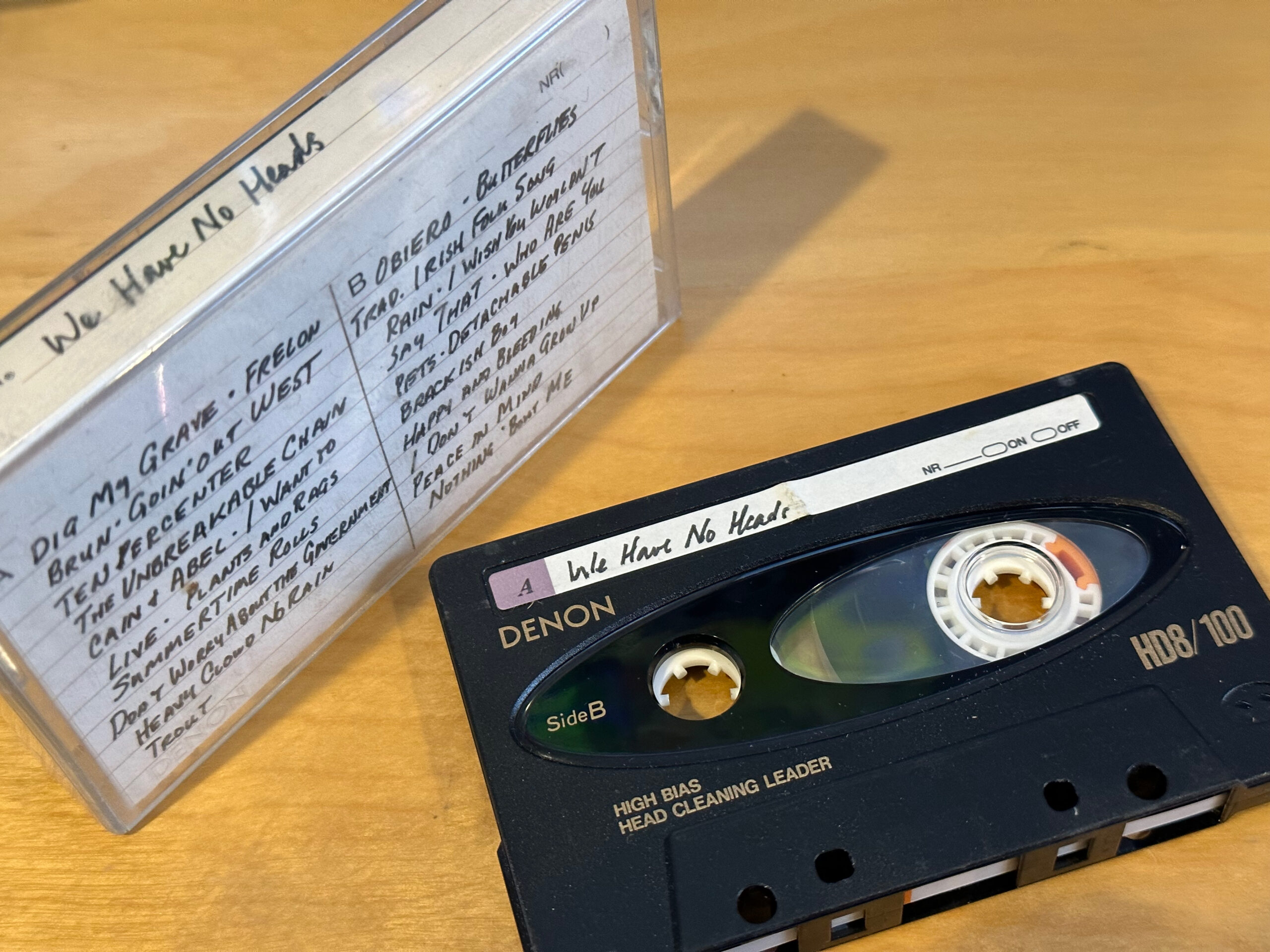
Sometimes my early mixes are what might charitably be described as “all over the place.” (Heck, sometimes my late mixes are too.) This one, which was assembled sometime around May of 1993, definitely fits that description.
There comes a time in every young music head’s life when they discover Tom Waits. For me, that was clearly happening right about the time this mix was made. It was fortuitous that Apollo 18 by They Might Be Giants had come out about six months previously, as the frenetic energy of the opening track plays nicely with “Goin’ Out West.” (Side note: because I bought a lot of my CDs through music clubs at this stage in my life, I was almost always late to the party when a new album was released. If I recall correctly, it could be a few months before a new release was available in the mail order catalog. —And yes, mail order catalog, because this was right before the Internet began to eat that business model.)
Between those two tracks is “Frelon Brun,” from Filles de Kilimanjaro. I had just picked up this CD, having fallen in love with the title track, which appeared on Miles’ The Columbia Years anthology (another box set I snagged at a discount). “Frelon Brun” is probably the most rock-oriented of the performances on that album; for one, it’s the only track that is under 6 minutes long. It’s funky and powerful and fun. On this album it punctuates the ferocious energy of the tracks on either side.
Side 2 opens with Ayub Ogada’s “Obiero,” a track that appears in slightly different forms on both his own En Mana Kuoyo and Peter Gabriel’s Plus from Us anthology; it’s the latter that appears here (and coincidentally helps to date the mix, since Plus from Us was released on May 16, 1993). That’s followed by “Rain” by An Emotional Fish, which was on the Spew 2 promotional compilation (which I’ve since lost), alongside King Missile’s dryly hilarious “Detachable Penis” (which also appears on this mixtape). And then comes “Traditional Irish Folk Song,” from Denis Leary’s comedy album No Cure for Cancer. Like I said, charitably described as all over the place.
This mixtape also memorializes the beginning of my interest in PJ Harvey, having picked up Dry based on word of mouth from the crew in the basement of Peabody Hall, i.e. the publications staffs of the Declaration and The Yellow Journal. I was still digesting the Talking Heads, having picked up the Sand in the Vaseline compilation earlier that year. And, having bought Neneh Cherry’s great Homebrew on a whim earlier that spring, I discovered the seductive pleasures of “Peace in Mind” by blasting the album out my Monroe Hill window one Sunday afternoon as we played an impromptu volleyball game.
Dig My Grave – They Might Be Giants (Apollo 18)
Frelon Brun (Brown Hornet) – Miles Davis (Filles De Kilimanjaro)
Goin’ Out West – Tom Waits (Bone Machine)
Ten Percenter – Frank Black (Frank Black)
The Unbreakable Chain – Daniel Lanois (For The Beauty Of Wynona)
Cain & Abel – Branford Marsalis Trio (The Beautyful Ones Are Not Yet Born)
I Want To Live – Talking Heads (Sand In The Vaseline Popular Favorites 1976-1992)