
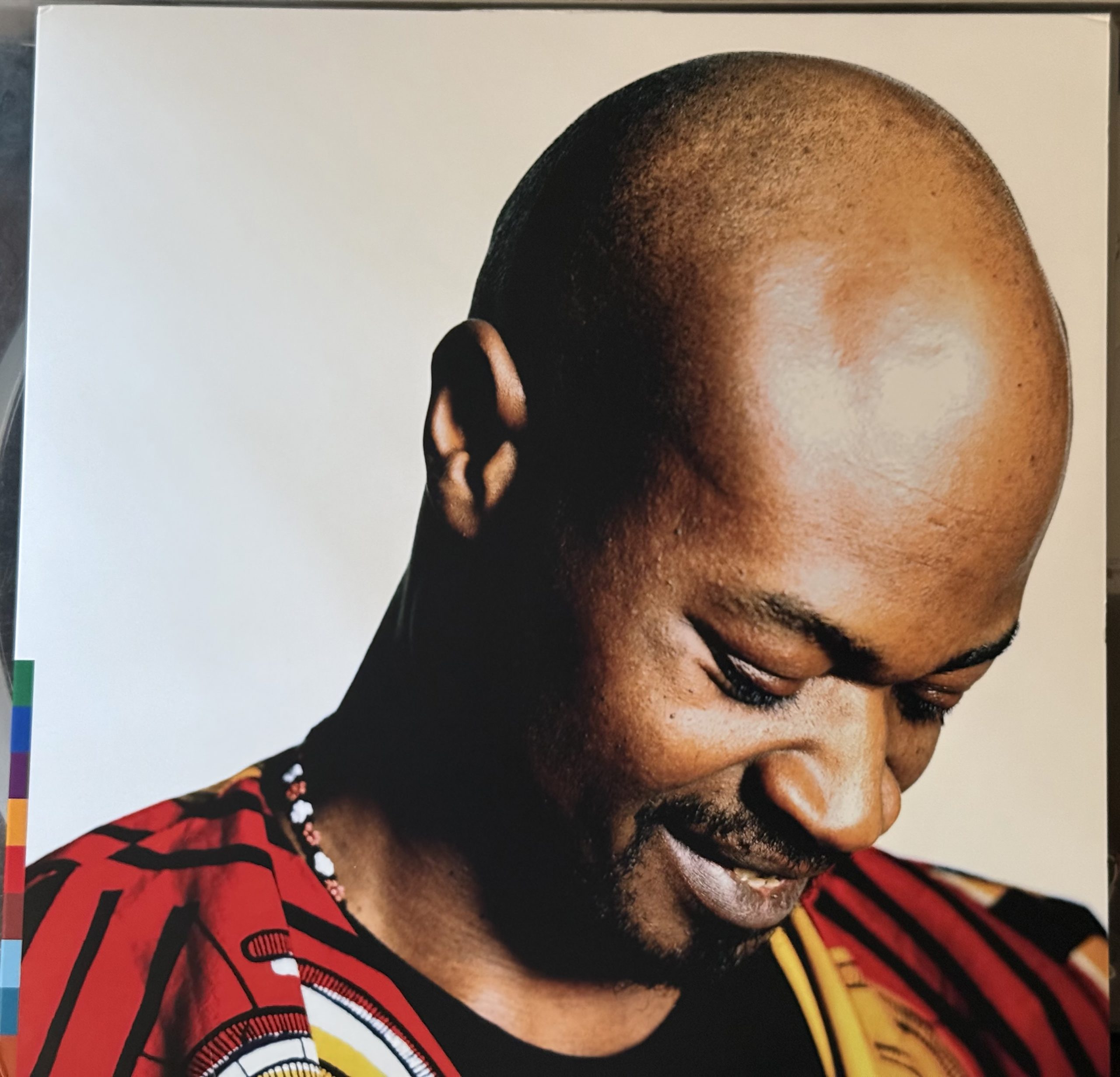
Album of the Week, September 5, 2026
I’ve been reading some things on social media about “Shoot Your Shot September”: making a radical change in your life to do the thing you always wanted to do and the hell with the risk. I suspect that’s what Ayub Ogada’s early life was like. Born Job Seda in Mombasa, Kenya in 1956, he secured a film role in Robert Redford’s Out of Africa under his birth name when he was twenty-nine years old—after playing in a rock band that incorporated musical influences from his native Luo culture for six years previously. He then decided to head to London and see if he could make his fortune; busked on the London streets and in the Underground, scraping by. That bold decision was rewarded when he was invited to play the 1988 WOMAD festival, and rewarded again when another act canceled, stretching his ten-minute performance slot into a full set. Among the impressed onlookers: Peter Gabriel.
Ogada ended up being invited to one of the recording weeks at Real World. There’s no detailed sessionography from the studio, so it’s hard to tell if he recorded his guest appearances on Peter’s Us as well as his guest spot on Geoffrey Oryema’s second album all in the same week as recording his only album for the label. What is clear is that he got a chance to do all three, playing and singing insinuating melodies that sound like sunshine with the combination of his baritone voice and his nyatiti, a traditional 8-stringed lyre of Luo origin.

“Obiero” opens with the nyatiti and Ogada’s voice, an impossibly sunny melody accompanied by subtle percussion and slightly un-subtle Hammond organ (though the single chord played by future Propellerhead Alex Gifford is more subliminal than anything else). I first heard an earlier version of this song on Gabriel’s Plus from Us compilation, which featured tracks from his various collaborators on the Us album, and the version here on Ogada’s own album is positively baroque in comparison to the sparer original.
“Dala” is instrumented even more sparsely, with only nyatiti and small bells (see the bonus videos for an image of them) accompanying Ogada’s multi-tracked vocals as he sings a homecoming song. The liner notes observe: “Home, not as in your house, but as in spiritual home. One person is alone, two people may dance, three people they open the door, four people begin to walk all the way home. Let’s get together and make it like home.”
Sometimes the nyatiti gives a more complex pattern that is itself percussive, as it does on “Wa Winjigo Ero.” The lyre pattern circles over a stretch of about a fourth with octaves, and Ogada’s melody is strongly rhythmic as the song evokes a careless young man leading his herd homeward: “A young man doesn’t look after the cattle, he walks home before them, so he doesn’t even know if all the cattle are behind him. Luckily for him the cattle have all got bells. People say to him, it’s okay, we hear then now.” The percussion gives us the sound of the bells and the overall song has a slight marching cadence.
“Thum Nyatiti” is another circular pattern on the nyatiti, this time accompanied by David Oladunni on the djembe and with the same simple percussion. Ogada emphasizes the driving, percussive nature of the nyatiti on this track, about which he says “the music of the lyre is the voice of the Luo.” A more complex rhythm—triple triplets—underpins “Kronkronhinko,” a paean to the Ghanaian Queen Mother, Yaa Asaantewa, who led the War of the Golden Stool of the Ashanti people against Great Britain. We also get Ogada’s piercing whistle on this track.

“Chiro” sees Geoffrey Oryema return the favor for Ogada’s appearance on his song “Hard Labour,” adding backing vocals alongside Zak Sikobe’s guitar. The vocals are complex but tell a simple story: “Go far, see the world, but don’t forget where you came from.” Sikobe also appears on “10%,” which he co-wrote, a political song responding to the idea that it’s okay if 10% of the population are suffering. Ogada also plays a flute—either an imbele or a wea—alongside the chorus on the latter song; all in all the mix is insinuatingly catchy.
“Ondiek” feels like a more somber version of “Obiero,” as Ogada sings about the dangers of duplicity: “Beware the hand that seems to feed you! A hyena in human form – watch out, where he walks the earth burns.” After two verses and a chorus, Sikobe adds a skittering guitar line, lending a slight feeling of South African mbaqanga (familiar to Western listeners from Paul Simon’s Graceland).
“Kothbiro” opens with the nyatiti playing a pattern like raindrops, setting up a ballad that calls the children and the cattle back to the house. The harmonies of guitar, lute and voice tell a sadder story, as we wonder if the children will ever return. Gifford plays a subtle piano line over the instrumental verse.
The final song, “En Mana Kuoyo,” feels even more strongly like mbaqanga, with Sikobe’s guitar intertwining with the lute and his own overdubbed bass. This is African music for driving down the street with the top down, an indelible feeling of summer.

Ogada only recorded one album for Real World, but he continued to be active musically, recording an album with his band Union Nowhere in the late 1990s and appearing at the Live 8 concert The Eden Project in 2005. He moved back to Kenya and recorded a few more albums with English musician Trevor Warren before his death in 2019. Next week we’ll return to another Real World musician who was intersecting ancient and modern musical styles.
You can listen to this week’s album here:
BONUS: Real World has done a good job of preserving and sharing its performance history. This performance in particular, from 1991, is great because you can not only watch his fingerwork on the nyatiti, you can also see the source of the bells that are the rhythmic accompaniment for so many of his songs, and they’re probably not where you think they’ll be…
BONUS BONUS: Here’s a second live performance of “Obiero” by Ayub Ogada at Real World Studios from 1995: