Ayub Ogada, En Mana Kuoyo

The Kenyan musician’s sole Real World album is a mesmerizing window onto music both specific to the Luo tradition, and universal.

Album of the Week, September 5, 2026

I’ve been reading some things on social media about “Shoot Your Shot September”: making a radical change in your life to do the thing you always wanted to do and the hell with the risk. I suspect that’s what Ayub Ogada’s early life was like. Born Job Seda in Mombasa, Kenya in 1956, he secured a film role in Robert Redford’s Out of Africa under his birth name when he was twenty-nine years old—after playing in a rock band that incorporated musical influences from his native Luo culture for six years previously. He then decided to head to London and see if he could make his fortune; busked on the London streets and in the Underground, scraping by. That bold decision was rewarded when he was invited to play the 1988 WOMAD festival, and rewarded again when another act canceled, stretching his ten-minute performance slot into a full set. Among the impressed onlookers: Peter Gabriel.

Ogada ended up being invited to one of the recording weeks at Real World. There’s no detailed sessionography from the studio, so it’s hard to tell if he recorded his guest appearances on Peter’s Us as well as his guest spot on Geoffrey Oryema’s second album all in the same week as recording his only album for the label. What is clear is that he got a chance to do all three, playing and singing insinuating melodies that sound like sunshine with the combination of his baritone voice and his nyatiti, a traditional 8-stringed lyre of Luo origin.

“Obiero” opens with the nyatiti and Ogada’s voice, an impossibly sunny melody accompanied by subtle percussion and slightly un-subtle Hammond organ (though the single chord played by future Propellerhead Alex Gifford is more subliminal than anything else). I first heard an earlier version of this song on Gabriel’s Plus from Us compilation, which featured tracks from his various collaborators on the Us album, and the version here on Ogada’s own album is positively baroque in comparison to the sparer original.

“Dala” is instrumented even more sparsely, with only nyatiti and small bells (see the bonus videos for an image of them) accompanying Ogada’s multi-tracked vocals as he sings a homecoming song. The liner notes observe: “Home, not as in your house, but as in spiritual home. One person is alone, two people may dance, three people they open the door, four people begin to walk all the way home. Let’s get together and make it like home.”

Sometimes the nyatiti gives a more complex pattern that is itself percussive, as it does on “Wa Winjigo Ero.” The lyre pattern circles over a stretch of about a fourth with octaves, and Ogada’s melody is strongly rhythmic as the song evokes a careless young man leading his herd homeward: “A young man doesn’t look after the cattle, he walks home before them, so he doesn’t even know if all the cattle are behind him. Luckily for him the cattle have all got bells. People say to him, it’s okay, we hear then now.” The percussion gives us the sound of the bells and the overall song has a slight marching cadence.

“Thum Nyatiti” is another circular pattern on the nyatiti, this time accompanied by David Oladunni on the djembe and with the same simple percussion. Ogada emphasizes the driving, percussive nature of the nyatiti on this track, about which he says “the music of the lyre is the voice of the Luo.” A more complex rhythm—triple triplets—underpins “Kronkronhinko,” a paean to the Ghanaian Queen Mother, Yaa Asaantewa, who led the War of the Golden Stool of the Ashanti people against Great Britain. We also get Ogada’s piercing whistle on this track.

“Chiro” sees Geoffrey Oryema return the favor for Ogada’s appearance on his song “Hard Labour,” adding backing vocals alongside Zak Sikobe’s guitar. The vocals are complex but tell a simple story: “Go far, see the world, but don’t forget where you came from.” Sikobe also appears on “10%,” which he co-wrote, a political song responding to the idea that it’s okay if 10% of the population are suffering. Ogada also plays a flute—either an imbele or a wea—alongside the chorus on the latter song; all in all the mix is insinuatingly catchy.

“Ondiek” feels like a more somber version of “Obiero,” as Ogada sings about the dangers of duplicity: “Beware the hand that seems to feed you! A hyena in human form – watch out, where he walks the earth burns.” After two verses and a chorus, Sikobe adds a skittering guitar line, lending a slight feeling of South African mbaqanga (familiar to Western listeners from Paul Simon’s Graceland).

“Kothbiro” opens with the nyatiti playing a pattern like raindrops, setting up a ballad that calls the children and the cattle back to the house. The harmonies of guitar, lute and voice tell a sadder story, as we wonder if the children will ever return. Gifford plays a subtle piano line over the instrumental verse.

The final song, “En Mana Kuoyo,” feels even more strongly like mbaqanga, with Sikobe’s guitar intertwining with the lute and his own overdubbed bass. This is African music for driving down the street with the top down, an indelible feeling of summer.

Ogada only recorded one album for Real World, but he continued to be active musically, recording an album with his band Union Nowhere in the late 1990s and appearing at the Live 8 concert The Eden Project in 2005. He moved back to Kenya and recorded a few more albums with English musician Trevor Warren before his death in 2019. Next week we’ll return to another Real World musician who was intersecting ancient and modern musical styles.

You can listen to this week’s album here:

BONUS: Real World has done a good job of preserving and sharing its performance history. This performance in particular, from 1991, is great because you can not only watch his fingerwork on the nyatiti, you can also see the source of the bells that are the rhythmic accompaniment for so many of his songs, and they’re probably not where you think they’ll be…

BONUS BONUS: Here’s a second live performance of “Obiero” by Ayub Ogada at Real World Studios from 1995:

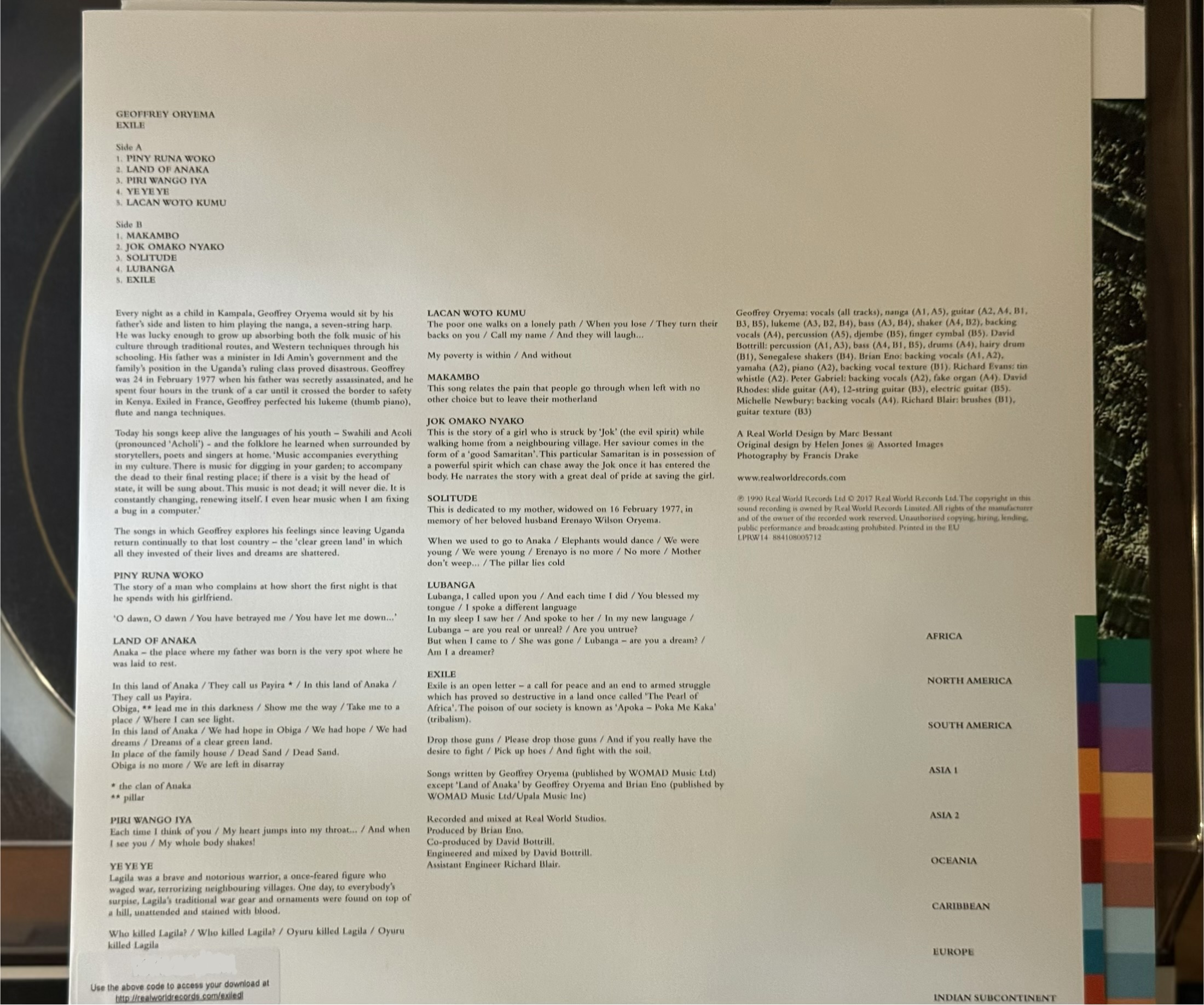
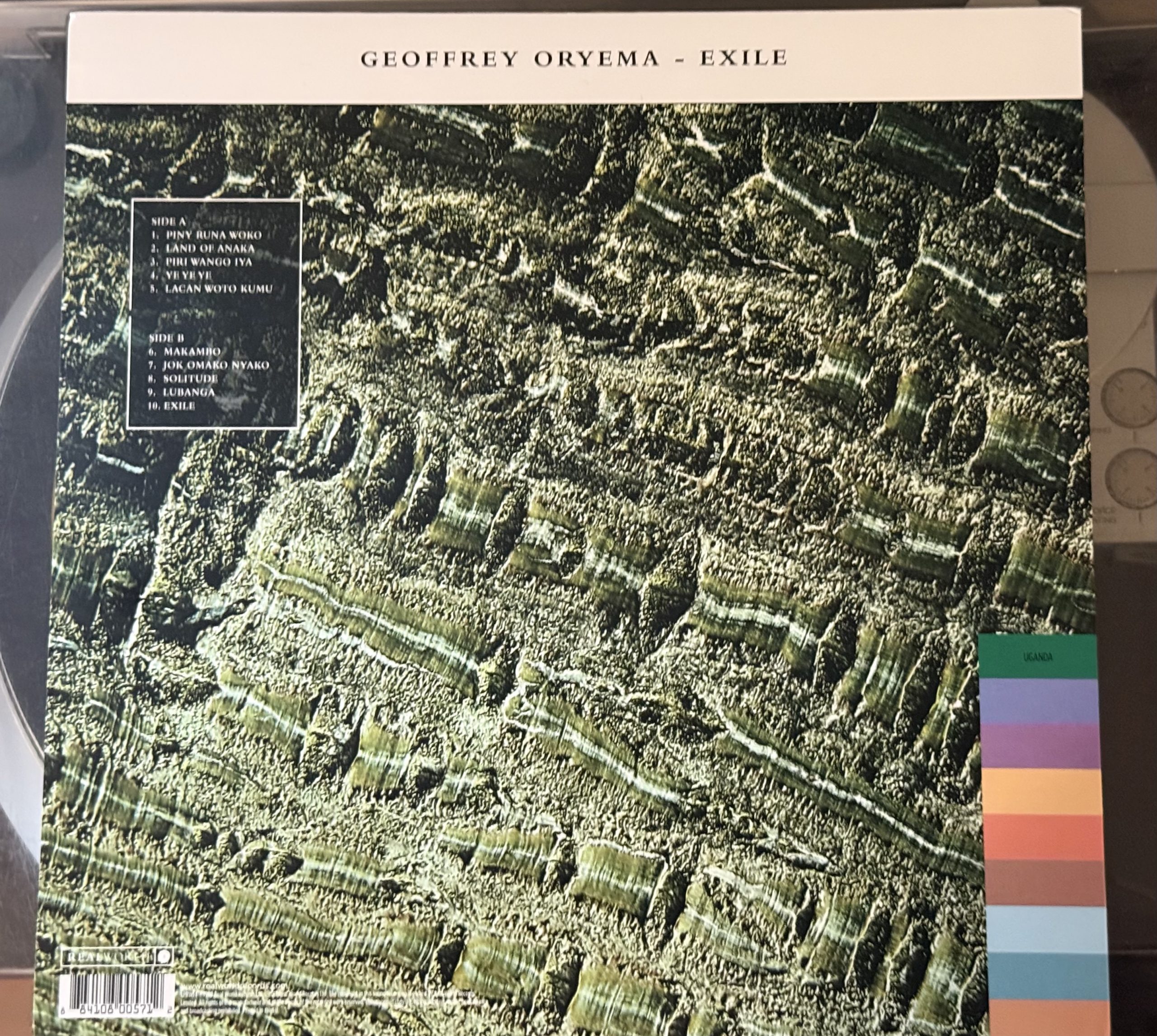
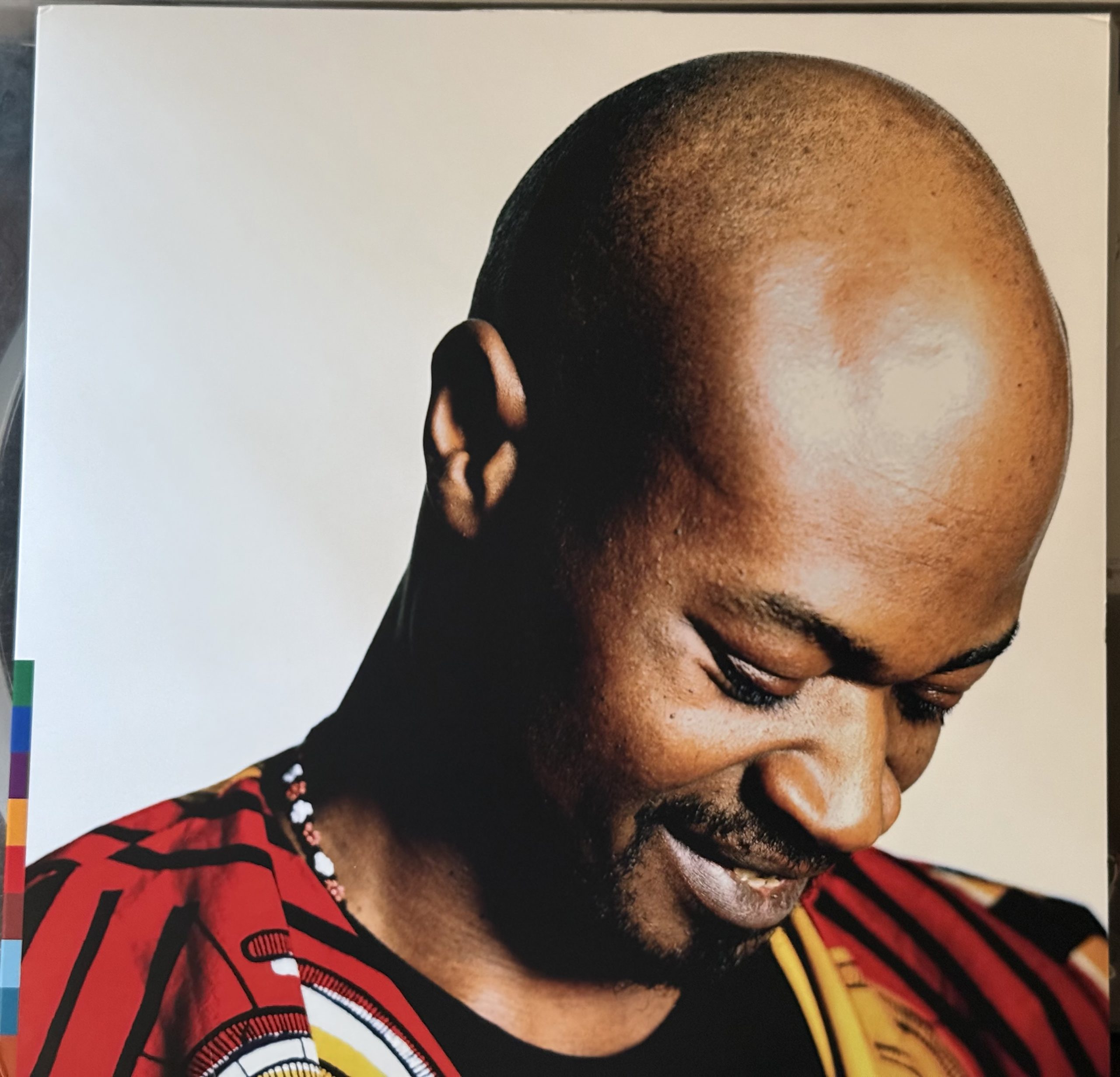
Geoffrey Oryema, Exile

An album mixing traditional music from Uganda and modern reflections, by turns joyous and sober, from a musician in exile.

Album of the Week, August 1, 2026

Imagine you’re a music student, and your father is a senior government minister who gets assassinated when you are 24 years old. Your family is part of an ethnic minority in Uganda, the Acholi people, who are economically marginalized and systematically targeted by Uganda’s dictatorial leader Idi Amin. It’s a crazy situation and you’re afraid for your life, so you get smuggled out of the country in the trunk of a car. You seek asylum in Paris, taking odd jobs and teaching yourself guitar. And then imagine you get invited to play at Peter Gabriel’s WOMAD Festival. This was the path to fame followed by Geoffrey Oryema, an Ugandan exile who became one of the most well known East African musicians of his generation.

Oryema was a songwriter and multi-instrumentalist who played the nanga, an African harp, as well as guitar and many percussion instruments. Most of his early performances were solos, but he had a few memorable collaborations with Gabriel, including appearing with him at WOMAD and performing together with Gabriel and Suzanne Vega on the One World, One Voice compilation.

It’s the nanga you hear first on the album to open “Piny Runa Woko,” as Oryema plays a complex circular pattern that reveals itself to be in common time as his voice enters, singing in Acholi. Sometimes the greatest moments on these Real World recordings are where the musicians just get to be themselves, and this is definitely one of them as Oryema’s voice phrases in and out against the rhythm. He layers additional vocals over the repetitive song bemoaning the arrival of dawn after the first night spent with a new lover; the lowest vocals create a murmuring atmosphere of mystery like a dawn chorus. Some of those vocals are from an unexpected backup singer, ambient pioneer Brian Eno.

Oryema switches to guitar for “Land of Anaka,” and the arrangement as a whole is more Western but not more conventional. This is largely thanks to the hands on the keys; Eno contributes both melodies and textures from the Yamaha and is joined on backing vocals by Peter Gabriel. A high tin whistle by Richard Evans, whom we last heard on Passion, underscores the melancholy of the song, which mourns Oryema’s exile from his homeland: “We had hope/ We had dreams/ Dreams of a clear green land/ In place of the family home/ Dead sand, dead sand.” This song of exile is one of Oryema’s most acclaimed and it’s easy to see why.

“Piri Wango Iya” is another love song, this time played on the lukeme, a northern Ugandan “thumb piano” like the mbira of Zimbabwe. Oryema is mostly on his own here on the lukeme and bass, with a little percussion from engineer David Bottrill, accompanying his voice which seamlessly swings from a high falsetto to a low bass line. “Each time I think of you / My heart jumps into my throat…” It’s a gorgeous miniature of a piece.

“Ye Ye Ye” is a more traditional bluesy rocker, and here the band features David Rhodes on slide guitar, with Gabriel contributing “fake organ” on the synthesizer and David Bottrill adding bass and drums. It has the feel of an in-the-studio improvisation with whoever happened to be around the Real World Big Room at the time, but the lyric is serious, telling the legend of the Ugandan warrior Lagila and his death at the hands of Oyuru after a long time of terrorizing the villages. It’s followed by “Lacan Woto Kumu,” which returns to the sound-world of the nanga as it creates complex patterns under Oryema’s vocals and whistling. It’s a hypnotic end to the first side.

“Makambo” is entirely different, mostly driven by Oryema’s guitar with a heavy reverb applied, backed by Bottrill on bass and Eno on “vocal textures.” The liner notes don’t supply any lyrics, only saying, “This song relates the pain that people go through when left with no other choice but to leave their motherland.” Oryema’s vulnerable whistle seems to carry the pain all on its own.

Oryema returns to the lukeme for “Jok Omako Nyako,” the story of a girl possessed by an evil spirit as she walks home from the neighboring village; she is saved by a passerby who has a more powerful spirit that drives the evil one away. Though sung entirely in Acholi, Oryema’s voice carries the story, dipping into his lower range to convey the battle of the spirits. By contrast, “Solitude” is built around a 6/8 pattern on David Rhodes’ 12-string guitar alongside Oryema’s own, as he sings a song dedicated to his mother, a memorial to his assassinated father. “When we used to go to Anaka / Elephants would dance / We were young / We were young/ Erenayo is no more / No more / Mother don’t weep…”

It’s back to the lukeme for “Lubanga” as Oryema sings about his uncertainty about whether Lubanga, who blessed his tongue to learn new languages, is real or unreal. In pre-Christian Uganda, Lubanga was understood to be a spirit of disease and death, but the arriving Christian missionaries identified it with the creator God, which needless to say creates some ambiguity about the interpretation of the lyrics.

Oryema closes with “Exile,” accompanying himself on guitar and djembe and joined by Rhodes on electric guitar and Bottrill on bass, as he sings a prayer for peace and the end of tribalism: “Drop those guns … And if you really have the desire to fight / Pick up a hoe and fight with the soil.”

Oryema’s debut was embraced as both a new voice in “world music” and a powerful humanitarian, and human, statement in the face of exile. It’s an unusual record in the early Real World catalog, featuring almost no percussion and very minimal added instrumentation and mostly letting Oryema’s deep voice and rhythmic playing drive the sound forward. Oryema made two more records on Real World following the success of Exile and “Land of Anaka”; his 1993 Beat the Border was his biggest hit for the label, followed by 1996’s Night to Night. He moved labels to Sony International, releasing four more albums between 2000 and 2010, including Words, a collaboration with Peter’s daughter Melanie. He died of cancer in Lorient, a commune in Brittany, in 2018.

We’ll explore the Real World catalog a little more next week, with another record that dives deep into musical traditions from other parts of the world.

You can listen to this week’s album here:

BONUS: When WOMAD came to the United States for the first time in 1994, Oryema joined Peter Gabriel in an interview and performance on the Today show. Here’s Matt Lauer interviewing them, followed by a performance of “The River” from Beat the Border:

BONUS BONUS: Oryema continued to perform “Land of Anaka” throughout his career; here’s a 2005 performance with Peter Gabriel on backing vocals from the Africa Calling festival:

Old mix: the bang and the clatter (as an angel runs to ground) (summer 1993)

In the summer of 1993, I was on top of the world. Having finished a great Glee Club season and gotten a literary magazine off the ground, I had just gotten a room on the Lawn and was staying in Charlottesville for the summer as an undergraduate assistant in a physics lab. I had just started listening to the funkier side of James Brown and was starting to discover blues, hip-hop and world music. Plus, I now had wheels, in the form of an incredibly fun but unreliable 1977 MGB.

This mixtape, accordingly, was shaped by all these factors, perhaps not least of all by the last. Most of the selections on this mix were chosen because they sounded great in the MGB with the top down. That was certainly true of “Ocean Size,” the opening track. After ignoring Jane’s Addiction for many years, I finally got into them about two years after they had broken up. This was a version of Los Angeles rock I could get behind—something like heavy metal for art students. And the lead-in to Hubert Sumlin’s slashing guitar on the great “Killing Floor” remains a potent link from the first song to the second. I had first picked up the Chess blues sound from a phenomenal box set of Willie Dixon recordings, and then this 1965 Chess anthology of Howlin’ Wolf’s work, which had just been reissued on CD. (It’s with no shame that I note that my first exposure to the title of this track was in William Gibson’s short story “Johnny Mnemonic,” where he borrows the phrase and puts it to an entirely different purpose.)

On the strength of Peter Gabriel’s early Real World compilation Passion Sources, I started to branch out and find other artists on the label. The African artists on the label, such as Geoffrey Oryema and Ayub Ogada. Oryema’s “Piri Wango Iya” is a great introduction to the Ugandan’s sound, featuring only his voice and the traditional Ugandan lukeme (a gourd with plucked resonating metal strips).

I was still working my way through Suzanne Vega’s phenomenal 99.9 Fº, and “Blood Makes Noise” was just the sort of twitchy dance that I could get behind. Likewise PJ Harvey’s “Sheela-Na-Gig,” which even then struck me as a striking reversal of traditional gender politics, with Harvey’s narrator confidently offering herself sexually to a man who flatly rejects her as an exhibitionist and is terrified of being dirtied by her. We hadn’t explicitly covered Freud’s take on what would now be called the Madonna-whore complex when I read him in my first year, but it was a pretty clear illustration.

Then follows, for some reason, “Englishman in New York,” a track which I love by itself but which doesn’t flow very well here. Then “North Dakota.” I never had listened to much country music, but a friend who came to visit that summer left me with an aching heart, and a mixtape featuring this phenomenal Lyle Lovett song. “If you love me, say I love you” sounds like the loneliest thing ever, and it resonates at the heart of this tape once you peel back everything else.

I wasn’t emotionally mature enough to acknowledge or linger in my feelings, but I was more than capable of irony, and PJ Harvey was always there to help, as was the gently mocking narrator of Laurie Anderson’s “Language is a Virus.” Self-mockery always made me feel better, so it was a good transition from there into “What Goes On” and “Numb,” which may have been the first U2 song that made me laugh. Ditto the over-the-top apocalyptic Western of Nick Cave’s track from Until the End of the World, another third-year frequent rotation CD that I was still digesting.

The end of this summer, when I was starting to put this mix together, was a rough one physically, and I was starting to feel ragged and tired around the edges. When I came home at the end of the summer for a few weeks before school started, I realized why — I had contracted mononucleosis, probably as a consequence of the close living quarters in the student apartment that was my home for the summer. (While I was dating someone that summer, we only spent a few days together as she was off doing her own things, so I’m pretty sure I didn’t get the “kissing disease” the fun way.) “Run That Body Down” accordingly became my theme song. It’s a good thing I didn’t know then how rundown a body could actually get…

More feelings avoidance, more loud rock! I still love “Ain’t No Right,” though not as much as I love the downtempo shift that follows it. I listened to For the Beauty of Wynona for the first time with a good friend and neighbor who had good taste in music and confused my feelings (a common theme of my college years). And Lanois’ country-infused guitar had a natural connection, at least in my mind, to the freaked-out electric blues that Miles and his band pulled from thin air on “Honky Tonk.”

My immature late teenage feelings (okay, I was actually 20) loved getting lost in Elvis Costello’s Brodsky Quartet collaboration, and on no track was this more true than on “Who Do You Think You Are?,” a paean for those with a more active imagination than love life. And again, any time I felt actual feelings getting close to the surface, it was time for a shift of gears. I have always loved “Le Bien, Le Mal” ever since borrowing Jazzmatazz Vol. 1 (and the first Digable Planets album) from a neighbor in that crowded college apartment (thanks, Patrick!), but the name of the transition technique between the Elvis Costello track and this is called “discontinuity.” Once I found that groove, though, it was a logical connection to James Brown, whose “Get Up (I Feel Like Being A) Sex Machine” had soundtracked a memorable party a few months prior in an apartment full of physics students, quality porter and stout, and someone’s incredible record collection (including, oddly, Speak No Evil).

I didn’t always know how to end mix tapes then, so there’s no real through line for the last few tracks. But “En Mana Kuoyo” is a fine closer, a brightly percolating groove from Kenya that transported me to another place. I hope it does the same for you.

Full track listing below:

  1. Ocean Size – Jane’s Addiction (Nothing’s Shocking)
  2. Killing Floor – Howlin’ Wolf (The Real Folk Blues)
  3. Piri Wango Iya – Geoffrey Oryema (Exile)
  4. Blood Makes Noise – Suzanne Vega (99.9 F°)
  5. Sheela-Na-Gig – PJ Harvey (Dry)
  6. Englishman in New York – Sting (Nothing Like The Sun)
  7. North Dakota – Lyle Lovett (Joshua Judges Ruth)
  8. Rub ‘Til It Bleeds – PJ Harvey (Rid Of Me)
  9. Language Is A Virus – Laurie Anderson (Home Of The Brave)
  10. What Goes On (Closet Mix) – The Velvet Underground (Peel Slowly and See)
  11. Numb – U2 (Zooropa)
  12. (I’ll Love You) Till The End Of The World – Nick Cave And The Bad Seeds (Until The End Of The World)
  13. Run That Body Down – Paul Simon (Paul Simon)
  14. Ain’t No Right – Jane’s Addiction (Ritual De Lo Habitual)
  15. Still Learning How To Crawl – Daniel Lanois (For The Beauty Of Wynona)
  16. Honky Tonk – Miles Davis (Get Up With It)
  17. Who Do You Think You Are? – Elvis Costello And The Brodsky Quartet (The Juliet Letters)
  18. Le Bien, Le Mal – Guru Featuring Mc Solaar (Jazzmatazz Volume 1)
  19. Get Up (I Feel Like Being A) Sex Machine – James Brown (Funk Power 1970: Brand New Thang)
  20. I’ve Been Tired – The Pixies (Come On Pilgrim)
  21. Jane Says – Jane’s Addiction (Nothing’s Shocking)
  22. Stay (Faraway, So Close!) – U2 (Faraway So Close)
  23. Every Time I Go Around Here – Frank Black (Frank Black)
  24. En Mana Kuoyo – Ayub Ogada (En Mana Kuoyo)

You can listen to (most of) the mix on Apple Music:

Old mix: faith and blues

When I got to the University of Virginia, I started buying much more music. Plan 9 (the original one on the Corner) was within walking distance, I had the mail order music clubs, I had neighbors with their own CD collections, and I started checking out different musical directions.

One of the directions that was new to me at the time was the blues. There had started to be some serious efforts to reissue and preserve old delta blues recordings, starting with the complete works of Robert Johnson and a series of box sets of artists on Chess Records. I found both available on the various CD clubs (probably Columbia, in this case) for a fraction of the list price, and started digesting the music by putting it alongside other blues that I understood better, namely jazz, the Rolling Stones, and folk music.

I might have been on to something. The Child Ballads that Dylan rifled for “Seven Curses” have a straight through-line to the blues. So does every single Leonard Cohen song. And the themes of death, guilt, and murder that snake through most of the rest of the tracks are all steeped in the blues. The outlier might be David Byrne’s “Make Believe Mambo,” but it works well melodically with the songs that surround it, and some blues are for dancing.

I note in passing that I made this mix in the late spring of 1992, long before Jeff Buckley covered the version of “Hallelujah” that appears on this mix as performed by John Cale and made it immortal. I always liked Cale.

Special shouts out in this mix to my upstairs neighbor in Harrison Portal at Monroe Hill for lending me the Rolling Stones compilation; to Greg for introducing me to Reckoning and Camper Van Beethoven in our first year; and to now-Bishop Poulson Reed for suggesting that we visit Preservation Hall on our visit to New Orleans while on the Tour of the South in 1992, where I heard the band play and picked up New Orleans – Vol. 4.

  1. “Sweet Home Chicago” – Robert Johnson (The Complete Recordings)
  2. “Sympathy for the Devil” – The Rolling Stones (Beggars Banquet)
  3. “Seven Curses” – Bob Dylan (The Bootleg Series, Vols. 1–3: Rare and Unreleased)
  4. “Carolyn’s Fingers” – Cocteau Twins (Blue Bell Knoll)
  5. “Suzanne” – Geoffrey Oryema (I’m Your Fan — The Songs of Leonard Cohen)
  6. “Nigh Eve” – Marcus Roberts (As Serenity Approaches)
  7. “Peace Like a River” – Paul Simon (Paul Simon)
  8. “St. James Infirmary” – Preservation Hall Jazz Band (New Orleans – Vol. IV)
  9. “So. Central Rain” – R.E.M. (Reckoning)
  10. “Eye of Fatima, Pt. 1 & 2” – Camper Van Beethoven (Our Beloved Revolutionary Sweetheart)
  11. “Halo” – Depeche Mode (Violator)
  12. “Preaching Blues (Up Jumped the Devil)” – Robert Johnson (The Complete Recordings)
  13. “Hallelujah” – John Cale (I’m Your Fan — The Songs of Leonard Cohen)
  14. “Kindhearted Woman Blues” – Robert Johnson (The Complete Recordings)
  15. “Make Believe Mambo” – David Byrne (Rei Momo)
  16. “Creole Blues” – Marcus Roberts (As Serenity Approaches)
  17. “Gimme Shelter” – The Rolling Stones (Let It Bleed)
  18. “She Divines Water” – Camper Van Beethoven (Our Beloved Revolutionary Sweetheart)
  19. “Blues in the Evening” – Marcus Roberts (As Serenity Approaches)
  20. “From Four Till Late” – Robert Johnson (The Complete Recordings)
  21. “7 Chinese Bros.” – R.E.M. (Reckoning)
  22. “Who By Fire” – The House of Love (I’m Your Fan — The Songs of Leonard Cohen)
  23. “Death’s Door” – Depeche Mode (Until the End of the World Soundtrack)
  24. “Armistice Day” –Paul Simon (Paul Simon)
  25. “Come On In My Kitchen” – Robert Johnson (The Complete Recordings)
  26. “Walkin’ After Midnight” – Cowboy Junkies (The Trinity Session)

You can listen to (most of) the mix on Apple Music: