

Album of the Week, August 1, 2026
Imagine you’re a music student, and your father is a senior government minister who gets assassinated when you are 24 years old. Your family is part of an ethnic minority in Uganda, the Acholi people, who are economically marginalized and systematically targeted by Uganda’s dictatorial leader Idi Amin. It’s a crazy situation and you’re afraid for your life, so you get smuggled out of the country in the trunk of a car. You seek asylum in Paris, taking odd jobs and teaching yourself guitar. And then imagine you get invited to play at Peter Gabriel’s WOMAD Festival. This was the path to fame followed by Geoffrey Oryema, an Ugandan exile who became one of the most well known East African musicians of his generation.
Oryema was a songwriter and multi-instrumentalist who played the nanga, an African harp, as well as guitar and many percussion instruments. Most of his early performances were solos, but he had a few memorable collaborations with Gabriel, including appearing with him at WOMAD and performing together with Gabriel and Suzanne Vega on the One World, One Voice compilation.
It’s the nanga you hear first on the album to open “Piny Runa Woko,” as Oryema plays a complex circular pattern that reveals itself to be in common time as his voice enters, singing in Acholi. Sometimes the greatest moments on these Real World recordings are where the musicians just get to be themselves, and this is definitely one of them as Oryema’s voice phrases in and out against the rhythm. He layers additional vocals over the repetitive song bemoaning the arrival of dawn after the first night spent with a new lover; the lowest vocals create a murmuring atmosphere of mystery like a dawn chorus. Some of those vocals are from an unexpected backup singer, ambient pioneer Brian Eno.
Oryema switches to guitar for “Land of Anaka,” and the arrangement as a whole is more Western but not more conventional. This is largely thanks to the hands on the keys; Eno contributes both melodies and textures from the Yamaha and is joined on backing vocals by Peter Gabriel. A high tin whistle by Richard Evans, whom we last heard on Passion, underscores the melancholy of the song, which mourns Oryema’s exile from his homeland: “We had hope/ We had dreams/ Dreams of a clear green land/ In place of the family home/ Dead sand, dead sand.” This song of exile is one of Oryema’s most acclaimed and it’s easy to see why.
“Piri Wango Iya” is another love song, this time played on the lukeme, a northern Ugandan “thumb piano” like the mbira of Zimbabwe. Oryema is mostly on his own here on the lukeme and bass, with a little percussion from engineer David Bottrill, accompanying his voice which seamlessly swings from a high falsetto to a low bass line. “Each time I think of you / My heart jumps into my throat…” It’s a gorgeous miniature of a piece.
“Ye Ye Ye” is a more traditional bluesy rocker, and here the band features David Rhodes on slide guitar, with Gabriel contributing “fake organ” on the synthesizer and David Bottrill adding bass and drums. It has the feel of an in-the-studio improvisation with whoever happened to be around the Real World Big Room at the time, but the lyric is serious, telling the legend of the Ugandan warrior Lagila and his death at the hands of Oyuru after a long time of terrorizing the villages. It’s followed by “Lacan Woto Kumu,” which returns to the sound-world of the nanga as it creates complex patterns under Oryema’s vocals and whistling. It’s a hypnotic end to the first side.
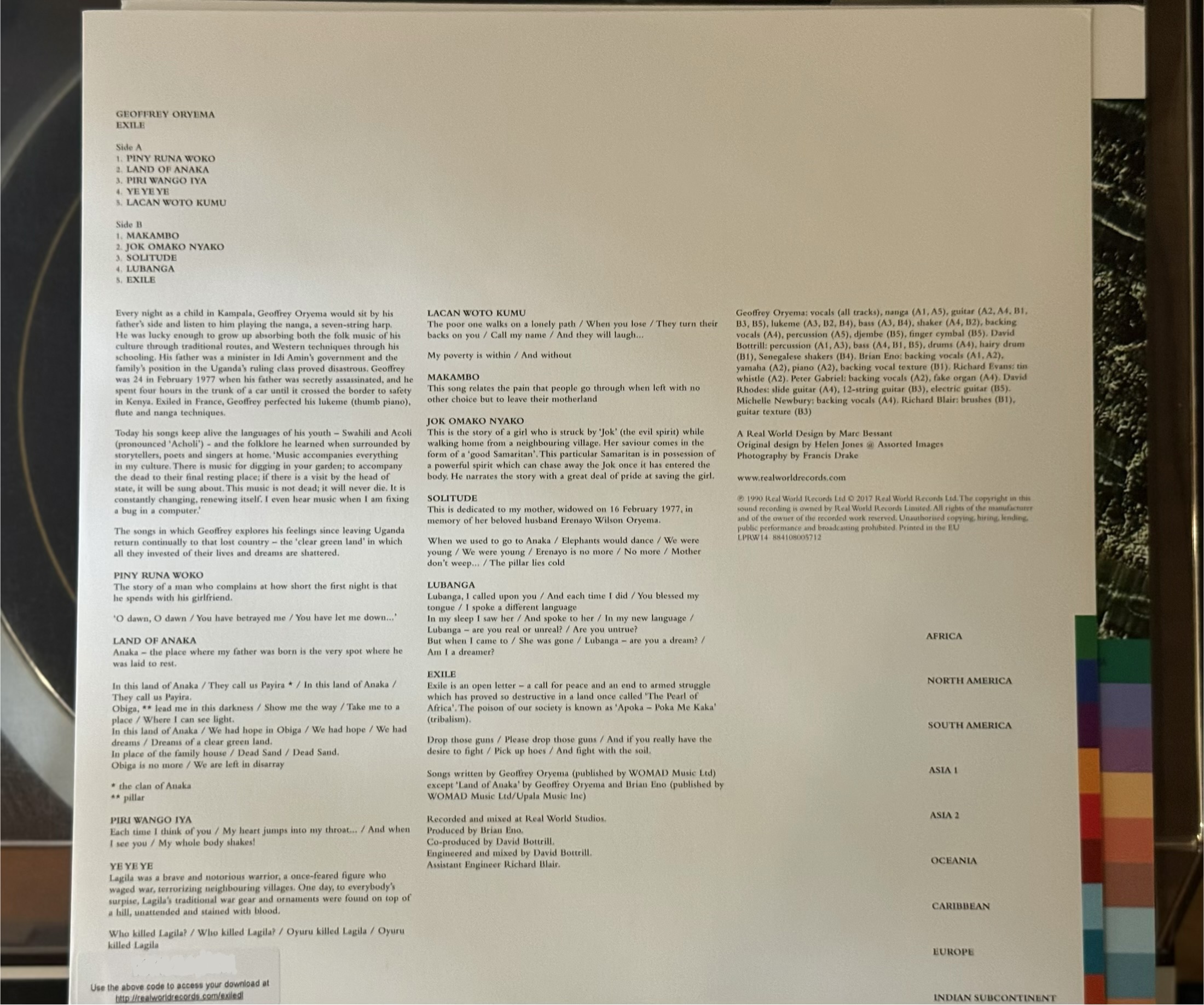
“Makambo” is entirely different, mostly driven by Oryema’s guitar with a heavy reverb applied, backed by Bottrill on bass and Eno on “vocal textures.” The liner notes don’t supply any lyrics, only saying, “This song relates the pain that people go through when left with no other choice but to leave their motherland.” Oryema’s vulnerable whistle seems to carry the pain all on its own.
Oryema returns to the lukeme for “Jok Omako Nyako,” the story of a girl possessed by an evil spirit as she walks home from the neighboring village; she is saved by a passerby who has a more powerful spirit that drives the evil one away. Though sung entirely in Acholi, Oryema’s voice carries the story, dipping into his lower range to convey the battle of the spirits. By contrast, “Solitude” is built around a 6/8 pattern on David Rhodes’ 12-string guitar alongside Oryema’s own, as he sings a song dedicated to his mother, a memorial to his assassinated father. “When we used to go to Anaka / Elephants would dance / We were young / We were young/ Erenayo is no more / No more / Mother don’t weep…”
It’s back to the lukeme for “Lubanga” as Oryema sings about his uncertainty about whether Lubanga, who blessed his tongue to learn new languages, is real or unreal. In pre-Christian Uganda, Lubanga was understood to be a spirit of disease and death, but the arriving Christian missionaries identified it with the creator God, which needless to say creates some ambiguity about the interpretation of the lyrics.
Oryema closes with “Exile,” accompanying himself on guitar and djembe and joined by Rhodes on electric guitar and Bottrill on bass, as he sings a prayer for peace and the end of tribalism: “Drop those guns … And if you really have the desire to fight / Pick up a hoe and fight with the soil.”
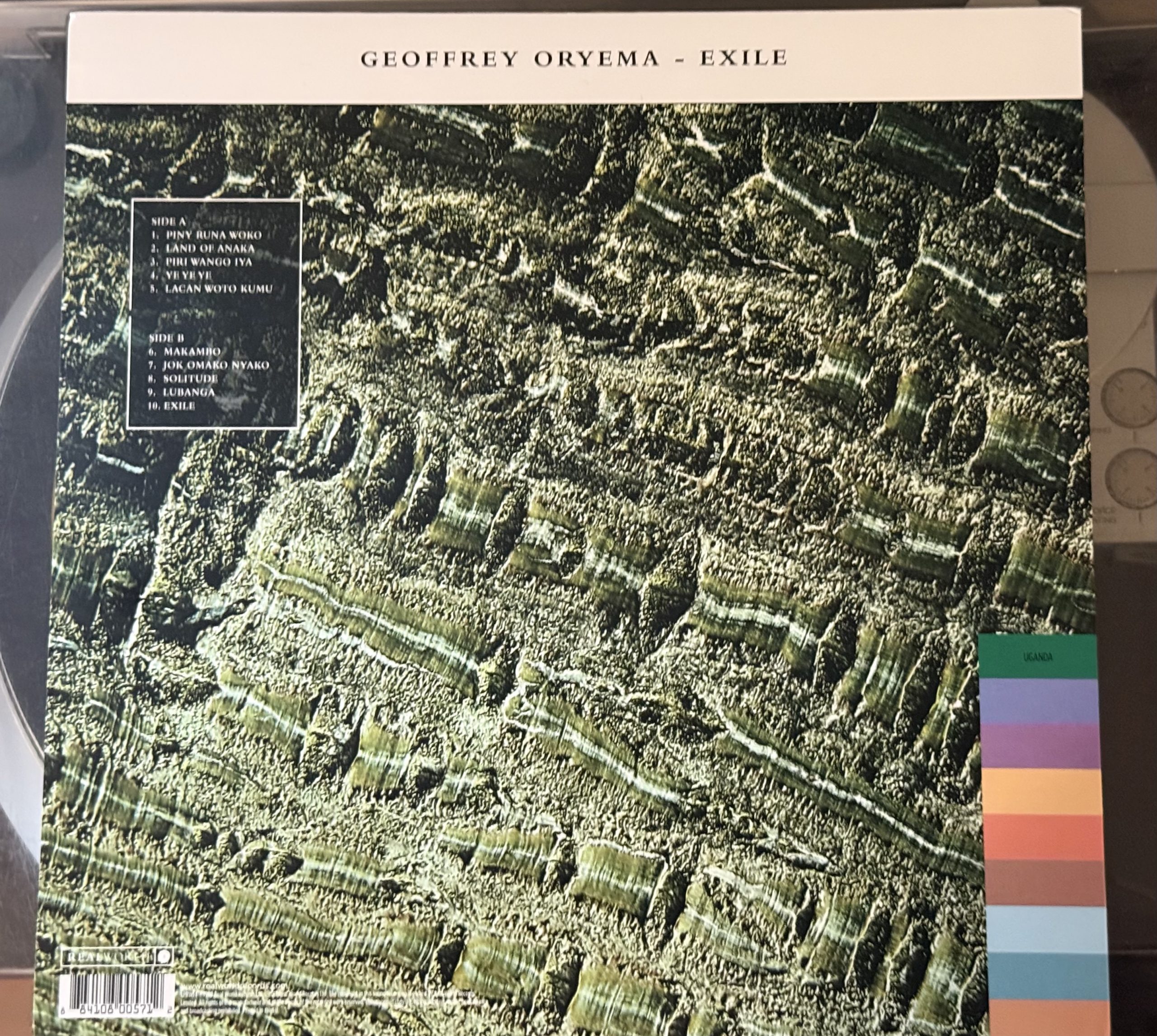
Oryema’s debut was embraced as both a new voice in “world music” and a powerful humanitarian, and human, statement in the face of exile. It’s an unusual record in the early Real World catalog, featuring almost no percussion and very minimal added instrumentation and mostly letting Oryema’s deep voice and rhythmic playing drive the sound forward. Oryema made two more records on Real World following the success of Exile and “Land of Anaka”; his 1993 Beat the Border was his biggest hit for the label, followed by 1996’s Night to Night. He moved labels to Sony International, releasing four more albums between 2000 and 2010, including Words, a collaboration with Peter’s daughter Melanie. He died of cancer in Lorient, a commune in Brittany, in 2018.
We’ll explore the Real World catalog a little more next week, with another record that dives deep into musical traditions from other parts of the world.
You can listen to this week’s album here:
BONUS: When WOMAD came to the United States for the first time in 1994, Oryema joined Peter Gabriel in an interview and performance on the Today show. Here’s Matt Lauer interviewing them, followed by a performance of “The River” from Beat the Border:
BONUS BONUS: Oryema continued to perform “Land of Anaka” throughout his career; here’s a 2005 performance with Peter Gabriel on backing vocals from the Africa Calling festival:
One thought on “Geoffrey Oryema, Exile”