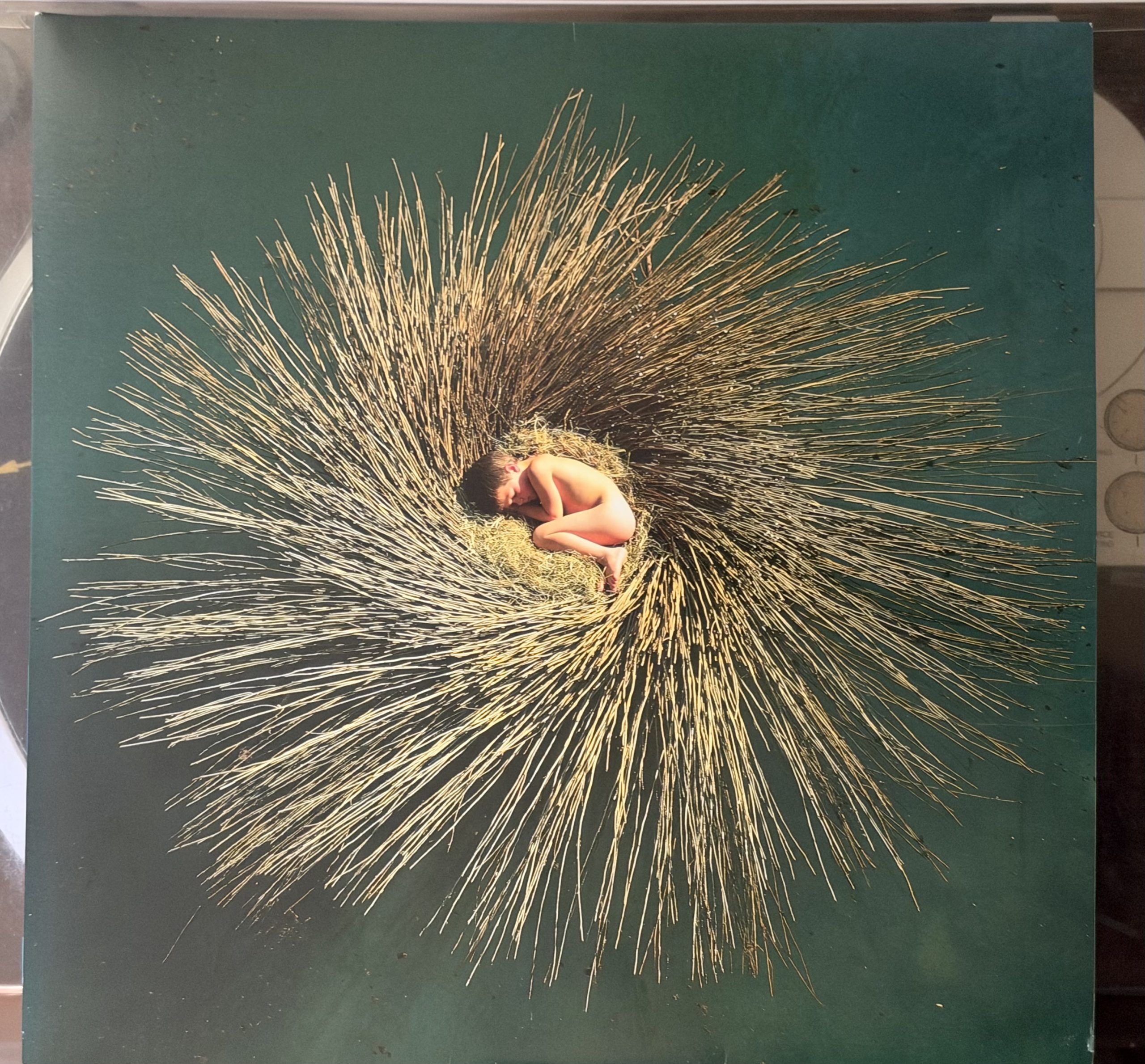
Peter Gabriel, OVO

An unlikely source for the great musician’s most personal song, in a cast album for a musical that had 999 performances in the Millennium Dome.

Album of the Week, October 10, 2026

Even in the moment, in the mid-1990s following the release of Us, it seemed like Peter Gabriel was all over the place while simultaneously being invisible. Interactive computer entertainment via the then-new medium of the CD-ROM? He was there, with XPlora 1: Peter Gabriel’s Secret World (reviews now differ: was it a computer game or an extended advertising campaign? Having played it back in the day, I can say with confidence: it was slow) and Eve. There were talks about a theme park. But new music under his name was slow to appear, until in 2000 an odd album appeared. A soundtrack, but for a live show rather than a movie; a concept album with an impossible-to-describe concept; and a Peter Gabriel album with almost everyone except Peter Gabriel on lead vocals. What, exactly, was OVO?

First of all, it was the soundtrack to the Millennium Dome Show, intended as a massive multimedia event but remembered today mostly as an expensive flop. The show, built inside a massive dome on London’s Greenwich Peninsula near Canary Wharf that now houses the O2 Arena, was meant to commemorate the Millennium and, not coincidentally, to announce to the world that Tony Blair’s New Labour was creating fabulous things in Great Britain. Ultimately the show, which ran for a year, did not draw the crowds the organizers anticipated; though the 6.5 million visitors who saw one of the 999 shows were reportedly happy with the experience, organizers had planned for more than 10 million.

Second, it was a concept album, but a meandering one. The Skypeople live in the trees, while the Earth People were originally agrarian but develop iron technology, creating alienating cities in towers, such as the Tower That Ate People. Sofia of the Earth People nevertheless falls in love with Skyboy of the Skypeople. Sofia’s brother, who built the tower, grows paranoid about the Skypeople and jealous of Skyboy, and imprisons him in the tower. The desperate Skypeople attack the tower and free Skyboy; Sofia’s brother, understanding at last his folly, dies atop the tower, and the Skypeople bring it down, killing Sofia’s mother in the rubble. Sofia, bereft, finally finds Skyboy again and goes with him above the clouds, ultimately bearing his child, a boy named OVO (the caps are in the score); at his birth a tree springs from his grandmother’s grave, rapidly growing into a giant oak. When catastrophic rains come and endanger earth and Skypeople alike, Sofia has a dream that the world is upside down and that one can sail away to safety into the sky. Inspired by the dream, she places OVO in a nest and sends him sailing into the sky to find hope and a safer place. While the story has deeper emotional resonance than Mozo’s radio-born revolution, it’s plenty bonkers.

But last, OVO contains some of Peter’s most personal writing, with some melodies dating back to So, and some truly gorgeous sonic landscapes, even if he doesn’t sing most of it. It’s all delivered in something that’s more musical theater than rock album, complete with recurring themes, big set numbers, and a broad cast of characters.

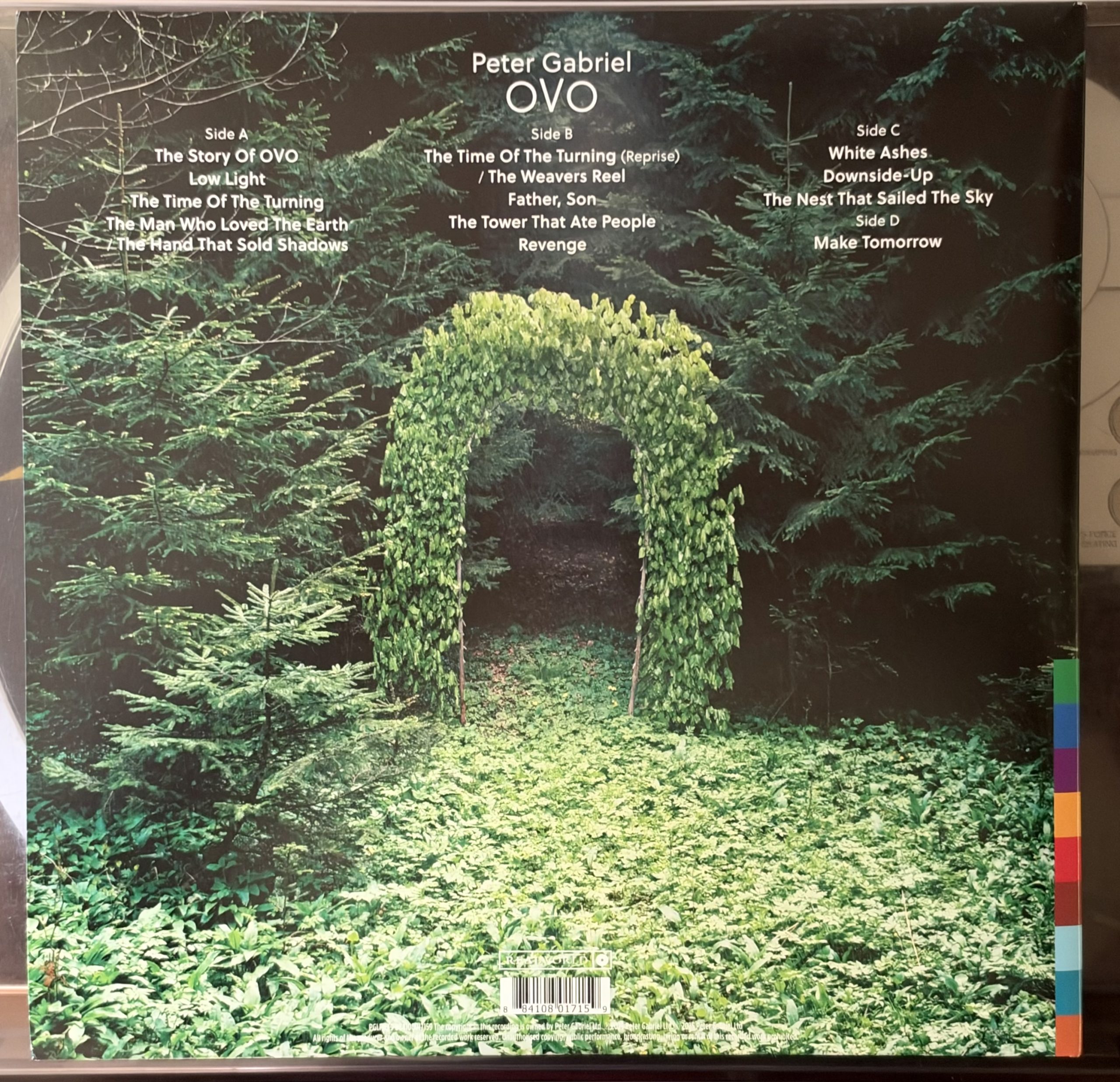
“The Story of OVO” opens with a grimy groove which immediately subverts the listener’s expectation: yes, that’s rap, and yes, that’s Neneh Cherry, alongside American rapper Rasco. Gabriel apparently chose this approach because he wanted to interest a broader range of listeners in the material, and he knew “kids listened to rap.” Hamilton it ain’t, but the track does what it needs to do, which is to move the plot along atop the deepest beats on the album.

We subvert expectations once again with “Low Light,” which immediately turns aside from the groove into an ambient soundscape that wouldn’t have been out of place on Passion but is even deeper and more enveloping. The stunning Irish voice on the latter half of the track belongs to Iarla Ó Lionáird, a sean–nós singer who had released his first solo album on Real World in 1997 and was also a member of the beat-driven Irish and West African crossover ensemble, the Afro Celt Sound System. There are undercurrents throughout the work of musical themes that will appear later in the album, including the “Downside-Up” theme.

“The Time of the Turning” is something else again, an acoustic ballad with vocals by electronica singer Alison Goldfrapp, a few years away from her star turns on the album Black Cherry and the hit single “Ooh La La.” Alongside Goldfrapp is none other than singer-songwriter Richie Havens, voicing the perspective of Sofia’s father and his traditional agrarian ways. But Goldfrapp warns us, “It’s the time of the turning/And we’d better learn to say our goodbyes.”

“The Man Who Loved the Earth/The Hand That Sold Shadows” revisits the groove from the opening track as an instrumental, so you can hear the play of the buzzing didgeridoo against the bass line and thundering drums. The only problem with the arrangement is the odd interjections from the villagers as they build their constructions of iron, which sounds like something in between the didgeridoo and scratching. In the last minute and 30 seconds there’s a hard cut to a more ominous percussive rhythm, driven forward by a hooky, whistling synth and David Rhodes’ monster guitar.

“The Time of the Turning (Reprise)/The Weaver’s Reel” brings Goldfrapp back for one more chorus, accompanied by a brass band, before we abruptly transition into a frantic Celtic dance, anchored by the redoubtable Richard Evans but also by the Dhol Foundation (a South Asian drumming ensemble based in London), Johnny Kalsi and James McNally (members of the Afro Celt Sound System), and a host of Celtic musicians. The net effect is a thesis statement that will be familiar to listeners of Sheila Chandra: that there is a through-line among the music of the Irish, the South Asians, and West African cultures. It’s the adrenaline climax of the album, and it pointed the way to where the Afro Celts and others were heading in blending these musics into something you’d want to dance to.

“Father, Son” is a rare introspective moment, and a rare instance of Gabriel’s vocals on the record. As the industrialist Ion mourns the death of his father, he reflects on their relationship in a piano-driven ballad. It stands completely apart from the rest of the material, and was written earlier. The lyrics, as the two men have an emotional breakthrough while doing yoga together, are both concrete (“spine against spine”) and incredibly moving. Emotionally it feels of a piece with other introspective Gabriel songs like “I Grieve,” which had appeared on the soundtrack to the movie City of Angels some years prior, and it continued in Gabriel’s set lists for years after; I remember being struck by its impact at Gabriel’s 2001 WOMAD performance in Redmond, Washington.

“The Tower That Ate People” introduces a new theme driven by snarling guitars courtesy of David Rhodes and tight drums from Manu Katché. Gabriel’s vocals here are treated and, in his own words, influenced by Dr. John as he snarls out his paranoia in the role of Ion. The music would fit well alongside earlier songs like “Steam” and some of Gabriel’s forthcoming projects, which we’ll hear more of later.

“Revenge,” as the Skypeople attack the Tower, is a massive drum number with the Dhol Foundation playing alongside programmed drums and a thrumming keyboard line. It’s brief and leads into the grief-filled “White Ashes,” anchored by vocals from Omi Hall as the villagers sort through the rubble of the Tower.

“Downside-Up” opens the third act with one of the most thoroughly realized and dramatic tracks on the album, a duet between the Cocteau Twins’ Elizabeth Fraser and the Blue Nile’s Paul Buchanan. Fraser doesn’t get the opportunity to do much of her trademark vocal acrobatics here, but Skyboy’s part was written for Buchanan’s haunted baritone and he sounds fantastic here. It’s a full-blown PG song, with his full band joined by former Super Étoile de Dakar members Assane Thiam and Babacar Faye—in fact it’s really two PG songs in one, with the gentle “Downside-Up” theme grafted to the more rhythmic “Ovo” theme in the second half as they celebrate the infant’s arrival.

“The Nest That Sailed the Sky” gives us one last instrumental, with the brass band joined by Shankar and a string and synth-driven soundscape for another track that wouldn’t have been out of place on Passion. It leads into the cast finale, “Make Tomorrow,” as we hear from Buchanan, Fraser, Richie Havens and Gabriel in their grief and hope as they send OVO into the sky, and snippets of the “Downside-Up” and “Ovo” themes blend into moments of percussion that recall the more conflict-driven moments of the album. When the percussion and growling didgeridoo re-emerge to underpin the “Make Tomorrow” theme, we get a sort of synthesis moment that gives us hope that all the forces can actually work together, which one suspects was the narrative point.
Gabriel’s grand musical may not have ultimately congealed into a fully coherent statement, but it still stands as a unique point in his repertoire as the only musical theatre in his solo repertoire and his first major concept album since Genesis’ The Lamb Lies Down on Broadway. Gabriel would make more soundtrack albums following this, including The Long Walk Home (soundtrack to The Rabbit-Proof Fence), but he would also finally release more original songs. In fact, simultaneously with OVO he was working on another album, a proper sequel to Us, which would finally be released two years after the ambitious concept. We’ll hear that one next week.

You can listen to this week’s album here:

BONUS: Peter performed some of the music live with the musicians on the project on the promotional circuit. Here he is with Fraser and Buchanan on the Jools Holland show a few weeks before the album was released:

BONUS BONUS: Peter took the material from OVO into live performances through the 2000s, and in his 2010 orchestral project New Blood. Here’s a performance from his “Growing Up” tour, and from the New Blood concert film Taking the Pulse:

BONUS BONUS BONUS: This wouldn’t be Peter’s last collaboration with the Afro Celt Sound System. It was with delighted disbelief that I heard his voice on their song “When You’re Falling” on the air in 2003. Here’s a live version of the song from an unspecified television program:

Peter Gabriel, Us

The artist’s most emotionally direct album digs in the dirt to yield a richly organic collaboration featuring some of his most enduring songs.

Album of the Week, August 15, 2026

When Peter Gabriel released his new album Us on September 28, 1992, it seemed like an eternity had passed since his last pop album, So, in 1986. (How little we knew!) Over the past weeks we’ve looked into some of what he was doing during the period—the Passion soundtrack and sister album Passion – Sources, massive world tour, WOMAD, and starting the Real World label and launching the western careers of some of his key contributors. But it has to be said that part of what he was doing was recalibrating. For the former art-pop auteur, life could never be the same after So. He had to find a new way to make music.

He also had to come to terms with himself. His marriage to Jill Gabriel, long strained, ended in divorce in 1987 in the middle of the massive world tour. He was famously linked with actress Rosanna Arquette for some time after his divorce, but the relationship was not long lasting. The dissolution of his marriage resulted in depression and therapy, which continued for six years. The divorce and his therapy both influenced the songwriting on Us, his most personal album to date.

To make the album real, he turned to a group of collaborators both familiar and new, many drawn from the sessions in the massive state-of-the-art studio he built in a former mill building complex in Box, Wiltshire, England. There was the core band, by now familiar: Tony Levin, Manu Katché, David Rhodes, producer Daniel Lanois, engineer David Bottrill; frequent collaborators like Shankar and Peter Hammill; collaborators from Passion including Hossam Ramzy, Doudou N’Diaye Rose, Kudsi Erguner, Assane Thiam, Manny Elias, and the Babacar Faye Drummers; and collaborators drawn from the nascent Real World label including many of the Passion names, the Dmitri Pokrovsky Ensemble, and Ayub Ogada. There were also some brand new faces, including Meters guitarist Leo Nocentelli, Lanois’ producing partner Brian Eno, ascendant electronic producer William Orbit, duduk player Levon Minassian, and incandescent vocalist Sinéad O’Connor.

“Come Talk to Me” begins in a silence that builds to a shout: layers of keyboards crescendo up to a bagpipe solo over the bass, thundering drums courtesy of the combined forces of Katché, the Babacar Faye Drummers, and a 1980 drum loop from Doudou N’Diaye Rose, and a response on the duduk. Peter’s vocals are direct and intimate, reaching out to someone who has been incommunicado, asking for a bridge over which they can rebuild a relationship; he’s subsequently disclosed that the rift was with one of his daughters. The chorus features harmony vocals from Sinéad; Peter had met her doing an Amnesty concert in Santiago, Chile in 1990 and invited her to the studio, and having her very present voice on the opening track effectively signals that this album is about dialog and communication. It’s also a showcase for his collaborative work with the artists of Real World: that choir that enters after the bridge, the storied Dmitri Pokrovsky Ensemble, were recording their album for the label, The Wild Field, at the same time Gabriel was working on Us.

The contrast as the album flows into “Love to Be Loved” is marked. Cool where “Come Talk to Me” is hot, the second track is all about minimal groove, with both the late William Orbit and the legendary Brian Eno contributing programming and keys. Katché’s drum programming and Hossam Ramzy’s tabla (as well as Daryl Johnson’s hand drum) anchor the rhythm along with Tony Levin’s bass. And the lyrics take us on an emotional journey, starting from talking about the need for contact (echoes of “I Have the Touch”) to a startling transition in the bridge in which Peter confesses, “This old familiar craving / I’ve been here before, this way of behaving… Let it pass, let it go, let it leave / From the deepest place I grieve / This time, I believe.” But even that isn’t the end, and we get to the root of it: “Though it takes all the strength in me / And all the world can see / I’m losing such a central part of me / I can let go of it… I recognize how much I’ve lost / And I cannot face the cost / ‘Cause I love to be loved.” The track’s stark honesty about the need for physical relationships and letting go of destructive behaviors, even as other relationships are falling apart, is striking; one really feels those years that Peter spent in therapy at work here. And it’s a jam.

That brings us to “Blood of Eden,” which feels like the most primal, innocent love song Peter has ever written. It comes out of an idyllic opening with the doudouk over layers of keyboards, and Peter sings about the darkness in his heart and the “heated and the holy.” The song is surely one of the best known from the album thanks in no small part to Sinéad O’Connor’s pure vocals in the chorus duet (and the face morphing of the two singers in the video), but the lyrics are a bit of a hodgepodge, with the heated and the holy looking down from on high “so secure with everything they’re buying.” The narrator returns to “the union of the woman and the man” as a retreat to paradise even as he acknowledges the worm at the heart of the apple: “All the while the distance grows between you and me.” There are echoes here of “Don’t Give Up,” both in the duet structure of the song and the plight of the narrator, but the catastrophe seems more emotional than economic here. This was one of the songs that underwent the longest gestation, with multiple versions and arrangements extant; the liner notes hint at this when they credit Richard Chappell for the mix from which the bridge section was drawn, and another version of the song appeared even before the album was released on a soundtrack (see the bonus section below). Other versions have been released to Peter’s fan club on Bandcamp.

“Steam” underwent a similar evolution, with a stunning “Quiet Steam” appearing as a b-side to the album’s first single. But there’s plenty to recommend the released version, starting with the funky guitar of Leo Nocentelli of the Meters. The horns aren’t given quite as much prominence as they are in the song’s spiritual predecessor “Sledgehammer,” but they’re still pretty tasty, and the Babacar Faye Drummers add an edge to the percussive energy that is otherwise all Motown. One fun thing to listen for is Peter’s keys, here easily distinguished because he’s switched from the airy synth sounds of the Prophet to a fairly convincing Hammond organ soundalike, adding to the sweaty funk of the mix.

“Only Us” returns to a more open, idyllic sound, with a duet between Peter and Kenyan musician Ayub Ogada. This is another track with contributions from William Orbit, but here the vibe is organic rather than chill. Shankar and ney flautist Kudsi Erguner contribute to the feeling of limitless nature, and Peter’s lyrics signal the song’s centrality to the album’s overall concept as he refocuses on relationships and people: “Seduced by the noise and the bright things that glisten / I knew all the time I should shut up and listen / And I’m finding my way home from the great escape… Yes I can read you loud and clear … The further on I go, oh the less I know / Friend or foe, there’s only us.” I realized as I was relistening to the album that this was a track that had slipped under my radar, but it repays listening to again.

The second half of the album starts with “Washing of the Water,” easily Peter’s most gospel song starting with just bass, snare and piano accompanying Peter’s unvarnished vocals. This too has echoes of “Don’t Give Up”—we could be over the same river that flowed through the earlier song. But here the protagonist gives in to the lure of the water, choosing to accept the call to immerse himself in grief as he mourns the loss of the relationship. The horns under the bridge as Peter sings “Letting go, it’s so hard / The way it’s hurting now / To get this love untied / So tough to stay with this thing / ‘Cause if I follow through / I face what I’ve denied / I’ll get those hooks out of me / and I’ll take out the hooks that I’ve sunk deep in your side.” The acceptance of the dissolution of the relationship, the unhooking and the desire to finally sleep, feels like a brutally sad step, but also like emotional honesty and progress as the narrator names the pain that is at his core.

The progress of Peter’s emotional journey is most vivid in “Digging in the Dirt,” a metaphor for the hard work of therapy as Peter allows himself to express anger as well as sadness and grief. The rage of the narrator boiling over in the chorus—“Don’t talk back, just drive the car”—is shocking when it comes to the surface, the “something in me / dark and sticky” rising like Sting’s monster crawling to the surface of a dark Scottish loch. Significantly, though, the narrator doesn’t stay stuck in this moment of rage; he takes a step back, asking, “Stay with me, I need support,” and goes digging to “find the places I got hurt.” By the end of the song (a fantastic slow groove built atop Babacar’s djembe, Assane Thiam’s tama, and Hossam Ramzy’s surdu, with Leo Nocentelli joining David Rhodes, Manu Katché, and Tony Levin plus more background vocals from Ogada, this time joined by Peter Hammill and Richard Macphail), the narrator has even opened up his area of concern to “find the places we got hurt,” acknowledging the difficulties he’s caused his partner. I remember watching the video for this song live, introduced by Gabriel on MTV, in a student lounge and thinking, “I guess Peter’s been in therapy”; the vivid claymation of Peter sinking into the grass covered by insects and worms is among the most memorable video images of him in his entire ouevre.

“Fourteen Black Paintings” follows. The longer CD format allowed Gabriel to expand beyond the 45-50 minute limit of an LP, and this composition, which reads like a cross between Passion and “We Do What We’re Told (Milgram’s 37),” is the beneficiary, as it surely would have been cut for time otherwise. Yet it’s significant in its own way; Peter’s only known collaboration with Led Zeppelin’s John Paul Jones, the song is an echo of “Biko” in its call for the people to embrace their power and bring about change. There’s also some vivid percussion from Babacar and Assane Thiam alongside the doudouk and electric violin that build the atmosphere of the song.

All of which makes “Kiss That Frog” even more of a shock. A playful metaphor-song that plays as a straightforward fairy tale, Peter’s lyrics have rarely been so direct, and his singing is unusually free, especially in the scat choruses at the beginning and end of the song. If “Steam” is a lesser shadow of “Sledgehammer,” I’d rate “Kiss That Frog” as a superior successor to “Big Time.” Both more open and more generous in its worldview, it’s also downright funny: “Let him sit beside you / Eat right off your plate / You don’t have to be afraid / There’s nothing here to hate.” When Gabriel shifts perspective from the narrator to the frog, croaking “Kiss that frog / You may get your prince,” it’s a laugh-out-loud moment. When I was a cynical, critical teen I disliked the song for exactly the same characteristics that make it enduring (and endearing) now: the extended metaphor, the straightforward pop, the echoes of gospel and R&B in Peter’s harmonica and “fake organ” and Marylin McFarlane’s backing vocals. This is one of the few songs on the record that doesn’t have an extensive list of guest musicians, just programming by David Bottrill and Richard Blair, a percussion loop from the Adzido Drummers and shakers from Manny Elias, and David Rhodes’ guitar.

The album closes with “Secret World,” another contender for the theme song, as Peter sings with open regret, but “no guilt and no shame, no sorrow, no blame,” about the dissolution of the relationship and about moving on: “All the places we were hiding love / What was it we were thinking of?” The song, again built on a drum loop from Doudou N’Diaye Rose (the album’s secret MVP), is an open ballad sung with regret but also with forgiveness, and with a sort of intimacy not present in the singer’s earlier works: “So I watch you wash your hair / Underwater, unaware / And the plane flies through the air / Did you think you didn’t have to choose it? / That I alone could win or lose it?” After many works berating himself for the dissolution of the relationship, Peter dispassionately observes that it wasn’t only up to him, and allows himself to absolve some of the guilt, shame, sorrow and blame. It’s probably the most mature reflection on the end of a relationship in pop music, certainly in Peter’s work, and it puts truth to Peter’s dedication to Jill and to Rosanna Arquette in the liner notes: “To Jill, for giving up so much in all the time we were growing up together. To Rosanna for all her love and support that I didn’t properly acknowledge.” And it’s all wrapped in a tasty groove, with one of Tony Levin’s most sinuous bass lines as the foundation.

Us in many ways is clearly a direct successor to So in terms of the ambition, artistic scope, and stadium-readiness of its sound. But where its 1986 predecessor is the slickest thing Gabriel has ever recorded, Us embraces the organic, acoustic, and human side of music making. The collaborations from Passion and the experiences producing and recording—and singing alongside—so many great world musicians seem to have opened Peter up to a more human way of making music. It also evolved his songwriting in ways that opened new opportunities in his career; when we check back with some of his later work we’ll explore that thought some more. But first we’ll listen to another voice on his Real World label, one who didn’t participate in the making of Us.

You can listen to this week’s album here:

BONUS: “Blood of Eden” appears in a different version, based on an earlier approach to the song, in Wim Wender’s great 1991 film Until the End of the World, accompanying a scene that hints at nuclear catastrophe — or at least an EMP. Here’s that scene (but you should really watch the whole movie):

BONUS BONUS: “Washing of the Water” would seem to be a non-obvious choice to perform on “The Tonight Show with Jay Leno” to promote this album, but that’s where Peter went in this incredible performance with Shankar, Joy Askew on keyboards, Tony Levin on acoustic bass—and with Branford Marsalis, who was music director for Jay’s band at the time, sitting in on soprano sax:

BONUS BONUS BONUS: Much of the b-side material that came from the Us sessions consists of alternate takes of the album tracks, but “Bashi-Bazouk” is the exception. An instrumental that feels a bit like Passion given a dance floor treatment, it’s got a shocking opening and a mean groove:

BONUS X 4: Just as Passion – Sources served as a Real World sampler for the artists appearing on Passion, so there was Plus From Us. Sadly the compilation has never been released on vinyl, but there’s a lot to like here: Ayub Ogada, the Meters, solo tracks from Rhodes, Levin, and Katché, and more.

Geoffrey Oryema, Exile

An album mixing traditional music from Uganda and modern reflections, by turns joyous and sober, from a musician in exile.

Album of the Week, August 1, 2026

Imagine you’re a music student, and your father is a senior government minister who gets assassinated when you are 24 years old. Your family is part of an ethnic minority in Uganda, the Acholi people, who are economically marginalized and systematically targeted by Uganda’s dictatorial leader Idi Amin. It’s a crazy situation and you’re afraid for your life, so you get smuggled out of the country in the trunk of a car. You seek asylum in Paris, taking odd jobs and teaching yourself guitar. And then imagine you get invited to play at Peter Gabriel’s WOMAD Festival. This was the path to fame followed by Geoffrey Oryema, an Ugandan exile who became one of the most well known East African musicians of his generation.

Oryema was a songwriter and multi-instrumentalist who played the nanga, an African harp, as well as guitar and many percussion instruments. Most of his early performances were solos, but he had a few memorable collaborations with Gabriel, including appearing with him at WOMAD and performing together with Gabriel and Suzanne Vega on the One World, One Voice compilation.

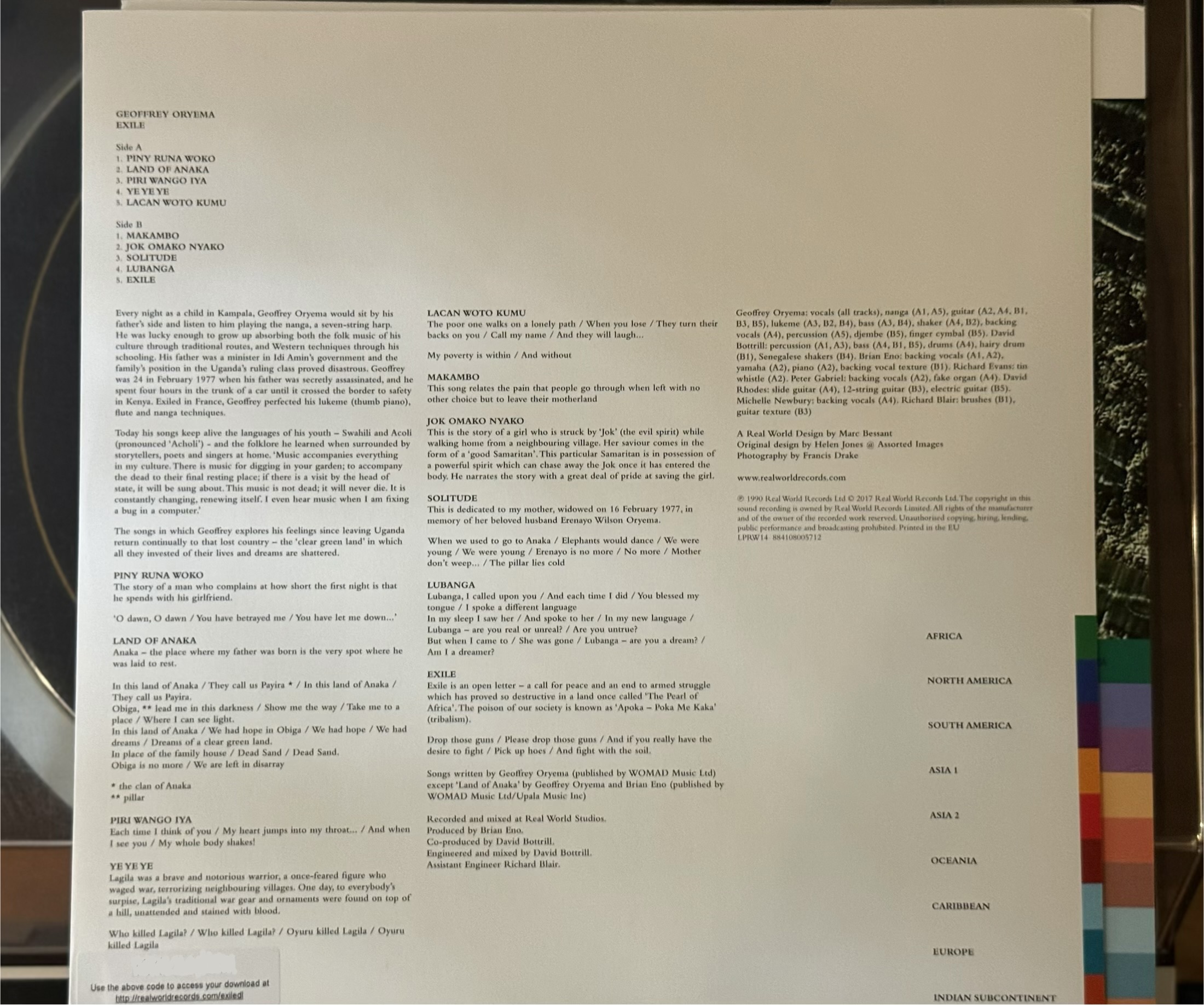
It’s the nanga you hear first on the album to open “Piny Runa Woko,” as Oryema plays a complex circular pattern that reveals itself to be in common time as his voice enters, singing in Acholi. Sometimes the greatest moments on these Real World recordings are where the musicians just get to be themselves, and this is definitely one of them as Oryema’s voice phrases in and out against the rhythm. He layers additional vocals over the repetitive song bemoaning the arrival of dawn after the first night spent with a new lover; the lowest vocals create a murmuring atmosphere of mystery like a dawn chorus. Some of those vocals are from an unexpected backup singer, ambient pioneer Brian Eno.

Oryema switches to guitar for “Land of Anaka,” and the arrangement as a whole is more Western but not more conventional. This is largely thanks to the hands on the keys; Eno contributes both melodies and textures from the Yamaha and is joined on backing vocals by Peter Gabriel. A high tin whistle by Richard Evans, whom we last heard on Passion, underscores the melancholy of the song, which mourns Oryema’s exile from his homeland: “We had hope/ We had dreams/ Dreams of a clear green land/ In place of the family home/ Dead sand, dead sand.” This song of exile is one of Oryema’s most acclaimed and it’s easy to see why.

“Piri Wango Iya” is another love song, this time played on the lukeme, a northern Ugandan “thumb piano” like the mbira of Zimbabwe. Oryema is mostly on his own here on the lukeme and bass, with a little percussion from engineer David Bottrill, accompanying his voice which seamlessly swings from a high falsetto to a low bass line. “Each time I think of you / My heart jumps into my throat…” It’s a gorgeous miniature of a piece.

“Ye Ye Ye” is a more traditional bluesy rocker, and here the band features David Rhodes on slide guitar, with Gabriel contributing “fake organ” on the synthesizer and David Bottrill adding bass and drums. It has the feel of an in-the-studio improvisation with whoever happened to be around the Real World Big Room at the time, but the lyric is serious, telling the legend of the Ugandan warrior Lagila and his death at the hands of Oyuru after a long time of terrorizing the villages. It’s followed by “Lacan Woto Kumu,” which returns to the sound-world of the nanga as it creates complex patterns under Oryema’s vocals and whistling. It’s a hypnotic end to the first side.

“Makambo” is entirely different, mostly driven by Oryema’s guitar with a heavy reverb applied, backed by Bottrill on bass and Eno on “vocal textures.” The liner notes don’t supply any lyrics, only saying, “This song relates the pain that people go through when left with no other choice but to leave their motherland.” Oryema’s vulnerable whistle seems to carry the pain all on its own.

Oryema returns to the lukeme for “Jok Omako Nyako,” the story of a girl possessed by an evil spirit as she walks home from the neighboring village; she is saved by a passerby who has a more powerful spirit that drives the evil one away. Though sung entirely in Acholi, Oryema’s voice carries the story, dipping into his lower range to convey the battle of the spirits. By contrast, “Solitude” is built around a 6/8 pattern on David Rhodes’ 12-string guitar alongside Oryema’s own, as he sings a song dedicated to his mother, a memorial to his assassinated father. “When we used to go to Anaka / Elephants would dance / We were young / We were young/ Erenayo is no more / No more / Mother don’t weep…”

It’s back to the lukeme for “Lubanga” as Oryema sings about his uncertainty about whether Lubanga, who blessed his tongue to learn new languages, is real or unreal. In pre-Christian Uganda, Lubanga was understood to be a spirit of disease and death, but the arriving Christian missionaries identified it with the creator God, which needless to say creates some ambiguity about the interpretation of the lyrics.

Oryema closes with “Exile,” accompanying himself on guitar and djembe and joined by Rhodes on electric guitar and Bottrill on bass, as he sings a prayer for peace and the end of tribalism: “Drop those guns … And if you really have the desire to fight / Pick up a hoe and fight with the soil.”

Oryema’s debut was embraced as both a new voice in “world music” and a powerful humanitarian, and human, statement in the face of exile. It’s an unusual record in the early Real World catalog, featuring almost no percussion and very minimal added instrumentation and mostly letting Oryema’s deep voice and rhythmic playing drive the sound forward. Oryema made two more records on Real World following the success of Exile and “Land of Anaka”; his 1993 Beat the Border was his biggest hit for the label, followed by 1996’s Night to Night. He moved labels to Sony International, releasing four more albums between 2000 and 2010, including Words, a collaboration with Peter’s daughter Melanie. He died of cancer in Lorient, a commune in Brittany, in 2018.

We’ll explore the Real World catalog a little more next week, with another record that dives deep into musical traditions from other parts of the world.

You can listen to this week’s album here:

BONUS: When WOMAD came to the United States for the first time in 1994, Oryema joined Peter Gabriel in an interview and performance on the Today show. Here’s Matt Lauer interviewing them, followed by a performance of “The River” from Beat the Border:

BONUS BONUS: Oryema continued to perform “Land of Anaka” throughout his career; here’s a 2005 performance with Peter Gabriel on backing vocals from the Africa Calling festival:

Nusrat Fateh Ali Khan, Mustt Mustt

A legendary collaboration between the great singer and ambient artist Michael Brook that gave traditional qawwali music a new beat.

Album of the Week, July 26, 2026

We’ve heard several albums by the great Pakistani singer Nusrat Fateh Ali Khan, featuring the hallmarks of the qawwali tradition: accompanied by harmonium and tabla plus a chorus, extended introductions, vocal improvisation, performances stretching anywhere from eight minutes to half an hour. We’ve also heard him in modern contexts collaborating with Peter Gabriel and others. But we haven’t heard his traditional work directly adapted for a wider Western audience. That’s where producer Michael Brook came in.

We met Brook last week, as the producer on Youssou N’Dour’s Set. But the Canadian guitarist had been in the music industry for years previously, working as an engineer at Daniel and Bob Lanois’ Grant Avenue Studio, where he worked with musical polymath Brian Eno, composer Harold Budd, and U2 guitarist The Edge, among others. It was during this period that Brook invented a kind of infinite sustain device that allowed an electric guitar to hold a continuously sustained note.1 Brook had a background in ambient music through his collaborations with Eno, Budd and Lanois, and his ideas for this collaboration with Nusrat were twofold: bring some hallmarks of modern music to Nusrat’s sound, and explore what happened if you slowed down the pace and allowed Nusrat to just explore sound rather than perform with his customary vocal pyrotechnics. At both, Mustt Mustt succeeds admirably.

Brook brought a handful of Western musicians to the session, including bassist Darryl Johnson (Neville Brothers, Lanois, Bob Dylan’s Oh Mercy), engineer David Bottrill (Peter Gabriel), and percussionist James Pinker (Dead Can Dance), but members of Nusrat’s party including Farrukh Fateh Ali Khan (harmonium) and Dildar Hussein (tabla) were there as well.

“Mustt Mustt (Lost in His Work)” is a song of praise to the Sufi saints (“Upon my breath and in my intoxication is the great Qalandar…my worship and upon my breath is the great name Ali”) that is westernized with the interplay of Johnson’s bass and Brook’s guitar over the tabla and harmonium. What emerges is a mix of devotion and groove. It’s still fully recognizable as qawwali; Nusrat sets up the chorus, improvises vocally with the harmonium, unleashes strings of sangam syllables. But there’s that fat bass line throughout, interplaying with the tabla and harmonium to create something completely new. It’s also more concise than a traditional qawwali performance, thanks to Brook’s careful editing (though the liner notes indicate that Brook and Nusrat had to compromise on some of the edits so as not to affect the meaning of the traditional syllables).

“Nothing Without You (Tery Bina)” starts with percussion first, then harmonium, again bringing rhythm to the traditional Qawwali forms. There’s more of Nusrat’s chorus here, and the tune is slower and more deliberate than it might be in a qawwali performance. Brook’s guitar is used to add small amounts of harmonic complexity while still keeping the song anchored in its traditional form.

“Tracery” is where the ambient starts, with Brook and Johnson laying a gentle foundation upon which Nusrat builds up sound in dialog with himself just as the guitar builds up patterns on patterns in a hypnotic swirl. The liner notes observe that the form is complex, building on one cycle that has nine beats and another with eleven. Here Nusrat embraces the challenge, issuing vocal runs across the patterns. It’s a gorgeous collage of sound as Nusrat finds ways to bring more and more expressive vocal sounds into the mix.

“The Game” begins with sustained guitar tones that yield to a Western rhythm courtesy of a drum machine pattern that Peter Gabriel contributed. Darryl Johnson lays down a bass line on the Moog and plays piano to build the melodic core of the backing track. Across all of this is Nusrat’s improvised vocal, combining runs of syllables with soaring vocal lines.

“Taa Deem” is built from the interchange between Nusrat and his party on vocals over the harmonium, then with a complex rhythmic backing with Dildar Hussein on tabla, Michael Brook on the surdu, and James Pinker and Darryl Johnson on djembe. Brook also contributes some low searing guitar lines and the whole thing becomes a dark explosion of melodic interchange.

Brook and Johnson create a synthesized soundscape to open “Sea of Vapours,” against which Nusrat vocalizes low in his range. There’s no percussion, just multiple layers of drone. By contrast, “Fault Lines” builds from a hypnotic low vocal introduction into a rhythmic back and forth between a multitracked Nusrat and members of the party thanks to James Pinker’s percussion. There’s a wonderful bit at the end where all the percussion falls away and it’s just a gentle hint of Nusrat’s voice. “Tana Dery Na” feels like a continuation of “Fault Lines” on a simpler percussion line and with a more prominent guitar part, and with only Nusrat’s voice over the top.

“Shadow” is just Nusrat and harmonium, an extended sangam improvisation. It serves as a sort of extended prelude to “Avenue,” a group live-in-studio jam with Brook’s guitar, Johnson on clay drums, Pinker on djembe joining the harmonium and tabla. The three percussionists lock in on a groove while Nusrat and Farrukh reinforce each other and the guitar adds ecstatic high notes. It fades out just as Nusrat finds a new vocal pattern to throw into the mix. Someday there’ll be an extended anniversary edition of this album that restores some of the longer bits from this session that were edited out; I’ll be first in line.

Unusually for 1990, the album ends with a remix track. “Mustt Mustt (Massive Attack Remix)” is a dub-style remix that suspends bits of the original track in reverb, heavy percussion and synthesized bass, courtesy of the legendary Bristol collective a year before they released their debut album.

No one had combined East and West in quite this way prior to the release of Mustt Mustt, and the use of tablas with western sounds became a pivotal moment for British music, opening doors for many more musicians to mix Asian inspiration with the dance floor. It also raised Nusrat’s profile even further and gave him a wider base of fans and admirers. We’ll talk about some of the folks he influenced in the future and hear more music from him. Next week, though, we’ll hear from another artist who got his first exposure to Western audiences through Gabriel’s Real World label.

You can listen to this week’s album here:

BONUS: Here’s a more traditional rendition of “Mustt Mustt” from WOMAD Yokohama in 1992. This is how I heard the work when I saw Nusrat and party perform in Washington DC in 1996:

Footnotes

  1. Brook made three Infinite Guitars: one for himself and one each for Daniel Lanois and the Edge. You’ve heard the sound of the Infinite Guitar on U2’s The Joshua Tree, including on “With or Without You.” ↩︎