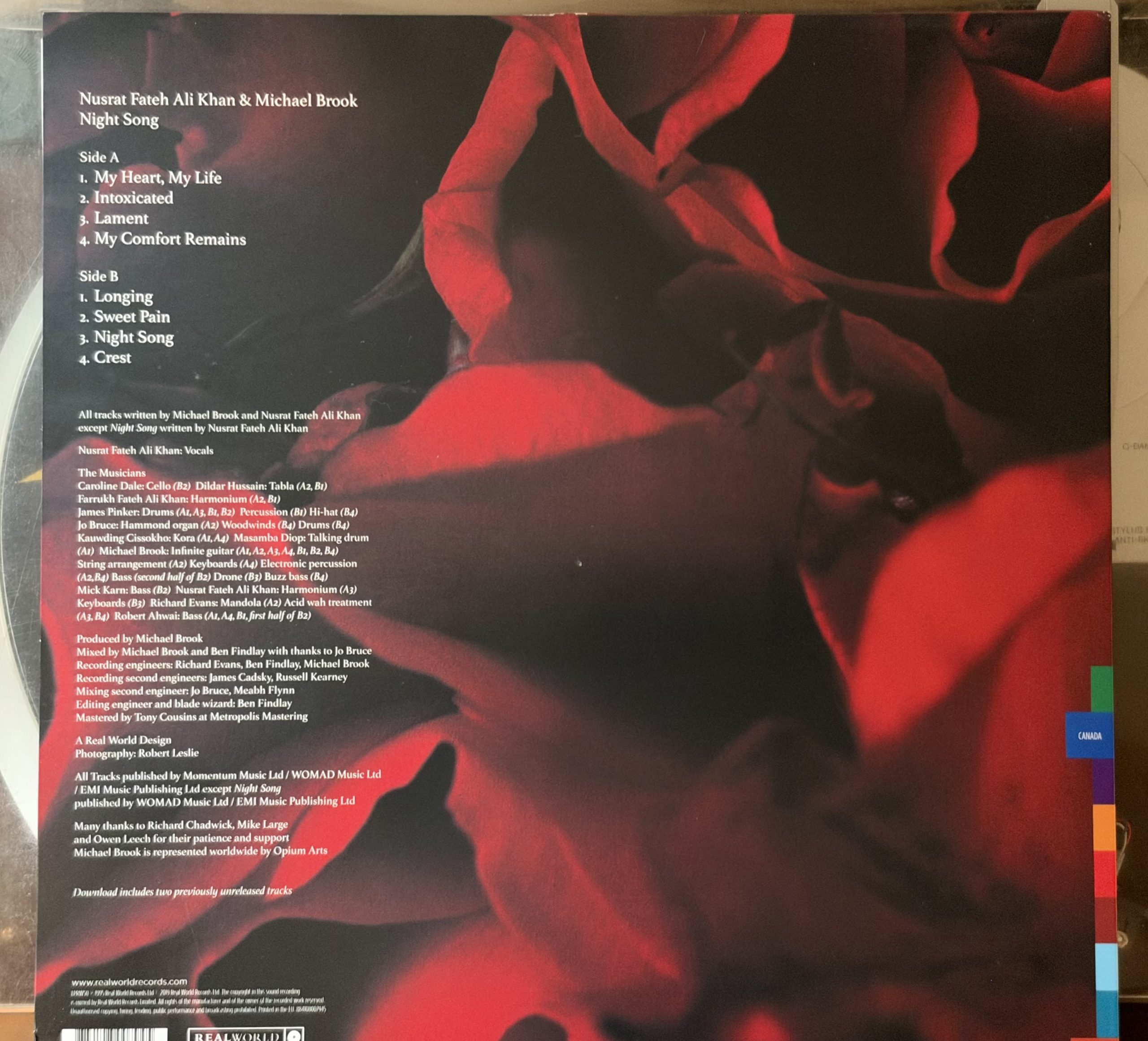
Nusrat Fateh Ali Khan, Mustt Mustt

A legendary collaboration between the great singer and ambient artist Michael Brook that gave traditional qawwali music a new beat.

Album of the Week, July 26, 2026

We’ve heard several albums by the great Pakistani singer Nusrat Fateh Ali Khan, featuring the hallmarks of the qawwali tradition: accompanied by harmonium and tabla plus a chorus, extended introductions, vocal improvisation, performances stretching anywhere from eight minutes to half an hour. We’ve also heard him in modern contexts collaborating with Peter Gabriel and others. But we haven’t heard his traditional work directly adapted for a wider Western audience. That’s where producer Michael Brook came in.

We met Brook last week, as the producer on Youssou N’Dour’s Set. But the Canadian guitarist had been in the music industry for years previously, working as an engineer at Daniel and Bob Lanois’ Grant Avenue Studio, where he worked with musical polymath Brian Eno, composer Harold Budd, and U2 guitarist The Edge, among others. It was during this period that Brook invented a kind of infinite sustain device that allowed an electric guitar to hold a continuously sustained note.1 Brook had a background in ambient music through his collaborations with Eno, Budd and Lanois, and his ideas for this collaboration with Nusrat were twofold: bring some hallmarks of modern music to Nusrat’s sound, and explore what happened if you slowed down the pace and allowed Nusrat to just explore sound rather than perform with his customary vocal pyrotechnics. At both, Mustt Mustt succeeds admirably.

Brook brought a handful of Western musicians to the session, including bassist Darryl Johnson (Neville Brothers, Lanois, Bob Dylan’s Oh Mercy), engineer David Bottrill (Peter Gabriel), and percussionist James Pinker (Dead Can Dance), but members of Nusrat’s party including Farrukh Fateh Ali Khan (harmonium) and Dildar Hussein (tabla) were there as well.

Mustt Mustt (Lost in His Work)” is a song of praise to the Sufi saints (“Upon my breath and in my intoxication is the great Qalandar…my worship and upon my breath is the great name Ali”) that is westernized with the interplay of Johnson’s bass and Brook’s guitar over the tabla and harmonium. What emerges is a mix of devotion and groove. It’s still fully recognizable as qawwali; Nusrat sets up the chorus, improvises vocally with the harmonium, unleashes strings of sangam syllables. But there’s that fat bass line throughout, interplaying with the tabla and harmonium to create something completely new. It’s also more concise than a traditional qawwali performance, thanks to Brook’s careful editing (though the liner notes indicate that Brook and Nusrat had to compromise on some of the edits so as not to affect the meaning of the traditional syllables).

Nothing Without You (Tery Bina)” starts with percussion first, then harmonium, again bringing rhythm to the traditional Qawwali forms. There’s more of Nusrat’s chorus here, and the tune is slower and more deliberate than it might be in a qawwali performance. Brook’s guitar is used to add small amounts of harmonic complexity while still keeping the song anchored in its traditional form.

Tracery” is where the ambient starts, with Brook and Johnson laying a gentle foundation upon which Nusrat builds up sound in dialog with himself just as the guitar builds up patterns on patterns in a hypnotic swirl. The liner notes observe that the form is complex, building on one cycle that has nine beats and another with eleven. Here Nusrat embraces the challenge, issuing vocal runs across the patterns. It’s a gorgeous collage of sound as Nusrat finds ways to bring more and more expressive vocal sounds into the mix.

The Game” begins with sustained guitar tones that yield to a Western rhythm courtesy of a drum machine pattern that Peter Gabriel contributed. Darryl Johnson lays down a bass line on the Moog and plays piano to build the melodic core of the backing track. Across all of this is Nusrat’s improvised vocal, combining runs of syllables with soaring vocal lines.

Taa Deem” is built from the interchange between Nusrat and his party on vocals over the harmonium, then with a complex rhythmic backing with Dildar Hussein on tabla, Michael Brook on the surdu, and James Pinker and Darryl Johnson on djembe. Brook also contributes some low searing guitar lines and the whole thing becomes a dark explosion of melodic interchange.

Brook and Johnson create a synthesized soundscape to open “Sea of Vapours,” against which Nusrat vocalizes low in his range. There’s no percussion, just multiple layers of drone. By contrast, “Fault Lines” builds from a hypnotic low vocal introduction into a rhythmic back and forth between a multitracked Nusrat and members of the party thanks to James Pinker’s percussion. There’s a wonderful bit at the end where all the percussion falls away and it’s just a gentle hint of Nusrat’s voice. “Tana Dery Na” feels like a continuation of “Fault Lines” on a simpler percussion line and with a more prominent guitar part, and with only Nusrat’s voice over the top.

Shadow” is just Nusrat and harmonium, an extended sangam improvisation. It serves as a sort of extended prelude to “Avenue,” a group live-in-studio jam with Brook’s guitar, Johnson on clay drums, Pinker on djembe joining the harmonium and tabla. The three percussionists lock in on a groove while Nusrat and Farrukh reinforce each other and the guitar adds ecstatic high notes. It fades out just as Nusrat finds a new vocal pattern to throw into the mix. Someday there’ll be an extended anniversary edition of this album that restores some of the longer bits from this session that were edited out; I’ll be first in line.

Unusually for 1990, the album ends with a remix track. “Mustt Mustt (Massive Attack Remix)” is a dub-style remix that suspends bits of the original track in reverb, heavy percussion and synthesized bass, courtesy of the legendary Bristol collective a year before they released their debut album.

No one had combined East and West in quite this way prior to the release of Mustt Mustt, and the use of tablas with western sounds became a pivotal moment for British music, opening doors for many more musicians to mix Asian inspiration with the dance floor. It also raised Nusrat’s profile even further and gave him a wider base of fans and admirers. We’ll talk about some of the folks he influenced in the future and hear more music from him. Next week, though, we’ll hear from another artist who got his first exposure to Western audiences through Gabriel’s Real World label.

You can listen to this week’s album here:

BONUS: Here’s a more traditional rendition of “Mustt Mustt” from WOMAD Yokohama in 1992. This is how I heard the work when I saw Nusrat and party perform in Washington DC in 1996:

Footnotes

  1. Brook made three Infinite Guitars: one for himself and one each for Daniel Lanois and the Edge. You’ve heard the sound of the Infinite Guitar on U2’s The Joshua Tree, including on “With or Without You.” ↩︎

Youssou N’Dour, Set

His second major label album finds the Senegalese superstar making uncompromising mbalax dance music that moves feet globally.

Album of the Week, July 18, 2026

When is a hit not a hit? In the world of the music business, having an album that tops a Billboard chart may not be enough to save you from the axe. Such was the fate of Youssou N’Dour’s contract with Virgin Records following the release of his second album for the label. Set, which sounded a note of support and positivity for the Senegalese Set-Setal movement, hit number one on the world charts but failed to generate a single that matched the performance of The Lion’s “Shakin’ the Tree.” That’s the bad news.

The good news is that in almost every way, Set is a superior album to Youssou’s major label debut. While produced by world music musician Michael Brooks (about whom more later), the musicians on the recording were almost entirely Youssou’s band, the Super Étoile de Dakar. Returning from the first album were Habib Faye on bass and keyboards, Pape Oumar Ngom on guitar, and Assane Thiam on talking drum; the rest of the band included Mbaye Dieye Faye on the sabar, Ibou Cisse on keyboards and guitar, Galass Niang on drums, and Thierno Koite and Issa Cissokho on alto and tenor saxophone. Daniel Lanois produced one track, adding a slightly more commercial note, but otherwise the album plays like music written for the streets of Dakar.

Set” starts things off with a bang, with the band delivering a guitar-led groove as Youssou sings about the desire for a clean slate, for the youth to be able to hope again. There’s a brief bridge in English: “Give me your hand, give me one chance to know what do you think for the future?” And there’s a tight horn section punctuating the final verses and the play-out. The whole thing is in and out in less than 3:50.

Alboury” is similarly tightly wound, but with the horns leading the charge this time and with shifts in meter driving the music forward. Youssou retells the story of Alboury Ndiaye, Buurba of the Jolof kingdom who led a rebellion against the French colonial powers in Senegal in the late 19th century before dying in battle against them in 1901. The music pivots from one motif to another with lightning speed, before speeding up to an epic finish.

Sabar” is a groove driven by guitar and talking drum as Youssou instructs the listener on how to dance the traditional sabar dance, which is accompanied by the sabar drum. It’s a cool little moment, a snack of a song, and you’d like to hear it go longer, but Youssou has other matters on his mind. “Toxiques” is clearly meant to be the single, with Daniel Lanois producing together with the UK DJ crew Coldcut. It’s a pointed political protest song: “Rich countries make toxic waste/Why should they send it to me?/Poor countries know toxic waste/ Why should they accept it?” There’s definitely a groove here, but one sees why the song wouldn’t get a lot of airplay in the European or American markets, unfortunately.

Sinebar” is a joyous, brisk song warning the listener about the dangers of illicit substances. I don’t know if we can trust the tone of the translation but it seems intended as humorous: “The breeze from the sea/Makes me feel hot rather than cool/I cannot even enjoy/Being with my girlfriend/And I’ve been wearing the same clothes since Sunday/Au secours, SOS.” Again interesting to hear how the musicians play against the meters laid down by the percussionists, veering from a strict 4/4 to an extended meter-blurring introduction in the keyboards to a punchy horn part. Youssou’s wordless chorus in which he sings along with the horns is infectious, and this is one where I tend to sing along regardless of my lack of knowledge of Wolof.

Medina” is a song of praise to the cradle of Islamic faith, over a gentle keyboard and percussion groove with a killer hook in the alto sax. It’s another short one, just over three minutes, and feels like a lead-in to the faster “Miyoko,” even though the latter song only runs about 20 seconds longer. The difference is in the punchy horn charts. The song is dedicated to the Japanese photographer Miyoko Akiyama, who documented Youssou’s tours of Japan and served as his business representative there. Those are her photos on the album cover and in the liner notes.

Xale (Our Young People)” puts Youssou’s vocals over the Kreisler String Orchestra, in an arrangement by Habib Faye. It shouldn’t work as well as it does, but the strings really dig into their parts, playing gnarly harmonies against the sinuous vocal melody. Youssou’s lyrics urge the young folks of Senegal to take control of their own destinies and start to contribute their own ideas for the improvement of their country.

Fenene (Another Place)” is a straightforward love song (“If you really love me/Come away with me/To a place/Where we may be at peace”) set to a jubilant arrangement. Opening with a strummed guitar chord, a brisk talking drum pattern and Youssou’s amazing vocals, the body of the song is built up with the horn section and bass locking in together on a tight groove as Youssou sings the verses above. We get to observe one of his distinctive vocal talents in action on this song, as the phrasing for each line of the verse is completely different, seemingly decided in the moment. For me, this is the one arrangement on the album that feels like it gives the right amount of time to the song; nothing feels rushed and you’re left feeling somewhat breathless when the talking drum ends.

Fakastalu (Watch Your Step)” is the closest to an American pop song on the album, what with the restrained backing synths and what is either an uncredited accordion or a very good accordion sound on the synth, as well as Youssou’s simpler singalong performance on the vocals. Were it not for the talking drum and the Wolof lyrics, we might be in an REM song, which might explain why I put this one on a mix tape back in the day (one whose anniversary is coming up; I sequenced it on July 28, 1992, preceding the song with “Simple Twist of Fate” and following it with “King of Birds”).

Hey You!” continues the general vibe of “Fakastalu” with similar instrumentation, but in service of a relative rarity: a Youssou break-up song. There’s the anguished sounding bridge: “Hey you! Hey you you! Where is Ami? / She’s no longer my girlfriend / For all I know she has found / Someone else who makes her happy.” If you don’t speak Wolof it comes across mostly as a chill out tune, with only a little extra grit in Youssou’s vocals to surface the emotional subtext.

One Day (Jaam),” by contrast, wears its emotional message of peace for the whole world, including peace between humans and animals, on its sleeve. The arrangement stacks a series of keyboards, from a slightly tinny sounding acoustic piano setting to a more convincing Hammond B3 soundalike to more 1980s synths, atop Habib Faye’s bass, insistent percussion, and horn blasts on the chorus. Youssou sings the “one day” part of the chorus in English atop a vibrant talking drum part, giving American listeners just enough of a hook to grab hold of and try to sing along with. The song comes to an end with a descending vocal line that ends with a cappella harmonies, showing off a casual virtuosity right to the finish.

As mentioned above, Youssou was dropped by Virgin Records after this album, but that was hardly the end of his career. He signed with Spike Lee’s 40 Acres and a Mule Musicworks label (an imprint of Columbia Records) and issued the great Eyes Open in 1992, followed by The Guide (Wommat) in 1994. The latter contained his greatest hit, the duet “7 Seconds” with Neneh Cherry, which hit Number One in the Europe, UK, Italy, France, Iceland, and other charts. In 2004 he released Egypt on Nonesuch Records, an album that honored and incorporated music from Mouride Sufism as a statement of solidarity with his religious background. The album was honored (he won his only Grammy award for it) and controversial: recorded in 1999, its release was delayed due to the September 11, 2001 attacks, and some Islamic listeners criticized the record for its perceived combination of Islamic and pop music. Youssou continued to record and even spent a year as Senegal’s Minister of Tourism. He’s now on his own label and showing no signs of slowing down.

We won’t hear another Youssou record, alas—aside from an unobtainable European vinyl release of The Guide, there haven’t been any subsequent album releases on vinyl. But next week we’ll hear another album that crossed over Islamic traditions and pop music, with startling results.

You can listen to this week’s album here:

BONUS: The CD version of Set featured a bonus track, “Ay Chono La”:

BONUS BONUS: A period music video for what seems to be an older version of “Alboury,” complete with soldiers on a train, an unsmiling Habib Faye, and a dance-off:

BONUS BONUS BONUS: There are a lot of longer versions of “Sabar” out there; this one, from a 1991 Earth Day performance in Tokyo, gives an idea of the dance and of some of the wildness left off the record. It’s a must-watch:

BONUS x4: Youssou is still out there performing. Here’s “Sinebar” from 2024. Youssou’s pipes are still impeccable even if his footwork is a little less fleet: