Album of the Week, October 24, 2026
I make mix tapes. I have since I was a teenager. We might call them mixes or playlists now—or “radio shows” when I’m doing something with Exfiltration Radio—but fundamentally they’re mix tapes. And making mix tapes carries with it a certain mindset. First, song order matters. Second, surprise is good. And one of the ways to surprise the listener is to take an artist they’ve heard and find a song by them they’ve never heard before. That’s why I have always loved b-sides and soundtracks; they tend to be places that these extra songs show up. And sometimes they’re really great in their own right.
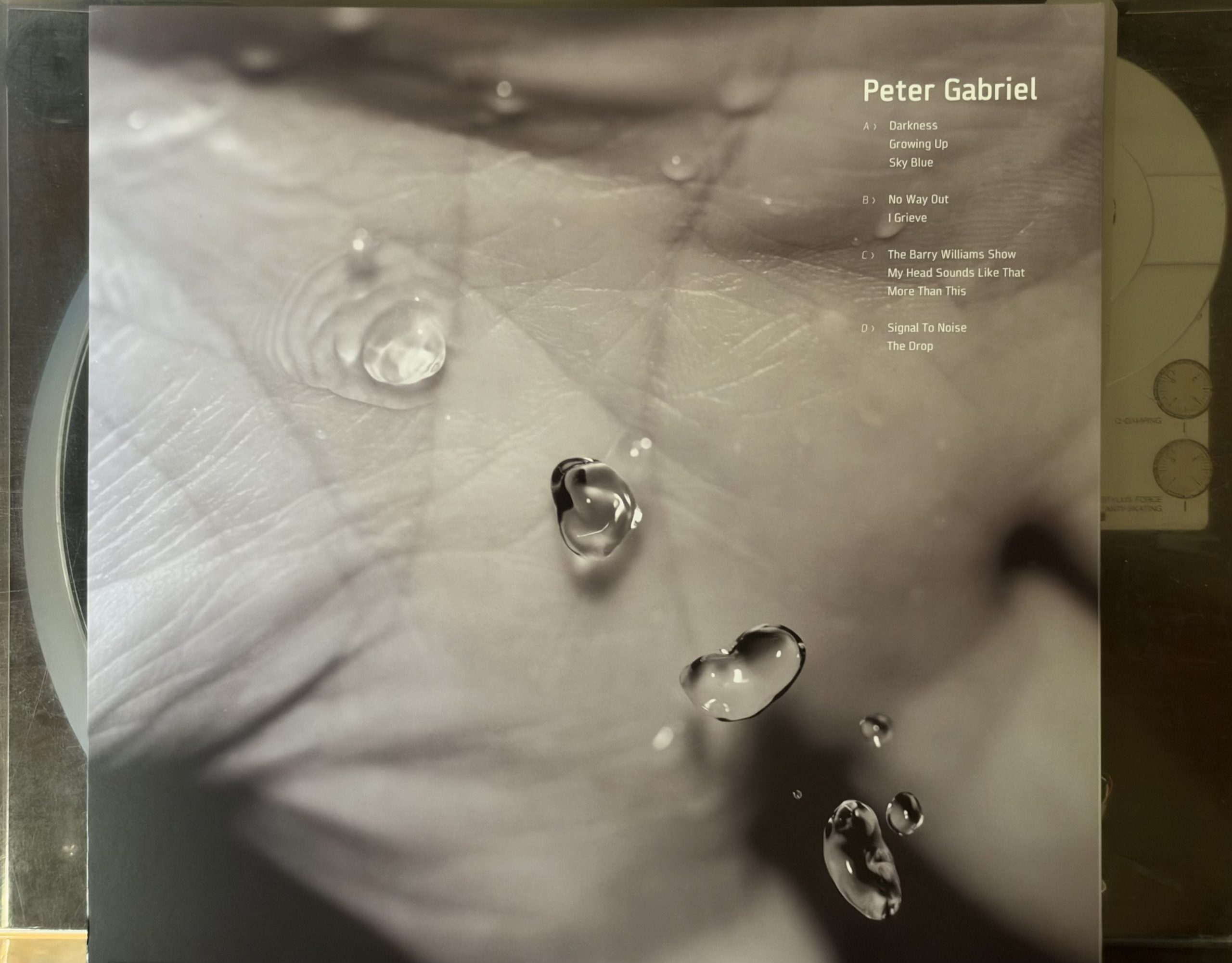
By the same token, I’m ambivalent about collections of these things. Often they’re a great way to find songs that I missed out on the first time around, but they also make that special song that I hunted for ever so slightly less special, since it’s easier to find. On the whole, though, I love that Rated PG, Peter Gabriel’s 2019 compilation of loose tracks made for movie soundtracks, exists, because it shows a lighter side of Peter’s writing and performing, and because there are some great songs on here.
Peter’s “That’ll Do,” written for the movie Babe, is an affectionate song about a pig that learns to herd sheep. (Yes, really.) I remember sitting upright in surprise in my bachelor living room, watching the movie on cable with friends and realizing who was performing the closing credits song. “That’ll Do” is on the sentimental side of Peter’s repertoire, with both Paddy Moloney of the Chieftains on pipes and the Black Dyke Band (who featured on “Father, Son”) providing the traditional brass band contributing to the overall effect. The instrumentation may be traditional, but no one is dialing anything in here; Gabriel’s vocals are as moving as anything in his catalog, and the brass band arrangements are gorgeous without being maudlin or clichéd. It sounds funny to say it, but while this track isn’t in my top 10 PG songs, it might make the top 20.
By contrast, “Down to Earth,” the other relatively well-known song from a famous movie, leans into the loose and joyous. The closing credits song for the 2008 Pixar film Wall-E, “Down to Earth” opens as a vocals and keyboards performance, with Peter doing some of his best R&B style on the verse, but the chorus opens up in technicolor, with chorus vocals and a shift into a brighter key. The long bridge and final chorus feature the Soweto Gospel Choir, a group that formed in 2002 and which numbers among his rare world music collaborators who never recorded on Real World. The chorus is a burst of singalong optimism that is notable even among Peter’s run of optimistic loose singles in the 2000s (see: “When You’re Falling” with the Afro Celt Sound System, “Whole Thing” from the Big Blue Ball sessions, the amazing cover of Vampire Weekend’s “Cape Cod Kwassa Kwassa” with Hot Chip1).
“This Is Party Man” is that rare creature, a co-write; credited to Peter, George Acogny and the brilliant Tori Amos, it’s technically a collaboration between Peter and The Worldbeaters, the vehicle for producer/guitarist George Acogny. It’s in service of the 1995 Denzel Washington vehicle Virtuosity, and it’s a great song with a singalong chorus, and a rare example of PG output from the years between Us and OVO.
Peter’s version of “The Book of Love” has a complicated history. A cover of Stephin Merritt’s standout track from the Magnetic Fields’ 1999 triple album 69 Love Songs, Peter recorded the cover in 2004 for, of all things, a Jennifer Lopez/Richard Gere film, Shall We Dance?, in a memorable scene that makes one nostalgic for the days that shopping malls mattered. The cover version is moving, if a touch heavy on the strings, and showcases the versatility of Gabriel’s voice in a ballad setting. It later appeared in the same arrangement on his 2010 orchestral covers album Scratch My Back.
On a completely different front, “Taboo” takes the wilder, more violent sounds of the Passion soundtrack and fast forwards them to the modern day. Appearing the most violently unforgivable scene from Oliver Stone’s 1994 film Natural Born Killers, the otherwise instrumental track features a pyrotechnic vocal improvisation from Nusrat Fateh Ali Khan, whose music deserved a better cinematic exposure.
“Everybird” is positioned as a new song on the album cover sticker, and it was never released outside its appearance in the 2017 animated movie Birds Like Us. While the song is a little less uptempo than some on this collection, the arrangement, which moves Peter’s voice against a hypnotic set of backing vocals (possibly from his daughter Melanie?), is gorgeous.
“Walk Through the Fire” is one of the oldest songs in the collection. Written for the 1984 movie Against All Odds—and what a Genesis reunion soundtrack that was, featuring not only Phil Collins’ chart-topping, Grammy-award-winning title song but also Mike Rutherford’s very ’80s “Making a Big Mistake”—the song is one of a set of songs that bridged the gap between the art rock of Security and the artsy pop of So. While this track has its moments of ’80s flashback—notably the percussion sounds, which date from a then-state-of-the-art drum machine—the song’s vocals are prime Gabriel, especially the chorus and the interplay between the hypnotic marimba-like synths and Tony Levin’s bass.
“Speak (Bol),” for the 2013 film The Reluctant Fundamentalist, is an odd hybrid of a song, with one of Peter’s straightforward ballads in the verse and a massive drum and orchestral swell in the pre-chorus, followed by a few moments of vocalist Atif Aslam singing in Urdu. The overall effect is a bit like a Pakistani dance party interrupting a VH1 acoustic concert, but in a good way.
“Nocturnal” is from the 2002 French film Les Morsures de l’Aube, which is obscure enough to not rate its own Wikipedia page, but is slightly better known under its English title Love Bites.2 The song’s arrangement blends Up-era guitars and beats with a typical mid-tempo Peter Gabriel ballad, and perhaps the best opening lyric of his late period: “I dream of birds, birds without wings / Children who grew up to be dangerous things.” The song lyrics appear to be about releasing homing pigeons at night, but it’s unclear what connection this has to the story. All in all, it’s definitely a lesser effort from Peter.
The same certainly can’t be said about the final track in the collection. “In Your Eyes” wasn’t especially well known to the broader public—though released as a single, it didn’t receive nearly the airplay of “Sledgehammer” or “Big Time” and was mostly known by the fans who bought and memorized the entirety of So—until its appearance in the John Cusack classic Say Anything… made it iconic to the average listener. The version used here appears to be a new edit—it trims some of the pre-chorus, makes some odd cuts in the chorus, and changes some of the backing instrumentation, as well as the timing of the Ronnie Bright bass “in your eyes” utterances, then attaches the “accepting all I’ve done and said” tag at the end… an interesting and unique version of a song that already has a lot of remixes floating around out there, but at least it’s not just the album version, and it certainly earns its place as Peter’s most memorable movie soundtrack song.

And so we end our survey of Peter’s recorded output… for now. I’m sure at some point I’m going to circle back around to his discography—I’ve skipped a few stellar live albums as well as his two last studio albums, and there’s a wealth of b-sides to write about as well (if you put his 2019 digital-only release Flotsam and Jetsam on vinyl, it would run to about eight LPs worth of material). But it’s getting to be time to change gears… after next week, when we listen to one more Real World record to close out this series that has covered both Peter and his collaborators.
You can listen to this week’s album here:
BONUS: Even omitting Peter’s soundtracks (Birdy, Passion, The Long Walk Home), this collection doesn’t catch every PG soundtrack cut. Among the notable exceptions: Peter’s contribution to 1993’s Philadelphia, “Lovetown” (omitted because it was collected on his 2002 greatest hits compilation Hit)…
BONUS BONUS: … and his contribution to the 1984 Gremlins, “Out Out,” presumably omitted because it’s very 1980s:
BONUS BONUS BONUS: Okay, I can’t resist. Here’s that scene from Say Anything with John Cusack and the boombox and “In Your Eyes”:
BONUS X 4: I didn’t realize that Peter’s collaboration with Deep Forest, a French band who originally rose to prominence with a record that sampled field recordings of the Efé peoples of the Congo, otherwise known as the Pygmy (and then immediately became ensnared in copyright and attribution arguments about sampling indigenous peoples), was a movie soundtrack song too, but it appeared in the 1995 sci-fi film Strange Days. This one comes with copyright questions as well, with Deep Forest citing the sample as a Bulgarian folk song and a Macedonian writer claiming it as an original song. Either way, it’s an odd note in Peter’s discography:
BONUS x5: This is an odd one. Peter wrote a song for Oliver Stone’s 2016 film Snowden, and it’s quite on the nose in its discussion of espionage and digital secrecy:
BONUS x6: Okay, okay, one last one, and this is a doozy. Peter’s first solo release was not 1977’s Peter Gabriel album; it was this very earnest cover version of the Beatles’ “Strawberry Fields Forever,” which appeared on the soundtrack to the film All This and World War II. There’s nothing wrong with the production here, but Peter’s voice has some interesting characteristics at this early point. Specifically, and I’m sorry for making the observation because you won’t un-hear it, but there are moments where he sounds exactly like Kermit the Frog. You’re welcome.
Footnotes