
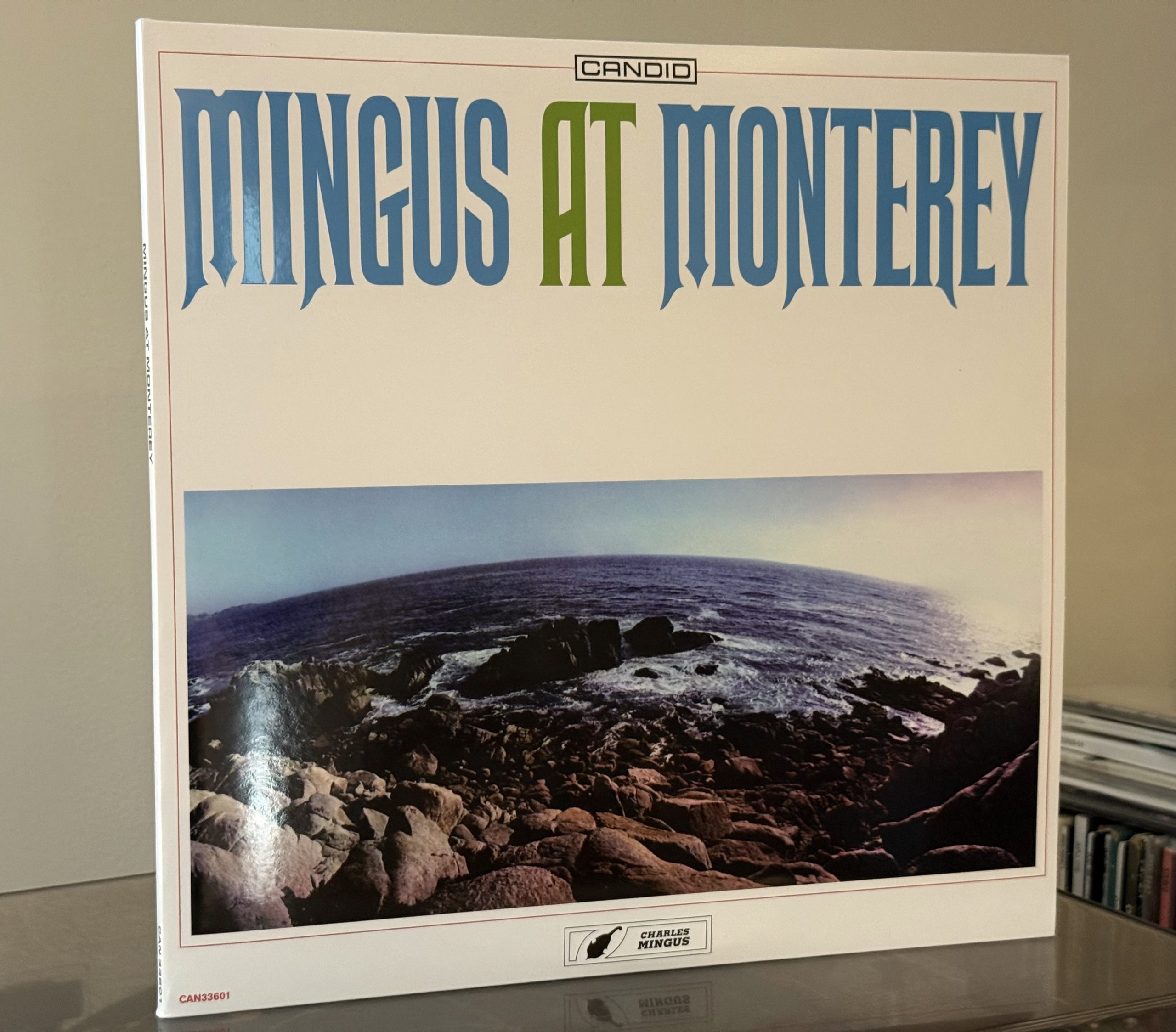
Charles Mingus, Mingus at Monterey

From Mingus’s golden year, a spectacular live set with something old, something new, something borrowed, and something blue.

Album of the Week, February 7, 2026

Last week we witnessed Charles Mingus solidifying his place in the pantheon with an album that realized some of his greatest compositions with definitive performances (and contractually required placeholder titles). As we noted, Mingus Mingus Mingus Mingus Mingus marked the reunion of the great bassist and his avant-garde compatriot Eric Dolphy. Mingus took the band on tour to Europe; Dolphy stayed there and died in a diabetic coma.

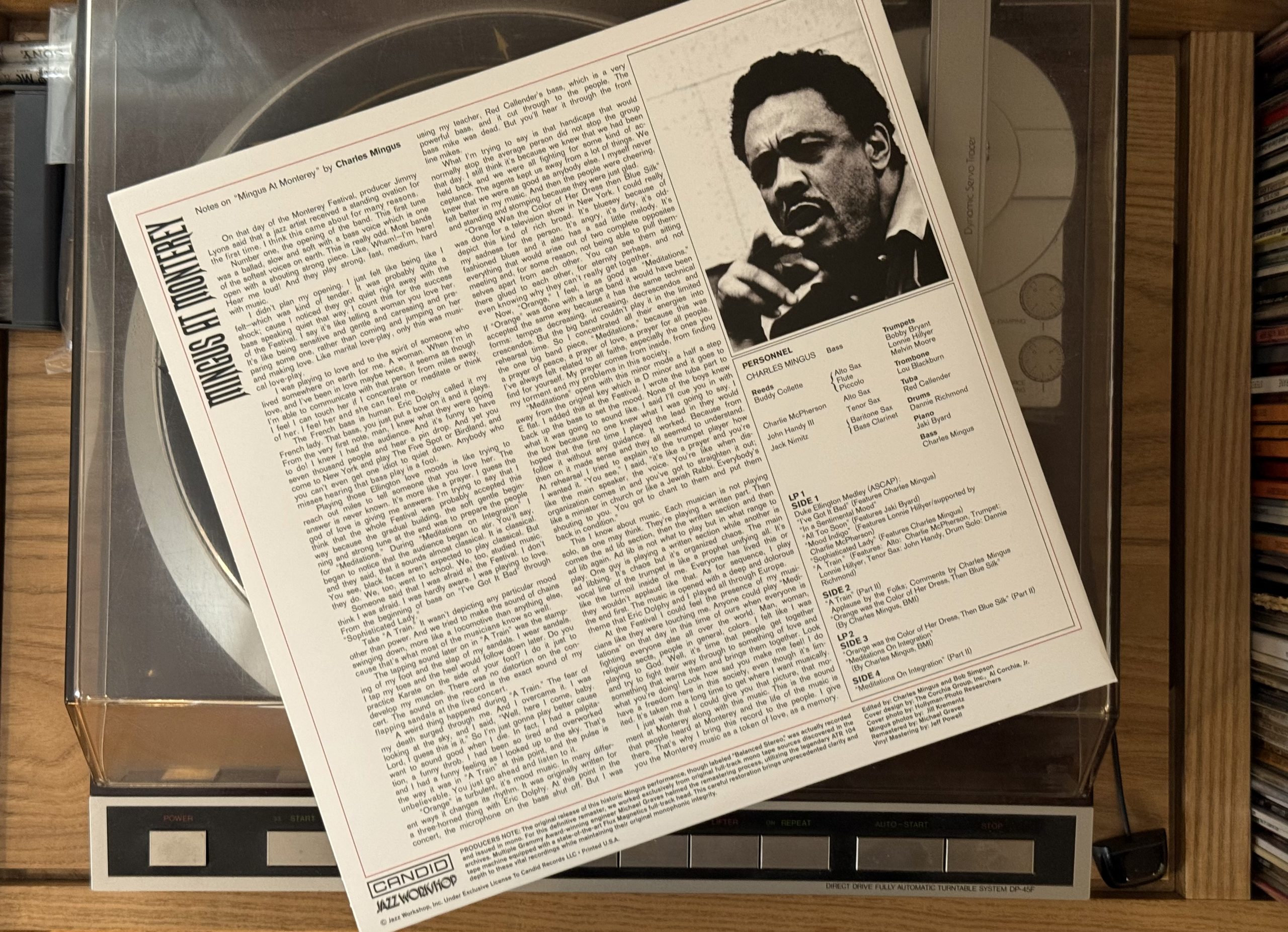
Given these facts, one could forgive Mingus for falling back to the familiar and focusing on that “greatest hits” repertoire, or from pulling back from touring and performing. Fortunately for us, the way Mingus dealt with challenges was to work and to create. His performance at the Monterey Jazz Festival on September 20, 1964 captured him doing both, with a band that had a rhythm section of Mingus stalwarts (Jaki Byard, Dannie Richmond) and a horn line consisting of Lonnie Hillyer on trumpet, Charles McPherson on alto and John Handy on tenor; Handy, an old Mingus band hand, rejoined at the last minute after Booker Ervin was hospitalized. For the last number, the band expanded into a big band formation, with Bobby Bryant and Melvin Moore on trumpet, Lou Blackburn on tuba, Red Callender on trombone, Buddy Collette on flute, piccolo and alto, and Jack Nimitz on bass clarinet and baritone sax. The performance gives us something old and borrowed, something new, and something blue (and orange).
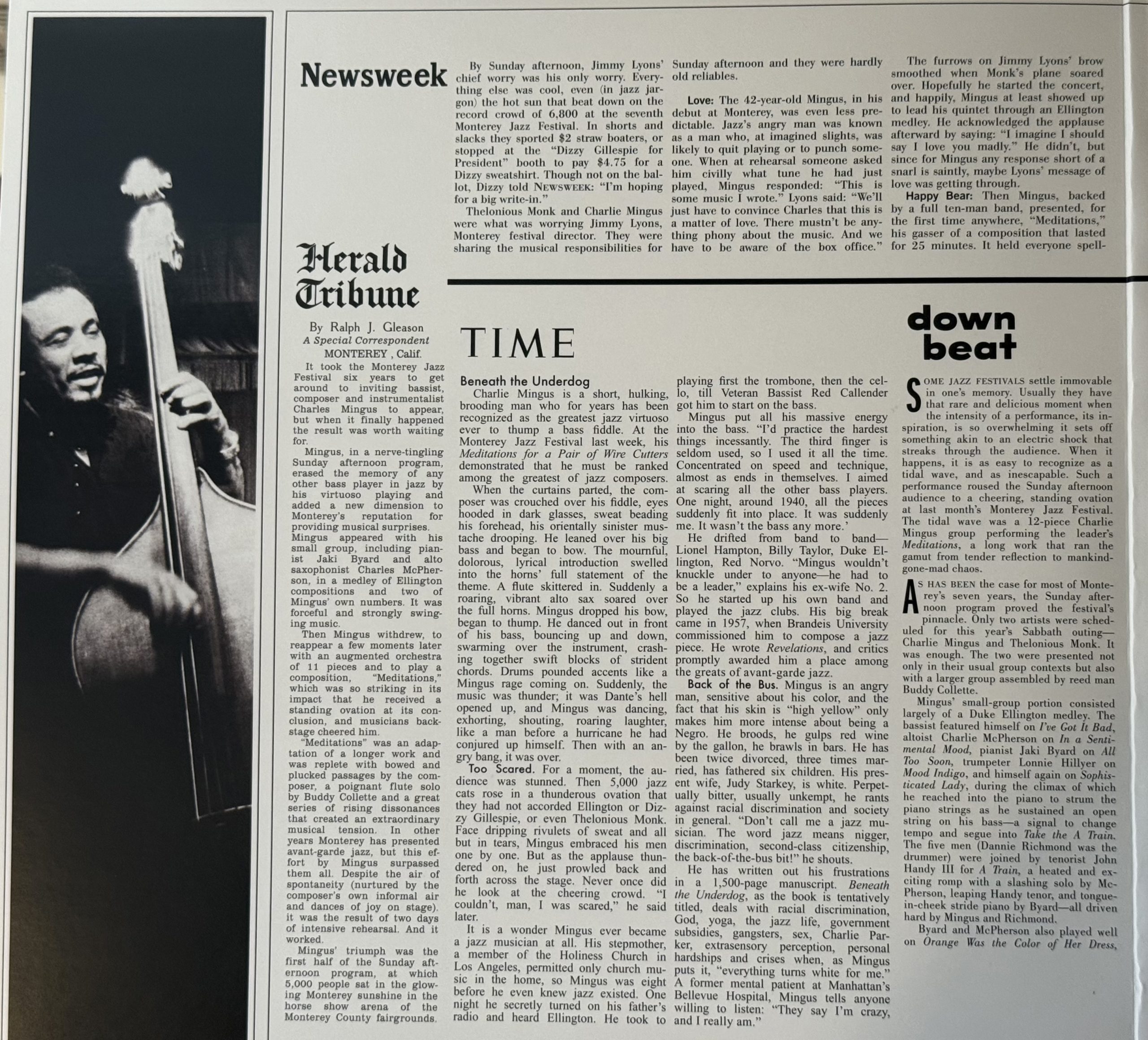
The “Ellington Medley: I’ve Got It BadIn a Sentimental MoodAll Too SoonMood IndigoSophisticated LadyA Train” is our “old and borrowed” segment, continuing Mingus’s exploration of the compositions of his inspiration, one-time boss and sometime sparring partner Duke Ellington. The band is relaxed; there’s a little stage chatter before Mingus takes a solo intro to “I’ve Got It Bad” with sparse accompaniment from Jaki Byard, and sensitive solos from McPherson and Byard. One Ellington classic flows into the next, all commented on from Mingus’s bass.1 Until, with a sudden break, we are taking the A Train. The band is jubilant to the point of almost unhinging, particularly Lonnie Hillyer’s imaginative trumpet and Handy’s tenor (the only shortcoming in the live recordings: the tenor saxophone is somehow overpowered by Byard’s piano). At the end there’s an unaccustomed solo from Richmond, showing that not only was he frequently the glue that held the adventuresome band’s performances together, but he could also blast a mean drum solo. The end dissolves into almost-dissonance, the band gasping over the final diminished chord. To the enthusiastic applause of the crowd, Mingus notes, “I imagine I should say ‘I love you madly’ at this point… Because, ah, if there is a recording, all the money will go to Duke Ellington, which is about due him; I’ve stole enough.”

Mingus announces “Orange Was the Color Of Her Dress, Then Blue Silk”; it’s a blues introduced with a shivering run in the bass over a stride influenced piano line. The trumpet and alto state the tune (Handy, from Mingus’ announcement, sat this one out because he had only had one day to learn the material!). Then suddenly we’re leaving the blues behind, falling into a woozy delirium that improvises on the chords and promptly lands us right back into the blues. McPherson’s solo continues to explore the tune in free time, but always coming back to the blues at the end, stretching the twelve-bar form to untold lengths. Byard’s statement anchors firmly in stride and the gospel blues, with the band smearing glissandi and shouting behind him, until everyone drops out and he plays something closer to a sonata. The kaleidoscope shifts again; Hillyer is here with something halfway between New Orleans and the Village Vanguard, then the band returns to that stretched out blues once more, leaning into it until the penultimate bar stretches out the seconds, finally turning into an unresolved sigh. (On the two record set, the composition splits between the back half of Side B and into the first half of Side C.)

Mingus announces “We’ll be back with more musicians,” and with the full band on stage launches into the arco solo that opens the premiere of “Meditations on Integration.” Out of a brief tune-up moment comes Mingus’ opening arco solo, sounding like a combination of the Beethoven 9 basses and the hora. The band enters with a busy line that Buddy Collette’s flute flies and darts above; McPherson’s alto answers with an anguished cry above the ongoing Stravinskyan rhythm of Mingus, Richmond and Byard and the stabs of horns from the rest of the band. Things threaten to dissolve into formlessness as Byard thunders on the low tonic and the band plays the chords of the melody in sequence, almost as choral interjections. McPherson returns to the melody as the band recapitulates the opening, rising to a chaotic crescendo out of which a duet of flute and low piano emerges. The band continues in this vein for some time, with Collette’s flute signaling turns in the melody and changes in the solo.

At almost 14 minutes into the tune there is a breathtakingly high bowed bass solo that sounds for all the world like a cello has appeared on the stage. Mingus plays a low stretto on the tonic and diminished supertonic as Byard speaks once more with moments of Liszt and Bud Powell; the duet between the two is an elegy from which Collette’s flute emerges once more, Ravel-like. A tremolo from Byard and rapt applause from the audience seem to signal another shift, but the interplay between Byard, Mingus and Collette continue until Mingus’s high shout calls Hillyer forward. The liner notes report a rehearsal conversation between Mingus and Hillyer, in which the composer tells him, “It’s like a prayer and you’re like the main speaker… Everybody’s shouting to you. You got to chant to them and put them back in condition.” And so the final portion goes, with the whole band hollering and Hillyer’s voice conjuring order forward. When the final chord comes, the audience gives Mingus a thundering standing ovation, the first in the entire history of the festival.
1964 was a career peak for Mingus; unfortunately, tough times were ahead. In 1966 he was evicted from his New York home; the only recordings to appear for the rest of the decade were older session recordings (Tonight At Noon, from 1957 and 1961 sessions for Atlantic records, is a classic) and live recordings from tour dates in Europe and America. That long drought would end in the early 1970s with a recording we’ll listen to next time.

You can listen to this week’s album here:

BONUS: Mingus’s tour of Europe with Eric Dolphy yielded early performances of “Meditations on Integration” and “Orange Was The Color of Her Dress, Then Blue Silk,” including this audio recording from the Salle Wagram in Paris on April 17, 1964:

  1. I believe one of the inspirations for Mingus’s bass technique is the contrabass recitative at the beginning of the fourth movement of Beethoven’s 9th Symphony. Like Beethoven’s basses, he was always observing the performance and the melody closely, and always, always opining. ↩︎

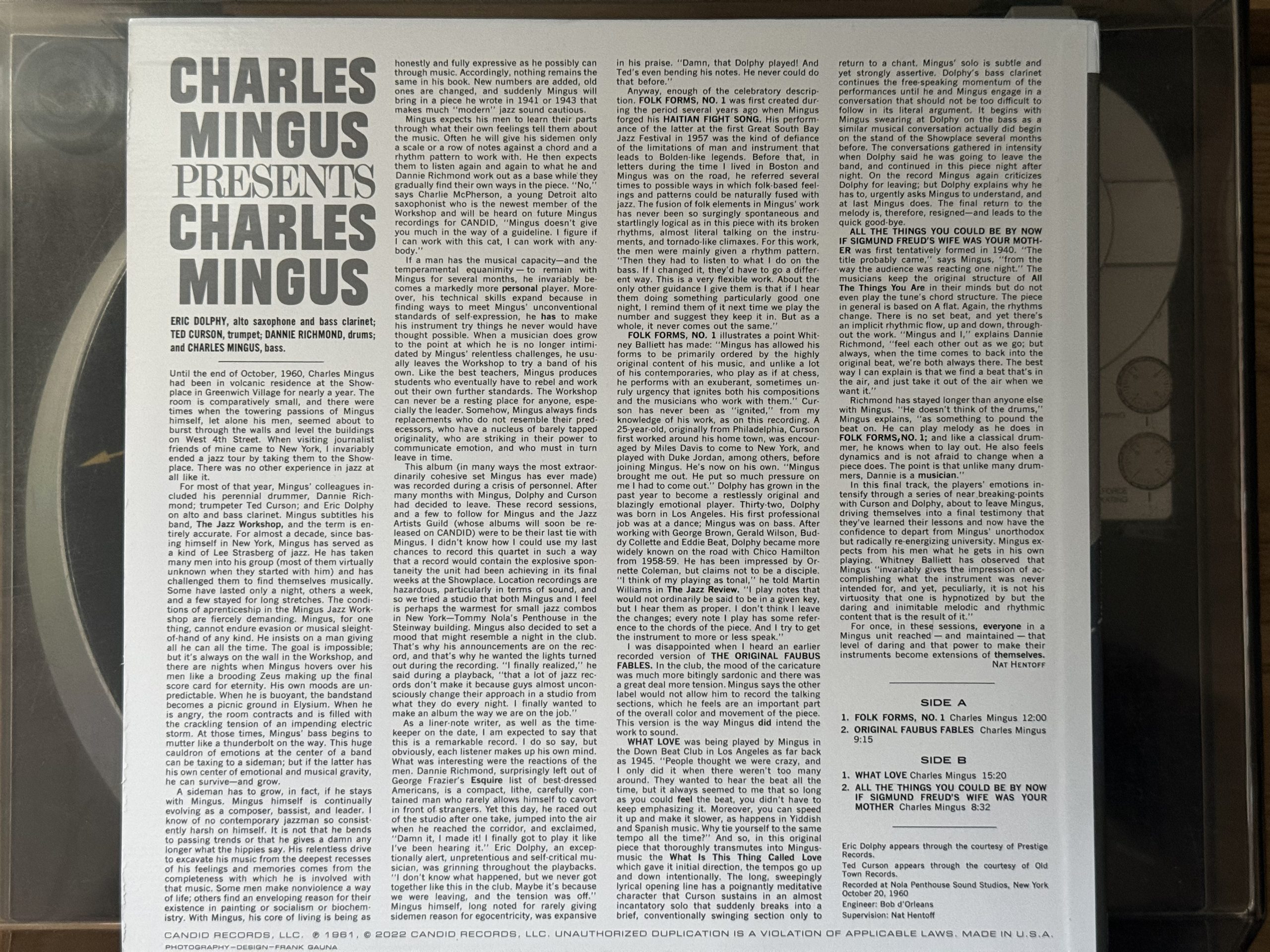
Charles Mingus, Charles Mingus Presents Charles Mingus

We begin our survey of the great bassist and composer in midstream, with a spectacular performance from the last days of one of his best bands.

Album of the Week, January 3, 2026

There is a danger, with larger-than-life musicians (or really any public figures), that you remember them as caricatures, not for the balance of what made them great but for the quirks that stand them out from the crowd. Such a figure is Charles Mingus, about some of whose albums we’ll write about for the next little bit. Undeniably a genius and a great composer and performer, it’s tempting to remember him for his rages1, for the impenetrability of his performances,2 and for his wild Epicureanism that launched such monuments of excess as his legendary eggnog recipe. As always, the curative is simple: let’s listen.

As I’ve lamented before, the scope of this series of posts about music is limited, by design, to the contents of my vinyl collection. If that were not the case, we might start with a different Mingus recording: Pithecanthropus Erectus, for instance, or certainly his 1959 masterpiece for Columbia Records, Mingus Ah Um. But neither of those records is on my shelf at present, so we’re going to start with a slightly unconventional choice, a record that Mingus made at a time when both Atlantic and Columbia were releasing his albums but that he chose to release on the small Candid Records label, to give a less filtered view of his work.

Candid, founded in early 1960 by parent label Cadence Records owner Archie Bleyer, had as its A&R director jazz writer and critic, and civil rights activist, Nat Hentoff. He sought out sounds that, to him, reflected the jazz of the dawning 1960s. The second album the fledgling label released was Max Roach’s milestone civil rights suite We Insist!; Mingus, Roach’s former rhythm section partner in Charlie Parker’s combo, released the fifth album in the series with a pianoless quartet consisting of multi-instrumentalist Eric Dolphy, trumpeter Ted Curson, and drummer Dannie Richmond. Though recorded in the studio in October 1960, Mingus sought to present the illusion that the performance was happening live in a nightclub, going so far as to introduce the first tune with the admonition not to applaud between tracks and to refrain from ordering food and drink during the recording. Generally speaking, his approach to the album (as indicated by the title) was to take control of the way his own music was typically presented to the public.

The first tune is titled “Folk Forms, No. 1;” the “folk form” in question is the blues. Mingus had a complicated relationship with the blues; he was clearly conversant with the form and the feel of the blues, but just as clearly resented the insistent demands that he play more blues and less of his own music.3 However he felt about it, this is a deep blues. Mingus starts the song solo, with a rhythmic figure in the bass that is slightly reminiscent of the opening to his great tune “Better Get Hit In Yo’ Soul.” Richmond follows him, listening to his rhythm and replicating it in snare and hi-hat. Dolphy follows with an essay at the melody, and Ted Curson plays a counterpoint to the melody; the two horns trade ideas and thoughts as though executing a complex fugue, but the lines are all improvised, the group turning on a dime as Mingus proposes different phrases and rhythms in his solos.

Original Faubus Fables,” a retitling of the 1959 “Fables of Faubus” for contractual reasons, is the most clear case of Mingus presenting his music the way he wanted it to be heard. The original version of the tune had lyrics that were highly critical of Arkansas governor Orval Faubus, who legendarily called out the Arkansas National Guard to prevent Blacks from enrolling in Little Rock High School following the 1957 federally mandated desegregation order. Columbia Records was legendarily cowardly about putting out any records that would offend the Southern buyer, and requested that Mingus present the song as an instrumental; this conflict and others possibly led to Mingus not extending his recording contract with Columbia beyond the two records released in 1959. The lyrics are not exactly epic poetry, but they resonate:

Name me someone who’s ridiculous, Dannie
Governor Faubus!
Why is he so sick and ridiculous?
He won’t permit us in his schools!
Then he’s a fool!

Boo! Nazi Fascist supremists!
Boo! Ku Klux Klan (With your Jim Crow plan)

Name me a handful that’s ridiculous, Dannie Richmond
Bilbo, Thomas, Faubus, Russel, Rockefeller, Byrd, Eisenhower!

Don Heckman has commented that Mingus doesn’t let his portrait of Faubus give the politician too much power; he keeps the music on a light, satirical level, poking fun at Faubus rather than demonizing him.

What Love?” is an original composition that approximately combines “You Don’t Know What Love Is” and “What Is This Thing Called Love?” Hentoff’s liner notes position this deep dark ballad as being inspired by a personnel crisis in the band; after many months together, both Dolphy and Curson had decided to move on from Mingus’ band, and Hentoff cites some of the melodic choices in “What Love?” as conversations between the bandleader and his saxophonist, alternately cursing the choice to leave and imploring him to stay. Dolphy plays some far-out music on the bass clarinet in this number in conversation with Mingus’s angry, imploring, and ultimately resigned pizzicato solo.

The final track, “All The Things You Could Be By Now If Sigmund Freud’s Wife Was Your Mother,” is a complete free-for-all, introduced by a complex melody played by both Dolphy and Curson in harmony before the trumpeter takes the first solo, followed by Dolphy, with Richmond banging things out underneath both. This performance shows Mingus at his most far-out. There isn’t much of his genius for melody or harmony here, just him and his three players going flat-out in a wunderkammer of improvisational magic.

Mingus’s many facets as a musician included the ability to collectively improvise with his band at the highest order, and …Presents Charles Mingus is a great example of that. But he might have been even more effective and innovative as a composer of longer works, and we’ll hear one of those next week.

You can listen to this week’s album here:

BONUS: This quartet doesn’t seem to have too many live shows recorded, but an expanded version of the band, adding Booker Ervin on tenor and the amazing Bud Powell on piano, played the Antibes Jazz Festival on July 13, 1960, five days before the quartet entered the studio to record …Presents…. It’s a monster of a live recording; here’s “I’ll Remember April” from the French TV presentation of the concert.

  1. Mingus was legendarily fired from Duke Ellington’s band in 1953 over a confrontation with trombonist Juan Tizol. Accounts differ as to what happened exactly; Mingus’s autobiography Beneath the Underdog claims Tizol impugned his musical abilities while using the N-word, while other onlookers claim Mingus was insulted when Tizol called him out for flubbing a note. It is pretty clear from all accounts, though, that Mingus rushed after Tizol with either a pipe or a fire axe in his hand. ↩︎
  2. Mingus premiered his major work Epitaph in 1962 at Town Hall in New York City to mixed reception. Again, accounts differ as to what happened, but poor sound at the venue and a general state of under-rehearsedness on the part of the band appear to have doomed the original performance. The concert was later released on Blue Note Records in the 1990s, when I was first expanding my jazz horizons; I thought it was pretty good. ↩︎
  3. In the liner notes to his 1960 Atlantic Records session Blues and Roots, Mingus noted, “This record is unusual— it presents only one part of my musical world, the blues. A year ago, Nesuhi Ertegün suggested that I record an entire blues album in the style of ‘Haitian Fight Song,’ because some people, particularly critics, were saying I didn’t swing enough. He wanted to give them a barrage of soul music: churchy, blues, swinging, earthy. I thought it over. I was born swinging and clapped my hands in church as a little boy, but I’ve grown up and I like to do things other than just swing. But blues can do more than just swing. So I agreed.” ↩︎