Charles Mingus, Mingus at Monterey

From Mingus’s golden year, a spectacular live set with something old, something new, something borrowed, and something blue.

Album of the Week, February 7, 2026

Last week we witnessed Charles Mingus solidifying his place in the pantheon with an album that realized some of his greatest compositions with definitive performances (and contractually required placeholder titles). As we noted, Mingus Mingus Mingus Mingus Mingus marked the reunion of the great bassist and his avant-garde compatriot Eric Dolphy. Mingus took the band on tour to Europe; Dolphy stayed there and died in a diabetic coma.

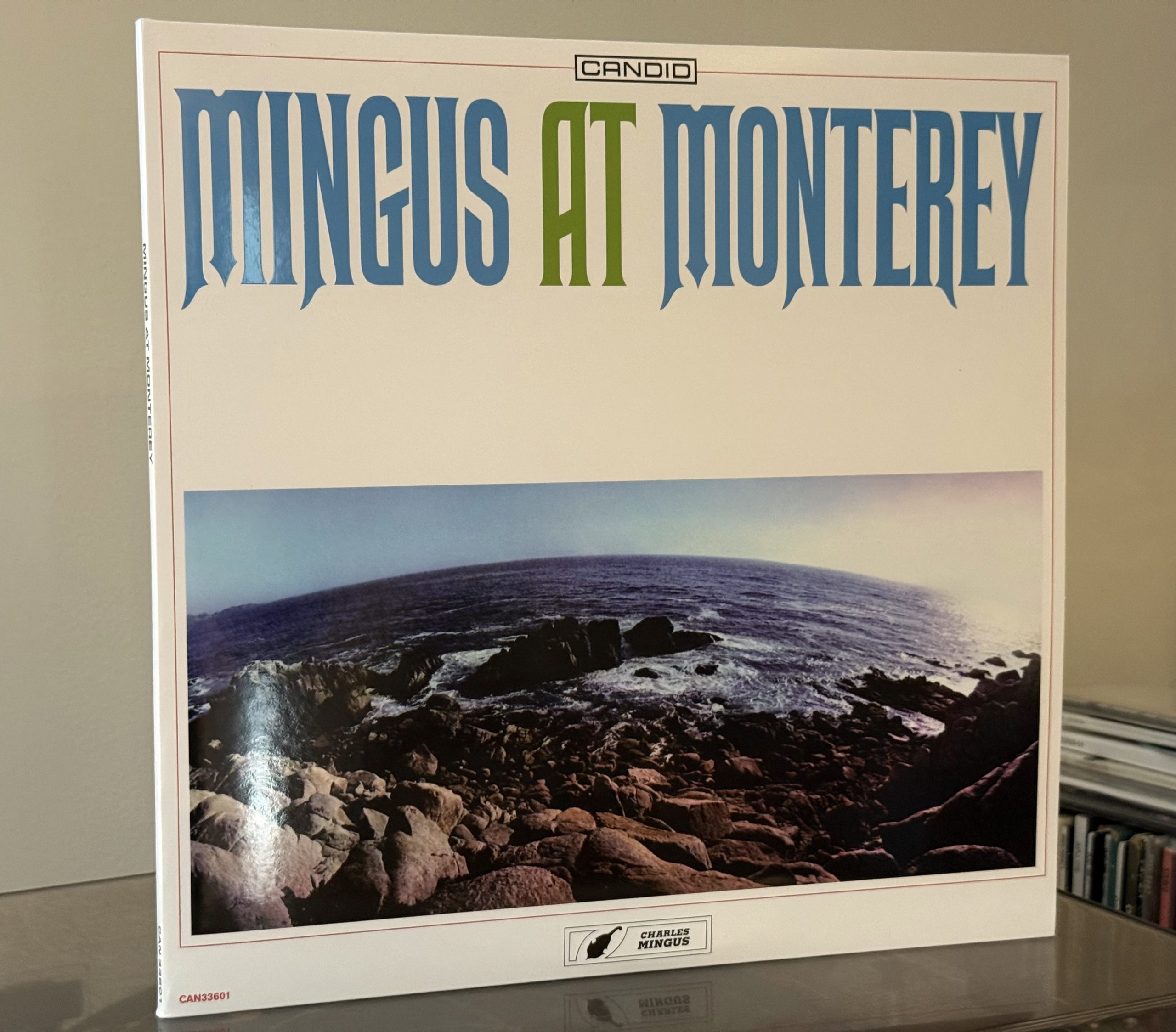
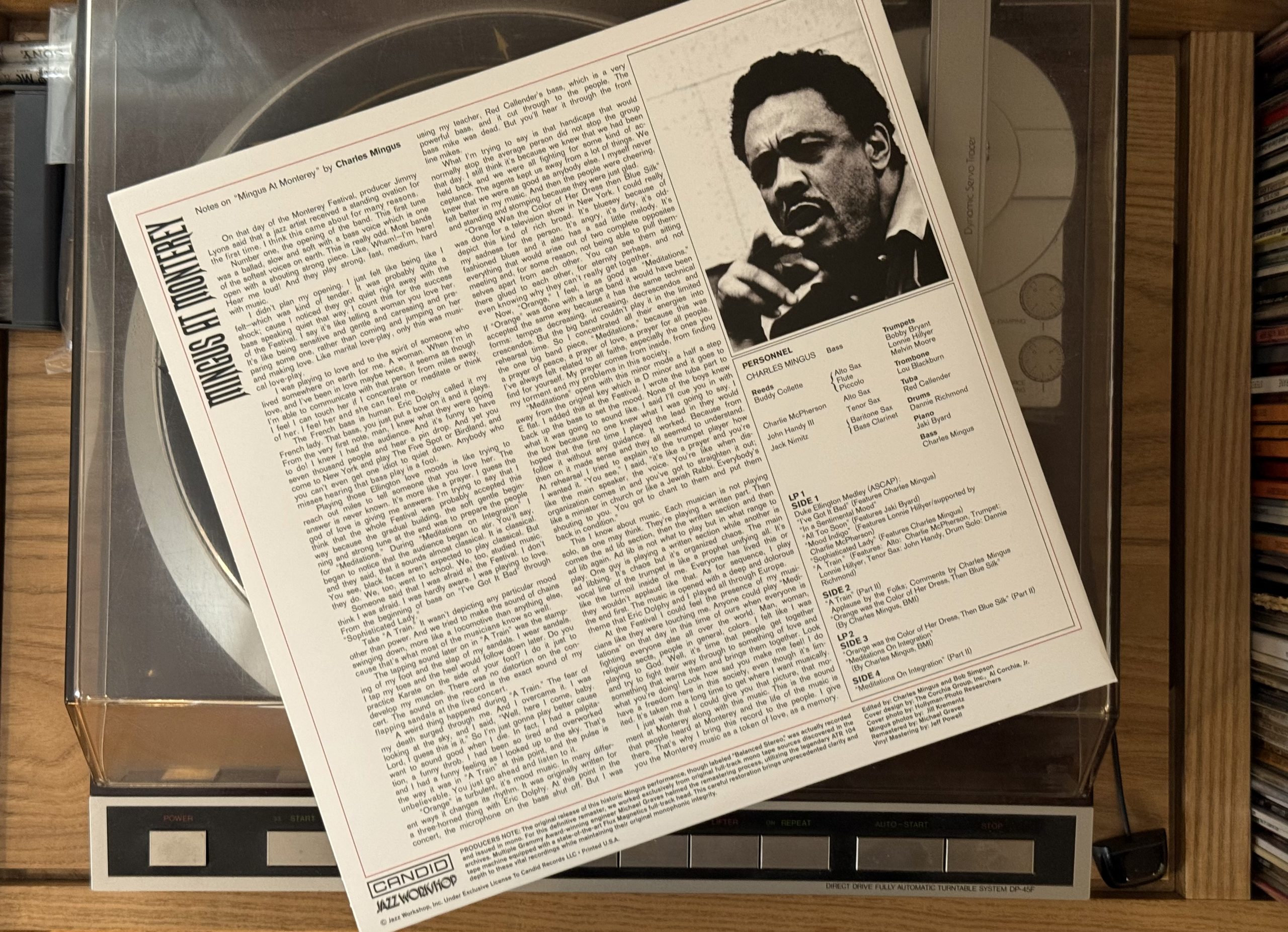
Given these facts, one could forgive Mingus for falling back to the familiar and focusing on that “greatest hits” repertoire, or from pulling back from touring and performing. Fortunately for us, the way Mingus dealt with challenges was to work and to create. His performance at the Monterey Jazz Festival on September 20, 1964 captured him doing both, with a band that had a rhythm section of Mingus stalwarts (Jaki Byard, Dannie Richmond) and a horn line consisting of Lonnie Hillyer on trumpet, Charles McPherson on alto and John Handy on tenor; Handy, an old Mingus band hand, rejoined at the last minute after Booker Ervin was hospitalized. For the last number, the band expanded into a big band formation, with Bobby Bryant and Melvin Moore on trumpet, Lou Blackburn on tuba, Red Callender on trombone, Buddy Collette on flute, piccolo and alto, and Jack Nimitz on bass clarinet and baritone sax. The performance gives us something old and borrowed, something new, and something blue (and orange).
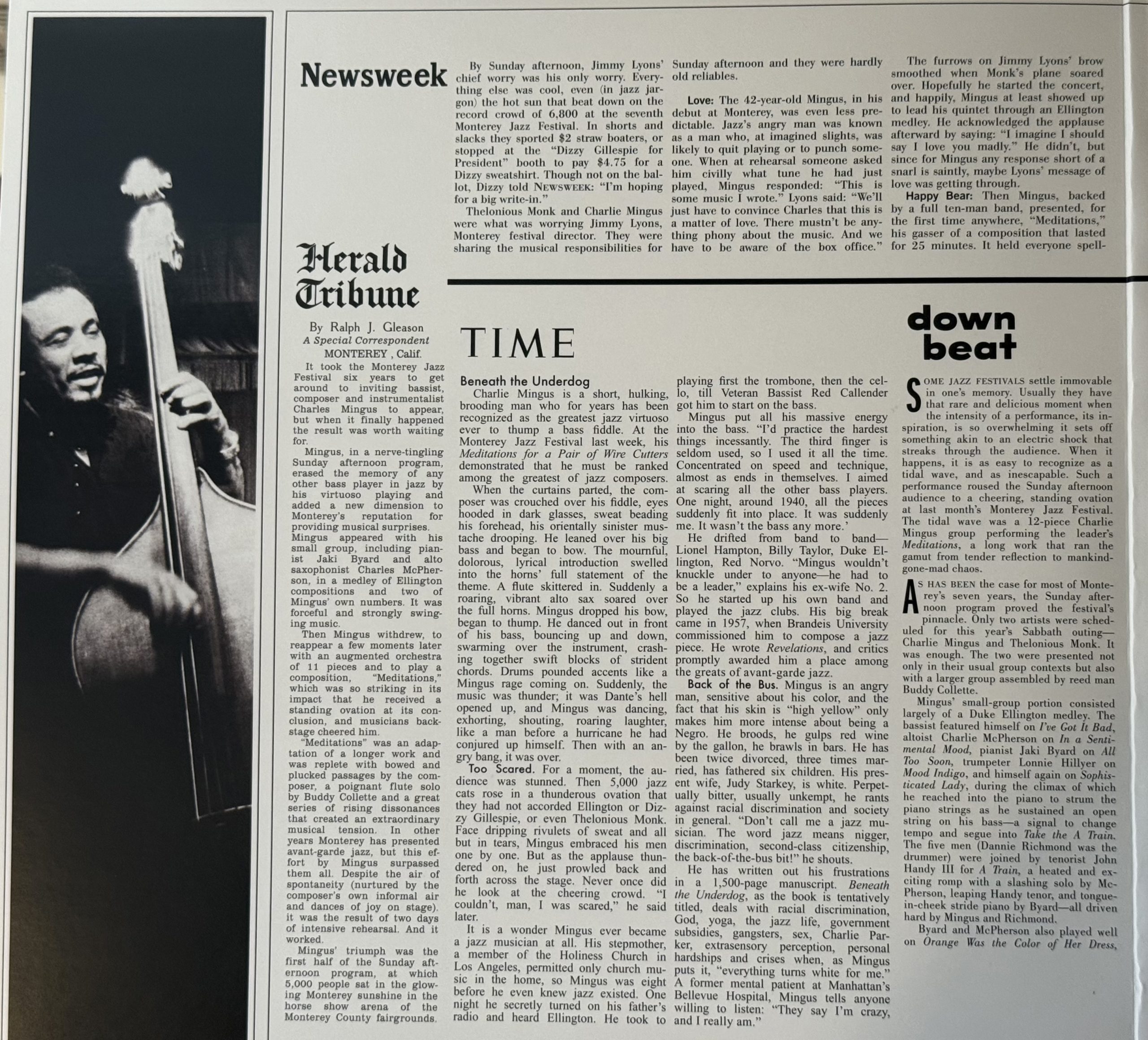
The “Ellington Medley: I’ve Got It BadIn a Sentimental MoodAll Too SoonMood IndigoSophisticated LadyA Train” is our “old and borrowed” segment, continuing Mingus’s exploration of the compositions of his inspiration, one-time boss and sometime sparring partner Duke Ellington. The band is relaxed; there’s a little stage chatter before Mingus takes a solo intro to “I’ve Got It Bad” with sparse accompaniment from Jaki Byard, and sensitive solos from McPherson and Byard. One Ellington classic flows into the next, all commented on from Mingus’s bass.1 Until, with a sudden break, we are taking the A Train. The band is jubilant to the point of almost unhinging, particularly Lonnie Hillyer’s imaginative trumpet and Handy’s tenor (the only shortcoming in the live recordings: the tenor saxophone is somehow overpowered by Byard’s piano). At the end there’s an unaccustomed solo from Richmond, showing that not only was he frequently the glue that held the adventuresome band’s performances together, but he could also blast a mean drum solo. The end dissolves into almost-dissonance, the band gasping over the final diminished chord. To the enthusiastic applause of the crowd, Mingus notes, “I imagine I should say ‘I love you madly’ at this point… Because, ah, if there is a recording, all the money will go to Duke Ellington, which is about due him; I’ve stole enough.”

Mingus announces “Orange Was the Color Of Her Dress, Then Blue Silk”; it’s a blues introduced with a shivering run in the bass over a stride influenced piano line. The trumpet and alto state the tune (Handy, from Mingus’ announcement, sat this one out because he had only had one day to learn the material!). Then suddenly we’re leaving the blues behind, falling into a woozy delirium that improvises on the chords and promptly lands us right back into the blues. McPherson’s solo continues to explore the tune in free time, but always coming back to the blues at the end, stretching the twelve-bar form to untold lengths. Byard’s statement anchors firmly in stride and the gospel blues, with the band smearing glissandi and shouting behind him, until everyone drops out and he plays something closer to a sonata. The kaleidoscope shifts again; Hillyer is here with something halfway between New Orleans and the Village Vanguard, then the band returns to that stretched out blues once more, leaning into it until the penultimate bar stretches out the seconds, finally turning into an unresolved sigh. (On the two record set, the composition splits between the back half of Side B and into the first half of Side C.)

Mingus announces “We’ll be back with more musicians,” and with the full band on stage launches into the arco solo that opens the premiere of “Meditations on Integration.” Out of a brief tune-up moment comes Mingus’ opening arco solo, sounding like a combination of the Beethoven 9 basses and the hora. The band enters with a busy line that Buddy Collette’s flute flies and darts above; McPherson’s alto answers with an anguished cry above the ongoing Stravinskyan rhythm of Mingus, Richmond and Byard and the stabs of horns from the rest of the band. Things threaten to dissolve into formlessness as Byard thunders on the low tonic and the band plays the chords of the melody in sequence, almost as choral interjections. McPherson returns to the melody as the band recapitulates the opening, rising to a chaotic crescendo out of which a duet of flute and low piano emerges. The band continues in this vein for some time, with Collette’s flute signaling turns in the melody and changes in the solo.

At almost 14 minutes into the tune there is a breathtakingly high bowed bass solo that sounds for all the world like a cello has appeared on the stage. Mingus plays a low stretto on the tonic and diminished supertonic as Byard speaks once more with moments of Liszt and Bud Powell; the duet between the two is an elegy from which Collette’s flute emerges once more, Ravel-like. A tremolo from Byard and rapt applause from the audience seem to signal another shift, but the interplay between Byard, Mingus and Collette continue until Mingus’s high shout calls Hillyer forward. The liner notes report a rehearsal conversation between Mingus and Hillyer, in which the composer tells him, “It’s like a prayer and you’re like the main speaker… Everybody’s shouting to you. You got to chant to them and put them back in condition.” And so the final portion goes, with the whole band hollering and Hillyer’s voice conjuring order forward. When the final chord comes, the audience gives Mingus a thundering standing ovation, the first in the entire history of the festival.
1964 was a career peak for Mingus; unfortunately, tough times were ahead. In 1966 he was evicted from his New York home; the only recordings to appear for the rest of the decade were older session recordings (Tonight At Noon, from 1957 and 1961 sessions for Atlantic records, is a classic) and live recordings from tour dates in Europe and America. That long drought would end in the early 1970s with a recording we’ll listen to next time.

You can listen to this week’s album here:

BONUS: Mingus’s tour of Europe with Eric Dolphy yielded early performances of “Meditations on Integration” and “Orange Was The Color of Her Dress, Then Blue Silk,” including this audio recording from the Salle Wagram in Paris on April 17, 1964:

  1. I believe one of the inspirations for Mingus’s bass technique is the contrabass recitative at the beginning of the fourth movement of Beethoven’s 9th Symphony. Like Beethoven’s basses, he was always observing the performance and the melody closely, and always, always opining. ↩︎
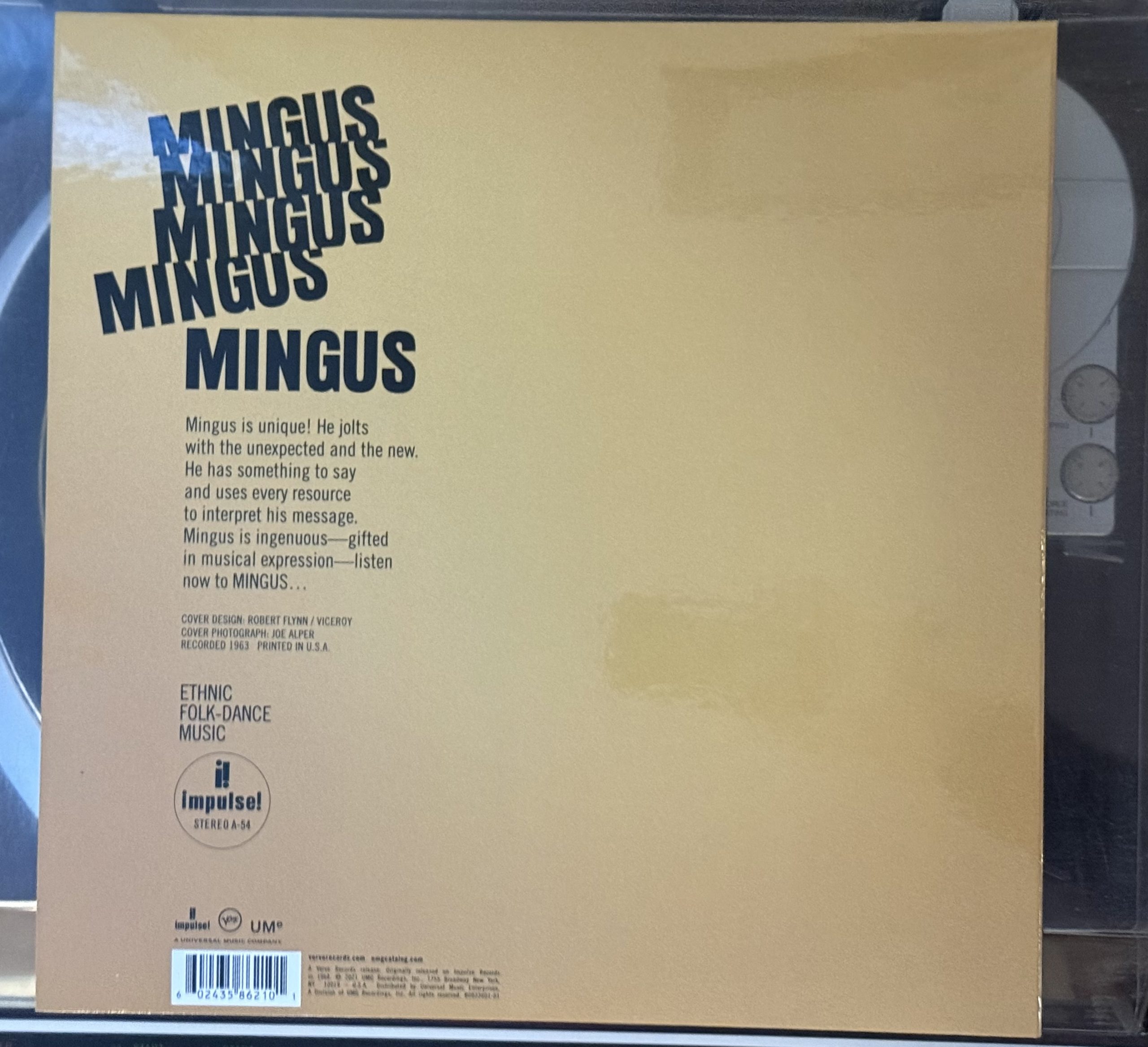
Charles Mingus, Mingus Mingus Mingus Mingus Mingus

An illuminating revisitation of some of the bassist’s greatest compositions.

Album of the Week, January 31, 2026

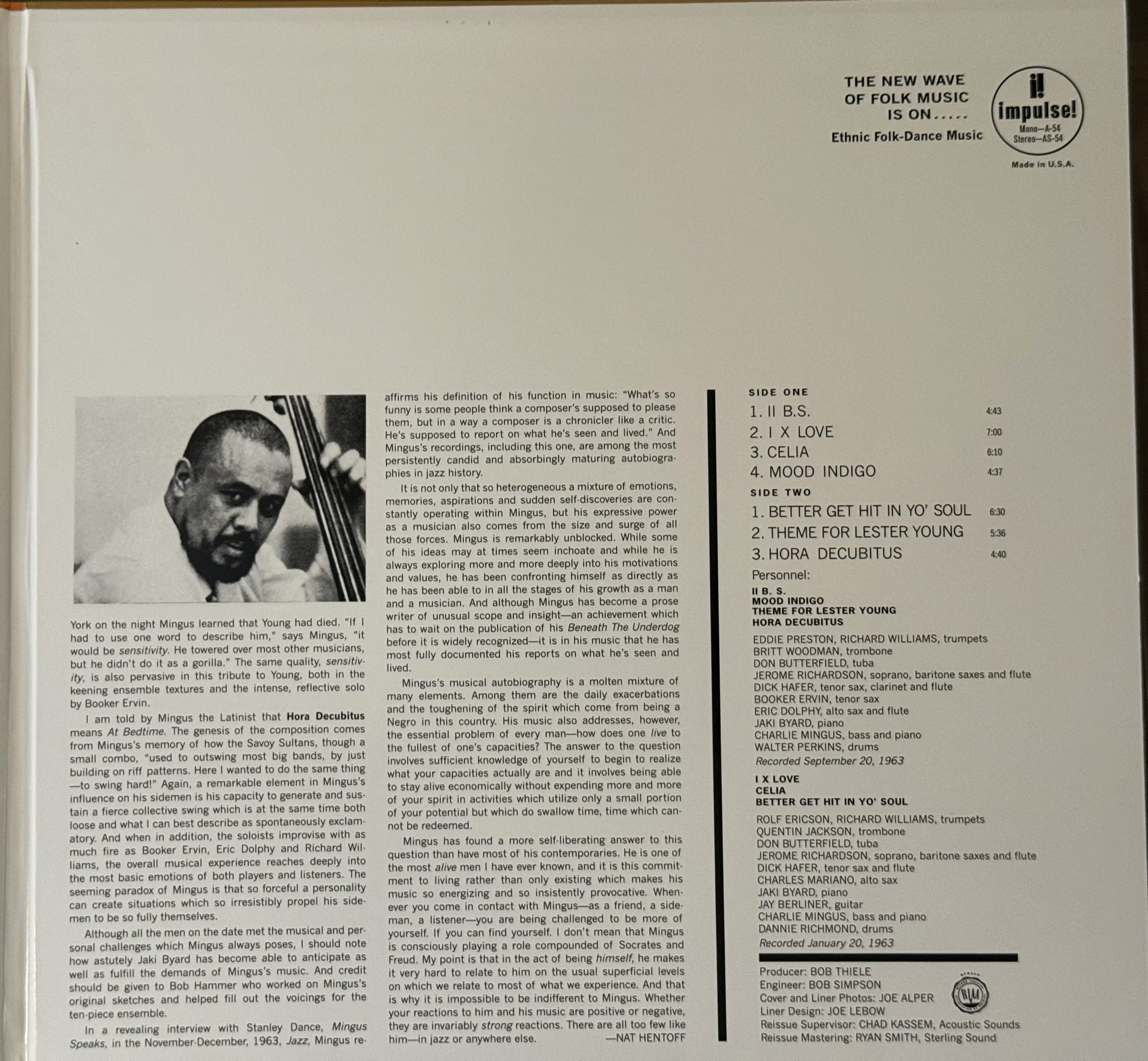
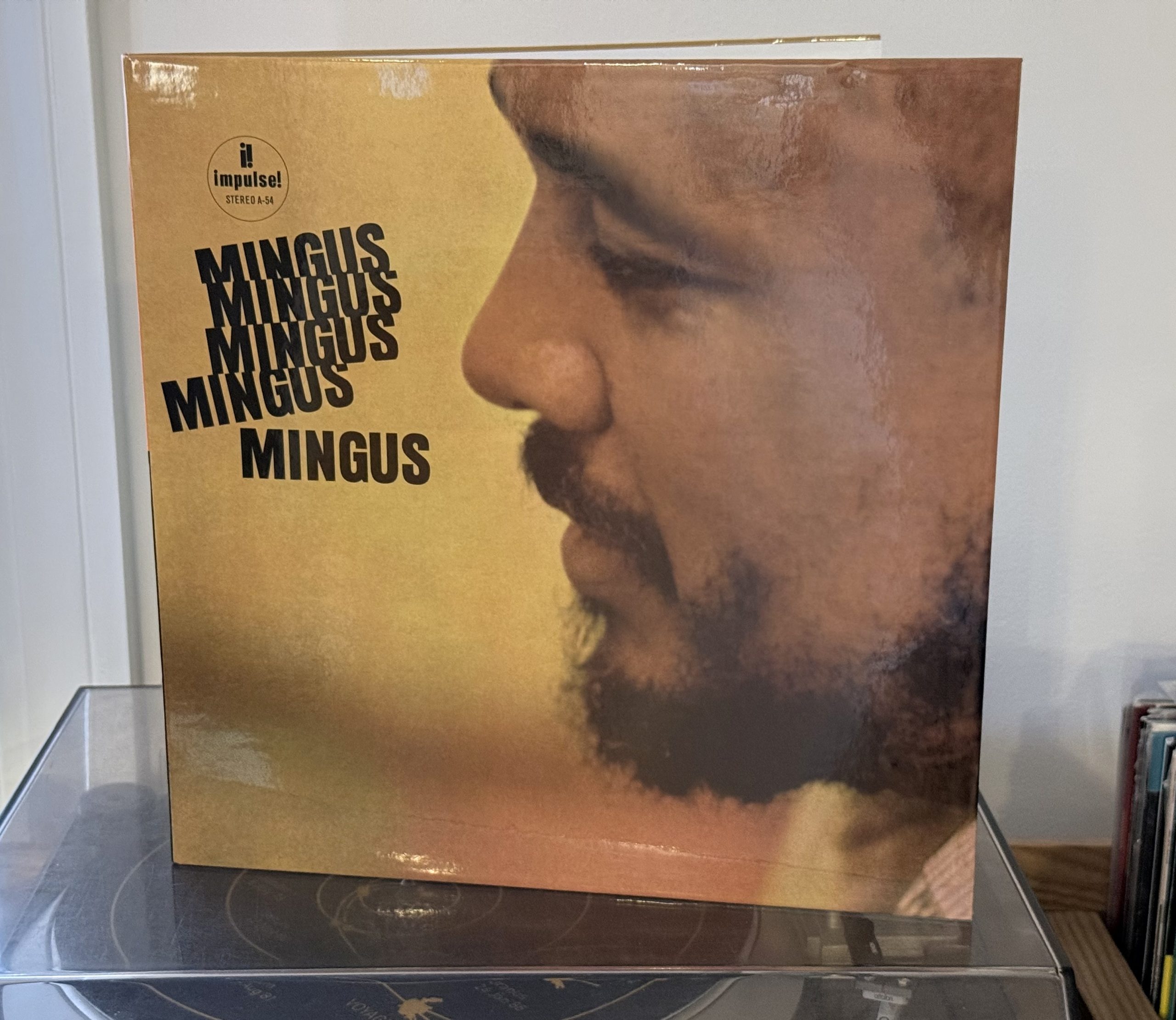
As we mentioned last week, Charles Mingus felt that he had found a sympathetic producer and label when he recorded The Black Saint and the Sinner Lady with Bob Thiele on Impulse!, and stated in the liner notes, “I intend to record it all over again on this label the way it was intended to sound.” Today’s album, Mingus Mingus Mingus Mingus Mingus, is the fulfillment of that promise, with many of the same players who appeared on the earlier album and a set of career-defining compositions (and one memorable cover) filling out the grooves.

Indeed, of the band, Jaki Byard, Jay Berliner and Dannie Richmond were back (though Walter Perkins actually played drums on most of the tracks). Of the horns and reeds, almost all (Charlie Mariano, Jerome Richardson, Dick Hafer, Quentin Jackson, Don Butterfield, Richard Williams, Rolf Ericson) were returnees from the prior album, but a few new-to-us faces appeared: Britt Woodman on trombone, Eddie Preston on trumpet. And returning to the band were Booker Ervin and Eric Dolphy.

Ervin began playing with Mingus in 1958, and appeared on almost all the great bassist’s records between that year and 1961, including Mingus Ah Um and Blues and Roots, before going his own way for a few years. He played with Randy Weston and released almost 20 albums as a leader across Bethlehem, Savoy, Candid, Pacific Jazz, and most of all Prestige before his untimely death in 1970. And Dolphy, whose departure from Mingus’ band had informed the composition “What Love?” on Charles Mingus Presents, had played with Ornette Coleman, John Coltrane, John Lewis, Oliver Nelson, and a whole host of other musicians before returning to Mingus’s working band for this record; he rejoined the band in earnest in early 1964.

For publishing and copyright reasons many of the tunes on the album appear with different titles than on their first appearances. Accordingly, “II B.S.”—a retitling of “Haitian Fight Song” from Mingus’s early recordings Plus Max Roach and The Clown—begins the album in swinging form, with Mingus’s fierce bass playing over a skittering of stick hits in the drums. The horns build up section by section over the bass melody, play countermelodies underneath, pull back under Jaki Byard’s piano solo, re-enter with a chugging rhythmic pulse, and then return with the slow burn once more until they build to a screaming climax.

I X Love” is a reworking of “Duke’s Choice” from A Modern Jazz Symposium of Music and Poetry. It’s a swoony, gorgeous ballad, introduced by cluster chords and an out-of-nowhere guitar run, spotlighted with melodic solos from Dolphy and Mariano on alto sax and from the trumpet trumpet as the rest of the band splash out in seemingly (but not actually) random harmonic directions all around. There’s a spectacular clarinet moment from Dick Hafer before the lower brass take us back to the top once more. Throughout, the combination of Butterfield on tuba anchoring the bottom of the chords and Mingus’ nimble bass solos yields a deeply satisfying sonic landscape with deep harmonic range, nowhere more so than at the very end leading into the final alto cadenza.

Celia” originally appeared on Mingus’ 1957 record East Coasting, in a sextet performance with none other than Bill Evans at the piano. Here it appears to continue the slow dance of “1 X Love,” until suddenly the corner turns and the band humphs into a fast groove led by Dolphy’s alto sax. The two modes of the tune continue to alternate, now with a tuba melody line, now with Mariano’s alto, always with Mingus’ steadfast walk alongside Richmond’s rhythmic outbursts. The work winds to an end with the lowest possible rumble from the tuba lending a faint edge of madness to the concluding chords.

Mood Indigo” is the sole non-Mingus original on the album. In the liner notes Mingus states, “It’s absurd to put Ellington in polls. A man who has accomplished what he has shouldn’t be involved in contests. He should just be assumed to be in first place every year.” (Apparently there were no ill feelings after the drama of Money Jungle.) The arrangement is deeply felt, starting with a quiet horn chorus under Mingus’ sensitive bass; the horns drop away for an unhurried bass solo with splashes of piano and quiet brushed cymbals. The band returns for one more quiet chorus before finding their way through the end of this deeply felt tribute.

Better Get Hit In Your Soul,” making its memorable debut on Mingus Ah Um as “Better Git It In Yo’ Soul,” is opened with Mingus’ solo bass and then the reeds playing the melody. It’s Jerome Richmond’s baritone that gets the chorus part, accompanied by wordless yells from Mingus way down in the mix that are just barely picked up by his bass direct mic. That’s Walter Perkins on the drums on this one, coming as it does from the September session that makes up the majority of the tracks. The brilliant bit of this arrangement: after Mingus sings the tag line, “Better get hit in your soul,” and the band stops, they recapitulate everything in an extended coda, this time in a swinging 4/4 rather than the fierce 6/8 of the melody. They seem likely to do it again, too, as Mingus trails pizzicato and Byard plays into the fade-out.

Theme for Lester Young” follows “Better Get Hit” as it did on Mingus Ah Um, when it was titled “Goodbye Pork Pie Hat.” Written as a tribute to Young a few months after his death, the song proceeds as a series of statements from each of the horns over the noir-ish charts. The tune feels as familiar as a worn suit, given new life by the depth of the horn section and by Byard’s extended chords at the end.

Last, “Hora Decubitus” appears in a new title, having originally been “E’s Flat, Ah’s Flat Too” on Blues and Roots. This is blues all right and a fast one, swung by Mingus and Richardson, then the rest of the band joining in. Dolphy’s solo switches out of time for a minute before he’s joined by the rest of the group. It’s a joyously swinging dance with each member of the group improvising across the tightly arranged charts, and a coda that calls to mind all the high points from the album as Mingus gets the last word.

Mingus kept a subsection of this band together for the next year, recording a few concerts and taking a tour to Europe where they met much acclaim. At the end of the tour, Dolphy told Mingus his intention to remain in Europe. He had a series of dates booked, traveling to West Berlin on June 27, 1964 to play the opening of a jazz club called the Tangent, but he fell severely ill and could barely play. On June 29 he fell into a diabetic coma and died; stories vary as to whether doctors gave him too much insulin, causing insulin shock and death, or whether they assumed that he was on drugs and left him to die in his bed. Mingus, bereft, carried on. We’ll hear another milestone performance from after the band’s return to the States next time.

You can listen to this album here:

BONUS: The Mingus-Dolphy European tour of 1964 yielded a number of memorable performances recorded for television. This one, recorded in Belgium, has some spectacular moments of interplay between Mingus and Dannie Richmond, and truly spectacular moments between the horns and Dolphy on flute, plus a truly fantastic bit where Mingus plucks the strings of the piano in what appears to be an avant-garde improvisation until we realize, no, he’s taking a tuning break.

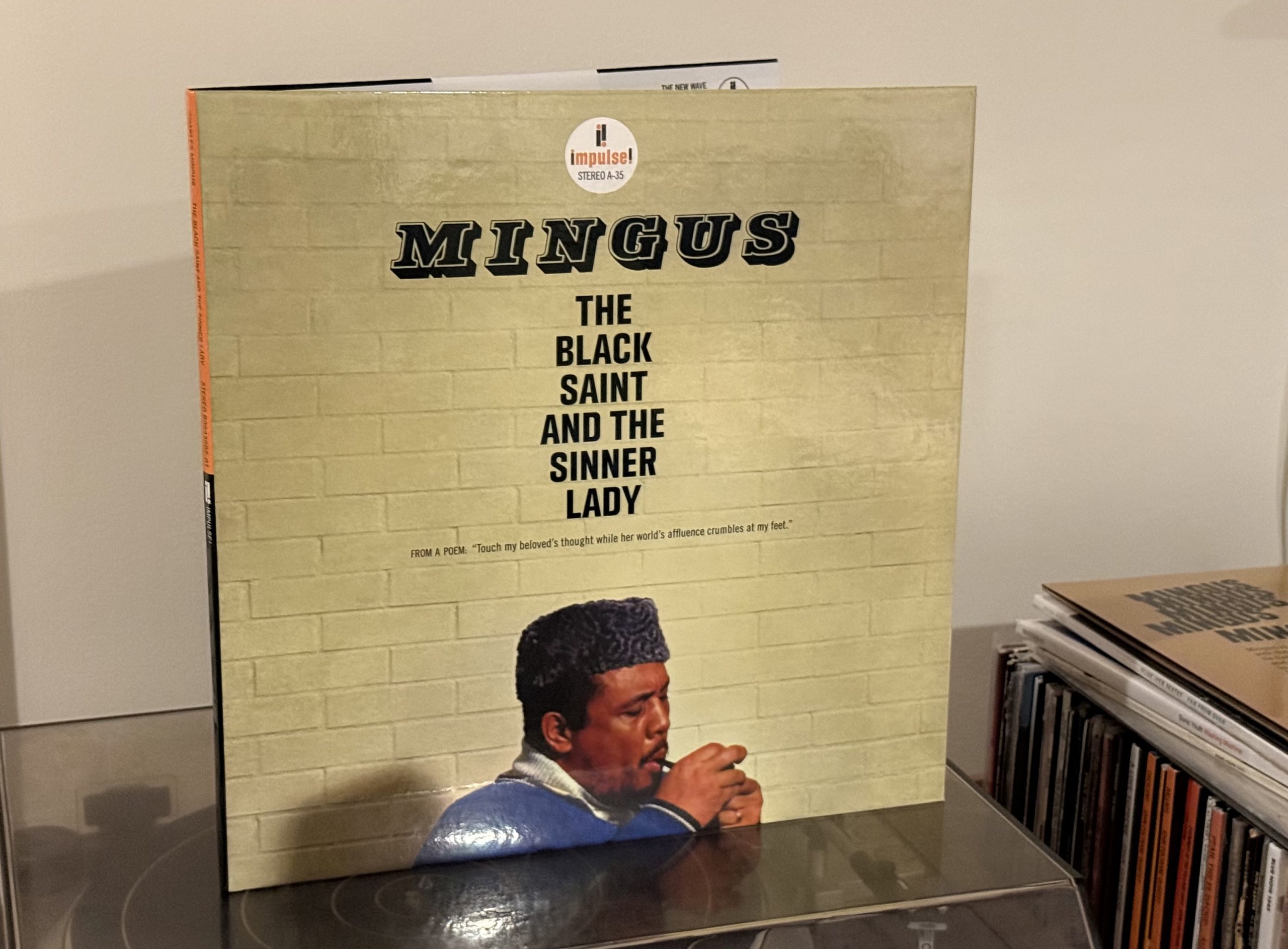
Charles Mingus, The Black Saint and the Sinner Lady

The composer’s masterpiece is a cry of despair and a dance of freedom (or maybe vice versa).

Album of the Week, January 24, 2026

Given the challenges with labels that we’ve seen other jazz geniuses have (cf: Miles’s contractual obligations with Prestige, Trane’s back material being issued for years (again by Prestige), Monk’s contract being bounced around by Riverside until their bankruptcy), it’s remarkable to contemplate Charles Mingus’ seeming ability to record on any label he wanted. Managing to record on Atlantic and Candid simultaneously, doing a few releases on Columbia, bopping over to United Artists, it’s interesting to note that he wanted even more label time—and with Bob Thiele and Impulse!, he found it, at least for a while.

Thiele was a few years into his stewardship of the Impulse! label, and had recorded four major Coltrane albums—Coltrane “Live” at the Village Vanguard, Coltrane, Duke Ellington and John Coltrane, and Ballads—by the time that Mingus entered the studio. Mingus’s session, held January 20, 1963 at the familiar Atlantic studio in New York, was to be both in a line with these great records and totally different. While the session was, like the string of Coltrane Impulse! records, a career-defining work of genius, considered along with Mingus Ah Um to be the summation of his compositional powers, it was different in that it was composed for a much larger group, an eleven-piece jazz orchestra.

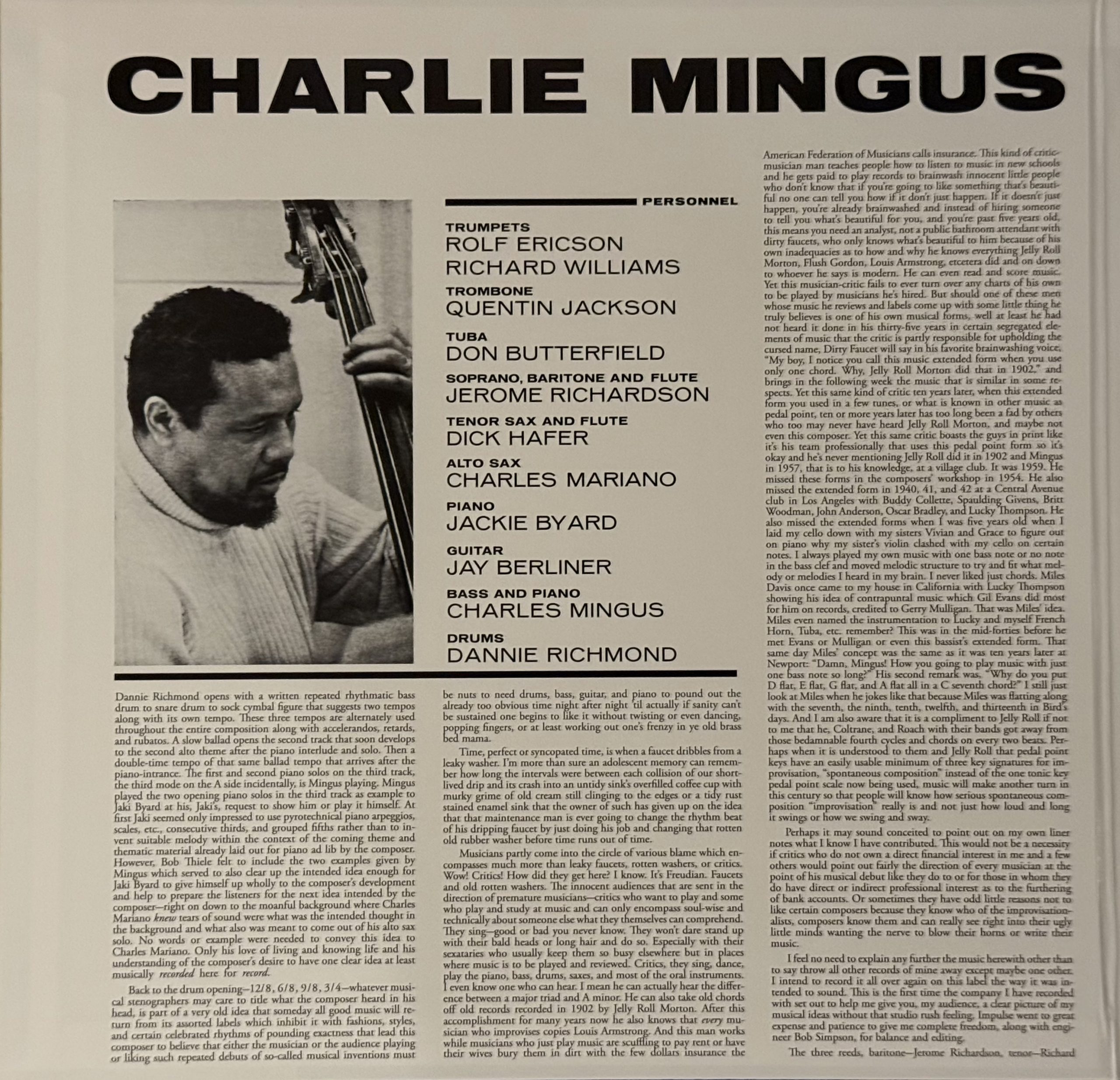
Effectively it was someone else’s orchestra. Bob Hammer, a pianist who had performed with Mingus on his totally bonkers A Modern Jazz Symposium of Music and Poetry and would later play with Johnny Hartman, had formed the orchestra only to have Mingus take it for a run at the Village Vanguard for six weeks, during which time he worked out much of the compositions of the album. In addition to Hammer’s arrangements, the group also featured the redoubtable Dannie Richmond on drums, Don Butterfield on tuba, Jerome Richardson on soprano and bari sax and flute, Charlie Mariano on alto sax, Dick Hafer on tenor sax, Rolf Ericson and Richard Williams on trumpet, Quentin Jackson on trombone, Jay Berliner on classical guitar, and Jaki Byard on piano. Byard, hailing from Worcester, Mass, had played professionally from age 16, was drafted into the Army at age 19 (where he mentored the Adderley brothers), then returned to Boston where he played with musicians including Sam Rivers and Mariano. Byard joined Mingus’ band with his legendary Town Hall concert in 1962 and played regularly through 1964, and off and on in the bassist’s bands through the end of his life.

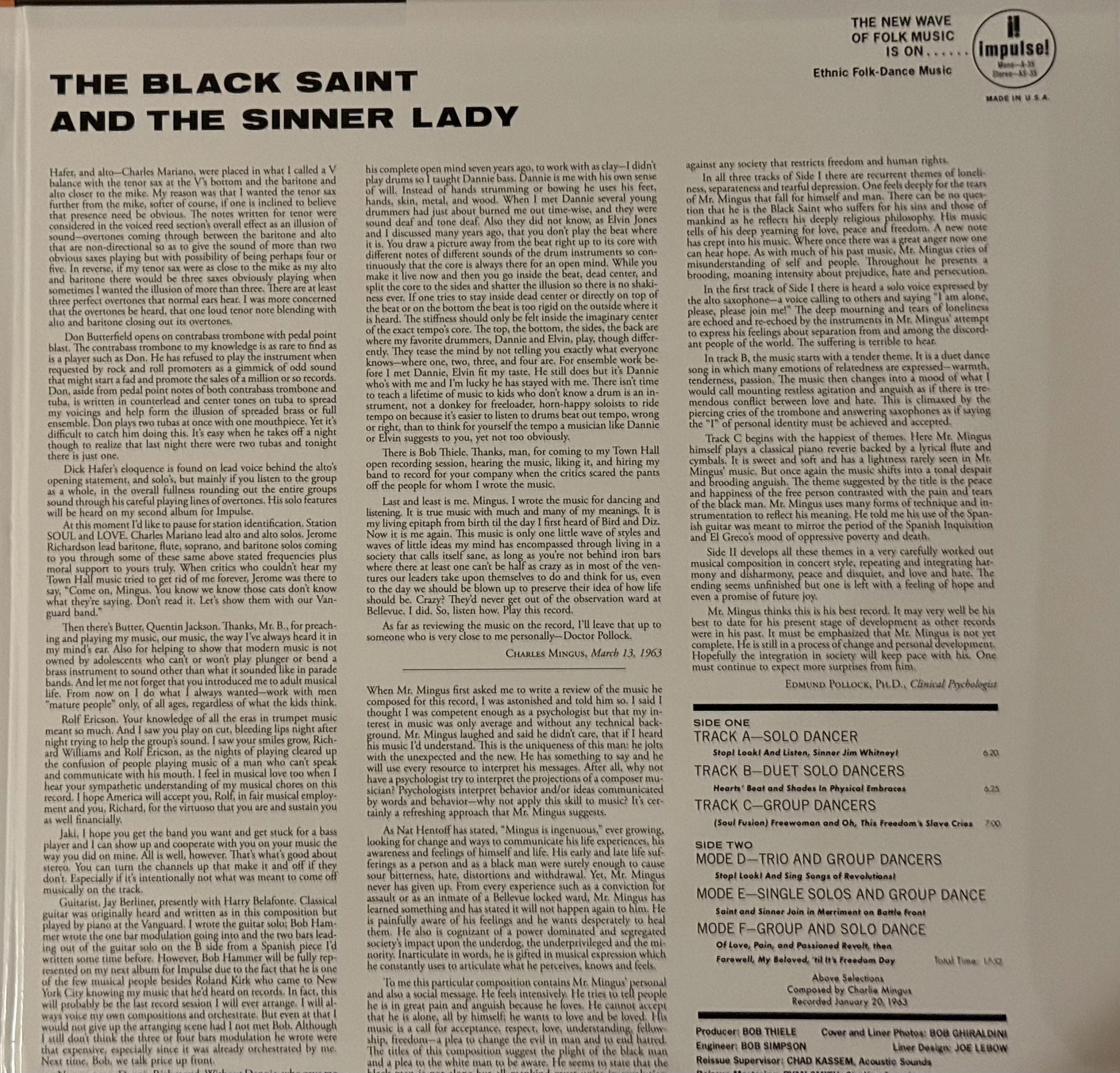
Mingus himself writes astonishingly complete (and verbose) liner notes describing the composition; I’m going to restrain myself to impressions.

Solo Dancer” opens with a a flourish from Richmond and a solo voice on the alto sax (Mariano) crying in the wilderness against a pedal point of Jerome Richardson’s baritone, Don Butterfield’s tuba (both in the right channel) and collective improvisation by the group against a III – IV vamp—which is to say, a thick cluster of sound out of which solo voices pop. Richardson’s soprano sax solo against a cluster of trumpets grinds deep into that vamp, until the piano calls an end to the dance.

Duet Solo Dancers” opens with that piano, finally taking us out of the repeated two-chord vamp into something like an Ellington ballad. The movement is subtitled “Hearts’ Beat and Shades in Physical Embraces,” and one imagines the dancers sharing a tender moment before suddenly a pulse in the tuba signals a shift in mood; an argument perhaps? The tempo ebbs and flows as though the fight is picking up volume, until a climax is reached; the fight music returns, this time in a note of regret, until the dancers reconcile and the ballad returns once more.

Group Dancers,” subtitled “(Soul Fusion) Freewoman and, Oh, This Freedom’s Slave Cries,” opens with the piano (played by Mingus) introducing the third theme, a descending trill from the fifth down to the tonic and then up to the submediant. After some conversational interjections from the band, they pick up the new theme and try it out. The piano returns, playing a segment of Ravel-esque beauty complete with moments of parallel beauty, and then the band picks up the theme once more, with the trumpets, then the flute, then the other instruments picking up the descending theme. Ultimately a new theme (the “freedom’s slave cries?”) emerges, with layers of themes in a long vamp for the entire orchestra, as Mingus’s bass urges the ensemble forward, controlling the tempo as it surges forward and ebbs back. A closing note from the alto leaves us in a cliffhanger going into the second side of the record.

Medley: Trio and Group Dancers/Single Solos and Group Dance/Group and Solo Dancers” is a single long track that comprises the second side. Opening with conversations between the instruments followed by a soliloquy from Mingus on the bass, the muted trumpets lead us into a sort of cockeyed ballad once more. The dense structure is broken apart by Jay Berliner’s Spanish guitar flourish; one imagines a dancer in full flamenco garb taking the center stage for a moment. The ensemble is not so easily brought into this new sound world, and a tumult follows as they improvise over a theme that slowly reveals its similarity to the “Los Mariachis” theme from Tijuana Moods. Another break from the piano (this time by Jaki Byard) introduces a recapitulation of the descending theme from “Group Dancers,” followed by a Liszt-like cadenza and the descending theme’s return.

A series of solos follows, with the alto sax leading into the group and solo dance “Of Love, Pain, and Passioned Revolt, Then Farewell, My Beloved, ’til It’s Freedom Day.” The love theme from the Duet Solo Dancers returns, introducing a new theme, built atop a major-key vamp, that slowly accelerates as the revolution gains momentum, until the whole ensemble reaches a sort of exhausted collapse, only to start all over again. Ultimately the band reaches a jubilant climax punctuated by the shouts of the different instruments, then returns to an echo of the opening music, as if to say “Look out, folks, we aren’t done yet.” A massive final saxophone solo points at an angle into the sky, as if to promise better days lie yet ahead.

Mingus came to Impulse! following the near-disaster of his Town Hall concert, at which he premiered what eventually became his long-form composition Epitaph in a “jazz workshop” model, with the players working out ideas on stage. In the liner notes, he thanks producer Bob Thiele (who had become the lead at Impulse! following Creed Taylor’s decampment for Verve) for “for coming to my Town Hall session, hearing the music, liking it, and hiring my band to record for your company when the critics scared the pans off the people for whom I wrote the music.” He found the experience congenial, noting, “This is the first time the company I have recorded with set out to help me give you, my audience, a dear picture of my musical ideas without that studio rush feeling, Impulse went to great expense and patience to give me complete freedom…” He also said “Throw all other records of mine away except maybe one other. I intend to record it all over again on this label the way it was intended to sound.” We’ll hear the result of that session next time.

You can listen to this week’s album here:

BONUS: There have been a few attempts to essay a live performance of Mingus’ great composition. This 2013 performance by the Nu Civilization Orchestra in London is worth a listen:

BONUS BONUS: The Nu Civilization Orchestra has kept the work in repertoire, and recently brought the work to the Barbican, along with dancers!