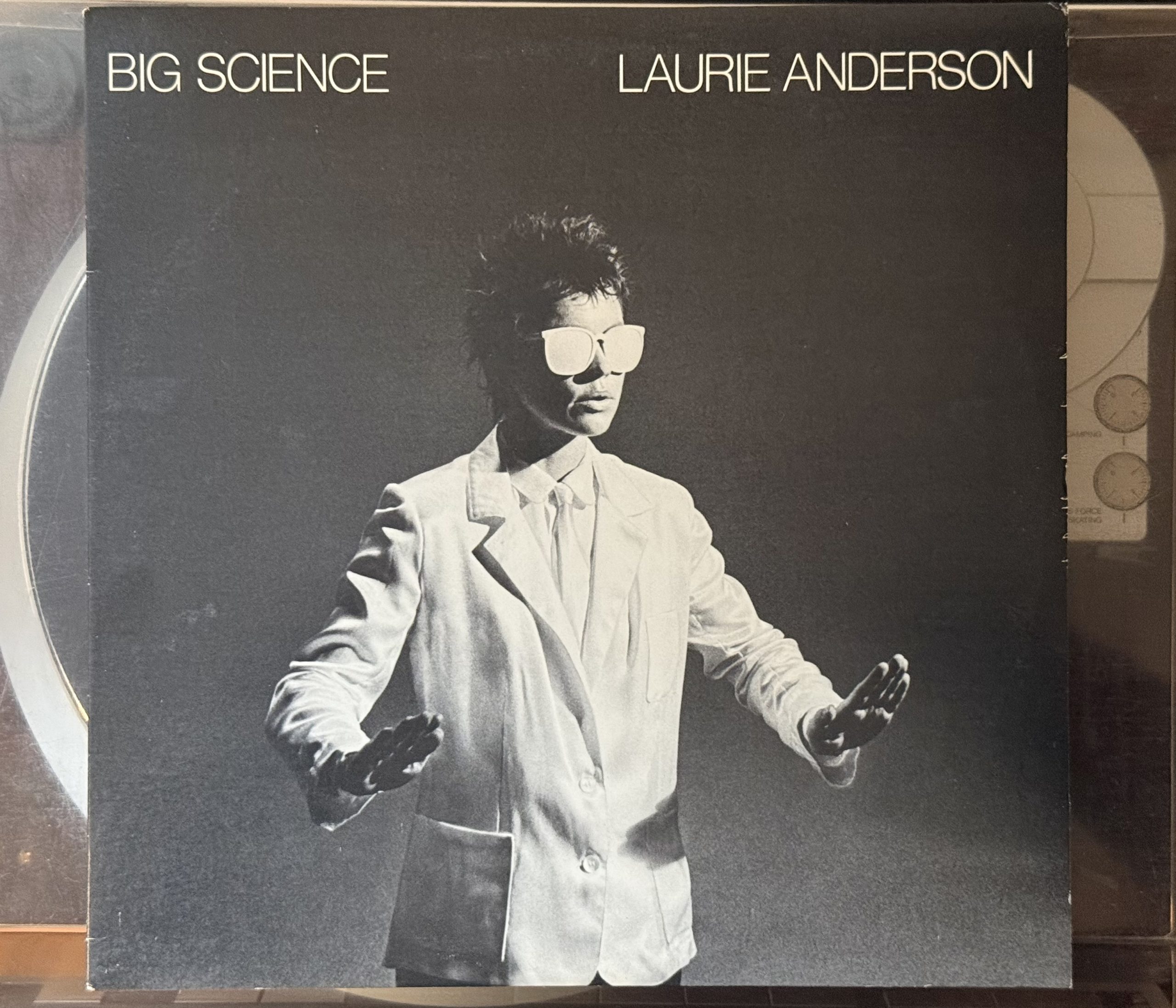
Laurie Anderson, Big Science

The conceptual artist’s first major label album is an unliikely, and highly listenable, artifact from an ambiguous future.

Album of the Week, March 28, 2026

Performance artists do art pieces and get grants. They might release recordings of their work on small labels. They don’t, typically, have singles that hit the top of the charts, and they certainly don’t dedicate those singles to a dead French composer. But then, Laurie Anderson has never been typical.

The story of Big Science starts before You’re the Guy I Want to Share My Money With. Laurie had recorded the song and released it as a single in the UK in 1980 on the small label One Ten Records, in a limited edition of 1000 copies. That’s when BBC DJ John Peel changed the trajectory of her career. Putting it in frequent rotation on his show on BBC Radio One, his championing of the song led a British distributor to request 80,000 copies of the single. Laurie signed a distribution deal with Warner Bros. Records and the single went all the way to Number Two in the UK. On the strength of the single, Warner Bros. signed Laurie to an eight-album deal.

The album was released in April 1982. Produced by Roma Baran, who also played keyboards, accordion and percussion, and featuring installation artist Perry Hoberman on reeds, experimental composer Peter Gordon on clarinet and tenor sax, Bill Obrecht on alto sax, and composer David Van Tieghem on drums, marimba and percussion, the album featured a variety of performances drawn from a long-form show that she would eventually perform and record as United States Live I – IV. The material is much more melodic than the numbers on You’re the One I Want to Share My Money With, but still far from traditional song structures; built on loops, repetition, and open-ended chords, the pieces on Big Science feel like alerts from the future.
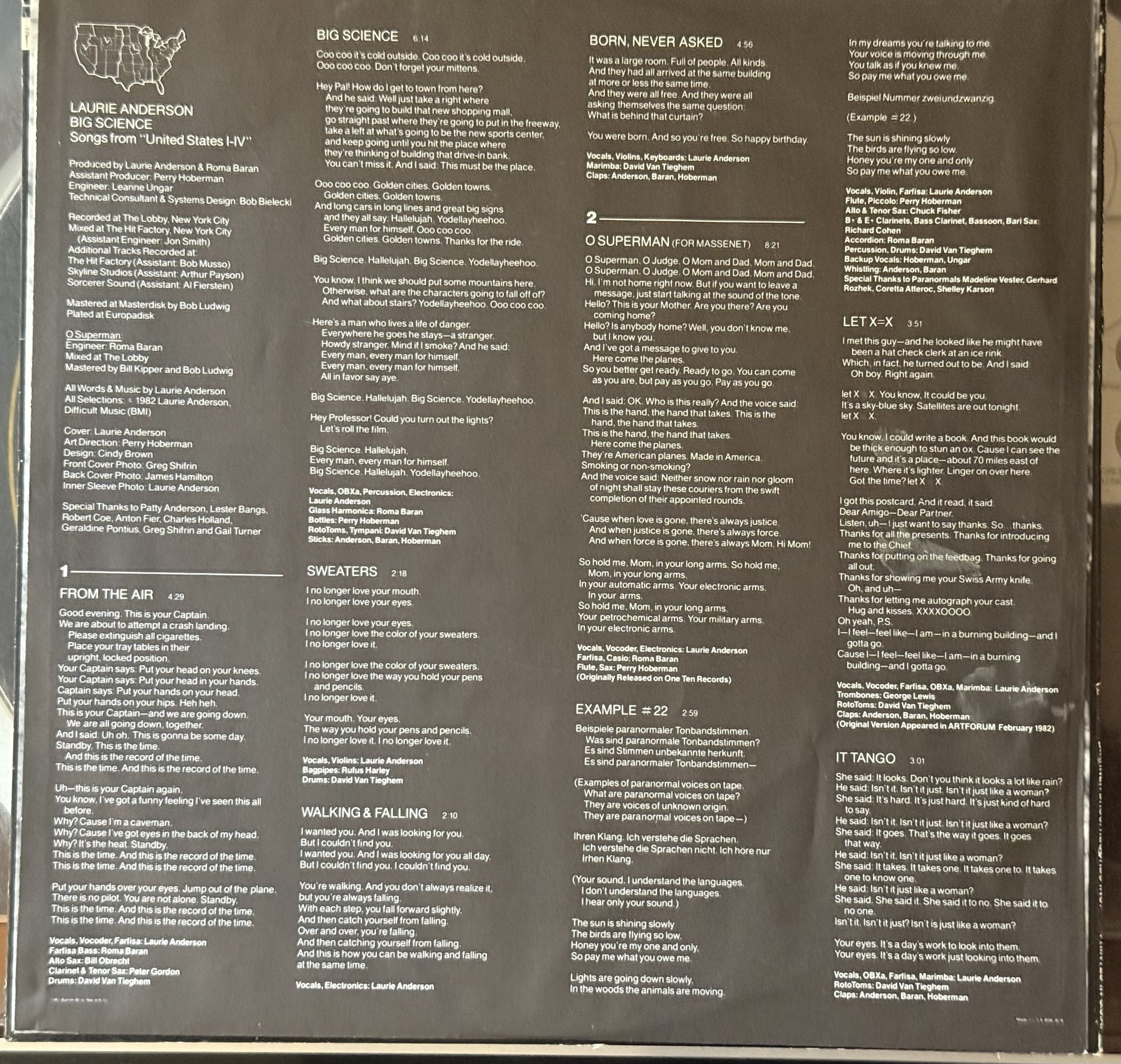
From the Air” starts with a blast of keyboards and saxophones against the drums as Laurie Anderson narrates the increasingly unhinged thoughts of an in-flight announcement: “Your Captain says put your head on your knees. Your Captain says put your head in your hands. Captain says, put your hands on your head. Put your hands on your hips! Heh heh. This is your Captain, and we are going down. We are all going down together. And I said Uh-oh. This is going to be some day.” The repetition and music slowly ratchets up in intensity, and the syncopated drum pattern the sense of uncertainty, until the final verse: “Put your hands over your eyes. Jump out of the plane. There is no pilot. You are not alone. Standby. This is the time, and this is the record of the time.” Anderson’s words here (and elsewhere on Big Science) take on an uncomfortable resonance in the shadow of the September 11th attacks, but even without that massive hole in history lending its gravity, the intersection between order and chaos, the apparent power of the captain that is revealed to be illusion, pulls us in.

If “From the Air” has a sense of claustrophobia, “Big Science” and its synthesized lonely howl bring us to a wide empty space, with echoing handclaps and open fifths adding to the sense of anticipatory emptiness. We hear Laurie’s actual singing voice, a pure soprano in contrast to her normally lower pitched speaking voice, which gives an apocalyptic vision of the future: “I said, Hey pal, how do I get to town? And he said, well, just take a right where they’re going to build that new shopping mall, go straight past where they’re going to put in the freeway, and take a left at what’s going to be the new sports center. And keep going til you get to the place where they’re thinking of putting in the new drive-in bank.… And I said, ‘This must be the place.’” The future here is anticipatory but also hostile: “And long cars and long lines and great big signs/And they all say: Hallelujah. Yodellayheehoo. Every man for himself.” Laurie was listening to the same wavelength as William Gibson, who had written “The Gernsback Continuum” a year before about hallucinatory invasions of alternate future universes from 1930s pulp paperbacks: “The Thirties dreamed white marble and slip-stream chrome, immortal crystal and burnished bronze, but the rockets on the covers of the Gernsback pulps had fallen on London in the dead of night, screaming. After the war, everyone had a car—no wings for it—and the promised superhighway to drive it down, so that the sky itself darkened, and the fumes ate the marble and pitted the miracle crystal…” But here rather than hallucinatory bleed-through the future is just full of totemic emptiness.

Sweaters” has all the edge of Laurie’s more confrontational early work, here amped up to eleven by Van Tieghem’s stumbling drum work and Rufus Harley’s screaming bagpipes, playing against Laurie’s nonverbal vocalizations and her drone-like violin, all against a series of aleatory declarations of ended love: “I no longer love the color of your eyes/I no longer love the color of your sweaters.”

Walking and Falling” is a quieter experimental reading against a looped background, a meditation leading into a straightforward reading of a poem ending with the question: “What is behind that curtain?” Then we get the keyboards and marimba of “Born, Never Asked,” in a new reading that is compositionally identical to the version on You’re the Guy… but with much better sound. A voiceover announces “You were born, and so you’re free. So happy birthday,” providing a non-answer to the question of what lies behind the curtain: it’s up to you, apparently, even if that self determination ultimately leads to the desolation of “Big Science.”

Side two opens with the album’s most enduring work. “O Superman (For Massenet)” is so titled because of Laurie’s cockeyed translation of the Massenet aria (from the opera El Cid) “Ô Souverain, ô juge, ô père”: “O Superman, o judge, o mom and dad.” The music is simple: built on a loop of Anderson’s voice on a single note, the vocal melody destabilizes, going from a major key (with the single note on the third) to a minor key with the repeated note on the tonic. Effects on Anderson’s voice make the sung lines sound at once like a Greek chorus and a robot. Even more than “From the Air,” the stark arrangement and openness of the voices fill the listener with a sense of growing unease, ultimately growing to a real feeling of dread: “Hello? This is your mother. Are you there? Are you coming home? —Well you don’t know me/But I know you/And I have a message/To give to you:/Here come the planes.” Anderson has stated that she wrote the song in the aftermath of the failed rescue of the Iranian hostages, Operation Eagle Claw, and the tragic deaths of eight American servicemen, and it continues the message of dependence and violence: “So hold me mom/In your long arms… In your automatic arms/Your petrochemical arms/In your electronic arms.” Other motifs weave their way through the song, culminating in a crescendo of minor-key chord progressions that echo the melody of “From the Air,” rise like the tide to a crashing climax, and fall away, leaving only the “ah-ah-ah.” Listening to it, you understand what would drive John Peel to play the song over and over, and Warner Bros. to sign her.

From the sublime to the ridiculous, “Example #22” announces itself in German as “examples of paranormal voices on tape” (Beispeile paranormaler Tonbandstimmen), interspersed with ringing phones, saxophones, reeds, and an accordion, accompanying what must surely be Laurie’s brattiest vocal. It’s great fun and completely impenetrable.

By contrast, “Let X = X / It Tango” closes out the record with quotably wry wit. “Let X = X” is practically a quotable aphorism in every line: “And I said, O boy. Right. Again. … You know. It could be you. It’s a sky-blue sky. Satellites are out tonight. … You know, I could write a book. And this book would be thick enough to stun an ox. ‘Cause I can see the future, and it’s a place about 70 miles east of here. Where it’s lighter.” The handclaps and marimba tie the arrangement back to “Born, Never Asked,” only in a much lighter vein; they continue through “It Tango,” a stopping and starting argument in search of an antecedent. She closes with a declaration of utterly failed communication: “Your eyes. It’s a day’s work just looking into them.”
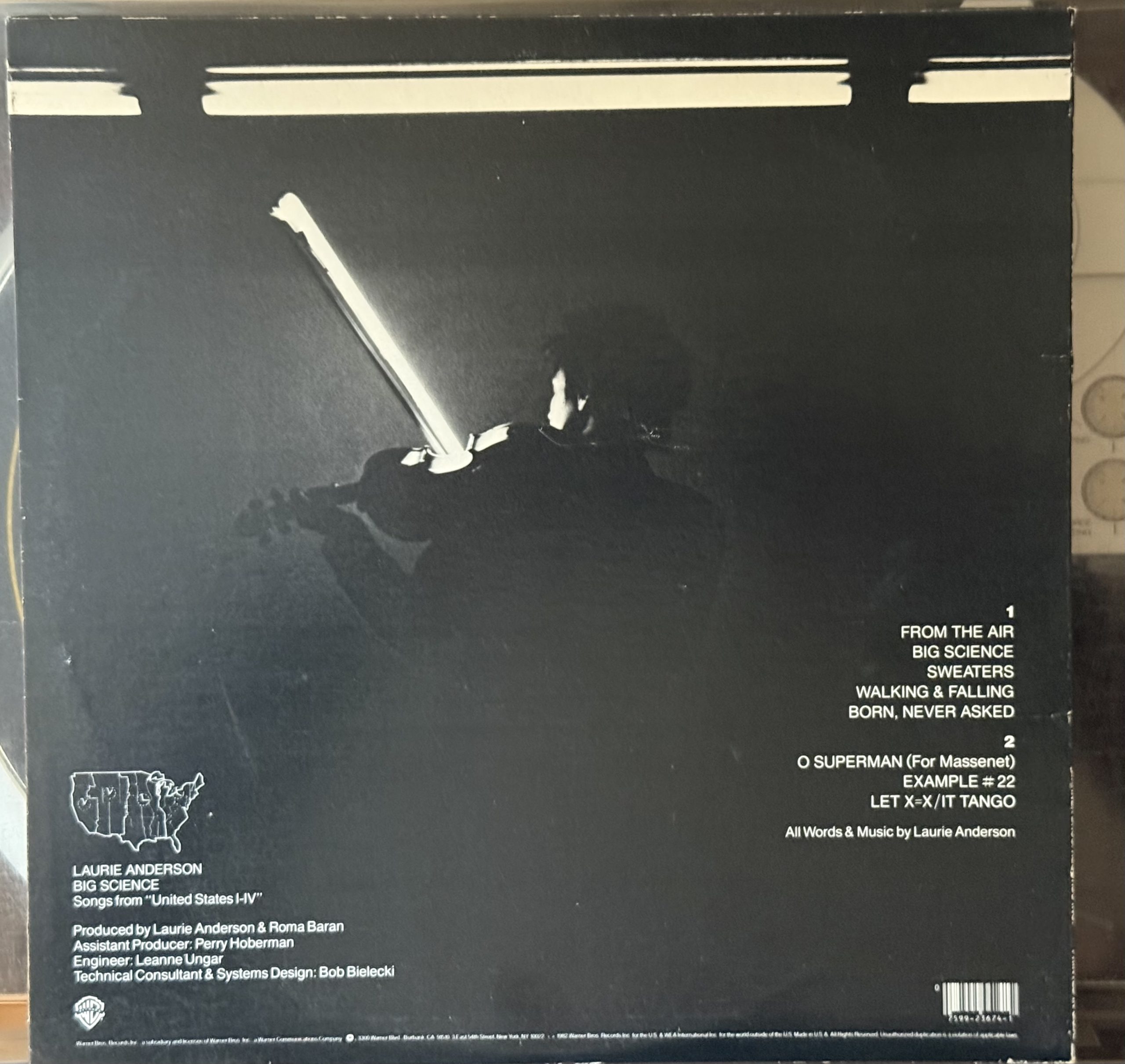
Laurie’s first album immediately established her as a witty, thoughtful, highly listenable artist. And a bankable one: it sold 150,000 copies in its first year of release, smaller sales than a typical rock album but not by much (compare to 100,000 copies of Peter Gabriel (1977) in the UK). Her voice would continue to develop over the next few years, and we’ll check in on her again soon, but first we’ll see what kept Peter busy since the 1980 self-titled album.

You can listen to this week’s album here:

BONUS: The b-side of “O Superman” was “Walk the Dog,” an exercise in odd narrative that leans into a trope from her shows, the “difficult listening hour,” with barking dogs, a voice shifted high in pitch to the edge of squeak, strummed violin strings, and a bashed drum kit:

BONUS BONUS: Laurie Anderson did a Tiny Desk Concert from home back in 2021, joined by Roma Baran and cellist Robin Kodheli, performing “Let X=X” and “O Superman”:
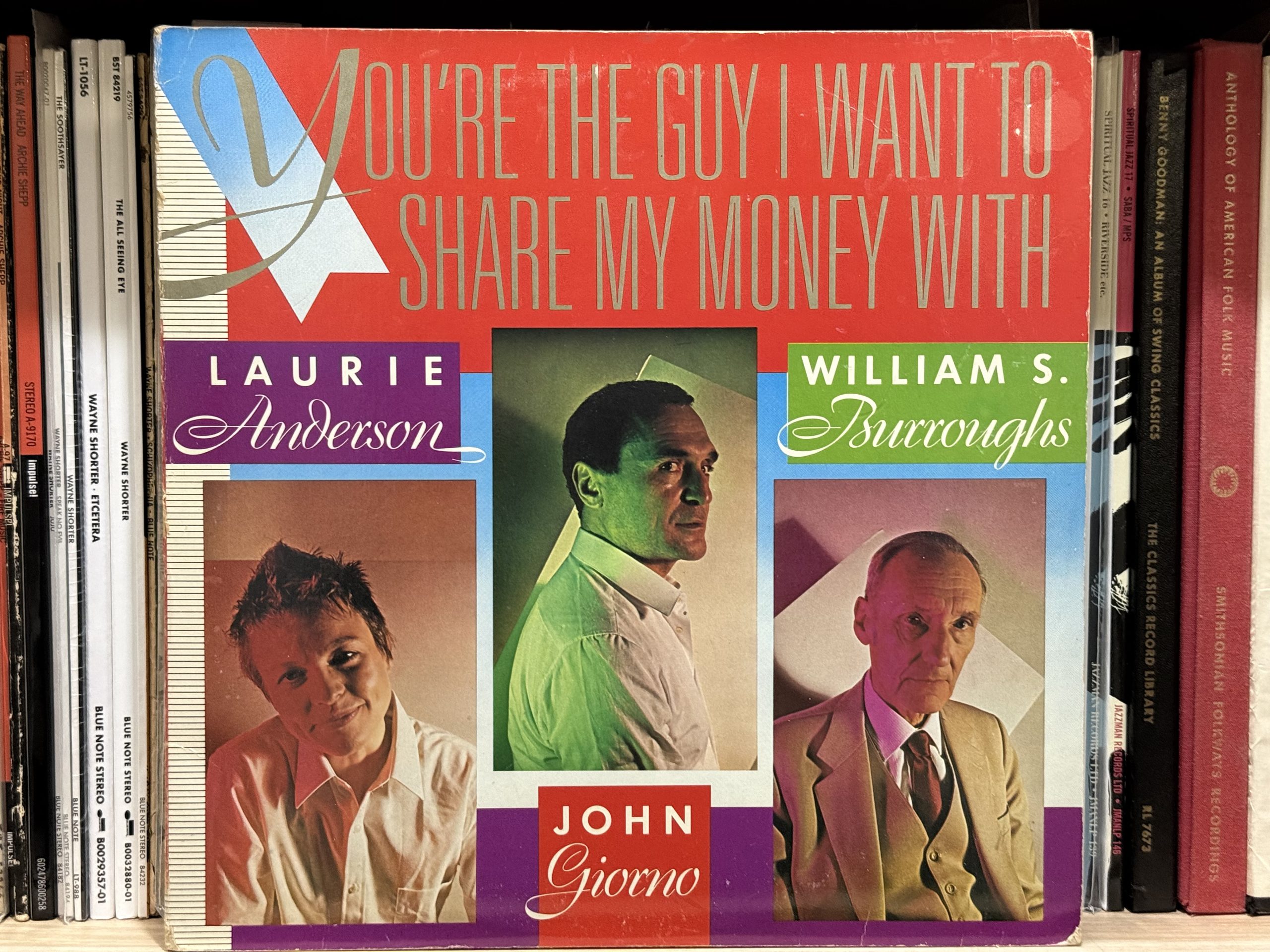
Anderson/Giorno/Burroughs, You’re the Guy I Want to Share My Money With

A dip into the wild world of performance art and avant-garde writing from the dawn of the New Wave.

Album of the Week, March 21, 2026

The name of this segment of my album reviews was originally going to be “art rock.” But while that term has been used to apply to Peter Gabriel’s work, it’s impossibly undefinable, and didn’t really cover the work of one of his collaborators whose story we’ll begin to discuss today. Though Laurie Anderson is undeniably an artist, the “rock” part is an ill-fitting label, and none of her recordings illustrates the challenge as much as today’s recording, a compilation of spoken word, performance art, and poetry that pairs her with two other challenging artists over a year before the release of her debut album.

Laurie Anderson was born in Chicago and grew up in the Illinois suburbs studying art and playing in the Chicago Youth Symphony. She drew comics, made sculpture, and did performance art: her first public performance was a symphony for automobile horns, and one of her best-known pieces from the 1970s, “Duets on Ice,” involved her playing violin against a recording of herself while wearing ice skates that had been frozen into blocks of ice—the performance ended when the ice melted enough to free her skates.1 Also in the 1970s she connected with New York poet and performance artist John Giorno, on whose Giorno Poetry Systems label she released some of her earliest recordings (including some for his groundbreaking “Dial-A-Poem” system).2

Increasingly Anderson was drawn to recorded art, though she never abandoned her more visual instincts, and in 1981 she released two important records. One, a single called “O Superman,” was released in October on a small label and had an unusually strong reception (which we’ll discuss another time). The second was a side (er, a side-plus) of this double album on Giorno Poetry Systems, with which Anderson appeared alongside two even more avant-garde poets: Giorno himself, and William S. Burroughs.

The latter had outlived his early tumultuous years—gay, addicted to opiates, accidental murderer—and had built a solid, if solidly weird, literary reputation as the author of works like The Naked Lunch, a science fiction trilogy (The Soft Machine,3 The Ticket That Exploded, Nova Express) and a great many short stories. He also made a number of recordings on a variety of small labels that featured his distinctive reading of his own works, based on the live readings that he was now giving on the lecture circuit. It was in this vein4 that Burroughs appeared on this recording. All three artists had appeared together in a series of readings and performances dubbed “The Red Night Tour.”

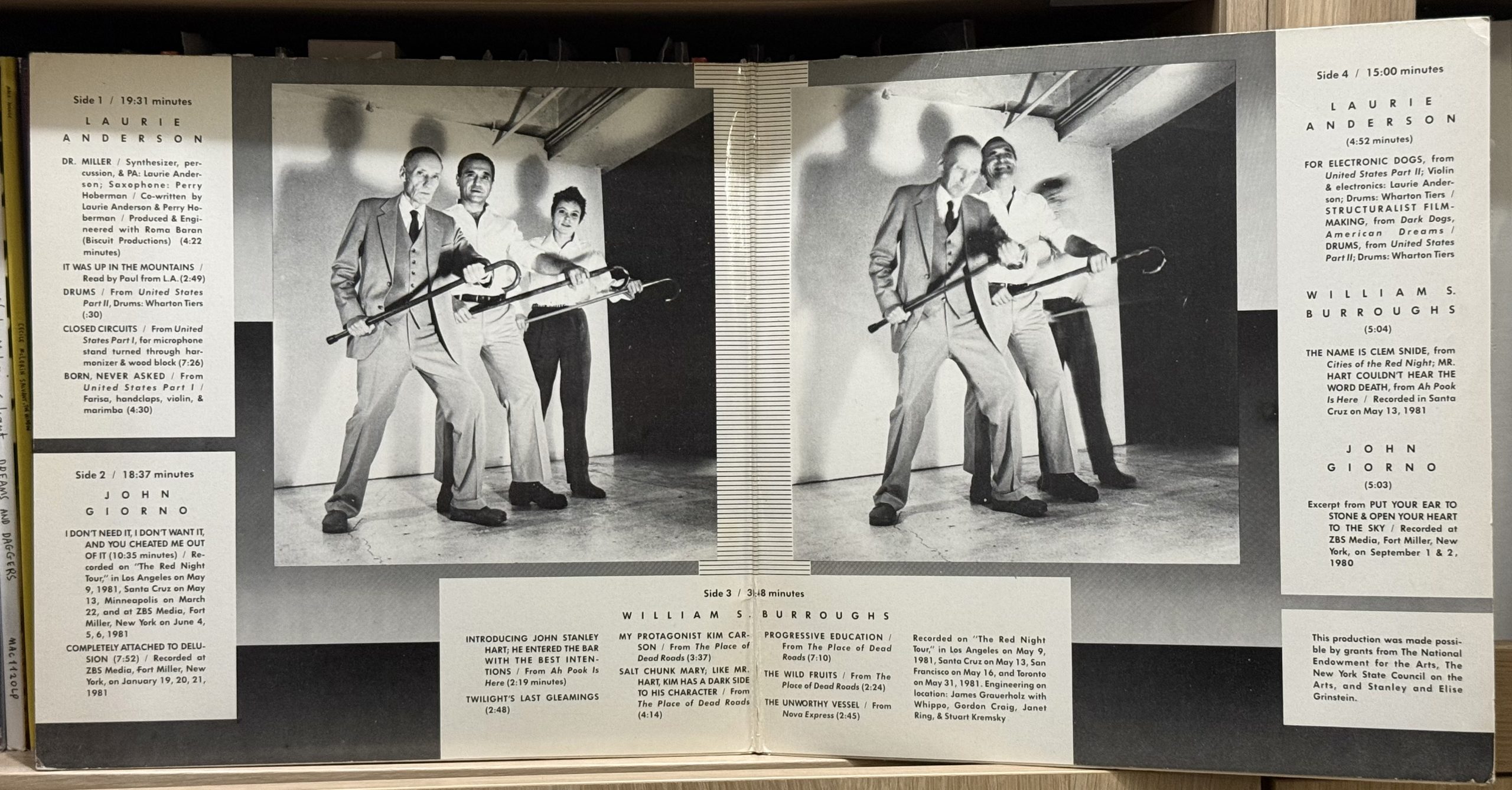
Laurie Anderson’s segment of the album is the most straightforward, and that’s saying something. While parts of the performance were recognizably connected to other things happening in music in the early 1980s (“Doctor Miller” is practically a Kraftwerk song, if you subtract the increasingly anxious PA voiceovers calling for the doctor), others are distinctively and uniquely Laurie’s voice, even (“It Was Up in the Mountains”) when the words are spoken by someone else. If I’m honest, “Closed Circuit” is more interesting than listenable, notable primarily for featuring Laurie’s use of vocal effects to create a deeper timbre for her speaking voice—a trick that she would perfect elsewhere, but here is marred by the lengthy lyric that feels more like a shaggy dog story. The end of Side 1 closes with an eerie instrumental played on a Farfisa, a marimba, handclaps, and Laurie’s brilliant violin; “Born, Never Asked” would appear again.

Side 2 is given over to two John Giorno poems, “I Don’t Need It, I Don’t Want It, and You Cheated Me Out of It” and “Completely Attached to Delusion.” Like Laurie Anderson, he plays with vocal effects, but his use of tape delay and pre-recorded alternate readings of the work is by turns disorienting, exhilarating and overwhelming. But it is a committed and fully out there reading, and there’s a direct line to be traced from his work to poetry slams.

Burroughs gets the next side, giving a series of readings from his novels, including the first appearance of his horrifically funny Dr. Benway (“Dr. Benway, ship’s doctor, drunkenly added two inches to a four inch incision with one stroke of his scalpel… ‘Perhaps the appendix is already out, doctor?’ The nurse said, appearing dubiously over his shoulder. ‘I saw a little scar.’”) But listening to the material one after another, one draws the following conclusions: that half the joy in listening to Burroughs comes from the sheer naughtiness of it and the joy he takes in elongating the sneering tones of protagonist and antagonist alike; that beneath that sneer lurks a pointed and deadly serious battle against inhumanity, stupidity and senseless violence; and that the non sequiturs introduced by Burroughs’ “cut up” method of literally cutting and pasting his writing together into new alearic combinations can sometimes be the only defense against a nonsensical and fragmenting world.

The most unusual feature of the album is its tracklist. Each of the performers takes up a side from 1 to 3, but the fourth side is something else again, featuring three independent grooves about five minutes each. Which one you get depends on where you drop the needle. Laurie’s contribution is a montage featuring two electronic percussion numbers (“For Electronic Dogs” and “Drums”) sandwiching an earnest young man reading a short bit over some cheery library music. “Structuralist Filmmaking” is one of Laurie’s most dryly funny bits; I wonder how much of its narrative was inspired by Burroughs’ cut-up method.

Taken together, the two hours of You’re the Guy I Want To Share My Money With are by turns funny, bracing, moving, and occasionally maddening. The connection from Laurie Anderson’s experimental synthesizers and samples to Peter Gabriel’s increasingly rhythmic art-pop sensibility is hard to see at this stage. But in next week’s album, we’ll see the bridge begin to be built, and it starts with that other 1981 Laurie Anderson release.

You can listen to this week’s album here:

BONUS: Giorno was one of a group of artists in Burroughs’ orbit when he returned to New York City in the 1970s, and later lived in the windowless apartment (dubbed “The Bunker”) where Burroughs lived and wrote and shot pistols for target practice (!). Here he gives a tour through the Bunker, which was restored to the way it was when Burroughs lived there after the latter’s death:

Footnotes

  1. For those for whom this sort of stuff is fascinating, her 1994 book Stories from the Nerve Bible offers a great look at all the wonderful weirdness of her performance art days. ↩︎
  2. Somewhat to my amazement, not only is Giorno Poetry Systems still online, but so is the web version of Dial-A-Poem. ↩︎
  3. The Soft Machine later lent its name to an English progressive-rock group that included about twenty musicians among its membership in its lifetime, including Rick Wakeman (later of Yes), Andy Summers of the Police, and Peter Gabriel’s occasional saxophonist Dick Morrissey. ↩︎
  4. Pun intended. ↩︎

Peter Gabriel, Peter Gabriel 3 (1980)

In this 1980 recording, a massive drum sound and sharpened songwriting lead to the discovery of a new voice.

Album of the Week, March 14, 2026

It’s the drums that hit you first. The booming sound, enormous and then cut off, of the opening snare on the first track of Peter Gabriel’s 1980 album (also called Peter Gabriel), might be the most iconic of all 1980s percussion sounds, and it immediately arrests your attention—as does the crackling sound of fingernails on guitar strings that follows. You begin to understand why Ahmet Ertegun, founder of Atlantic Records (who had distributed Peter’s first two albums in the States), asked upon hearing the album, “Has Peter been in a mental hospital?” But that rhythm-centered sound and the lyrical unease were the key to unlocking Peter Gabriel’s most successful period of songwriting, and it’s all here in the first few seconds.

Peter was continuing to look for new sounds, and he found them here, starting with the idea that he would write “rhythm first.” Keyboard player Larry Fast had introduced him to the PAiA Programmable Drum Set, which allowed Peter to build his own rhythms so that he could write his songs around them during the songwriting process.

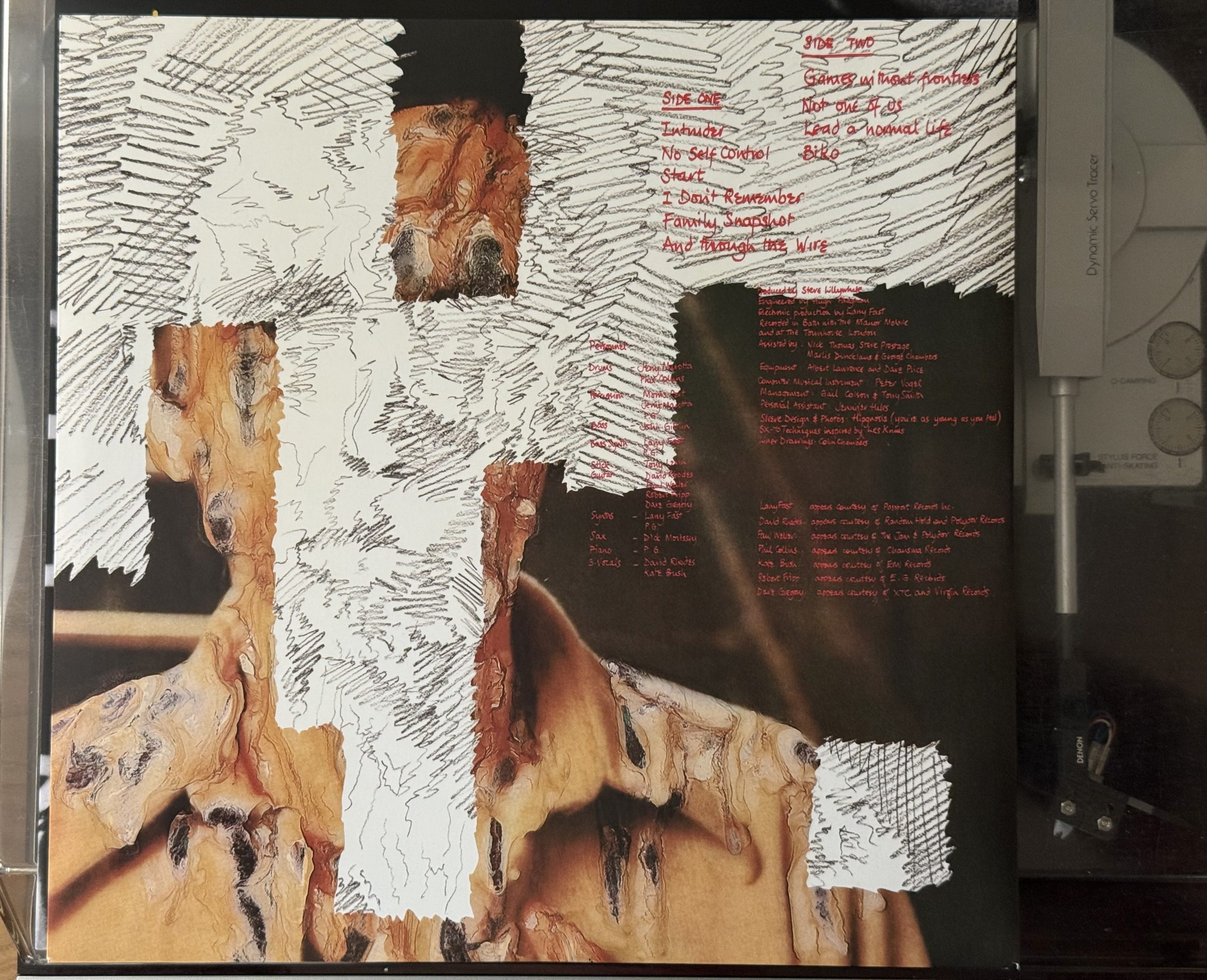
Part of the magic of the album was the cast of musicians. In addition to Collins, the core band of Tony Levin, Jerry Marotta and Larry Fast were all back, joined by David Rhodes, recently of Random Hold. Robert Fripp was out of the producer’s chair but still contributed hot solos on three of the tracks; also in the guest guitarist chair were Dave Gregory of XTC and Paul Weller of The Jam. Jazz artist Dick Morrissey brought saxophone to a number of the tracks. John Giblin, who had joined the British jazz-fusion band Brand X alongside Collins, played a fair amount of electric bass on the album. And appearing on two tracks with guest vocals was Kate Bush (who we briefly met at the end of our discussion of Peter Gabriel 1); at age 21 she had two albums under her belt (including a Number One hit in the UK), and was working on her third.

All together the musicians produced a recording that, while met with puzzlement by Atlantic Records (who distributed Peter’s music in the US and ultimately passed on the release, causing him to switch to Mercury Records), stands as one of his most original and enduring. Let’s dive in.

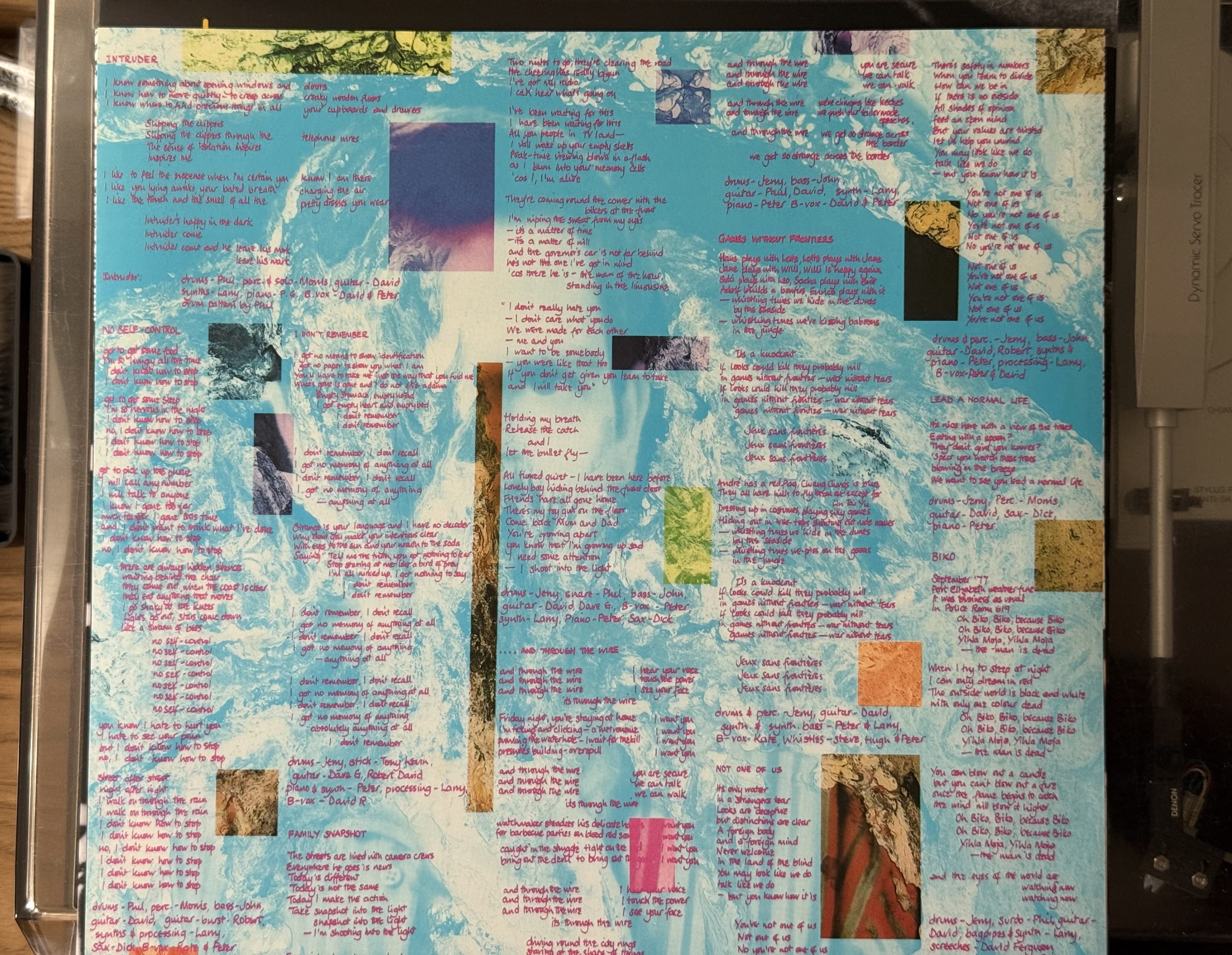
Intruder” (with Collins on drums) brings forward all the unique aspects of Gabriel’s songwriting that defined this album: the heavy rhythmic focus, the paranoia and alienation, and the painstaking focus on aural textures. Opening with that immense gated reverb sound in the drums, Gabriel’s narrator confesses to disturbing crimes: “I know something about/Opening windows and doors… Slipping the clippers/Slipping the clippers through the telephone wires.” There’s a new sense of artistic confidence in Peter’s voice; the lyrics are terse, the chords stabbing, and that thunderous drum sound all combine to terrifying effect, culminating in the final verse: “I like to feel the suspense/When I’m certain you know I am there.” Also noteworthy is the percussion part in the midst of the song; Peter has said that he was hugely influenced by Steve Reich’s Music for 18 Musicians and its marimba textures, and the sound of the marimba would feature at several other key points in the album (here played by composer Morris Pert, who had also spent some time in Brand X). The whistled melody at the end is the chilling cherry on top.

No Self Control” opens with a guitar hook that is panned hard in the stereo mix, alternating between the left and right channels, courtesy Robert Fripp. But the main story of the song is the textures behind the verse: Pert’s marimba, wordless choruses of backing vocals from Kate Bush, an unassuming piano part, and then going into the chorus a massive build up in Phil Collins’ gated snare that sounds like the apocalypse arriving. The lyrics reference compulsive behavior (“Got to get so food, I’m so hungry all the time… Got to get some sleep, I’m so nervous in the night/And I don’t know how to stop”), but the real story may be the connecting thread of implied violence in a relationship, picking up where the last verse of “Intruder” left off: “You know I hate to hurt you, I hate to see your pain/But I don’t know how to stop, I don’t know how to stop.” The song is a superb miniature where all the parts work together

We get a breather from the intensity thanks to the jazz interlude of “Start,” which combines synthesizer and sampling keyboards with a grade-A rock saxophone solo from Dick Morrissey. It builds up to a hard cut into “I Don’t Remember,” powered by Jerry Marotta’s thudding backbeat and a killer guitar sound from Dick Gregory, alongside Tony Levin’s Chapman Stick and a falsetto vocal intro that seems equally influenced by disco and Middle Eastern chant. More alienation here, with verses that could be read both as immigration to a strange land and to interpersonal communications breakdowns: “Strange is your language and I have no decoder/Why don’t you make your intention clear/With eyes to the sun and your mouth to the soda/Saying, ‘Tell me the truth, you’ve got nothing to fear.’”

Family Snapshot” puts us in the mind of an assassin with a twist. There’s a quiet introduction on the keyboard as the narrator surveys the crowded street awaiting the arrival of his target, and anticipating becoming part of the story: “Today is different/Today is not the same/Today I make the action/Take snapshot into the light… I’m shooting into the light.” The band takes off with excitement as the action deepens: “The governor’s car is not far behind/He’s not the one I’ve got in mind/‘Cause there he is, the man of the hour/Standing in the limousine.” It’s at this point that the song takes a twist as the narrator makes it clear his action has nothing to do with his feelings about his target, but about being abandoned and anonymous. By shooting his victim, he reclaims some part of his own narrative, even through infamy. And then the final twist: “All turned quiet, I’ve been here before/A lonely boy hiding behind the front door… Come back mum and dad/You’re growing apart, know that I’m growing up sad.” Gabriel would later write honest songs about the pain in his relationship with his father; here for the first time he explores that dynamic of interpersonal relationships leading to tragic outcomes in one five-minute epic. It’s deeply moving and instantly memorable. Small wonder that when Gabriel’s nascent Internet fan club asked members to write in their favorites for his 2001 WOMAD performance in Redmond, Washington, that this song made the cut.

And Through the Wire” stays focused on relationships, this time through the lens of communication and introduced by the crunch of Paul Weller’s guitar lead. Though it has the sharper focus and songwriting characteristic of this higher level of Gabriel’s artistry, its combination of 7/4 and triple meter is a reminder of his progressive rock roots. But with that insane guitar and Marotta’s drumming, you hardly notice the rhythmic complexity. It’s a breath following “Family Snapshot” and an effective closer for a stunning Side 1.

Side 2 doesn’t let up, either. Peter counts in the intro and “Games Without Frontiers” kicks off with a vaguely disco-feeling drum machine, heightened by the combination of David Rhodes’ lead guitar, Marotta’s percussion and, most of all, Kate Bush’s high backing vocals as she sings “jeux sans frontières.” The lyrics are playful with an undercurrent of menace as “Hans plays with Lotte/Lotte plays with Jane” yields to “Adolf builds a bonfire/Enrico plays with it.” But it’s all somehow danceable and weirdly singable, and it yielded his first top 10 UK hit.

Not One of Us” starts with Peter’s ululating vocals and a Robert Fripp guitar solo that sounds like shredded glass. John Giblin’s bass is a lead character in the song as Peter sings about racism, first telling the immigrant “A foreign body and a foreign mind/Never welcome in the land of the blind,” then telling the racist “All shades of opinion feed an open mind/but your values are twisted.” Between the two verses, the chorus—“You may look like we do, talk like we do/But you know how it is/You’re not one of us”—inverts its meaning. In the coda, the last minute-plus of the song becomes a monster driven by a massive four-note hook in the guitar and bass and Jerry Marotta’s frenetic, polyrhythmic drumming. It’s among the most intense music Peter had ever created to that point, and he would return to it later in the 1980s.

After the climax, “Lead a Normal Life” seems to offer a respite in the cool tones of Morris Pert’s marimba. But the marimba pattern refuses to settle in tonality, playing on an open fifth indefinitely, and the synth lead is similarly unsettled, wandering past but never landing on the tonic. A distorted cry accompanies the bridge but then we return to the music of confinement, which repeats three times and then suddenly drops into tonality. But what initially sounds like a refuge reveals itself to be even more of a trap: “It’s nice here with a view of the trees/Eating with a spoon, they don’t give you knives/‘Spect you watch those trees blowing in the breeze/We want to see you lead a normal life.” And the menacing music of what is now revealed to be an institution returns, with a reprise of the distorted cry, with guitar distortion that subliminally builds in the background into a constant weeping. It’s masterful and deeply discomforting.

The final track, “Biko,” prompted Ahmet Ertegun’s other unfortunate comment about the album: “What do people in America care about this guy in South Africa?” Peter had been deeply moved by the story of the death of anti-apartheid activist Steve Biko in the custody of the South African police in 1977, and wrote the final song of the album as a eulogy. It opens with an excerpt of “Ngomhla sibuyayo” and segues into a massive two-tone drumbeat on the Brazilian Surdo drum (played by Collins), with an emphatic David Rhodes guitar drone above which Peter sings about Biko’s death: “September ’77, Port Elizabeth weather fine/It was business as usual in Police Room 619.” He sings in Xhosa “Yila moja” (Come Spirit), invoking the continued presence of Biko’s cause even as he sings “The man is dead” over the sounds of bagpipes. In the last verse he warns, “You can blow out a candle/But you can’t blow out a fire/Once the flames begin to catch/The wind will blow it higher… And the eyes of the world are watching now.” This first Western protest song against the inhumanity of the South African apartheid system would have been sufficiently noteworthy; its incredible anthemic quality and singability made it a totem of a new movement.

Gabriel found his voice on this third self-titled album, and found a connection to the broader outside world. “Biko” in particular led to performances with Amnesty International later in his career, but it would also bring him into contact with a world full of musicians who would radically shape his music even as he brought them to wider attention. We’ll explore some of those connections in a few weeks. But next week we’ll listen to the work of a future Gabriel collaborator who brought a different kind of artistic sensibility to the unlikely world of pop music.

You can listen to this week’s album here:

BONUS: Peter had found German audiences receptive on his late-1970s tours, apparently, because he did a version of Peter Gabriel (1980) in German, with him singing translated lyrics over the original backing tracks from the album. Here’s “Keine Selbskontrolle”:

BONUS BONUS: “Biko” became an enduring part of Peter’s musical legacy and has been played many, many times live. Here’s an early one from the very first WOMAD festival in 1982 (about which, more later…):

BONUS BONUS BONUS: Peter’s 2010–2013 project of cover songs yielded a bunch of fascinating Peter Gabriel cover versions of some great songs (Scratch My Back), and some reciprocal covers. In exchange for Peter’s cover of the Talking Heads song “Listening Wind,” David Byrne recorded this fascinating take on “I Don’t Remember” which led off the compilation And I’ll Scratch Yours:

Peter Gabriel, Peter Gabriel 2 (1978)

The second PG album finds him experimenting, with sometimes thrilling and sometimes uneven results.

Album of the Week, March 7, 2026

Looking back at Peter Gabriel’s career, some of the consistent themes are perfectionism and painstaking deliberation. We’re talking about a performer who went from 2002 (Up) until 2023 (I/O) — 21 years between releases of original music. (There was other music of merit in that period, but that’s a different story.) So it comes as a surprise to realize that Peter Gabriel’s second album was released only 15 months after his first. Almost all of that is due to his choice of producer for the second album: Robert Fripp.

Fripp was starting to transition in his career from sideman (most notably for David Bowie on “Heroes”) and leader of the intermittently active King Crimson to producer, on the strength of his ingenious guitar work and technological inventiveness (the unique “Frippertronics” system, the first live looping solution for performers, is the best known example). Peter was looking for a specific sound texture, and brought musicians to the record who could provide it, like the redoubtable Tony Levin, drummer Jerry Marotta, and synth player Larry Fast, all of whom would appear in more PG albums. He also admired Fripp’s more improvisational and brisk working methods; he’s said about the album, “Robert Fripp was very keen to try speeding up my recording process, as many people have been since and failed, but he got closest to it.”

Unusually, the album is the second to be titled Peter Gabriel; Gabriel felt this allowed more attention to be paid to the album artwork by design house Hipgnosis (who also shot the “rainy windshield” on Peter Gabriel (1977)). I’ve also read that he thought of it almost like a magazine or periodical—“here’s the latest Peter Gabriel.” Looking at the entire discography, it’s clear he was never much of a fan of album titles, as we’ll see.

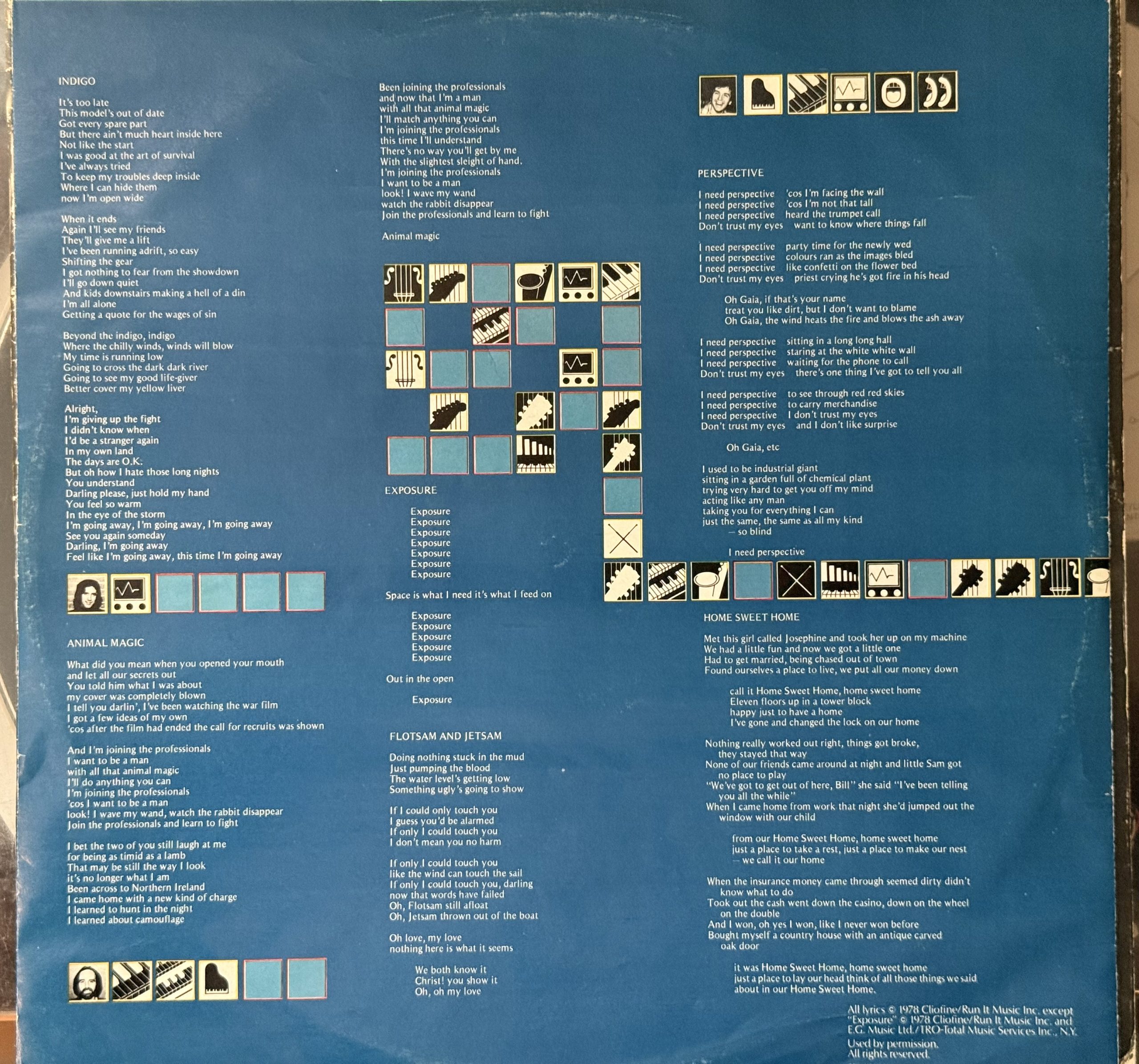
On the Air” starts in a very different sonic landscape from where PG1 left off. Bright synthesizer lines lead to muscular guitar and bass, backed up by the massive drums of Jerry Marotta. The song is a straightforwardly driving 4/4 until the chorus, which drops into 6/8 for a few bars. And the vocals, while rough—you can hear the strain in his high notes, and his sometimes sandy tenor sounds thin and scratchy—are exciting, especially as he soars up the lines of “on the air” in the chorus. Lyrically, the subject—Gabriel’s Mozo character building a radio transmitter so that he can project his psychic energy out to the world—is obscure but the writing is taut: “Built in the belly of junk by the river my cabin stands/Made from the trash, I dug off the heap with my own fair hands/Every night I’m back at the shack and I’m sure no one else is there/I’m putting the aerial up so I can go out on the air.”

D.I.Y.,” driven by a throbbing Tony Levin line on the Chapman Stick, is even more tautly wound. Gabriel says he was listening to punk and new wave at this time, and this song shows the influence even though it’s in 5/4 and has a complex chord change in the pre-chorus. It’s another song dealing with the aftermath of his time in Genesis: “You’re still looking for the resurrection/Come up to me with your ‘What did you say?’/And I’ll tell you, straight in the eye.” It’s short and pointed and a great song.

Mother of Violence” is the only song in Peter’s work with a writing credit by his then-wife Jill. It’s a quiet tune with unusual instrumentation—pedal steel, acoustic piano—and a vocal that sounds a bit like late-1970s Phil Collins and ends with vocalese. It’s all in service of a lyric about difficult family relationships that is one of the more fraught bits of writing on the album.

A Wonderful Day in a One-Way World” is an odd bit of a song, with a vocal that sounds a bit like a scratch take and a slightly proggy reggae feel, and a lyric that is reminiscent of some of the odder corners of Paul Simon, particularly in the dialog with the old man in the second verse. But it also has some of the better vocal harmonies on the album in the chorus, so that’s something in its favor at least. It’s followed with the frustratingly opaque “White Shadow,” which marries an instrumental track that could have been at home on late-1970s Genesis, circa …And Then There Were Three…. The first verse starts promisingly enough—“Ten coaches roll into the dust/Chrome windows turned to rust”—but then we’re rhyming “spirit died” with “Kentucky Fried.” Fripp’s guitar solo at the end is a thing of beauty, though, in duet with Tony Levin’s increasingly virtuosic bass, and there are hints of a synthesizer sound played by Peter that would become an increasingly familiar backdrop in his other albums.

Indigo” is a piano-driven ballad with recorder and pedal steel, a story of an elderly man coming to terms with his impending death. The track seems to have a bunch of different ideas that never quite cohere, but the vocal is one of the finer on the album technically, with properly prepared high notes and controlled dynamics adding to the emotional affect. That’s a contrast with “Animal Magic,” which has one of the rougher vocals on the album and a lyric about proving manhood by becoming a soldier, and an anonymous guitar solo that sounds a bit like generic ’70s rock.

Exposure,” though, is one of the key sonic pieces on the album. Driven by a mean locked in groove from Levin and Marotta, the main event here is the Frippertronics and Peter’s repeated chants of “exposure… space is what I need…” It’s the groove, though, that feels the most like a Peter Gabriel song, and we’ll hear it again in many other contexts.

Flotsam and Jetsam” is a song of lament for a failed relationship. It’s competently written but ultimately forgettable, thanks in part to indifferent vocal recording featuring one of the few instances of an echo or reverb on the album which only serves to underscore the brevity of the song. Peter seems rather in a hurry to get on to “Perspective,” which feels a bit like a downtown 1970s New York number complete with saxophone on the chorus and a repeated “I need perspective” on the verses. Gabriel sings from the perspective of an industrial businessman to his former lover, who may or may not be the earth (“Oh Gaia, if that’s your name/Treat you like dirt, but I don’t want to blame…”)

That leads us to “Home Sweet Home,” which frustratingly sums up all the off characteristics of this second album. The songwriting feels a bit like Peter’s version of Randy Newman (last heard on “Waiting for the Big One”), the pedal steel seems like we’re in a country song, and we have another one of the indifferently recorded scratch vocals. And it’s about a man whose wife commits suicide, killing his child at the same time; despairing, he gambled with the insurance check and won big, buying a country home far away from his eleventh floor walk-up. The last verse features one of Peter’s most challenging-to-listen-to vocals, as his high vocal obbligato provides an impression of the man’s wordless sobs. It feels dark in an exploitive way. We will get much more earned dark passages in future albums, but here it feels like he’s trying on someone else’s pain.

Ultimately 1978’s Peter Gabriel is a frustratingly uneven album. There are some great songs—both “On the Air” and “D.I.Y.” are in the canon of his greatest songs, and “Exposure” is affecting, but many of the others suffer from the rapid approach to recording and writing. He took more time on the next record, and it showed. We’ll listen to that one next time.

You can listen to this week’s album here:

BONUS: Fripp connected a series of albums that he produced in the late 1970s, including Peter Gabriel, Daryl Hall’s Sacred Songs, and his own debut solo album Exposure, as a loose trilogy. He re-recorded “Exposure” for the latter album, and it’s … really something, thanks to vocals by Terre Roche of the Roches:

BONUS BONUS: The band for this tour, with Sid McGinnis in for Fripp, was a tight machine. Here’s a German performance of “On the Air” from 1978 that shows Peter had been watching punk acts: