Album of the Week, September 19, 2026
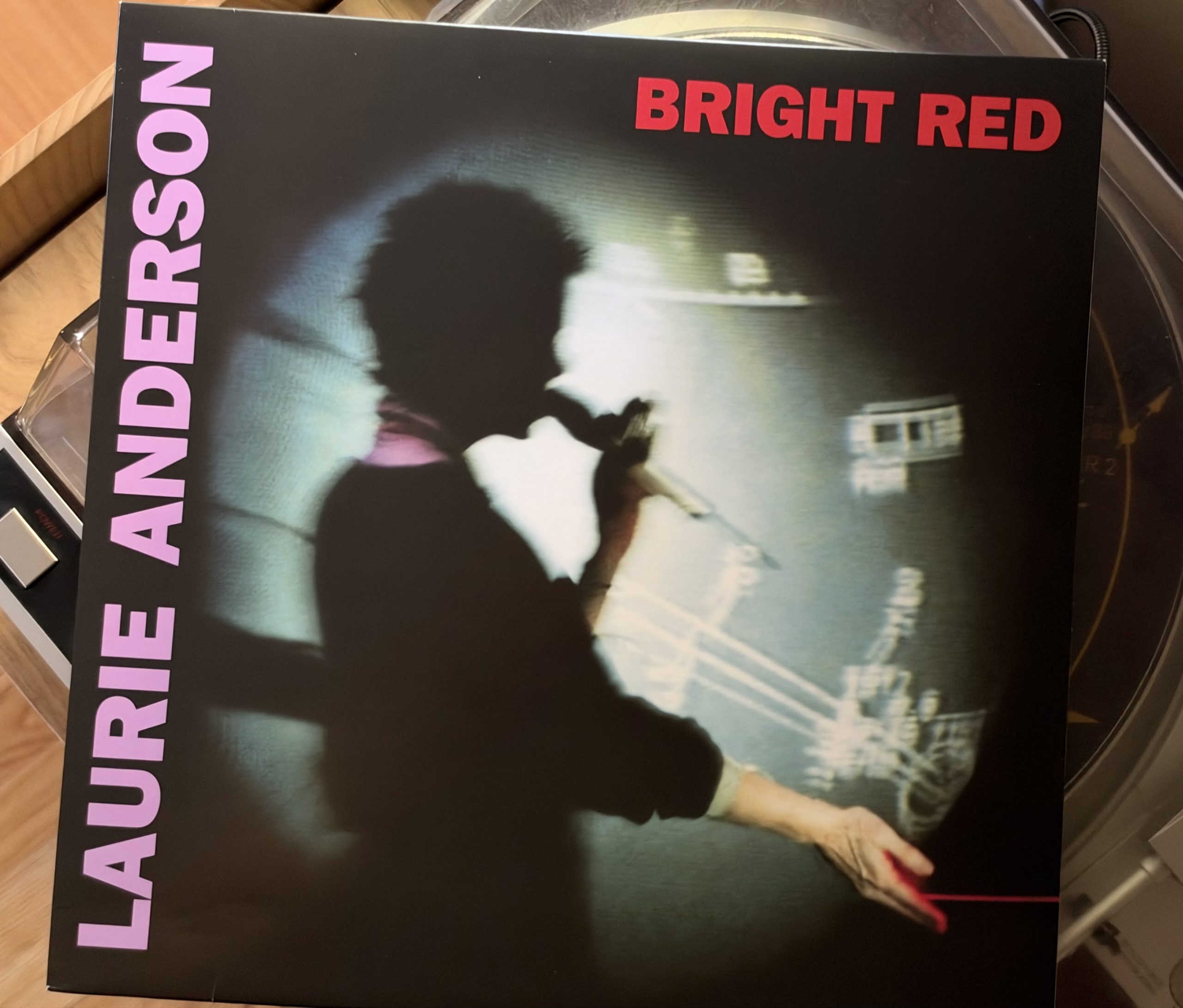
For all the brilliantly trenchant observations that Laurie Anderson made in her 1980s recordings, there was one topic that was rarely the focus of her songs. Though “O Superman” had the military-industrial complex and the doomsday clock wired into its synthesized “ah ah ah,” the United States had not been in outright war during the entirety of her recorded career. That changed abruptly in January 1991 with the commencement of Operation Desert Storm and what eventually became known as Gulf War I.
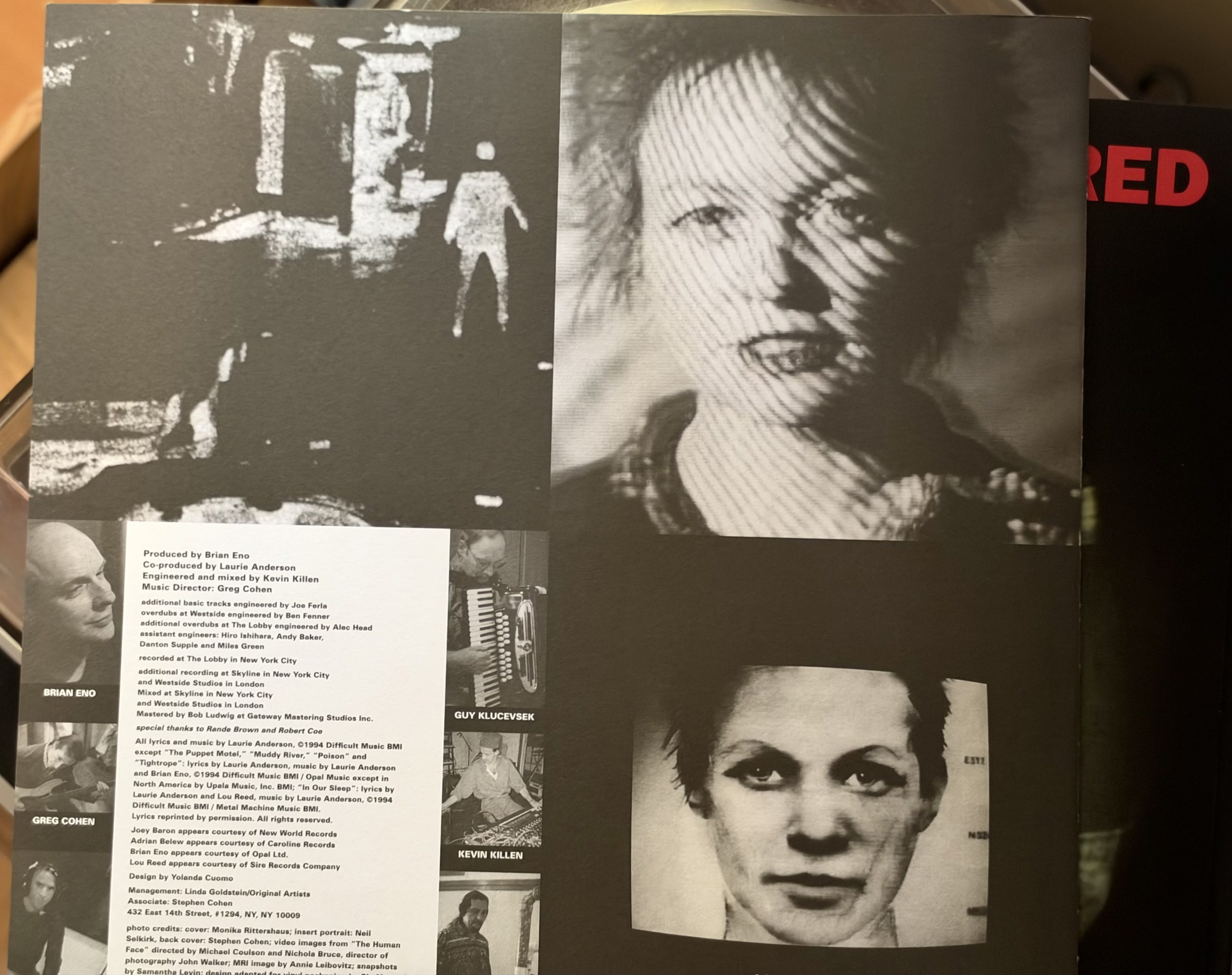
That conflict, and the questions it immediately posed about the lethality and morality of technological war, looms at the heart of Bright Red, alongside reflections on more personal types of grief and loss. Accordingly, Laurie chose a more stripped down sound with fewer instruments; the record is made with a relatively smaller number of collaborators, including percussionist Cyro Baptista, drummer Joey Baron, bassist Ben Fenner, guitarists Gerry Leonard, Greg Cohen, Jamie West-Oram, Adrian Belew, and Marc Ribot, and accordionist Guy Klucevsek However, producer Brian Eno, whose electronics amplify, stretch, and alter the sounds on the record, is the single biggest influence on the sound of the record, even factoring in a special guest on Side 2.

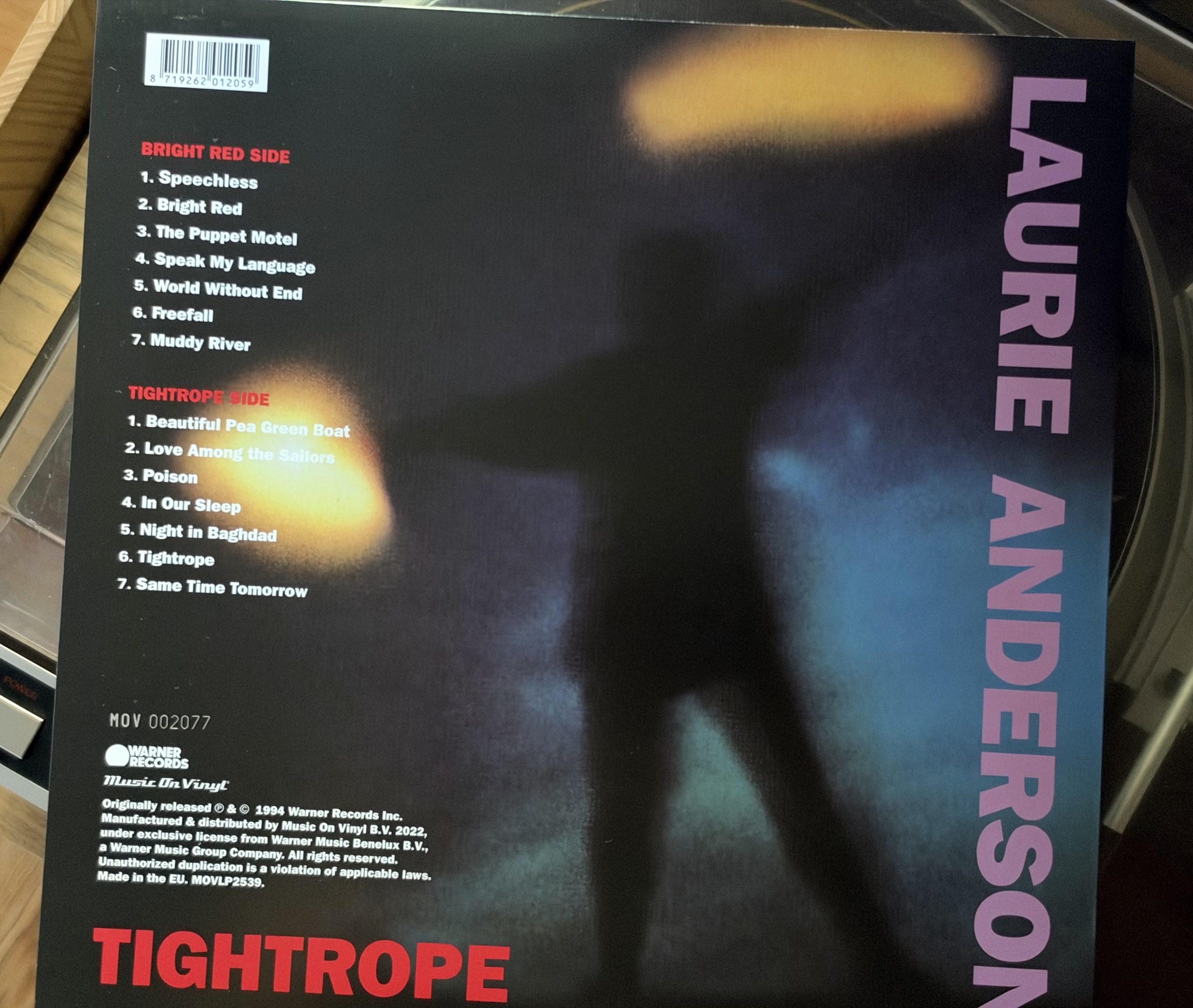
“Speechless” sets us down in martial territory right away, with Laurie’s voice accompanied only by a sharp snare roll as she tells the story of a woman out for a fast, hard joyride with her lover. We gradually get the feeling that this isn’t a happy relationship: “You did all the talking and me / I didn’t make a sound / If I open my mouth now / I’ll fall to the ground.” Laurie names her reference in the chorus, a short story by Annie Dillard about an eagle who was found dead with the skull of a weasel hanging onto its neck. Like Dillard, Laurie imagines the weasel hanging on for dear life even in death as she contemplates the narrator’s place in the relationship: “And me? I’m going in circles / I’m circling around / And if I open my mouth now / I’ll fall to the ground.” The music circles ominously around the tonic throughout the whole song, never getting off the ground.
“Bright Red” floats its narrative over a bed of electronics, as Anderson and Arto Lindsay alternate the words of each verse: “Did” “she” “fall” “or” “was she” “pushed.” There’s a menace in the song, especially in the second verse: “Come here, little girl, get into the car. It’s a brand new Cadillac, bright red.” There is a sense of non-specific threat underpinning the song, and the quotation from Isaiah, about the desolation of Babylon, does not clarify it:
“Puppet Motel” is built off a nasty riff, snare and bass distorted and edgy under Laurie’s manipulated vocals. The lyrics play out a series of dystopian future images, with the “puppets” “having virtual sex, eating virtual food/no wonder these puppets/are always in a lousy mood.” The theme of alienation induced by modern technology is clear, but I’ve always connected this song to a more specific literary dystopia, William Gibson’s cyberpunk Sprawl stories. The puppet parlors like the House of the Blue Lights, in which humans serve as prostitutes disconnected from their bodies via neural cutouts, seem like a clear forerunner to the Puppet Motel. And if we are the puppets, Anderson seems to ask, what are we allowing ourselves to do while our conscious minds are dulled and distracted by technology?
“Speak My Language” is one of two songs on the album to have previously appeared, in substantially altered earlier forms, on the soundtrack to Wim Wenders’ Faraway, So Close! The album version is built atop a spare percussion loop, with timpani and snare building the foundation for the bass to slide ominously beneath Laurie’s vocals and a wistful accordion: “Daddy, daddy/It was just like you said/Now that the living/Outnumber the dead.”
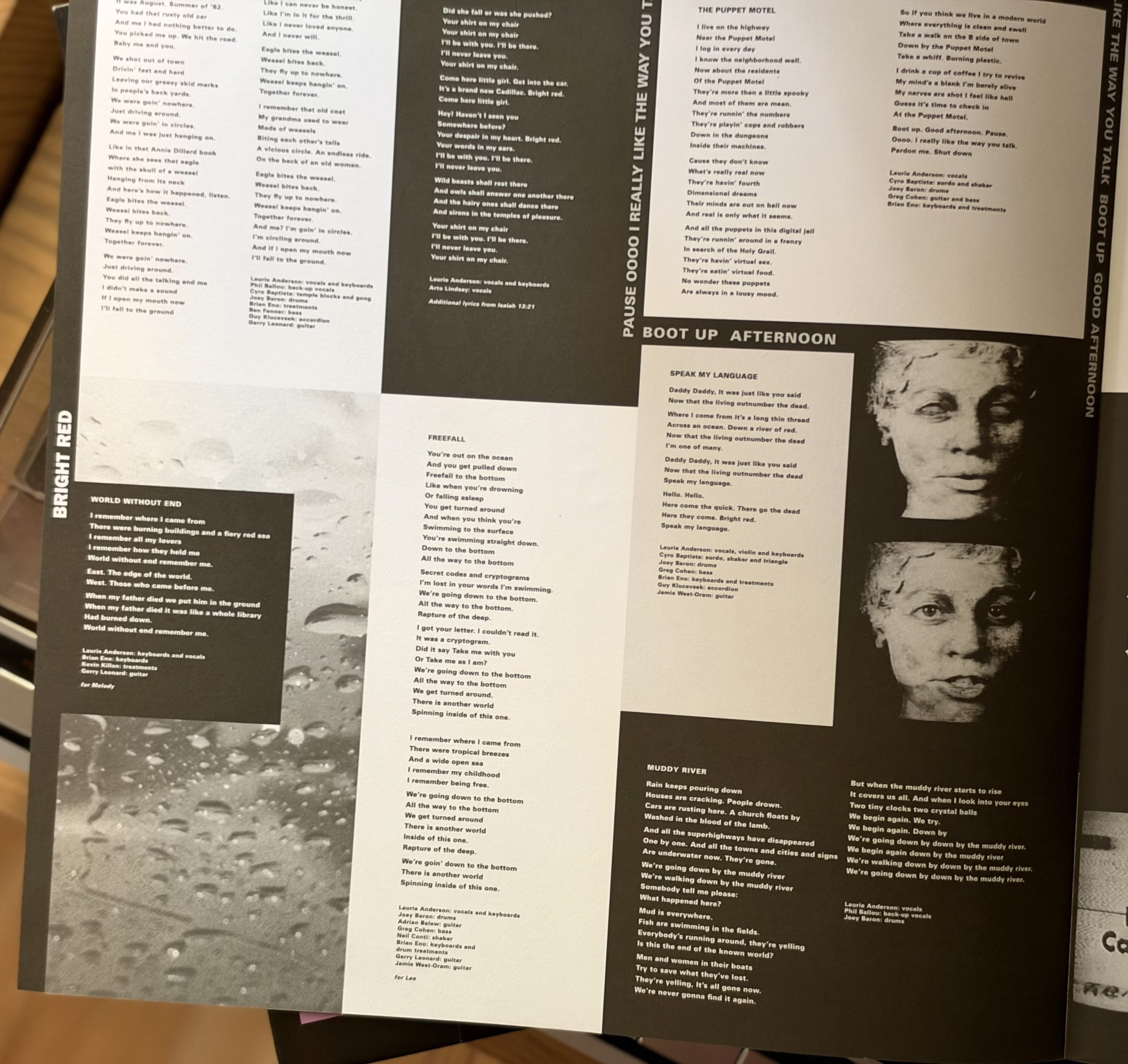
“World Without End” lands its anxiety in both an apocalyptic landscape (“I remember where I came from/There were burning buildings and a fiery red sea”) and a more direct grief, the death of a parent. The lines “When my father died we put him in the ground/When my father died it was like a whole library burned down” locate both a deeply specific grief and a broader civic mourning. It’s tempting to read this now as a response to the unthinking “patriotic” embrace of high-tech warfare in Gulf War I, especially given the “fiery Red Sea” reference.
By contrast, “Freefall” is a more figurative disorientation, with the narrator pulled into a vortex, “drowning in the deep.” This one seems a more personal disconnection, a literal alienation: “I got your letter, I couldn’t read it / It was a cryptogram / Did you say ‘take me with you’? / Or ‘take me as I am’?” The Brian Eno ambient soundscape below again builds from percussion, with thin threads of guitar and spare synths building out the landscape underneath. The conflation of disasters physical and personal carries into the last track on the first side. Two years after Hurricane Helene, I still have trouble listening to “Muddy River”; its evocation of an apocalyptic flood is both uncomfortably vivid and wholly inadequate compared to the devastation of the real thing. Laurie’s sudden cut to the human scale—“But when the muddy river starts to rise / It covers us all / And when I look into your eyes / Two tiny clocks, two crystal balls”—locates us away from the global apocalypse and into the mere tragedy of a human landscape ending. As though there is anything “mere” about the end of relationship, of “the known world.”
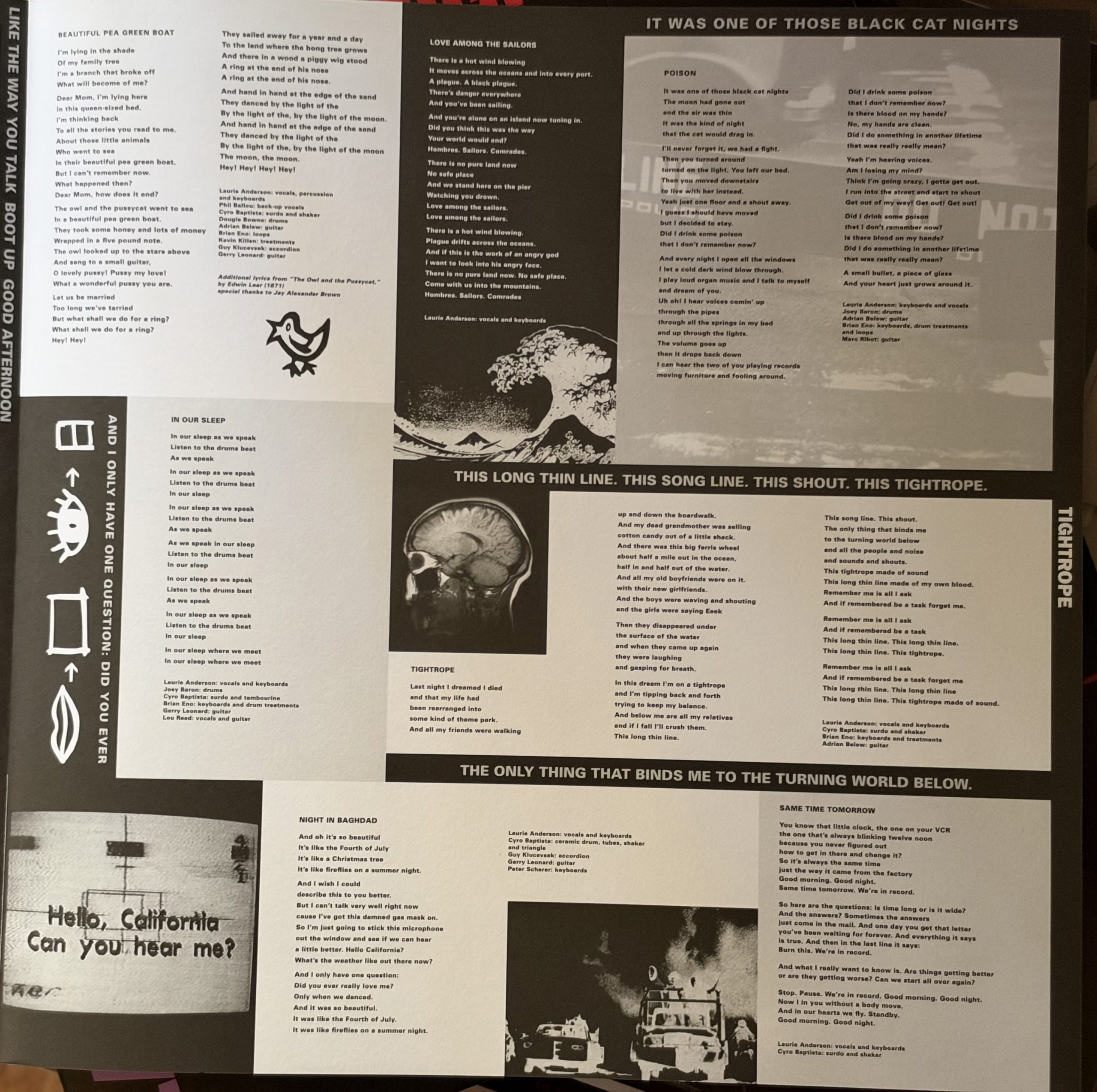
As the record flips, Laurie thankfully lightens the mood in “Beautiful Pea Green Boat.” Though the alienated mood persists, the alienation is relocated from personal relationships to childhood, as she muses “I’m lying in the shade of my family tree / I’m a branch that broke off.” She recalls her mother reading her stories, and then quotes almost the entirety of Edward Lear’s “The Owl and the Pussycat,” omitting only the three couplets regarding the marriage of the Owl and the Pussycat and their dining on “mince and slices of quince.” Omitting or perhaps forgetting, as the lyric says during the introduction: “I can’t remember now / What happened then / Dear Mom, how does it end?” The narrator can’t allow her childhood memories to surface a happy ending, even the ending of Lear’s story. But the arrangement subverts Anderson’s glum mood, particularly Guy Klucevsek’s accordion. (And yes, the insanely distorted guitar sound that closes out the song is courtesy none other than Adrian Belew!)
“Love Among the Sailors” tells the story of a “hot wind blowing… [that] moves across the oceans and into every port / A plague.” Laurie’s song mourns the loss of the love among the sailors, who, Walt Whitman-like, are referred to as “hombres. Sailors. Comrades,” and who are taken by the plague. Laurie continues to process the death of artistic colleagues from AIDS, angrily challenging the fundamentalist Christian view of the plague as divine retribution: “And if this is the work of an angry God/I want to look into his angry face.” The anger continues on a more interpersonal level in “Poison,” as the narrator marvels at her anger over a lover who leaves her to move in with her downstairs neighbor: “I can hear the two of you playing records / Moving furniture and fooling around / Did I drink some poison that I don’t remember now? … Did I do something in another lifetime / that was really, really mean?” The narrator reflects on the pain and anger that stay deep within her: “A small bullet, a piece of glass / And your heart just grows around it.”
“In Our Sleep,” by contrast, brings us into a new relationship, a new heartbeat, as mantralike Anderson repeats “In our sleep, as we speak/Listen to the drums beat/As we speak” in duet with the guitar and voice of Lou Reed. The two had met in 1992 at a festival curated by John Zorn and had started to collaborate; this record represented the first of their joint performances to be issued, the year Lou’s divorce from Sylvia Morales became final and a full fourteen years before Laurie married him.
The moment of peace transitions into the electronic cricket noises of “Night in Baghdad,” which borrows sounds from earlier in the record (the sighs of “Speak My Language”) as well as from earlier in her career (the bass line of “Sharkey’s Night”) as the heartbeat underneath a journalist’s report from the Gulf War. “It’s so beautiful/It’s the Fourth of July/It’s like a Christmas tree/It’s like fireflies” the narrator says of the explosions in the sky, before turning “I wish I could describe this to you better/But I can’t talk very well right now/Because I’ve got this damned gas mask on.” She transitions from the war to the personal as she asks: “Did you ever really love me? Only when we danced. And it was so beautiful. It was like the Fourth of July. It was like fireflies…”
The heartbeat slows and transitions to “Tightrope,” the longest of the songs on the record and the most evocative. Over a Brian Eno soundscape, Laurie opens the song with a dream of death, in which the narrator’s life is represented as a theme park with a boardwalk and a massive Ferris wheel that sweeps its passengers (Laurie’s old boyfriends, “with their new girlfriends”) under the water as it turns. She is herself perched high above on a tightrope, above her relatives, and fears that if she takes a wrong step, “if I fall / I’ll crush them.” She feels keenly the temporariness and thinness of her connections: “This long thin line. This song line. This shout / The only thing that binds me to the turning world below… This tightrope made of sound / This tightrope, made of my own blood.” This precarious image would seem to be a likely place to end the song—and in fact, in the first version on Faraway, So Close!, the song ends here. But this version carries on, having founds some peace with the precariousness of existence and with the ending of her relationships, as Laurie paraphrases the William Percy French poem, “Remember me is all I ask / And if remembered / Be a task / Forget me.”
The album closes with one more glimpse of the challenges of technology, here more humorous, in “Same Time Tomorrow.” She ponders the question of progress, describing a clock stuck blinking twelve noon and asking “Is time long, or is it wide? What I really want to know is, are things getting better or are they getting worse?” A live version of the song then recapitulates apocalyptic quotations from the “Bright Red” side of the record, but on the record, she cryptically quotes the seventeenth-century poet George Herbert: “Now I in you without a body move,” adding “and in our hearts, we fly,” leaving us to decide whether the apocalypse has a happy ending.
Bright Red channels all sorts of images—the death of a parent, the AIDS epidemic, war, flood, the eagle and the weasel—into a convincingly powerful portrait of lost love that bristles with connections to the universal. It’s a body blow of a record and one that may stand as an artistic high point among many in Laurie’s discography. She continues to record—I particularly enjoy the follow-up to Bright Red, her spoken-word recording The Ugly One with the Jewels—but for me these first four albums are the heart of all her output. Next week we’ll hear a milestone album from another Peter Gabriel collaborator.
You can listen to this week’s album here:
BONUS: A different version of “Tightrope” was featured in the film Faraway, So Close, Wim Wenders’ sequel to Wings of Desire. Like his Until the End of the World, the soundtrack is a marvel and worth seeking out on its own merits. (The soundtrack also features an alternate version of “Speak My Language” which I can’t find on streaming services).
BONUS BONUS: Laurie’s touring show in 1994-1995 was “The Nerve Bible.” There was a companion book, Stories from the Nerve Bible, that was a retrospective of her entire career to that point. I took my wife Lisa while we were first dating to see the show at the Kennedy Center, which is how we discovered her dislike for Laurie Anderson performances. (It was a great show.) This video purports to be a recording of the full show from its 1995 date in Kansas City, Missouri: