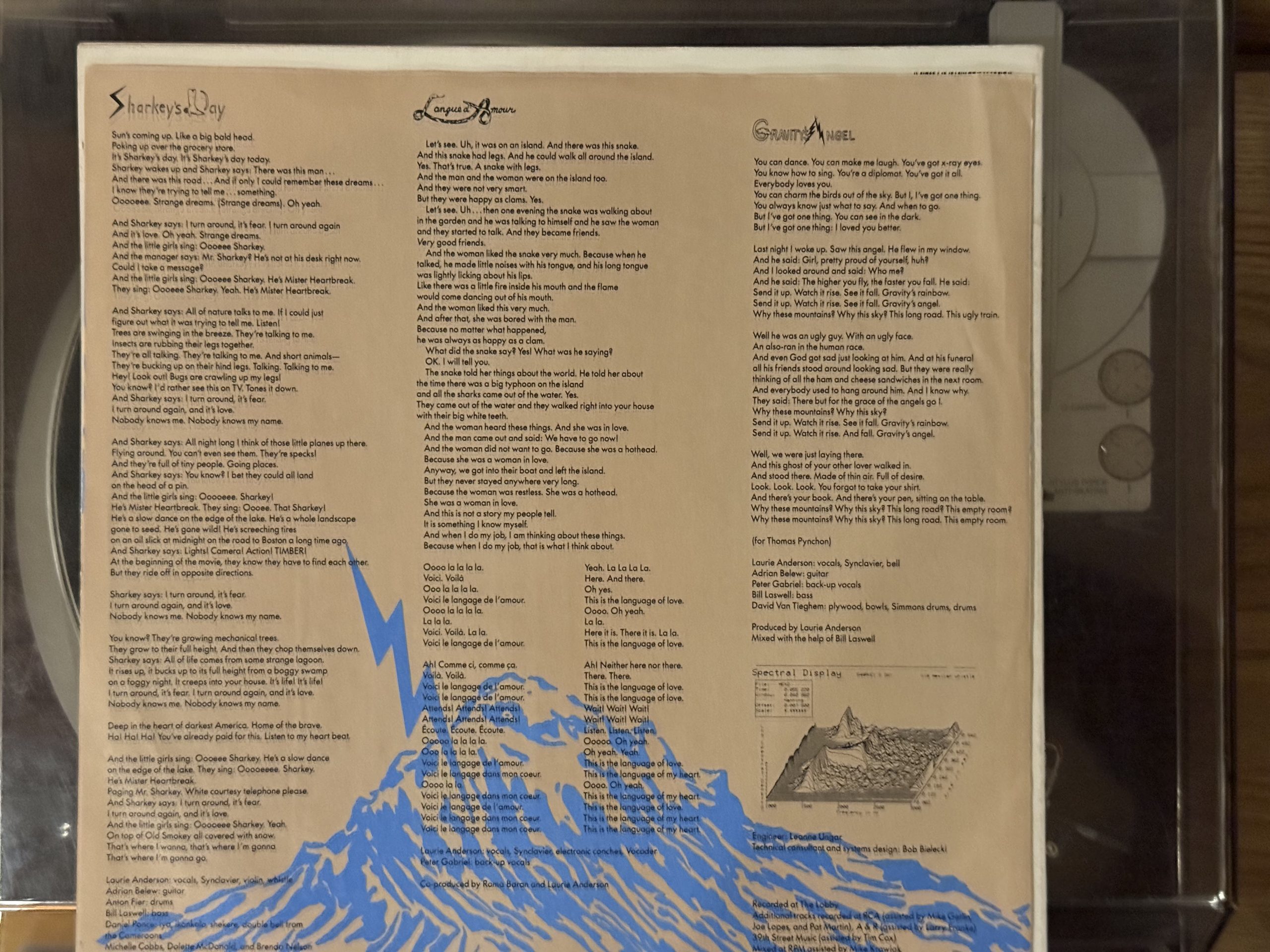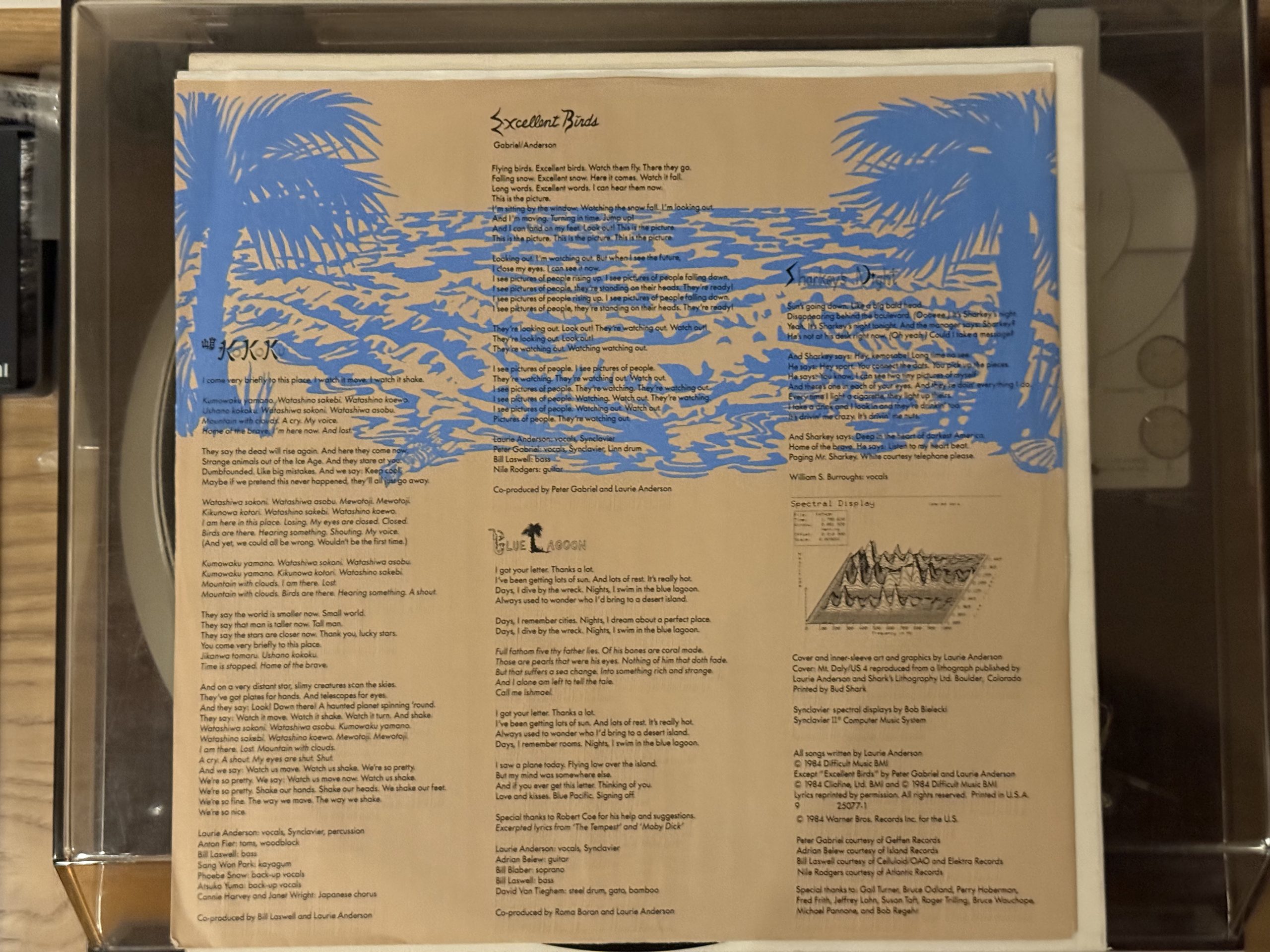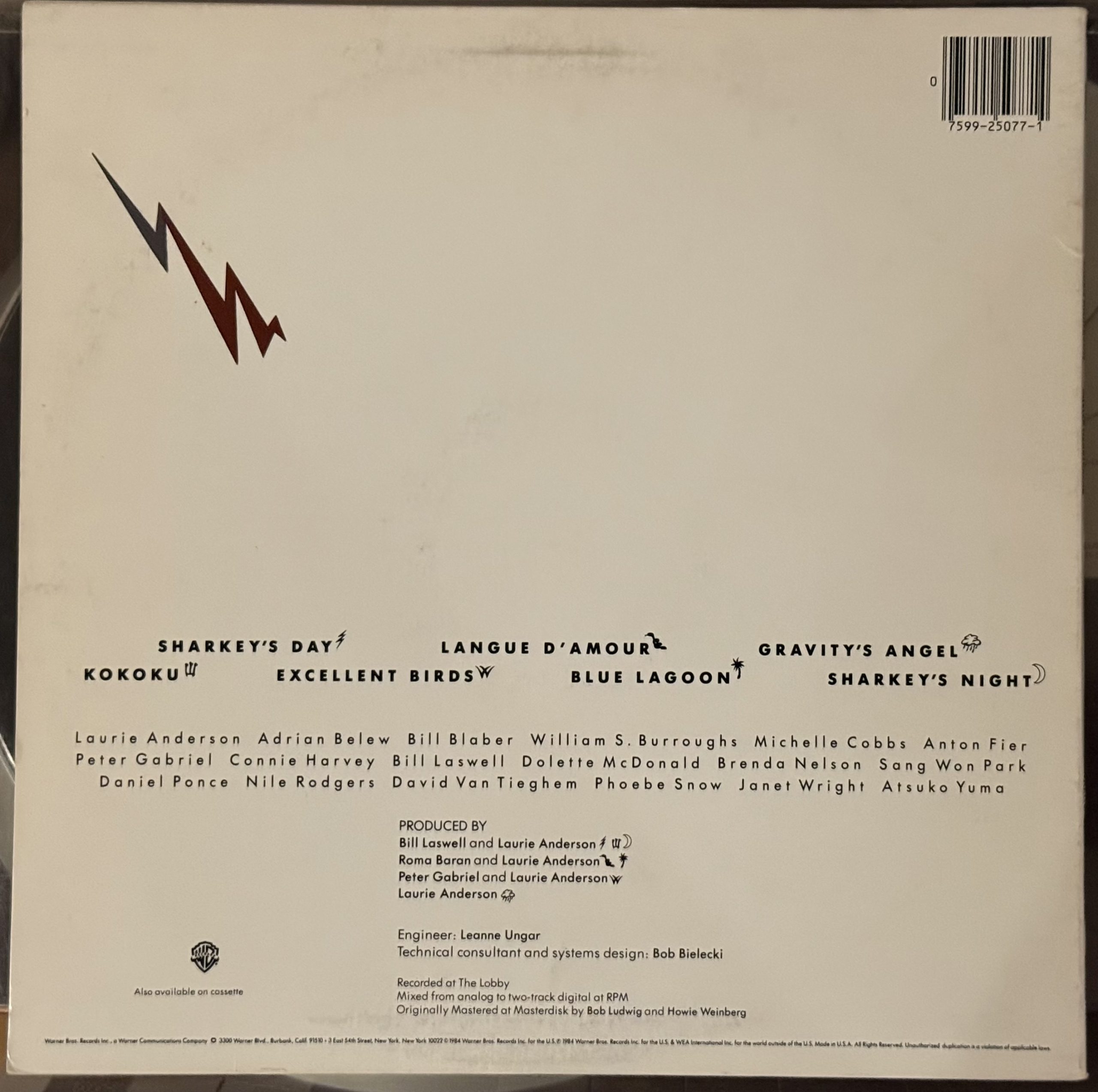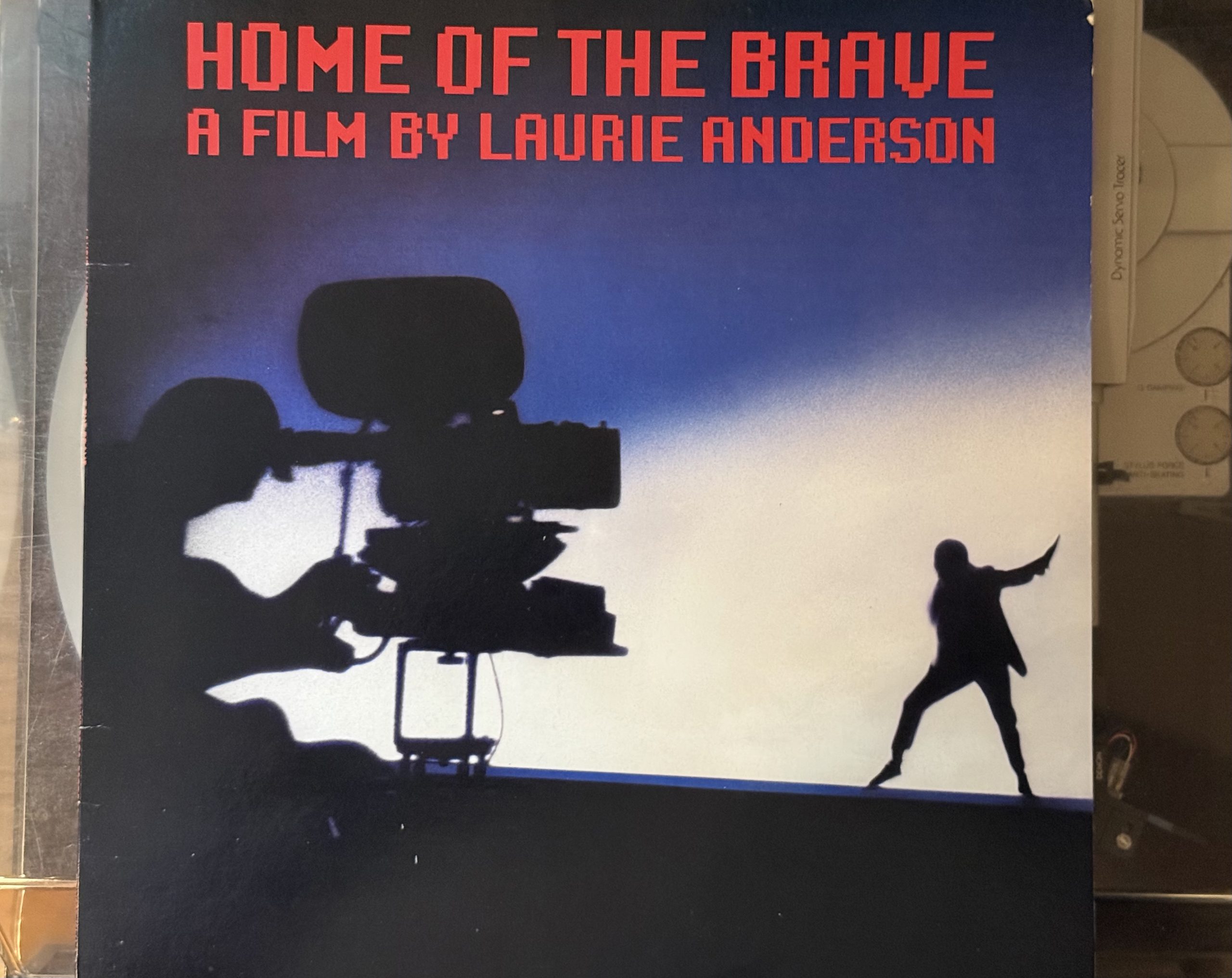
Laurie Anderson, Home of the Brave

A soundtrack of a concert film of a performance art show, with wild technological magic under its skin.

Album of the Week, May 30, 2026

Following Mister Heartbreak, Laurie Anderson continued to develop and tour shows based around her unique combination of performance art and music, as well as technology. In 1986 that led to an unexpected place: a theatrical release of a movie capturing the touring show that she mounted in support of the 1982 album. The movie flopped, grossing only $1.25 million at the box office, but it spawned a video release and a soundtrack, which provide a fascinating picture of how her art evolved alongside the technology she used to produce it.

The tour featured a subset of the musicians who had contributed to Mister Heartbreak, including Adrian Belew on guitar, David Van Tieghem on percussion, and William S. Burroughs as himself (he appears on stage only in a brief nonspeaking role); they were joined by keyboardist Joy Askew and backing vocalists Dolette McDonald and Janice Pendarvis, fresh from performing with Sting on his Dream of the Blue Turtles tour. Five of the soundtrack’s eight tracks were drawn directly from the performance captured in the film; the other three were recorded in the studio and featured additional musicians including Bill Laswell, Nile Rodgers, and others. Only “Sharkey’s Night” repeats from Mister Heartbreak, here in a greatly extended form; the rest of the songs are new.
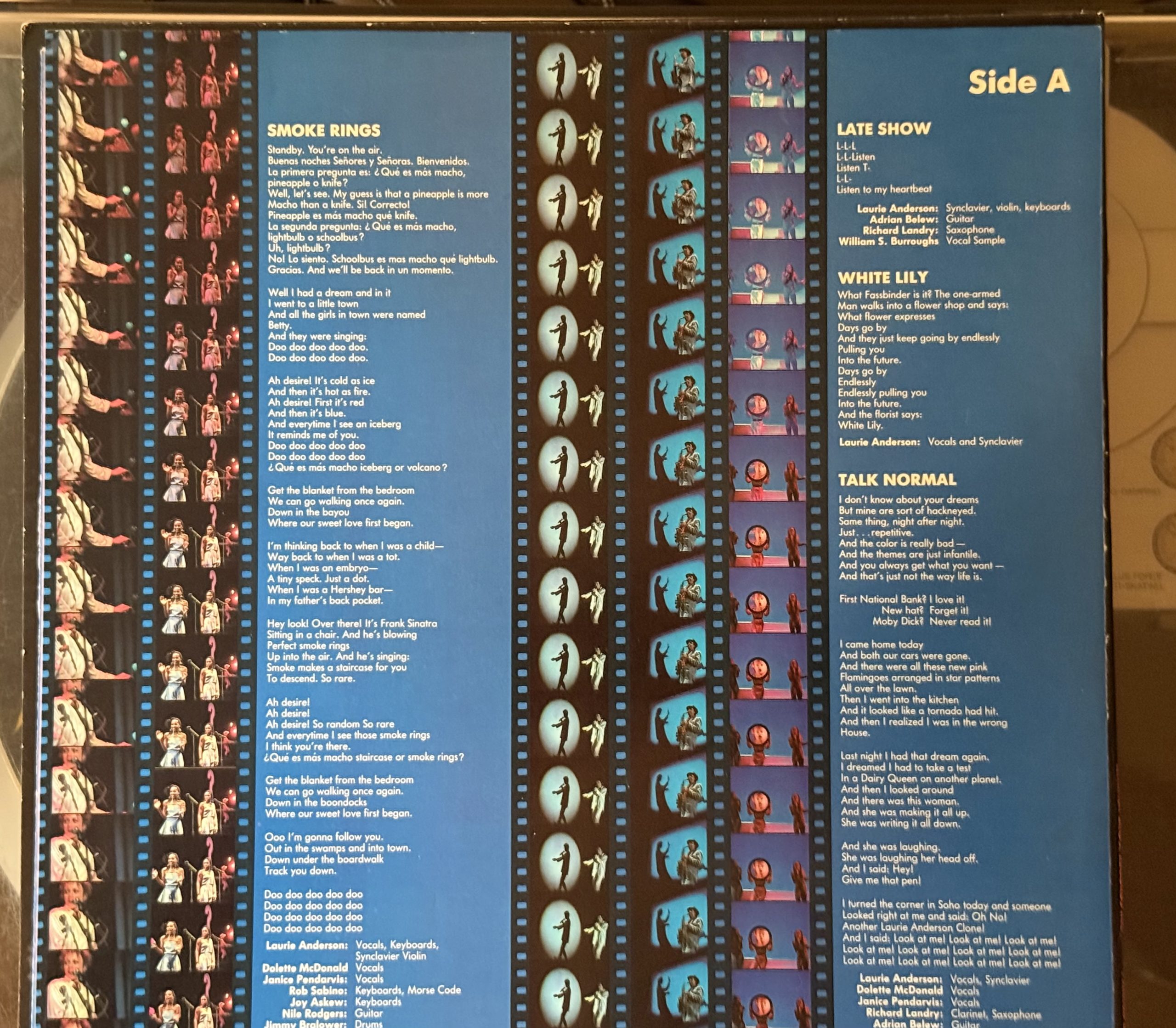
Smoke Rings” starts with a descending synth line slightly reminiscent of “From the Air,” but quickly veers into surrealist territory with a Spanish game show establishing what is more macho. This idea, while promising, is quickly abandoned for a dream about “a little town… and all the girls in town were named Betty.” As she moves past the humor of the opening image, though, we get to the song’s serious core: “Ah, desire! It’s cold as ice and then it’s hot as fire… And every time I see an iceberg it reminds me of you.” The music itself is driven by a pulsing drum + synth groove and punctuated by the gorgeous backing vocals of McDonald and Pendarvis and the high reverberating sampled soprano note, as well as the sounds of dense beasts from Belew’s guitar. It’s a dizzying introduction to the album.

After this we get a quiet moment, driven by a skittering synthesizer line, in which Laurie asks “What Fassbinder film is it? The one-armed man walks into a flower shop and says: What flower expresses Days go by / and they just keep going by endlessly / pulling you into the future… and the florist says, ‘White Lily.’” As gnomic moments, this one is high on the list of Anderson’s most quotable aphorisms, but it’s married to a texture that’s mostly throwaway.

The same can’t be said for “Late Show,” a hypnotic 9/8 riff over which Laurie plays an electric violin, first with a conventional bow and then with something very different. She had been experimenting with the idea of a “tape bow,” a violin bow in which a length of recorded tape replaces the hair of the bow and passes over a magnetic pickup on the violin to play fragments of the recorded sound, since the late 1970s. Here, this instrument acts instead as a MIDI controller, playing back a sample of William S. Burroughs’ voice at different speeds and timbres as he intones “Listen to my heart beat.” You kind of have to see it to believe it.

Talk Normal,” one of the tracks recorded in the studio. is a scene of pure chaos, with a doo-wop backing vocal behind different improvisations: a wild saxophone line, screeching Adrian Belew guitar noises played on a guitar with a flexible neck, and a set of odd stories from Laurie, including my favorite: “I turned the corner in Soho today and someone / Looked right at me and said: / Oh No! Another Laurie Anderson clone!” I like the idea that there is an alternate reality version of the 1980s in which the streets of the world were full of Laurie Anderson lookalikes — at least elsewhere than in SoHo. The version in the movie is even more extended and surreal, with jugglers, weightlifters, and a giant projected head of Laurie behind the stage. (There’s an image of that on the back of the album cover.)

Language is a Virus” is another studio recording, this one produced by Nile Rodgers, who also contributes guitar, keyboards and Synclavier to the track. The track riffs off William Burroughs’ line “Language is a virus from outer space,” and Laurie plays with the disconnect between words and intentions throughout: “I was talking to a friend/And I was saying: I wanted you / And I was looking for you / But I couldn’t find you. I couldn’t find you / And he said: Hey! / Are you talking to me? / Or are you just practicing / For one of those performances of yours?” But the stories here feel a little flip, a little forced, as though the words have been squeezed to fit the pop song format. (Though I do confess to quoting the last stanza to myself whenever visiting a tourist attraction: “And there was a beautiful view / that nobody could see / Cause everybody on the island / Was saying Look at me! Look at me!”)

Radar” is a brief snippet of wordless song against a crashing synth chord; if Laurie didn’t have another piece called the “Difficult Listening Hour,” the first minute of this would be a contender. But a synth melody punctuated by birdsongs provides an achingly beautiful bridge into “Sharkey’s Night,” here performed by Anderson using the Voice of Authority1 filter. This version loses the unforgettable William S. Burroughs “Paging Mr. Sharkey, white courtesy telephone please” tag from the original, but remixes in the vocal harmonies from “Talk Normal,” a bit that sounds a lot like a Prince song, an extended saxophone solo from Richard Landry, and a riff on World War III accompanied by an Adrian Belew guitar freakout that will upset your dog. Anderson gives us a backslapping moment with the “Big Boys in room 1003” who are “talking Big B, little O, little M, silent B” and then moments later asking “Hey, what’s that big noise from the sky? … It’s just those angels walking / They’re clomping around again / Wearing those big clumsy shoes we got for them.” Sharkey’s closing “ah, ah, ah, you’ve already paid for this / listen to my heart beat” feels at the end more like a threat, an implied standoff with the bomb as the payoff.

The song ends in a haze of klaxons, segueing into “Credit Racket,” an instrumental that harmonizes its guitar and synth parts from the sound of the sirens; the same track played over the closing credits of the film.
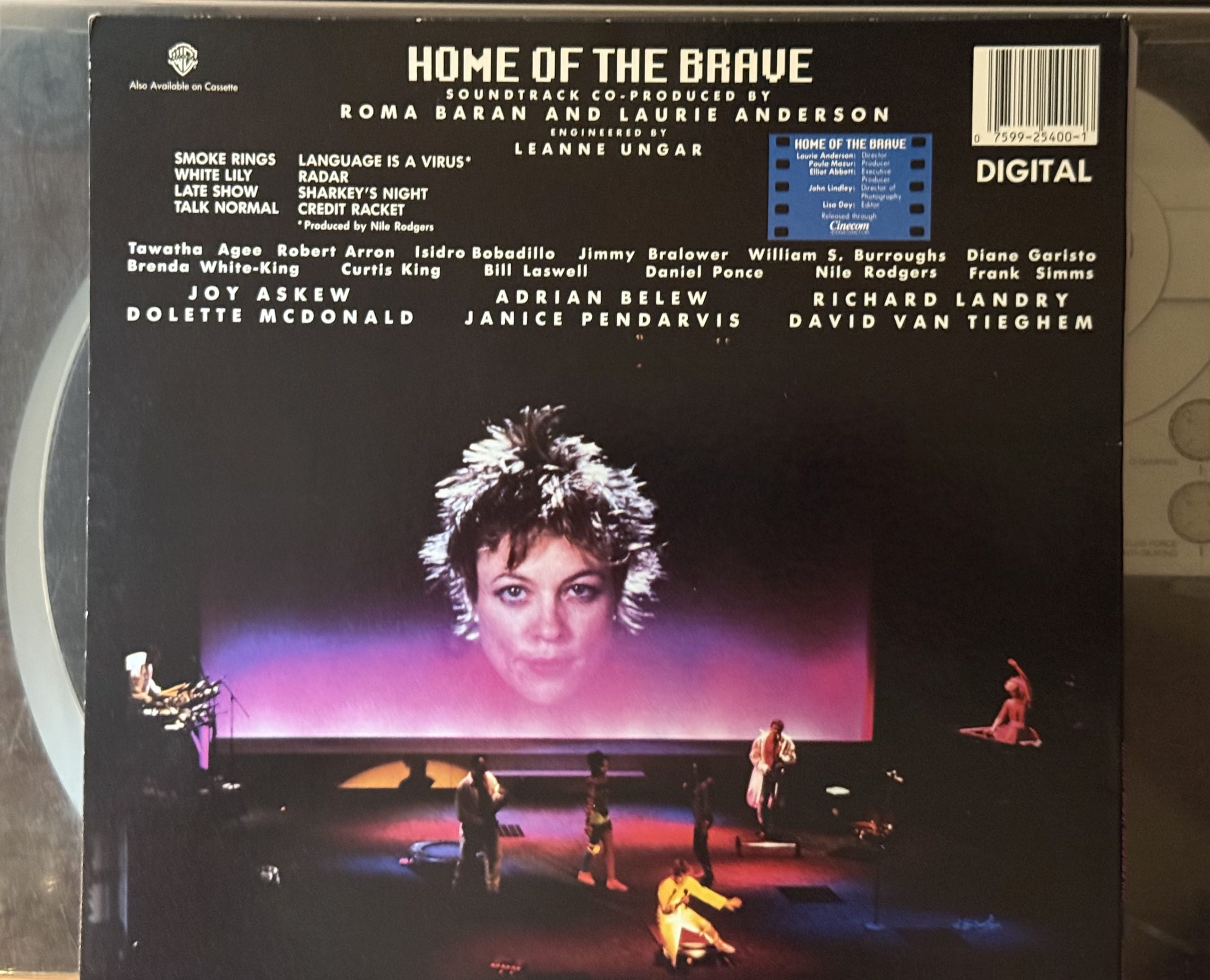
For me, part of the wonder of revisiting Laurie’s work is the ways in which her art, though undeniably limited by the technology available at the time, embraced those limitations (for example, the use of the Mac bitmapped system font Chicago as the title type for the record).2 As Anderson’s art evolved, the technology got more integrated into the work and the musical parts stepped forward more, leaving questions: was she a performance artist who sang or a singer who told stories? Her next album would deepen that confusion in strange and interesting ways. But first we’ll hear from another artist exploring the collision between technology and music with a completely different outcome.

You can listen to this week’s album here:

BONUS: The full concert film is available on YouTube, somehow. Watch it for Laurie’s tape bow, the waltz between her and Burroughs, the drum dance, the “¿Que es mas macho?” game show, and more:

Footnotes

  1. Years later, Lou Reed, who married Laurie in 2008, named the persona that she adopted with the Voice of Authority filter “Fenway Bergamot.” ↩︎
  2. There are a variety of free revivals of the original bitmapped Chicago font, which is a good thing because the scalable vector TrueType version was pretty awful. ↩︎
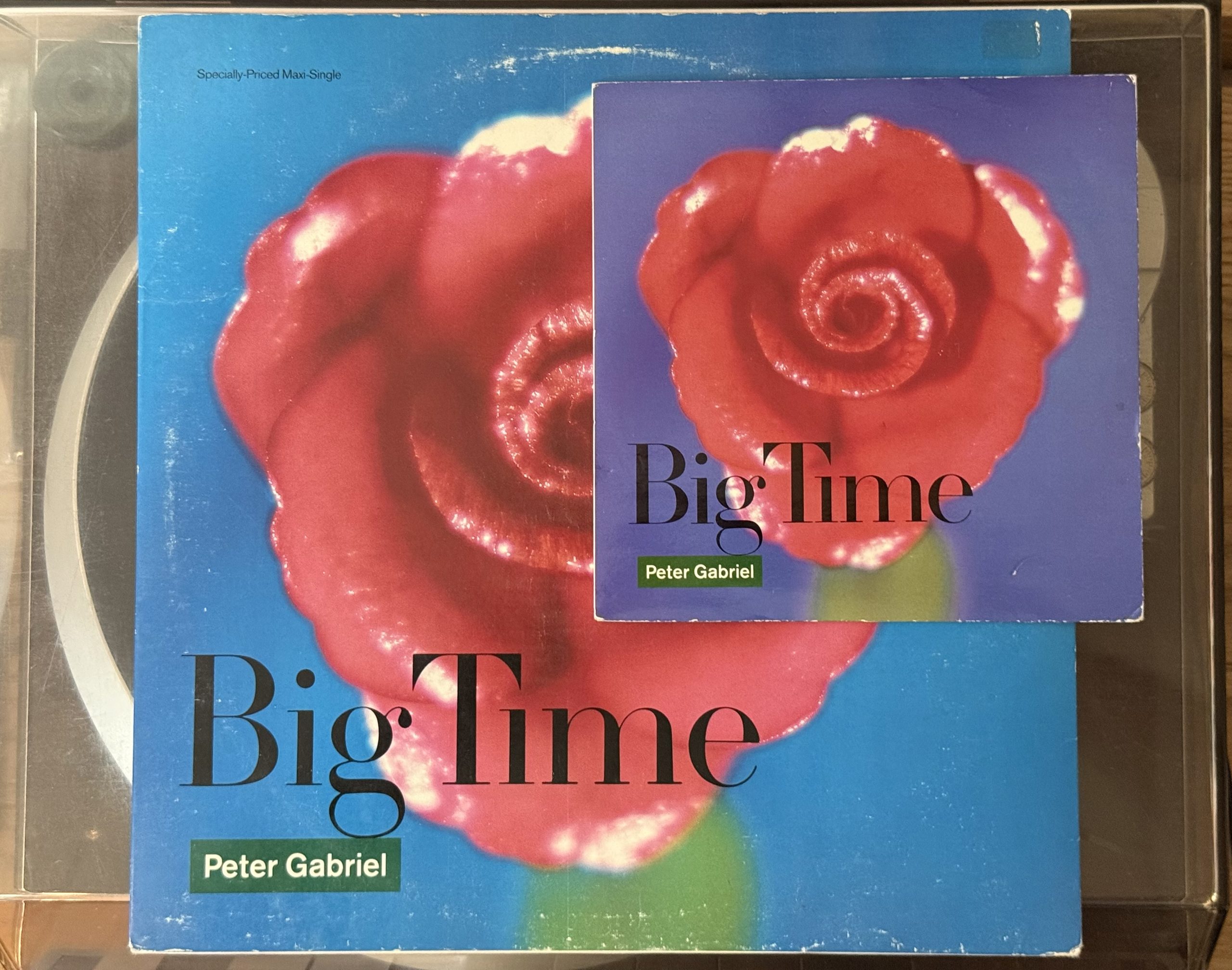
Peter Gabriel, Big Time

Peter’s singles provide a good excuse to linger in the world of “So” a little longer.

Album of the Week, May 23, 2026

The album cycle for Peter Gabriel’s So went on for quite a while. The first single, “Sledgehammer,” hit the streets on April 14, 1986, about a month before the album was released. There followed “In Your Eyes” in August, “Don’t Give Up” in October, “Big Time” in March 1987 and “Red Rain” in June.1 That’s a lot of releases, and by extension a lot of opportunities for B-sides.

I love B-sides.2 They’re a glimpse of what else was happening when the album was recorded (or, sometimes, some other album, as we’ll see today). Sometimes they illustrate where else a song could go. And sometimes they’re just dance mixes. And the great thing about there being huge markets for pop music in both the US and the UK is that sometimes you got completely different B-sides!

If the above discursion and the picture have led you to think that I’m using these facts to just talk about a bunch of Peter Gabriel rarities, you would be correct. I’m going to pull from three different releases of “Big Time”: the 12″ US single, the 7″ UK release, and the CD maxi-single, which is the one that I first owned back in the day. (Shhh.)

The 12″ opens with “Big Time (dance mix),” which is what it says on the tin. It’s mixed by Tom Lord-Alge, a recording engineer who had previously crossed paths with Peter on “No More Apartheid” on the Sun City compilation, and who had also engineered or mixed for the Force MDs, Jeff Beck, Southside Johnny and the Asbury Jukes, David Johansen, Sly Fox, Steve Winwood’s Back in the High Life, OMD’s “If You Leave,” and Billy Crystal’s “You Look Marvelous.” This cavalcade of 1980s sounds perhaps explains the low-end drum machine and handclaps that get spliced onto the beginning of the track. I do love the way that he pulls out and isolates Tony Levin (and Jerry Marotta)’s bass line at the beginning though, as well as letting us hear the nasty (in a good way) David Rhodes guitar riff without vocals over it. The verses are largely untouched—a little extra echo here, an extra-80s guitar in the texture there—but the chorus gets a spacey reinforcement on the backing vocals that’s almost dublike. This is kicked into high gear after the second verse, where it’s just backing vocals, drum machine, and Peter going “huh!” for about 30 seconds. As dance mixes go it’s relatively harmless but also fairly unimaginative.

In Your Eyes (special mix)” is an entirely different story. Produced by Bill Laswell and mixed by Jason Corsaro, the mix shuffles the key bits of the original recording, but also adds an entirely new opening featuring Peter singing over a low synth note, chiming thirds and fourths, and a hi-hat heartbeat: “Accepting all I’ve done and said / I want to stand and stare again / Til there’s nothing left out / All that remains there in your eyes.” The intro is punctuated by a brilliant vocal run by Youssou N’Dour, then the brilliant Ronnie Bright bass vocal. Youssou sings a bit in Wolof: “Sa bet chi lamp, chi tangaay, sa bet maangi ci biir,” meaning “Your eyes are lit, your eyes are bright, it’s in your eyes.” And then, when we think we’re going to get the verse, there’s instead an extended meditation with talking drums and synths, with more incredible Wolof vocals from Youssou and some vocalese from Peter. The chorus finally joins with even more Youssou vocals atop it. There’s an extended reverbful talking drum break, reminding us that Laswell has always been the king of dub. Somehow the complete absence of the verse pulls me into a trance listening to this mix—or maybe that’s just Youssou. This is a masterful mix and still holds up incredibly well, which is why it featured on one of my playlists years later. The twelve-inch single finishes with the album version of “We Do What We’re Told.”

The UK 7″ single, on the other hand, has a single B-side, “Curtains.” The composition here is reminiscent of Peter’s work on Birdy, but with more space around the edges. There’s an extended bit that is just a heartbeat of a talking drum with a tiny whoosh of a cymbal brush, and a panoply of synth textures giving the effect of opening doors, echoing caverns, distant bells, all leading to Peter’s vocals: “Oh, draw the blinds / we can shut out the night.” This is the most erotically direct of his love songs to this point, but even here love is filled with ambiguity and tinged with regret: “And there are lions on our curtains / They lick their wounds / They lick their doubt.” It’s a stunning miniature of a song, and I can only imagine what might have gone through the heads of the casual buyers of the single in 1987 when they flipped it over and listened to it.

“Curtains” also appears on the Big Time CD maxi-single, alongside the album version of “No Self Control.” It’s rounded out by “Across the River,” which was used as a mood-setting opener for the original 1982 WOMAD festival and which was recorded in the studio for the WOMAD benefit Music and Rhythm. It begins as an improvisation by Shankar and Peter, joined by David Rhodes, and then a thundering drum part from Stewart Copeland enters. I’ve always been captivated by the combinations of sounds, particularly the low notes from Shankar’s instrument (not a traditional Western violin), and have long wondered what a full album of collective improvisation from a group like this might have sounded like.

The relatively long period of time between Security and So, combined with Peter’s collaborations in WOMAD and with others, combined to make the experience of following the various offshoots from the album a rich musical journey. We’re going to continue following some of those connections for … well, for a while. Next week we’ll pick back up with one of those collaborators and listen to a unique live album.

BONUS: Peter brought “Across the River” back for his “Secret World Live” tour in the 1990s, with Shankar:

BONUS BONUS: A version of “Curtains” with extended vocals appears in the video game Myst IV, though I’m unsure if these were newly recorded or just an alternate take. Here’s a playthrough video showing the song in context:

Footnotes

  1. Making this the only Peter Gabriel album with a singles-to-non-singles ratio of greater than 2 to 1, regardless of whether you count the LP track listing with eight tracks or the CD with nine. ↩︎
  2. I don’t know if I have to spell this out after four years of writing about vinyl records, but just in case: songs played on the radio used to come on 7″ vinyl records that were played at a faster speed (45RPM rather than 33 1/3). The faster playback speed meant the grooves could be cut deeper for better dynamic range. The records had two sides: the A-side, aka the actual single, and the B-side, which was usually whatever the artist or the label felt like putting on there. ↩︎

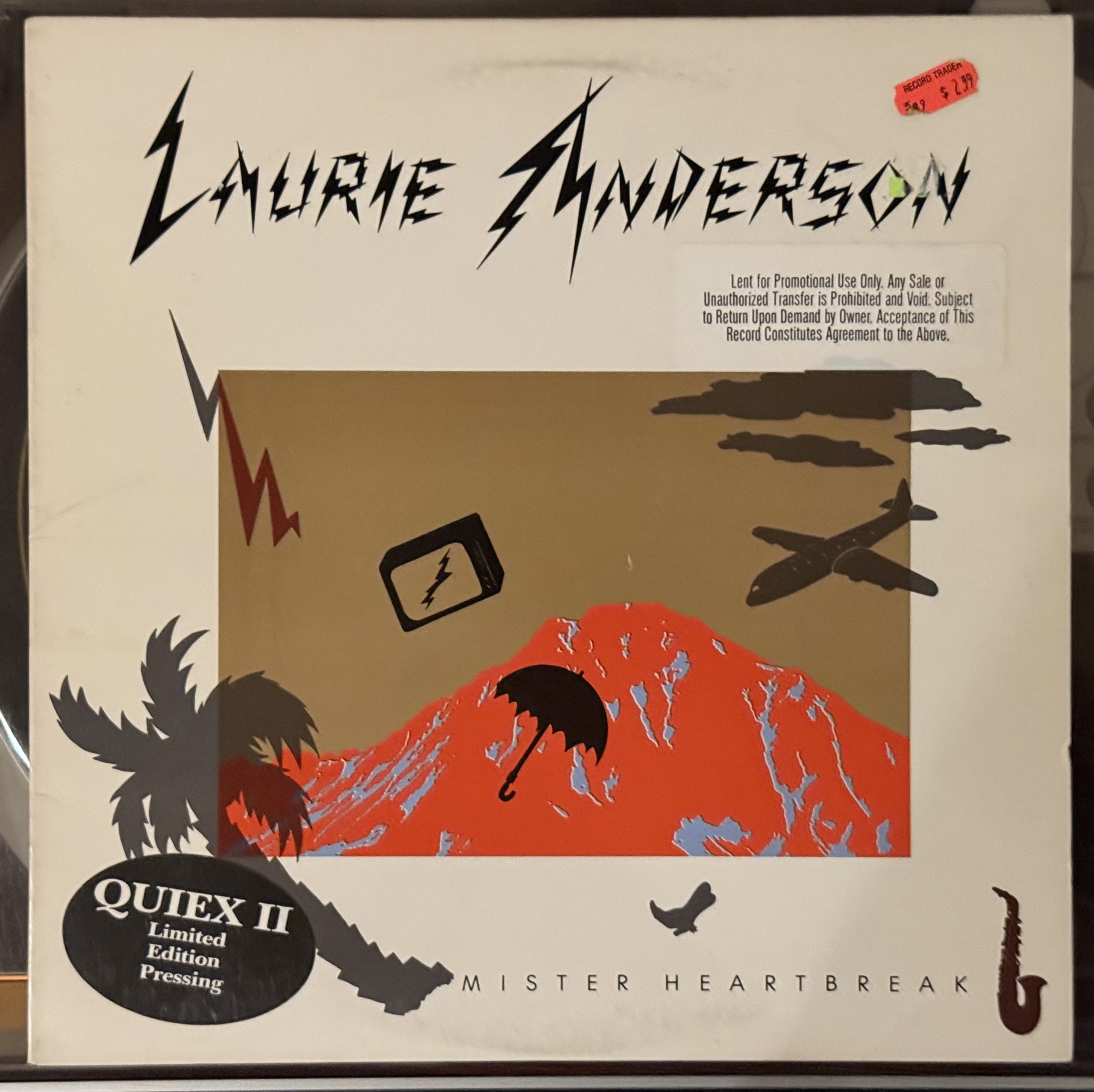
Laurie Anderson, Mister Heartbreak

Anderson’s second studio album expands her sonic palette, producing a hypnotic record full of the rich and the strange.

Album of the Week, April 18, 2026

Laurie Anderson had made an album that had a high-charting single. She had gone from performing conceptual art pieces on the street to a major-label contract, with an album that sold over 100,000 copies. Many artists would have rested on their laurels, or tried to pander to a broader audience. Instead, she took her art to somewhere rich and strange… and sold many more copies in the process.

It helped that she had a budget. Artistic choices allow you to make great songs. A budget lets you get a Synclavier II, a then-new digital synthesizer that supported multiple voices with a single keypress as well as digital sampling. It lets you hire a Who’s Who of guest musicians, including guitarist Adrian Belew (cf: Lodger-era David Bowie, Talking Heads, David Byrne, King Crimson), drummer Anton Fier (Golden Palominos), bassist Bill Laswell (Brian Eno, John Zorn, Sonny Sharrock, Material), Nile Rodgers (Chic, Diana Ross, Debbie Harry, Let’s Dance-era Bowie), and William S. Burroughs, as well as her collaborators Roma Baran and David Van Tieghem.

While on tour with her United States show in the spring of 1983 , she also met Peter Gabriel. Later artist Nam June Paik suggested that Gabriel and Anderson collaborate on a song and music video that could become part of a PBS special she was curating called Good Morning, Mr. Orwell; the song, recorded under time pressure in Anderson’s studio, became “Excellent Birds.”

Sharkey’s Day” has almost all of that sound coming at you all at once; as my former Tanglewood Festival Chorus conductor James Burton would say, it “sounds expensive.” There are layers of Synclavier flutes, Adrian Belew guitar, Bill Laswell bass, Anton Fier drums, bata drums and shekere courtesy Cuban-American jazz percussionist Daniel Ponce, and Laurie’s violin all stirred up together, with a healthy dollop of female backing singers courtesy of the group November, consisting of Michelle Cobbs, Brenda Nelson, and none other than a pre-Sting Dolette McDonald. Anderson’s protagonist Sharkey wanders through this sonic landscape in a spoken-word reverie, alternately fascinated and frightened by both the natural world and the artifacts of modernity (“All night long I think of those little planes up there flying around/You can’t even see them, they’re specks!/And they’re full of tiny people going places/And Sharkey says, You know? I bet they could all land/On the head of a pin.” The wildness in the discoveries of Sharkey are reflected in the instrumentation, as Sharkey hypothesizes that all life “comes from some strange lagoon.” Laurie Anderson is no longer ironically commenting on the future being a place about 50 miles from here; she’s reveling in it.

If “Langue d’Amour” feels a bit more like the material from Big Science, that may be because it doesn’t feature the cast of thousands—it’s just Laurie and her Synclavier. It may also be because the track originated in the same place much of Big Science did, as part of her United States show, as a spoken word track called “Hothead.” Here, the work is transformed into something hypnotic—and erotic—thanks to the stumbling bass line and the vocal-like synthesizer chords, as well as the air of unreality added by the harmonies on Laurie’s voice (as well as Peter Gabriel’s subtle backing vocals). The story, about a restless Eve-like character who falls in love with a snake through his stories, ends with an extended section in French declaring: here is the language of love. Here is the language of my heart. And it is revealed to be a meditation on the power of language to upend everything—a theme Laurie would return to later.

Gravity’s Angel,” named after Thomas Pynchon’s Gravity’s Rainbow,1 is a full band track with some of the space of Laurie’s solo work, telling the story of the end of a love affair (“You can see in the dark/But I’ve got one thing: I loved you better”). The hypnotic percussion, loping bass line, and the chorus vocal (again with Gabriel) all combine to produce a meditative space in which magic happens, as when “this ghost of your other lover walked in/And stood there. Made of thin air. Full of desire” and reveals the collapse of the relationship. At the end Laurie pulls the lyrical camera way back to the big picture, then zooms in tightly on the scene of the ending: “ Why these mountains? Why this sky? This long road? This empty room?” The entire work reveals itself in this compressed journey from the broad to the hyper-specific, but still leaves the listener in a fog of mystery.

Kokoku” had also originated in United States, but is here given a sparse reading on the Synclavier with Fier and Laswell providing the rhythm section, accented by Japanese (and Korean) backing vocalists and a solo on the kayagum (performed by Sang Won Park). Coming after “Gravity’s Angel,” it reads as a song of loss and regret: “They say the dead will rise again/ And here they come now, strange animals out of the Ice Age/ And they stare at you, dumbfounded, like big mistakes. And we say:/ Keep cool. Maybe if we pretend this never happened, they’ll all just go away.” The spoken English words alternate with brief poems in Japanese, which Laurie translates in the liner notes: “Mountain with clouds. A cry. My voice. Home of the brave. I’m here now. And lost.” Laurie’s echoing of “home of the brave” from “Mister Heartbreak” suggests another common thread through the songs, as her narrator’s loneliness and alienation is grounded in American soil (despite the dislocating Japanese affectations of the song.)

Excellent Birds” comes as a gear-shift, Anderson and Gabriel accompanied only by Nile Rodgers’ guitar, Bill Laswell’s bass, and Gabriel’s Linn drum machine. Both sing and play Synclavier as they tour a strange landscape full of “excellent birds… excellent snow… excellent words,” finding motion and activity in looking out onto an empty landscape, surrounded with pictures of people who seem poised to some unspoken action. But the heart of the song is in the groove, not the words, and in that Synclavier bass line made of a sampled voice that seems to provide the wordless root of everything that happens.

Blue Lagoon,” by contrast, is an opera in a song, driven by the relentless Synclavier in a stumbling waltz pattern underscored by that sampled-voice bass. But Adrian Belew’s guitar and Bill Laswell’s bass, as well as more Synclavier, build additional layers on top of the ground until we are taken away by Laurie’s gentle spoken voice to a strange desert island. At first it seems like a vacation, but little clues (“Days I remember cities… Days, I dive by the wreck”) suggest a more sinister imprisonment. As the wordless cries of the guitar rise up, there’s an extended quotation from The Tempest (“Full fathom five thy father lies…”) that ends with “Call me Ishmael,” invoking both shipwreck and death. Anderson says, “Always used to wonder who I’d bring to a desert island,” but as the sounds of bamboo and steel drum (played by Van Tieghem) rise, she ends accepting her loneliness: “If you ever get this letter, thinking of you.” The piece is hypnotic, mesmerizing, utterly distinctive.

The album closes with “Sharkey’s Night,” which revisits the chorus and bass line of “Sharkey’s Day” with a darker, more cynical Sharkey read by William Burroughs: “Hey, kemosabe, long time no see! … You connect the dots. You pick up the pieces.” We are left with Sharkey’s assertion that he is “deep in the heart of darkest America, home of the brave… Listen to my heart beat,” as Laurie pulls back the focus a final time to show the loneliness mixed with determined forward motion at the heart of the world.

Remarkably, the album cracked the top 200, rising to number 60 in the US. Anderson continued to evolve the songs in her live performances, eventually creating a full show out of her exploration of the alienation and joy of living in the technology-rich present. We’ll visit that another time. Next week, we’ll see another film project in which Gabriel found himself involved following the completion of Security, one whose soundtrack may sound both familiar and strange.

You can listen to this week’s album here:

BONUS: Anderson produced videos for several of the songs on Mister Heartbreak. The video for “Sharkey’s Day” combines animation, green screen dancing, and a generally phantasmagoric artistic statement into a blender:

BONUS BONUS: Here’s the music video for “Excellent Birds,” also produced by Laurie over a green screen. Interestingly it seems to use the version of the song that Peter later released on his 1986 album (about which more later):

BONUS BONUS BONUS: Anderson would revisit much of the music for Mister Heartbreak live, making a concert movie called Home of the Brave after the lyric in “Sharkey’s Day.” Here’s that live concert version:

BONUS BONUS BONUS BONUS: While on tour behind Mister Heartbreak, Laurie was booked on Late Night with David Letterman, where, rather than performing one of the numbers from her album, she opted to do “Walk the Dog” (!). Here’s that little piece of television history:

Footnotes

  1. Laurie famously asked permission from Pynchon to compose an opera based on Gravity’s Rainbow. To her surprise, the reclusive novelist wrote back with his agreement, with one stipulation: that it be scored for solo banjo. She has said, “Some people have the nicest way of saying no.” ↩︎

Herbie Hancock, Mega-Mix/TFS

Album of the Week, November 16, 2024

I’ve hinted at it, I’ve teased it, I’ve done all but say it outright. Finally today we take a left turn out of jazz and into early hip-hop, following the steps of Herbie Hancock.

When not cutting traditional jazz albums like Herbie Hancock Quartet, Herbie had been making fusion records since at least 1972’s Head Hunters (a giant album that will melt your head if you aren’t prepared). But his taste radar seemed to go astray as he went further afield from funk into commercial R&B. Some of the late 1970s albums in between the VSOP dates are … well, calling them an acquired taste is probably accurate. They didn’t perform especially well commercially and were savaged by critics.

In the early 1980s he began to make changes, leaving longtime producer David Rubinson to cut Lite Me Up with Quincy Jones (RIP), which had a strong disco influence but didn’t move buyers (or critics). But other winds were blowing, and the duo of bassist Bill Laswell and keyboardist/producer Michael Beinhorn, collectively known as the band Material, approached Herbie to collaborate on material that left more traditional fusion behind for a postmodern, hip-hop sound. The result was the album Future Shock, which both went platinum and earned critical acclaim.

The standout track on the album, the one I remember being played on my school bus, at the bus stop, in the streets, really everywhere I went, was “Rockit.” As part of the work on the album the track was remixed by Grand Mixer DXT, together with other songs from the album (“Autodrive,” “Future Shock,” “TFS,” and “Rough”) and an updated version of the lead song from Head Hunters, “Chameleon.”

The resulting track, “Mega-mix,” was one of the first such remixes, a genre that built a medley out of whole sections of songs, often played over a single beat and joined together with scratching or other DJ techniques. As such, Grand Mixer DXT was a natural artist to innovate in this style, as he is credited as the first turntablist. The mix was issued as both a 7 inch single and a 12 inch extended play; I’m reviewing the single today.

Mega-Mix” opens with an echoing clatter of percussion over which the beat from “Rockit” plays, interspersed with a man”s voice saying “Herbie… Herbie… Herbie” and the bass line to “Chameleon.” As the track carries on DXT intersperses samples of spoken word and synthesized percussion across the different segments of the track. It’s disorienting and danceable. It sounds like the future. But it also sounds like riding the bus in fifth grade and listening to this tune, and other pieces of electro-funk, coming in over slightly static-y airwaves. There’s very little direct performance by Herbie on it, save for the prominent synth line that is the main melody of “Rockit”—as well as the bass line from “Chameleon,” which he played on the ARP Odyssey.

TFS” is less influenced by DXT, but that’s not to say it resembles a traditional Herbie Hancock track. The dominant voice here is producer and bassist Bill Laswell. Laswell got his start playing in funk bands in Michigan before moving to New York City in the early 1970s, where he started the long-running project Material with Beinhorn and drummer Fred Maher. The track he wrote for “TFS” is nervous and twitchy, with a squelchy bass line and gated percussion underlying Herbie’s melody piano and synth lines.

Herbie did three albums with the “Rockit” crew, but remained artistically restless, also recording collaborations with kora player Foday Musa Suso (who appeared on the second album, Sound System). In the early 1990s he made a definitive return to acoustic jazz on A Tribute to Miles, a sort of reunion of the V.S.O.P. band with Wallace Roney filling in for Freddie Hubbard, who had injured his lip. Aside from concert performances and one last Bill Laswell collaboration, he’s stayed in the acoustic vein since. A frequent collaborator on those records, especially 1+1 and River: The Joni Letters, was his fellow Miles Davis band mate Wayne Shorter. We’ll hear from Wayne next time.

You can listen to today’s music here:

Bonus: Here’s the song “Rockit” in full, with its slightly insane music video: