
Album of the Week, August 8, 2026
If you’ve just done a big crossover album, as an artist you have an implicit choice: do you continue mining that vein, coming closer and closer to pop? Or do you return to the music that made you famous? Following the success of Mustt Mustt, one imagines this was a choice facing Nusrat Fateh Ali Khan at some point. After all, the album, and his appearances at WOMAD and other Western festivals, were gaining him increasing fame. But his choice was to double down on the traditional repertoire that had been his life, and he released Shahbaaz, an album with four tracks of traditional qawwali music that, as the liner notes by Pervais Khan observe, take us “on a quest to find new and even more daring paths to the sublime.”
The album, as before recorded in Real World’s Big Room, features many of the members of Nusrat’s party, including his brother Farrukh, long-time tabla player Dildar Hussein, and his young student Rahat Ali, who once again both participates in the choruses and receives live instruction in the art of qawwali while the performance is underway.
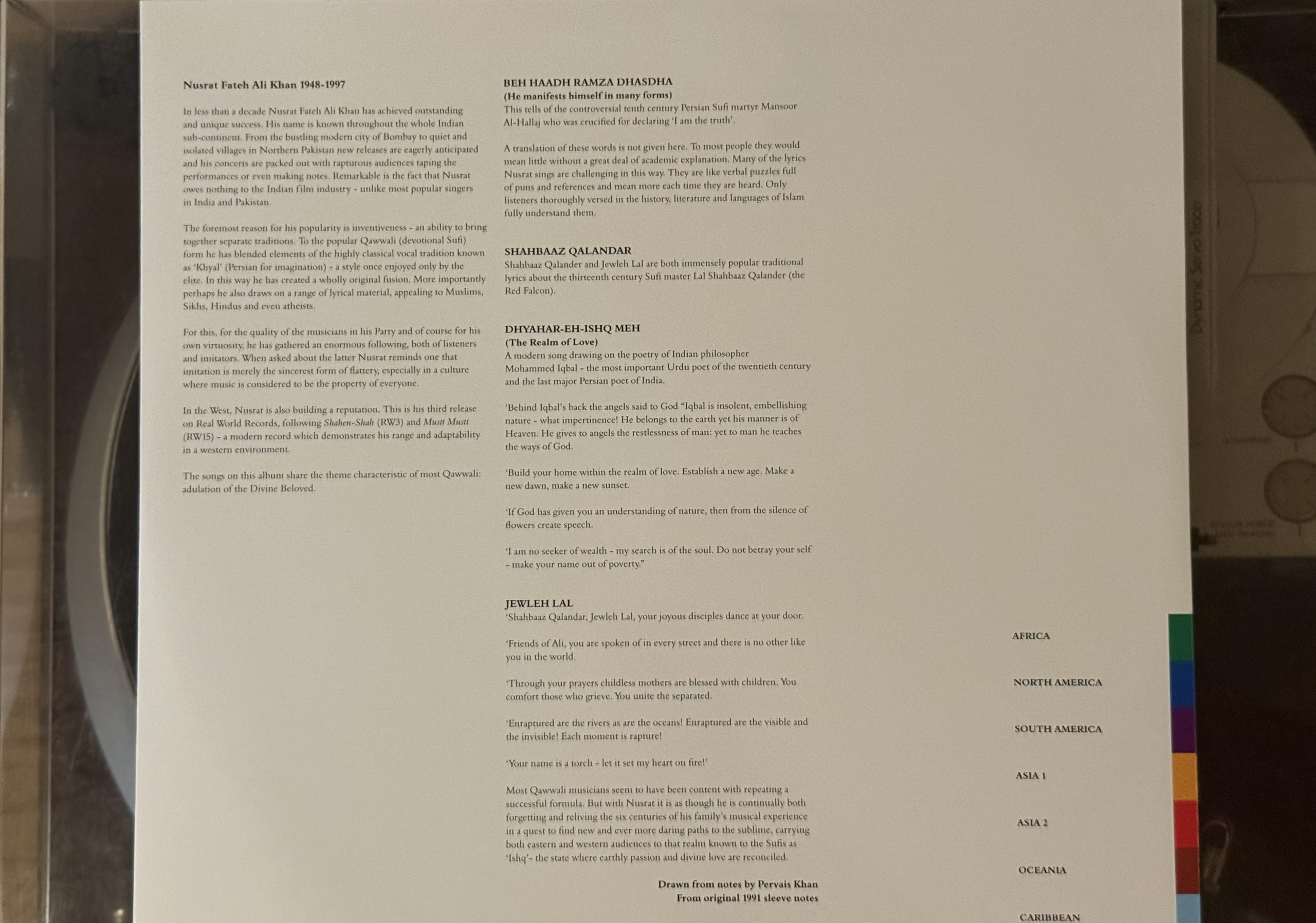
“Beh Haadh Ramza Dhasdha” drops us directly into the mix, as harmonium and tabla give us six bars and Nusrat and the chorus immediately wordlessly improvise over the melody for another six before beginning the qawaali song. Nusrat and the party improvise vocal responses after the melodic intervals, until Nusrat interrupts the fourth repetition to climb the scale, inviting Rahat to follow. At around the three minute mark, Nusrat briefly pulls the song into a different mode before bringing it back, and the song continues in this manner, with the party continuing in a more traditional fashion while Nusrat continually interjects in different scales and patterns, illustrating the message of the song, “He manifests Himself in many forms.”
We’ve heard “Shahbaaz Qalandar” before, in that 1985 WOMAD performance. This rendition runs about three minutes longer, partly due to a longer harmonium introduction and partly due to Nusrat’s interjection of additional lyrics in several places which are then picked up and elaborated by the party. The party works into a frenzy at the end with a chant of “Ali, Ali,” but doesn’t engage in the overlapping chorus lines that made the prior live version so fascinating; it’s still a riveting performance.
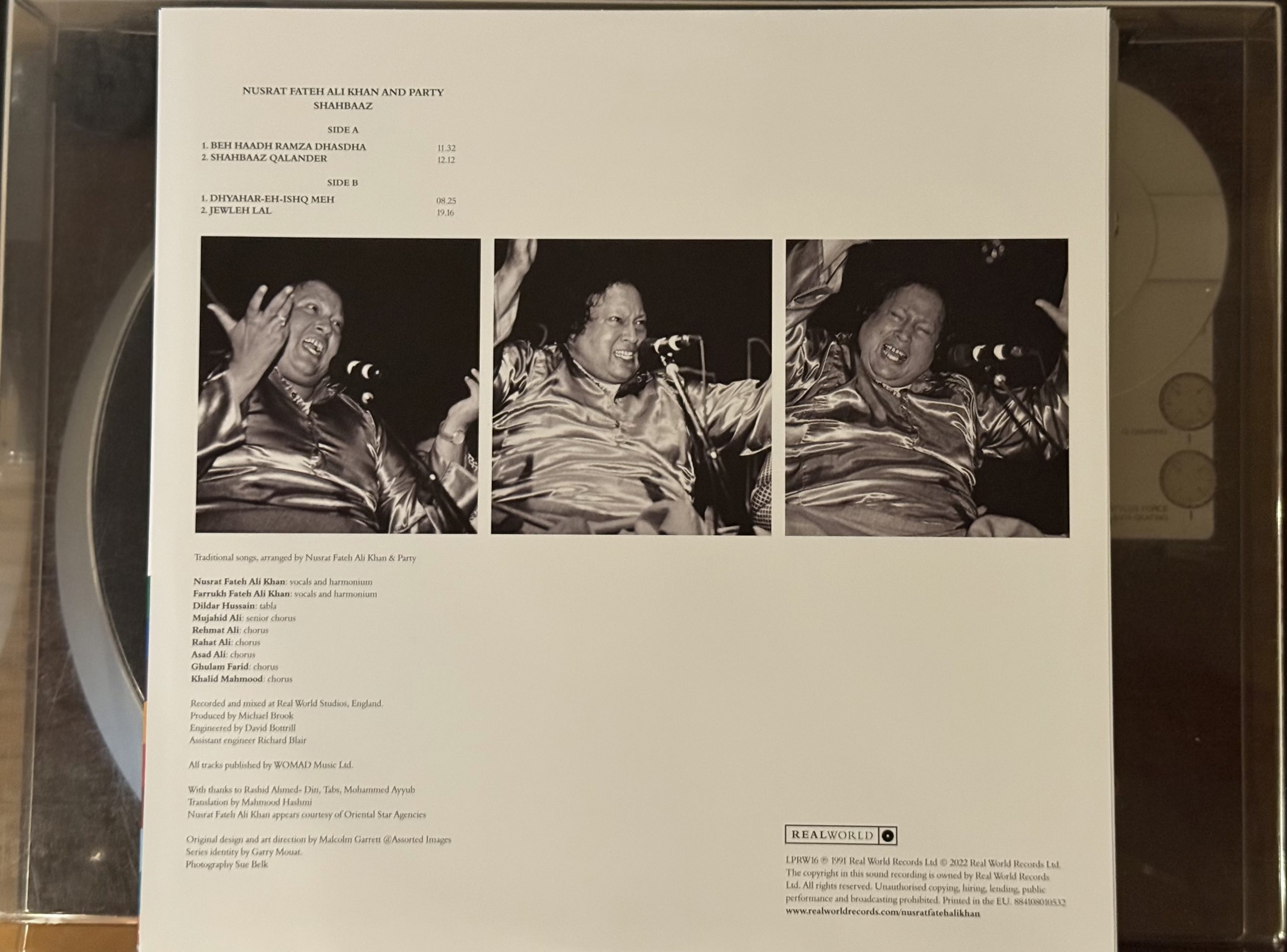
“Dhyahar-Eh-Ishq Meh” is a modern song setting poetry of the twentieth-century writer Mohammed Iqbal; the tune is rhythmically complex and provides a good opportunity for Nusrat to engage in pyrotechnics in multiple scales. It isn’t two minutes before Nusrat turns the conventional minor tonality into something more modal and unleashes a blistering run; a minute later, he breaks the pattern with a series of low utterances on the tonic before doing a series of up and down runs. The “bridge” is two winding runs in that modal scale. At the end of the tune, Nusrat shifts the rhythm into a different world before bringing it back to the hypnotic main tune.
“Jewleh Lal” enters directly with the entire chorus singing the title to open the chorus: “Jewleh Lal, Shahbaaz Qalandar, your joyous disciples dance at your door.” Both “Jewleh Lal” and “Shahbaaz Qalandar” are hymns of praise to the South Asian Sufi saint and poet Sayyid Shah Hussain Qadri, who was popularly known as Lal Shahbaaz Qalandar (ruby-coloured, noble and divine spirit, spiritual man), with Jewleh Lal meaning the “red bridegroom.” Lal Shahbaaz Qalandar is one of the key Sufi saints, as is clear from the heights of ecstasy the party reaches through the repetition of the hymn over the nearly twenty minute running time of the song. It helps that Nusrat’s setting is catchy, major-key, and a combination of a simple scalewise melody and a high shout to the saint. The tune allows Nusrat ample room for sangam explorations as the party continues to anchor the performance with the repetitions of “Jewleh Lal Shahbaaz” on the high tonic. As each member of the party solos in turn, the tempo imperceptibly increases until the group settles to the final repetition, exhausted with the ecstasy of praise.

The album continues to be a favorite of mine, and I imagine other listeners, for the sheer unbridled ecstatic heights that the party reaches in both “Shahbaaz Qalandar” and “Jewleh Lal.” I know the latter was a favorite of many fans because they were shouting for it at the Nusrat concert I attended almost exactly thirty years ago, on August 3, 1996 in the Warner Theatre in Washington, DC. Nusrat’s tours would continue to emphasize his traditional material even as he collaborated on record with many other western musicians. We’ll hear more of both those musical directions from him before the series is over. But next week, we’ll check back in on what one of those Western musicians was doing all this time.
You can listen to this week’s album here:
BONUS: “Shahbaaz Qalandar” is likely one of Nusrat’s most-performed songs and there are many live versions available. This one comes from a historic open-air concert in New York’s Central Park that was held on August 14, 1993, and gathered a huge crowd, including some unlikely listeners (whom we’ll discuss later):