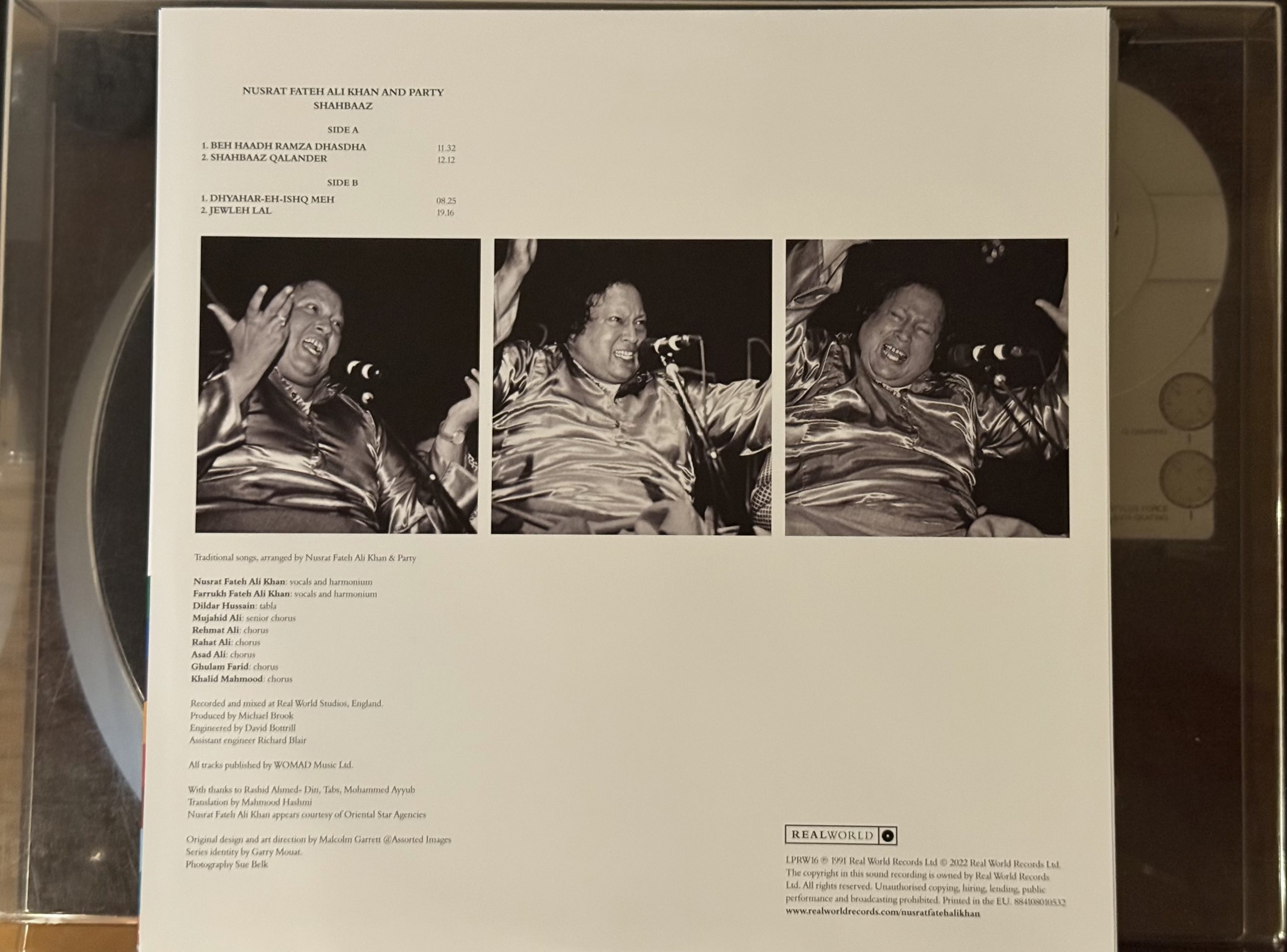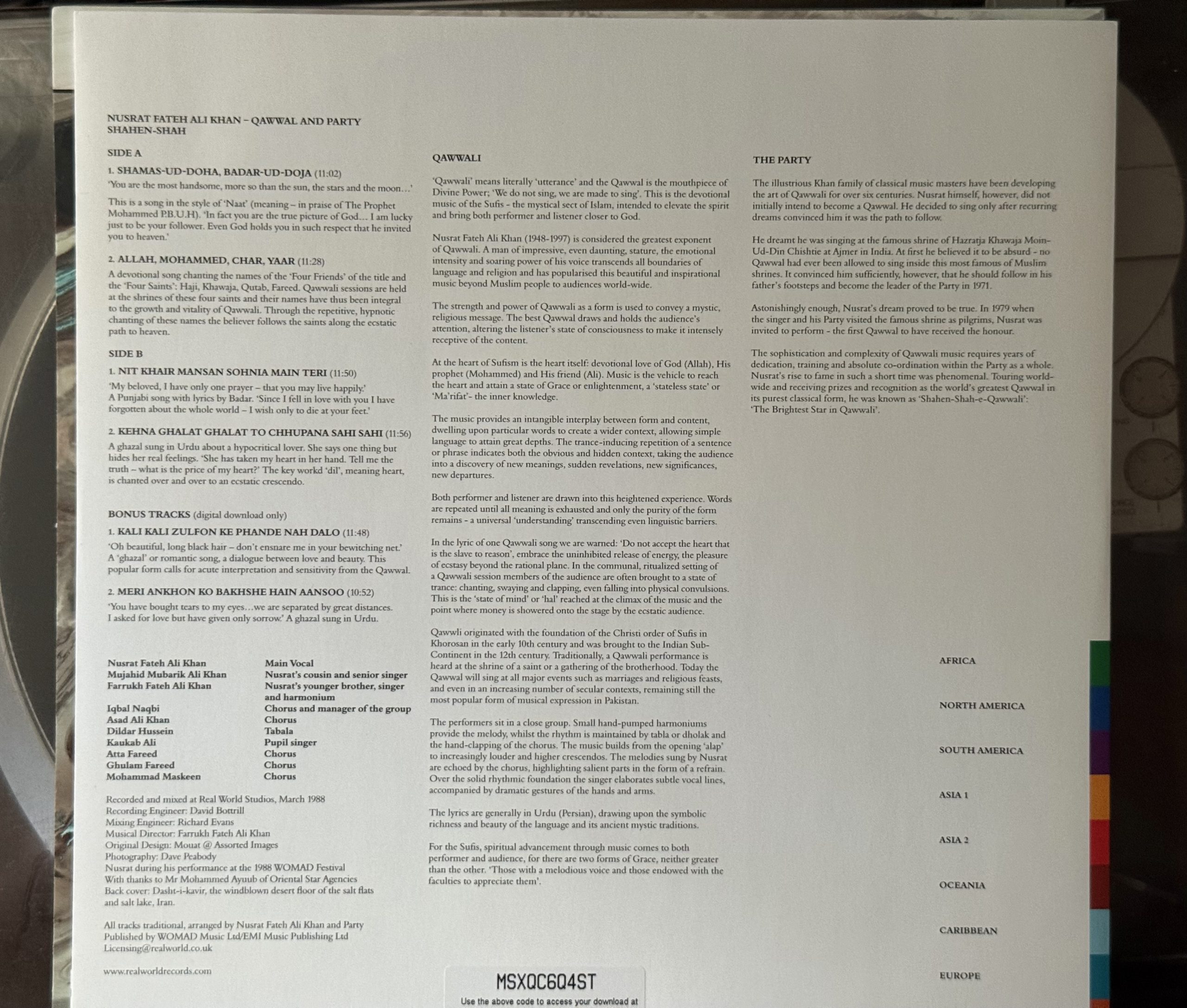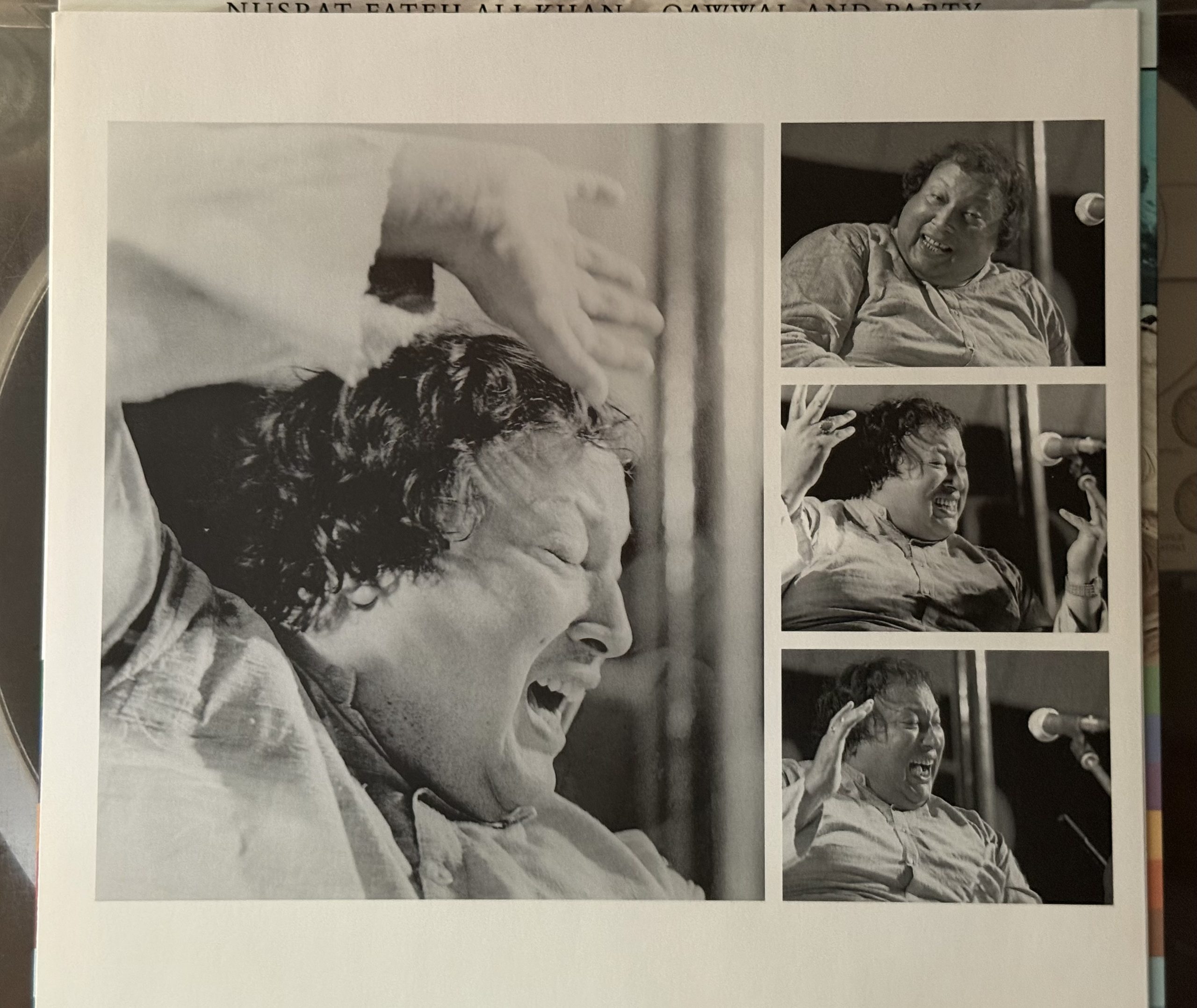
Nusrat Fateh Ali Khan, Shahbaaz

A mesmerizing collection of traditional and modern song from the great qawwali master.

Album of the Week, August 8, 2026

If you’ve just done a big crossover album, as an artist you have an implicit choice: do you continue mining that vein, coming closer and closer to pop? Or do you return to the music that made you famous? Following the success of Mustt Mustt, one imagines this was a choice facing Nusrat Fateh Ali Khan at some point. After all, the album, and his appearances at WOMAD and other Western festivals, were gaining him increasing fame. But his choice was to double down on the traditional repertoire that had been his life, and he released Shahbaaz, an album with four tracks of traditional qawwali music that, as the liner notes by Pervais Khan observe, take us “on a quest to find new and even more daring paths to the sublime.”

The album, as before recorded in Real World’s Big Room, features many of the members of Nusrat’s party, including his brother Farrukh, long-time tabla player Dildar Hussein, and his young student Rahat Ali, who once again both participates in the choruses and receives live instruction in the art of qawwali while the performance is underway.

Beh Haadh Ramza Dhasdha” drops us directly into the mix, as harmonium and tabla give us six bars and Nusrat and the chorus immediately wordlessly improvise over the melody for another six before beginning the qawaali song. Nusrat and the party improvise vocal responses after the melodic intervals, until Nusrat interrupts the fourth repetition to climb the scale, inviting Rahat to follow. At around the three minute mark, Nusrat briefly pulls the song into a different mode before bringing it back, and the song continues in this manner, with the party continuing in a more traditional fashion while Nusrat continually interjects in different scales and patterns, illustrating the message of the song, “He manifests Himself in many forms.”

We’ve heard “Shahbaaz Qalandar” before, in that 1985 WOMAD performance. This rendition runs about three minutes longer, partly due to a longer harmonium introduction and partly due to Nusrat’s interjection of additional lyrics in several places which are then picked up and elaborated by the party. The party works into a frenzy at the end with a chant of “Ali, Ali,” but doesn’t engage in the overlapping chorus lines that made the prior live version so fascinating; it’s still a riveting performance.

Dhyahar-Eh-Ishq Meh” is a modern song setting poetry of the twentieth-century writer Mohammed Iqbal; the tune is rhythmically complex and provides a good opportunity for Nusrat to engage in pyrotechnics in multiple scales. It isn’t two minutes before Nusrat turns the conventional minor tonality into something more modal and unleashes a blistering run; a minute later, he breaks the pattern with a series of low utterances on the tonic before doing a series of up and down runs. The “bridge” is two winding runs in that modal scale. At the end of the tune, Nusrat shifts the rhythm into a different world before bringing it back to the hypnotic main tune.

Jewleh Lal” enters directly with the entire chorus singing the title to open the chorus: “Jewleh Lal, Shahbaaz Qalandar, your joyous disciples dance at your door.” Both “Jewleh Lal” and “Shahbaaz Qalandar” are hymns of praise to the South Asian Sufi saint and poet Sayyid Shah Hussain Qadri, who was popularly known as Lal Shahbaaz Qalandar (ruby-coloured, noble and divine spirit, spiritual man), with Jewleh Lal meaning the “red bridegroom.” Lal Shahbaaz Qalandar is one of the key Sufi saints, as is clear from the heights of ecstasy the party reaches through the repetition of the hymn over the nearly twenty minute running time of the song. It helps that Nusrat’s setting is catchy, major-key, and a combination of a simple scalewise melody and a high shout to the saint. The tune allows Nusrat ample room for sangam explorations as the party continues to anchor the performance with the repetitions of “Jewleh Lal Shahbaaz” on the high tonic. As each member of the party solos in turn, the tempo imperceptibly increases until the group settles to the final repetition, exhausted with the ecstasy of praise.

The album continues to be a favorite of mine, and I imagine other listeners, for the sheer unbridled ecstatic heights that the party reaches in both “Shahbaaz Qalandar” and “Jewleh Lal.” I know the latter was a favorite of many fans because they were shouting for it at the Nusrat concert I attended almost exactly thirty years ago, on August 3, 1996 in the Warner Theatre in Washington, DC. Nusrat’s tours would continue to emphasize his traditional material even as he collaborated on record with many other western musicians. We’ll hear more of both those musical directions from him before the series is over. But next week, we’ll check back in on what one of those Western musicians was doing all this time.

You can listen to this week’s album here:

BONUS: “Shahbaaz Qalandar” is likely one of Nusrat’s most-performed songs and there are many live versions available. This one comes from a historic open-air concert in New York’s Central Park that was held on August 14, 1993, and gathered a huge crowd, including some unlikely listeners (whom we’ll discuss later):

Nusrat Fateh Ali Khan, Mustt Mustt

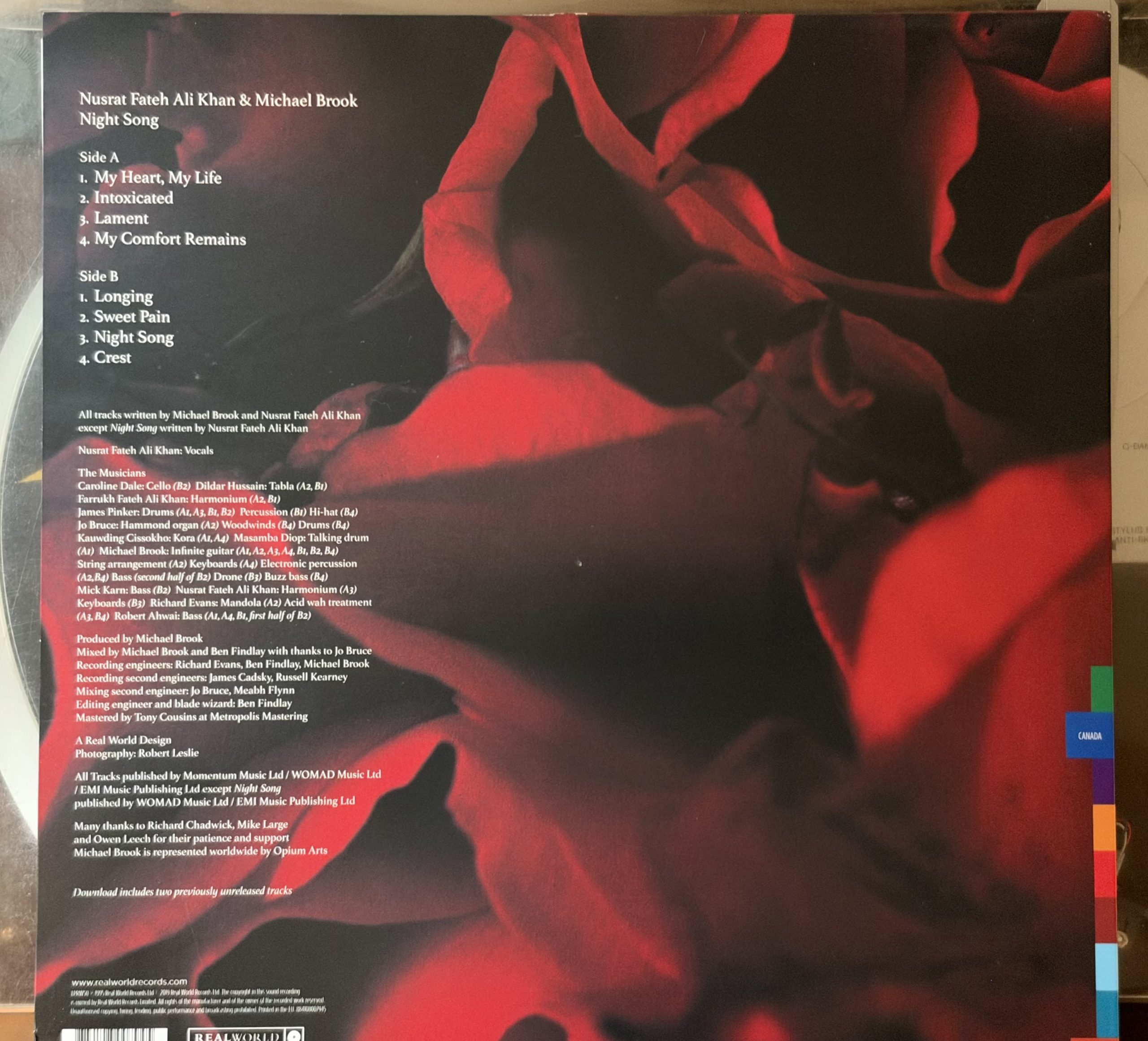
A legendary collaboration between the great singer and ambient artist Michael Brook that gave traditional qawwali music a new beat.

Album of the Week, July 26, 2026

We’ve heard several albums by the great Pakistani singer Nusrat Fateh Ali Khan, featuring the hallmarks of the qawwali tradition: accompanied by harmonium and tabla plus a chorus, extended introductions, vocal improvisation, performances stretching anywhere from eight minutes to half an hour. We’ve also heard him in modern contexts collaborating with Peter Gabriel and others. But we haven’t heard his traditional work directly adapted for a wider Western audience. That’s where producer Michael Brook came in.

We met Brook last week, as the producer on Youssou N’Dour’s Set. But the Canadian guitarist had been in the music industry for years previously, working as an engineer at Daniel and Bob Lanois’ Grant Avenue Studio, where he worked with musical polymath Brian Eno, composer Harold Budd, and U2 guitarist The Edge, among others. It was during this period that Brook invented a kind of infinite sustain device that allowed an electric guitar to hold a continuously sustained note.1 Brook had a background in ambient music through his collaborations with Eno, Budd and Lanois, and his ideas for this collaboration with Nusrat were twofold: bring some hallmarks of modern music to Nusrat’s sound, and explore what happened if you slowed down the pace and allowed Nusrat to just explore sound rather than perform with his customary vocal pyrotechnics. At both, Mustt Mustt succeeds admirably.

Brook brought a handful of Western musicians to the session, including bassist Darryl Johnson (Neville Brothers, Lanois, Bob Dylan’s Oh Mercy), engineer David Bottrill (Peter Gabriel), and percussionist James Pinker (Dead Can Dance), but members of Nusrat’s party including Farrukh Fateh Ali Khan (harmonium) and Dildar Hussein (tabla) were there as well.

Mustt Mustt (Lost in His Work)” is a song of praise to the Sufi saints (“Upon my breath and in my intoxication is the great Qalandar…my worship and upon my breath is the great name Ali”) that is westernized with the interplay of Johnson’s bass and Brook’s guitar over the tabla and harmonium. What emerges is a mix of devotion and groove. It’s still fully recognizable as qawwali; Nusrat sets up the chorus, improvises vocally with the harmonium, unleashes strings of sangam syllables. But there’s that fat bass line throughout, interplaying with the tabla and harmonium to create something completely new. It’s also more concise than a traditional qawwali performance, thanks to Brook’s careful editing (though the liner notes indicate that Brook and Nusrat had to compromise on some of the edits so as not to affect the meaning of the traditional syllables).

Nothing Without You (Tery Bina)” starts with percussion first, then harmonium, again bringing rhythm to the traditional Qawwali forms. There’s more of Nusrat’s chorus here, and the tune is slower and more deliberate than it might be in a qawwali performance. Brook’s guitar is used to add small amounts of harmonic complexity while still keeping the song anchored in its traditional form.

Tracery” is where the ambient starts, with Brook and Johnson laying a gentle foundation upon which Nusrat builds up sound in dialog with himself just as the guitar builds up patterns on patterns in a hypnotic swirl. The liner notes observe that the form is complex, building on one cycle that has nine beats and another with eleven. Here Nusrat embraces the challenge, issuing vocal runs across the patterns. It’s a gorgeous collage of sound as Nusrat finds ways to bring more and more expressive vocal sounds into the mix.

The Game” begins with sustained guitar tones that yield to a Western rhythm courtesy of a drum machine pattern that Peter Gabriel contributed. Darryl Johnson lays down a bass line on the Moog and plays piano to build the melodic core of the backing track. Across all of this is Nusrat’s improvised vocal, combining runs of syllables with soaring vocal lines.

Taa Deem” is built from the interchange between Nusrat and his party on vocals over the harmonium, then with a complex rhythmic backing with Dildar Hussein on tabla, Michael Brook on the surdu, and James Pinker and Darryl Johnson on djembe. Brook also contributes some low searing guitar lines and the whole thing becomes a dark explosion of melodic interchange.

Brook and Johnson create a synthesized soundscape to open “Sea of Vapours,” against which Nusrat vocalizes low in his range. There’s no percussion, just multiple layers of drone. By contrast, “Fault Lines” builds from a hypnotic low vocal introduction into a rhythmic back and forth between a multitracked Nusrat and members of the party thanks to James Pinker’s percussion. There’s a wonderful bit at the end where all the percussion falls away and it’s just a gentle hint of Nusrat’s voice. “Tana Dery Na” feels like a continuation of “Fault Lines” on a simpler percussion line and with a more prominent guitar part, and with only Nusrat’s voice over the top.

Shadow” is just Nusrat and harmonium, an extended sangam improvisation. It serves as a sort of extended prelude to “Avenue,” a group live-in-studio jam with Brook’s guitar, Johnson on clay drums, Pinker on djembe joining the harmonium and tabla. The three percussionists lock in on a groove while Nusrat and Farrukh reinforce each other and the guitar adds ecstatic high notes. It fades out just as Nusrat finds a new vocal pattern to throw into the mix. Someday there’ll be an extended anniversary edition of this album that restores some of the longer bits from this session that were edited out; I’ll be first in line.

Unusually for 1990, the album ends with a remix track. “Mustt Mustt (Massive Attack Remix)” is a dub-style remix that suspends bits of the original track in reverb, heavy percussion and synthesized bass, courtesy of the legendary Bristol collective a year before they released their debut album.

No one had combined East and West in quite this way prior to the release of Mustt Mustt, and the use of tablas with western sounds became a pivotal moment for British music, opening doors for many more musicians to mix Asian inspiration with the dance floor. It also raised Nusrat’s profile even further and gave him a wider base of fans and admirers. We’ll talk about some of the folks he influenced in the future and hear more music from him. Next week, though, we’ll hear from another artist who got his first exposure to Western audiences through Gabriel’s Real World label.

You can listen to this week’s album here:

BONUS: Here’s a more traditional rendition of “Mustt Mustt” from WOMAD Yokohama in 1992. This is how I heard the work when I saw Nusrat and party perform in Washington DC in 1996:

Footnotes

  1. Brook made three Infinite Guitars: one for himself and one each for Daniel Lanois and the Edge. You’ve heard the sound of the Infinite Guitar on U2’s The Joshua Tree, including on “With or Without You.” ↩︎

Nusrat Fateh Ali Khan, Shahen-Shah

Nusrat’s first Western album is an ideal representation of the sacred and secular art of qawwali singing.

Album of the Week, June 13, 2026

When it came time for Nusrat Fateh Ali Khan to record his first album for Peter Gabriel’s nascent Real World Records, he could have Westernized his sound—after all, he had just spent time in the studio with Gabriel on the Passion project. Instead, he and his party produced an album that was as accurate a representation of qawwali tradition that had ever been released, opening the door for Westerners to discover the tradition.

Nusrat was not new to being recorded; prior to 1989 and this session he had already released some twenty-eight albums, a few for EMI but most for small local labels, or for the French world music label Ocora. But listeners noted that “studio-recorded Nusrat [could] often feel rushed, as if the party was singing qawwali for the sake of the recording rather than for the sake of religious praise.” No such limitation existed here; this was full-throttle qawwali, with the group providing authentic examples of devotional songs as well as ghazals (romantic songs).

Part of the secret of the recording was the timing. The original Real World recordings were not limited by the running times of vinyl; by 1989 most releases were CD-first, and a project containing six tracks each stretching more than ten minutes was no longer out of the question. Unfortunately this led to some choices when releasing these recordings on vinyl, mostly at the time for the European market which continued to demand vinyl releases through the early 1990s. Today’s record is the 2017 reissue of the 1989 European vinyl release, and it omits two tracks, “Meri Ankhon Ko Bakhshe Hain Aansoo” and “Kali Kali Zulfon Ke Phande Nah Dalo.” The latter is probably my favorite Nusrat track of all time, so I was irked to find it omitted from this release; we’re going to talk about it in the bonus tracks.

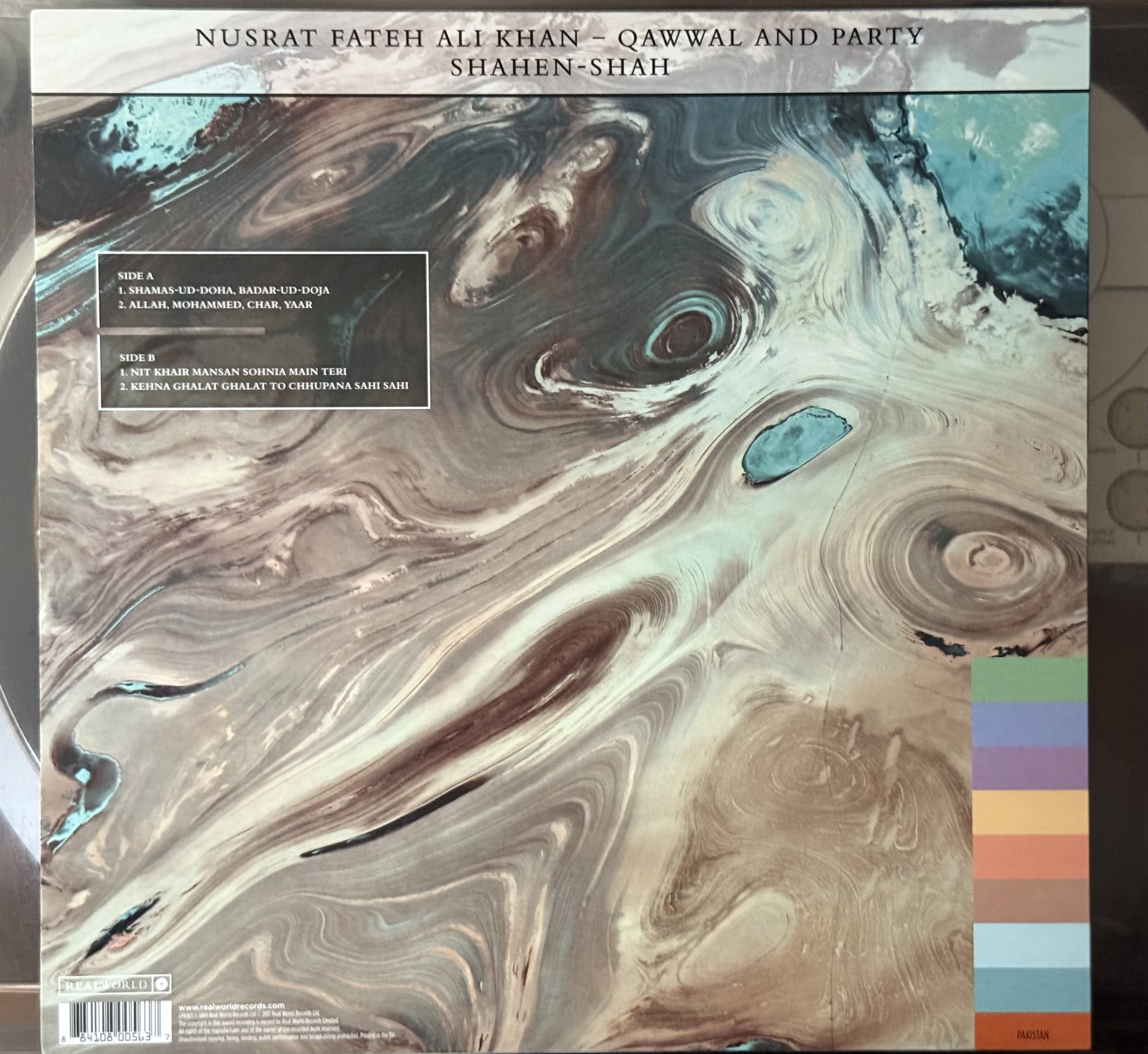
Shamas-Ud-Doha, Badar-Ud-Doja” opens with the instrumentalists: harmonium playing the melody of the hymn in praise to Mohammed, hand claps. Then Nusrat leads the party in a gathering tone, wordlessly outlining the tonic, the third and the fourth in an introductory vocalese before singing a rhythmic verse that loosely follows the main tune, followed by everyone entering on the chorus. Nusrat lets us know how it’s going to go when, at the end of the second chorus repetition, he easily rips a vocal improvisation an octave up. At the end of the fourth chorus, he lays down a series of 32nd-note runs. The other singers in the party contribute too; one of them adds a run around the fifth, another at the octave, and there are numerous places where Nusrat improvises in the middle range while one of the other singers provides a high obbligato above. (This record features vocals from Nusrat’s cousin Mujahid Mubarak Ali Khan and his brother Farrukh, as well as his pupil Kaukab Ali, as well as other singers in a chorus; the youngest pupil heard on Live at WOMAD 1985, Rahat, is not heard here.) About halfway through, Nusrat engages in some stepwise sangam improvisation and some rhythmic improvised vocal syllables, which are closely followed by the tabla and harmonium. The closing series of runs where Nusrat rips a series of 32nd-note patterns up the scale are simply awe inspiring.

Allah, Mohammed, Char, Yaar” is a devotional chant to God, the Prophet, and the “four friends”—four Sufi saints whose graves are the site of pilgrimages and qawwali sessions. It’s also gnarly as hell. The melody syncopates from the second note and recovers the non-syncopated beat with three eighth notes, and those off-beats in the middle have me leaning forward into the beat all the way. It’s in the raga marwa, something like the Locrian western mode, meaning that it sits unstably between a major and minor feeling, and also meaning that the qawwal singer can explore both tonalities in the solo, a fact of which Nusrat takes full advantage. There is less for the party to do in this song, aside from some high obbligato late in the song; mostly they groove on the chant. And there’s a lot to groove on; Nusrat’s sense of the beat is impeccable, and he’ll seemingly fly off at random only to have an improvisation circle right back to the tonic at the start of the chant again, over and over again.

Nit Khair Mansan Sohnia Main Teri” is a Punjabi love song: “My beloved, I have only one prayer, that you may live happily…Since I fell in love with you, I have forgotten about the whole world; I wish only to die at your feet.” You can hear a little more of the traditional raga sound in this one, as Nusrat and the party sing the introduction and then get to the chorus. Here you can hear the roles of the other singers in the party, as one specializes in singing descending wordless lines in a thin clear voice from the octave while another, with a stronger voice, provides more of a high tenor line above the proceedings. Nusrat’s incredibly resonant and vibrato-rich instrument essays rhythmic running lines throughout. This one is trancelike, perhaps because of the raga foundation combined with the relentless major key feeling.

Another love song, in this case a ghazal in Urdu, “Kehna Ghalat Ghalat To Chhupana Sahi Sahi” is a song of complaint about a lover who says one thing and does another. Even here Nusrat steps into moments of ecstatic crescendo; rather than sounding angry or exasperated this too is a moment to celebrate the musical world of qawwali. The extended series of solos on the syllable dil (heart) are a magnificent punctuation of the overall arc of the song. At the end of the song, we get the only decelerando in the whole album as the party slows to the final repetitions of the love song.

With his first album for Real World, it was clear why Nusrat Fateh Ali Khan had chosen this title: “Shahen-shah” means brightest star, and this was clearly a performance of a leading light in the qawwali tradition. The record opened the door for Western listeners to immerse themselves in an entirely new cultural sound world. Some, like Jeff Buckley, were awestruck by Nusrat’s vocal ability and sought to learn from him. Some heard exotic sounds and sought ways to bring them into Western music; we’ll hear examples of that later. And some took it as a cue to explore more varieties of non-European music. We’ll hear from another great musician who opened some of these same doors next time.

You can listen to the full version of this week’s album, including the tracks that didn’t make the LP version, here:

BONUS: Let’s talk about “Kali Kali Zulfon Ke Phande Nah Dalo.” I have always liked the track a lot; it appears on a mix I made just out of college and was likely one of the tracks I played the afternoon I met my wife (though it was Tuvan throat singing that was blasting from my stereo when I actually opened the door and met her). The tune of this Urdu love song is stated in the harmonium, which gets its own elaborate improvisation until Nusrat and the party join with sustained gathering tones. When Nusrat starts the chorus, we get an initial statement, a repetition tagged with an octave high emphatic tone, a third with a high obbligato, a fourth with Nusrat ripping a descending vocal line from the third above the octave. Then the party alternates singing the chorus statement with more obbligato from the other singers and elaborate improvisations from Nusrat. Starting about three minutes in he starts to essay some call-and-response verses. I learned a lot as a college just sitting and listening to all the ways he interrupted the flow of the chorus with solos, how his vocal lines reinforced or altered the tonality, and especially how he played with the meter of the lines. The stretch from around 5:45 to 6:20 is a masterclass in how to fluidly slip in and out of metrical alignment with the groove, particularly the triple sets of triplets which shift out of and into phase flawlessly. I can still put it on and listen to it all these years later, and discover something I’ve never heard before.

BONUS BONUS: Here’s “Nit Khair Mansan Sohnia Main Teri” live from the 1988 WOMAD festival, about the time that Nusrat was headed into the newly constructed Real World studio to record this album.