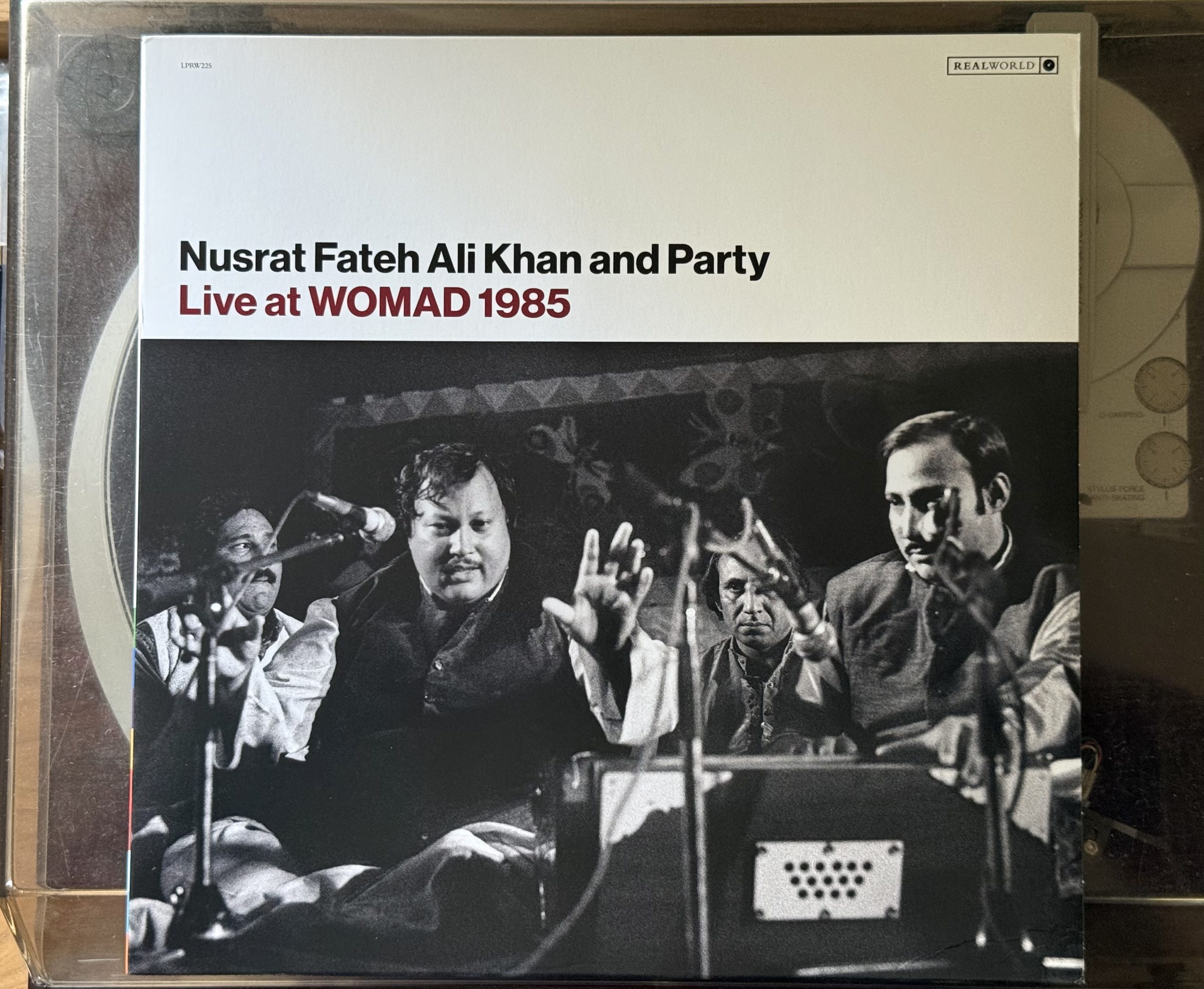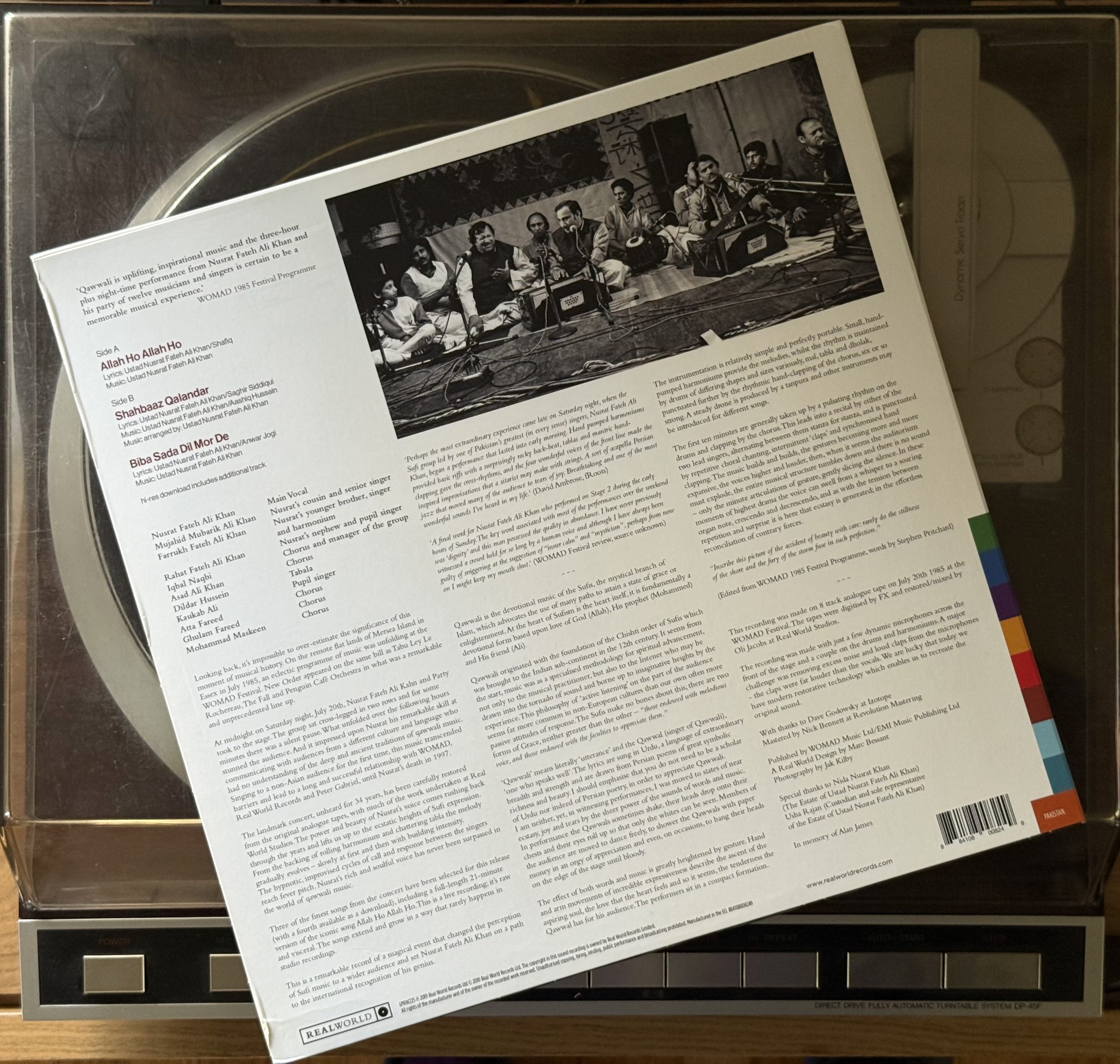

Album of the Week, June 13, 2026
When it came time for Nusrat Fateh Ali Khan to record his first album for Peter Gabriel’s nascent Real World Records, he could have Westernized his sound—after all, he had just spent time in the studio with Gabriel on the Passion project. Instead, he and his party produced an album that was as accurate a representation of qawwali tradition that had ever been released, opening the door for Westerners to discover the tradition.
Nusrat was not new to being recorded; prior to 1989 and this session he had already released some twenty-eight albums, a few for EMI but most for small local labels, or for the French world music label Ocora. But listeners noted that “studio-recorded Nusrat [could] often feel rushed, as if the party was singing qawwali for the sake of the recording rather than for the sake of religious praise.” No such limitation existed here; this was full-throttle qawwali, with the group providing authentic examples of devotional songs as well as ghazals (romantic songs).
Part of the secret of the recording was the timing. The original Real World recordings were not limited by the running times of vinyl; by 1989 most releases were CD-first, and a project containing six tracks each stretching more than ten minutes was no longer out of the question. Unfortunately this led to some choices when releasing these recordings on vinyl, mostly at the time for the European market which continued to demand vinyl releases through the early 1990s. Today’s record is the 2017 reissue of the 1989 European vinyl release, and it omits two tracks, “Meri Ankhon Ko Bakhshe Hain Aansoo” and “Kali Kali Zulfon Ke Phande Nah Dalo.” The latter is probably my favorite Nusrat track of all time, so I was irked to find it omitted from this release; we’re going to talk about it in the bonus tracks.
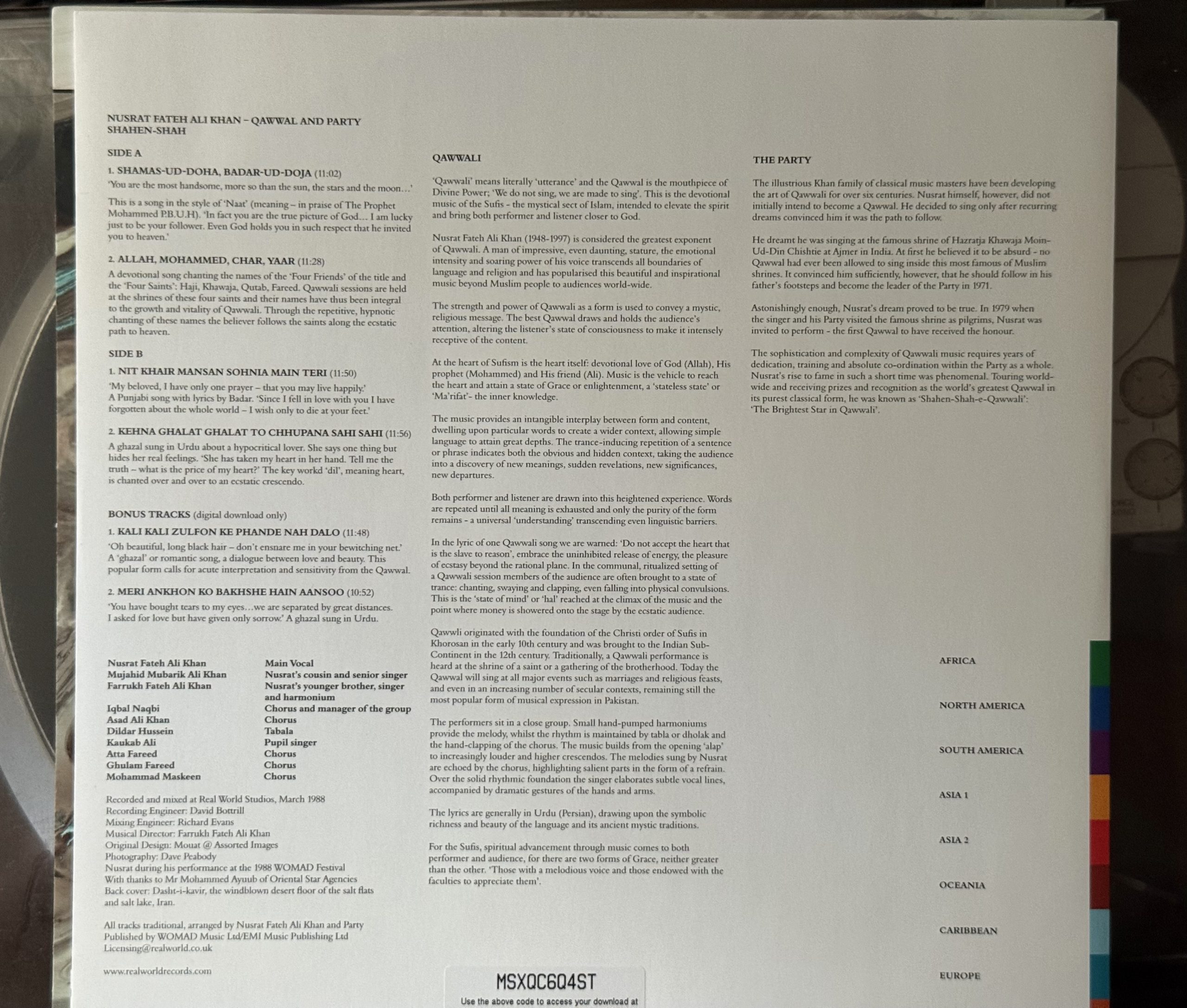
“Shamas-Ud-Doha, Badar-Ud-Doja” opens with the instrumentalists: harmonium playing the melody of the hymn in praise to Mohammed, hand claps. Then Nusrat leads the party in a gathering tone, wordlessly outlining the tonic, the third and the fourth in an introductory vocalese before singing a rhythmic verse that loosely follows the main tune, followed by everyone entering on the chorus. Nusrat lets us know how it’s going to go when, at the end of the second chorus repetition, he easily rips a vocal improvisation an octave up. At the end of the fourth chorus, he lays down a series of 32nd-note runs. The other singers in the party contribute too; one of them adds a run around the fifth, another at the octave, and there are numerous places where Nusrat improvises in the middle range while one of the other singers provides a high obbligato above. (This record features vocals from Nusrat’s cousin Mujahid Mubarak Ali Khan and his brother Farrukh, as well as his pupil Kaukab Ali, as well as other singers in a chorus; the youngest pupil heard on Live at WOMAD 1985, Rahat, is not heard here.) About halfway through, Nusrat engages in some stepwise sangam improvisation and some rhythmic improvised vocal syllables, which are closely followed by the tabla and harmonium. The closing series of runs where Nusrat rips a series of 32nd-note patterns up the scale are simply awe inspiring.
“Allah, Mohammed, Char, Yaar” is a devotional chant to God, the Prophet, and the “four friends”—four Sufi saints whose graves are the site of pilgrimages and qawwali sessions. It’s also gnarly as hell. The melody syncopates from the second note and recovers the non-syncopated beat with three eighth notes, and those off-beats in the middle have me leaning forward into the beat all the way. It’s in the raga marwa, something like the Locrian western mode, meaning that it sits unstably between a major and minor feeling, and also meaning that the qawwal singer can explore both tonalities in the solo, a fact of which Nusrat takes full advantage. There is less for the party to do in this song, aside from some high obbligato late in the song; mostly they groove on the chant. And there’s a lot to groove on; Nusrat’s sense of the beat is impeccable, and he’ll seemingly fly off at random only to have an improvisation circle right back to the tonic at the start of the chant again, over and over again.
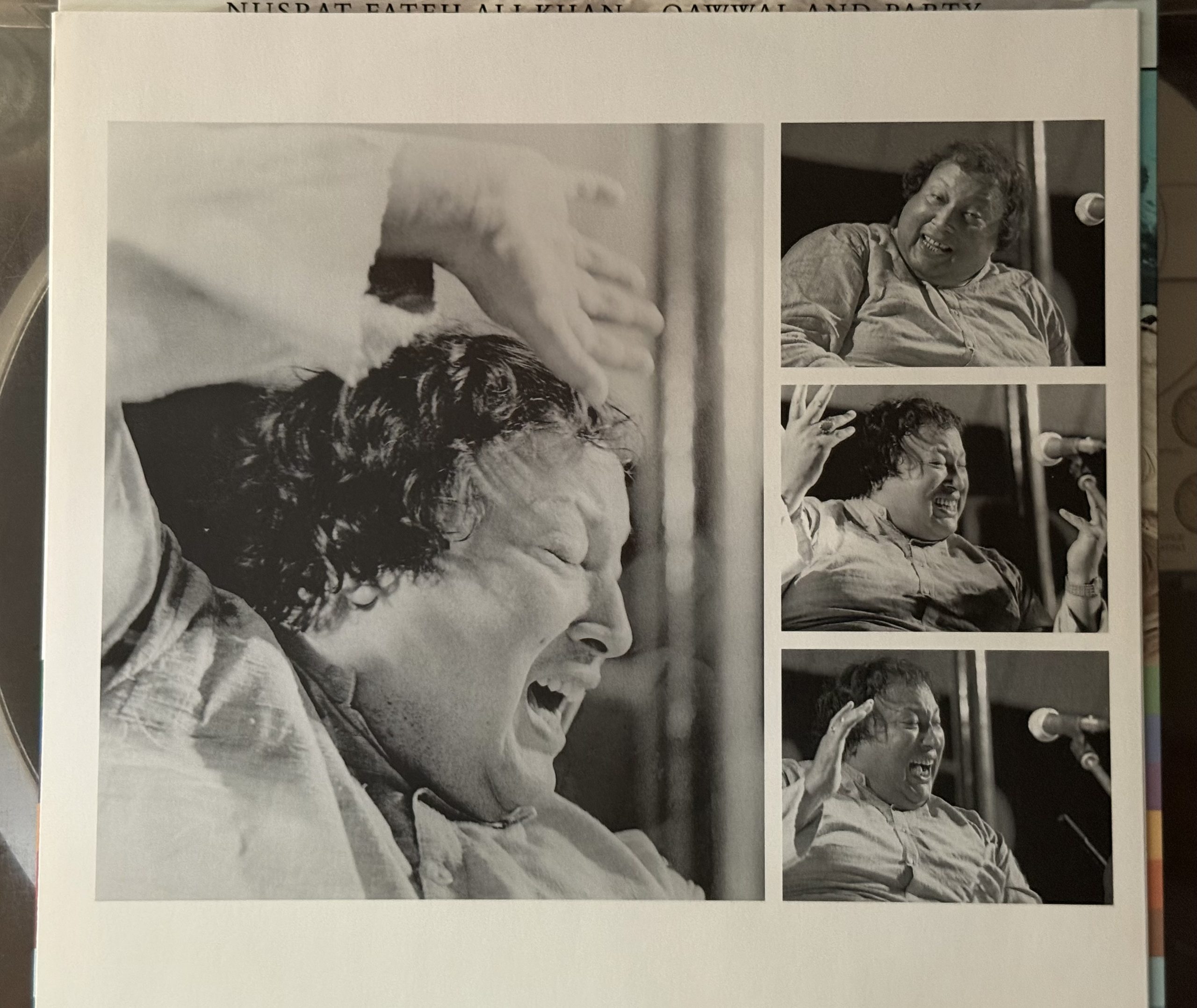
“Nit Khair Mansan Sohnia Main Teri” is a Punjabi love song: “My beloved, I have only one prayer, that you may live happily…Since I fell in love with you, I have forgotten about the whole world; I wish only to die at your feet.” You can hear a little more of the traditional raga sound in this one, as Nusrat and the party sing the introduction and then get to the chorus. Here you can hear the roles of the other singers in the party, as one specializes in singing descending wordless lines in a thin clear voice from the octave while another, with a stronger voice, provides more of a high tenor line above the proceedings. Nusrat’s incredibly resonant and vibrato-rich instrument essays rhythmic running lines throughout. This one is trancelike, perhaps because of the raga foundation combined with the relentless major key feeling.
Another love song, in this case a ghazal in Urdu, “Kehna Ghalat Ghalat To Chhupana Sahi Sahi” is a song of complaint about a lover who says one thing and does another. Even here Nusrat steps into moments of ecstatic crescendo; rather than sounding angry or exasperated this too is a moment to celebrate the musical world of qawwali. The extended series of solos on the syllable dil (heart) are a magnificent punctuation of the overall arc of the song. At the end of the song, we get the only decelerando in the whole album as the party slows to the final repetitions of the love song.
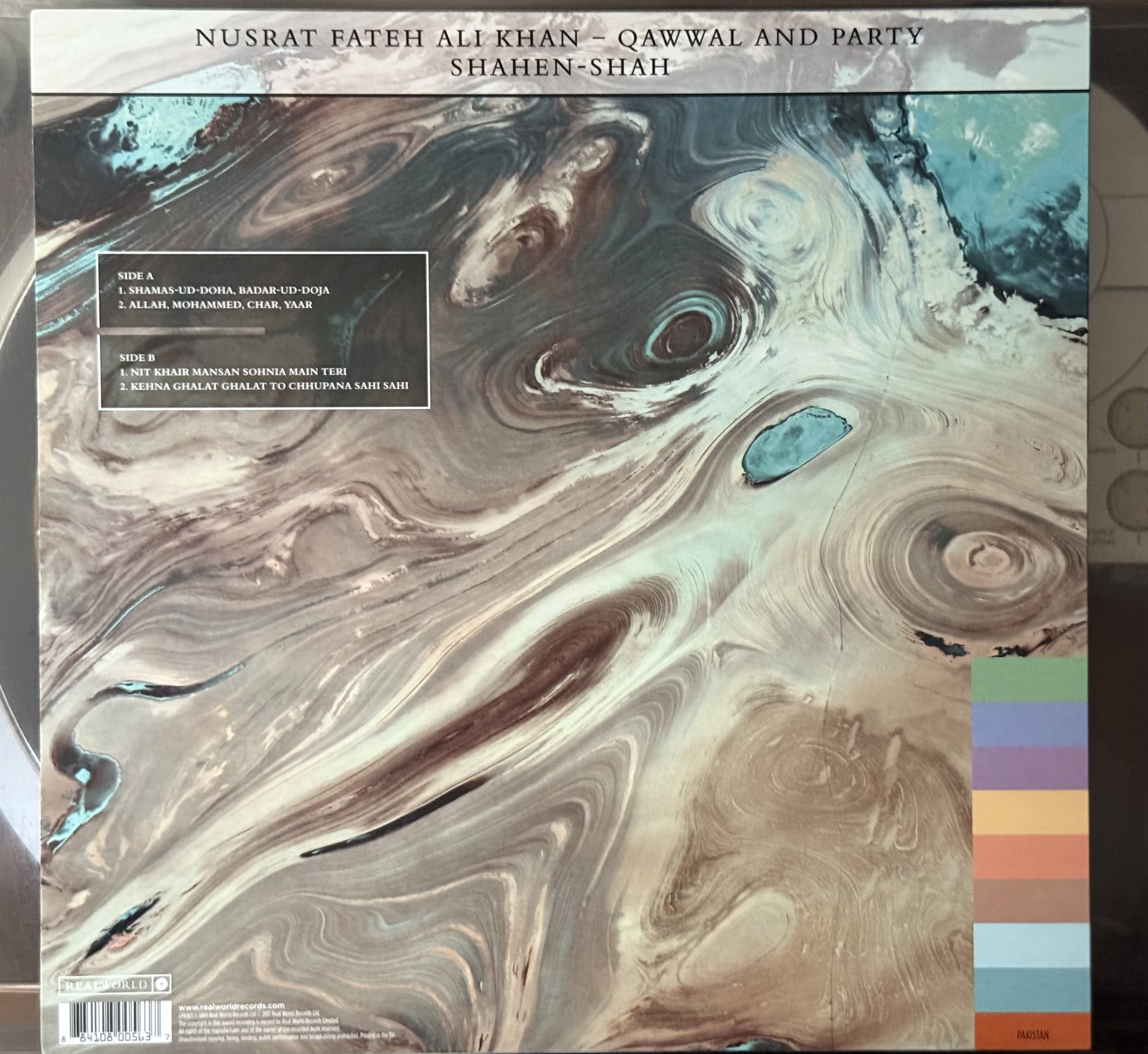
With his first album for Real World, it was clear why Nusrat Fateh Ali Khan had chosen this title: “Shahen-shah” means brightest star, and this was clearly a performance of a leading light in the qawwali tradition. The record opened the door for Western listeners to immerse themselves in an entirely new cultural sound world. Some, like Jeff Buckley, were awestruck by Nusrat’s vocal ability and sought to learn from him. Some heard exotic sounds and sought ways to bring them into Western music; we’ll hear examples of that later. And some took it as a cue to explore more varieties of non-European music. We’ll hear from another great musician who opened some of these same doors next time.
You can listen to the full version of this week’s album, including the tracks that didn’t make the LP version, here:
BONUS: Let’s talk about “Kali Kali Zulfon Ke Phande Nah Dalo.” I have always liked the track a lot; it appears on a mix I made just out of college and was likely one of the tracks I played the afternoon I met my wife (though it was Tuvan throat singing that was blasting from my stereo when I actually opened the door and met her). The tune of this Urdu love song is stated in the harmonium, which gets its own elaborate improvisation until Nusrat and the party join with sustained gathering tones. When Nusrat starts the chorus, we get an initial statement, a repetition tagged with an octave high emphatic tone, a third with a high obbligato, a fourth with Nusrat ripping a descending vocal line from the third above the octave. Then the party alternates singing the chorus statement with more obbligato from the other singers and elaborate improvisations from Nusrat. Starting about three minutes in he starts to essay some call-and-response verses. I learned a lot as a college just sitting and listening to all the ways he interrupted the flow of the chorus with solos, how his vocal lines reinforced or altered the tonality, and especially how he played with the meter of the lines. The stretch from around 5:45 to 6:20 is a masterclass in how to fluidly slip in and out of metrical alignment with the groove, particularly the triple sets of triplets which shift out of and into phase flawlessly. I can still put it on and listen to it all these years later, and discover something I’ve never heard before.
BONUS BONUS: Here’s “Nit Khair Mansan Sohnia Main Teri” live from the 1988 WOMAD festival, about the time that Nusrat was headed into the newly constructed Real World studio to record this album.