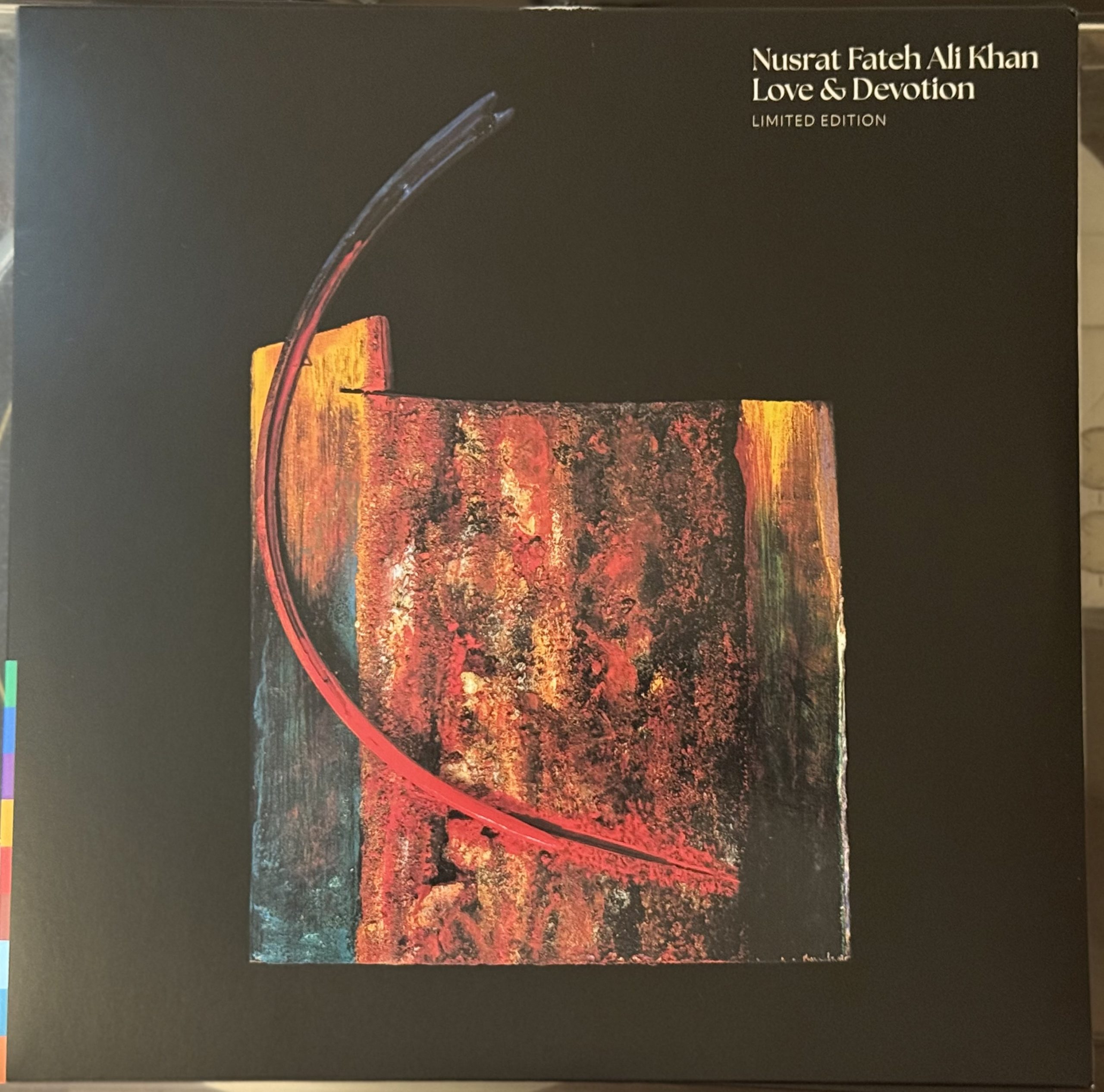
Nusrat Fateh Ali Khan, Love and Devotion

Album of the Week, August 29, 2026

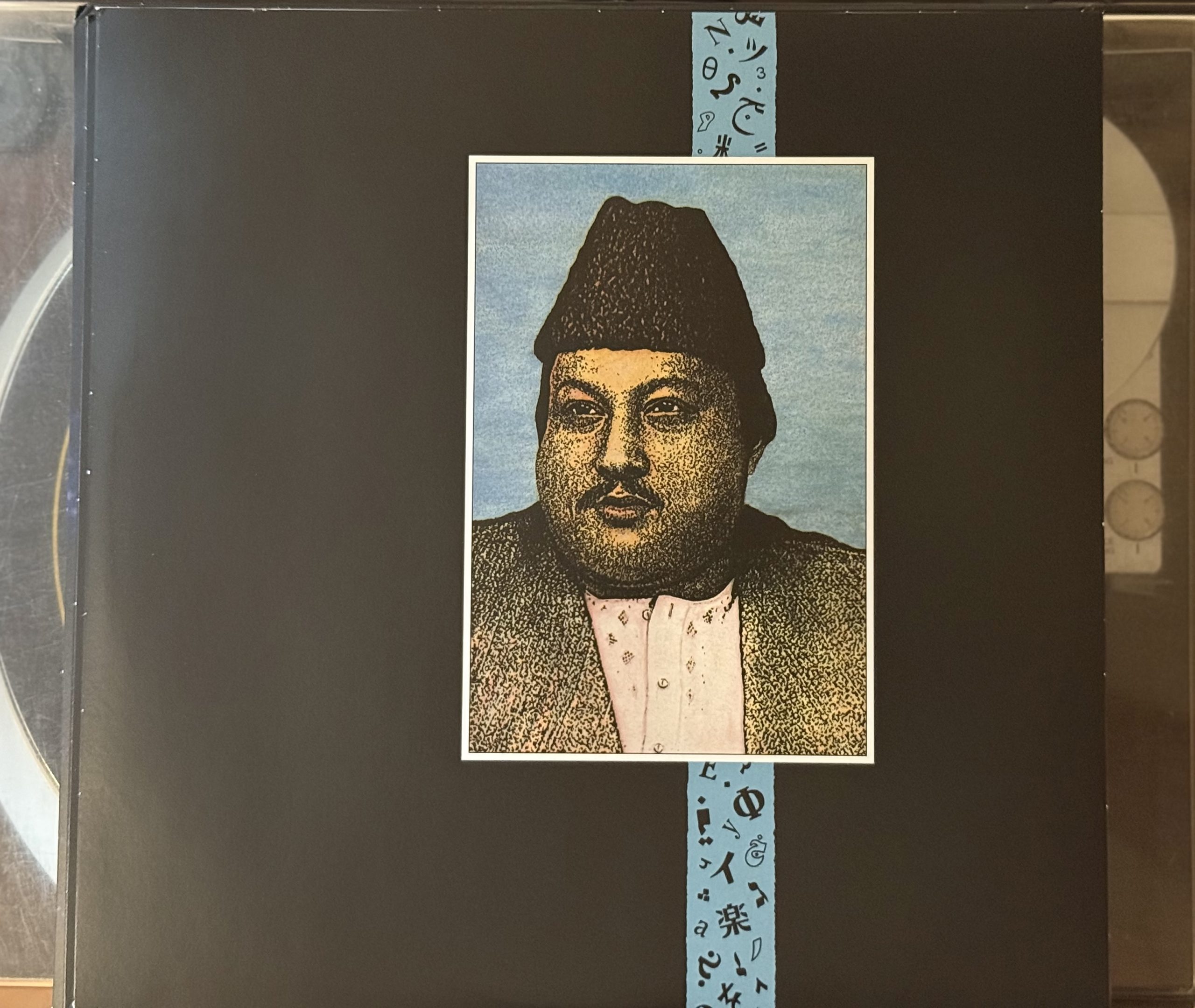
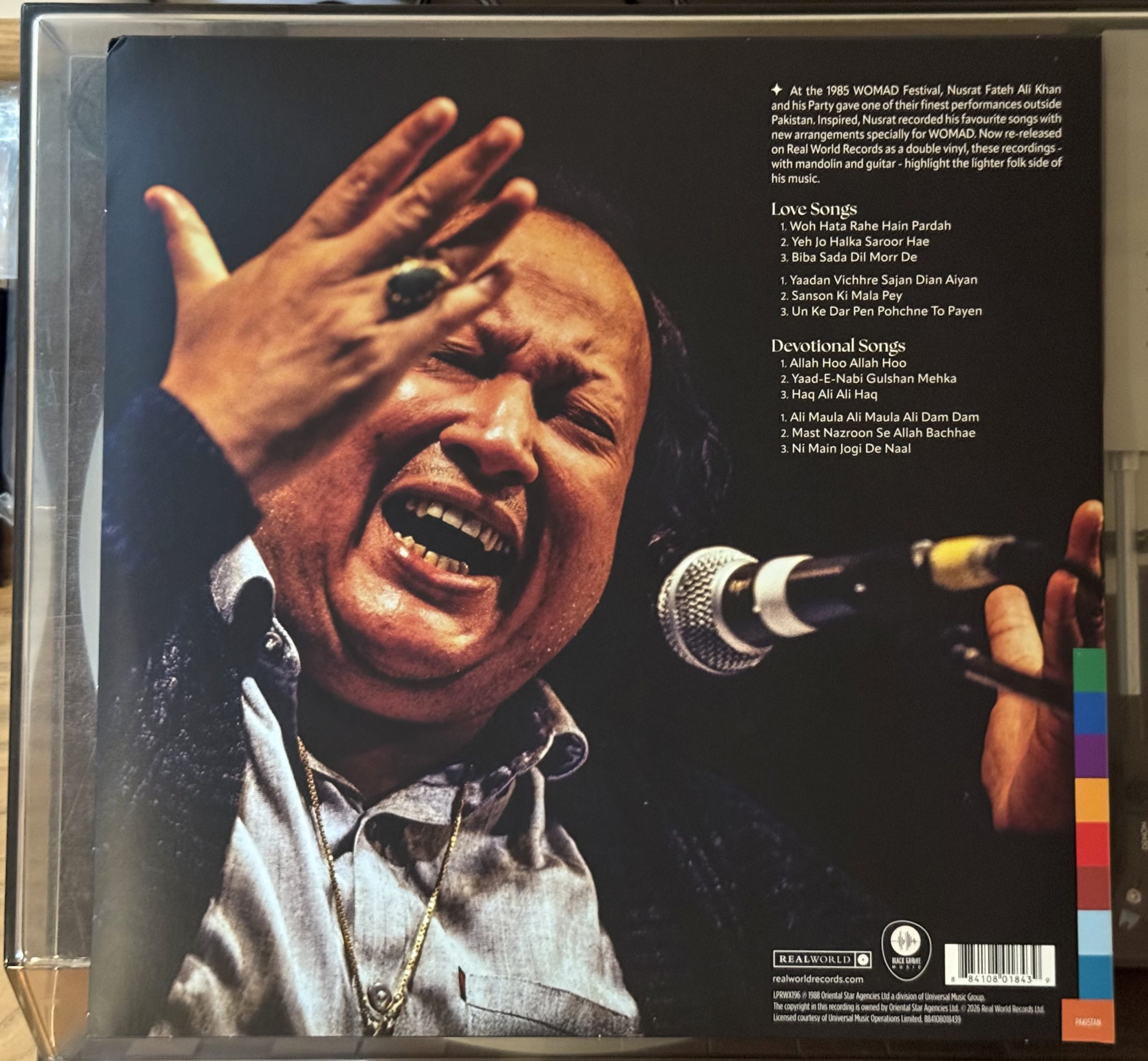
This week is another round of traditional qawwali music from Nusrat Fateh Ali Khan, and it has a complicated release history. Originally there were two records, released separately in 1986 for WOMAD Records following Nusrat’s triumphal 1985 performance, Love Songs and Devotional Songs. These were rereleased on Real World following the 1992 liquidation of WOMAD as a standalone entity due to mounting debts.1 The records were subsequently combined on a CD under the title Devotional and Love Songs; it was this version that was in my collection. The first-time-ever vinyl reissue from earlier this year flipped the order, putting the love songs first.

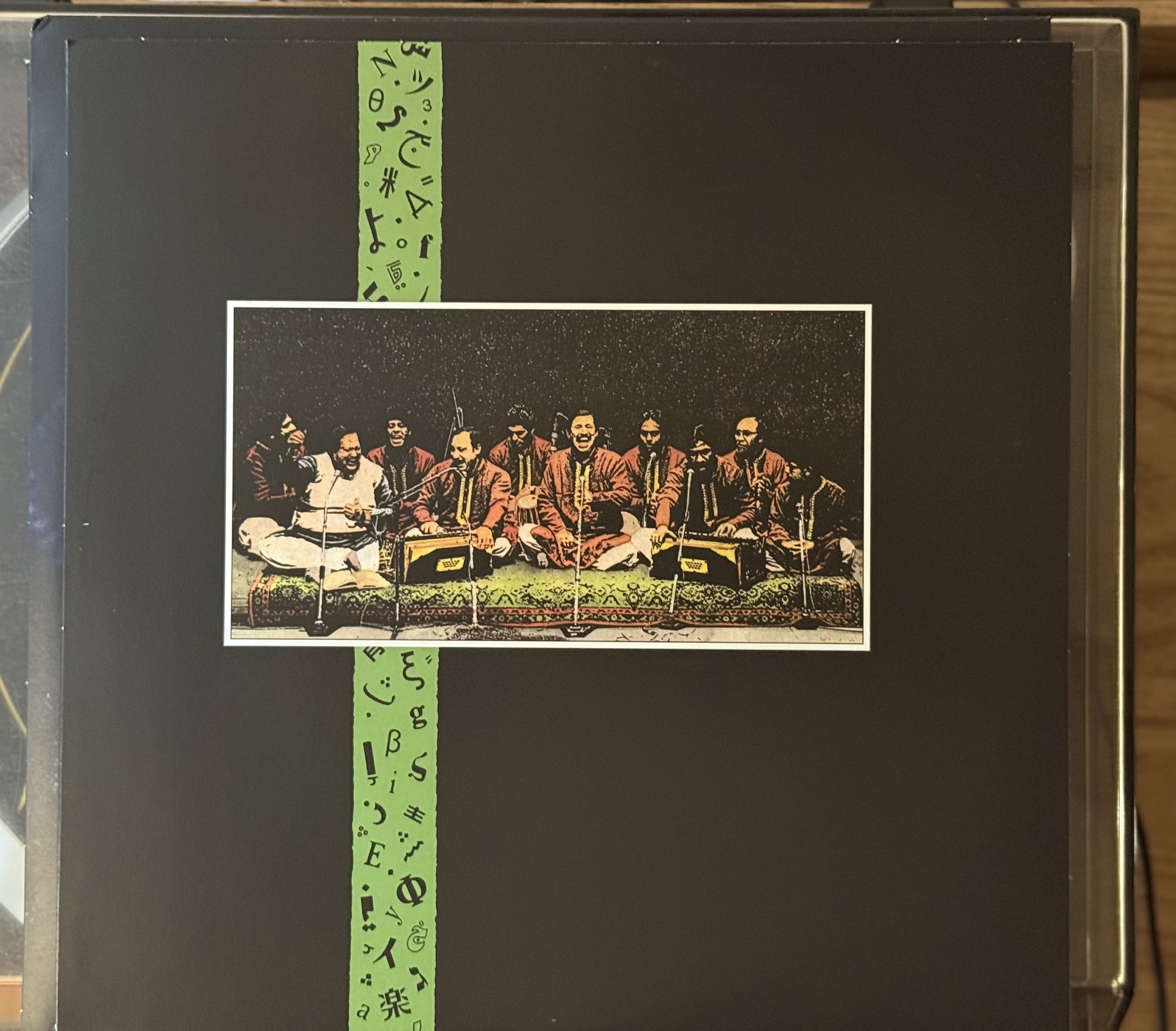
Because the original performances date to 1986, the group is much closer to the 1985 WOMAD performers than the group that recorded Shahbaaz. Specifically, there are the usual suspects: Majahid Mubarak Ali Khan and Maqsood Hussain on vocals, Farrukh Fateh Ali Khan on vocals and harmonium, Mohammed Iqbal Naqbi, Asad Ali, Ghulam Fareed and Kaukab Ali in the chorus, Dildar Hussain on tabla, and two additional instrumentalists: Rahmat Ali on harmonium and Majawar Abbas on mandolin and guitar. The recording also features the young Rahat Ali, Nusrat’s pupil, who was only ten years old at the time.
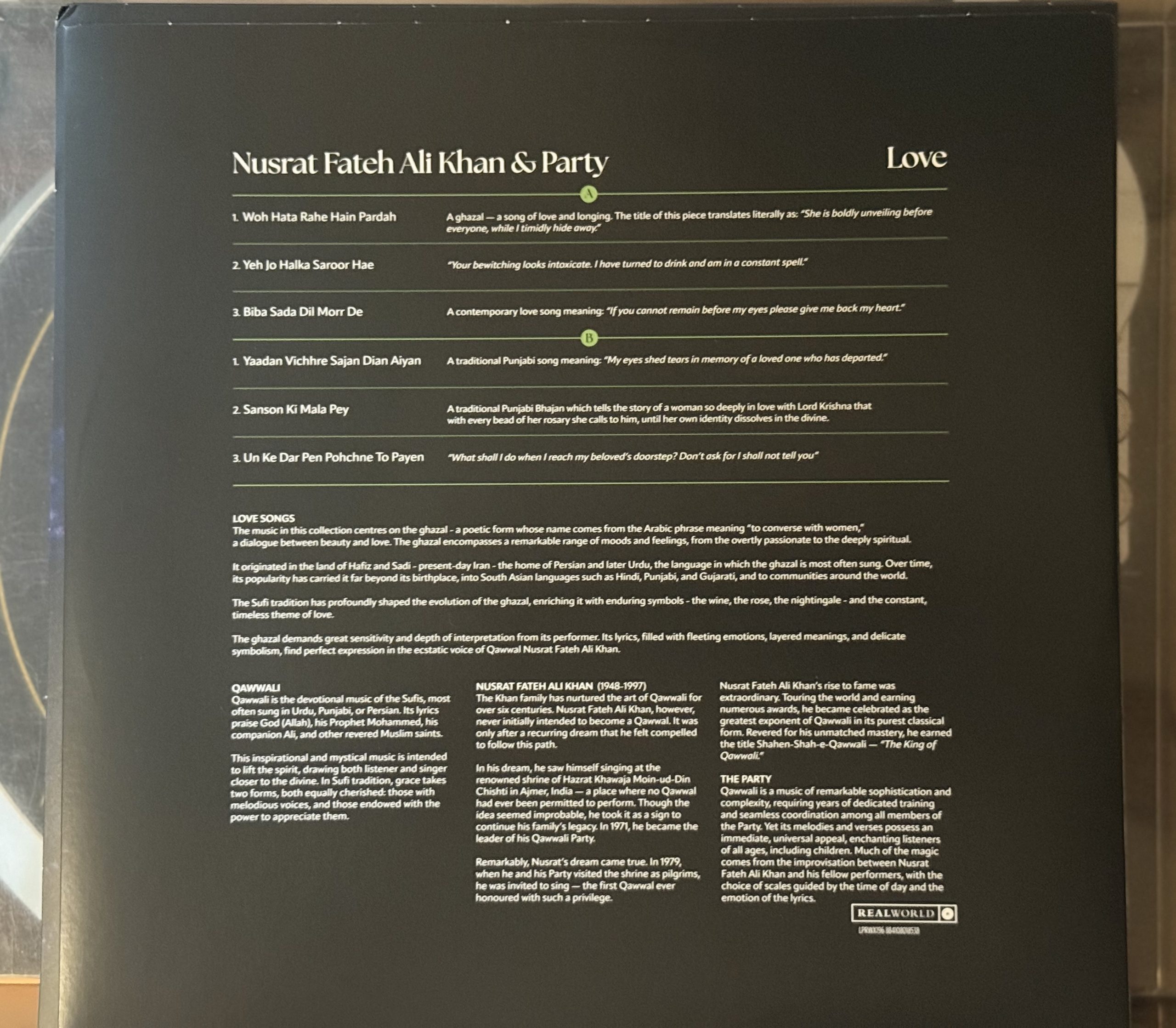
The title of the record refers not only to its subject matter but also to the styles of music represented. The “Love” side is the traditional ghazal, an ancient (ca. 615-700) Islamic love song form that spread via the Persian administrative force of the Moghul empire into South Asia, where its primary language movedf from Persian into Urdu. “Woh Hata Rahe Hain Pardah” emphasizes the difference in form via its instrumentation, which here includes Abbas’ guitar in addition to the normal harmonium and tabla. Nusrat’s performance leans heavily on the repetitions of the melodies with the chorus, with occasional moments of vivid improvisation.

The guitar opens “Yeh Jo Halka Saroor Hae” as well, with some unexpected harmonies and articulations. The poet writes about love as intoxication, literally: “Your bewitching looks intoxicate. I have turned to drink and am in a constant spell.” If the title sounds familiar, it’s because it was this song that Jeff Buckley essayed a surprisingly competent performance of in the extended Live at Sin-É, but he didn’t work from this recording; he appears to have had a copy of a 1988 Nusrat album that was released under the titles Greatest Hits Vol. 3, Yeh Jo Halka Halka (in a 1991 German release), and later Intoxicated Spirit. The arrangement here is different; after the guitar intro and the first statement of the tune, the party improvises on the bridge of the tune rather than the opening lines. In the last two minutes, Nusrat’s improvisation takes off, engaging a third melody that he uses to bring the party back to the start.

A more contemporary song, “Biba Sada Dil Morr De” unusually starts in a minor key, as Nusrat pleads, “If you cannot remain before my eyes, please give me back my heart”… a universal trope. The performance gives room for Nusrat to stretch out on some higher sangam improvisations, and the other members of the party get some high lines as well. Nusrat also inserts a long section of single-note syllabary that becomes a more traditional scale-wise improvisation, and he and the party “trade licks” through the end of the performance. Another version of this can be heard on Live at WOMAD 1985.
“Yaadan Vichhre Sajan Dian Aiyan” is a traditional Punjabi song lamenting the death of the beloved. Here the mandolin puts us into the minor key, but most of the work is done by the party, who navigate the downward chromatic direction of the melody with ease. Nusrat’s improvisations negotiate the tone row of the piece with his customary blistering pace, but other members of the party add their own flavor with extended melismas and other improvisations. It’s Nusrat’s last scalewise melody that is the most dramatic, though, comprising an augmented minor progression that he rips through twice before returning to the main melody with the party.

Not all the ghazals are about romantic love. “Sanson Ki Mala Pey,” another traditional Punjabi song, talks about a woman whose love for Lord Krishna intensifies so much that she loses her own identity and becomes incorporated into the divine. The opening melody improvises across the scale in the guitar with unusual leaps, and the party’s statement of the melody is unusual as well with an eighteen-beat melodic pattern, organized as six slow triplets. So there’s an unusual waltz feel to the song that, coupled with the unusual chord progression, lends the feel of a Western folk song. Until the party begins its high improvisation, you could almost imagine this track (with English words) as the closing song of a downtempo set.

The Devotional and Love Songs compilation excluded two tracks, one from each of the original albums, from its running order to fit within the limits of a CD. “Un Ke Dar Pen Pohchne to Payen” is one of these, the last track on the Love Songs album, here restored to the running order in the double album. The sunny major key melody, with its unusual use of the ninth in the melodic progression, cheekily conveys the spirit of the lover: “What shall I do when I reach my beloved’s doorstep? Don’t ask, for I shall not tell you.” There are multiple improvisational asides as the party navigates the song, and a slight accelerando conveys the eagerness of the narrator at least as much as the intensity of the party in their performance.
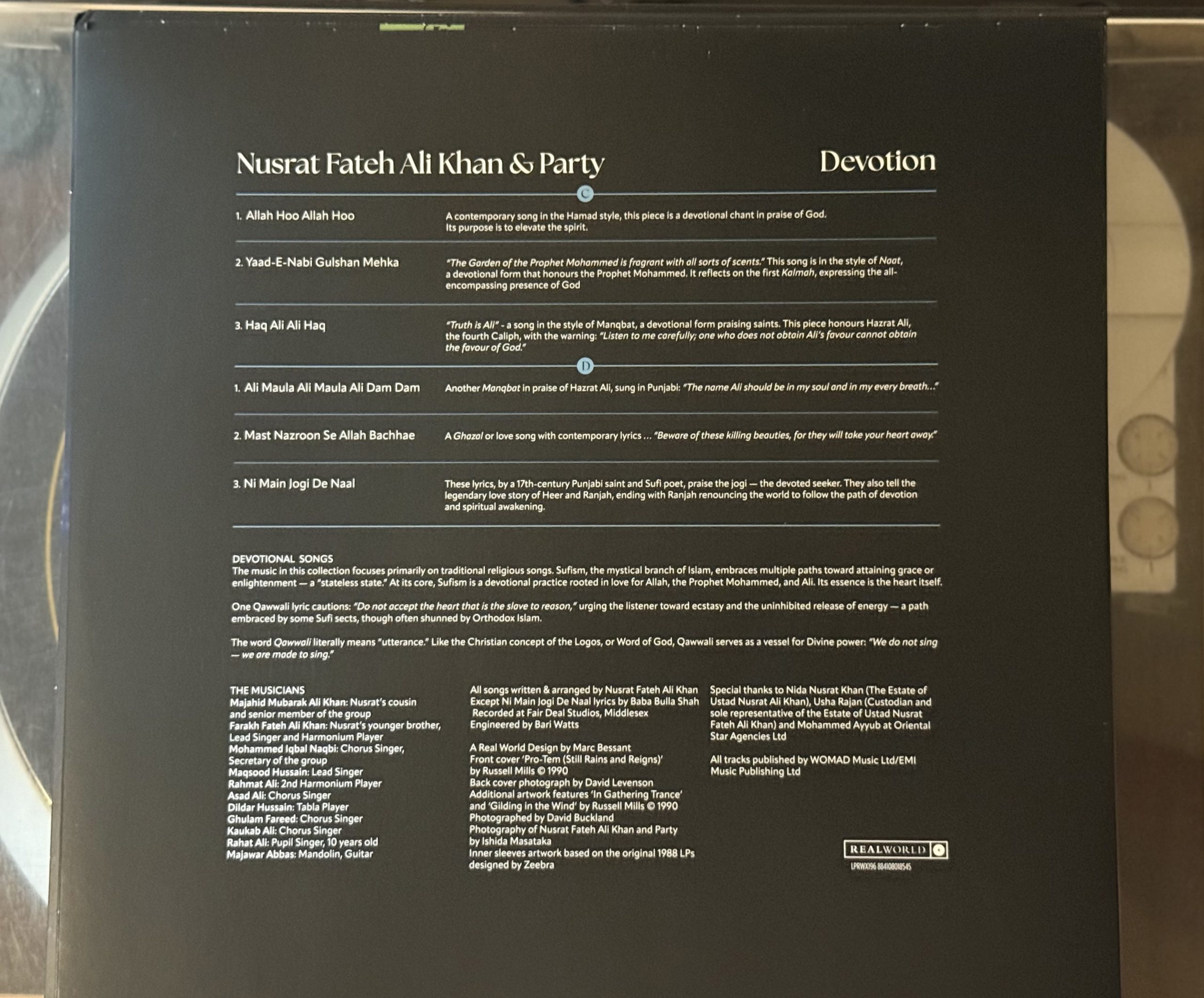
We are back to the devotional qawwali music with “Allah Hoo Allah Hoo,” previously heard on Live at WOMAD 1985. This recording, true to the reputation of Nusrat’s pre-Real World sets, is much briefer, limiting the amount of time each member of the party gets for their improvisation and resulting in a more focused, punchier performance. The addition of mandolin to the instrumentation helps to move things in a sprightlier direction as well.

“Yaad-E-Nabi Gulshan Mehka” is also given an upbeat reading, with Nusrat leading the way in quick rhythmic variations of the melody almost as soon as it’s stated. We’re in a major key, which seems appropriate for a song reflecting on the “fragrance of the garden of the Prophet Mohammed.” “Haq Ali Ali Haq,” which also appears on Live at WOMAD, starts in a more reflective mode but quickly picks up momentum as the party negotiates the intricate, turning melody. This performance provides a little more stretch room for the performers, with high solos from the party and some meteoric sangam from Nusrat. The party performs a circling take on the melody that moves up and down the scale. All told, though, one appreciates the truth of the reviewer who noted that Nusrat’s other Real World albums provided opportunities for magic to happen by letting the performance stretch out over fifteen or twenty minutes; as complex as this rendition is, it feels like the band is just getting started (and in fact the song is subjected to the indignity of a fade-out).
“Ali Maula Ali Maula Ali Dam Dam” is a devotional Manqbat (a song sung in praise to the Sufi saints) praising Hazrat Ali. Here it’s sung largely homophonically, with little of the extended improvisation in the first half of the performance and with alternating single-voice solos from the different lead singers of the party. There’s a truly dizzying bit of sangam in what sounds like triple-tongued rhythm from Nusrat near the end; if you listen carefully you can hear his young pupil Rahat, here only 10 years old and not given his own mic, singing along behind the master.

“Mast Nazroon Se Allah Bachhae” is the sole ghazal on the “devotional” half of the album. Here the form feels similar to his performance of “Kali Kali Zulfon Ke” on Shahen-Shah, with the qawwal and party intoning the chorus twice and then Nusrat interrupting the third repetition with the first of many solos. The party continues to provide call-and-response support throughout.

The final track, like “Un Ke Dar Pen…,” was cut for space from the 1992 Devotional and Love Songs compilation. “Ni Main Jogi De Naal” is a devotional song dedicated to the jogi or devoted seeker. With a bright opening on mandolin and harmonium, Nusrat and the party sing overlapping iterations of the devotional, alternating with solo verses that elaborate the story of the jogi. In the end they achieve the sort of liftoff present in the best Nusrat performances, engaging in a sort of collective musical frenzy that ends in a final tempo downshift and a last utterance of the chorus.
Nusrat’s next album for Real World was 1994’s traditional The Last Prophet, which has yet to see a vinyl release. He followed that with something less traditional, and we’ll get to that soon. Next time, though, we’ll hear from one of his Real World labelmates, who had already made his world debut through a collaboration with Peter Gabriel.

You can listen to this week’s album here:

BONUS: This two-hour Channel Four program presents a live 1993 Nusrat concert from London, highlighting the diverse and very large crowds that Nusrat’s traditional qawwali music was bringing during this time.

Footnotes

  1. The liquidation resulted in consolidation, as the WOMAD assets were subsequently acquired by the Real World group. ↩︎

Nusrat Fateh Ali Khan, Shahen-Shah

Nusrat’s first Western album is an ideal representation of the sacred and secular art of qawwali singing.

Album of the Week, June 13, 2026

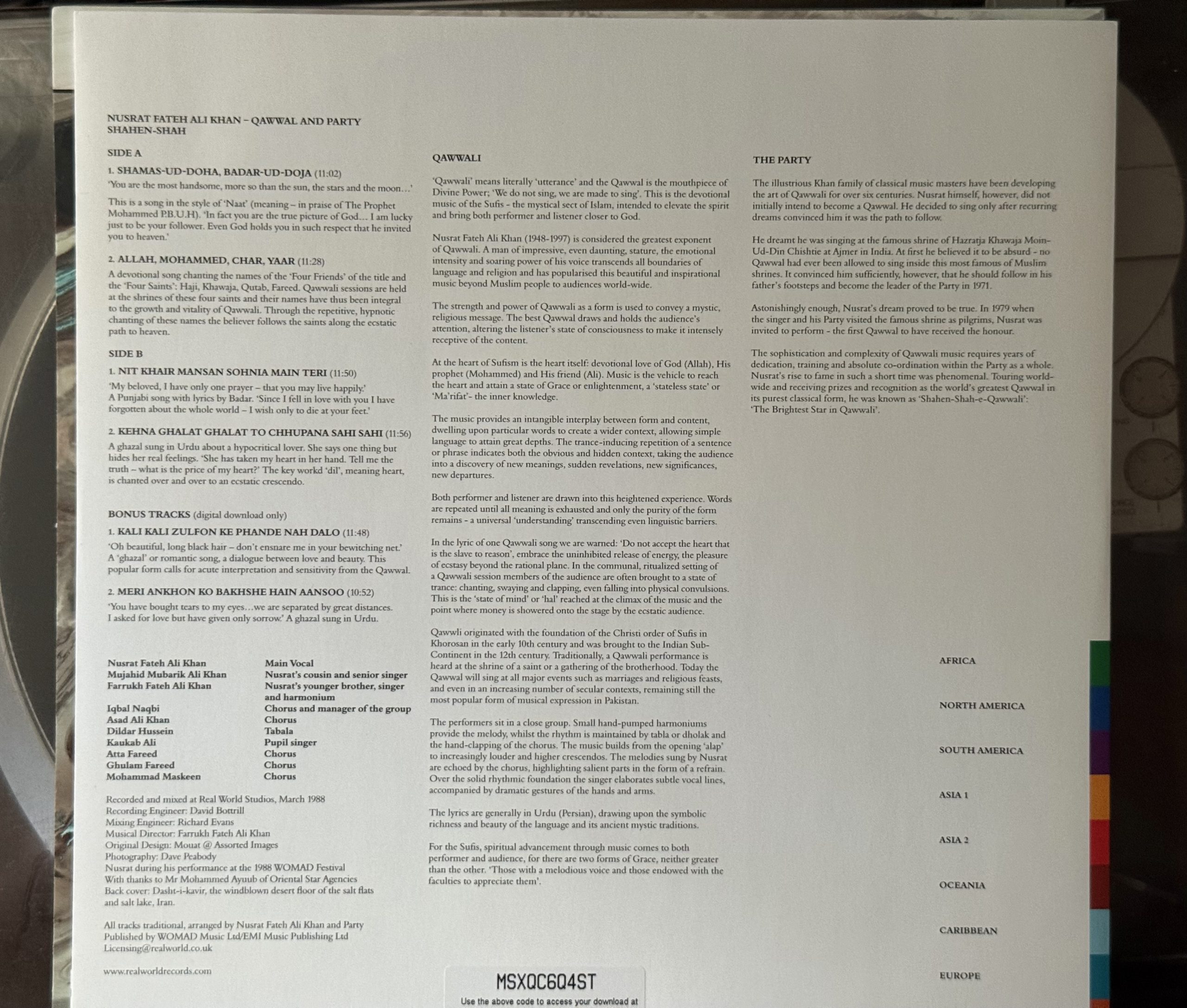
When it came time for Nusrat Fateh Ali Khan to record his first album for Peter Gabriel’s nascent Real World Records, he could have Westernized his sound—after all, he had just spent time in the studio with Gabriel on the Passion project. Instead, he and his party produced an album that was as accurate a representation of qawwali tradition that had ever been released, opening the door for Westerners to discover the tradition.

Nusrat was not new to being recorded; prior to 1989 and this session he had already released some twenty-eight albums, a few for EMI but most for small local labels, or for the French world music label Ocora. But listeners noted that “studio-recorded Nusrat [could] often feel rushed, as if the party was singing qawwali for the sake of the recording rather than for the sake of religious praise.” No such limitation existed here; this was full-throttle qawwali, with the group providing authentic examples of devotional songs as well as ghazals (romantic songs).

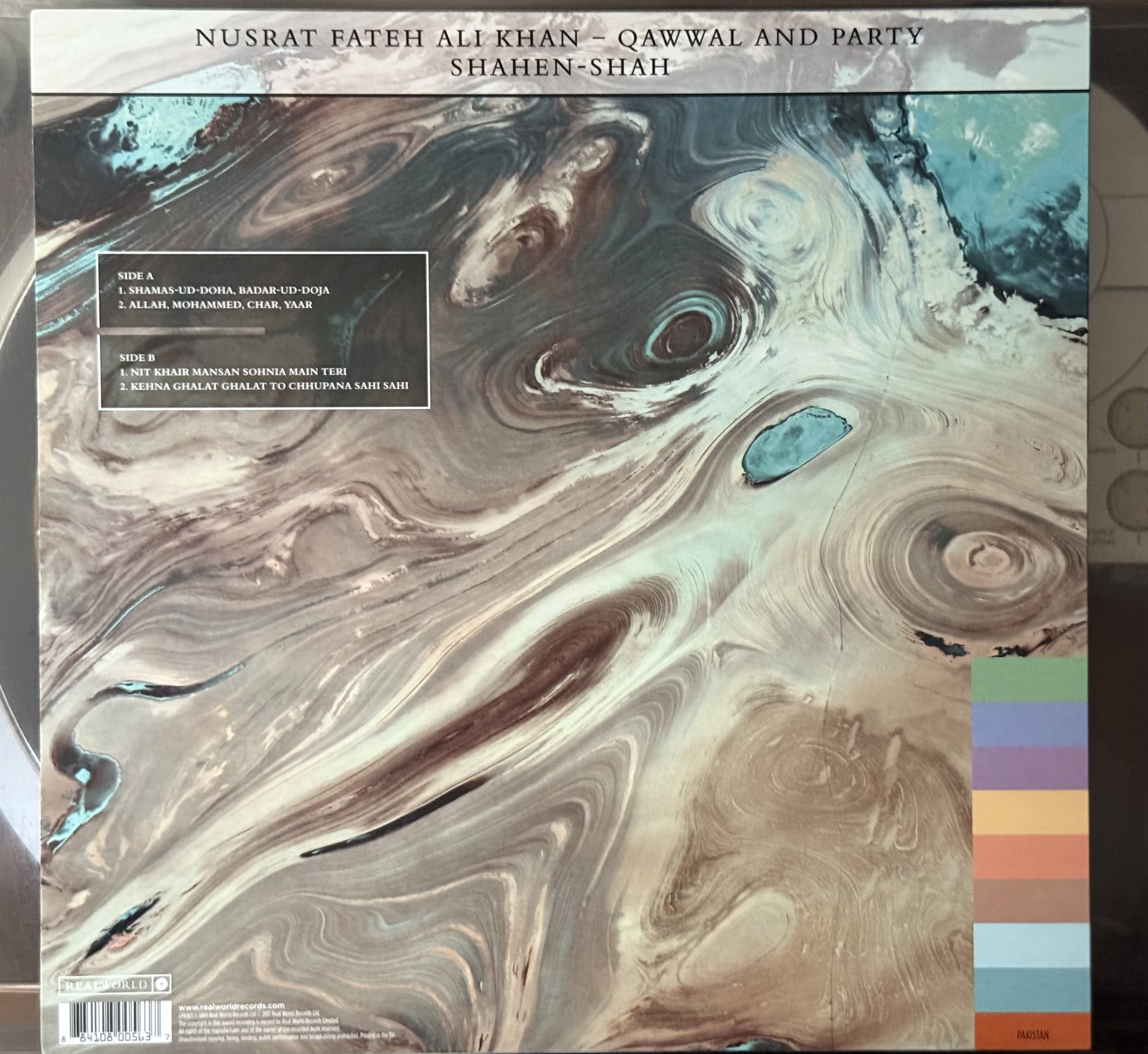
Part of the secret of the recording was the timing. The original Real World recordings were not limited by the running times of vinyl; by 1989 most releases were CD-first, and a project containing six tracks each stretching more than ten minutes was no longer out of the question. Unfortunately this led to some choices when releasing these recordings on vinyl, mostly at the time for the European market which continued to demand vinyl releases through the early 1990s. Today’s record is the 2017 reissue of the 1989 European vinyl release, and it omits two tracks, “Meri Ankhon Ko Bakhshe Hain Aansoo” and “Kali Kali Zulfon Ke Phande Nah Dalo.” The latter is probably my favorite Nusrat track of all time, so I was irked to find it omitted from this release; we’re going to talk about it in the bonus tracks.

“Shamas-Ud-Doha, Badar-Ud-Doja” opens with the instrumentalists: harmonium playing the melody of the hymn in praise to Mohammed, hand claps. Then Nusrat leads the party in a gathering tone, wordlessly outlining the tonic, the third and the fourth in an introductory vocalese before singing a rhythmic verse that loosely follows the main tune, followed by everyone entering on the chorus. Nusrat lets us know how it’s going to go when, at the end of the second chorus repetition, he easily rips a vocal improvisation an octave up. At the end of the fourth chorus, he lays down a series of 32nd-note runs. The other singers in the party contribute too; one of them adds a run around the fifth, another at the octave, and there are numerous places where Nusrat improvises in the middle range while one of the other singers provides a high obbligato above. (This record features vocals from Nusrat’s cousin Mujahid Mubarak Ali Khan and his brother Farrukh, as well as his pupil Kaukab Ali, as well as other singers in a chorus; the youngest pupil heard on Live at WOMAD 1985, Rahat, is not heard here.) About halfway through, Nusrat engages in some stepwise sangam improvisation and some rhythmic improvised vocal syllables, which are closely followed by the tabla and harmonium. The closing series of runs where Nusrat rips a series of 32nd-note patterns up the scale are simply awe inspiring.

“Allah, Mohammed, Char, Yaar” is a devotional chant to God, the Prophet, and the “four friends”—four Sufi saints whose graves are the site of pilgrimages and qawwali sessions. It’s also gnarly as hell. The melody syncopates from the second note and recovers the non-syncopated beat with three eighth notes, and those off-beats in the middle have me leaning forward into the beat all the way. It’s in the raga marwa, something like the Locrian western mode, meaning that it sits unstably between a major and minor feeling, and also meaning that the qawwal singer can explore both tonalities in the solo, a fact of which Nusrat takes full advantage. There is less for the party to do in this song, aside from some high obbligato late in the song; mostly they groove on the chant. And there’s a lot to groove on; Nusrat’s sense of the beat is impeccable, and he’ll seemingly fly off at random only to have an improvisation circle right back to the tonic at the start of the chant again, over and over again.

“Nit Khair Mansan Sohnia Main Teri” is a Punjabi love song: “My beloved, I have only one prayer, that you may live happily…Since I fell in love with you, I have forgotten about the whole world; I wish only to die at your feet.” You can hear a little more of the traditional raga sound in this one, as Nusrat and the party sing the introduction and then get to the chorus. Here you can hear the roles of the other singers in the party, as one specializes in singing descending wordless lines in a thin clear voice from the octave while another, with a stronger voice, provides more of a high tenor line above the proceedings. Nusrat’s incredibly resonant and vibrato-rich instrument essays rhythmic running lines throughout. This one is trancelike, perhaps because of the raga foundation combined with the relentless major key feeling.

Another love song, in this case a ghazal in Urdu, “Kehna Ghalat Ghalat To Chhupana Sahi Sahi” is a song of complaint about a lover who says one thing and does another. Even here Nusrat steps into moments of ecstatic crescendo; rather than sounding angry or exasperated this too is a moment to celebrate the musical world of qawwali. The extended series of solos on the syllable dil (heart) are a magnificent punctuation of the overall arc of the song. At the end of the song, we get the only decelerando in the whole album as the party slows to the final repetitions of the love song.

With his first album for Real World, it was clear why Nusrat Fateh Ali Khan had chosen this title: “Shahen-shah” means brightest star, and this was clearly a performance of a leading light in the qawwali tradition. The record opened the door for Western listeners to immerse themselves in an entirely new cultural sound world. Some, like Jeff Buckley, were awestruck by Nusrat’s vocal ability and sought to learn from him. Some heard exotic sounds and sought ways to bring them into Western music; we’ll hear examples of that later. And some took it as a cue to explore more varieties of non-European music. We’ll hear from another great musician who opened some of these same doors next time.

You can listen to the full version of this week’s album, including the tracks that didn’t make the LP version, here:

BONUS: Let’s talk about “Kali Kali Zulfon Ke Phande Nah Dalo.” I have always liked the track a lot; it appears on a mix I made just out of college and was likely one of the tracks I played the afternoon I met my wife (though it was Tuvan throat singing that was blasting from my stereo when I actually opened the door and met her). The tune of this Urdu love song is stated in the harmonium, which gets its own elaborate improvisation until Nusrat and the party join with sustained gathering tones. When Nusrat starts the chorus, we get an initial statement, a repetition tagged with an octave high emphatic tone, a third with a high obbligato, a fourth with Nusrat ripping a descending vocal line from the third above the octave. Then the party alternates singing the chorus statement with more obbligato from the other singers and elaborate improvisations from Nusrat. Starting about three minutes in he starts to essay some call-and-response verses. I learned a lot as a college just sitting and listening to all the ways he interrupted the flow of the chorus with solos, how his vocal lines reinforced or altered the tonality, and especially how he played with the meter of the lines. The stretch from around 5:45 to 6:20 is a masterclass in how to fluidly slip in and out of metrical alignment with the groove, particularly the triple sets of triplets which shift out of and into phase flawlessly. I can still put it on and listen to it all these years later, and discover something I’ve never heard before.

BONUS BONUS: Here’s “Nit Khair Mansan Sohnia Main Teri” live from the 1988 WOMAD festival, about the time that Nusrat was headed into the newly constructed Real World studio to record this album.

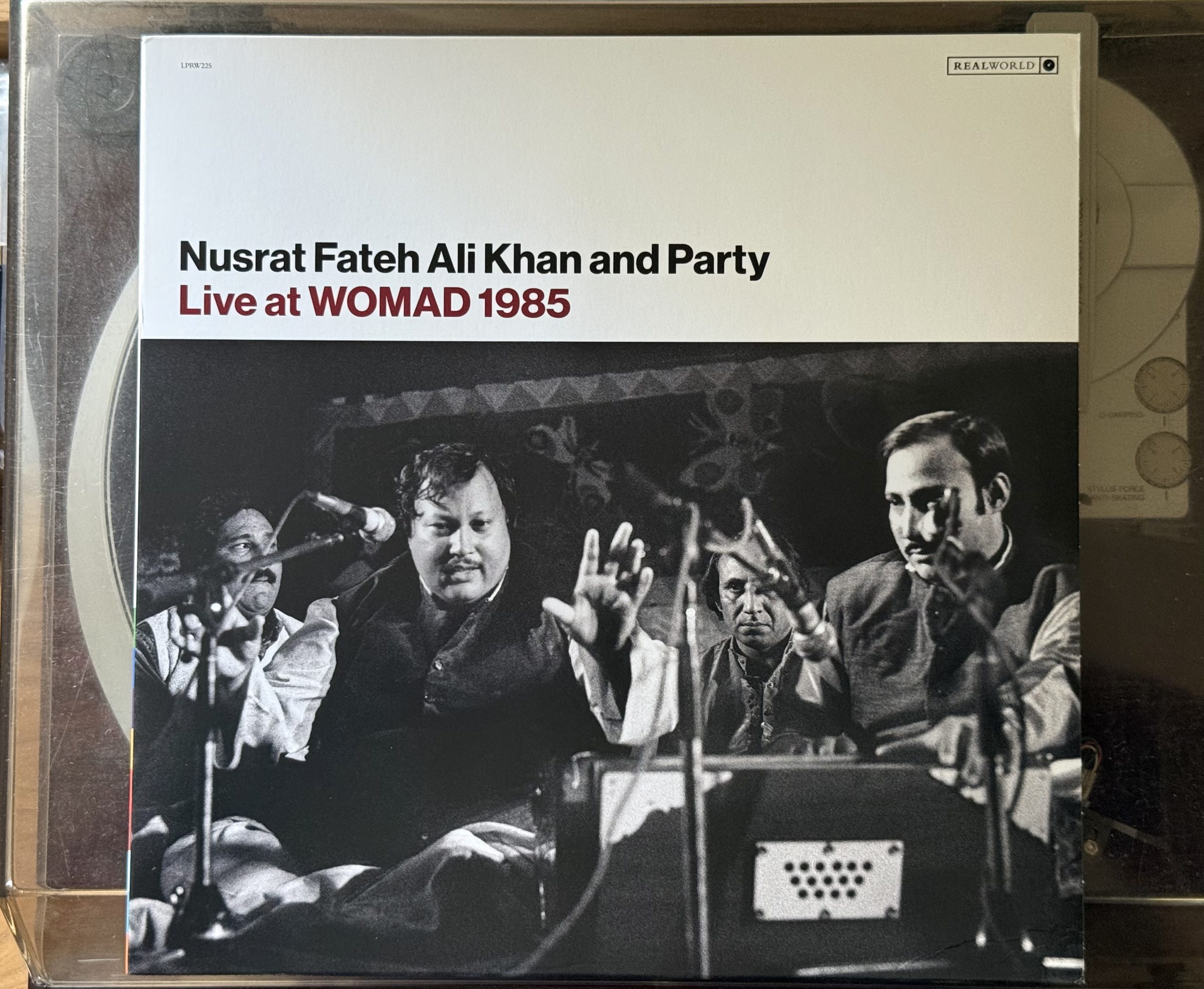
Nusrat Fateh Ali Khan and Party, Live at WOMAD 1985

A recently released archival recording documenting the moment when the great qawwali burst onto the world stage.

Album of the Week, May 2, 2026

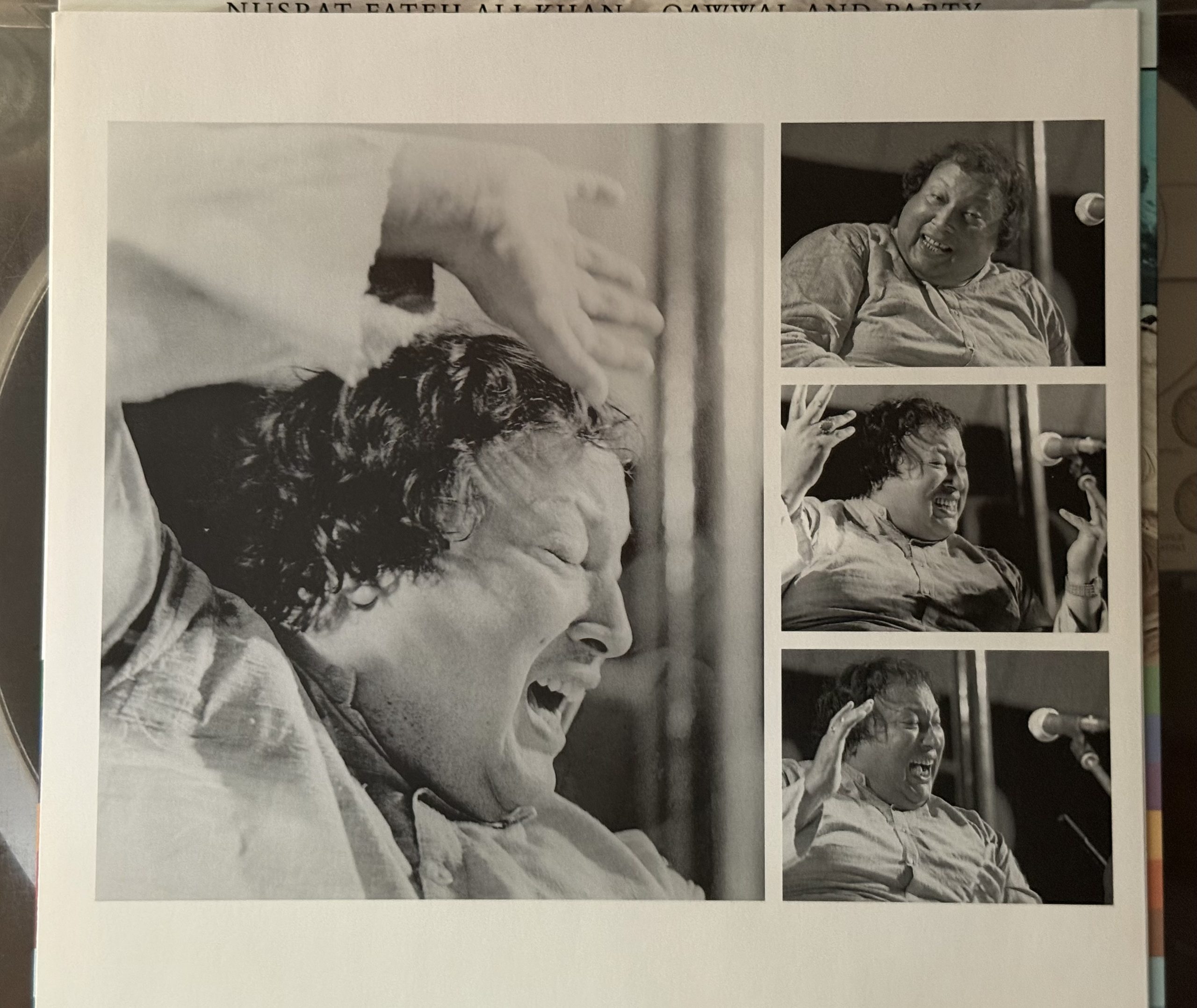
A traditional religious singer from Pakistan who performed with a harmonium player, percussionists, and a group of singers that included two students, one of whom was his nephew, would seem an unlikely choice for a superstar. The rise of Nusrat Fateh Ali Khan, about whom Jeff Buckley once famously remarked “Nusrat, he’s my Elvis,” is the story of a musician who was already acknowledged to be the greatest artist in his field before most Western listeners ever heard of him. And that journey to worldwide fame began with a midnight concert 41 years ago this year, at Peter Gabriel’s 1985 WOMAD festival, on a bill that also featured New Order, the Pogues, Toots and the Maytals, and The Fall.

Ustad Nusrat Fateh Ali Khan (“Ustad” means “master” or “craftsman” in Urdu, Persian and a host of other languages) was born in 1948 in western Pakistan. His family were practitioners of the art of qawwali, or Sufi devotional music, with their musical heritage going back at least 600 years. Nusrat’s father Fateh Ali Khan wanted Nusrat to follow a more reputable profession like engineering or medicine, but the young musician’s playing on the tabla earned praise from master qawwali artists and convinced his father to let his son follow in his footsteps. At age 16, following the death of his father, Nusrat became the lead singer of his father’s party alongside his uncle Mubarik Ali Khan; in 1971 his uncle died and he rose to leadership of the party at age 23.

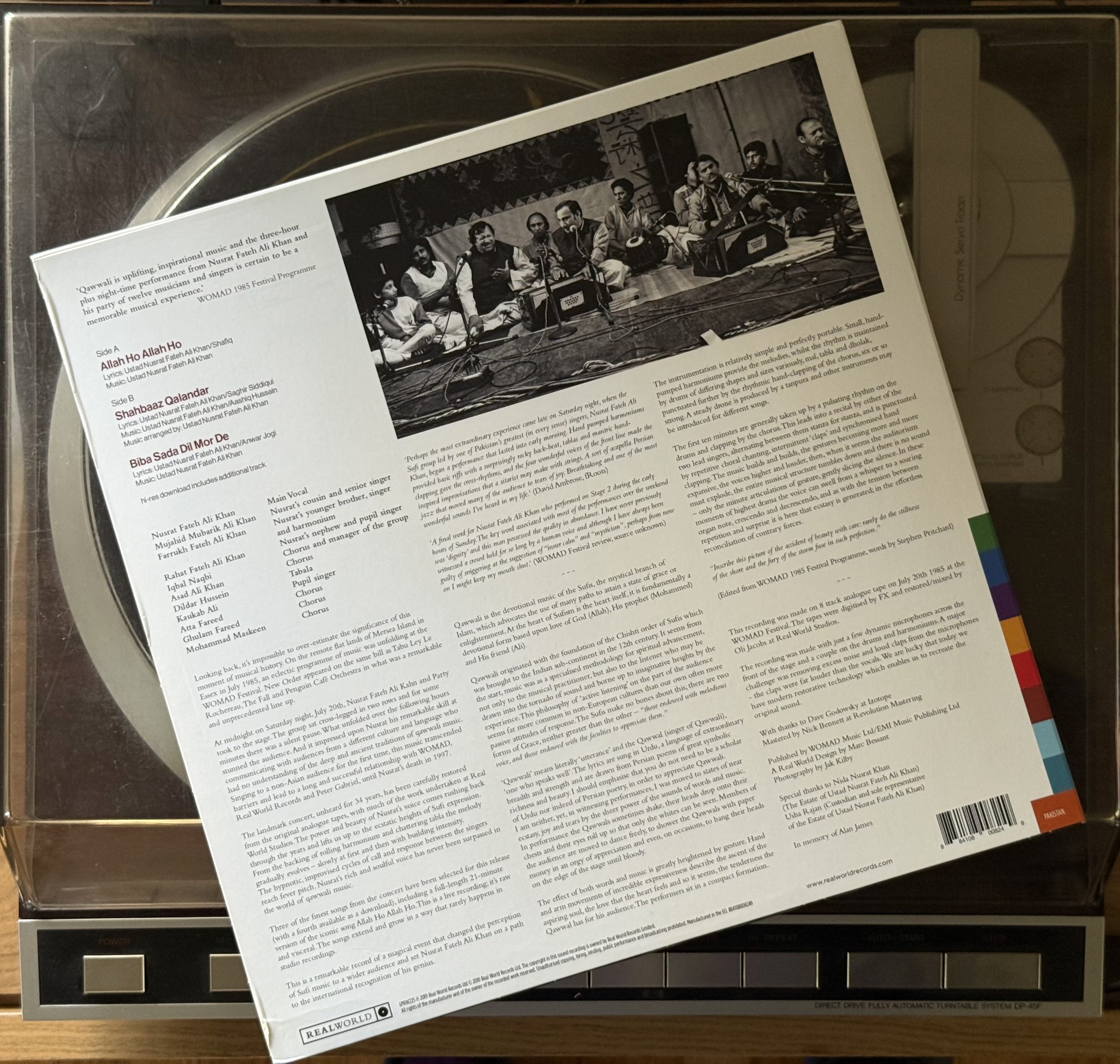
A qawwali party is a band optimized for traveling performances. The instrumentation is light—tabla or other percussion instruments and a harmonium—and is primarily there to support the singers. In Nusrat’s party this included Mujarad Mubarik Ali Khan (son of Nusrat’s uncle), Farrukh Fateh Ali Khan (younger brother), two pupils, Kaukab Ali and Rahat Fateh Ali Khan (Nusrat’s nephew) and a five-voice chorus. This group of musicians crowded onto a stage on Mersea Island in Essex for an audience that at first sat politely, but by the end of the first song were on their feet, clapping and chanting along.

“Allah Hoo, Allah Hoo” begins with a several-minutes long instrumental solo with the harmonium and the tabla as the group settles in, then Nusrat intones the initial verse melody in something like a plainchant style, alternating with the other vocalists of the party in higher and higher vocal lines, and finally segueing into the chorus with its repeated exhortations of “Allah Hoo, Allah Hoo” after over six minutes of introductory material. From this point forward the party improvises over several main melodic lines: the “Allah Hoo” melody, the verse melody “Ye zamee’n jab na thi, ye jahaa’n jab na tha,” and a stretch of free improvisation in which each of the singers takes turns ascending and descending octaves, a practice called sargam. This section is particularly notable for the interchanges between Nusrat and his young nephew Rahat (now Ustad Rahat Fateh Ali Khan), who was young enough in this record that his voice had not yet attained his adult range. The overall song is a hymn of praise: “O God, O God… When the earth was not, when this world was not / When the moon and the sun had not been created / When even the secret of Truth was hidden from all / There was nothing here / But still, You alone existed.” The overall performance runs for more than twenty minutes.

Nusrat introduces the next song for the festival audience after the instrumental introduction, saying “This is very famous tune—very famous tune ‘Shahbaaz Qalandar laalmeri pat rakhiyo bal’.” The tune, a hymn to the Sufi mystic “Hazrat Lal Shahbaz Qalendar” (literally “Prophet of God, Red-Robed, Falcon King, Sufi Saint”) who sought to bring peace between the Hindi and Muslim populations in Pakistan and who was regarded by the Hindi people as as an incarnation of God. He was also known as “Jhulelal,” and both the Shahbaaz and Jhulelal names recur in many of Nusrat’s songs of praise. The song itself features a strong melodic pattern that circles between the fifth and tenth tones of the scale. There are fewer sangam passages in this performance, but an extended instrumental break on harmonium and tabla brings cheers and whistles from the crowd. By the end the singers of the party are singing the chorus in overlapping waves, ultimately stopping only as one of the singers suffers an audible coughing fit.

“Biba Sada Dil Mor De” is the sole non-religious song on the album, a ghazal, or love song, that can be translated as “Darling, give me my heart back” or, in the liner notes to one of Nusrat’s later albums, “If you cannot remain before my eyes please give me back my heart.” For the most part the party repeats the refrain over and over again, but after about six minutes they start a series of vocal improvisations, ranging from high obbligato to highly rhythmic sangam utterances from Nusrat. The record ends in a fade out on the cheers of the crowd.

This performance was legendary but not broadly circulated until 2025, when improvements in digital technology made it possible to adjust the levels in a way that permitted the vocals to be appropriately prominent; on the original tapes the sound of the handclaps of the chorus dominated the sound. The release reopens an old question: would Nusrat have found his way to world prominence without the 1985 WOMAD appearance? We will never know, but this first experience led to many later collaborations with Peter Gabriel and a bigger platform for his solo works. We’ll listen to some of those later, but next week we’ll hear from a different Peter Gabriel collaborator on an album that was itself a breakthrough.

You can listen to this week’s album here, including a bonus performance of Nusrat’s famous “Haq Ali Ali”:

BONUS: The recording, amazing though it is, doesn’t fully convey what this band could do. This crowd video of “Shahbaaz Qalandar” shows it all: the polite listening, then the rhythm starts to grab them, then everyone is on their feet. That’s more or less exactly how it happened to me when I saw Nusrat in the mid-1990s in Washington, DC: