
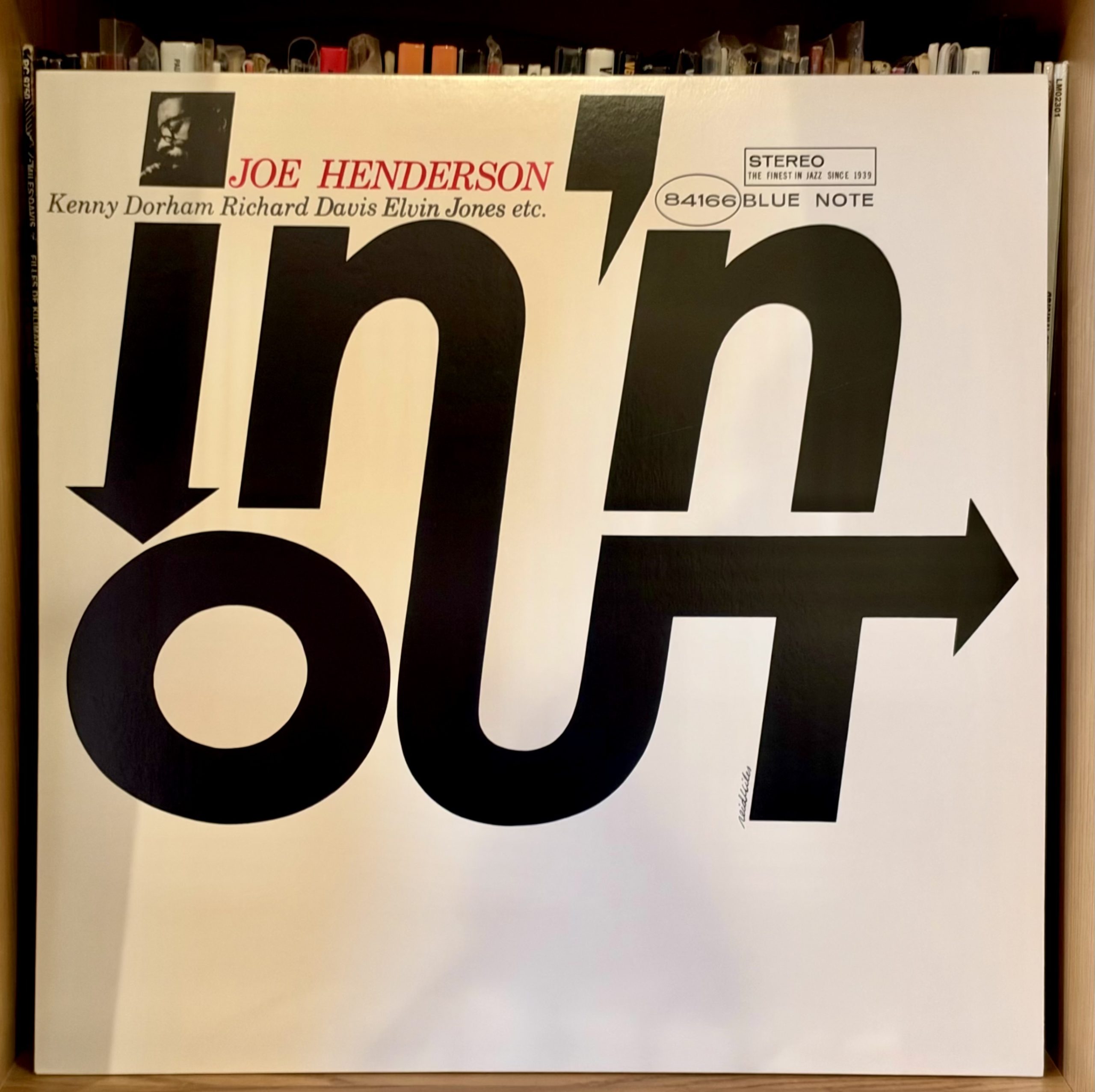
Album of the Week, November 7, 2026
We’ve seen saxophonist Joe Henderson a few times in our jazz record reviews, as a sideman for Alice Coltrane, Ron Carter, Freddie Hubbard, Miroslav Vitouš, and Herbie Hancock. But before any of these recordings were the classic albums the Lima, Ohio-born Henderson made as a leader, starting with a string of recordings for Blue Note Records that reflected both a more conventional hard bop and a broader, more original compositional palette that was informed by modal jazz but came with its own unique compositional and melodic sensibilities. We’ll explore a small selection of these albums over the next few weeks, refracted as always through the prism of my vinyl collection, and we’ll start with this album, Henderson’s third for Blue Note, which has one of the most distinctive and memorable covers in jazz record history.
Of the ingredients in Blue Note Records’ long-lasting success, Reid Miles’ album covers are certainly the most visible, and In ’n Out boasts one of the most iconic. Reversing the normal prominence of the band photo and the title, here the title is the album cover, and the band photo is reduced in prominence, literally serving as a tittle. The letters blur together with directional signs in the illustration, and the players appear shoehorned in around the logotype. Indeed, Miles seems to have sacrificed some of the function of the album cover to fit the form; of the players, only Henderson, trumpeter Kenny Dorham, bassist Richard Davis, and drummer Elvin Jones are named, while pianist McCoy Tyner is listed only as “etc,” possibly due to contractual restrictions. The session, recorded at Rudy Van Gelder’s Englewood Cliffs studio, took place April 10, 1964 after a false start on April 7, and a mere 17 days before Jones and Tyner returned to Van Gelder’s studio to record Crescent with John Coltrane.
“In ’n Out” starts out with a sort of hurtling fanfare, as Henderson and Dorham trade flourishes in a strict sequence. Henderson’s solo emphasizes the modal logic behind the tune while pulling forward the blues in a few bars, and introducing what I tend to think of as his signature improvisational move, a series of downward arpeggiated triplets. Tyner’s solo has all the hallmarks of his Coltrane-era greatness—running melodies, strong block chords, modal voicing—without the shamanic intensity that came in his later-1960s records. And Dorham provides a ripping solo that sounds in its clarity and melodic imagination like a forerunner to some of Wynton Marsalis’s mid-1980s records, before his transformation to an Ellingtonian composer and bandleader. Under it all, Richard Davis keeps a running commentary on the bass alongside Elvin’s rolling thunder. Henderson tags in once more at the end for a brief coda, which ultimately resolves in a final statement of the fanfare. It’s heady modal hard bop, of a drive and sophistication that were uniquely Henderson’s.
The modal direction continues with “Punjab,” and an easier-tempo melodic statement that sees the horns playing in parallel up a modal scale, with the syncopated rhythms creating a melodic statement and with Tyner punctuating the melody along the way. Henderson’s solo displays his melodic imagination and arpeggiated articulation, which almost seem to outpace his fingers at points. As the soloists proceed the chords reveal themselves to be somewhat “Giant Steps” inspired, with a bit of a modal detour in the turnaround. Dorham’s trumpet makes it all sound easy, and when the horns fall back to let the trio play it could almost be a Bill Evans record—albeit one where Elvin Jones occasionally drops depth charges among the players. Henderson’s second brief solo threatens to lead us off into a thicket of modal arpeggios but he finds his way back to the recap just in time.
Henderson’s “Serenity” is one of his great compositions, its easy melody instantly memorable even as the chords reveal its kinship with the other modal tunes on the album. Dorham gets the lead solo here, albeit briefly, before Henderson essays his own laid-back wander through the tune. Tyner’s modal comping through the chords evokes Bill Evans even more strongly here, before Davis takes a proper solo of his own, strolling along the melodic lines.
The record ends with two Dorham compositions. “Short Story” is presented in a head arrangement that calls to mind Henderson’s long arrangement with Latin music, before shifting to a more straight-ahead blues rhythm in the solos. Dorham’s solo borrows Henderson’s arpeggiated triad riff in its second iteration, while Henderson repeats the trick. Under both soloists Richard Davis and Elvin Jones keep that arpeggiated triad going as a kind of heartbeat. The coda is a lovely bit of harmonic evolution.
We close with Dorham’s “Brown’s Town,” a lively blues that wanders between common time and 6/8 in the head. Dorham takes the lead solo on his tune again, and there’s one understated riff after another here as he unspools a series of hits before casually restating the theme and passing the ball to Tyner. Someone’s grunted vocalizations are slightly audible in the right channel—maybe Jones? It lends the recording a sense of intimacy, as does Davis’s brilliant bass solo.

Henderson’s ability to record a laid-back, casual modal classic that was full of ideas without sounding too cerebral is on full display on In ’n Out, as is his ability to write a memorable melody. (There’s a reason that “Serenity” gets the cover performances that it does and it has everything to do with that wistful near-octave jump that starts the tune.) All of these attributes are on display in the Henderson album we’ll hear next week, though a few of them will be considerably amped-up.
You can listen to this week’s album here:
BONUS: “Serenity” stayed in Henderson’s book, and he recorded it several times with a pianoless trio with Al Foster and Charlie Haden or Dave Holland on bass. Here’s a live performance of the tune by the trio with Dave Holland in 1993…
BONUS BONUS: … and with his big band project for Verve Records in the late 1990s.
BONUS BONUS BONUS: I first heard “Serenity” on a 1990s Roy Hargrove record, with Henderson playing alongside. Here’s that version, from Hargrove’s With the Tenors of Our Time: