
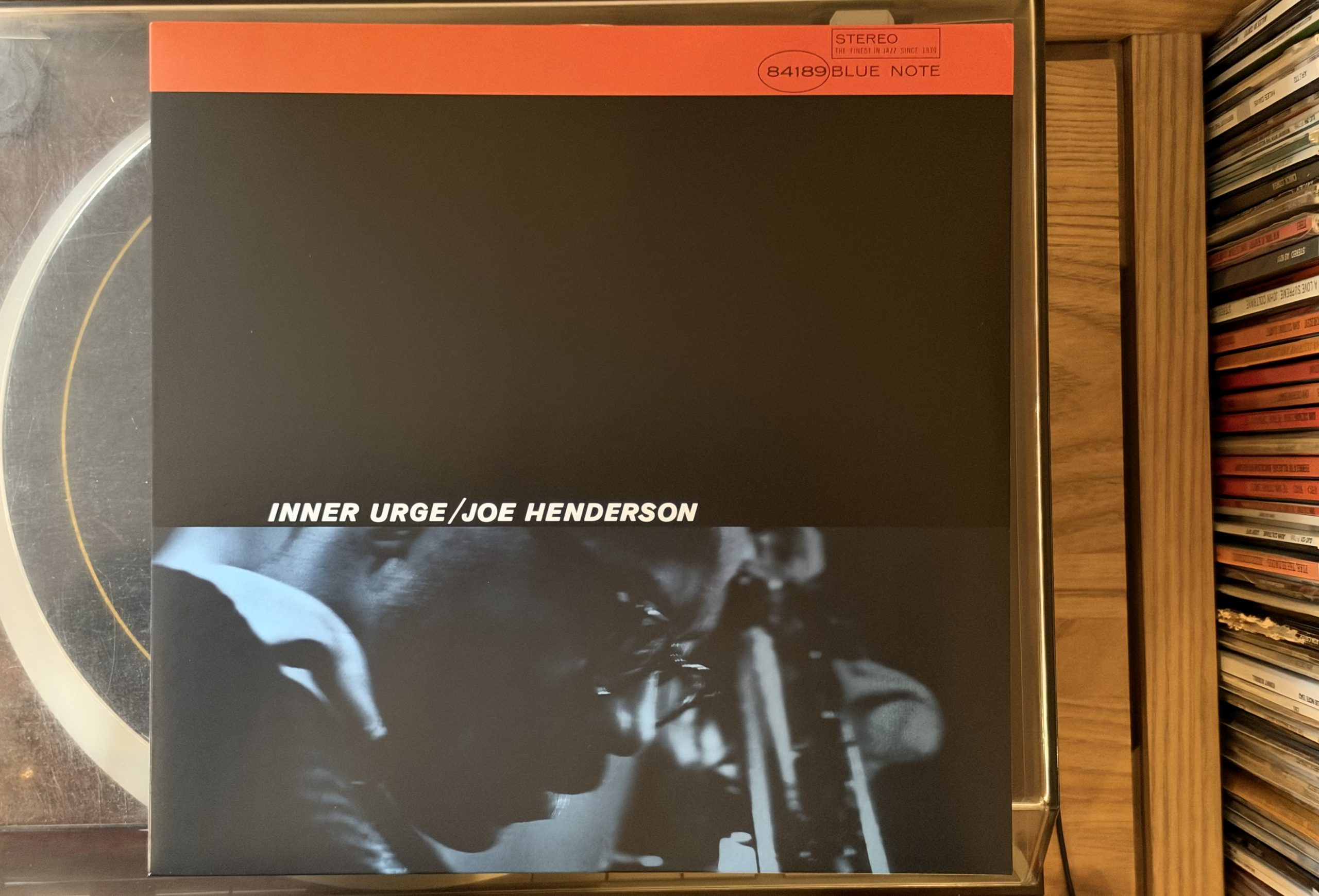
Album of the Week, November 14, 2026
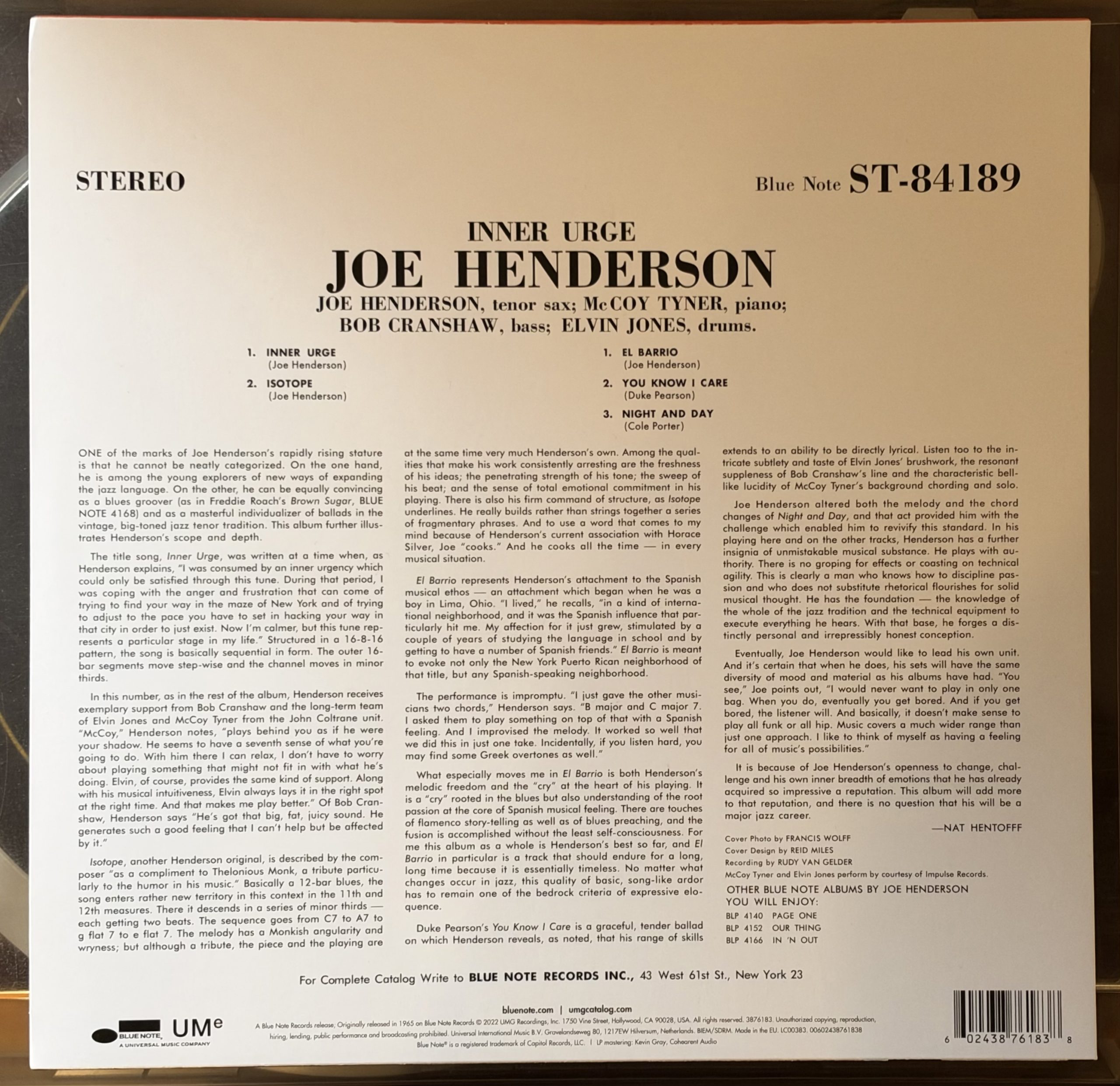
Between recording In ’N Out and stepping back into Rudy Van Gelder’s studios to record the follow-up, today’s record, Joe Henderson kept very busy. Between the April 1964 sessions for In ’N Out and the November 30 sessions for this one, he recorded albums with Grant Green, Horace Silver (that’s his saxophone on “Song for My Father”), Kenny Dorham, and Duke Pearson. But Inner Urge was distinctively Henderson, featuring a Dorham-less quartet with Elvin Jones and McCoy Tyner returning, plus bassist Bob Cranshaw. Cranshaw was Blue Note house bassist who played on sessions for Grant Green, Donald Byrd, Dexter Gordon, Sonny Criss, Bobby Hutchinson, Duke Pearson, and others, and was known for his long association with Sonny Rollins. Together the band allowed Henderson’s compositional flair and improvisational voice to bloom.
Henderson has described “Inner Urge” as reflecting the challenges and emotions of working in New York following his upbringing in Ohio, his early career in Detroit, and his two years in the Army. It’s a workout—a twelve-bar tune that goes through at least eleven chord changes, with a nervous, antic rhythm driving through it. In the opening bass solo, Bob Cranshaw shows why he’s here. Henderson says of the bassist in the liner notes that “He’s got that big, fat juicy sound. He generates such a good feeling that I can’t help but be affected by it,” and that’s exactly what he delivers in the solo—a series of straight and syncopated takes on the opening rhythm, and then a set of improvised additions to the chord structure that open things up from the bottom of the chords. Henderson’s solo flies in atop it all, deploying a set of melodic runs, rhythmic melodies, and washes of triadic waves. Tyner starts with a simple improvised melody in the right hand before anchoring it with strong octaves on the tonic and adding a forceful hemiola statement. And Jones gives a master class in time keeping as his drum solo cascades over and over the bar lines. The whole piece is a spectacular example of a particular kind of 1964 Blue Note specialty, joining Wayne Shorter’s “Juju” and others in a modal hard bop hall of fame.
The transition to “Isotope,” though, shows that Henderson had more than one trick up his compositional sleeve. The tune, a major key blues, is a playful romp that feels a bit like a precursor to Branford Marsalis’s “Broadway Fools” or “Wolverine”; Henderson himself says it’s a tip of that hat to Thelonious Monk, and you can hear it in Tyner’s playing and his choice of off-beat moments to add in the chords. At the end of the tune, Henderson trades fours, then eights, with Jones, and you can hear them responding to each other’s rhythmic feints and jabs. “Isotope,” like “Serenity,” took up permanent residence in Henderson’s book, and you can hear the tune in many different settings on recordings throughout his career.
The influence of Latin music is strong in Henderson’s discography, but rarely does he evoke Spain as forcefully as in “El Barrio,” which opens the second side. Indeed, the opening fanfare sounds as if it could have come from Rodrigo, and Elvin’s drumming has more than a hint of flamenco about it. The tune itself evokes a modal, Islamic tonality, carrying echoes of Egypt as well as Seville. Tyner’s solo whirls around the scale while constantly repeating the tonic note in the left hand. The track fades out as Henderson continues to improvise atop the melody; I’d give a lot to hear the unfaded version.
The record closes with a pair of ballads. “You Know I Care” sounds like a standard, but was written by Blue Note A&R man Duke Pearson. The chorus proceeds over a pulse in the piano and bass that reminds me of some of Coltrane’s ballads, not least of which because the collective spends a good amount of time on the fifth before eventually resolving down into the tonic through a major key change. This is not to say that the performance is without humor, and the wholesale insertion of “The Irish Washerwoman” in Henderson’s solo always makes me giggle a little. One of the chord progressions in the chorus reminds me more than a little of “Body and Soul,” but there’s also a bit of the DNA of “Night and Day,” and the Cole Porter standard follows it to close out the album. Henderson’s version has Latin flavor courtesy of the interplay between Jones and Cranshaw, and repeats the pedal note trick from Pearson’s ballad through the chorus, along with a hypnotic triplet rhythm in the tom on the chorus.
Henderson’s recordings for Blue Note, both as leader and sideman, remain some of the most exciting of his long career. Unfortunately, his time with the label came to an end after one more album, the epochal Mode for Joe, which featured another of his enduring compositions, “Shade of Jade.” There would be an eventual return to Blue Note in his future, later in his career, as well as an epochal live album that arrived almost thirty years after his death. We’ll hear that one next time.
You can listen to this week’s album here:
BONUS: There’s been a number of great Joe Henderson live records that have seen the light of day. Here’s “Isotope” with a group that included Woody Shaw, George Cables, Ron McClure, Lenny White and Tony Waters, live from the Lighthouse in 1970: