Album of the Week, September 26, 2026
In retrospect, it’s amazing that Nusrat Fateh Ali Khan took six years to follow up Mustt Mustt, his crossover qawwali + club album that he recorded for Real World with Michael Brook in 1990. Not only did the album do fairly big numbers—Real World has claimed over 600,000 albums sold, not counting sales in the Indian subcontinent—but the cultural impact was big, with reports that British youth in particular were turned onto more traditional qawwali music thanks to the album. But Nusrat was focused on his more traditional format, as we’ve heard, and it wasn’t until 1995 that Brook coaxed him back into Real World Studio to make a follow-up.
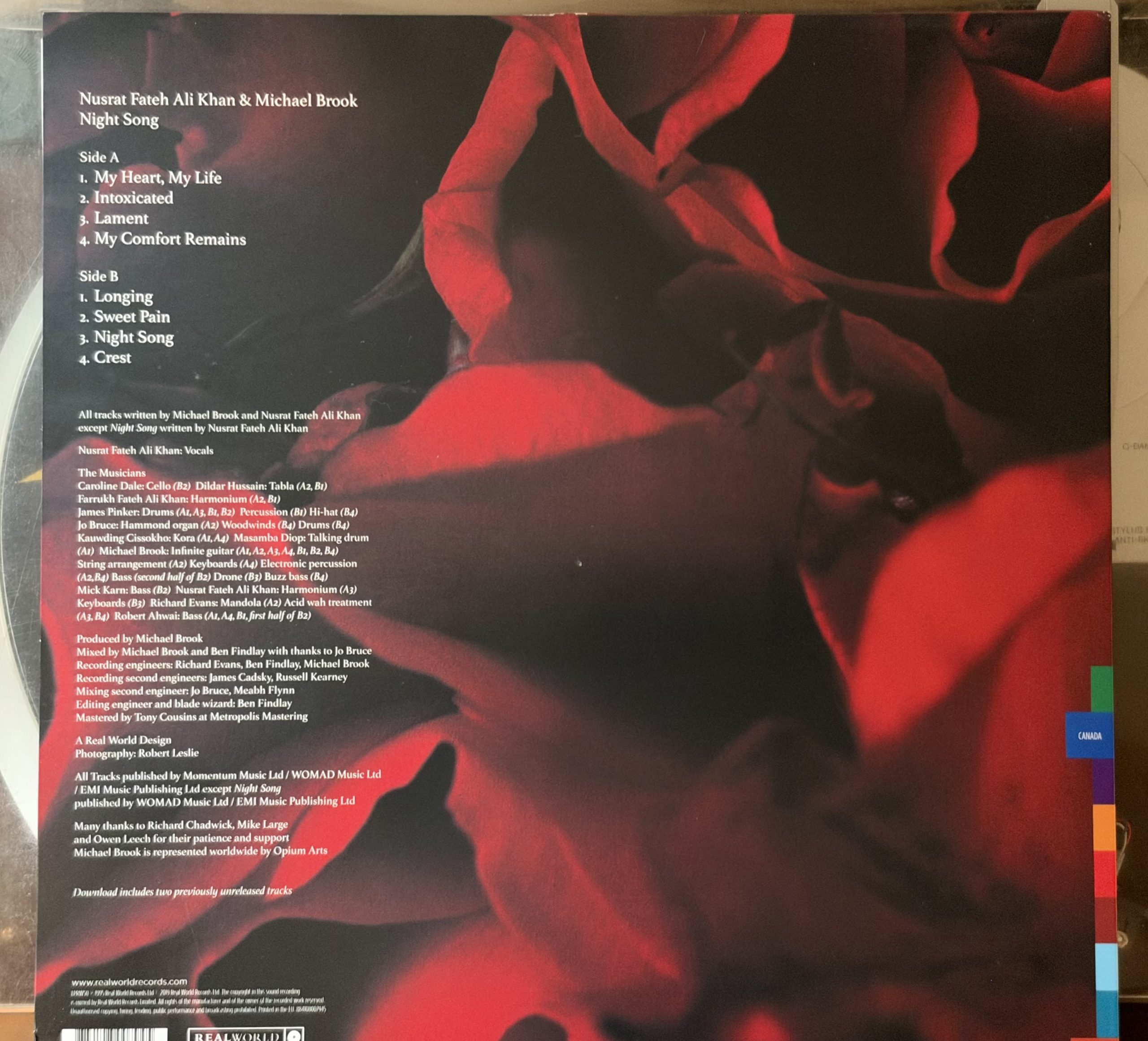
The plan was different this time. Brook learned from the first encounter that Nusrat’s best vocal moments happened in the middle of improvisational flights, some of which lasted an hour or more. So instead of constructing loops and trying to marry Nusrat’s music up to them, here Brook started with Nusrat doing lengthy improvisations and then built the tracks up from there. This meant that while some tracks still featured members of Nusrat’s party, including tabla player Dildar Hussein and harmonium player Farrukh Fateh Ali Khan, there were a few of the usual Real World suspects as well, including multi-instrumentalist Richard Evans, bassist Mick Karn, and Senegalese percussionists Masamba Diop (talking drum) and Kauwding Cissokho (kora), as well as session musicians James Pinker (drums) and Jo Bruce (organ, drums, woodwinds). The overall sound is quite different from both Nusrat’s traditional material and Mustt Mustt, but still recognizably Nusrat.
“My Heart, My Life” foregrounds some of the musical differences introduced by this new method. The kora, played by Kauwding Cissokho, calls back to the guitar that featured in Nusrat’s early recordings on Love and Devotion and gives the opening a spare, delicate sound. Nusrat’s vocals respond to it, being less full throated than when he is fronting the party. Diop’s talking drum is here less full throated than the normal tabla but provides a strong rhythmic foundation over which Nusrat builds a multi-tracked, chantlike chorus. There’s a subtle bass throb underneath the otherwise placid surface, and Nusrat erupts above the top just once, for a run that brings the brilliant edge of his voice forward.
“Intoxicated” builds up over a foundation of electronic strings and percussion from Brook’s synths, joined by Jo Bruce’s Hammond B3 organ. Once long ago, I trashed the Charlatans (UK) for using the noble Hammond as a rhythm instrument, but that’s exactly the role it plays here, running alongside Farrukh Fateh Ali Khan’s harmonium in a slow shuffle with Mick Karn’s bass and the drum loop. Nusrat again is in a lower vocal gear, but still gives us some sangam runs against the loping beat. The result: plenty of vocal pyrotechnics, lifting the track from a mere groove to something more… well, intoxicating. Gradually the groove falls away to just Nusrat and the harmonium, landing the number mid-thought.
“Lament” is just Nusrat and James Pinker’s drums (sludgily distorted by Richard Evans’ effects) with Brooks’ infinite guitar laying soundscapes around them. He performs a modal chant that is tonally reminiscent of the shuffling “Allah, Mohammed, Char, Yaar,” but which dissolves into the slow waves of guitar. “My Comfort Remains” rises up out of another shuffle of electronics, Nusrat’s voice shifting from major to minor on the chorus and moving around the blue note on the verses. We get a sustained set of improvisations in parallel on the raga over the bed of electronics, but just as it seems likely to take off into infinity, the kora rises up with a countermelody that takes us down from boiling, keeping things at a simmer as Nusrat improvises a series of rhythmically shifting vocals that Brook aligns in space around the listener, surrounding us with a Nusrat chorus.
“Longing” opens with a wistful guitar that could have been on a Daniel Lanois record, over a trembling reverb. Nusrat and the harmonium step forward in the sound then fall back, only to surge forward again over a gentle patter of drums that is gradually joined by Dildar Hussain’s tabla. The longing is unresolved, the whole song pivoting around the transition from the third to the fourth and back, some nasty guitar work swirling around the fourth as Nusrat ramps up to something like full volume in double-tracked chorus vocals into the outro, until suddenly the guitar halts as if a plug were pulled.
“Sweet Pain” opens with an intro that sounds a lot like it came from the Sling Blade soundtrack, several years before Lanois released it. But after the intro, Brook shifts the song into a minor range as Nusrat joins, improvising over the slow burn of the instruments until suddenly he takes flight. The ensuing vocal improv feels a little like the vocal flight of “Mustt Mustt,” but settles back into the ambience at the end.
The title track, “Night Song,” is just a drone from Brooks and some light keyboard work under Nusrat’s voice as he explores an augmented minor scale. The combination of the drone and voice lends an oceanic feel that is at once earthy and mysterious. A different sort of mystery, a melody that takes us around the notes of the raga, opens “Crest,” its simple descending scale picked out by the bass as Nusrat’s voice flies into a full impassioned melisma. But here comes a drum beat, and suddenly we’ve resolved up the octave for a moment as we reach the crest of the harmony, and finally fall back down to the fifth, settling just above that opening descending scale. The combination of that incredible voice and the insistent guitar riff underneath sounds like nothing Nusrat had ever recorded before. You can practically hear the tectonic plates shifting at the birth of a new sound. But as quickly as it comes, it settles back down into the liquid sounds of the guitar, fading out.
The collaboration between Brook and Nusrat reached new territories on Night Song, and one can only speculate where else they might have gone together. Unfortunately, we’ll have to wonder. Nusrat recorded with Brook in 1995, and toured through much of 1996 (including the show I saw in Washington DC in August that year). But he was slowing down. The following summer, having been ill for months, Nusrat flew to London for treatment of liver and kidney problems, then was rushed to a nearby hospital where he died of a sudden cardiac arrest on August 16, 1997, just two months shy of his forty-ninth birthday.
With Nusrat’s passing, a phase of Real World’s development ended, though new records didn’t; there were untold hours of his recordings still in the vault, and releases like the 1985 WOMAD recording have allowed fans to continue to be enthralled by his vocal acumen. There’s even one more that we’ll get to in this series, in a few weeks. But next time we’ll listen to an even more experimental album from another Real World artist.
You can listen to this week’s album here:
BONUS: Following Nusrat’s death, a collection of remixes of Nusrat/Brook recordings by Asian DJs, Star Rise, was released later in 1997. Here’s a remix of “My Heart, My Life” by Talvin Singh:
BONUS BONUS: One of the more noteworthy posthumous Nusrat tracks was his final collaboration with Peter Gabriel, a track that made its first official appearance on Peter’s 2002 Up album, but which had first been performed on a VH1 performance in 1996; Nusrat’s vocal on the song was taken from this appearance. The song was well enough known to fans even before its 2002 release that when Peter asked fans to vote for their top favorite lesser-known songs to be part of his 2001 WOMAD set, “Signal to Noise” made the cut. Here’s the 2002 album version, followed by the 1996 live one: