Nusrat Fateh Ali Khan, Night Song

Nusrat’s final collaboration with Michael Brooks opens fascinating new directions in sound.

Album of the Week, September 26, 2026

In retrospect, it’s amazing that Nusrat Fateh Ali Khan took six years to follow up Mustt Mustt, his crossover qawwali + club album that he recorded for Real World with Michael Brook in 1990. Not only did the album do fairly big numbers—Real World has claimed over 600,000 albums sold, not counting sales in the Indian subcontinent—but the cultural impact was big, with reports that British youth in particular were turned onto more traditional qawwali music thanks to the album. But Nusrat was focused on his more traditional format, as we’ve heard, and it wasn’t until 1995 that Brook coaxed him back into Real World Studio to make a follow-up.

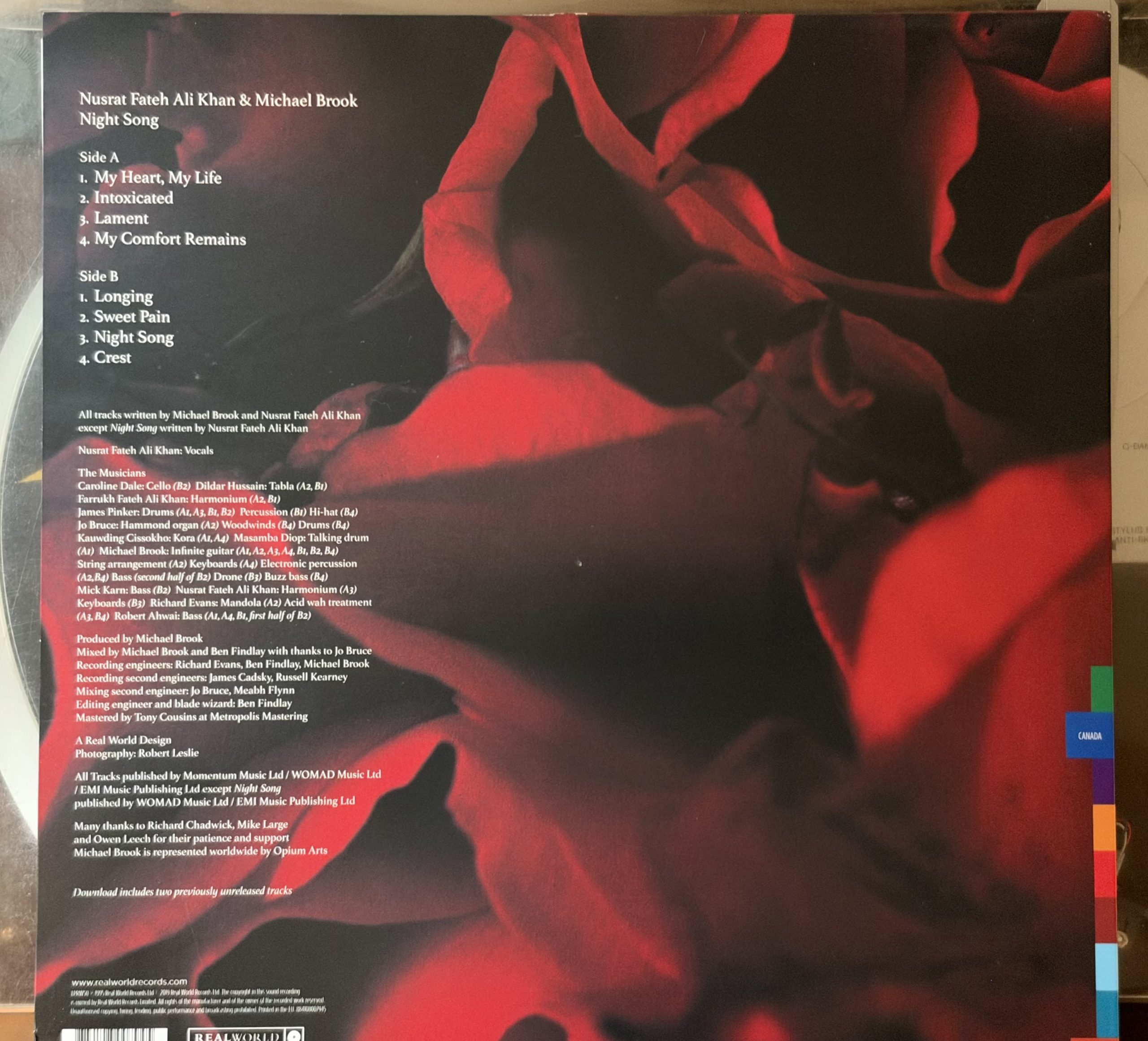
The plan was different this time. Brook learned from the first encounter that Nusrat’s best vocal moments happened in the middle of improvisational flights, some of which lasted an hour or more. So instead of constructing loops and trying to marry Nusrat’s music up to them, here Brook started with Nusrat doing lengthy improvisations and then built the tracks up from there. This meant that while some tracks still featured members of Nusrat’s party, including tabla player Dildar Hussein and harmonium player Farrukh Fateh Ali Khan, there were a few of the usual Real World suspects as well, including multi-instrumentalist Richard Evans, bassist Mick Karn, and Senegalese percussionists Masamba Diop (talking drum) and Kauwding Cissokho (kora), as well as session musicians James Pinker (drums) and Jo Bruce (organ, drums, woodwinds). The overall sound is quite different from both Nusrat’s traditional material and Mustt Mustt, but still recognizably Nusrat.

“My Heart, My Life” foregrounds some of the musical differences introduced by this new method. The kora, played by Kauwding Cissokho, calls back to the guitar that featured in Nusrat’s early recordings on Love and Devotion and gives the opening a spare, delicate sound. Nusrat’s vocals respond to it, being less full throated than when he is fronting the party. Diop’s talking drum is here less full throated than the normal tabla but provides a strong rhythmic foundation over which Nusrat builds a multi-tracked, chantlike chorus. There’s a subtle bass throb underneath the otherwise placid surface, and Nusrat erupts above the top just once, for a run that brings the brilliant edge of his voice forward.

“Intoxicated” builds up over a foundation of electronic strings and percussion from Brook’s synths, joined by Jo Bruce’s Hammond B3 organ. Once long ago, I trashed the Charlatans (UK) for using the noble Hammond as a rhythm instrument, but that’s exactly the role it plays here, running alongside Farrukh Fateh Ali Khan’s harmonium in a slow shuffle with Mick Karn’s bass and the drum loop. Nusrat again is in a lower vocal gear, but still gives us some sangam runs against the loping beat. The result: plenty of vocal pyrotechnics, lifting the track from a mere groove to something more… well, intoxicating. Gradually the groove falls away to just Nusrat and the harmonium, landing the number mid-thought.

“Lament” is just Nusrat and James Pinker’s drums (sludgily distorted by Richard Evans’ effects) with Brooks’ infinite guitar laying soundscapes around them. He performs a modal chant that is tonally reminiscent of the shuffling “Allah, Mohammed, Char, Yaar,” but which dissolves into the slow waves of guitar. “My Comfort Remains” rises up out of another shuffle of electronics, Nusrat’s voice shifting from major to minor on the chorus and moving around the blue note on the verses. We get a sustained set of improvisations in parallel on the raga over the bed of electronics, but just as it seems likely to take off into infinity, the kora rises up with a countermelody that takes us down from boiling, keeping things at a simmer as Nusrat improvises a series of rhythmically shifting vocals that Brook aligns in space around the listener, surrounding us with a Nusrat chorus.

“Longing” opens with a wistful guitar that could have been on a Daniel Lanois record, over a trembling reverb. Nusrat and the harmonium step forward in the sound then fall back, only to surge forward again over a gentle patter of drums that is gradually joined by Dildar Hussain’s tabla. The longing is unresolved, the whole song pivoting around the transition from the third to the fourth and back, some nasty guitar work swirling around the fourth as Nusrat ramps up to something like full volume in double-tracked chorus vocals into the outro, until suddenly the guitar halts as if a plug were pulled.

“Sweet Pain” opens with an intro that sounds a lot like it came from the Sling Blade soundtrack, several years before Lanois released it. But after the intro, Brook shifts the song into a minor range as Nusrat joins, improvising over the slow burn of the instruments until suddenly he takes flight. The ensuing vocal improv feels a little like the vocal flight of “Mustt Mustt,” but settles back into the ambience at the end.

The title track, “Night Song,” is just a drone from Brooks and some light keyboard work under Nusrat’s voice as he explores an augmented minor scale. The combination of the drone and voice lends an oceanic feel that is at once earthy and mysterious. A different sort of mystery, a melody that takes us around the notes of the raga, opens “Crest,” its simple descending scale picked out by the bass as Nusrat’s voice flies into a full impassioned melisma. But here comes a drum beat, and suddenly we’ve resolved up the octave for a moment as we reach the crest of the harmony, and finally fall back down to the fifth, settling just above that opening descending scale. The combination of that incredible voice and the insistent guitar riff underneath sounds like nothing Nusrat had ever recorded before. You can practically hear the tectonic plates shifting at the birth of a new sound. But as quickly as it comes, it settles back down into the liquid sounds of the guitar, fading out.
The collaboration between Brook and Nusrat reached new territories on Night Song, and one can only speculate where else they might have gone together. Unfortunately, we’ll have to wonder. Nusrat recorded with Brook in 1995, and toured through much of 1996 (including the show I saw in Washington DC in August that year). But he was slowing down. The following summer, having been ill for months, Nusrat flew to London for treatment of liver and kidney problems, then was rushed to a nearby hospital where he died of a sudden cardiac arrest on August 16, 1997, just two months shy of his forty-ninth birthday.

With Nusrat’s passing, a phase of Real World’s development ended, though new records didn’t; there were untold hours of his recordings still in the vault, and releases like the 1985 WOMAD recording have allowed fans to continue to be enthralled by his vocal acumen. There’s even one more that we’ll get to in this series, in a few weeks. But next time we’ll listen to an even more experimental album from another Real World artist.

You can listen to this week’s album here:

BONUS: Following Nusrat’s death, a collection of remixes of Nusrat/Brook recordings by Asian DJs, Star Rise, was released later in 1997. Here’s a remix of “My Heart, My Life” by Talvin Singh:

BONUS BONUS: One of the more noteworthy posthumous Nusrat tracks was his final collaboration with Peter Gabriel, a track that made its first official appearance on Peter’s 2002 Up album, but which had first been performed on a VH1 performance in 1996; Nusrat’s vocal on the song was taken from this appearance. The song was well enough known to fans even before its 2002 release that when Peter asked fans to vote for their top favorite lesser-known songs to be part of his 2001 WOMAD set, “Signal to Noise” made the cut. Here’s the 2002 album version, followed by the 1996 live one:
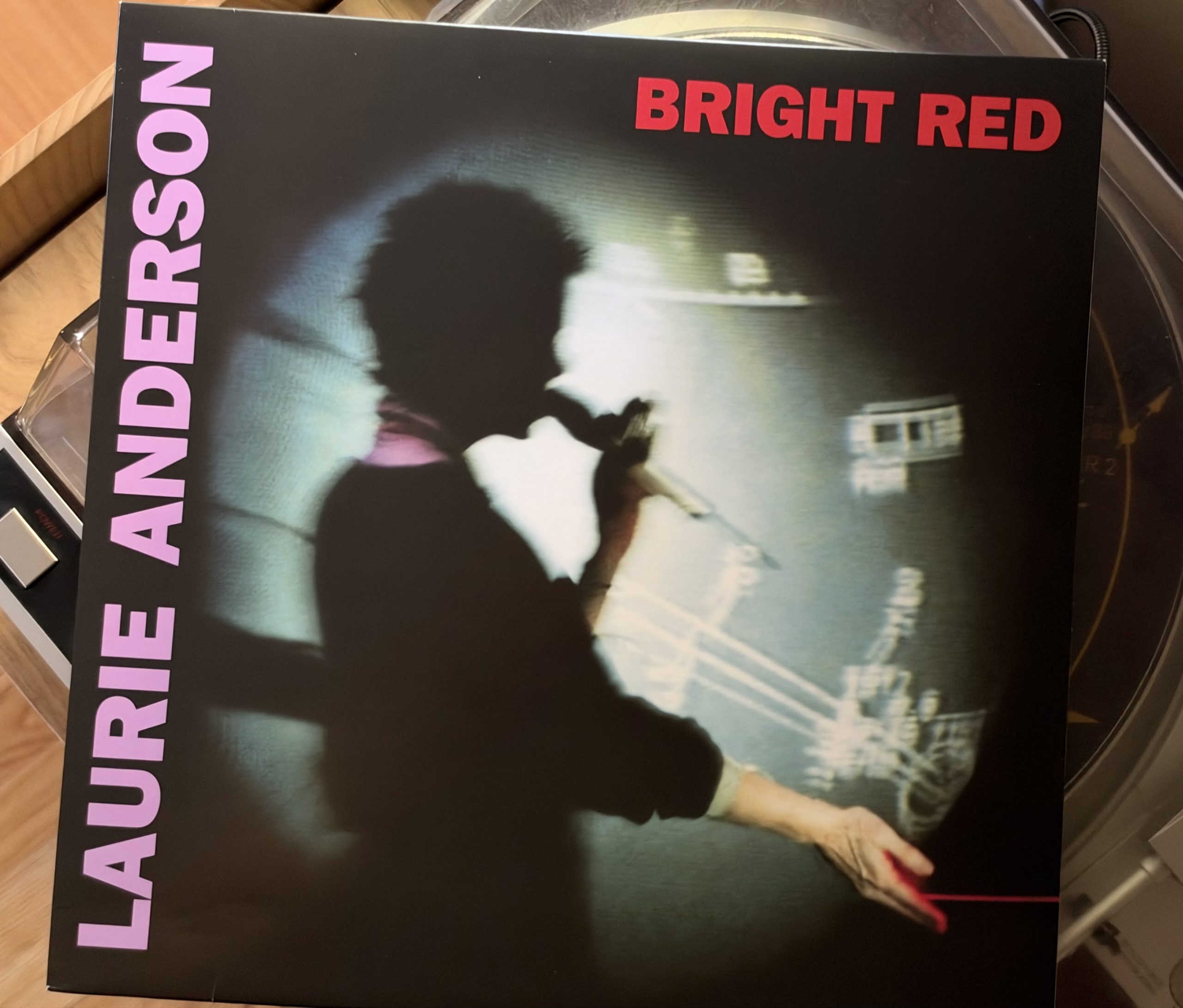
Laurie Anderson, Bright Red

A brilliant work that coalesces personal and global tragedies into a searing song cycle, this 1994 record stands among Laurie’s best.

Album of the Week, September 19, 2026

For all the brilliantly trenchant observations that Laurie Anderson made in her 1980s recordings, there was one topic that was rarely the focus of her songs. Though “O Superman” had the military-industrial complex and the doomsday clock wired into its synthesized “ah ah ah,” the United States had not been in outright war during the entirety of her recorded career. That changed abruptly in January 1991 with the commencement of Operation Desert Storm and what eventually became known as Gulf War I.

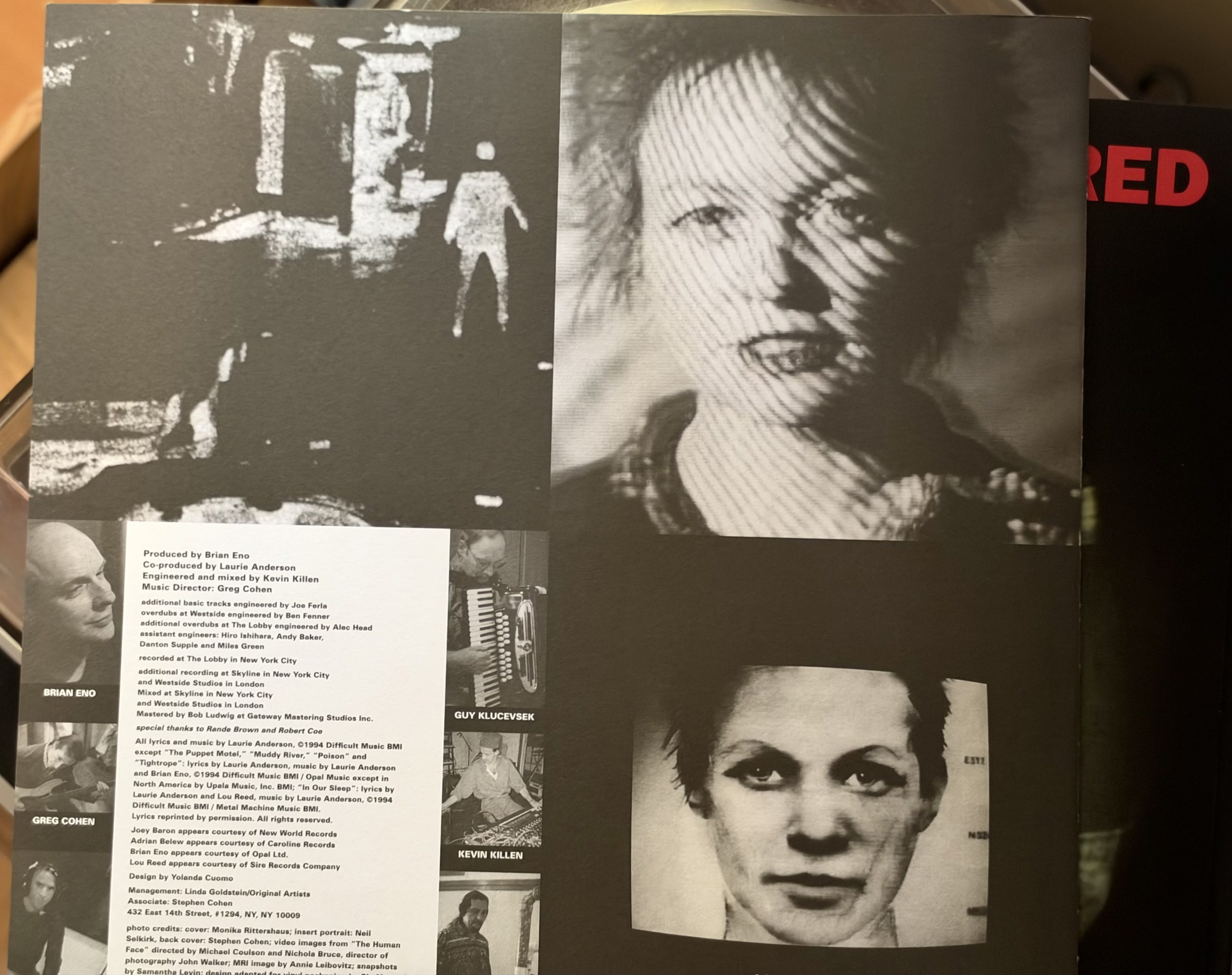
That conflict, and the questions it immediately posed about the lethality and morality of technological war, looms at the heart of Bright Red, alongside reflections on more personal types of grief and loss. Accordingly, Laurie chose a more stripped down sound with fewer instruments; the record is made with a relatively smaller number of collaborators, including percussionist Cyro Baptista, drummer Joey Baron, bassist Ben Fenner, guitarists Gerry Leonard, Greg Cohen, Jamie West-Oram, Adrian Belew, and Marc Ribot, and accordionist Guy Klucevsek However, producer Brian Eno, whose electronics amplify, stretch, and alter the sounds on the record, is the single biggest influence on the sound of the record, even factoring in a special guest on Side 2.

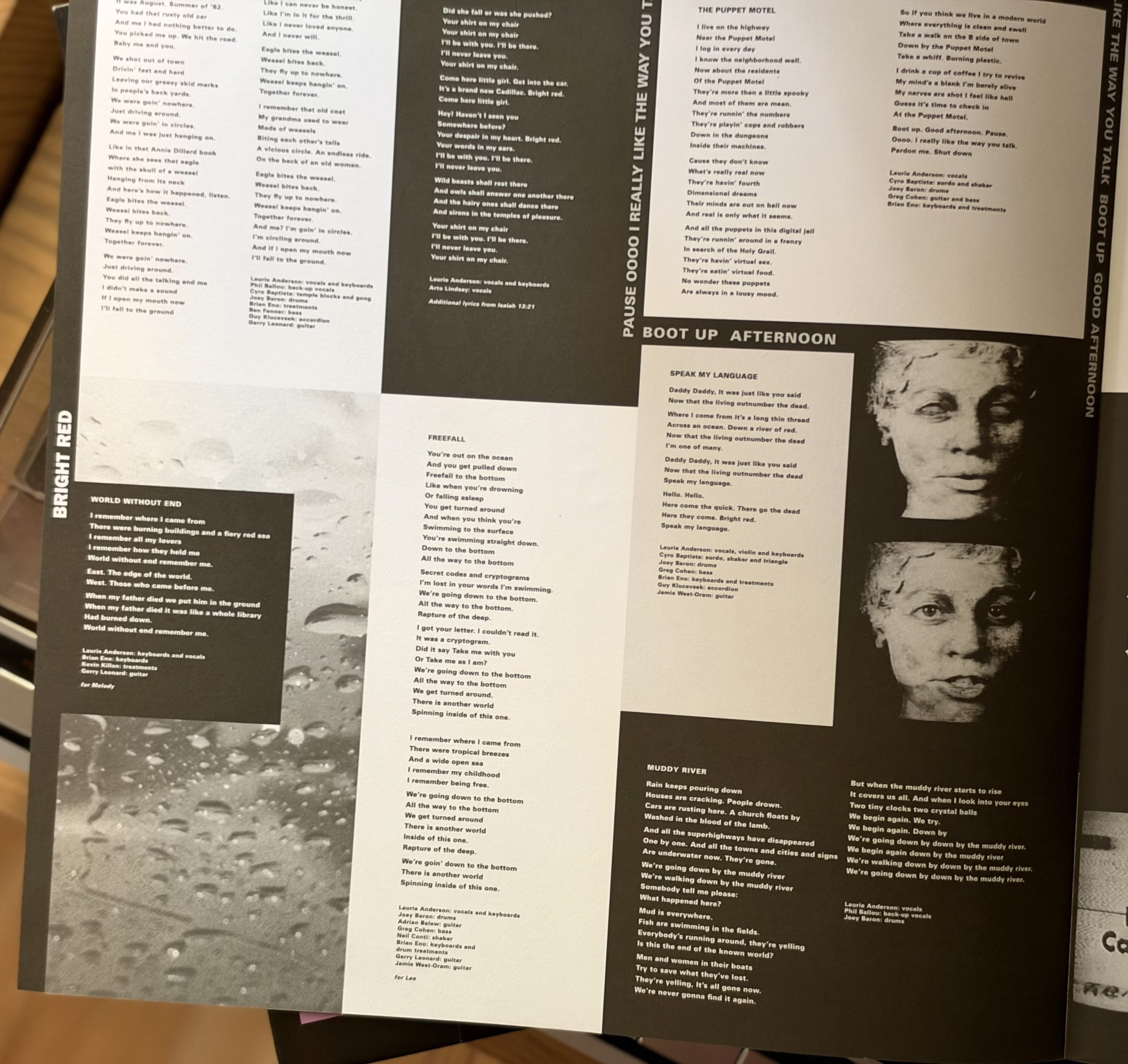
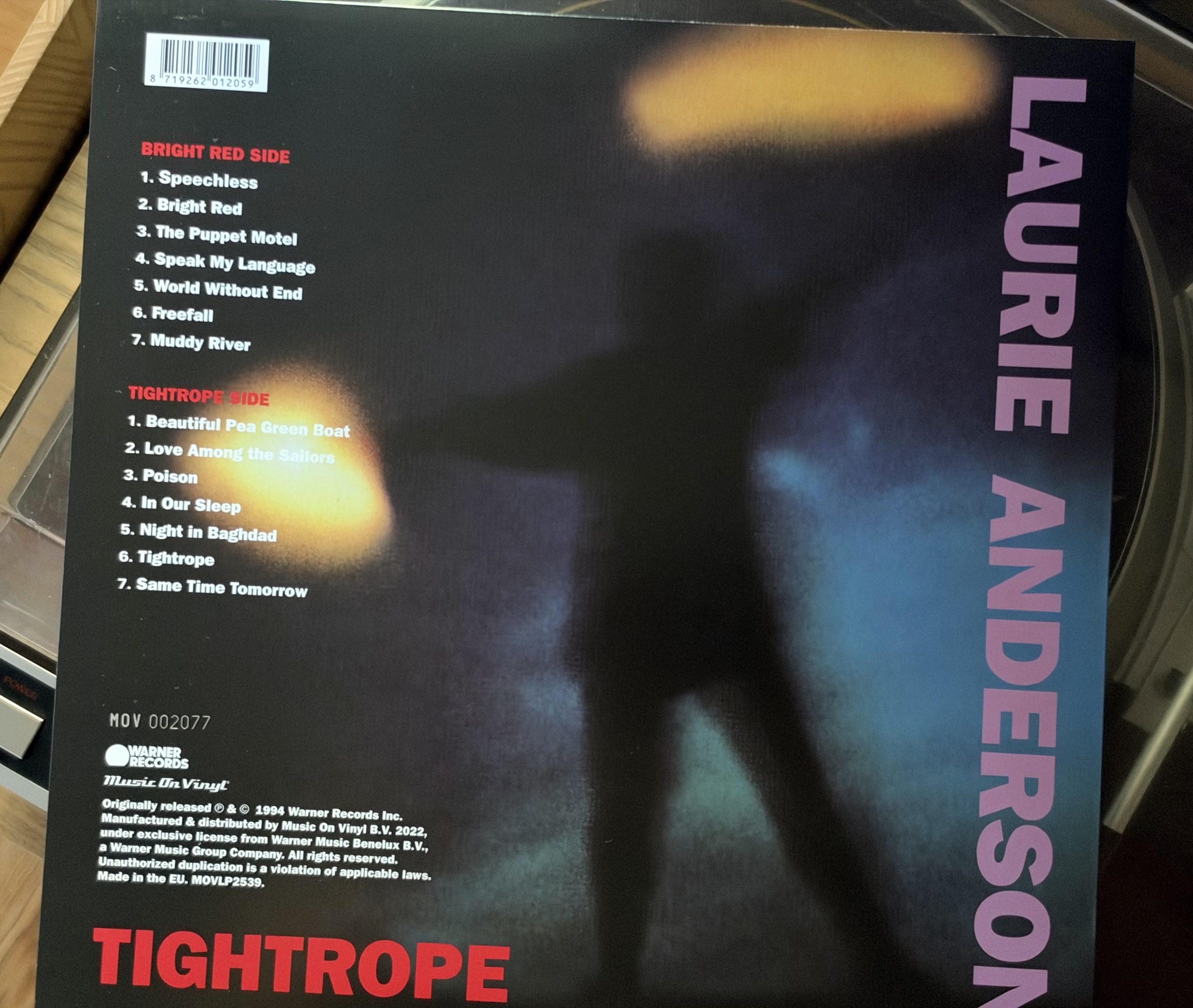
“Speechless” sets us down in martial territory right away, with Laurie’s voice accompanied only by a sharp snare roll as she tells the story of a woman out for a fast, hard joyride with her lover. We gradually get the feeling that this isn’t a happy relationship: “You did all the talking and me / I didn’t make a sound / If I open my mouth now / I’ll fall to the ground.” Laurie names her reference in the chorus, a short story by Annie Dillard about an eagle who was found dead with the skull of a weasel hanging onto its neck. Like Dillard, Laurie imagines the weasel hanging on for dear life even in death as she contemplates the narrator’s place in the relationship: “And me? I’m going in circles / I’m circling around / And if I open my mouth now / I’ll fall to the ground.” The music circles ominously around the tonic throughout the whole song, never getting off the ground.

“Bright Red” floats its narrative over a bed of electronics, as Anderson and Arto Lindsay alternate the words of each verse: “Did” “she” “fall” “or” “was she” “pushed.” There’s a menace in the song, especially in the second verse: “Come here, little girl, get into the car. It’s a brand new Cadillac, bright red.” There is a sense of non-specific threat underpinning the song, and the quotation from Isaiah, about the desolation of Babylon, does not clarify it:

“Puppet Motel” is built off a nasty riff, snare and bass distorted and edgy under Laurie’s manipulated vocals. The lyrics play out a series of dystopian future images, with the “puppets” “having virtual sex, eating virtual food/no wonder these puppets/are always in a lousy mood.” The theme of alienation induced by modern technology is clear, but I’ve always connected this song to a more specific literary dystopia, William Gibson’s cyberpunk Sprawl stories. The puppet parlors like the House of the Blue Lights, in which humans serve as prostitutes disconnected from their bodies via neural cutouts, seem like a clear forerunner to the Puppet Motel. And if we are the puppets, Anderson seems to ask, what are we allowing ourselves to do while our conscious minds are dulled and distracted by technology?

“Speak My Language” is one of two songs on the album to have previously appeared, in substantially altered earlier forms, on the soundtrack to Wim Wenders’ Faraway, So Close! The album version is built atop a spare percussion loop, with timpani and snare building the foundation for the bass to slide ominously beneath Laurie’s vocals and a wistful accordion: “Daddy, daddy/It was just like you said/Now that the living/Outnumber the dead.”

“World Without End” lands its anxiety in both an apocalyptic landscape (“I remember where I came from/There were burning buildings and a fiery red sea”) and a more direct grief, the death of a parent. The lines “When my father died we put him in the ground/When my father died it was like a whole library burned down” locate both a deeply specific grief and a broader civic mourning. It’s tempting to read this now as a response to the unthinking “patriotic” embrace of high-tech warfare in Gulf War I, especially given the “fiery Red Sea” reference. 

By contrast, “Freefall”  is a more figurative disorientation, with the narrator pulled into a vortex, “drowning in the deep.” This one seems a more personal disconnection, a literal alienation: “I got your letter, I couldn’t read it / It was a cryptogram / Did you say ‘take me with you’? / Or ‘take me as I am’?” The Brian Eno ambient soundscape below again builds from percussion, with thin threads of guitar and spare synths building out the landscape underneath. The conflation of disasters physical and personal carries into the last track on the first side. Two years after Hurricane Helene, I still have trouble listening to “Muddy River”; its evocation of an apocalyptic flood is both uncomfortably vivid and wholly inadequate compared to the devastation of the real thing. Laurie’s sudden cut to the human scale—“But when the muddy river starts to rise / It covers us all / And when I look into your eyes / Two tiny clocks, two crystal balls”—locates us away from the global apocalypse and into the mere tragedy of a human landscape ending. As though there is anything “mere” about the end of relationship, of “the known world.”

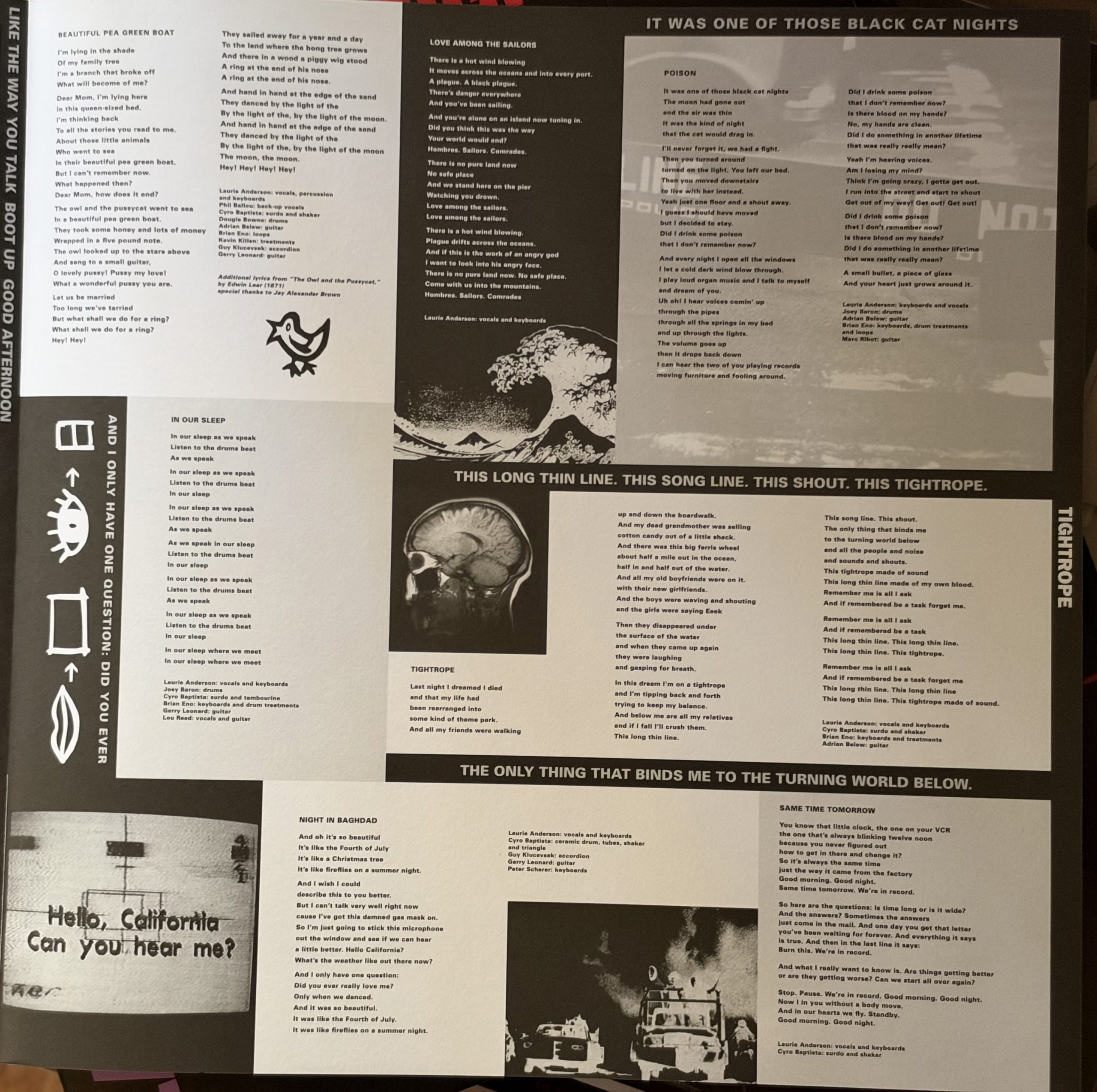
As the record flips, Laurie thankfully lightens the mood in “Beautiful Pea Green Boat.” Though the alienated mood persists, the alienation is relocated from personal relationships to childhood, as she muses “I’m lying in the shade of my family tree / I’m a branch that broke off.” She recalls her mother reading her stories, and then quotes almost the entirety of Edward Lear’s “The Owl and the Pussycat,” omitting only the three couplets regarding the marriage of the Owl and the Pussycat and their dining on “mince and slices of quince.” Omitting or perhaps forgetting, as the lyric says during the introduction: “I can’t remember now / What happened then / Dear Mom, how does it end?” The narrator can’t allow her childhood memories to surface a happy ending, even the ending of Lear’s story. But the arrangement subverts Anderson’s glum mood, particularly Guy Klucevsek’s accordion. (And yes, the insanely distorted guitar sound that closes out the song is courtesy none other than Adrian Belew!)

“Love Among the Sailors” tells the story of a “hot wind blowing… [that] moves across the oceans and into every port / A plague.” Laurie’s song mourns the loss of the love among the sailors, who, Walt Whitman-like, are referred to as “hombres. Sailors. Comrades,” and who are taken by the plague. Laurie continues to process the death of artistic colleagues from AIDS, angrily challenging the fundamentalist Christian view of the plague as divine retribution: “And if this is the work of an angry God/I want to look into his angry face.” The anger continues on a more interpersonal level in “Poison,” as the narrator marvels at her anger over a lover who leaves her to move in with her downstairs neighbor: “I can hear the two of you playing records / Moving furniture and fooling around / Did I drink some poison that I don’t remember now? … Did I do something in another lifetime / that was really, really mean?” The narrator reflects on the pain and anger that stay deep within her: “A small bullet, a piece of glass / And your heart just grows around it.”

“In Our Sleep,” by contrast, brings us into a new relationship, a new heartbeat, as mantralike Anderson repeats “In our sleep, as we speak/Listen to the drums beat/As we speak” in duet with the guitar and voice of Lou Reed. The two had met in 1992 at a festival curated by John Zorn and had started to collaborate; this record represented the first of their joint performances to be issued, the year Lou’s divorce from Sylvia Morales became final and a full fourteen years before Laurie married him.

The moment of peace transitions into the electronic cricket noises of “Night in Baghdad,” which borrows sounds from earlier in the record (the sighs of “Speak My Language”) as well as from earlier in her career (the bass line of “Sharkey’s Night”) as the heartbeat underneath a journalist’s report from the Gulf War. “It’s so beautiful/It’s the Fourth of July/It’s like a Christmas tree/It’s like fireflies” the narrator says of the explosions in the sky, before turning “I wish I could describe this to you better/But I can’t talk very well right now/Because I’ve got this damned gas mask on.” She transitions from the war to the personal as she asks: “Did you ever really love me? Only when we danced. And it was so beautiful. It was like the Fourth of July. It was like fireflies…”

The heartbeat slows and transitions to “Tightrope,” the longest of the songs on the record and the most evocative. Over a Brian Eno soundscape, Laurie opens the song with a dream of death, in which the narrator’s life is represented as a theme park with a boardwalk and a massive Ferris wheel that sweeps its passengers (Laurie’s old boyfriends, “with their new girlfriends”) under the water as it turns. She is herself perched high above on a tightrope, above her relatives, and fears that if she takes a wrong step, “if I fall / I’ll crush them.” She feels keenly the temporariness and thinness of her connections: “This long thin line. This song line. This shout / The only thing that binds me to the turning world below… This tightrope made of sound / This tightrope, made of my own blood.” This precarious image would seem to be a likely place to end the song—and in fact, in the first version on Faraway, So Close!, the song ends here. But this version carries on, having founds some peace with the precariousness of existence and with the ending of her relationships, as Laurie paraphrases the William Percy French poem, “Remember me is all I ask / And if remembered / Be a task / Forget me.”

The album closes with one more glimpse of the challenges of technology, here more humorous, in “Same Time Tomorrow.” She ponders the question of progress, describing a clock stuck blinking twelve noon and asking “Is time long, or is it wide? What I really want to know is, are things getting better or are they getting worse?” A live version of the song then recapitulates apocalyptic quotations from the “Bright Red” side of the record, but on the record, she cryptically quotes the seventeenth-century poet George Herbert: “Now I in you without a body move,” adding “and in our hearts, we fly,” leaving us to decide whether the apocalypse has a happy ending.

Bright Red channels all sorts of images—the death of a parent, the AIDS epidemic, war, flood, the eagle and the weasel—into a convincingly powerful portrait of lost love that bristles with connections to the universal. It’s a body blow of a record and one that may stand as an artistic high point among many in Laurie’s discography. She continues to record—I particularly enjoy the follow-up to Bright Red, her spoken-word recording The Ugly One with the Jewels—but for me these first four albums are the heart of all her output. Next week we’ll hear a milestone album from another Peter Gabriel collaborator.

You can listen to this week’s album here:

BONUS: A different version of “Tightrope” was featured in the film Faraway, So Close, Wim Wenders’ sequel to Wings of Desire. Like his Until the End of the World, the soundtrack is a marvel and worth seeking out on its own merits. (The soundtrack also features an alternate version of “Speak My Language” which I can’t find on streaming services).

BONUS BONUS: Laurie’s touring show in 1994-1995 was “The Nerve Bible.” There was a companion book, Stories from the Nerve Bible, that was a retrospective of her entire career to that point. I took my wife Lisa while we were first dating to see the show at the Kennedy Center, which is how we discovered her dislike for Laurie Anderson performances. (It was a great show.) This video purports to be a recording of the full show from its 1995 date in Kansas City, Missouri:

Sheila Chandra, The Zen Kiss

Chandra’s second album for Real World Records is both a magnum opus of the female voice and an instrument of alchemical transformation.

Album of the Week, September 12, 2026

Following Weaving My Ancestors’ Voices, Sheila Chandra continued her exploration of voice and drone, of the interconnections between breath and thought, of voice and listener. She noted in the original liner notes to The Zen Kiss, “My last album … illustrates crossing between different musics within a single vocal line. The Zen Kiss has moved on. The structure of my songs have become more challenging now that those connections have been absorbed into my sub-conscious.” What results on this 1994 album is a set of vocal performances that range from meditative drones to traditional songs to vocal experiments, that range from British folk song to Indian raga to soul music to kannakol vocal percussion, sometimes all in the same performance.

Even more than Weaving, the album is a solo performance, with only producer Steve Coe adding drones. As before, Chandra recorded in a Bristol studio and mixed the album at Real World Studios. But with all the similarities, there’s an important difference: instead of lyrics drawn from ragas and folk songs, here Chandra wove a series of stories about women and their roles that was positively revolutionary for pop music in 1994, to say nothing of world music.

“La Sagesse (Women, I’m Calling You)” is the most direct expression of this new lyrical focus. Singing an obbligato that starts out as a raga and turns into a soul riff, Chandra sings “Oh, women, whose wisdom is in dreams… where do I go to find images of woman woman-made?” The track is entirely unaccompanied, putting the focus solely on Chandra’s incredible voice, as she seamlessly blends ragas and soul improvisation. The track transitions directly into “Speaking In Tongues III,” another of the series of kannakol spoken percussion compositions that began on Weaving. Here Chandra explores both the tonal ranges of the percussion that the form imitates and a broad range of tempos and meters. She expands the types of syllables in use as well, with umlauts and other sounds helping to shape the release of the sound.

“Waiting” reintroduces drone accompaniment under Chandra’s song of anticipation: “Like a desert bloom I sit at your feet / Trolling for a raindrop to fall from your lips / Waiting to be awoken and born by your calling.” The song passages are alternated with ragas, explorations of the song’s tone-row. In Chandra’s vocal we hear an expression of love carried to reflection and ultimate unity between the singer and the beloved. At one point in the improvisation there’s a familiar melodic progression, outside the conventions of the raga, that recalls the melody of “Love Will Tear Us Apart.”

“Shehnai Song” is a deeper drone work, in which Chandra uses pitch bending around the raga for a sitar-like effect. It’s a brief but striking fragment of a song, followed by “Love It Is A Killing Thing,” a British folk song ornamented with flourishes that are simultaneously rooted in traditional Indian and soul music. Here, as in “La Sagesse,” Chandra’s voice is left unadorned to maximize the impact of her amazing vocal control.

The last song in the series of kannakol performances, “Speaking In Tongues IV” is even wilder than its predecessors, using sung interludes, digital effects, and a cut-and-paste aesthetic to broaden the sound palette to its widest. Chandra has said that she could not have written this work without hearing what a sampler could do, but that “the human sampler is ultimately the best.” Compositionally she races from rapid to languid and back, from normal volume to subliminal, almost ASMR-like whispers.

Another reviewer has called “Woman And Child” the centerpiece of the album, and both its position leading off side two and the unusual spoken word composition support it. Over a background of drone and bells, she tells the story of a woman with her infant child that foregrounds the eroticism in the physicality of mother/child relationship. The narration draws the connection between everyday nature, sensuality and spirituality. As much as I listened to woman-forward music in early 1994—and this was after Under the Pink and Exile in Guyville—I wasn’t ready for this at the time. I thought Chandra’s description of the erotic physicality of nursing was exaggerated and felt unprepared to listen to this intimacy. Thirty years on, having raised two children, I understand how much I didn’t know then.

Chandra turns to Spanish for the unaccompanied “En Mireal Del Penal,” again underscoring the connections between Spanish, Arabic and South Asian music. Unlike her performance of de Falla’s “Nana” on Weaving, here she embraces some of the passing tones and accidentals in the tone row even as she interweaves raga improvisations between verses.

“A Sailor’s Life” is Chandra’s most direct embrace of the British folk tradition. The song, a ballad with eighteenth-century roots, was famously performed by Sandy Denny and Fairport Convention in an eleven-minute-long version. Here the performance is stripped back to just drone and voice, but you can hear echoes of Denny’s restrained vocal ornaments in Chandra’s approach, which again brings echoes of Indic valleys to the traditional ballad. The shorter version here underpins the tragic swing from the roguish “A sailor’s life, it is a merry life” that opens the performance, to the same lyric sung a cappella that closes the song after the sailor’s death by drowning, as well as the girl’s desolation after the sailor’s passing.

The Latin plainchant of “Abbess Hildegard” would seem an unusual inclusion in the album’s narrative arc. But the alternating chant verses and ragas connect the famed twelfth-century nun, polymath and composer to the album’s exploration of feminine strength. At the time of the record there was a resurgence in interest in Hildegard, whose music was suddenly everywhere thanks to releases by the early music ensemble Sequentia (their 1994 Canticles of Ecstasy on the Harmonia Mundi label was a best seller) and a 1994 BBC documentary. “Kafi Noir,” in the same key but not the same tone-row, closes the album with an extended raga meditation that brings all the vocal traditions of the album together. Particularly striking are the subtle organum (parallel fourth and fifth) harmonies that seem almost like harmonic overtones emerging from the richness of her voice.

The Zen Kiss is ultimately both about the power of the female voice and an alchemical experience. The kiss of the title is the passage of breath from the singer that transforms the listener. The sheer power and virtuosity of Chandra’s voice ultimately dissolves boundaries between traditional styles and cultures. And ultimately the interpretive grace and power of her performances make the album a statement of female strength that is still stunning to absorb three decades on.

Chandra wasn’t done with this exploration of her voice and we’ll hear the last album in that arc in a few weeks. Next week, though, we will hear a different perspective on strength, grief and loss from another artist we’ve heard before.

You can listen to this week’s album here:

BONUS: Sheila went out on the promotional circuit for the album, and did a brief interview on the BBC program Pebble Mill along with a performance of “Speaking in Tongues III.” The stunning live work, stripped of vocal effects, underscores the brilliant power of her voice:

Remembering

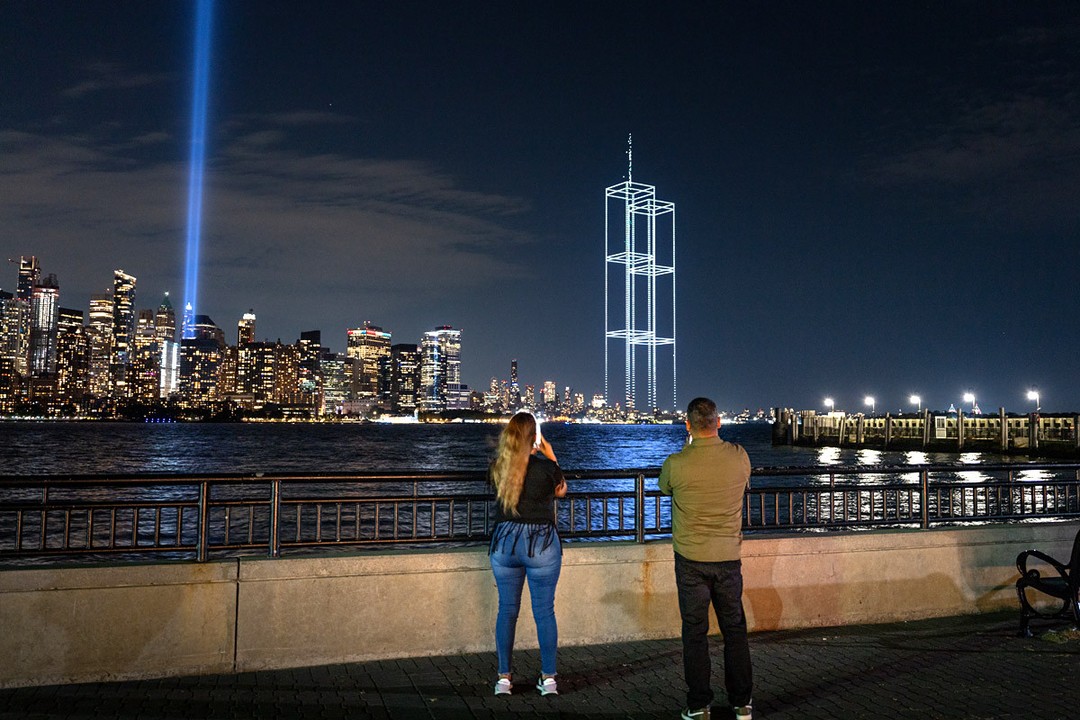
Drone reconstruction of the World Trade Center, NYC, 2026. Courtesy Getty Images

Twenty-five years ago was a long time, long enough for me to have written down my thoughts about the day several times before; long ago enough for the act of remembering to yield to the act of editing, redacting, and constructing a narrative thread of the day.

In September 2001 I was in the second year of business school. On a brilliant blue Tuesday morning, I had just finished writing a blog update and had gone into the library to study. Starting up my web browser to download some course notes, I hit the message on Yahoo (images weren’t loading) that a plane had crashed into the World Trade Center. I went looking for more information and found it at Dave Winer’s Scripting News blog.

Shellshocked, I left the library and walked into the lobby of E-52, MIT Sloan’s main building, where I joined a gathering crowd of students, faculty, administration staff, and others watching the coverage. I saw the videos, and I saw the second tower go down on live TV as I watched. After a while I walked next door to the E-51 lobby, worried about my friend Kate’s fiancé Oli who worked in the financial district. I ran into my finance professor, who was just coming out of class and had no idea what was happening. I told him that both towers had come down and the Pentagon had been hit. “Oh my God,” he said, as if he had been slapped. I found Kate. At the time she hadn’t heard from Oli (he was fine). We just sat and watched and listened.

Lisa had planned a trip to Italy with her parents that was due to leave that day and was with them in New Jersey. The worst part was the train ride back to Boston—there were no planes. She still won’t talk about that journey.

It wasn’t until much later that I learned that my UVA friend Doug Ketcham had been in the Cantor Fitzgerald offices that morning. I sat with the grief of what had happened to him for fifteen years, until I attempted to describe Doug Ketcham to one of my TFC colleagues during a rehearsal for John Adams’ “On the Transmigration of Souls.” And I could not speak. I was suddenly dumbstruck by the immense unfairness of what happened to him: twenty-seven years old, a rising star at Cantor Fitzgerald, who retained enough presence of mind to call his parents from underneath his desk after the first plane hit the towers to tell them that he loved them.

Later on 9/11, I heard that MIT wasn’t taking more blood donors because their infrastructure couldn’t process the mass rush of volunteers. That was before we learned that there was little need for blood, before the awful scope of the casualties in New York and Washington became clear.

That evening, I left my apartment building to make a run for some needed groceries. I saw a young muscular man in his mid-twenties wearing a t-shirt, obviously homemade. The t-shirt said on the front, “Die Raghead Scum.” And In the corner store, I heard a soft spoken talk show host explaining that this wasn’t really America against terrorism but the civilized world against terrorism, because you didn’t know who would be next. I agreed with this assessment, but then he went on to say, “There’s a surprisingly small number of countries in the world that are civilized. Outside of the US and Canada, Europe and Japan, most of the rest of the world are barbarians.”

A week later, with no air traffic and the world still eerily quiet, we started seeing monarch butterflies. One dogged our steps returning to our apartment along Richmond Street. Another one fluttered along beside the Longfellow Bridge, careered across the traffic, and over the other side of the bridge. When we saw it, it was winging lazily across the Charles. There were more of them. Practically every five minutes–on Massachusetts Ave, in the shadow of Calder’s Great Sail… I couldn’t decide, and it seemed very important at the time: had they been there all along and were just leaving? Or had they just arrived from another place, just when we most needed to see them?

Two years later we were in the midst of the 2003 Iraq War, a war fought with the pretext of a 9/11 connection that didn’t exist (the attackers were largely from Saudi Arabia and had no backing from Saddam Hussain). I wrote, “if we’re still in mourning even as we invade and remake nations, we are in danger of seeing the decisions we must face through eyes clouded with the smoke of the past. So I am going to let others remember the day, and I’m going to continue to do my part by asking questions about actions taken in the names of the fallen that I believe do them no honor.”

In 2008, I wrote about Steinski’s sound collage “Number Three on Flight Eleven.” A previously unreleased track collected that year on the veteran mix artist’s retrospective “What Does It All Mean?”, it takes the recorded phone call of American Airlines flight attendant Betty Ong from on board Flight 11 and sets it sparingly above an almost subliminally ominous drone and beat, and in counterpoint to another speaking voice reciting lyrics by Paul Opperman from the Silos’ “When the Telephone Rings” and poems by Basho. It’s an unsettling, frightening track and I can’t listen to it more than once in a blue moon. And yet, there’s something in the end that carries a note of redemption: a repeating coda, the voice of the American Airlines call center reassuring Betty Ong, who’s holding on the line communicating the last moments aboard the hijacked plane, repeating “Yes. We’re still here.”

We’re still here.

As John Irving, who as a novelist is one of our greatest living students of violence, put it in The Hotel New Hampshire, the real question in this violent crime is: did they get the us in us? Did the attack violate us so deeply that it touched our core and twisted who we were? Or are we still here?

There can be no one simple answer. But in the course of that 2016 performance of “On the Transmigration of Souls,” I decided that it is the souls of the living who need the transmigration. We must allow ourselves to be changed, to not continue to stand, breath held, on the edge of that dreadful day. We who must resolve upward.

A fleuron, a typographical symbol that looks like a flower, dividing sections of a post

Other remembrances: Dave Winer, Doc Searls, Universal Hub.

F.G. Rathbun, Virginia Glee Club conductor and hymn composer

F.G. Rathbun, courtesy Rathbun-Rathbone-Rathburn Family Historian

A brief one today, about a peripheral feature in early Virginia Glee Club history. Frederick G. Rathbun (1862–1903) conducted the Glee Club for a single season, but lived an unusually varied and rich life in music outside of his experience with the Glee Club.

Rathbun was born in South Lee, Massachusetts, which is about a fifteen-minute drive from Tanglewood, in 1862, and attended New England Conservatory, making him one of only a few Glee Club conductors with conservatory training (the others: Frank Albinder and James S. Constantine). Following his marriage to Ida S. Warren, he and his bride moved to Virginia, where he was the organist at St. John’s Episcopal Church in Hampton and a music teacher at Hampton Institute (now Hampton University). Sometime in the following years he was connected with the University of Virginia Glee Club, and became their conductor for the 1895–1896 season, succeeding Harrison Randolph.

1895–1896 Virginia Glee Club. Rathbun is third row, fourth from right

When I found the photo above, fifteen years ago, I thought with little evidence that Rathbun was likely a student. There is, it is now clear, no evidence to support this assumption, as he appears in no yearbook or directory as a student. So how did he find his way to Charlottesville?

The best guess is that he spent time in Charlottesville pursuing his other musical career, composition. He published his first work, the “Wythe Rifles Quickstep,” with the Dise Company of Philadelphia in 1885, and went on to publish dozens of other compositions, including the 1891 Cabin and Plantation Songs as Sung by Hampton Students. His best known work, though, might be the hymn “I Heard the Voice of Jesus Say,” setting a text by Horatius Bonar.

Rathbun, “I Heard the Voice of Jesus Say,” from Favorite Sacred Songs for Church and Home, 1921

Unfortunately, Rathbun’s wife died in 1898, and though his family rallied around him, he too passed away in 1903 following the death of his brother.

The above biography is heavily indebted to a 1987 Rathbun family genealogical newsletter that leaves open several questions: Where was Rathbun living while serving as organist in Hampton? The family history says “nearby Virginia City,” but the only thing that turns up by that name in the state is out near Blacksburg. Also, how did he wind up as a Glee Club conductor while remaining the organist in Hampton? His 1903 grave marker says he was the organist for nearly 20 years. With luck, we’ll get more information about Rathbun that will explain the mystery.

Ayub Ogada, En Mana Kuoyo

The Kenyan musician’s sole Real World album is a mesmerizing window onto music both specific to the Luo tradition, and universal.

Album of the Week, September 5, 2026

I’ve been reading some things on social media about “Shoot Your Shot September”: making a radical change in your life to do the thing you always wanted to do and the hell with the risk. I suspect that’s what Ayub Ogada’s early life was like. Born Job Seda in Mombasa, Kenya in 1956, he secured a film role in Robert Redford’s Out of Africa under his birth name when he was twenty-nine years old—after playing in a rock band that incorporated musical influences from his native Luo culture for six years previously. He then decided to head to London and see if he could make his fortune; busked on the London streets and in the Underground, scraping by. That bold decision was rewarded when he was invited to play the 1988 WOMAD festival, and rewarded again when another act canceled, stretching his ten-minute performance slot into a full set. Among the impressed onlookers: Peter Gabriel.

Ogada ended up being invited to one of the recording weeks at Real World. There’s no detailed sessionography from the studio, so it’s hard to tell if he recorded his guest appearances on Peter’s Us as well as his guest spot on Geoffrey Oryema’s second album all in the same week as recording his only album for the label. What is clear is that he got a chance to do all three, playing and singing insinuating melodies that sound like sunshine with the combination of his baritone voice and his nyatiti, a traditional 8-stringed lyre of Luo origin.

“Obiero” opens with the nyatiti and Ogada’s voice, an impossibly sunny melody accompanied by subtle percussion and slightly un-subtle Hammond organ (though the single chord played by future Propellerhead Alex Gifford is more subliminal than anything else). I first heard an earlier version of this song on Gabriel’s Plus from Us compilation, which featured tracks from his various collaborators on the Us album, and the version here on Ogada’s own album is positively baroque in comparison to the sparer original.

“Dala” is instrumented even more sparsely, with only nyatiti and small bells (see the bonus videos for an image of them) accompanying Ogada’s multi-tracked vocals as he sings a homecoming song. The liner notes observe: “Home, not as in your house, but as in spiritual home. One person is alone, two people may dance, three people they open the door, four people begin to walk all the way home. Let’s get together and make it like home.”

Sometimes the nyatiti gives a more complex pattern that is itself percussive, as it does on “Wa Winjigo Ero.” The lyre pattern circles over a stretch of about a fourth with octaves, and Ogada’s melody is strongly rhythmic as the song evokes a careless young man leading his herd homeward: “A young man doesn’t look after the cattle, he walks home before them, so he doesn’t even know if all the cattle are behind him. Luckily for him the cattle have all got bells. People say to him, it’s okay, we hear then now.” The percussion gives us the sound of the bells and the overall song has a slight marching cadence.

“Thum Nyatiti” is another circular pattern on the nyatiti, this time accompanied by David Oladunni on the djembe and with the same simple percussion. Ogada emphasizes the driving, percussive nature of the nyatiti on this track, about which he says “the music of the lyre is the voice of the Luo.” A more complex rhythm—triple triplets—underpins “Kronkronhinko,” a paean to the Ghanaian Queen Mother, Yaa Asaantewa, who led the War of the Golden Stool of the Ashanti people against Great Britain. We also get Ogada’s piercing whistle on this track.

“Chiro” sees Geoffrey Oryema return the favor for Ogada’s appearance on his song “Hard Labour,” adding backing vocals alongside Zak Sikobe’s guitar. The vocals are complex but tell a simple story: “Go far, see the world, but don’t forget where you came from.” Sikobe also appears on “10%,” which he co-wrote, a political song responding to the idea that it’s okay if 10% of the population are suffering. Ogada also plays a flute—either an imbele or a wea—alongside the chorus on the latter song; all in all the mix is insinuatingly catchy.

“Ondiek” feels like a more somber version of “Obiero,” as Ogada sings about the dangers of duplicity: “Beware the hand that seems to feed you! A hyena in human form – watch out, where he walks the earth burns.” After two verses and a chorus, Sikobe adds a skittering guitar line, lending a slight feeling of South African mbaqanga (familiar to Western listeners from Paul Simon’s Graceland).

“Kothbiro” opens with the nyatiti playing a pattern like raindrops, setting up a ballad that calls the children and the cattle back to the house. The harmonies of guitar, lute and voice tell a sadder story, as we wonder if the children will ever return. Gifford plays a subtle piano line over the instrumental verse.

The final song, “En Mana Kuoyo,” feels even more strongly like mbaqanga, with Sikobe’s guitar intertwining with the lute and his own overdubbed bass. This is African music for driving down the street with the top down, an indelible feeling of summer.

Ogada only recorded one album for Real World, but he continued to be active musically, recording an album with his band Union Nowhere in the late 1990s and appearing at the Live 8 concert The Eden Project in 2005. He moved back to Kenya and recorded a few more albums with English musician Trevor Warren before his death in 2019. Next week we’ll return to another Real World musician who was intersecting ancient and modern musical styles.

You can listen to this week’s album here:

BONUS: Real World has done a good job of preserving and sharing its performance history. This performance in particular, from 1991, is great because you can not only watch his fingerwork on the nyatiti, you can also see the source of the bells that are the rhythmic accompaniment for so many of his songs, and they’re probably not where you think they’ll be…

BONUS BONUS: Here’s a second live performance of “Obiero” by Ayub Ogada at Real World Studios from 1995: