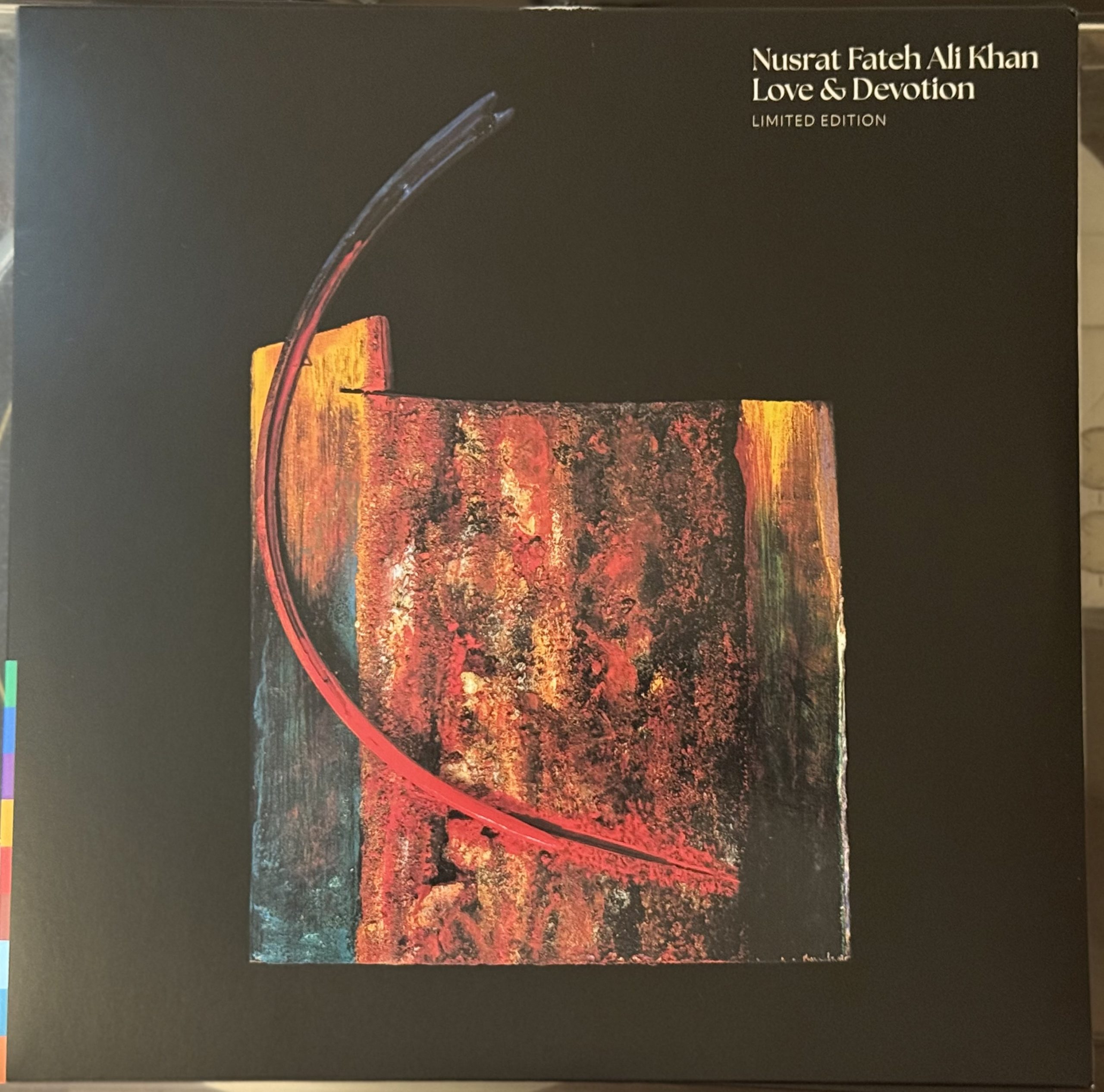
Nusrat Fateh Ali Khan, Love and Devotion

Album of the Week, August 29, 2026

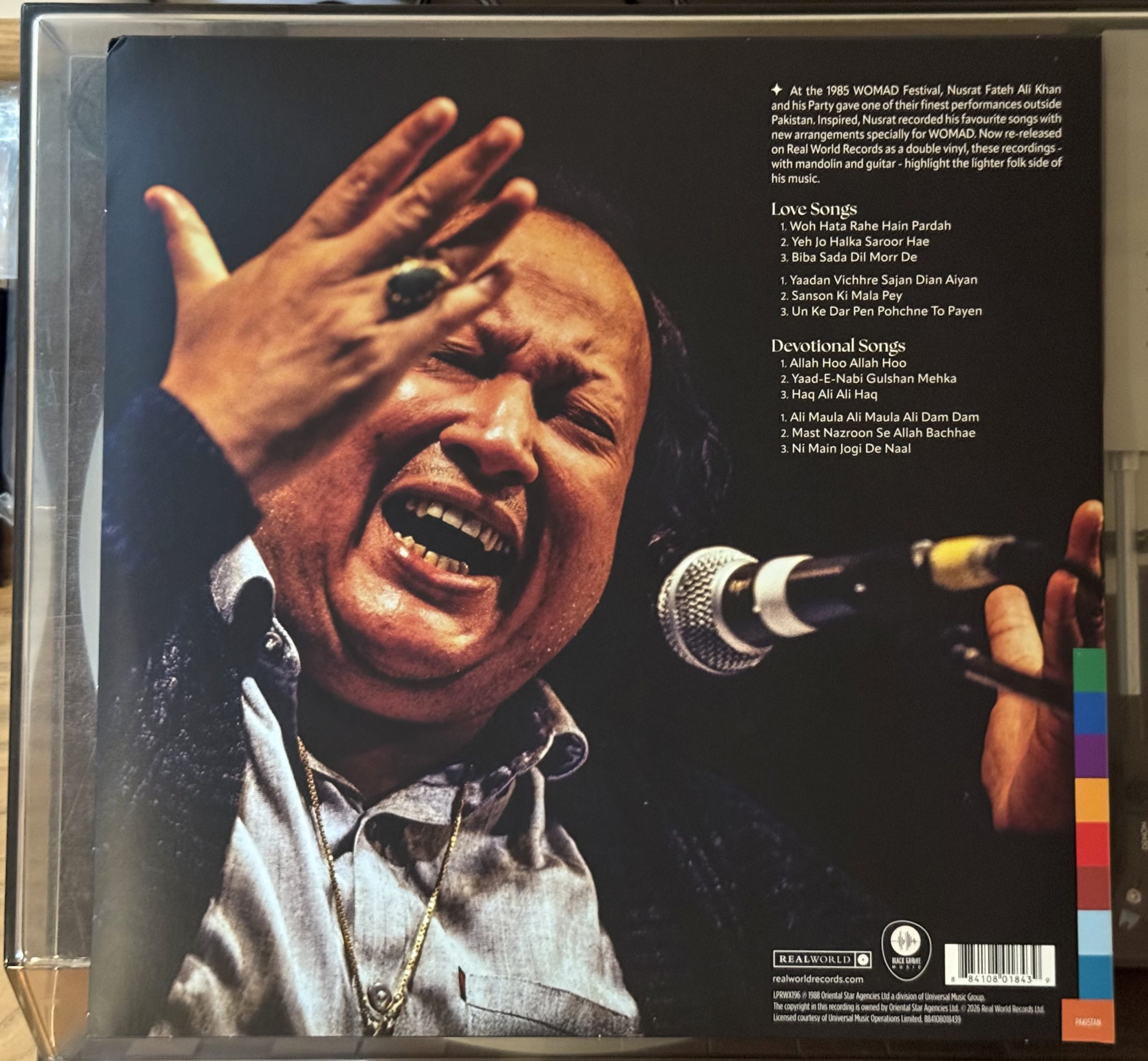
This week is another round of traditional qawwali music from Nusrat Fateh Ali Khan, and it has a complicated release history. Originally there were two records, released separately in 1986 for WOMAD Records following Nusrat’s triumphal 1985 performance, Love Songs and Devotional Songs. These were rereleased on Real World following the 1992 liquidation of WOMAD as a standalone entity due to mounting debts.1 The records were subsequently combined on a CD under the title Devotional and Love Songs; it was this version that was in my collection. The first-time-ever vinyl reissue from earlier this year flipped the order, putting the love songs first.

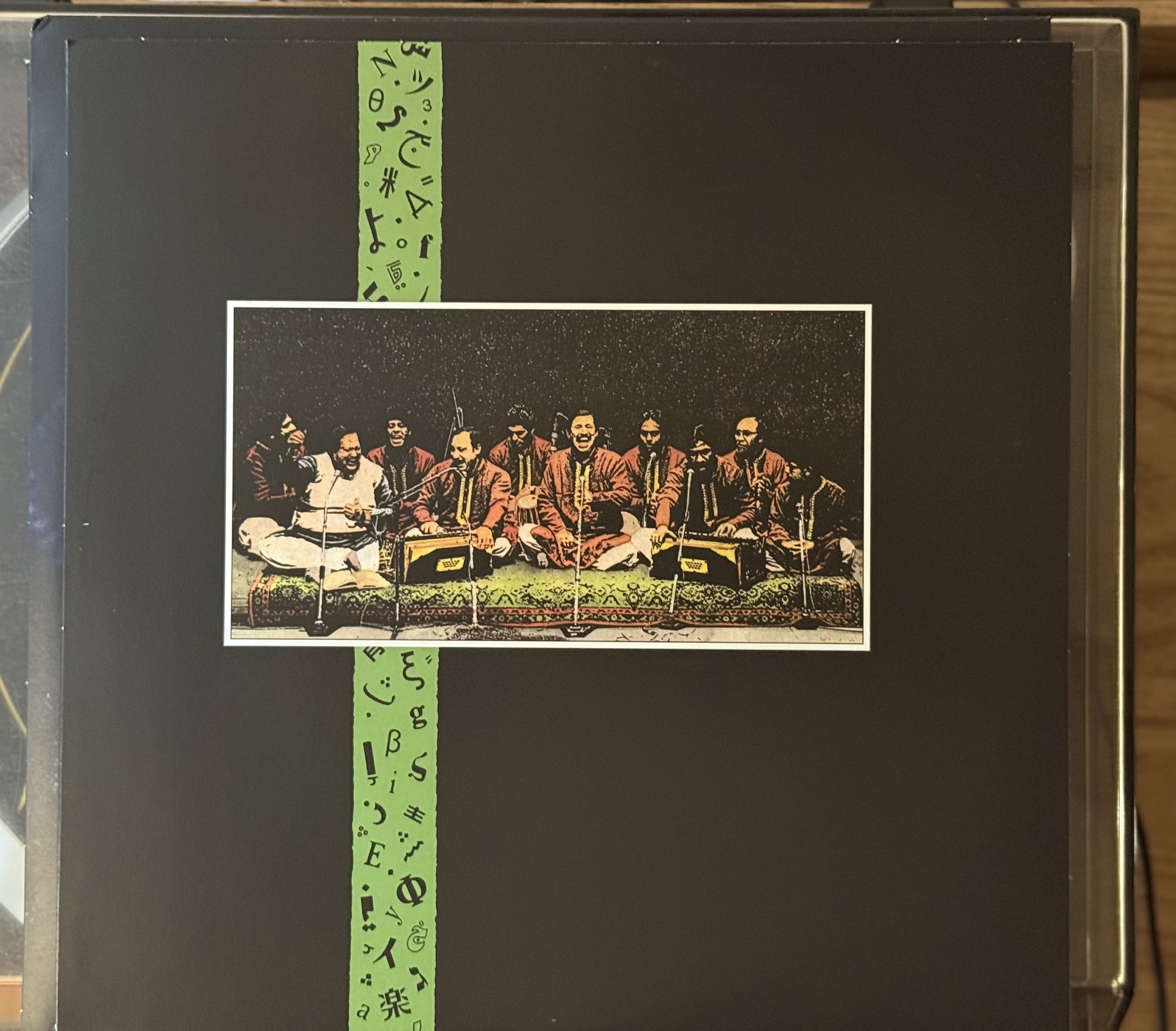
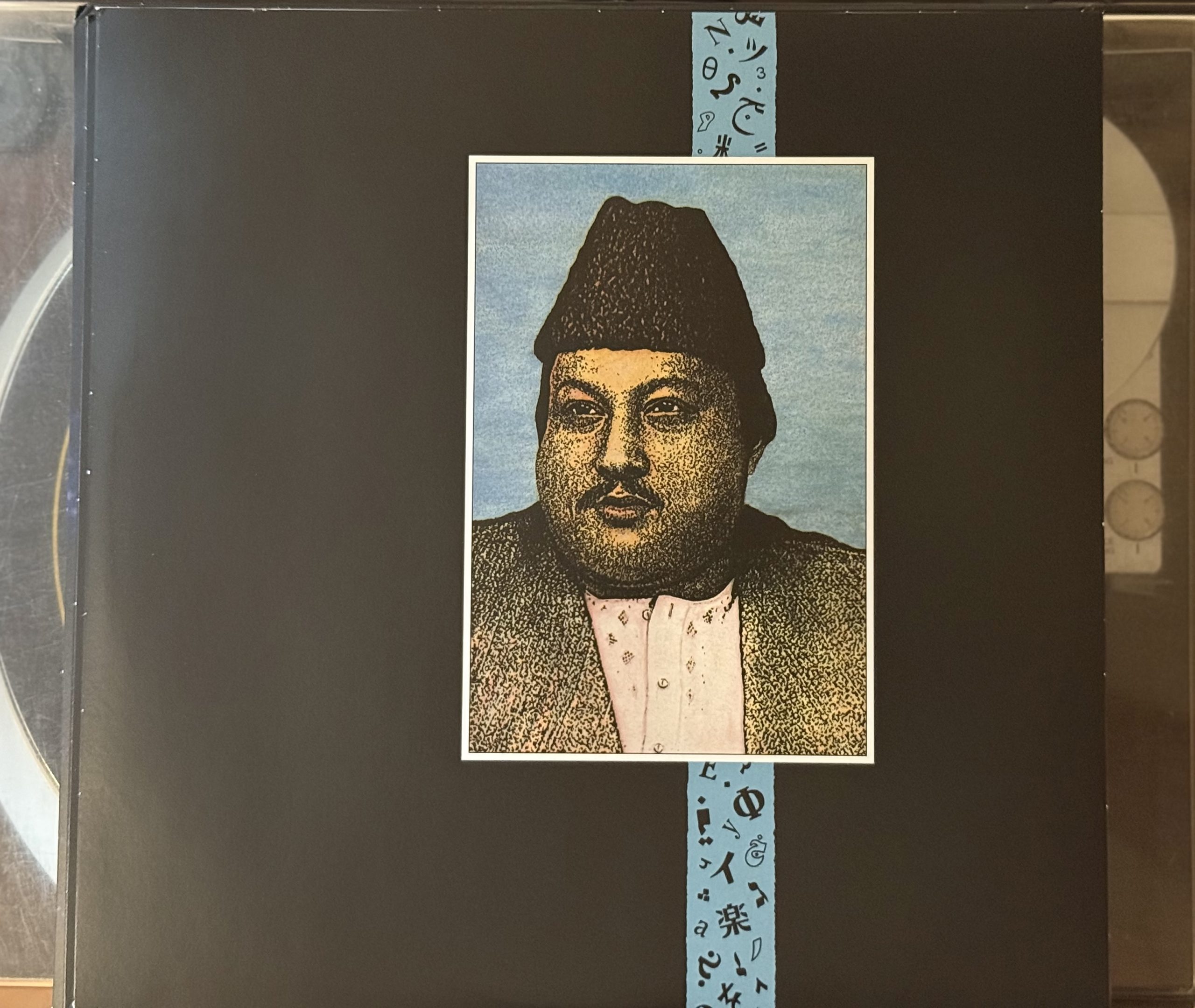
Because the original performances date to 1986, the group is much closer to the 1985 WOMAD performers than the group that recorded Shahbaaz. Specifically, there are the usual suspects: Majahid Mubarak Ali Khan and Maqsood Hussain on vocals, Farrukh Fateh Ali Khan on vocals and harmonium, Mohammed Iqbal Naqbi, Asad Ali, Ghulam Fareed and Kaukab Ali in the chorus, Dildar Hussain on tabla, and two additional instrumentalists: Rahmat Ali on harmonium and Majawar Abbas on mandolin and guitar. The recording also features the young Rahat Ali, Nusrat’s pupil, who was only ten years old at the time.
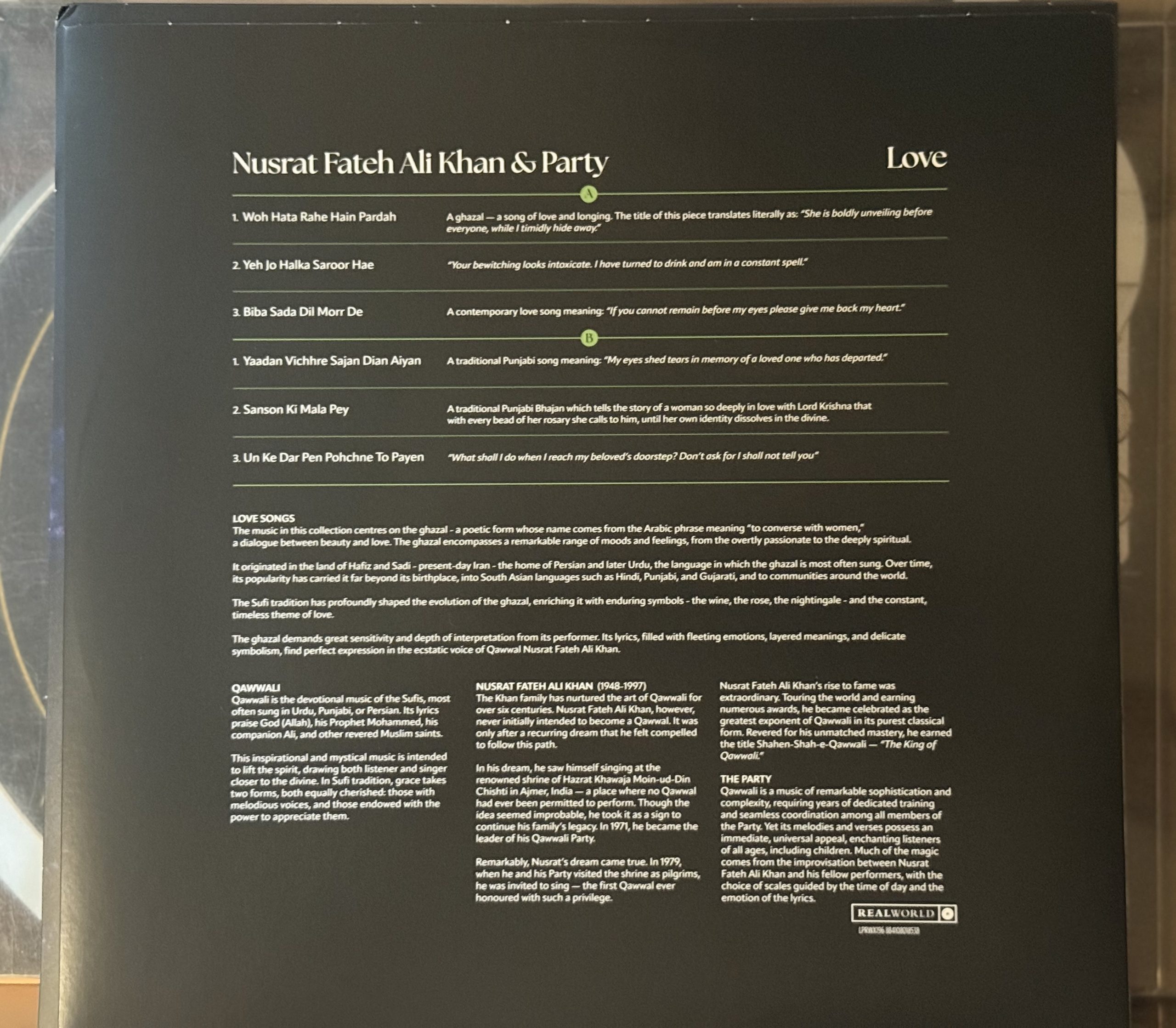
The title of the record refers not only to its subject matter but also to the styles of music represented. The “Love” side is the traditional ghazal, an ancient (ca. 615-700) Islamic love song form that spread via the Persian administrative force of the Moghul empire into South Asia, where its primary language movedf from Persian into Urdu. “Woh Hata Rahe Hain Pardah” emphasizes the difference in form via its instrumentation, which here includes Abbas’ guitar in addition to the normal harmonium and tabla. Nusrat’s performance leans heavily on the repetitions of the melodies with the chorus, with occasional moments of vivid improvisation.

The guitar opens “Yeh Jo Halka Saroor Hae” as well, with some unexpected harmonies and articulations. The poet writes about love as intoxication, literally: “Your bewitching looks intoxicate. I have turned to drink and am in a constant spell.” If the title sounds familiar, it’s because it was this song that Jeff Buckley essayed a surprisingly competent performance of in the extended Live at Sin-É, but he didn’t work from this recording; he appears to have had a copy of a 1988 Nusrat album that was released under the titles Greatest Hits Vol. 3, Yeh Jo Halka Halka (in a 1991 German release), and later Intoxicated Spirit. The arrangement here is different; after the guitar intro and the first statement of the tune, the party improvises on the bridge of the tune rather than the opening lines. In the last two minutes, Nusrat’s improvisation takes off, engaging a third melody that he uses to bring the party back to the start.

A more contemporary song, “Biba Sada Dil Morr De” unusually starts in a minor key, as Nusrat pleads, “If you cannot remain before my eyes, please give me back my heart”… a universal trope. The performance gives room for Nusrat to stretch out on some higher sangam improvisations, and the other members of the party get some high lines as well. Nusrat also inserts a long section of single-note syllabary that becomes a more traditional scale-wise improvisation, and he and the party “trade licks” through the end of the performance. Another version of this can be heard on Live at WOMAD 1985.
Yaadan Vichhre Sajan Dian Aiyan” is a traditional Punjabi song lamenting the death of the beloved. Here the mandolin puts us into the minor key, but most of the work is done by the party, who navigate the downward chromatic direction of the melody with ease. Nusrat’s improvisations negotiate the tone row of the piece with his customary blistering pace, but other members of the party add their own flavor with extended melismas and other improvisations. It’s Nusrat’s last scalewise melody that is the most dramatic, though, comprising an augmented minor progression that he rips through twice before returning to the main melody with the party.

Not all the ghazals are about romantic love. “Sanson Ki Mala Pey,” another traditional Punjabi song, talks about a woman whose love for Lord Krishna intensifies so much that she loses her own identity and becomes incorporated into the divine. The opening melody improvises across the scale in the guitar with unusual leaps, and the party’s statement of the melody is unusual as well with an eighteen-beat melodic pattern, organized as six slow triplets. So there’s an unusual waltz feel to the song that, coupled with the unusual chord progression, lends the feel of a Western folk song. Until the party begins its high improvisation, you could almost imagine this track (with English words) as the closing song of a downtempo set.

The Devotional and Love Songs compilation excluded two tracks, one from each of the original albums, from its running order to fit within the limits of a CD. “Un Ke Dar Pen Pohchne to Payen” is one of these, the last track on the Love Songs album, here restored to the running order in the double album. The sunny major key melody, with its unusual use of the ninth in the melodic progression, cheekily conveys the spirit of the lover: “What shall I do when I reach my beloved’s doorstep? Don’t ask, for I shall not tell you.” There are multiple improvisational asides as the party navigates the song, and a slight accelerando conveys the eagerness of the narrator at least as much as the intensity of the party in their performance.
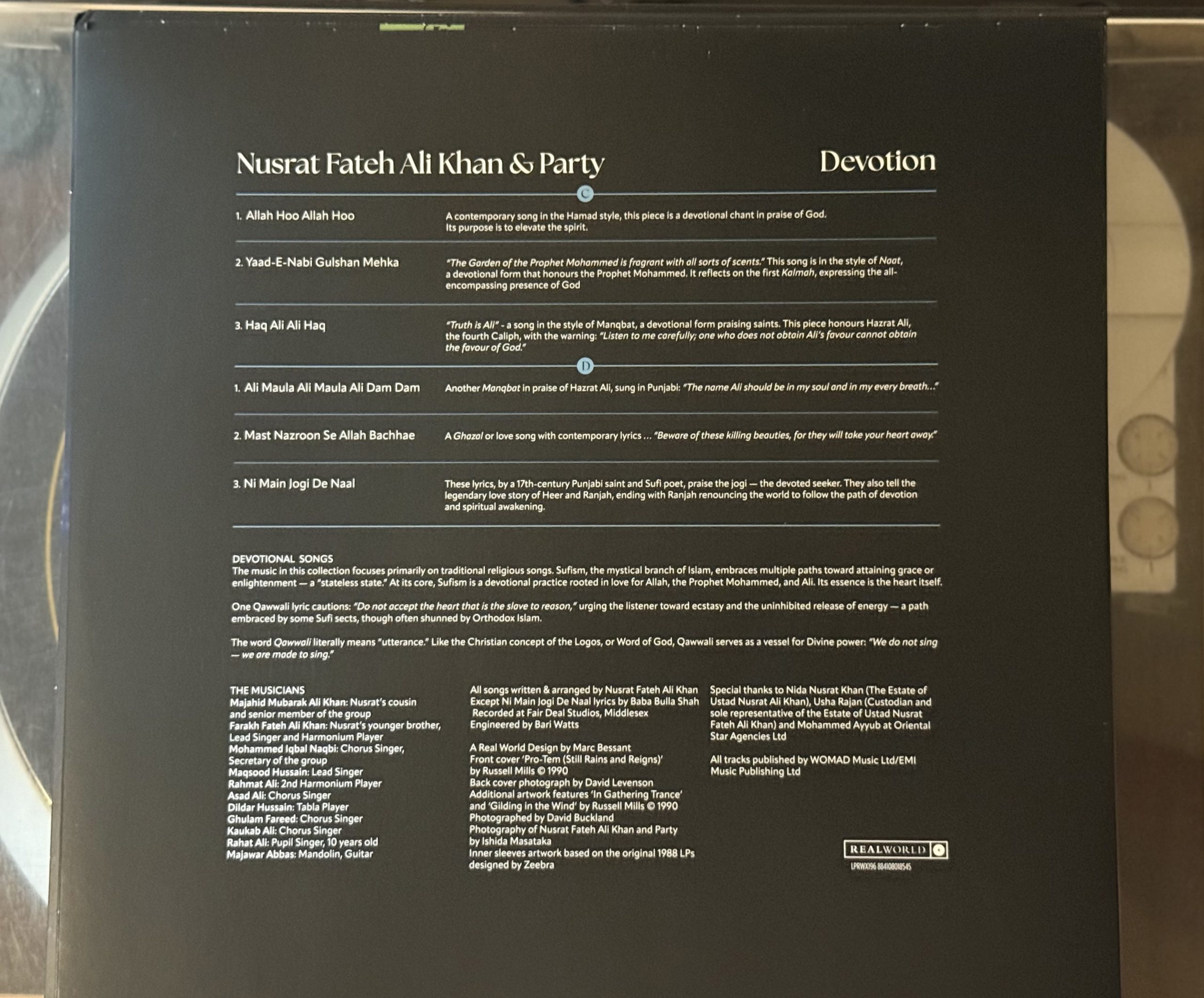
We are back to the devotional qawwali music with “Allah Hoo Allah Hoo,” previously heard on Live at WOMAD 1985. This recording, true to the reputation of Nusrat’s pre-Real World sets, is much briefer, limiting the amount of time each member of the party gets for their improvisation and resulting in a more focused, punchier performance. The addition of mandolin to the instrumentation helps to move things in a sprightlier direction as well.

Yaad-E-Nabi Gulshan Mehka” is also given an upbeat reading, with Nusrat leading the way in quick rhythmic variations of the melody almost as soon as it’s stated. We’re in a major key, which seems appropriate for a song reflecting on the “fragrance of the garden of the Prophet Mohammed.” “Haq Ali Ali Haq,” which also appears on Live at WOMAD, starts in a more reflective mode but quickly picks up momentum as the party negotiates the intricate, turning melody. This performance provides a little more stretch room for the performers, with high solos from the party and some meteoric sangam from Nusrat. The party performs a circling take on the melody that moves up and down the scale. All told, though, one appreciates the truth of the reviewer who noted that Nusrat’s other Real World albums provided opportunities for magic to happen by letting the performance stretch out over fifteen or twenty minutes; as complex as this rendition is, it feels like the band is just getting started (and in fact the song is subjected to the indignity of a fade-out).
Ali Maula Ali Maula Ali Dam Dam” is a devotional Manqbat (a song sung in praise to the Sufi saints) praising Hazrat Ali. Here it’s sung largely homophonically, with little of the extended improvisation in the first half of the performance and with alternating single-voice solos from the different lead singers of the party. There’s a truly dizzying bit of sangam in what sounds like triple-tongued rhythm from Nusrat near the end; if you listen carefully you can hear his young pupil Rahat, here only 10 years old and not given his own mic, singing along behind the master.

Mast Nazroon Se Allah Bachhae” is the sole ghazal on the “devotional” half of the album. Here the form feels similar to his performance of “Kali Kali Zulfon Ke” on Shahen-Shah, with the qawwal and party intoning the chorus twice and then Nusrat interrupting the third repetition with the first of many solos. The party continues to provide call-and-response support throughout.

The final track, like “Un Ke Dar Pen…,” was cut for space from the 1992 Devotional and Love Songs compilation. “Ni Main Jogi De Naal” is a devotional song dedicated to the jogi or devoted seeker. With a bright opening on mandolin and harmonium, Nusrat and the party sing overlapping iterations of the devotional, alternating with solo verses that elaborate the story of the jogi. In the end they achieve the sort of liftoff present in the best Nusrat performances, engaging in a sort of collective musical frenzy that ends in a final tempo downshift and a last utterance of the chorus.
Nusrat’s next album for Real World was 1994’s traditional The Last Prophet, which has yet to see a vinyl release. He followed that with something less traditional, and we’ll get to that soon. Next time, though, we’ll hear from one of his Real World labelmates, who had already made his world debut through a collaboration with Peter Gabriel.

You can listen to this week’s album here:

BONUS: This two-hour Channel Four program presents a live 1993 Nusrat concert from London, highlighting the diverse and very large crowds that Nusrat’s traditional qawwali music was bringing during this time.

Footnotes

  1. The liquidation resulted in consolidation, as the WOMAD assets were subsequently acquired by the Real World group. ↩︎
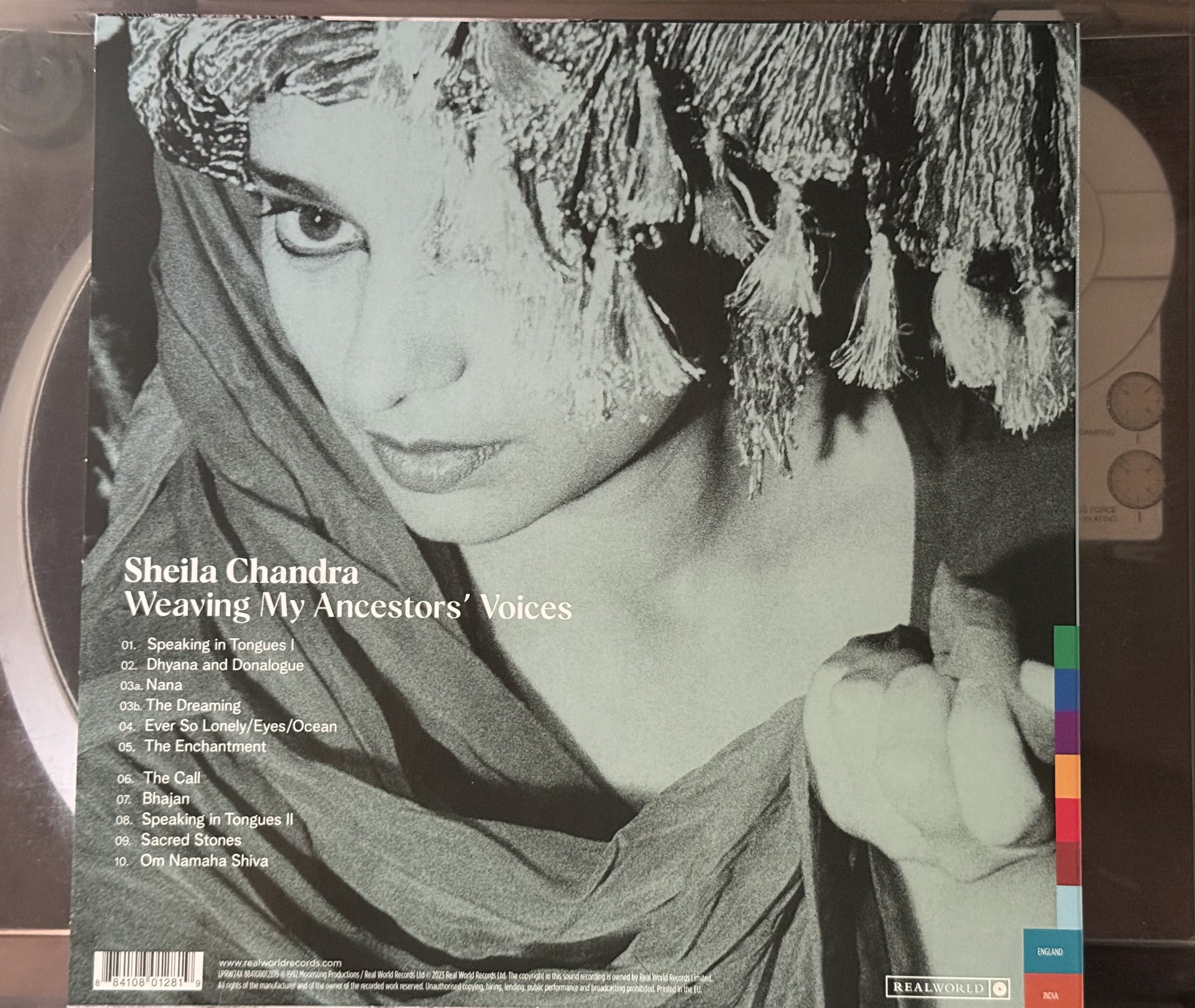
Sheila Chandra, Weaving My Ancestors’ Voices

Voice, drone and the universality of musical expression.

Album of the Week, August 22, 2026

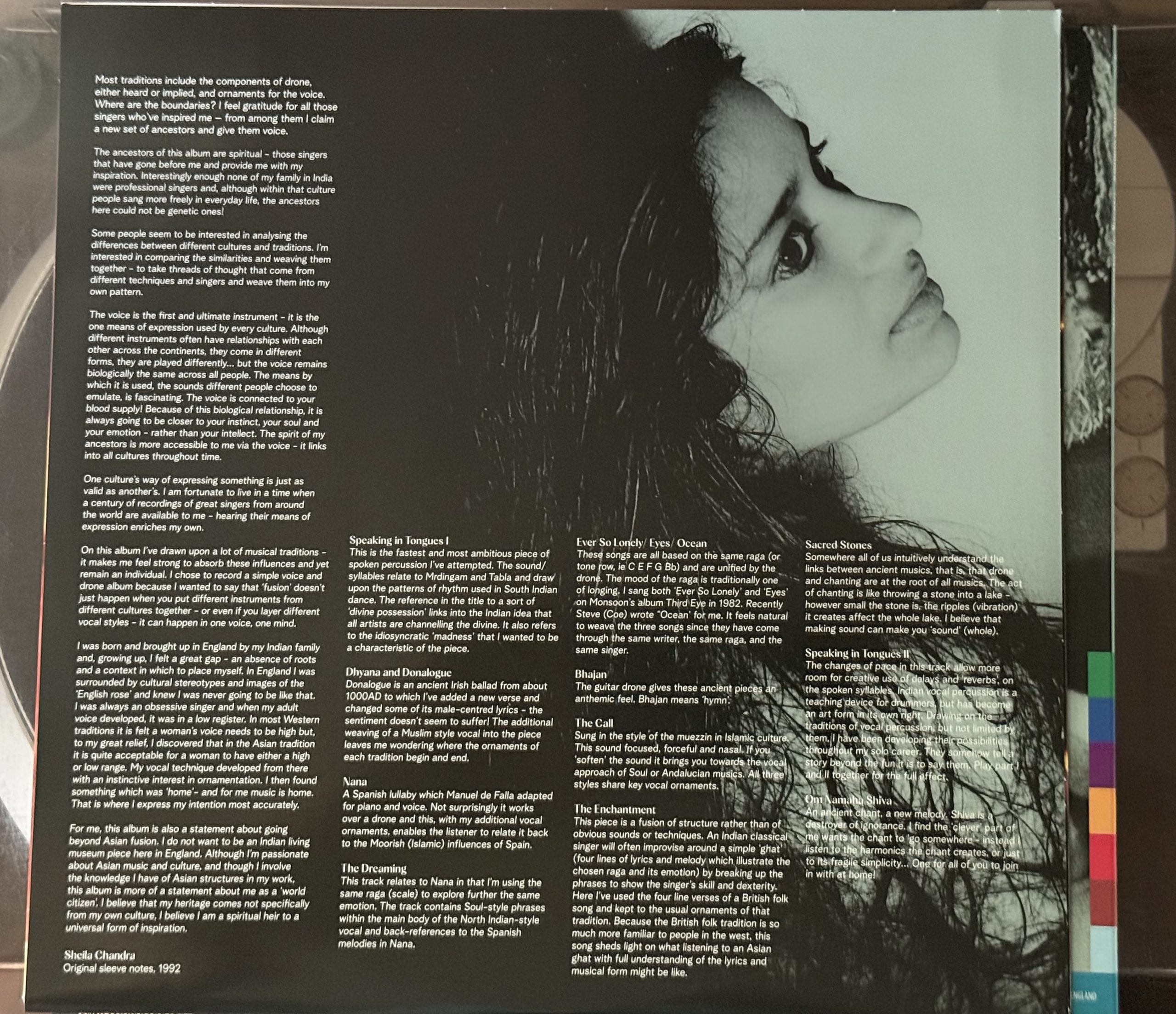
Sheila Chandra had a career arc: actress on the BBC drama series Grange Hill, lead singer in the band Monsoon, top 20 UK hit with “Ever So Lonely.” Then her label wanted her band to drop its Indian influences. She quit the band, went deep into traditional music until she came out the other side, blending influences from traditional British folk music—or, as she notes, “many of the vocal ornaments that are used in British folk are also used in Indian music… And I became interested in the crossover point between those influences.”

She made records in isolation, having retreated from live performing, until she decided it was time to return, and spent time at Real World Studios during a recording week in 1991. That experience may have helped her decide to take the new record she had just made, with just her voice and a drone—so she could perform the material live, completely by herself—and license it to Real World Records for distribution. The approach led to a trio of albums on Real World that she, and critics, still view as her best work, starting with the release of 1992’s Weaving My Ancestors’ Voices.

Speaking in Tongues I” plunges us off the deep end from the beginning. The performance features Indian vocal percussion, a style called konnakol, which translates to “reciting the rhythmic syllables.” But where traditional konnakol performance is rhythmic within the context of a larger performance, Chandra’s performance here varies rhythm, meter and vocal register to create entire sound worlds. She’s remarked that she wanted the title to invoke the concept of possession, to reflect the degree to which the performance takes flight, and the ending, with its three repetitions of an incredibly tongue-twisting syllabary, reflects the theme of stepping off the edge into something big and new.

Chandra has said that the “ancestors” here are not blood ancestors, but rather all of humanity—or at least the part that sings. “Dhyana and Donalogue” gives us a taste of this approach, with an 11th century Irish ballad juxtaposed against a meditative vocalization (dhyana means “meditation” or “profound reflection”) inspired by Muslim practice. The performance is so quiet and uncluttered that you can hear Chandra shift her vocal resonance from a lower register into a sharper tone within the same breath.

Nana/The Dreaming” incorporates the music of another ancestral culture, in this case a traditional Spanish lullaby as adapted by the twentieth century composer Manuel de Falla. Set over a drone, it foregrounds the Islamic influences of medieval Spanish culture, even more so as Chandra combines it with a North Indian style improvisation in the same tone row (raga).

Ever So Lonely / Eyes / Ocean” embraces the idea of combining multiple works that use the same raga, but in this case it takes the form of a greatest-hits medley. “Ever So Lonely” was the first Asian Fusion hit in the British pop charts, and “Eyes” comes from the same debut album; “Ocean” was a later song written by Chandra’s producer and former Monsoon bandmate Steve Coe for her. The combination works like a single utterance of loneliness, desire and reflection. The first side ends with “The Enchantment,” a traditional British folk song broken up in the same way that an Indian ghat might be expanded and improvised upon in Indian classical music.

The Call” is intended to evoke the Islamic “call to prayer” tradition, which we heard Baaba Maal perform in a Senegalese interpretation on Passion – Sources. Chandra points out the difference in vocal placement, with more resonance in the facial mask (often called a “nasal” sound) as a key difference in the style, which otherwise leverages the vocal improvisation on a a single raga that we’ve heard in other works here.

Bhajan” is a performance of ancient texts over a guitar drone, which makes them feel more powerful and a little less intimate. Unlike some of the other works here, the single musical anchor is the drone; each fragment uses a different raga. The intensity of the spiritual reflection provides the unifying factor through all the works.

And speaking of intensity, “Speaking in Tongues II” revisits the konnakol practice of the first track and ramps it up to eleven, applying multiple production techniques (reverb vs. dry, sonic manipulation of the vocal, etc.) to make it sound as though the continuous performance is composed of multiple segments edited together. Chandra says this was a deliberate choice, as she perceived she was being dismissed as a “studio artist” who couldn’t perform live; for this record she created deliberately difficult vocal percussion exercises with the sole purpose of being able to recreate them exactly live to silence the doubters!

Sacred Stones” opens with an improvisation on the drone, here an open fifth that leaves a wide amount of room for melodic exploration. Textually, Chandra combines Indian prayers, Latin prayers, and alleluias into a single invocation of the sacred. The tune flows into the closing track, “Om Namaha Shiva,” a mantra invoking the god that Chandra names “the destroyer of ignorance.” To my ears the performance invokes both the South Asian musical forms and the British folk melodies that she weaves through the rest of the record. It ends as a meditation on divinity and the nature of destruction… and creation.

Weaving My Ancestors’ Voices cemented Chandra’s reputation as an innovating musical thinker, and her subsequent live performances at WOMAD and elsewhere established her as a confident musician. She would take things even further, as we’ll hear soon. But next week we’ll hear some more traditional South Asian music in a massive collection that was released through Real World a few months after this album.

You can listen to this week’s album here:

BONUS: Chandra’s work translated directly to the stage, and there are a lot of live performances to draw from. Here’s “Ever So Lonely / Eyes / The Ocean” in a 1992 performance at World in the Park:

BONUS BONUS: An interview with Chandra from 1992’s WOMAD Festival in Finland leads into a short performance segment of her “Speaking in Tongues” material:

Peter Gabriel, Us

The artist’s most emotionally direct album digs in the dirt to yield a richly organic collaboration featuring some of his most enduring songs.

Album of the Week, August 15, 2026

When Peter Gabriel released his new album Us on September 28, 1992, it seemed like an eternity had passed since his last pop album, So, in 1986. (How little we knew!) Over the past weeks we’ve looked into some of what he was doing during the period—the Passion soundtrack and sister album Passion – Sources, massive world tour, WOMAD, and starting the Real World label and launching the western careers of some of his key contributors. But it has to be said that part of what he was doing was recalibrating. For the former art-pop auteur, life could never be the same after So. He had to find a new way to make music.

He also had to come to terms with himself. His marriage to Jill Gabriel, long strained, ended in divorce in 1987 in the middle of the massive world tour. He was famously linked with actress Rosanna Arquette for some time after his divorce, but the relationship was not long lasting. The dissolution of his marriage resulted in depression and therapy, which continued for six years. The divorce and his therapy both influenced the songwriting on Us, his most personal album to date.

To make the album real, he turned to a group of collaborators both familiar and new, many drawn from the sessions in the massive state-of-the-art studio he built in a former mill building complex in Box, Wiltshire, England. There was the core band, by now familiar: Tony Levin, Manu Katché, David Rhodes, producer Daniel Lanois, engineer David Bottrill; frequent collaborators like Shankar and Peter Hammill; collaborators from Passion including Hossam Ramzy, Doudou N’Diaye Rose, Kudsi Erguner, Assane Thiam, Manny Elias, and the Babacar Faye Drummers; and collaborators drawn from the nascent Real World label including many of the Passion names, the Dmitri Pokrovsky Ensemble, and Ayub Ogada. There were also some brand new faces, including Meters guitarist Leo Nocentelli, Lanois’ producing partner Brian Eno, ascendant electronic producer William Orbit, duduk player Levon Minassian, and incandescent vocalist Sinéad O’Connor.

Come Talk to Me” begins in a silence that builds to a shout: layers of keyboards crescendo up to a bagpipe solo over the bass, thundering drums courtesy of the combined forces of Katché, the Babacar Faye Drummers, and a 1980 drum loop from Doudou N’Diaye Rose, and a response on the duduk. Peter’s vocals are direct and intimate, reaching out to someone who has been incommunicado, asking for a bridge over which they can rebuild a relationship; he’s subsequently disclosed that the rift was with one of his daughters. The chorus features harmony vocals from Sinéad; Peter had met her doing an Amnesty concert in Santiago, Chile in 1990 and invited her to the studio, and having her very present voice on the opening track effectively signals that this album is about dialog and communication. It’s also a showcase for his collaborative work with the artists of Real World: that choir that enters after the bridge, the storied Dmitri Pokrovsky Ensemble, were recording their album for the label, The Wild Field, at the same time Gabriel was working on Us.

The contrast as the album flows into “Love to Be Loved” is marked. Cool where “Come Talk to Me” is hot, the second track is all about minimal groove, with both the late William Orbit and the legendary Brian Eno contributing programming and keys. Katché’s drum programming and Hossam Ramzy’s tabla (as well as Daryl Johnson’s hand drum) anchor the rhythm along with Tony Levin’s bass. And the lyrics take us on an emotional journey, starting from talking about the need for contact (echoes of “I Have the Touch”) to a startling transition in the bridge in which Peter confesses, “This old familiar craving / I’ve been here before, this way of behaving… Let it pass, let it go, let it leave / From the deepest place I grieve / This time, I believe.” But even that isn’t the end, and we get to the root of it: “Though it takes all the strength in me / And all the world can see / I’m losing such a central part of me / I can let go of it… I recognize how much I’ve lost / And I cannot face the cost / ‘Cause I love to be loved.” The track’s stark honesty about the need for physical relationships and letting go of destructive behaviors, even as other relationships are falling apart, is striking; one really feels those years that Peter spent in therapy at work here. And it’s a jam.

That brings us to “Blood of Eden,” which feels like the most primal, innocent love song Peter has ever written. It comes out of an idyllic opening with the doudouk over layers of keyboards, and Peter sings about the darkness in his heart and the “heated and the holy.” The song is surely one of the best known from the album thanks in no small part to Sinéad O’Connor’s pure vocals in the chorus duet (and the face morphing of the two singers in the video), but the lyrics are a bit of a hodgepodge, with the heated and the holy looking down from on high “so secure with everything they’re buying.” The narrator returns to “the union of the woman and the man” as a retreat to paradise even as he acknowledges the worm at the heart of the apple: “All the while the distance grows between you and me.” There are echoes here of “Don’t Give Up,” both in the duet structure of the song and the plight of the narrator, but the catastrophe seems more emotional than economic here. This was one of the songs that underwent the longest gestation, with multiple versions and arrangements extant; the liner notes hint at this when they credit Richard Chappell for the mix from which the bridge section was drawn, and another version of the song appeared even before the album was released on a soundtrack (see the bonus section below). Other versions have been released to Peter’s fan club on Bandcamp.

Steam” underwent a similar evolution, with a stunning “Quiet Steam” appearing as a b-side to the album’s first single. But there’s plenty to recommend the released version, starting with the funky guitar of Leo Nocentelli of the Meters. The horns aren’t given quite as much prominence as they are in the song’s spiritual predecessor “Sledgehammer,” but they’re still pretty tasty, and the Babacar Faye Drummers add an edge to the percussive energy that is otherwise all Motown. One fun thing to listen for is Peter’s keys, here easily distinguished because he’s switched from the airy synth sounds of the Prophet to a fairly convincing Hammond organ soundalike, adding to the sweaty funk of the mix.

Only Us” returns to a more open, idyllic sound, with a duet between Peter and Kenyan musician Ayub Ogada. This is another track with contributions from William Orbit, but here the vibe is organic rather than chill. Shankar and ney flautist Kudsi Erguner contribute to the feeling of limitless nature, and Peter’s lyrics signal the song’s centrality to the album’s overall concept as he refocuses on relationships and people: “Seduced by the noise and the bright things that glisten / I knew all the time I should shut up and listen / And I’m finding my way home from the great escape… Yes I can read you loud and clear … The further on I go, oh the less I know / Friend or foe, there’s only us.” I realized as I was relistening to the album that this was a track that had slipped under my radar, but it repays listening to again.

The second half of the album starts with “Washing of the Water,” easily Peter’s most gospel song starting with just bass, snare and piano accompanying Peter’s unvarnished vocals. This too has echoes of “Don’t Give Up”—we could be over the same river that flowed through the earlier song. But here the protagonist gives in to the lure of the water, choosing to accept the call to immerse himself in grief as he mourns the loss of the relationship. The horns under the bridge as Peter sings “Letting go, it’s so hard / The way it’s hurting now / To get this love untied / So tough to stay with this thing / ‘Cause if I follow through / I face what I’ve denied / I’ll get those hooks out of me / and I’ll take out the hooks that I’ve sunk deep in your side.” The acceptance of the dissolution of the relationship, the unhooking and the desire to finally sleep, feels like a brutally sad step, but also like emotional honesty and progress as the narrator names the pain that is at his core.

The progress of Peter’s emotional journey is most vivid in “Digging in the Dirt,” a metaphor for the hard work of therapy as Peter allows himself to express anger as well as sadness and grief. The rage of the narrator boiling over in the chorus—“Don’t talk back, just drive the car”—is shocking when it comes to the surface, the “something in me / dark and sticky” rising like Sting’s monster crawling to the surface of a dark Scottish loch. Significantly, though, the narrator doesn’t stay stuck in this moment of rage; he takes a step back, asking, “Stay with me, I need support,” and goes digging to “find the places I got hurt.” By the end of the song (a fantastic slow groove built atop Babacar’s djembe, Assane Thiam’s tama, and Hossam Ramzy’s surdu, with Leo Nocentelli joining David Rhodes, Manu Katché, and Tony Levin plus more background vocals from Ogada, this time joined by Peter Hammill and Richard Macphail), the narrator has even opened up his area of concern to “find the places we got hurt,” acknowledging the difficulties he’s caused his partner. I remember watching the video for this song live, introduced by Gabriel on MTV, in a student lounge and thinking, “I guess Peter’s been in therapy”; the vivid claymation of Peter sinking into the grass covered by insects and worms is among the most memorable video images of him in his entire ouevre.

Fourteen Black Paintings” follows. The longer CD format allowed Gabriel to expand beyond the 45-50 minute limit of an LP, and this composition, which reads like a cross between Passion and “We Do What We’re Told (Milgram’s 37),” is the beneficiary, as it surely would have been cut for time otherwise. Yet it’s significant in its own way; Peter’s only known collaboration with Led Zeppelin’s John Paul Jones, the song is an echo of “Biko” in its call for the people to embrace their power and bring about change. There’s also some vivid percussion from Babacar and Assane Thiam alongside the doudouk and electric violin that build the atmosphere of the song.

All of which makes “Kiss That Frog” even more of a shock. A playful metaphor-song that plays as a straightforward fairy tale, Peter’s lyrics have rarely been so direct, and his singing is unusually free, especially in the scat choruses at the beginning and end of the song. If “Steam” is a lesser shadow of “Sledgehammer,” I’d rate “Kiss That Frog” as a superior successor to “Big Time.” Both more open and more generous in its worldview, it’s also downright funny: “Let him sit beside you / Eat right off your plate / You don’t have to be afraid / There’s nothing here to hate.” When Gabriel shifts perspective from the narrator to the frog, croaking “Kiss that frog / You may get your prince,” it’s a laugh-out-loud moment. When I was a cynical, critical teen I disliked the song for exactly the same characteristics that make it enduring (and endearing) now: the extended metaphor, the straightforward pop, the echoes of gospel and R&B in Peter’s harmonica and “fake organ” and Marylin McFarlane’s backing vocals. This is one of the few songs on the record that doesn’t have an extensive list of guest musicians, just programming by David Bottrill and Richard Blair, a percussion loop from the Adzido Drummers and shakers from Manny Elias, and David Rhodes’ guitar.

The album closes with “Secret World,” another contender for the theme song, as Peter sings with open regret, but “no guilt and no shame, no sorrow, no blame,” about the dissolution of the relationship and about moving on: “All the places we were hiding love / What was it we were thinking of?” The song, again built on a drum loop from Doudou N’Diaye Rose (the album’s secret MVP), is an open ballad sung with regret but also with forgiveness, and with a sort of intimacy not present in the singer’s earlier works: “So I watch you wash your hair / Underwater, unaware / And the plane flies through the air / Did you think you didn’t have to choose it? / That I alone could win or lose it?” After many works berating himself for the dissolution of the relationship, Peter dispassionately observes that it wasn’t only up to him, and allows himself to absolve some of the guilt, shame, sorrow and blame. It’s probably the most mature reflection on the end of a relationship in pop music, certainly in Peter’s work, and it puts truth to Peter’s dedication to Jill and to Rosanna Arquette in the liner notes: “To Jill, for giving up so much in all the time we were growing up together. To Rosanna for all her love and support that I didn’t properly acknowledge.” And it’s all wrapped in a tasty groove, with one of Tony Levin’s most sinuous bass lines as the foundation.

Us in many ways is clearly a direct successor to So in terms of the ambition, artistic scope, and stadium-readiness of its sound. But where its 1986 predecessor is the slickest thing Gabriel has ever recorded, Us embraces the organic, acoustic, and human side of music making. The collaborations from Passion and the experiences producing and recording—and singing alongside—so many great world musicians seem to have opened Peter up to a more human way of making music. It also evolved his songwriting in ways that opened new opportunities in his career; when we check back with some of his later work we’ll explore that thought some more. But first we’ll listen to another voice on his Real World label, one who didn’t participate in the making of Us.

You can listen to this week’s album here:

BONUS: “Blood of Eden” appears in a different version, based on an earlier approach to the song, in Wim Wender’s great 1991 film Until the End of the World, accompanying a scene that hints at nuclear catastrophe — or at least an EMP. Here’s that scene (but you should really watch the whole movie):

BONUS BONUS: “Washing of the Water” would seem to be a non-obvious choice to perform on “The Tonight Show with Jay Leno” to promote this album, but that’s where Peter went in this incredible performance with Shankar, Joy Askew on keyboards, Tony Levin on acoustic bass—and with Branford Marsalis, who was music director for Jay’s band at the time, sitting in on soprano sax:

BONUS BONUS BONUS: Much of the b-side material that came from the Us sessions consists of alternate takes of the album tracks, but “Bashi-Bazouk” is the exception. An instrumental that feels a bit like Passion given a dance floor treatment, it’s got a shocking opening and a mean groove:

BONUS X 4: Just as Passion – Sources served as a Real World sampler for the artists appearing on Passion, so there was Plus From Us. Sadly the compilation has never been released on vinyl, but there’s a lot to like here: Ayub Ogada, the Meters, solo tracks from Rhodes, Levin, and Katché, and more.

Nusrat Fateh Ali Khan, Shahbaaz

A mesmerizing collection of traditional and modern song from the great qawwali master.

Album of the Week, August 8, 2026

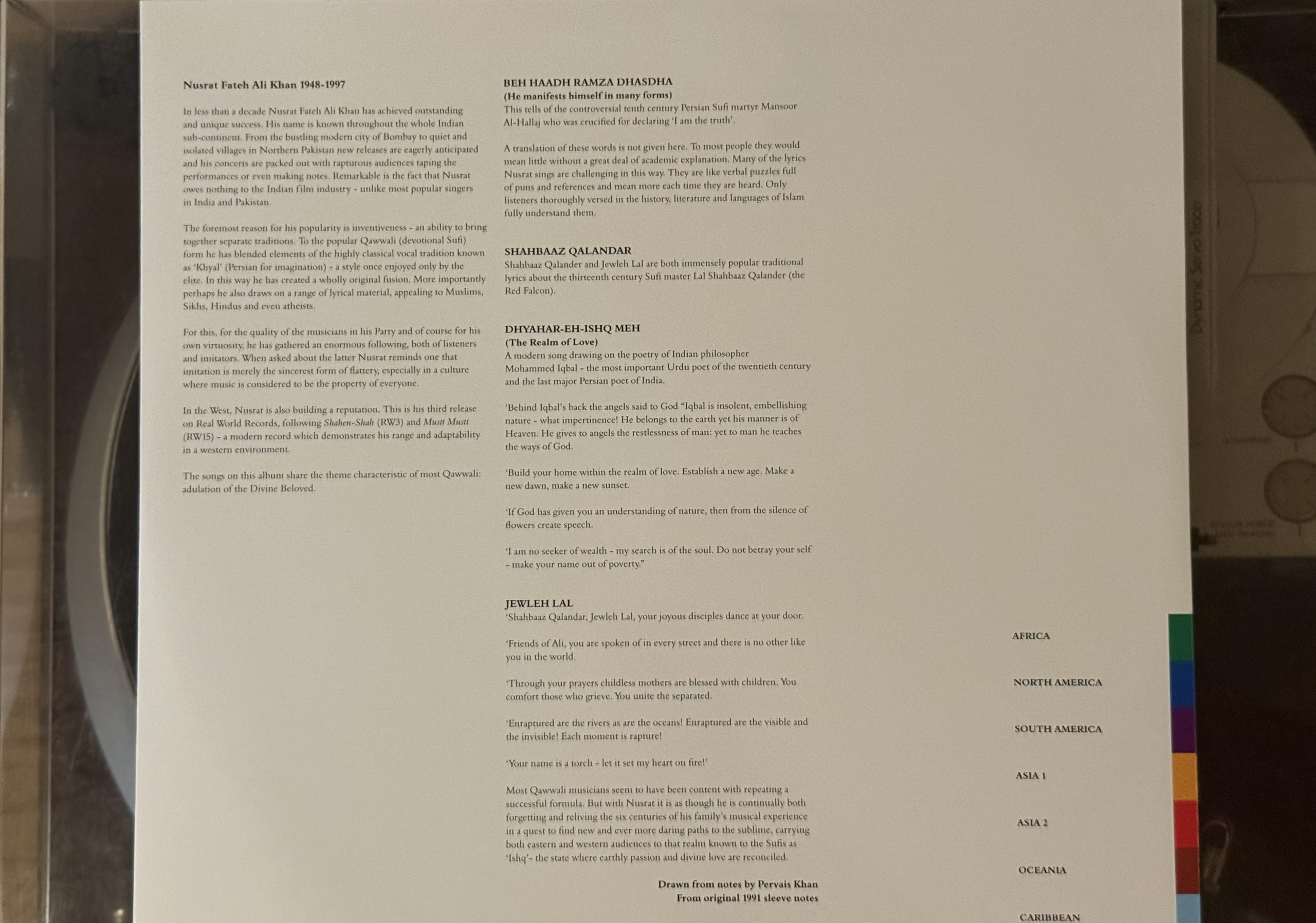
If you’ve just done a big crossover album, as an artist you have an implicit choice: do you continue mining that vein, coming closer and closer to pop? Or do you return to the music that made you famous? Following the success of Mustt Mustt, one imagines this was a choice facing Nusrat Fateh Ali Khan at some point. After all, the album, and his appearances at WOMAD and other Western festivals, were gaining him increasing fame. But his choice was to double down on the traditional repertoire that had been his life, and he released Shahbaaz, an album with four tracks of traditional qawwali music that, as the liner notes by Pervais Khan observe, take us “on a quest to find new and even more daring paths to the sublime.”

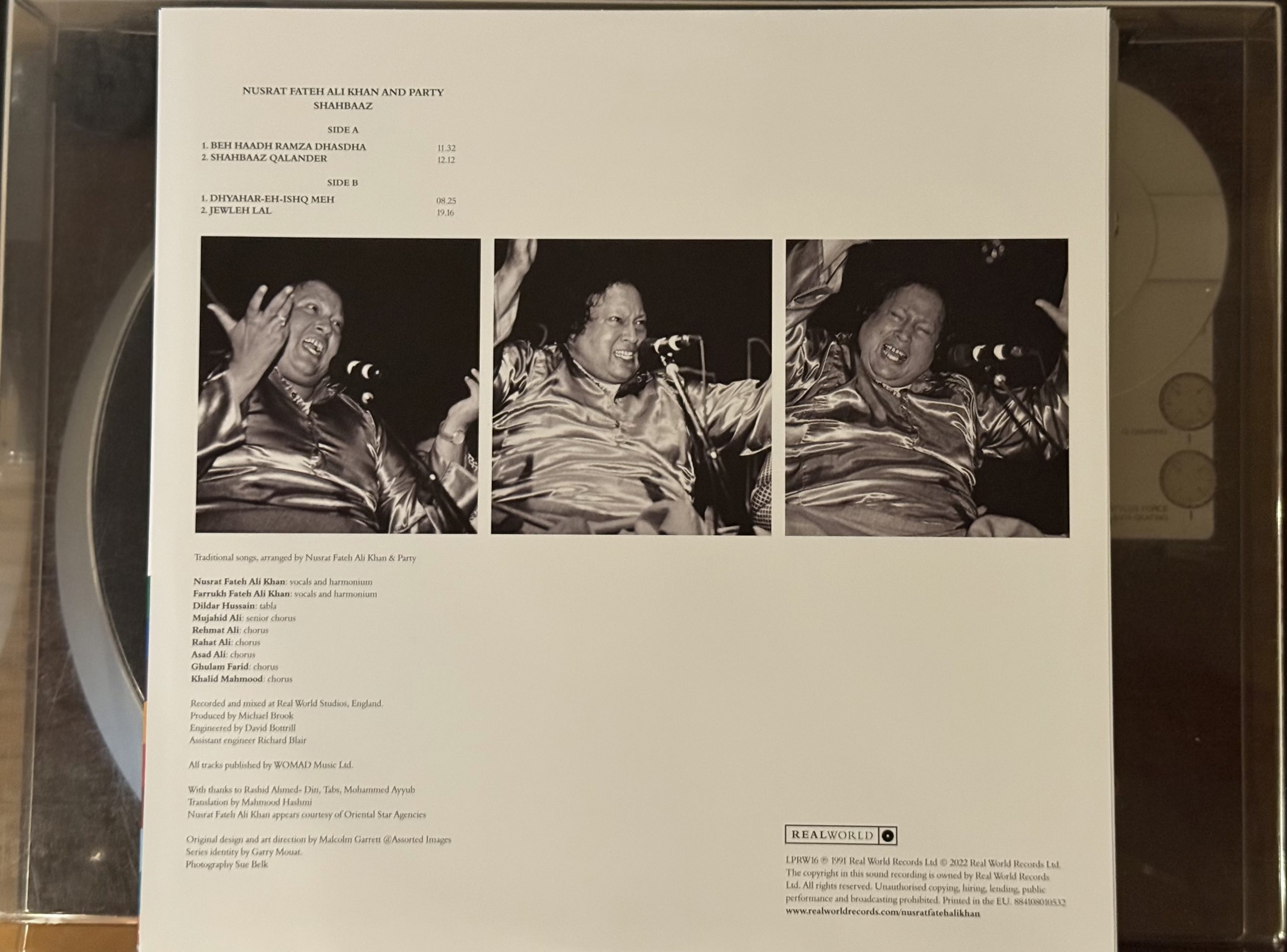
The album, as before recorded in Real World’s Big Room, features many of the members of Nusrat’s party, including his brother Farrukh, long-time tabla player Dildar Hussein, and his young student Rahat Ali, who once again both participates in the choruses and receives live instruction in the art of qawwali while the performance is underway.

Beh Haadh Ramza Dhasdha” drops us directly into the mix, as harmonium and tabla give us six bars and Nusrat and the chorus immediately wordlessly improvise over the melody for another six before beginning the qawaali song. Nusrat and the party improvise vocal responses after the melodic intervals, until Nusrat interrupts the fourth repetition to climb the scale, inviting Rahat to follow. At around the three minute mark, Nusrat briefly pulls the song into a different mode before bringing it back, and the song continues in this manner, with the party continuing in a more traditional fashion while Nusrat continually interjects in different scales and patterns, illustrating the message of the song, “He manifests Himself in many forms.”

We’ve heard “Shahbaaz Qalandar” before, in that 1985 WOMAD performance. This rendition runs about three minutes longer, partly due to a longer harmonium introduction and partly due to Nusrat’s interjection of additional lyrics in several places which are then picked up and elaborated by the party. The party works into a frenzy at the end with a chant of “Ali, Ali,” but doesn’t engage in the overlapping chorus lines that made the prior live version so fascinating; it’s still a riveting performance.

Dhyahar-Eh-Ishq Meh” is a modern song setting poetry of the twentieth-century writer Mohammed Iqbal; the tune is rhythmically complex and provides a good opportunity for Nusrat to engage in pyrotechnics in multiple scales. It isn’t two minutes before Nusrat turns the conventional minor tonality into something more modal and unleashes a blistering run; a minute later, he breaks the pattern with a series of low utterances on the tonic before doing a series of up and down runs. The “bridge” is two winding runs in that modal scale. At the end of the tune, Nusrat shifts the rhythm into a different world before bringing it back to the hypnotic main tune.

Jewleh Lal” enters directly with the entire chorus singing the title to open the chorus: “Jewleh Lal, Shahbaaz Qalandar, your joyous disciples dance at your door.” Both “Jewleh Lal” and “Shahbaaz Qalandar” are hymns of praise to the South Asian Sufi saint and poet Sayyid Shah Hussain Qadri, who was popularly known as Lal Shahbaaz Qalandar (ruby-coloured, noble and divine spirit, spiritual man), with Jewleh Lal meaning the “red bridegroom.” Lal Shahbaaz Qalandar is one of the key Sufi saints, as is clear from the heights of ecstasy the party reaches through the repetition of the hymn over the nearly twenty minute running time of the song. It helps that Nusrat’s setting is catchy, major-key, and a combination of a simple scalewise melody and a high shout to the saint. The tune allows Nusrat ample room for sangam explorations as the party continues to anchor the performance with the repetitions of “Jewleh Lal Shahbaaz” on the high tonic. As each member of the party solos in turn, the tempo imperceptibly increases until the group settles to the final repetition, exhausted with the ecstasy of praise.

The album continues to be a favorite of mine, and I imagine other listeners, for the sheer unbridled ecstatic heights that the party reaches in both “Shahbaaz Qalandar” and “Jewleh Lal.” I know the latter was a favorite of many fans because they were shouting for it at the Nusrat concert I attended almost exactly thirty years ago, on August 3, 1996 in the Warner Theatre in Washington, DC. Nusrat’s tours would continue to emphasize his traditional material even as he collaborated on record with many other western musicians. We’ll hear more of both those musical directions from him before the series is over. But next week, we’ll check back in on what one of those Western musicians was doing all this time.

You can listen to this week’s album here:

BONUS: “Shahbaaz Qalandar” is likely one of Nusrat’s most-performed songs and there are many live versions available. This one comes from a historic open-air concert in New York’s Central Park that was held on August 14, 1993, and gathered a huge crowd, including some unlikely listeners (whom we’ll discuss later):

Roland Hayes

E. Azalia Hackley Collection, Detroit Public Library.
Roland Hayes pictured with a diamond tie pin presented by King George V, of England on April 23, 1921.

I sang a composition arranged by Roland Hayes this Sunday at church. Our church’s regular choir doesn’t do the summer services, so I sometimes sign up to sing a solo one week. This year I learned that we would be preaching from Luke 2, which tells stories of Jesus as a boy, and went looking for solos that drew from those stories. I found one: an arrangement by Hayes of an African American spiritual, “Little Boy (How Old Are You?).”

I was unfamiliar with Hayes, which is somewhat criminal. Not only was he the most well-known African American classical tenor of the early part of the twentieth century, his name spoken in the same breath with Paul Robeson and Marian Anderson, but his adopted home base was Boston. He didn’t start there; he was born in Curryville, Georgia, near where his mother had been enslaved, and he learned spirituals and hymns from the elders in Curryville’s Mt. Zion Baptist Church, which his mother had helped to found. After his father’s death, his mother moved the family to Chattanooga, and he studied music at Fisk University and toured with the Fisk Jubilee Singers. He moved to Boston, where he studied with Arthur Hubbard, who encouraged the young man to take lessons at his house so that the white students at his studio wouldn’t be bothered.

Young Hayes had drive. He paid for his lessons with money earned from jobs as a messenger for the Hancock Life Insurance Company. He made his New York debut with Walter F. Craig’s orchestra in 1916, but was determined to launch a solo career, which he did by renting out Jordan Hall for his first concert, then Boston Symphony Hall for his second. He did his own publicity, taking out newspaper ads and using the phone book to call Bostonians. It worked; he filled the hall. The concert was a financial and artistic success. He began doing house concerts for wealthy patrons including Isabella Stewart Gardner. But he was still not taken seriously as a classical musician.

So he went to Europe, where he repeated the playbook in London, then other capitals. The photo above dates from this period; that’s a diamond tie pin that was given to him by the King of England. When he returned, he was finally able to command the artistic respect due him; he premiered with the Boston Symphony in 1923, and sang as a soloist with the orchestra in ten performances from 1923 to 1944, under both Pierre Monteux and Serge Koussevitsky. He reduced his performing schedule after this, but still gave yearly recitals at Carnegie Hall and taught.

Hayes made his earliest recordings in 1923, for Aeolian Vocalion, and made many other recordings for Columbia, Vanguard and other labels. 1954’s release of The Life of Christ, a recital with Reginald Boardman on the piano, featured the tune “Little Boy (How Old Are You?),” which is the rare solo written about the events at the end of Luke 2, when the 12-year-old boy Jesus went missing from his family to go and sit among the teachers at the Temple. It’s an affecting song, and hopefully my performance did it a little justice. You can hear Hayes’s performance of it below:

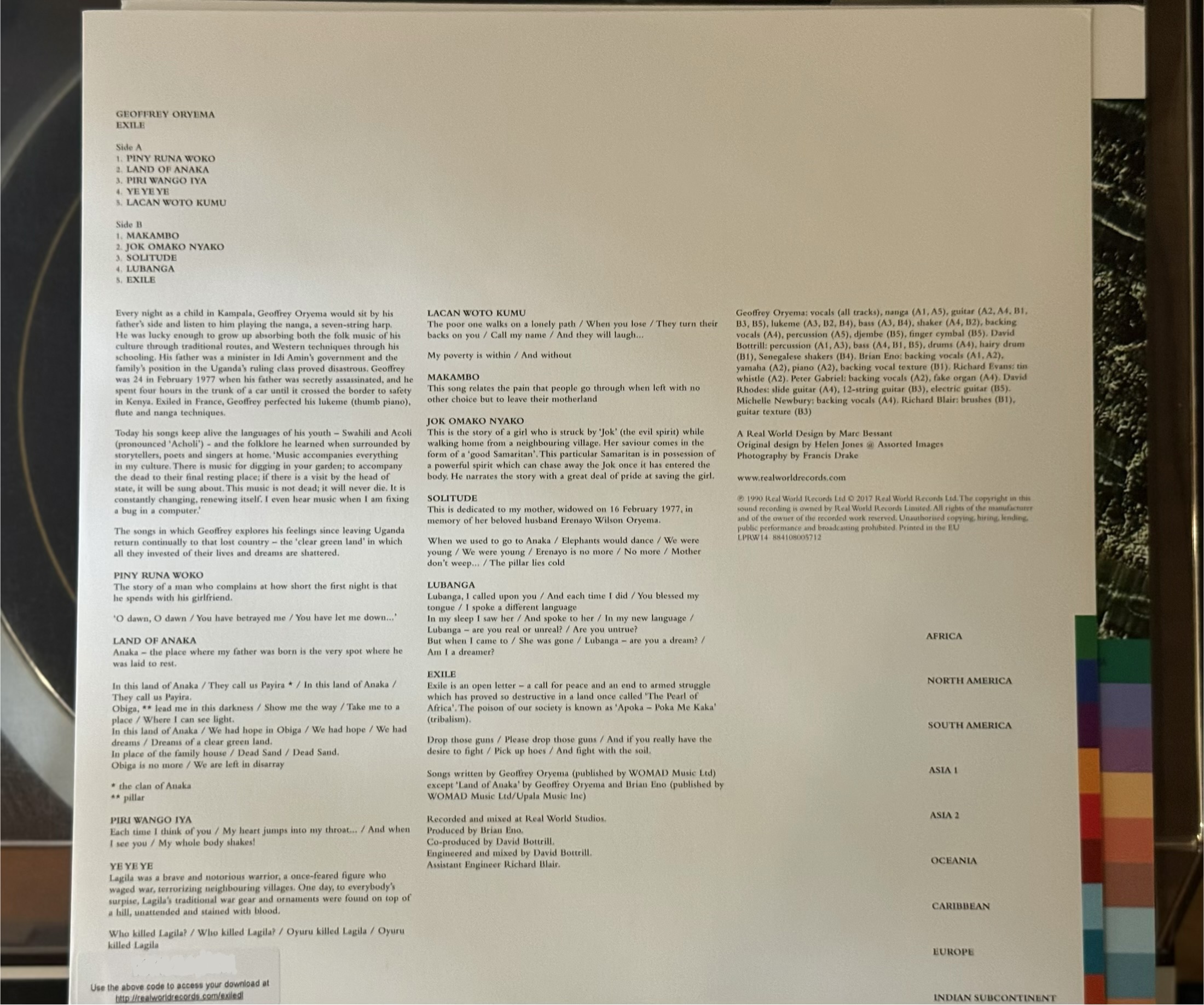
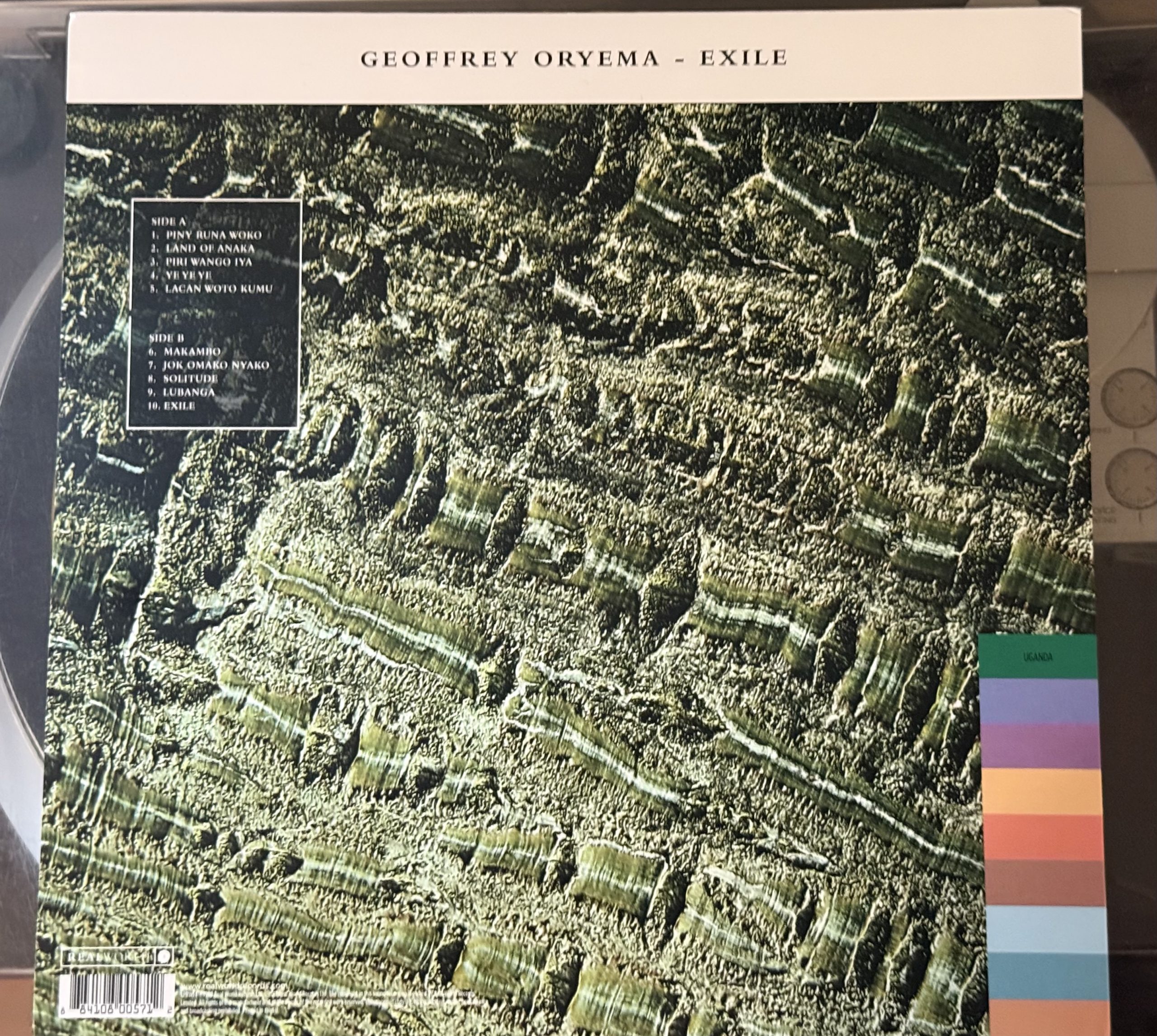
Geoffrey Oryema, Exile

An album mixing traditional music from Uganda and modern reflections, by turns joyous and sober, from a musician in exile.

Album of the Week, August 1, 2026

Imagine you’re a music student, and your father is a senior government minister who gets assassinated when you are 24 years old. Your family is part of an ethnic minority in Uganda, the Acholi people, who are economically marginalized and systematically targeted by Uganda’s dictatorial leader Idi Amin. It’s a crazy situation and you’re afraid for your life, so you get smuggled out of the country in the trunk of a car. You seek asylum in Paris, taking odd jobs and teaching yourself guitar. And then imagine you get invited to play at Peter Gabriel’s WOMAD Festival. This was the path to fame followed by Geoffrey Oryema, an Ugandan exile who became one of the most well known East African musicians of his generation.

Oryema was a songwriter and multi-instrumentalist who played the nanga, an African harp, as well as guitar and many percussion instruments. Most of his early performances were solos, but he had a few memorable collaborations with Gabriel, including appearing with him at WOMAD and performing together with Gabriel and Suzanne Vega on the One World, One Voice compilation.

It’s the nanga you hear first on the album to open “Piny Runa Woko,” as Oryema plays a complex circular pattern that reveals itself to be in common time as his voice enters, singing in Acholi. Sometimes the greatest moments on these Real World recordings are where the musicians just get to be themselves, and this is definitely one of them as Oryema’s voice phrases in and out against the rhythm. He layers additional vocals over the repetitive song bemoaning the arrival of dawn after the first night spent with a new lover; the lowest vocals create a murmuring atmosphere of mystery like a dawn chorus. Some of those vocals are from an unexpected backup singer, ambient pioneer Brian Eno.

Oryema switches to guitar for “Land of Anaka,” and the arrangement as a whole is more Western but not more conventional. This is largely thanks to the hands on the keys; Eno contributes both melodies and textures from the Yamaha and is joined on backing vocals by Peter Gabriel. A high tin whistle by Richard Evans, whom we last heard on Passion, underscores the melancholy of the song, which mourns Oryema’s exile from his homeland: “We had hope/ We had dreams/ Dreams of a clear green land/ In place of the family home/ Dead sand, dead sand.” This song of exile is one of Oryema’s most acclaimed and it’s easy to see why.

Piri Wango Iya” is another love song, this time played on the lukeme, a northern Ugandan “thumb piano” like the mbira of Zimbabwe. Oryema is mostly on his own here on the lukeme and bass, with a little percussion from engineer David Bottrill, accompanying his voice which seamlessly swings from a high falsetto to a low bass line. “Each time I think of you / My heart jumps into my throat…” It’s a gorgeous miniature of a piece.

Ye Ye Ye” is a more traditional bluesy rocker, and here the band features David Rhodes on slide guitar, with Gabriel contributing “fake organ” on the synthesizer and David Bottrill adding bass and drums. It has the feel of an in-the-studio improvisation with whoever happened to be around the Real World Big Room at the time, but the lyric is serious, telling the legend of the Ugandan warrior Lagila and his death at the hands of Oyuru after a long time of terrorizing the villages. It’s followed by “Lacan Woto Kumu,” which returns to the sound-world of the nanga as it creates complex patterns under Oryema’s vocals and whistling. It’s a hypnotic end to the first side.

Makambo” is entirely different, mostly driven by Oryema’s guitar with a heavy reverb applied, backed by Bottrill on bass and Eno on “vocal textures.” The liner notes don’t supply any lyrics, only saying, “This song relates the pain that people go through when left with no other choice but to leave their motherland.” Oryema’s vulnerable whistle seems to carry the pain all on its own.

Oryema returns to the lukeme for “Jok Omako Nyako,” the story of a girl possessed by an evil spirit as she walks home from the neighboring village; she is saved by a passerby who has a more powerful spirit that drives the evil one away. Though sung entirely in Acholi, Oryema’s voice carries the story, dipping into his lower range to convey the battle of the spirits. By contrast, “Solitude” is built around a 6/8 pattern on David Rhodes’ 12-string guitar alongside Oryema’s own, as he sings a song dedicated to his mother, a memorial to his assassinated father. “When we used to go to Anaka / Elephants would dance / We were young / We were young/ Erenayo is no more / No more / Mother don’t weep…”

It’s back to the lukeme for “Lubanga” as Oryema sings about his uncertainty about whether Lubanga, who blessed his tongue to learn new languages, is real or unreal. In pre-Christian Uganda, Lubanga was understood to be a spirit of disease and death, but the arriving Christian missionaries identified it with the creator God, which needless to say creates some ambiguity about the interpretation of the lyrics.

Oryema closes with “Exile,” accompanying himself on guitar and djembe and joined by Rhodes on electric guitar and Bottrill on bass, as he sings a prayer for peace and the end of tribalism: “Drop those guns … And if you really have the desire to fight / Pick up a hoe and fight with the soil.”

Oryema’s debut was embraced as both a new voice in “world music” and a powerful humanitarian, and human, statement in the face of exile. It’s an unusual record in the early Real World catalog, featuring almost no percussion and very minimal added instrumentation and mostly letting Oryema’s deep voice and rhythmic playing drive the sound forward. Oryema made two more records on Real World following the success of Exile and “Land of Anaka”; his 1993 Beat the Border was his biggest hit for the label, followed by 1996’s Night to Night. He moved labels to Sony International, releasing four more albums between 2000 and 2010, including Words, a collaboration with Peter’s daughter Melanie. He died of cancer in Lorient, a commune in Brittany, in 2018.

We’ll explore the Real World catalog a little more next week, with another record that dives deep into musical traditions from other parts of the world.

You can listen to this week’s album here:

BONUS: When WOMAD came to the United States for the first time in 1994, Oryema joined Peter Gabriel in an interview and performance on the Today show. Here’s Matt Lauer interviewing them, followed by a performance of “The River” from Beat the Border:

BONUS BONUS: Oryema continued to perform “Land of Anaka” throughout his career; here’s a 2005 performance with Peter Gabriel on backing vocals from the Africa Calling festival: