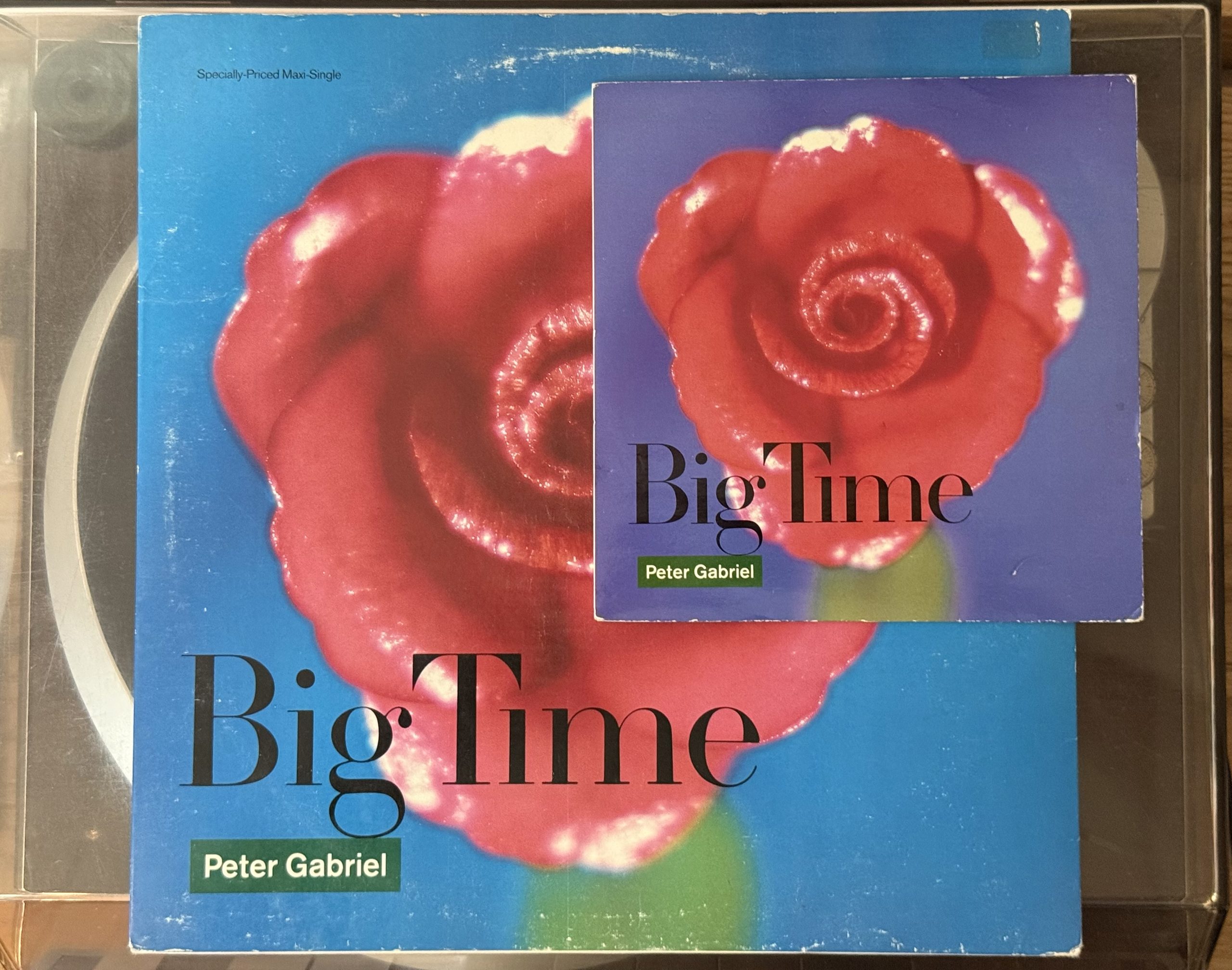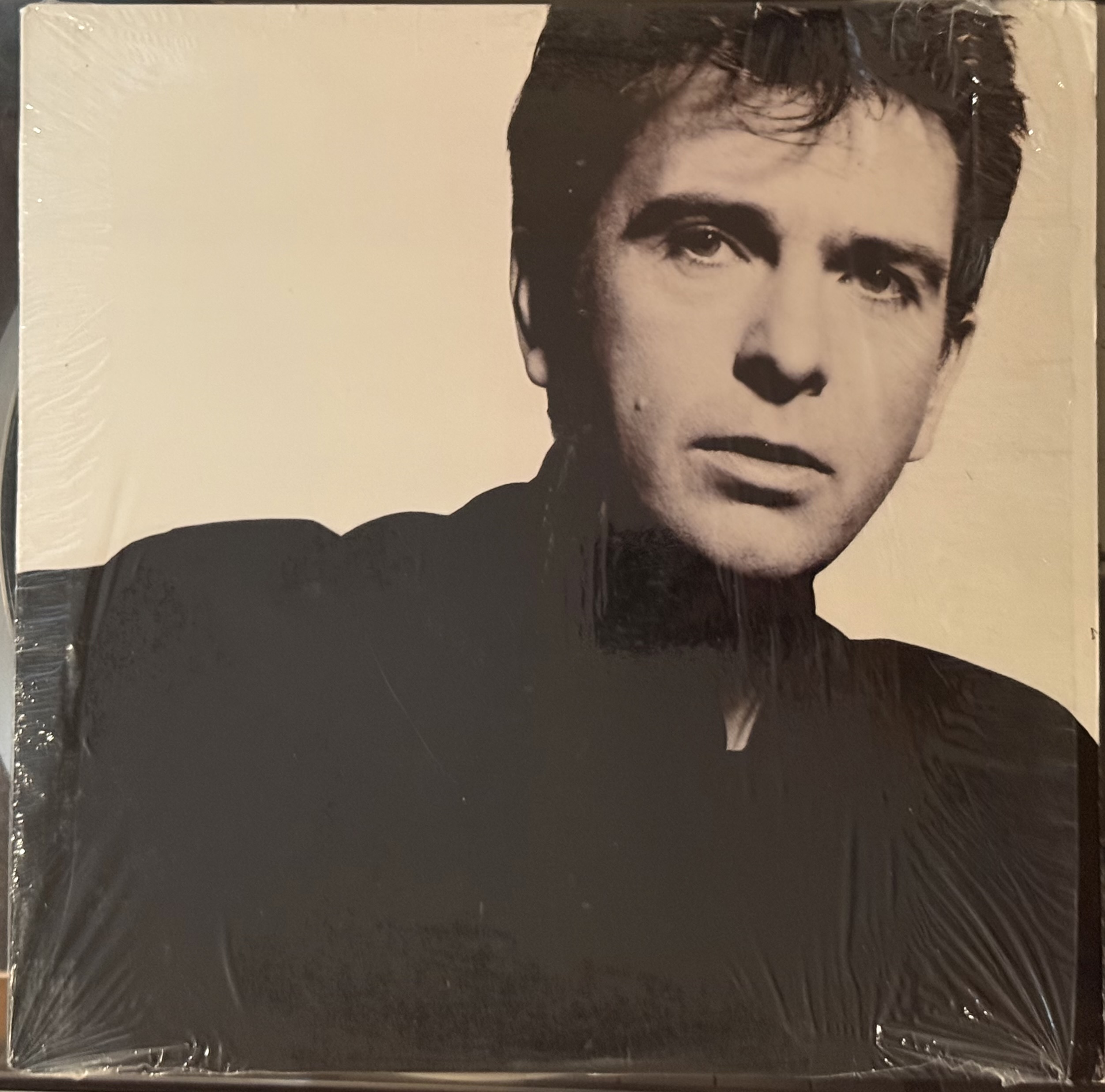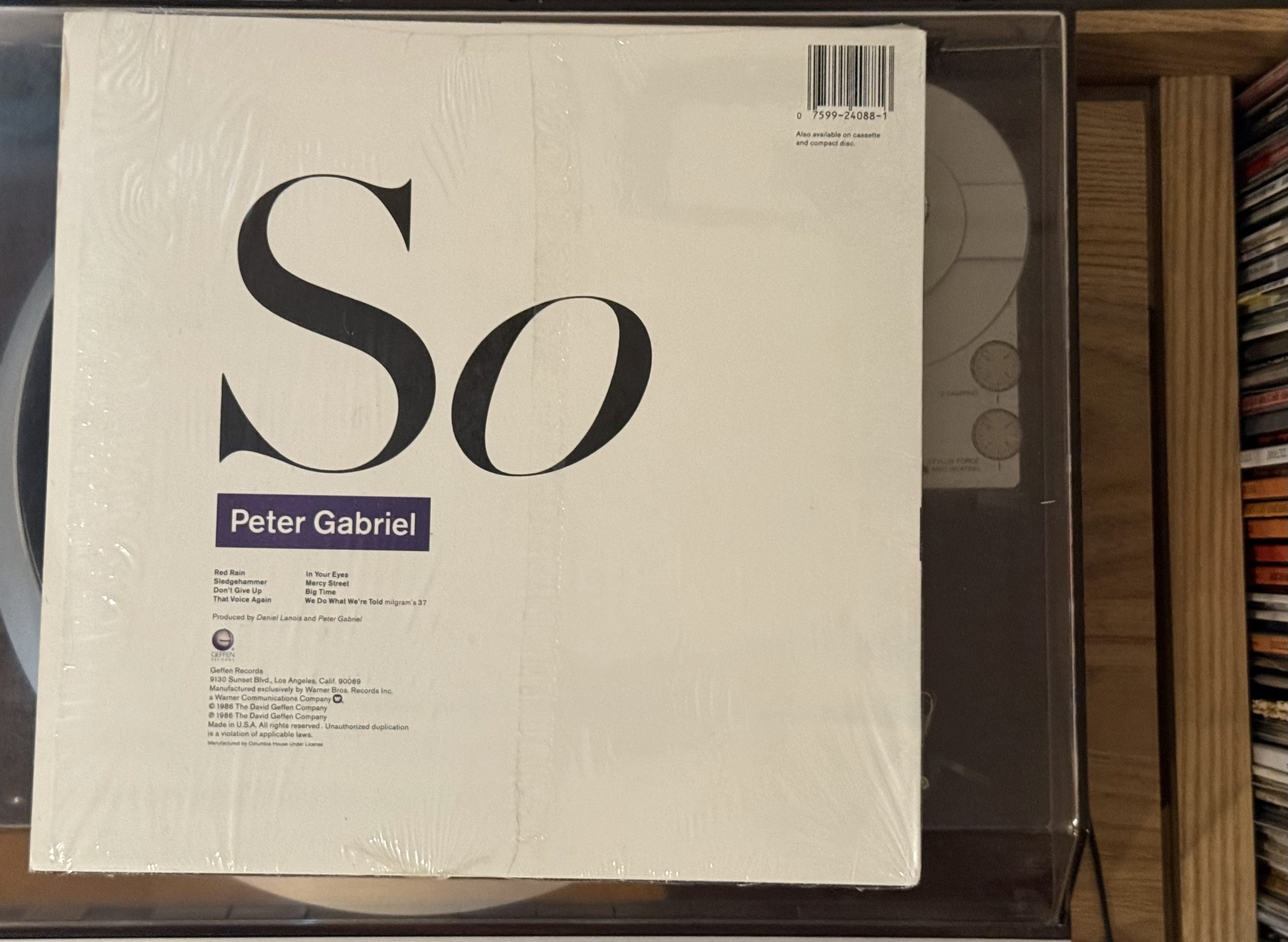
Peter’s singles provide a good excuse to linger in the world of “So” a little longer.
Album of the Week, May 23, 2026
The album cycle for Peter Gabriel’s So went on for quite a while. The first single, “Sledgehammer,” hit the streets on April 14, 1986, about a month before the album was released. There followed “In Your Eyes” in August, “Don’t Give Up” in October, “Big Time” in March 1987 and “Red Rain” in June.1 That’s a lot of releases, and by extension a lot of opportunities for B-sides.
I love B-sides.2 They’re a glimpse of what else was happening when the album was recorded (or, sometimes, some other album, as we’ll see today). Sometimes they illustrate where else a song could go. And sometimes they’re just dance mixes. And the great thing about there being huge markets for pop music in both the US and the UK is that sometimes you got completely different B-sides!
If the above discursion and the picture have led you to think that I’m using these facts to just talk about a bunch of Peter Gabriel rarities, you would be correct. I’m going to pull from three different releases of “Big Time”: the 12″ US single, the 7″ UK release, and the CD maxi-single, which is the one that I first owned back in the day. (Shhh.)
The 12″ opens with “Big Time (dance mix),” which is what it says on the tin. It’s mixed by Tom Lord-Alge, a recording engineer who had previously crossed paths with Peter on “No More Apartheid” on the Sun City compilation, and who had also engineered or mixed for the Force MDs, Jeff Beck, Southside Johnny and the Asbury Jukes, David Johansen, Sly Fox, Steve Winwood’s Back in the High Life, OMD’s “If You Leave,” and Billy Crystal’s “You Look Marvelous.” This cavalcade of 1980s sounds perhaps explains the low-end drum machine and handclaps that get spliced onto the beginning of the track. I do love the way that he pulls out and isolates Tony Levin (and Jerry Marotta)’s bass line at the beginning though, as well as letting us hear the nasty (in a good way) David Rhodes guitar riff without vocals over it. The verses are largely untouched—a little extra echo here, an extra-80s guitar in the texture there—but the chorus gets a spacey reinforcement on the backing vocals that’s almost dublike. This is kicked into high gear after the second verse, where it’s just backing vocals, drum machine, and Peter going “huh!” for about 30 seconds. As dance mixes go it’s relatively harmless but also fairly unimaginative.
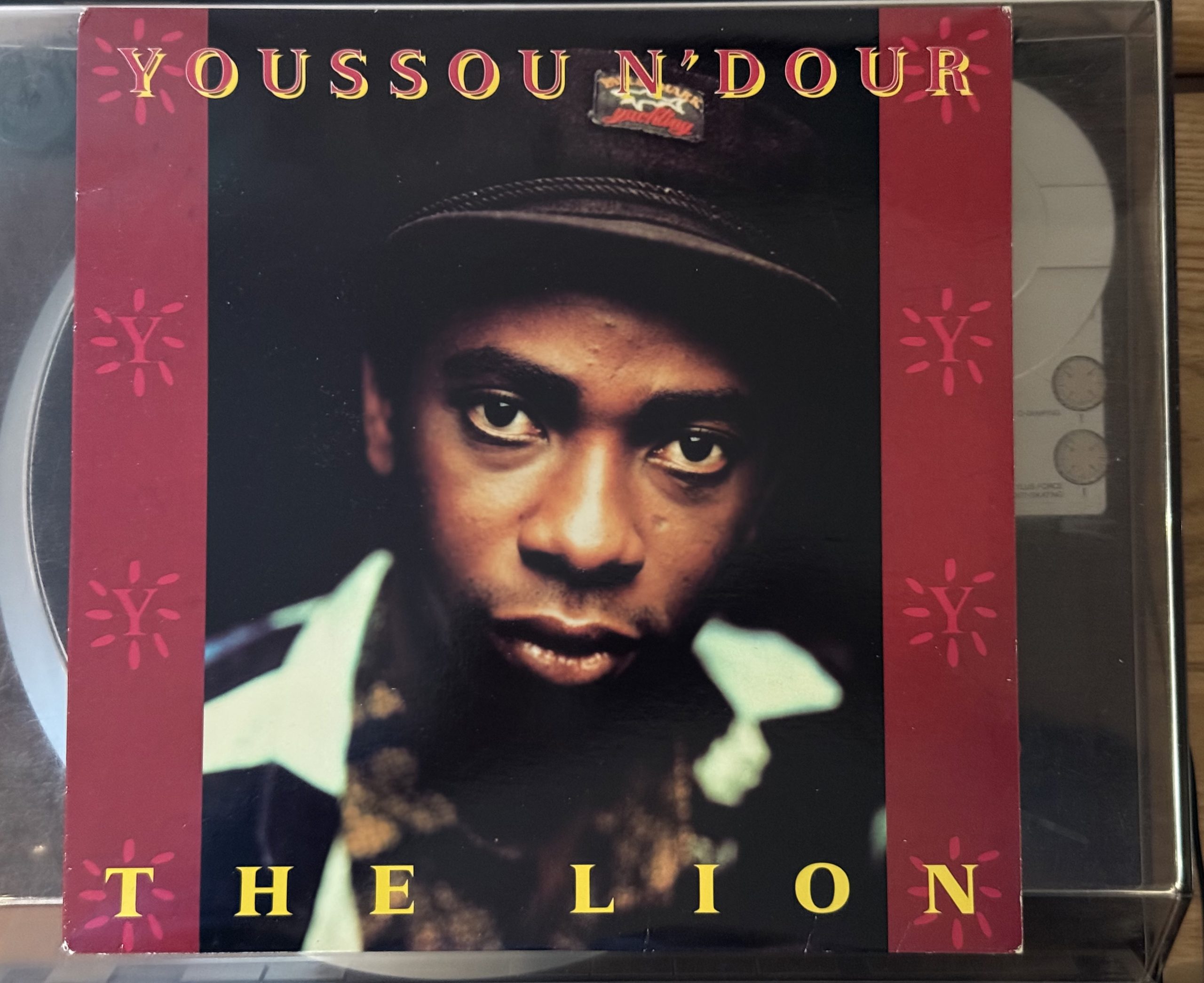
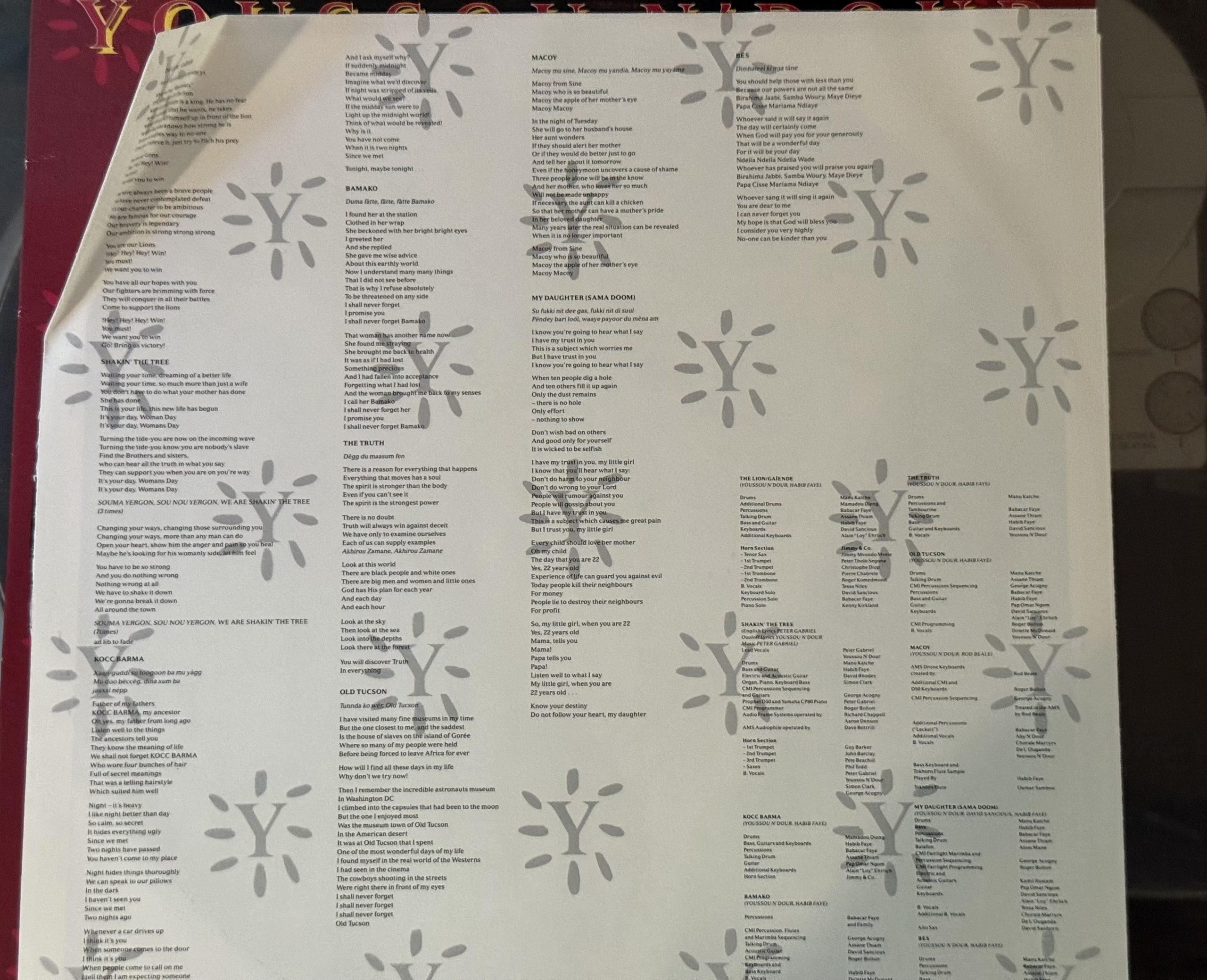
“In Your Eyes (special mix)” is an entirely different story. Produced by Bill Laswell and mixed by Jason Corsaro, the mix shuffles the key bits of the original recording, but also adds an entirely new opening featuring Peter singing over a low synth note, chiming thirds and fourths, and a hi-hat heartbeat: “Accepting all I’ve done and said / I want to stand and stare again / Til there’s nothing left out / All that remains there in your eyes.” The intro is punctuated by a brilliant vocal run by Youssou N’Dour, then the brilliant Ronnie Bright bass vocal. Youssou sings a bit in Wolof: “Sa bet chi lamp, chi tangaay, sa bet maangi ci biir,” meaning “Your eyes are lit, your eyes are bright, it’s in your eyes.” And then, when we think we’re going to get the verse, there’s instead an extended meditation with talking drums and synths, with more incredible Wolof vocals from Youssou and some vocalese from Peter. The chorus finally joins with even more Youssou vocals atop it. There’s an extended reverbful talking drum break, reminding us that Laswell has always been the king of dub. Somehow the complete absence of the verse pulls me into a trance listening to this mix—or maybe that’s just Youssou. This is a masterful mix and still holds up incredibly well, which is why it featured on one of my playlists years later. The twelve-inch single finishes with the album version of “We Do What We’re Told.”
The UK 7″ single, on the other hand, has a single B-side, “Curtains.” The composition here is reminiscent of Peter’s work on Birdy, but with more space around the edges. There’s an extended bit that is just a heartbeat of a talking drum with a tiny whoosh of a cymbal brush, and a panoply of synth textures giving the effect of opening doors, echoing caverns, distant bells, all leading to Peter’s vocals: “Oh, draw the blinds / we can shut out the night.” This is the most erotically direct of his love songs to this point, but even here love is filled with ambiguity and tinged with regret: “And there are lions on our curtains / They lick their wounds / They lick their doubt.” It’s a stunning miniature of a song, and I can only imagine what might have gone through the heads of the casual buyers of the single in 1987 when they flipped it over and listened to it.
“Curtains” also appears on the Big Time CD maxi-single, alongside the album version of “No Self Control.” It’s rounded out by “Across the River,” which was used as a mood-setting opener for the original 1982 WOMAD festival and which was recorded in the studio for the WOMAD benefit Music and Rhythm. It begins as an improvisation by Shankar and Peter, joined by David Rhodes, and then a thundering drum part from Stewart Copeland enters. I’ve always been captivated by the combinations of sounds, particularly the low notes from Shankar’s instrument (not a traditional Western violin), and have long wondered what a full album of collective improvisation from a group like this might have sounded like.
The relatively long period of time between Security and So, combined with Peter’s collaborations in WOMAD and with others, combined to make the experience of following the various offshoots from the album a rich musical journey. We’re going to continue following some of those connections for … well, for a while. Next week we’ll pick back up with one of those collaborators and listen to a unique live album.
BONUS: Peter brought “Across the River” back for his “Secret World Live” tour in the 1990s, with Shankar:
BONUS BONUS: A version of “Curtains” with extended vocals appears in the video game Myst IV, though I’m unsure if these were newly recorded or just an alternate take. Here’s a playthrough video showing the song in context:
Footnotes
Making this the only Peter Gabriel album with a singles-to-non-singles ratio of greater than 2 to 1, regardless of whether you count the LP track listing with eight tracks or the CD with nine. ↩︎
I don’t know if I have to spell this out after four years of writing about vinyl records, but just in case: songs played on the radio used to come on 7″ vinyl records that were played at a faster speed (45RPM rather than 33 1/3). The faster playback speed meant the grooves could be cut deeper for better dynamic range. The records had two sides: the A-side, aka the actual single, and the B-side, which was usually whatever the artist or the label felt like putting on there. ↩︎
The bestselling 1986 album seamlessly melds art and pop and marks Peter’s transition to a top tier star.
Album of the Week, May 16, 2026
It’s a challenge to approach an album like So. Easily Peter Gabriel’s most popular album, arguably one of the most talked about and best albums of the 1980s, and it’s not like it’s obscure. But, like the songs themselves, the album is made of layers upon layers, and that’s where our tale begins.
In fact, let’s begin at the beginning. Following the 1982 release of Security and the subsequent tour, you’d be forgiven for thinking that Peter took some time off, save for the soundtrack to Alan Paton’s film Birdy. In fact, he was recording the whole time. The years 1983–1985 were surprisingly fertile given that there was no official album released. In fact, there’s a rich batch of soundtrack appearances from this period, as well as non-album studio tracks: “Walk Through the Fire” (from Against All Odds),1 the studio version of “I Go Swimming,” “Across the River” (a collaboration with Indian violinist L. Shankar and Stewart Copeland), his song “No More Apartheid” from the 1985 Sun City compilation, and of course “Out Out,” Peter’s contribution to the Gremlins soundtrack.2 Unfortunately, around this time Peter’s long-term UK label, Charisma, was being acquired by Virgin Records. Ultimately the acquisition settled out and Charisma/Virgin continued to release Peter’s albums in the UK while Geffen handled releases in the rest of the world, but in the dust of the acquisition some of the wind went out of the sails of a new album.
But his creative juices were still flowing. So in February of 1985 Peter retreated to the recording studio at Ashcombe House, where he had recorded since 1978, and began laying down tracks. He considered working with a number of producers for the album, including Bill Laswell (whom he had crossed paths with in the making of the Laurie Anderson collaboration “Excellent Birds”) and Nile Rodgers, but ultimately decided to stick with Daniel Lanois, his collaborator from Birdy. It would prove a fruitful choice; not only was Lanois an expert in producing the combination of organic and atmospheric sounds that Peter was striving to produce, but he was also surprisingly adept at forcing the famously digressive Peter to finish work. My favorite anecdote: at one point Lanois resorted to locking Peter inside the studio so that he would finish a vocal. Peter wrote the core tracks of the songs with Lanois and guitarist David Rhodes from sketches that he produced using the Prophet-5 polyphonic synthesizer or his Yamaha piano, along with a Linn drum machine. Using this method, Peter built songs up from melodic ideas with nonsense vocal syllables to fully fledged songs, having the trio improvise with his rough demos in their headphones, bouncing the trio recordings into the headphones to bring in the larger band, and so on.
The larger band was built around familiar collaborators—Tony Levin, Jerry Marotta—and French drummer Manu Katché (who would follow this session with Sting’s …Nothing Like the Sun). A host of others would make appearances on the album, most on one or two tracks: Chris Hughes, fresh off producing Tears for Fears’ Songs from the Big Chair; Copeland; Shankar; trumpeter Wayne Jackson from the Stax Records backing band the Bar-Keys; saxophonist Mark Rivera from Billy Joel’s band; pianist Richard Tee, whom we’ve previously seen playing with Hubert Laws and Ron Carter on CTI Records; and guest vocalists Laurie Anderson, Kate Bush, and Youssou N’Dour. The last was a superstar in his native Senegal, but was yet to break out in the consciousness of the broader world; that was about to change.
“Red Rain” opens the album on a massive note, with an indelible riff on the hi-hat from Stewart Copeland and an echo of a keyboard line, then a massive chord through which Tony Levin’s indelible bass snakes. Peter’s apocalyptic lyrics sing of a dream of a rain that covers all those around, imagery that dates back to some of his earliest writings; in fact, the image is the one of the last remnants of the Mozo mythology that had previously informed “Down the Dolce Vita,” “Here Comes the Flood,” and “On the Air.” But Mozo aside, the song also features some deeply personal writing. His marriage to Jill Moore was falling apart—strained by his touring, she was unfaithful, and the resulting divorce sent Peter into a deep depression and to six years of therapy. It’s hard not to read lines like “I come to you, defenses down / with the trust of a child” and “Red rain is coming down all over me / I’m begging you” knowing this context without thinking of metaphors for accusations and retribution.
From the sublime to … “Sledgehammer,” easily Gabriel’s most-remembered song, thanks in no small measure to its innovative Claymation video and unsubtle but good-natured phallic imagery, as well as to the horn section, a first for a Gabriel album. Peter has explicitly called out the song as an homage to Stax-Volt soul singles, an early source of musical inspiration for him, to the point that he asked Wayne Jackson, who as a member of the Mar-Keys played behind Peter’s hero Otis Redding, to assemble the horns for the track, which included Rivera and trombonist Don Mikkelsen, who had played with Ann-Margret and in Louie Bellson’s band. There’s what sounds like a Hammond B-3 organ on the track, which is actually played on Peter’s Prophet-5 synthesizer, and a weird synthetic flute sound, which Peter plays on the E-mu Emulator II, a sampling synthesizer beloved by acts as diverse as Stevie Wonder, Belgian electronic band Front 242, Depeche Mode, and the Pet Shop Boys. The track is tremendous fun, thanks in no small part to its bouncy rhythm section courtesy Levin and Katché, who was literally getting on a bus to the airport when Peter encouraged him to stick around and help re-record the track from its original foundation, which had featured drummer Chester Thompson.
“Don’t Give Up” is another complete stylistic pivot, a hard-luck song constructed in response to Dorothea Lange photographs of starving farmers from the American Depression. It was built around a rhythmic part that Peter transferred from tuned drums to a Tony Levin bassline; Tony achieved a more muted sound by the expedient of placing a diaper that he had packed in his gig bag for his two-month-old child beneath the strings. The track is moving enough, but when the chorus comes and Kate Bush sings “Don’t give up, you still have … friends,” it enters spine-tingling territory. The song changes lives; both Elton John and the late Matthew Perry at different times credited the bridge’s lyric “Rest your head, you worry too much / It’s gonna be all right / When times get rough, you can fall back on us” with encouraging them in sobriety. And Richard Tee’s gospel piano on the second bridge similarly elevates the song to a different place. It was always conceived as a man-woman duet, though originally Peter had Dolly Parton in mind; now it’s hard to imagine the song without Kate’s contributions. This is particularly true with the video, which features Peter and Kate embracing each other and singing the song for the entire video as the sun rises and falls in the background. Though Peter asked Jill’s permission before embarking on the shoot, the video ultimately did not help their marriage.
“That Voice Again” has its origins in Peter’s efforts to write the soundtrack for Martin Scorcese’s The Last Temptation of Christ, believe it or not. Originally the lyrics were written about judgment and Christ’s commandment “Let him who is without sin cast the first stone,” but over several rewrites it became about the inner judgmental voice that “either helps or defeats us.” It is also the very last Mozo song, with the judgmental voice somehow fitting into Peter’s alchemical narrative. Twelve-string guitar from Lanois (the first time that instrument appeared on a Gabriel album since “Solsbury Hill”) and an elaborate drum part from Katché fill out the arrangement.
“In Your Eyes” is a pure love ballad, a form that Peter rarely essayed prior to So. It has several key features in the arrangement: Richard Tee’s piano, a soaring pre-chorus (that “I reach out from the inside” segueing into the wordless vocal bridge always hits me right in the feels), and Youssou N’Dour. That a previously-unknown-to-Westerners Senegalese vocalist would be the secret weapon of this track would seem unusual, especially given the Who’s Who of backup singers also appearing on the track—which included Simple Minds’ Jim Kerr, The Call’s Michael Been, and doo-wop singer Ronnie Bright, who performed the bass vocals on the classic song “Mr. Bass Man.” But that’s only if you don’t reckon with Youssou’s voice; a soaring, resonant instrument with bright edges that spans multiple octaves with heldentenor intensity and is comfortable in Wolof, French and English. More than any other track on the album, the arrangement for “In Your Eyes” is fluid, and live versions and remixes play with the running order of the song; we’ll hear an example of that another time. As a listener who fell in love with the album in 1986, the song sits at Number 5 in the running order for me, but Peter originally intended it to end the album; the limitations of the vinyl format, which made reproducing the low bass tones in the inner grooves a challenge, switched it to start Side Two.
“Mercy Street” is another of the songs on the albums about which I have difficulty being objective. The song introduced me to the writings of Anne Sexton, whose poetry (particularly 45 Mercy Street and The Awful Rowing Toward God) inspired the song. The song is built around a track by Brazilian percussionist Djalma Corrêa, who provided surdo, congas and triangle in a traditional Brazilian forró rhythm. (A different set of track by Corrêa provided the basis for “Don’t Break This Rhythm”, which became the b-side to “Sledgehammer.”) The arrangement, though uncluttered on the album, was painstakingly constructed, with piano parts from Richard Tee added and then removed, a Fairlight CMI-based melody played by Peter by hand instead of sequenced for a more human feeling, and double-tracked vocals, with the lower octave achieved by having Peter stay up all night at the studio and doing a single take at 7am when he was at his most fatigued. All this is in support of a jewel of a song, with bits of Sexton’s poetry turned into a stream-of-consciousness lyric full of confessional details, anchored around the desperate search for home: “Dreaming of Mercy Street / Wear your inside out / Looking for mercy / In your daddy’s arms again.” The final coda lends finality to the searching and despair in the song as Peter turns to images from Sexton’s posthumous book: “Anne with her father is out in the boat / Riding the water, riding the waves / On the sea.” A slightly extended version of the track was used for the official video.
“Big Time” is the other “overtly commercial” track on the album. The horn section from “Sledgehammer” returns over a rhythm track that was notoriously difficult to record; Tony Levin’s bass part was achieved by having Tony finger the notes on the fretboard while Jerry Marotta hit the strings with his drumsticks to achieve a percussion effect, while Stewart Copeland’s ingenious hits and fills didn’t exactly line up with the drum machine, so engineer Kevin Killen sampled his track and created the percussion from the samples. Former Ikette P. P. Arnold led the backing singers, and Peter’s Prophet-5 faux-Hammond organ returned. Where the phallic imagery in “Sledgehammer” is playful, here it’s sardonic, as Peter dismantles the consumerist mentality of the 1980s and ties it to the drive to overcompensate, a point brought home by the closing lyric: “Look at my circumstance / And the bulge in my big, big, big, big, big, big, big, big, big, big, big, big, big, big, big.”
The transition into “We Do What We’re Told (Milgram’s 37)” is abrupt and icy. The song, reminiscent of “Lead a Normal Life,” is mostly constructed around Peter’s synthesizers, with David Rhodes’ guitar and L. Shankar’s violin contributing to the texture over a beat from Jerry Marotta; many of the sounds, including Peter’s vocals, were processed through the Fairlight for extra texture. Peter wrote the lyrics as an attempt to process the results of Stanley Milgram’s experiments in authoritarian behavior, in which 37 of 40 participants continued to administer higher and higher levels of electric shocks to unseen subjects when encouraged to do so by their peers. The repeated “We do what we’re told” lyric repeats like a mantra, expressing the impulse to conformity that drove the awful behavior of the participants. Some listeners found this song the only part of So to their tastes; however one felt, it’s undeniably a direct link to the themes and preoccupations of 1980’s Peter Gabriel 3 (Melt), and in fact the song originated in those sessions.
“This is the Picture (Excellent Birds),” which appears on modern LP versions of the album but not the original, is a re-think of Peter’s 1984 collaboration with Laurie Anderson from Mister Heartbreak, with the groove (including an added talking drum from Manu Katché) brought to the fore and some elements (like Laurie’s idiosyncratic synth line) removed. My poor mother could never get Peter’s word choice in the song; hearing it in my childhood home as I was listening, she asked me not to listen to it again as the line about “bitches of evil” made her uncomfortable. (This was, of course, a mondegreen for “I see pictures of people.”)
It’s hard to overstate how huge So was. Quintuple platinum album sales, Number One on the UK album chart and Number Two on the US, a number one Billboard Top 200 spot (“Sledgehammer”) and nine MTV Video Music Awards (also “Sledgehammer”), number one on Billboard’s Album Rock chart (“In Your Eyes”), top 10 singles in the UK (“Don’t Give Up”) and US (“Big Time”), and number 3 on the Mainstream Rock chart (“Red Rain”). It launched Youssou N’Dour to worldwide fame, further raised the profile of Kate Bush, and most of all completed the transformation of Peter Gabriel from a niche artist for fans of progressive and experimental rock, to a pop artist with serious artistic and experimental bona fides. Because of the album’s long gestation and long singles cycle, many interesting tracks were released alongside as b-sides; we’ll linger in this album’s shadow a bit next week to listen to some of those.
You can listen to this week’s album here, in the original 1986 track order but including “This is the Picture (Excellent Birds)” in its spot on the original CD running order. This is controversial. Ever since 2002, Peter has preferred a revised running order that puts “In Your Eyes” last on side two.
BONUS: Peter’s So sessions sprawled across many months and there were a few songs that were recorded that never made it to the album, or even as a b-side. When the 25th anniversary of the album was released as a box set in 2011, Peter polished up a few of these songs. “Courage” is pretty great! It was released as a 12″ 45 single in the box set, with “Sagrada” and an alternative mix of “Don’t Give Up” as b-sides.
BONUS BONUS: There are a lot of live performances of these songs; they essentially form the core of Peter’s touring repertoire for the rest of his career. But the ones featuring the original performers, such as this 1987 live version of “Don’t Give Up” with Kate Bush, are special. Even if it is an audio-only cleaned-up bootleg:
BONUS BONUS BONUS: “In Your Eyes” was made newly famous through its use in the John Cusack/Ione Skye movie Say Anything, in a scene that is engraved in the hearts of otherwise-cynical GenX kids everywhere:
BONUS X4: The version of “Mercy Street” that was performed in Peter’s 1987 concert in Athens, Greece has always pierced me to the heart, with Peter singing from curled and crouched positions to echo the anguish of the lyrics:
Footnotes
I know that I probably just put the Phil Collins title song from that movie into your head. You’re welcome. ↩︎
We’ll talk about some of Peter’s other soundtrack work another time. ↩︎
Sting’s double-LP 1987 release is his last to feature a heavy jazz influence, and he goes out in strong form, with Branford Marsalis, Kenny Kirkland, Manu Katché, Mino Cinelu, and a guest appearance from Gil Evans.
Album of the Week, April 26, 2025
So it is that we come to Sting’s second solo album, and I have to warn you that I’m not sure I can be objective about this one. I was fourteen, almost fifteen when …Nothing Like the Sun, complete with its elliptical title, was released, and it pretty much consumed me. My parents gave me a copy on cassette; I joined a CD club, in part, to get a copy on CD. The tour was my first rock concert, at William and Mary Hall. For goodness’ sake, it was “Sister Moon” that got me attention from girls when I sang at a talent show at the Governor’s School for the Sciences in the summer of 1989.
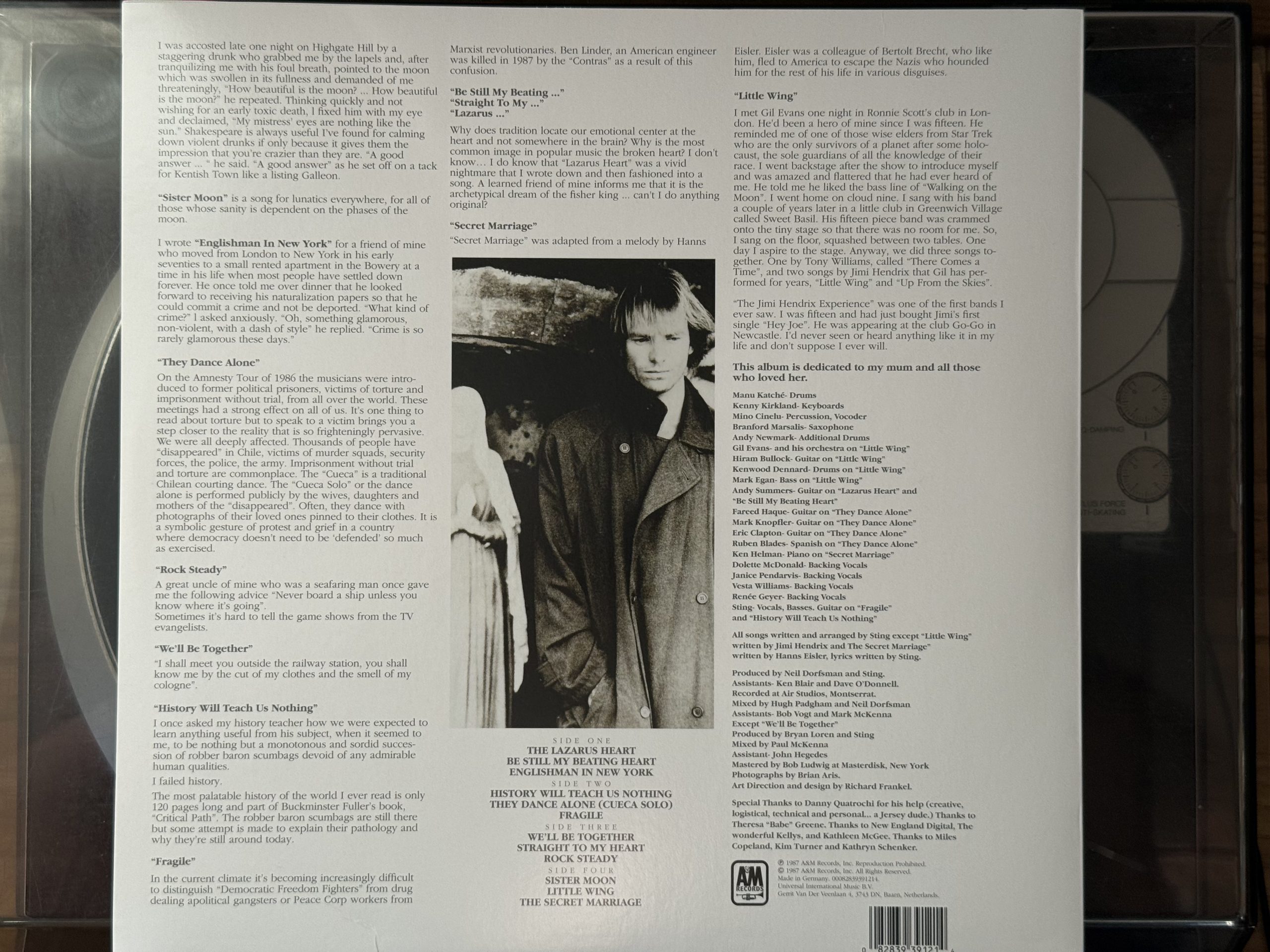
So let’s dive right in. “The Lazarus Heart” opens the album at full tilt and with seemingly every musician (as noted last week, both Omar Hakim and Darryl Jones did not return from Sting’s first solo album) making themselves known in the first couple of bars. There’s an arpeggiated guitar riff from none other than Andy Summers, over layers of more guitar and keyboards, percussion from Mino Cinelu and a bass pattern that seeks up to the supertonic. After four measures, Manu Katché’s snare and cymbals announce the start of the song. Branford and Kenny Kirkland play the opening hook together on soprano saxophone and a keyboard that sounds an awful lot like a flute. Sting’s vocals are syncopated and push and pull against the tempo as he tells the story of a dream of his mother and a wound in his heart. Even had Sting not dedicated the album to his mother’s memory, you would be able to tell that she loomed large in his subconscious still, seven years after he hurt both his parents with his words in a Rolling Stone interview. The arrangement itself feels dreamlike, with Andy Summers’ guitar and Kenny Kirkland’s keyboards echoing and washing around the corners of the song. There’s a brilliant moment at the bridge where Branford takes the tune out of the syncopated beat it’s been in since the start and pulls it into straight measure for about eight beats, and another in the last chorus where everyone but Mino Cinelu’s percussion drops out, revealing the richness of the arrangement by its absence.
Andy Summers sticks around for “Be Still My Beating Heart” (Sting asks in the liner notes, “Why does tradition locate our emotional center at the heart and not somewhere in the brain?”). This is a gentler song, but not a ballad, driven by a bass figure (doubled in the keyboards) that runs up from the dominant to the tonic, and washes of Andy Summers guitar that blend into saxophone obbligatos, all driven by the pulse of the percussionists. There’s subtle vocal harmony on the chorus and almost subliminal piano parts happening under the pre-chorus; the latter becomes apparent when the vocals drop out in the second chorus. The whole thing is the closest Sting ever got to writing a Sade song.
“Englishman In New York” stands as another in a long line of early Sting songs that are driven on the back of a busy synthesizer part, in this case a pizzicato string part that makes up the majority of the arrangement for the first verse of the song (turning into synth strings for the bridge). Thankfully there’s also a fantastic Branford Marsalis through-line on the soprano sax, as well as some top-notch contributions by Manu Katché (the hi-hat! the snare work on the first verse!) and Mino Cinelu (a fine use of the cuícathroughout the chorus). Branford gets a properly swinging solo verse after the bridge, with fine support from Kenny Kirkland. The whole thing was written as an homage to Quentin Crisp, as Sting reports in the liner notes.; there was a movie made of the gay icon’s last years in New York titled after the song, starring John Hurt.
“History Will Teach Us Nothing” is the one reggae-inflected song on the album, Sting having mostly moved well beyond the days of Reggatta de Blanc by now. The groove, with guitar, bass, drums and percussion, is tight, but unfortunately the trick of doubling the sax with the keyboards seems to water down both here. Sting is in verbose mode, working on the theme of “Spirits in the Material World” and “Love is the Seventh Way,” calling for us to stop repeating history’s mistakes in the most provocative way possible—telling us to stop listening to it. Alas, we now know what happens when you ignore signs that history is repeating itself… I would say, though, that the outro chorus (“Know your human rights/be what you come here for”) is now perhaps more relevant than ever.
This takes us into the most topical song on the album, which I spent years thinking was on the wrong side of topicality until this year. Sting has talked about his writing process for the album following the death of his mother, as he retreated to an apartment in New York in a monastic existence; when he debuted this song and others to friends, they were powerfully moved but he didn’t feel it, having been locked inside his head for too long. “They Dance Alone (Cueca Solo)” is potentially a moving song, and certainly made more powerful by Sting’s focus on the “mothers of the disappeared,” who danced by themselves in anguished protest against the abductions and murders of their loved ones by the regime of Chilean dictator Augusto Pinochet. After years of performing in Amnesty benefits, he had fully inhabited the grief as well as the outrage of this cause. It’s unfortunate that this performance is the most adult contemporary of all the songs on the album; stretching to over seven minutes long, the song doesn’t even get Branford Marsalis until the last verse, and it wastes guest guitarists Eric Clapton, Fareed Haque, and Mark Knopfler, who seem to disappear into the texture of the song. I would totally write this one off, but for two things: the brilliant outro, when Kenny Kirkland finally can kick things into high gear by going into double time and Branford is let off the leash; and the fact that we now have more than enough opportunities to dance alone, without having to go to Chile.
“Fragile” ends this topical segment of the album with one of Sting’s finest ballads, written in memory of Ben Linder, an American civil engineer killed by the Nicaraguan contras in 1987 while he was working on a hydroelectric project. It succeeds where “They Dance Alone” fails by virtue of its brevity and restraint, with the majority of the song carried by the gentle percussion of Cinelu and Katché and by Sting’s remarkable Spanish-style guitar work. “Fragile” has been the touchstone to which Sting has returned in his career at times of national grief; it took on extra resonance as the lead-off song of All This Time, an acoustic set from his Tuscan villa that was recorded on September 11, 2001 as the musicians became aware of the facts of the attacks.
I wrote about “We’ll Be Together” last week at least in part so I wouldn’t have to this week. (There are a lot of songs on this album!) So let’s skip ahead. “Straight To My Heart” is another straight-up love song, and another one built on a programmed keyboard riff, but again it’s substantially improved by the percussion; here Katché and Cinelu play polyrhythms throughout, and the cuica makes another appearance. There’s another of those whistly synth lines throughout the chorus, but it works better here, and the whole thing has the feeling of a sonnet in 7/4. It’s a great band-kid song by virtue of the unusual meter; when I saw Sting live for the third time in Richmond in 1993 with my sister and her friends Jeremy and Christina, we made his band double-take as we bobbed our heads in perfect 7/4 time to this song.
“Rock Steady” is that rarity, a Sting song with a sense of humor. Despite the name, this is more a blues than a reggae number. As Sting retells the story of Noah’s Ark in a modern setting, we get imitations of the cries of the animals, whether by the sampler or by members of the band I’ve never quite been clear. Sting tells the story of two young lovers who get dragooned into helping Noah with the animals during the flood; once they’ve finally found dry land at the end and are leaving the boat, one of the backing vocalists (I’ve always imagined it’s Janice Pendarvis) teasingly asks, “Got any more bright ideas?” We don’t get too many laugh-out-loud moments in Sting’s oeuvre, so I take this one while I can.
“Sister Moon” is a saxophone feature and a dark ballad, in some ways reminiscent of “Moon Over Bourbon Street.” But where that song’s arrangement builds from acoustic bass to keyboard and saxophone, here the track builds on washes of synthesizer sound, with only Branford’s playing to break it up. Thankfully he gives a bravura performance. I somehow found a saxophone player at the Governor’s School for the Sciences at Virginia Tech in July of 1989 and he learned the part by ear. We performed it twice, and by the time we were done I had decided I wanted to sing for the rest of my life.
Ironically, “Little Wing” is the other song I’ve performed from this album, about 21 years and change ago. The arrangement on this album is pretty special, marking Sting’s first collaboration with the great Gil Evans, whom we last saw working with Miles Davis in Carnegie Hall, and whom I mentioned had cut a killer version of “Murder by Numbers” with Sting in the late 1980s. This is where that collaboration started, though apparently Sting had met him years previously at Ronnie Scott’s Jazz Club in London. The arrangement is an endorphin overload, with Evans’ orchestra and keyboards supporting Sting’s vocals as he sings the hell out of the Jimi Hendrix standard. Mostly what you hear, though, is Hiram Bullock’s guitar, which gets a great solo that transitions into a cool take from Branford before Sting recaps the verse once more at the end. (Bullock, who died in 2008, had played on a variety of rock and fusion recordings, including playing on Steely Dan’s “My Rival” from Gaucho and Paul Simon’s “That’s Why God Made the Movies” from One Trick Pony.)
On this album, “Little Wing” serves as the center of a three-song set about love, moving from the inchoate mooning of “Sister Moon” into a declaration of love that seems to combine muscular feats of strength with moments of heavenward striving. The last song on the album moves into something considerably more intimate. “The Secret Marriage” was written to a tune by blacklisted German composer Hanns Eisler, who partnered with Bertolt Brecht in both Weimar Germany and in the United States and who composed scores for some 40 films, before being run out of American on a rail by the House Committee on Un-American Activities. Sting performed one of the duo’s songs, “An Den Kleinen Radio-Apparat,” in 1987 and adapted the song’s melody for “The Secret Marriage.” It’s an intensely private statement of love, and is a striking note on which to end …Nothing Like the Sun, as if declaring an end to the rule of the King of Pain.
The album cycle for …Nothing Like the Sun, from its release through the tour and the eventual follow-up, lasted for almost four years. During that time a great many things changed, including the almost complete cessation of new music releases on vinyl in the United States. You can find a copy of the follow-up, The Soul Cages, on LP but you have to really look hard, and the subsequent albums weren’t released in vinyl form in the US, or at all. (There’s still no US release of Ten Summoner’s Tales on vinyl, to my surprise.) Sting also played less jazz following the completion of this song cycle; though Kenny Kirkland played on The Soul Cages and Branford guested on a few songs, for the most part Sting has stayed straight on in the pop lane ever since. But Branford’s career as a bandleader was just taking off; we’ll hear one of his quartet’s albums next time.
You can listen to this week’s album here:
BONUS: There were some really interesting b-sides from this album. Last week we heard “Conversation with a Dog,” but there was also the jazz piece “Ghost in the Strand,” a pop song that maybe should have made the album (“If You There”), Sting’s well-done cover of Gershwin’s “Someone to Watch Over Me,” and an adventurous collaboration with Gil Evans on Jimi Hendrix’s “Up From the Skies.” (I wrote about getting “Someone to Watch Over Me” and “Up From the Skies” off a 3-inch CD single, with some difficulty and an adapter, some time ago.) The last spawned a full concert collaboration between Sting and the septuagenarian arranger/bandleader at the Umbria Jazz Festival in Perugia, Italy in 1987; you can watch that widely bootlegged performance below:
BONUS BONUS: There’s a popular but as far as I can tell apocryphal story that the song “The Lazarus Heart” was written for the movie Who Framed Roger Rabbit?, to be played over a scene that would have come from the original novel in which Roger is killed at the end of the movie. Sad to say, there is no footage combining the two.
Sting got up to a lot between his first and second album, including reuniting with the Police, saving the world, and … making beer commercials? The #albumoftheweek checks out the road to “We’ll Be Together.”
Album of the Week, April 19, 2025
I’m going to talk about the lead off single from Sting’s second solo studio album in this post, but it’s going to take me a while to get to it, because Sting took almost two and a half years to make the song. And what he was doing in the meantime kept him very busy.
The last we heard from Sting, he had followed his debut solo album with a documentary and live album, covering the formation of the jazz-rock combo that accompanied him through both those projects (and the birth of his son Jake). Those projects took up a good portion of 1985, though the Bring on the Nightlive album would not see release until the summer of 1986. So what was he doing in the meantime? Well, first of all he had to save the world. He appeared in a series of six concerts for Amnesty International known as the Conspiracy of Hope tour alongside Peter Gabriel, U2, Lou Reed, Joan Baez, Bryan Adams and the Neville Brothers. A number of Very Significant Things happened in these concerts. First, it solidified Sting’s association with Amnesty and his commitment to the cause of prisoners of conscience.
Second, the concerts served as a venue for an unexpected reunion of the Police, who hadn’t played together since their Synchronicity tour ended in March 1984 in Australia. The band wrapped up the Conspiracy of Hope tour by reuniting during the last three concerts; on June 15, 1986, they played a set at Giants Stadium in New Jersey in which they closed their set with “Invisible Sun.” U2’s earnest lead vocalist Bono joined that performance, and at the end, the Police members handed their instruments to the members of U2 as they joined the all-star finale version of “I Shall Be Released.” Bono, naturally regarded it as “a very big moment, like passing a torch.”
Sting and the band weren’t quite prepared to pass the torch, though, and they made arrangements to reconvene in the studio in July to start working on songs for a new album. Fate might have looked very differently if that project had gone ahead as planned, but the night before the recordings Stewart Copeland fell from a horse and broke his collarbone. Without the ability to effectively play together in the studio, the band did not gel as a writing and performing unit and they left after only recording two songs, both re-recordings of hits from Zenyatta Mondatta. “Don’t Stand So Close To Me ’86” would feature on their Every Breath You Take: The Singles compilation (and be played endlessly by me), but “De Do Do Do, De Da Da Da ’86” wouldn’t be officially released until 2000.
So much for the Police, alas. So what happened to Sting next? Well, the next thing he released was also associated with Amnesty; the “Conspiracy of Hope” tour begat a compilation record, also called Conspiracy of Hope (at least in the UK; the US version received the less euphonious name Rock for Amnesty). Other participants shared previously recorded album tracks (inevitably and appropriately, Peter Gabriel’s “Biko” from his third self-titled album leads the first side) or studio rarities like the re-recorded version of Tears for Fears’ “I Believe.”
Sting chose to go into the studio to record something specifically for the compilation. That he chose to cover Billie Holiday’s “Strange Fruit” seems a little incomprehensible now, but in the context of Amnesty’s work for justice, a pointed callout to America’s own history of racial injustice can be perhaps forgiven. The performance itself is brief but memorable; Sting’s vocals are in fine fettle and he is accompanied mostly by his own upright bass, with some subtle cymbals and keyboards.
After that, in late 1986, Sting’s mother died. They had not been especially close; in fact, Sting was at this point all but estranged from his family, having made some impolitic remarks in 1980 to a Rolling Stone interviewer: “I come from a family of losers – I’m the eldest of four – and I’ve rejected my family as something I don’t want to be like. My father delivered milk for a living and my mother was a hairdresser. Those are respectable occupations, but my family failed as a family, I grew up with a pretty piss-poor family life. I lived in Newcastle, which would be like living in Pittsburgh, and the whole thing for me was escape.” Though he was penitent in a 1983 interview, the family did not appear to have reconciled before his mother’s death. Years later, he confessed that he threw himself directly into work as a way to cope.
And the work that he found, at least for the time being, was a beer commercial. If you ever thought that “We’ll Be Together” sounded a little slick compared to the rest of Sting’s second album from which it was drawn, that might be because it was literally composed on spec: the Japanese brewing conglomerate Kirin Brewing Company asked him for a song for a commercial, to include the word “together” in the lyrics. Sting apparently wrote the song in a few minutes, the producers liked it, and he went and recorded it with Eric Clapton on guitar. A tidy payday.
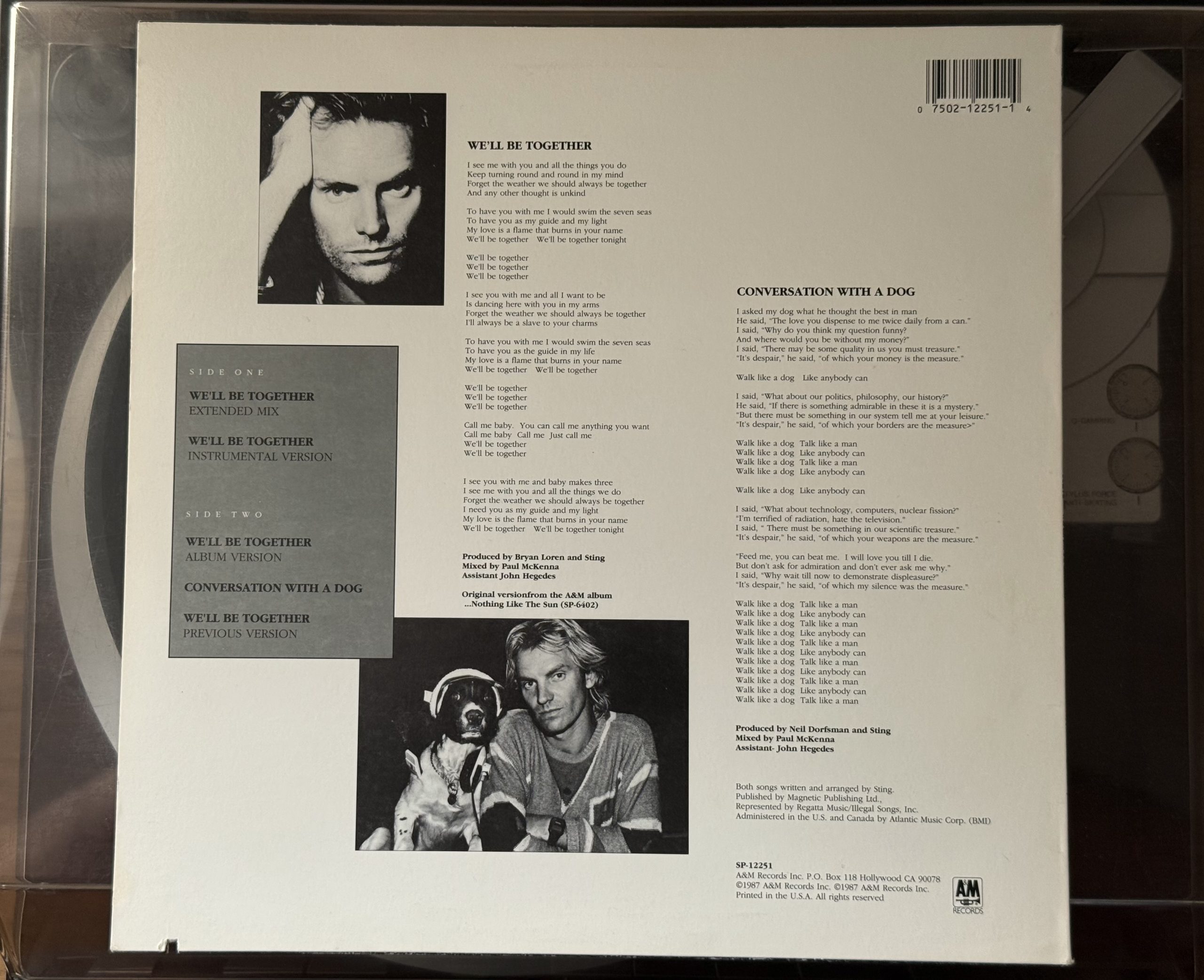
Apparently Sting felt some remorse or at least dissatisfaction with the track, because he re-recorded it for its single release and album incarnation, this time with session guitarist Bryan Loren (best known for authoring and performing the song “Do the Bartman” from the album The Simpsons Sing the Blues, with an uncredited Michael Jackson on backing vocals. You can’t make this stuff up). But you can hear the original version with Clapton on the expanded edition of his second album, or on the b-side of the 12″ single. The 12″ also features the original album version, an extended mix that elongates the intro and adds a few extra bars, and an instrumental version.
All the non-Clapton versions feature the same band: Sting on bass and vocals, Kenny Kirkland on keys, Branford Marsalis on saxophone, Dolette McDonald and Janice Pendarvis on backing vocals, and some new faces—French drummer Manu Katché, who had played with Peter Gabriel on So, percussionist Mino Cinelu who had played with Miles and Weather Report, and backing vocalists Renée Geyer and Vesta Williams (who scored six top-10 Billboard R&B hits in the 1980s and 1990s in her own right). Missing from the mix: Omar Hakim, who was busy with other commitments, and Darryl Jones, who had presciently observed in an interview segment in Bring On the Night that “I’m not so totally sure yet that this is a band, in that everyone has… a totally equal say in what happens.” He would not record again with Sting, though he went on to a long career as the bassist in The Rolling Stones.
The other song on the single is a true curiosity in Sting’s work. “Conversation with a Dog” features a tight bass groove, some robotic sequencing and funky keyboards, and some of Sting’s most philosophical lyrics, cast as a Socratic dialog with his dog: “What about our politics, philosophy, our history?/ ‘If something’s admirable in these, it is a mystery.’” It’s a great showcase for Kenny Kirkland, if nothing else, and for Sting’s moderately believable impression of a barking dog. And I must confess I continue to have in the back of my mind the couplet “There must be something in our scientific treasure/ ‘Despair,’ he said, ‘of which your weapons are the measure.’” “Conversation with a Dog” hinted that Sting had deeper preoccupations on his mind than beer commercials, and we’ll check more of those out next time.
You can see the original music video for “We’ll Be Together,” set to the extended mix of the song, here:
Sadly, there was no video for “Conversation with a Dog.” But! It turns out there were several Kirin beer commercials as part of the epic advertising campaign, all featuring Sting looking smoldering. You’re welcome.
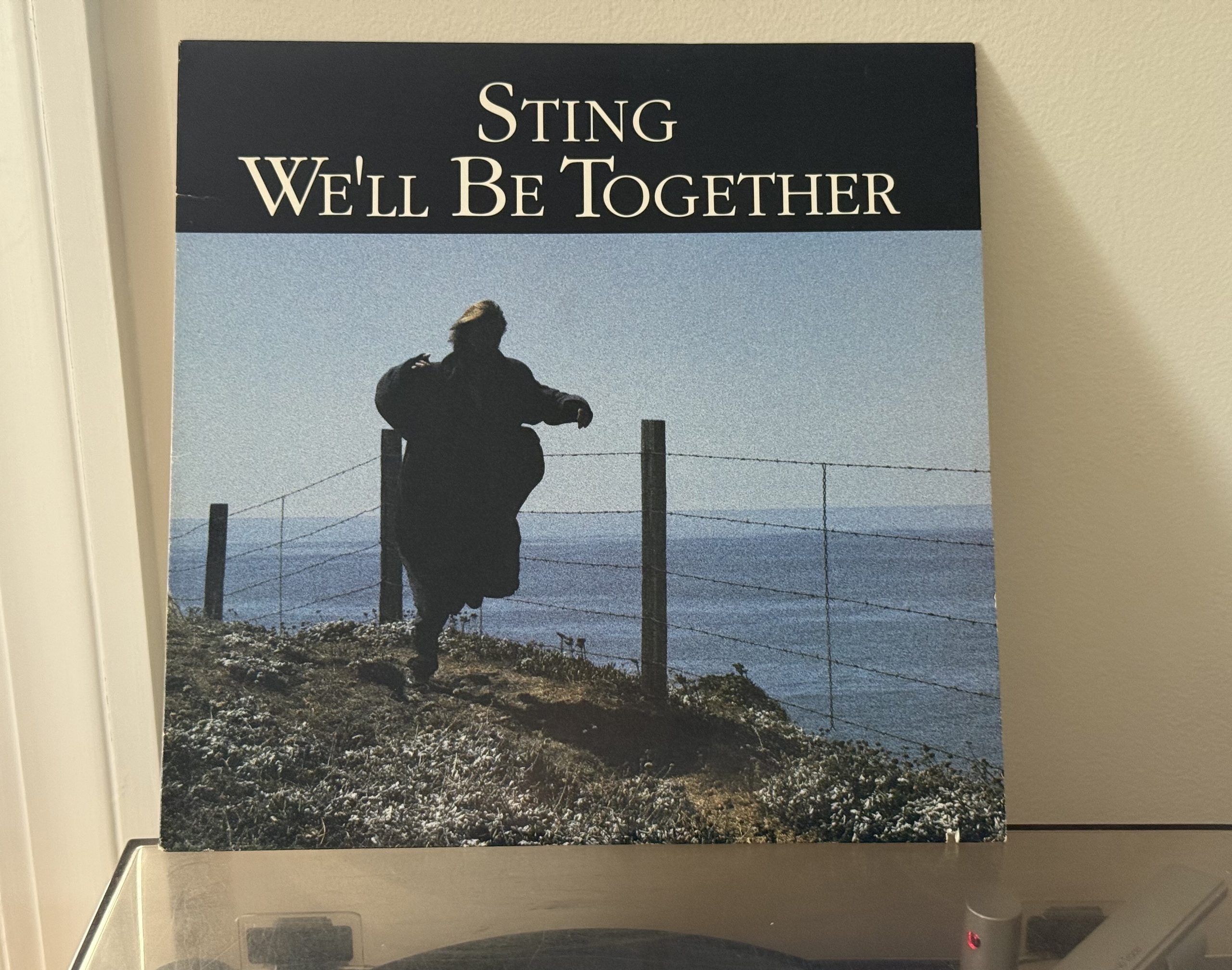
PS: I have yet to forgive the graphic designer of this record sleeve for not knowing the difference between a straight quotation mark and a proper apostrophe. I haven’t been able to prove it, but I’ve long suspected that this cover was a contributing factor leading to Robin Williams’ creation of her groundbreaking work The Mac Is Not a Typewriter. Still worth a read, if only to clear up the mystery of the number of spaces after a period (one).