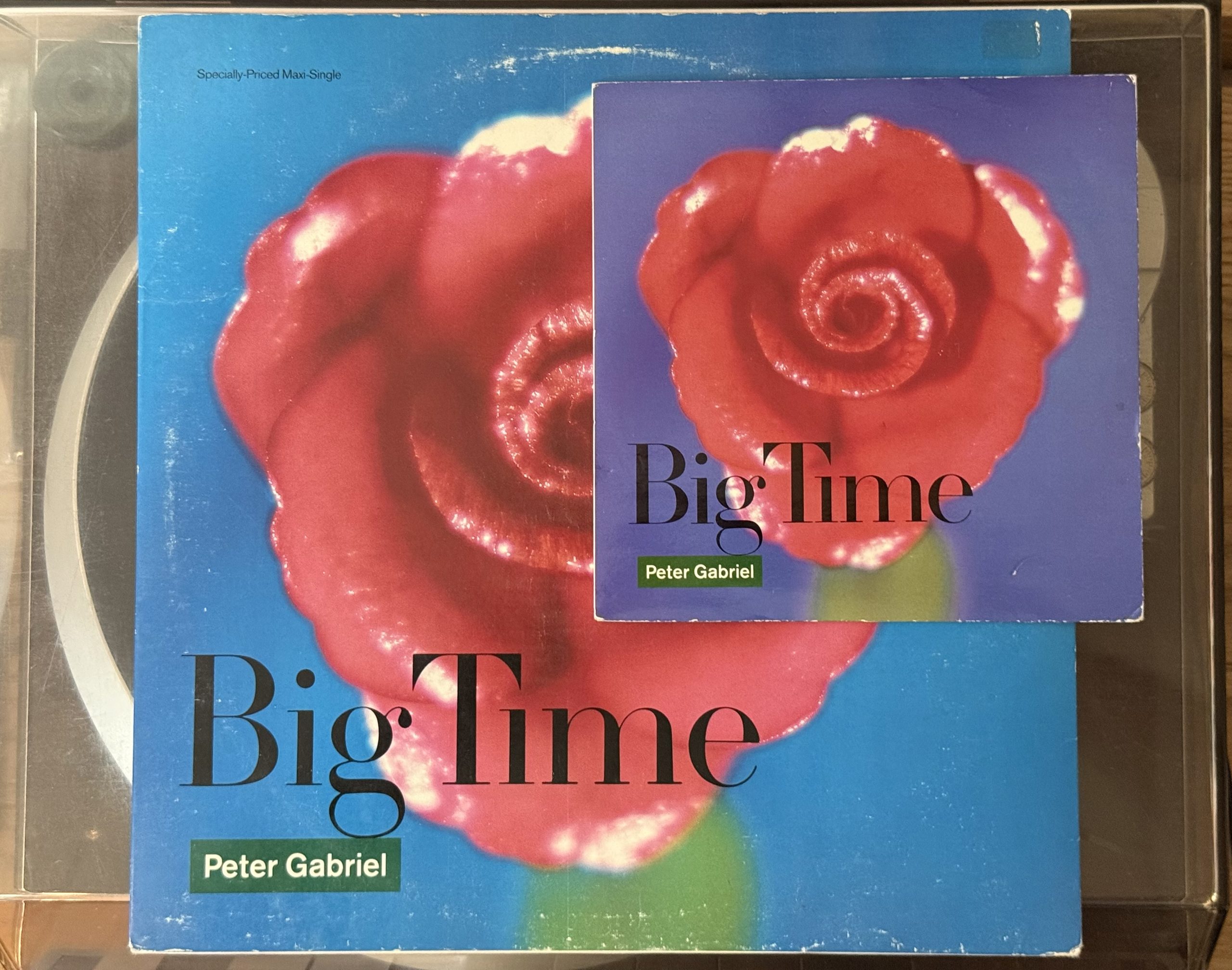
Peter’s singles provide a good excuse to linger in the world of “So” a little longer.
Album of the Week, May 23, 2026
The album cycle for Peter Gabriel’s So went on for quite a while. The first single, “Sledgehammer,” hit the streets on April 14, 1986, about a month before the album was released. There followed “In Your Eyes” in August, “Don’t Give Up” in October, “Big Time” in March 1987 and “Red Rain” in June.1 That’s a lot of releases, and by extension a lot of opportunities for B-sides.
I love B-sides.2 They’re a glimpse of what else was happening when the album was recorded (or, sometimes, some other album, as we’ll see today). Sometimes they illustrate where else a song could go. And sometimes they’re just dance mixes. And the great thing about there being huge markets for pop music in both the US and the UK is that sometimes you got completely different B-sides!
If the above discursion and the picture have led you to think that I’m using these facts to just talk about a bunch of Peter Gabriel rarities, you would be correct. I’m going to pull from three different releases of “Big Time”: the 12″ US single, the 7″ UK release, and the CD maxi-single, which is the one that I first owned back in the day. (Shhh.)
The 12″ opens with “Big Time (dance mix),” which is what it says on the tin. It’s mixed by Tom Lord-Alge, a recording engineer who had previously crossed paths with Peter on “No More Apartheid” on the Sun City compilation, and who had also engineered or mixed for the Force MDs, Jeff Beck, Southside Johnny and the Asbury Jukes, David Johansen, Sly Fox, Steve Winwood’s Back in the High Life, OMD’s “If You Leave,” and Billy Crystal’s “You Look Marvelous.” This cavalcade of 1980s sounds perhaps explains the low-end drum machine and handclaps that get spliced onto the beginning of the track. I do love the way that he pulls out and isolates Tony Levin (and Jerry Marotta)’s bass line at the beginning though, as well as letting us hear the nasty (in a good way) David Rhodes guitar riff without vocals over it. The verses are largely untouched—a little extra echo here, an extra-80s guitar in the texture there—but the chorus gets a spacey reinforcement on the backing vocals that’s almost dublike. This is kicked into high gear after the second verse, where it’s just backing vocals, drum machine, and Peter going “huh!” for about 30 seconds. As dance mixes go it’s relatively harmless but also fairly unimaginative.
“In Your Eyes (special mix)” is an entirely different story. Produced by Bill Laswell and mixed by Jason Corsaro, the mix shuffles the key bits of the original recording, but also adds an entirely new opening featuring Peter singing over a low synth note, chiming thirds and fourths, and a hi-hat heartbeat: “Accepting all I’ve done and said / I want to stand and stare again / Til there’s nothing left out / All that remains there in your eyes.” The intro is punctuated by a brilliant vocal run by Youssou N’Dour, then the brilliant Ronnie Bright bass vocal. Youssou sings a bit in Wolof: “Sa bet chi lamp, chi tangaay, sa bet maangi ci biir,” meaning “Your eyes are lit, your eyes are bright, it’s in your eyes.” And then, when we think we’re going to get the verse, there’s instead an extended meditation with talking drums and synths, with more incredible Wolof vocals from Youssou and some vocalese from Peter. The chorus finally joins with even more Youssou vocals atop it. There’s an extended reverbful talking drum break, reminding us that Laswell has always been the king of dub. Somehow the complete absence of the verse pulls me into a trance listening to this mix—or maybe that’s just Youssou. This is a masterful mix and still holds up incredibly well, which is why it featured on one of my playlists years later. The twelve-inch single finishes with the album version of “We Do What We’re Told.”
The UK 7″ single, on the other hand, has a single B-side, “Curtains.” The composition here is reminiscent of Peter’s work on Birdy, but with more space around the edges. There’s an extended bit that is just a heartbeat of a talking drum with a tiny whoosh of a cymbal brush, and a panoply of synth textures giving the effect of opening doors, echoing caverns, distant bells, all leading to Peter’s vocals: “Oh, draw the blinds / we can shut out the night.” This is the most erotically direct of his love songs to this point, but even here love is filled with ambiguity and tinged with regret: “And there are lions on our curtains / They lick their wounds / They lick their doubt.” It’s a stunning miniature of a song, and I can only imagine what might have gone through the heads of the casual buyers of the single in 1987 when they flipped it over and listened to it.
“Curtains” also appears on the Big Time CD maxi-single, alongside the album version of “No Self Control.” It’s rounded out by “Across the River,” which was used as a mood-setting opener for the original 1982 WOMAD festival and which was recorded in the studio for the WOMAD benefit Music and Rhythm. It begins as an improvisation by Shankar and Peter, joined by David Rhodes, and then a thundering drum part from Stewart Copeland enters. I’ve always been captivated by the combinations of sounds, particularly the low notes from Shankar’s instrument (not a traditional Western violin), and have long wondered what a full album of collective improvisation from a group like this might have sounded like.
The relatively long period of time between Security and So, combined with Peter’s collaborations in WOMAD and with others, combined to make the experience of following the various offshoots from the album a rich musical journey. We’re going to continue following some of those connections for … well, for a while. Next week we’ll pick back up with one of those collaborators and listen to a unique live album.
BONUS: Peter brought “Across the River” back for his “Secret World Live” tour in the 1990s, with Shankar:
BONUS BONUS: A version of “Curtains” with extended vocals appears in the video game Myst IV, though I’m unsure if these were newly recorded or just an alternate take. Here’s a playthrough video showing the song in context:
Footnotes
Making this the only Peter Gabriel album with a singles-to-non-singles ratio of greater than 2 to 1, regardless of whether you count the LP track listing with eight tracks or the CD with nine. ↩︎
I don’t know if I have to spell this out after four years of writing about vinyl records, but just in case: songs played on the radio used to come on 7″ vinyl records that were played at a faster speed (45RPM rather than 33 1/3). The faster playback speed meant the grooves could be cut deeper for better dynamic range. The records had two sides: the A-side, aka the actual single, and the B-side, which was usually whatever the artist or the label felt like putting on there. ↩︎
The bestselling 1986 album seamlessly melds art and pop and marks Peter’s transition to a top tier star.
Album of the Week, May 16, 2026
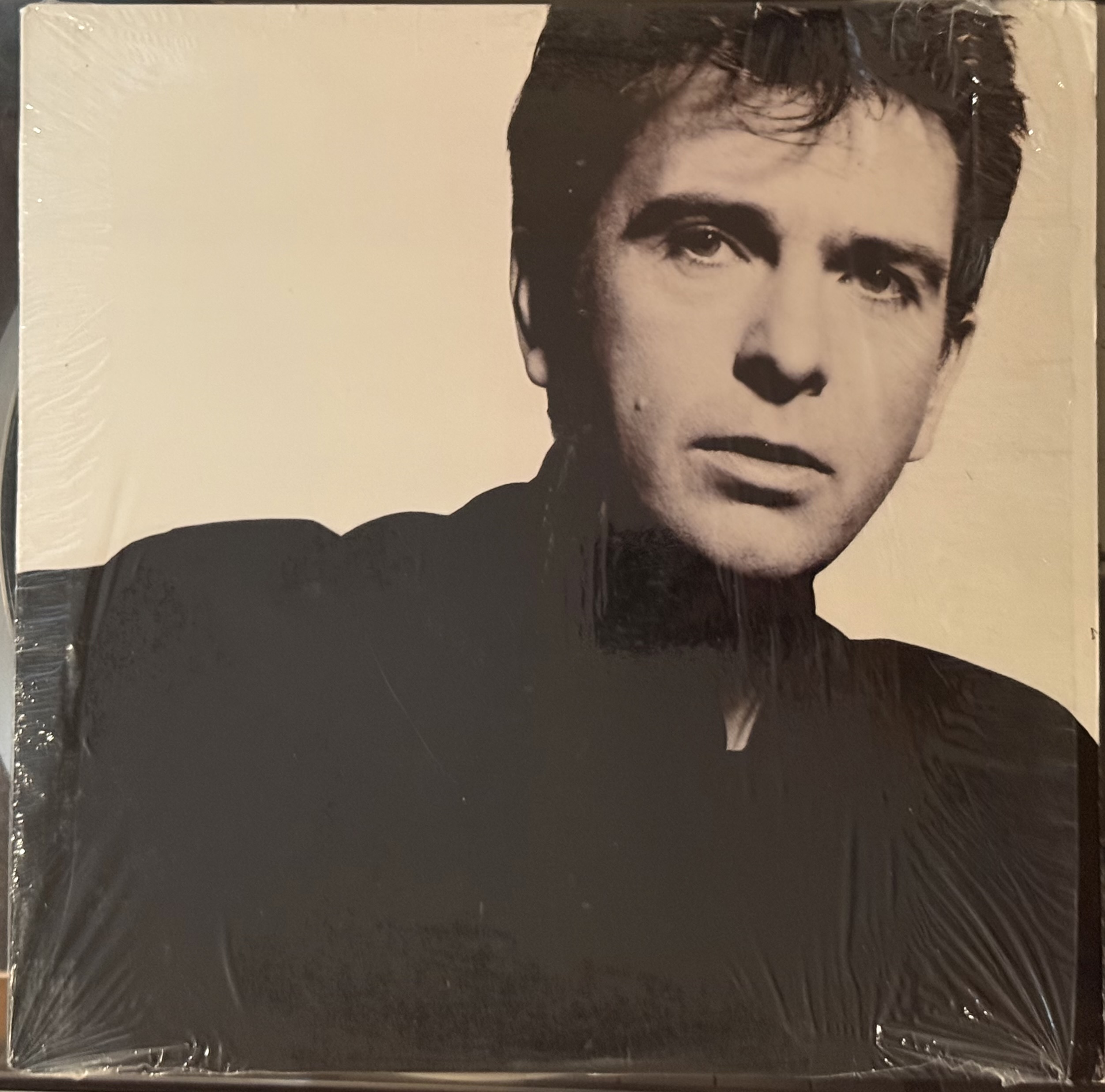
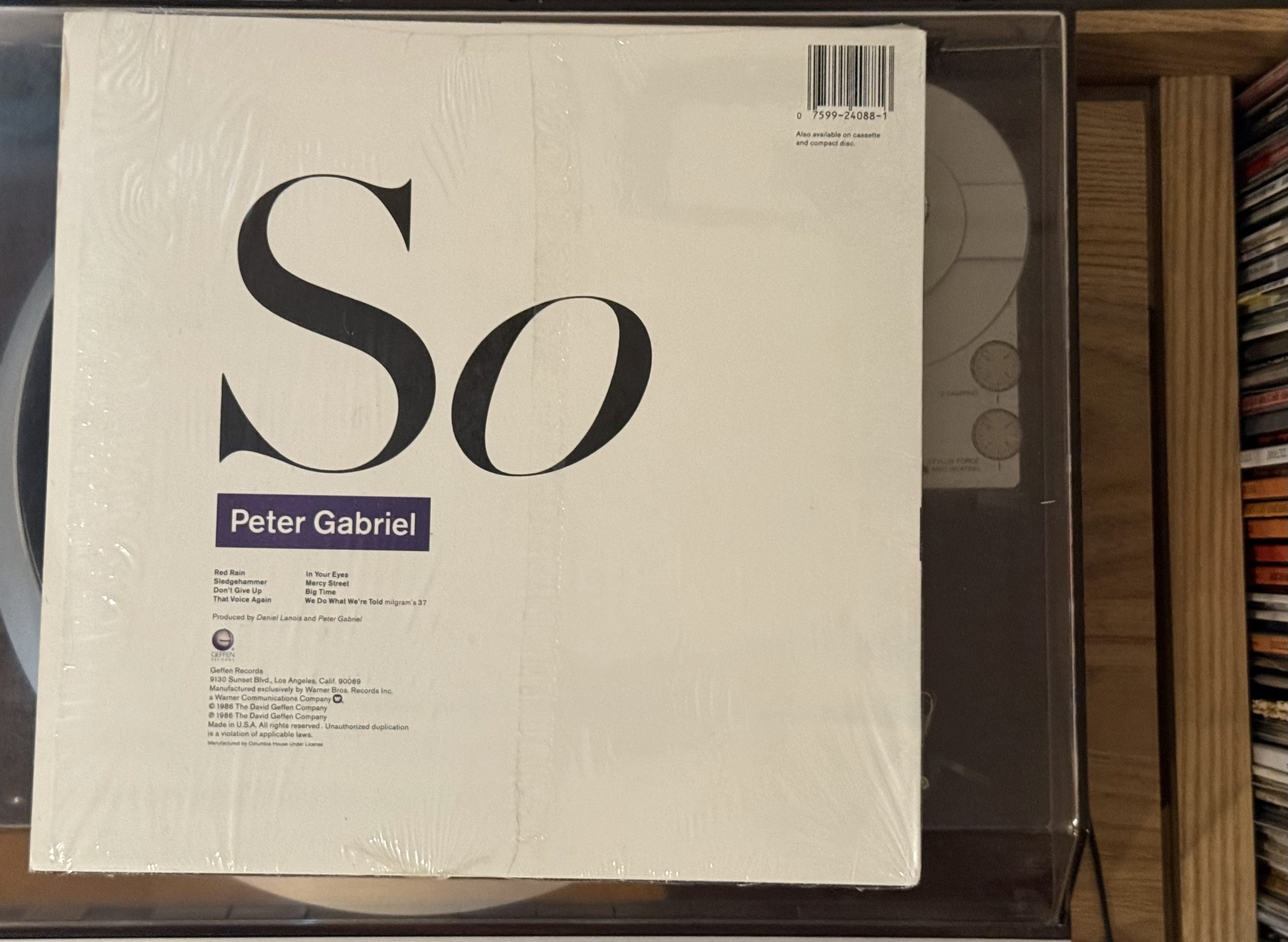
It’s a challenge to approach an album like So. Easily Peter Gabriel’s most popular album, arguably one of the most talked about and best albums of the 1980s, and it’s not like it’s obscure. But, like the songs themselves, the album is made of layers upon layers, and that’s where our tale begins.
In fact, let’s begin at the beginning. Following the 1982 release of Security and the subsequent tour, you’d be forgiven for thinking that Peter took some time off, save for the soundtrack to Alan Paton’s film Birdy. In fact, he was recording the whole time. The years 1983–1985 were surprisingly fertile given that there was no official album released. In fact, there’s a rich batch of soundtrack appearances from this period, as well as non-album studio tracks: “Walk Through the Fire” (from Against All Odds),1 the studio version of “I Go Swimming,” “Across the River” (a collaboration with Indian violinist L. Shankar and Stewart Copeland), his song “No More Apartheid” from the 1985 Sun City compilation, and of course “Out Out,” Peter’s contribution to the Gremlins soundtrack.2 Unfortunately, around this time Peter’s long-term UK label, Charisma, was being acquired by Virgin Records. Ultimately the acquisition settled out and Charisma/Virgin continued to release Peter’s albums in the UK while Geffen handled releases in the rest of the world, but in the dust of the acquisition some of the wind went out of the sails of a new album.
But his creative juices were still flowing. So in February of 1985 Peter retreated to the recording studio at Ashcombe House, where he had recorded since 1978, and began laying down tracks. He considered working with a number of producers for the album, including Bill Laswell (whom he had crossed paths with in the making of the Laurie Anderson collaboration “Excellent Birds”) and Nile Rodgers, but ultimately decided to stick with Daniel Lanois, his collaborator from Birdy. It would prove a fruitful choice; not only was Lanois an expert in producing the combination of organic and atmospheric sounds that Peter was striving to produce, but he was also surprisingly adept at forcing the famously digressive Peter to finish work. My favorite anecdote: at one point Lanois resorted to locking Peter inside the studio so that he would finish a vocal. Peter wrote the core tracks of the songs with Lanois and guitarist David Rhodes from sketches that he produced using the Prophet-5 polyphonic synthesizer or his Yamaha piano, along with a Linn drum machine. Using this method, Peter built songs up from melodic ideas with nonsense vocal syllables to fully fledged songs, having the trio improvise with his rough demos in their headphones, bouncing the trio recordings into the headphones to bring in the larger band, and so on.
The larger band was built around familiar collaborators—Tony Levin, Jerry Marotta—and French drummer Manu Katché (who would follow this session with Sting’s …Nothing Like the Sun). A host of others would make appearances on the album, most on one or two tracks: Chris Hughes, fresh off producing Tears for Fears’ Songs from the Big Chair; Copeland; Shankar; trumpeter Wayne Jackson from the Stax Records backing band the Bar-Keys; saxophonist Mark Rivera from Billy Joel’s band; pianist Richard Tee, whom we’ve previously seen playing with Hubert Laws and Ron Carter on CTI Records; and guest vocalists Laurie Anderson, Kate Bush, and Youssou N’Dour. The last was a superstar in his native Senegal, but was yet to break out in the consciousness of the broader world; that was about to change.
“Red Rain” opens the album on a massive note, with an indelible riff on the hi-hat from Stewart Copeland and an echo of a keyboard line, then a massive chord through which Tony Levin’s indelible bass snakes. Peter’s apocalyptic lyrics sing of a dream of a rain that covers all those around, imagery that dates back to some of his earliest writings; in fact, the image is the one of the last remnants of the Mozo mythology that had previously informed “Down the Dolce Vita,” “Here Comes the Flood,” and “On the Air.” But Mozo aside, the song also features some deeply personal writing. His marriage to Jill Moore was falling apart—strained by his touring, she was unfaithful, and the resulting divorce sent Peter into a deep depression and to six years of therapy. It’s hard not to read lines like “I come to you, defenses down / with the trust of a child” and “Red rain is coming down all over me / I’m begging you” knowing this context without thinking of metaphors for accusations and retribution.
From the sublime to … “Sledgehammer,” easily Gabriel’s most-remembered song, thanks in no small measure to its innovative Claymation video and unsubtle but good-natured phallic imagery, as well as to the horn section, a first for a Gabriel album. Peter has explicitly called out the song as an homage to Stax-Volt soul singles, an early source of musical inspiration for him, to the point that he asked Wayne Jackson, who as a member of the Mar-Keys played behind Peter’s hero Otis Redding, to assemble the horns for the track, which included Rivera and trombonist Don Mikkelsen, who had played with Ann-Margret and in Louie Bellson’s band. There’s what sounds like a Hammond B-3 organ on the track, which is actually played on Peter’s Prophet-5 synthesizer, and a weird synthetic flute sound, which Peter plays on the E-mu Emulator II, a sampling synthesizer beloved by acts as diverse as Stevie Wonder, Belgian electronic band Front 242, Depeche Mode, and the Pet Shop Boys. The track is tremendous fun, thanks in no small part to its bouncy rhythm section courtesy Levin and Katché, who was literally getting on a bus to the airport when Peter encouraged him to stick around and help re-record the track from its original foundation, which had featured drummer Chester Thompson.
“Don’t Give Up” is another complete stylistic pivot, a hard-luck song constructed in response to Dorothea Lange photographs of starving farmers from the American Depression. It was built around a rhythmic part that Peter transferred from tuned drums to a Tony Levin bassline; Tony achieved a more muted sound by the expedient of placing a diaper that he had packed in his gig bag for his two-month-old child beneath the strings. The track is moving enough, but when the chorus comes and Kate Bush sings “Don’t give up, you still have … friends,” it enters spine-tingling territory. The song changes lives; both Elton John and the late Matthew Perry at different times credited the bridge’s lyric “Rest your head, you worry too much / It’s gonna be all right / When times get rough, you can fall back on us” with encouraging them in sobriety. And Richard Tee’s gospel piano on the second bridge similarly elevates the song to a different place. It was always conceived as a man-woman duet, though originally Peter had Dolly Parton in mind; now it’s hard to imagine the song without Kate’s contributions. This is particularly true with the video, which features Peter and Kate embracing each other and singing the song for the entire video as the sun rises and falls in the background. Though Peter asked Jill’s permission before embarking on the shoot, the video ultimately did not help their marriage.
“That Voice Again” has its origins in Peter’s efforts to write the soundtrack for Martin Scorcese’s The Last Temptation of Christ, believe it or not. Originally the lyrics were written about judgment and Christ’s commandment “Let him who is without sin cast the first stone,” but over several rewrites it became about the inner judgmental voice that “either helps or defeats us.” It is also the very last Mozo song, with the judgmental voice somehow fitting into Peter’s alchemical narrative. Twelve-string guitar from Lanois (the first time that instrument appeared on a Gabriel album since “Solsbury Hill”) and an elaborate drum part from Katché fill out the arrangement.
“In Your Eyes” is a pure love ballad, a form that Peter rarely essayed prior to So. It has several key features in the arrangement: Richard Tee’s piano, a soaring pre-chorus (that “I reach out from the inside” segueing into the wordless vocal bridge always hits me right in the feels), and Youssou N’Dour. That a previously-unknown-to-Westerners Senegalese vocalist would be the secret weapon of this track would seem unusual, especially given the Who’s Who of backup singers also appearing on the track—which included Simple Minds’ Jim Kerr, The Call’s Michael Been, and doo-wop singer Ronnie Bright, who performed the bass vocals on the classic song “Mr. Bass Man.” But that’s only if you don’t reckon with Youssou’s voice; a soaring, resonant instrument with bright edges that spans multiple octaves with heldentenor intensity and is comfortable in Wolof, French and English. More than any other track on the album, the arrangement for “In Your Eyes” is fluid, and live versions and remixes play with the running order of the song; we’ll hear an example of that another time. As a listener who fell in love with the album in 1986, the song sits at Number 5 in the running order for me, but Peter originally intended it to end the album; the limitations of the vinyl format, which made reproducing the low bass tones in the inner grooves a challenge, switched it to start Side Two.
“Mercy Street” is another of the songs on the albums about which I have difficulty being objective. The song introduced me to the writings of Anne Sexton, whose poetry (particularly 45 Mercy Street and The Awful Rowing Toward God) inspired the song. The song is built around a track by Brazilian percussionist Djalma Corrêa, who provided surdo, congas and triangle in a traditional Brazilian forró rhythm. (A different set of track by Corrêa provided the basis for “Don’t Break This Rhythm”, which became the b-side to “Sledgehammer.”) The arrangement, though uncluttered on the album, was painstakingly constructed, with piano parts from Richard Tee added and then removed, a Fairlight CMI-based melody played by Peter by hand instead of sequenced for a more human feeling, and double-tracked vocals, with the lower octave achieved by having Peter stay up all night at the studio and doing a single take at 7am when he was at his most fatigued. All this is in support of a jewel of a song, with bits of Sexton’s poetry turned into a stream-of-consciousness lyric full of confessional details, anchored around the desperate search for home: “Dreaming of Mercy Street / Wear your inside out / Looking for mercy / In your daddy’s arms again.” The final coda lends finality to the searching and despair in the song as Peter turns to images from Sexton’s posthumous book: “Anne with her father is out in the boat / Riding the water, riding the waves / On the sea.” A slightly extended version of the track was used for the official video.
“Big Time” is the other “overtly commercial” track on the album. The horn section from “Sledgehammer” returns over a rhythm track that was notoriously difficult to record; Tony Levin’s bass part was achieved by having Tony finger the notes on the fretboard while Jerry Marotta hit the strings with his drumsticks to achieve a percussion effect, while Stewart Copeland’s ingenious hits and fills didn’t exactly line up with the drum machine, so engineer Kevin Killen sampled his track and created the percussion from the samples. Former Ikette P. P. Arnold led the backing singers, and Peter’s Prophet-5 faux-Hammond organ returned. Where the phallic imagery in “Sledgehammer” is playful, here it’s sardonic, as Peter dismantles the consumerist mentality of the 1980s and ties it to the drive to overcompensate, a point brought home by the closing lyric: “Look at my circumstance / And the bulge in my big, big, big, big, big, big, big, big, big, big, big, big, big, big, big.”
The transition into “We Do What We’re Told (Milgram’s 37)” is abrupt and icy. The song, reminiscent of “Lead a Normal Life,” is mostly constructed around Peter’s synthesizers, with David Rhodes’ guitar and L. Shankar’s violin contributing to the texture over a beat from Jerry Marotta; many of the sounds, including Peter’s vocals, were processed through the Fairlight for extra texture. Peter wrote the lyrics as an attempt to process the results of Stanley Milgram’s experiments in authoritarian behavior, in which 37 of 40 participants continued to administer higher and higher levels of electric shocks to unseen subjects when encouraged to do so by their peers. The repeated “We do what we’re told” lyric repeats like a mantra, expressing the impulse to conformity that drove the awful behavior of the participants. Some listeners found this song the only part of So to their tastes; however one felt, it’s undeniably a direct link to the themes and preoccupations of 1980’s Peter Gabriel 3 (Melt), and in fact the song originated in those sessions.
“This is the Picture (Excellent Birds),” which appears on modern LP versions of the album but not the original, is a re-think of Peter’s 1984 collaboration with Laurie Anderson from Mister Heartbreak, with the groove (including an added talking drum from Manu Katché) brought to the fore and some elements (like Laurie’s idiosyncratic synth line) removed. My poor mother could never get Peter’s word choice in the song; hearing it in my childhood home as I was listening, she asked me not to listen to it again as the line about “bitches of evil” made her uncomfortable. (This was, of course, a mondegreen for “I see pictures of people.”)
It’s hard to overstate how huge So was. Quintuple platinum album sales, Number One on the UK album chart and Number Two on the US, a number one Billboard Top 200 spot (“Sledgehammer”) and nine MTV Video Music Awards (also “Sledgehammer”), number one on Billboard’s Album Rock chart (“In Your Eyes”), top 10 singles in the UK (“Don’t Give Up”) and US (“Big Time”), and number 3 on the Mainstream Rock chart (“Red Rain”). It launched Youssou N’Dour to worldwide fame, further raised the profile of Kate Bush, and most of all completed the transformation of Peter Gabriel from a niche artist for fans of progressive and experimental rock, to a pop artist with serious artistic and experimental bona fides. Because of the album’s long gestation and long singles cycle, many interesting tracks were released alongside as b-sides; we’ll linger in this album’s shadow a bit next week to listen to some of those.
You can listen to this week’s album here, in the original 1986 track order but including “This is the Picture (Excellent Birds)” in its spot on the original CD running order. This is controversial. Ever since 2002, Peter has preferred a revised running order that puts “In Your Eyes” last on side two.
BONUS: Peter’s So sessions sprawled across many months and there were a few songs that were recorded that never made it to the album, or even as a b-side. When the 25th anniversary of the album was released as a box set in 2011, Peter polished up a few of these songs. “Courage” is pretty great! It was released as a 12″ 45 single in the box set, with “Sagrada” and an alternative mix of “Don’t Give Up” as b-sides.
BONUS BONUS: There are a lot of live performances of these songs; they essentially form the core of Peter’s touring repertoire for the rest of his career. But the ones featuring the original performers, such as this 1987 live version of “Don’t Give Up” with Kate Bush, are special. Even if it is an audio-only cleaned-up bootleg:
BONUS BONUS BONUS: “In Your Eyes” was made newly famous through its use in the John Cusack/Ione Skye movie Say Anything, in a scene that is engraved in the hearts of otherwise-cynical GenX kids everywhere:
BONUS X4: The version of “Mercy Street” that was performed in Peter’s 1987 concert in Athens, Greece has always pierced me to the heart, with Peter singing from curled and crouched positions to echo the anguish of the lyrics:
Footnotes
I know that I probably just put the Phil Collins title song from that movie into your head. You’re welcome. ↩︎
We’ll talk about some of Peter’s other soundtrack work another time. ↩︎
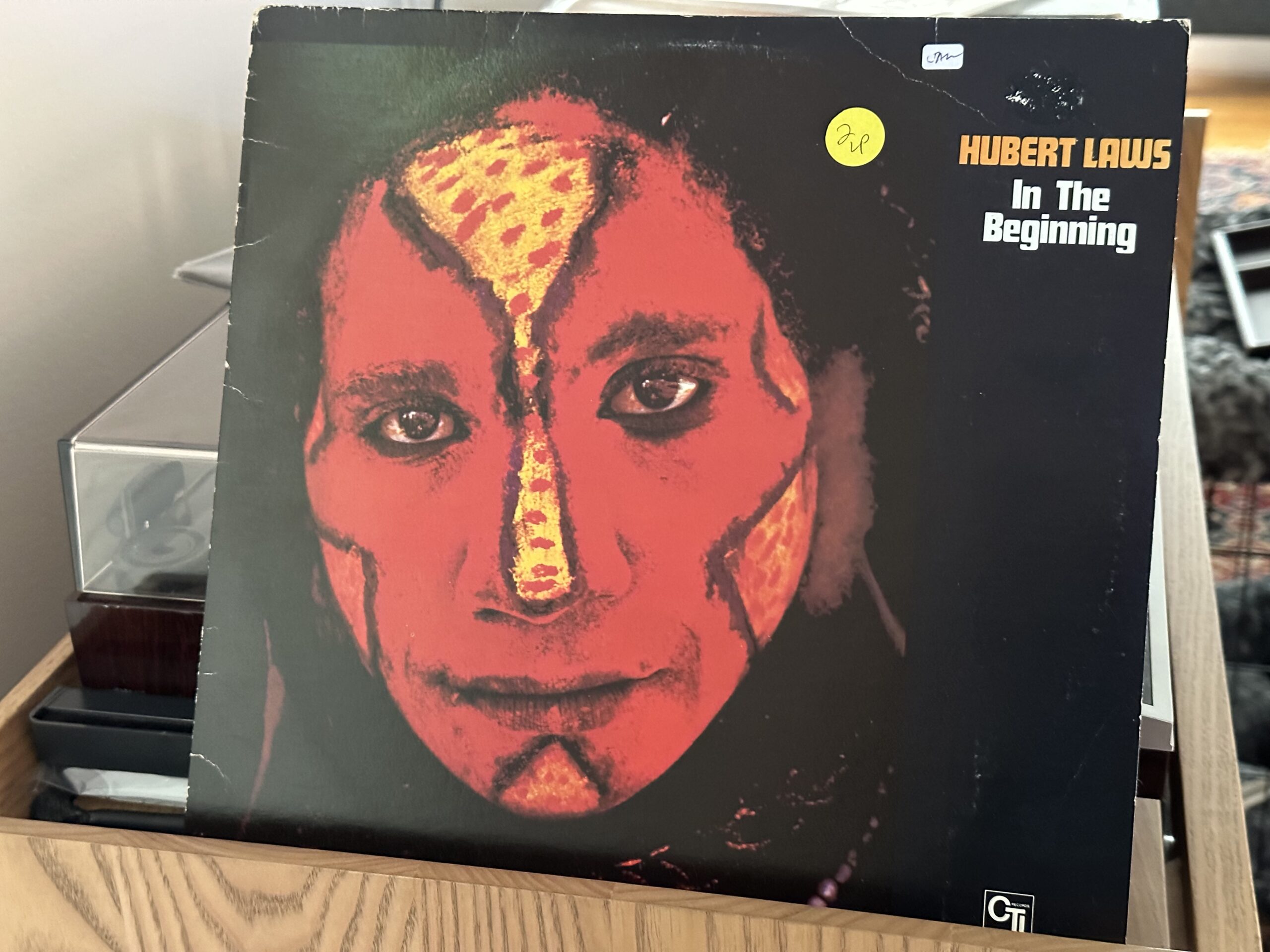
Hubert Laws was having a good few years. The last of his albums we reviewed, Morning Star, was nominated for a Grammy in 1973 for Best Jazz Performance by a Soloist. He had built up a track record as a sideman across a whole slew of CTI recordings—to say nothing of his appearance on Gil Scott-Heron’s major label debut, Pieces of a Man. (That’s Laws playing the killer flute obbligato on “The Revolution Will Not Be Televised.”) And CTI was having a pretty good run as a label, thanks to hits from Deodato and others. So Creed Taylor doubled down, literally, on Laws, and this double album was the result.
In the Beginning has a complicated discographical history. Originally issued in the form I’m reviewing today, a few years later the two disks were unbundled and released separately as Then There Was Light Vol. 1 and 2. We do know that the original record was recorded in four days between February 6 and 11, 1974 at the Van Gelder studio, and released sometime later in 1974. And it was a substantial cast, as always with Laws’ CTI recordings. His brother Ronnie Laws played tenor sax; Bob James, acoustic and electric piano; Richard Tee, organ; Clare Fischer, electric piano; Gene Bertoncini, guitar; Steve Gadd, drums; Airto, percussion; Dave Friedmann, vibes; the omnipresent Ron Carter, bass; and a string quartet. Fischer, James, and Laws all contributed arrangements.
Incidentally, we haven’t come across Clare Fischer’s work in this column before, but you’ve almost certainly heard it, thanks to a long career as an arranger. He was the pianist and arranger for the Hi-Los in the 1950s before swerving into Latin jazz, but had a parallel and far more successful career as an arranger, working on (among many others) Billie Holiday’s Lady in Satin, Paul McCartney’s Flowers in the Dirt, Chanticleer’s Lost in the Stars, the Buckshot LeFonque project of Branford Marsalis, Michael Jackson’s This Is It, Usher’s Here I Stand, and Prince’s Parade, Sign ‘☮’ the Times, Graffiti Bridge, [Love Symbol], “Pink Cashmere,” The Vault, Rave Un2 the Joy Fantastic and 3121. (!!!)
It’s a Fischer composition and arrangement that leads off the album. The title track is almost a capsule of jazz development from Ellingtonian chords to Trane-influenced minor key modality to a chunk of avant-garde, which fades into a slow rich blues. The richness of the arrangement falls back to an eight-bar solo for Carter, which then yields to a group blues with Laws taking a high solo. The final turn of the arrangement is into classic CTI jazz-funk, and then it circles back to the abstract theme of the beginning. A nifty little piece, and a great foretaste of what’s ahead.
“Restoration” is a slow waltz, supported by Bob James’s acoustic piano and a thoughtful Carter bass line. Here Laws’ flute recalls his performance with Chick Corea on “Windows,” from his early album Laws’ Clause, later collected with other Chick performances on Inner Space. Some fine Bertoncini guitar work hands off to a reflective Laws solo, and back to a Dave Friedman vibes passage, before the final chorus brings the performance to a meditative close.
That meditative feeling continues with Bob James’ arrangement of “Gymnopédie No. 1” for guitar, flute, piano, bass, vibes and string quartet. One of these years I’ll have to put together a collection of performances of this Erik Satie composition. For emotional reserve and measured tempo, this might be one of the best of the “covers” of the tune. Laws’ solo is by turns elegiac and birdlike, and the arrangement keeps the instruments from crowding each other; in most of the moments you hear only a few voices at a time. It comes too quickly to an end.
“Come Ye Disconsolate” is a gospel staple that received a contemporary pop boost from Roberta Flack and Donny Hathaway in 1972, and the performance here is appropriately pop-gospel flavored; improvisatory in the middle verses, with a down-home altar call feel in the final verse. It’s comfortable and easy on the ears.
“Airegin” immediately challenges that relaxation moment, ending Side 2 with a cover of the Sonny Rollins standard with just Laws and Steve Gadd. Gadd here is especially delightful under Laws’ increasingly complex improvisation; he starts with just a steady kick drum pattern, then adds cymbals, snare and tom until it’s as much a proclamation of drum ingenuity as it is a statement of flute virtuosity. It can be easy to forget, with the excellence of the arrangements that usually drape Laws’ CTI work, just how amazing a soloist he was; this track corrects that nicely.
“Moment’s Notice,” a cover of the Coltrane classic, features a fuller big band treatment, with Ronnie Laws’ tenor sax taking an appropriately more prominent voice, then yielding to Laws’ flute util the two end up in (of course) a battle, underpinned by James on piano with some brisk walking bass from Carter and a non-stop barrage of ingenuity on the drum kit from Gadd. It’s a fun exploration of the tune, with some wonderfully pointed dissonance from James keeping it from being just another Trane cover.
Rodgers Grant’s “Reconciliation” provides a way for Laws to shift back to more meditative material, with Carter, Gadd and James closely following. The tune moves in and out of minor modes, with Carter’s high-octave tonic providing the transition. Indeed, while there’s a lot going on with this track, it’s worth just listening to the way Carter negotiates the twists of the melody, providing a steadying pulse under Laws’ flute as it explores increasingly abstract textures, then taking a solo that’s a master class in saying everything with a few notes. This isn’t relaxed reflection, exactly; there’s a touch of anxiety in the way the tune never settles into a single tonality, as if fighting against the eventual concord promised in the title.
As if acknowledging the complexity of the penultimate track, “Mean Lene” is a simpler pleasure, some straight-ahead jazz funk with a Latin tinge. But even here the tempo shifts from measure to measure in the head, not settling down until Friedman’s vibes take the first solo over the rhythm section in a happily sambified mood. But as the track continues to stretch out, some of the conventionality breaks down for something richer and stranger, until it’s no longer clear who’s soloing and who’s supporting. It’s not free jazz exactly, but it’s the track on the album that comes closest to the give and take of a free performance. Throw in a left-field drum solo and a shift back to Latin funk, alongside some overdubbed flute and another rich Clare Fischer arrangement, and we have ourselves a party.
Laws was nominated for another Grammy for this record, and for good reason. It’s one of the most satisfying of the CTI Records discography, and one that most ably shrugs off the potential limitations of the CTI formula to end up at an entirely new place.
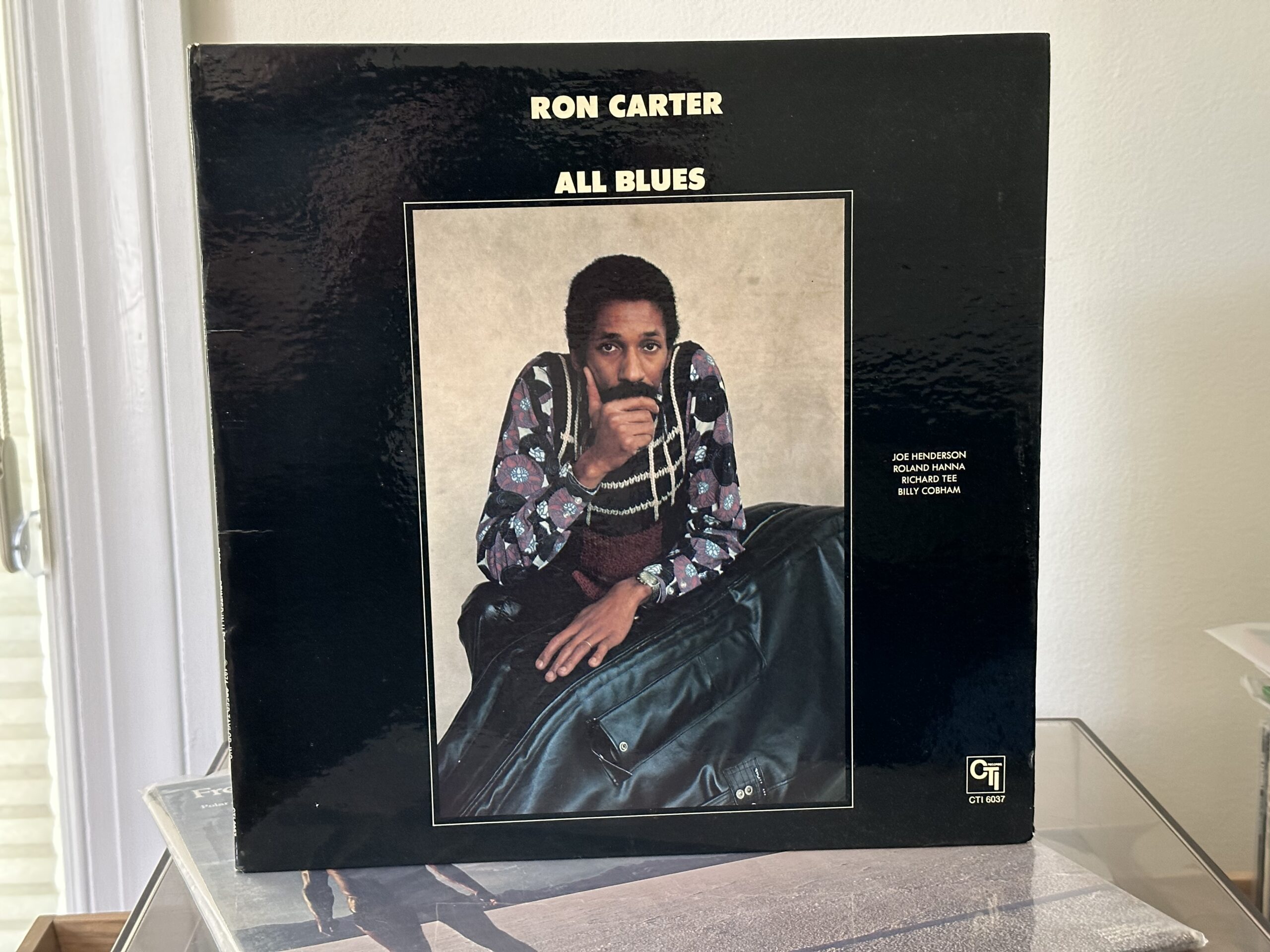
CTI Records has a funny history, for a record label with such a distinct sound. Just when you think you have it all figured out, it throws you a curve ball. Take this week’s record, for instance. Where last week we had virtuosic reed player Joe Farrell go all in on the CTI jazz funk sound, this week Ron Carter, whose prior headlining album was a good representation of the label’s trademark sound, has taken a left turn into acoustic jazz—and first class acoustic jazz, at that.
Part of the switch-up might have been a reaction to the label’s sound. It’s noteworthy that much of Carter’s output as a leader in the 1970s was a more traditional approach, with classics like Third Plane sounding distinctly like a reunion of the rhythm section from the Second Great Quintet (as indeed it was). But part of the credit for the sound must accrue to the players. In addition to drummer Billy Cobham and Richard Tee, who appears on electric piano on one number, Carter brought saxophonist Joe Henderson, who we last heard on Freddie Hubbard’s Straight Life, and pianist Roland Hanna.
Henderson had been busy with a prolific stretch of great albums for Milestone Records, including Black is the Color (featuring Carter on bass) and The Elements (with Alice Coltrane and Charlie Haden, among others). The latter session finished recording in Los Angeles exactly a week before Henderson entered the Van Gelder studio in Englewood Cliffs, on October 24, 1973. He was coming in hot. And he was landing alongside Hanna (later Sir Roland), who was just coming off recording his first solo album in fifteen years, after a long stint in the Thad Jones/Mel Lewis Orchestra. Together the band deliver four Carter compositions and two covers as a single, quietly confident statement.
“A Feeling” begins in a sprightly tone, with the band playing collectively into Carter’s composition. There’s a caesura at one turn of the melody, where the held chord allows Carter to slide from the tonic up to a major third. It’s the hook, a stop-time moment that comes back with each repetition of the chorus. Henderson has the melody here, and it’s briskly and concisely played as he alternates bars with Cobham and Carter. Roland Hanna’s solo (he plays acoustic piano throughout) is reminiscent of some of Herbie Hancock’s right hand soloing in the later years of the Miles Davis Quintet: angular, along the melody but not slavishly anchored to it.
“Light Blue” is a Roland Hanna feature on a Carter-composed ballad. Hanna sensitively plays the melody and improvisations as Carter gently anchors him, quietly sliding from one tonality into another in the verse, taking a moment for a brisk flurry of notes under Hanna’s solo elsewhere. Cobham underpins the song with brushes on cymbals, understatedly accenting the beat throughout.
“117 Special” is the one concession on the record to the traditional CTI sound, courtesy of Richard Tee’s work on the Fender Rhodes as well as Cobham’s backbeat and Carter’s blues-influenced bassline. Henderson states the melody on two repetitions of the chorus and then steps back for Carter’s solo, played on his trademark piccolo bass. Here Carter pulls out all his trademark techniques—the sliding pizzicato notes, the high solo line, the flurry of notes emphasizing the solo, the descending fifths—and welds them together into a brilliant solo that keeps on going into the final chorus and the fade-out.
“Rufus” starts Side Two with a blues-influenced tune in sax and bass that moves through four or five different keys in its brief melody, with pauses for drum flourishes, before circling back to the tonic. Roland Hanna improvises his way through the key changes as though navigating a high wire, with a casually brilliant poise. He then yields the stage to Carter, who adroitly navigates the outlines of the melody in his solo with only occasional support from Cobham and Hanna. The band comes back in earnest behind Henderson’s solo. The saxophonist stretches out relatively infrequently on this record, and the brief two-chorus solo he takes here serves as a brilliant reminder of how inventively harmonic his approach is.
The familiar bass and piano opening of “All Blues” is followed by a statement of the melody in Carter’s piccolo bass, which sounds as though it were overdubbed as he continues on the low bassline on his regular double bass. A contemporary review claims he was playing both lines simultaneously—a feat of virtuosity indeed. Henderson takes the second statement of the melody and unfolds into a solo that stretches out over the modes and into sheets of notes before coming to a close. Carter’s piccolo bass returns for a solo, finding another counter rhythm inside the melody before returning to the chorus once more as Henderson plays it out, only to light up with a piccolo solo on the last reprise before dipping into an unexpected key change through which the band vamps in a slow fade-out.
Carter takes a true solo on Matt Dennis and Tom Adair’s “Will You Still Be Mine,” with a brisk romp on the melody anchored by his simultaneous scaffolding of the bassline. It’s merely the final demonstration of confident brilliance in an album full of them.
Carter’s embrace of more traditional small group jazz on All Blues seems to have been a harbinger of his direction through the rest of the decade; in addition to his trio album Third Plane, he also reunited with Wayne Shorter, Herbie Hancock, and Tony Williams, who would play alongside Freddie Hubbard in a very special band throughout the late 1970s and early 1980s. We’ll hear some of those records, too, another time. In the meantime, he had a few more solo albums across the next few years with CTI, and continued to perform as an in-demand sideman as well; we’ll hear him in that capacity several times in the next few weeks.
This week’s lead artist has been in more essays in this column than anyone else save his former bandmates Miles Davis and Herbie Hancock, and that’s just because I haven’t written about many of the projects that he did outside the jazz sphere. The great bassist Ron Carter was not new to leading solo recordings, having recorded Where in 1961 with Eric Dolphy and Mal Waldron for New Jazz, Uptown Conversationin 1969 on Herbie Mann’s Embryo label, and Alone Together, a duo album with Jim Hall, the year before. But on this first album for CTI Records, the versatile bassist put together a collection of tracks that were more about the performance than the songs. The main effect of each track was to highlight Carter’s formidable skills as a bassist and, in some cases, shine a light on previously unrecorded capabilities as a soloist.
The backing band, which included the ever-stalwart Hubert Laws on flute, Richard Tee on electric piano and organ, Sam Brown on electric guitar, Billy Cobham on drums, and Ralph MacDonald on percussion, plus appearances from Bob James on three tracks and guitarist Gene Bertoncini on one, come to the session as supporters of Carter, consistently accompanying him rather than performing over top of the bass line. The way that Rudy Van Gelder records Carter’s bass throughout reminds me a little of the disclaimer that was always somewhere in the liner notes of Branford Marsalis’s albums for Columbia Records: “This album was recorded without the use of the dreaded bass direct, to get more wood sound from the bass.” Indeed, the close miking that Van Gelder uses eliminates a lot of the natural resonance of the wooden body of the bass—but at least it makes it so that the bass is practical as a lead instrument in the ensemble. (You have to turn up those Branford recordings pretty high to hear Bob Hurst in the mix, especially when Kenny Kirkland or Jeff “Tain” Watts are playing.)
At any rate, “Blues Farm” provides both one of the more memorable tunes on the album and an opportunity to hear Carter’s soloistic prowess. The melodic burden is carried by Hubert Laws on flute and Carter, playing both regular and piccolo bass. The piccolo, Carter’s preferred instrument for bass solos, has its strings pitched an octave higher than normal, which gives it two unique characteristics: it’s high enough in pitch to be heard as a solo instrument alongside the rest of the band, and the large range between notes of the scale on the bass fingerboard makes it rather more likely than on a smaller instrument that the bassist will hit pitches that fall between the strict pitches of the scale. Throughout, you can hear Carter turning this unusual characteristic into a feature of his performance using portamento to slide up and down into the desired pitch. The tune itself is a simple enough blues, but the arrangement between Laws and Carter gives it a jaunty air.
“A Small Ballad” is the most fragile, and unusual, composition on the record. Opening with a piano figure from Bob James that wouldn’t have sounded out of place on a Herbie Hancock record, the track yields to Carter’s solo bass, which pivots from a major to minor figure. The two duet with each other over a drum pattern played mostly on the cymbals by Cobham, with Carter playing a ground under James’ piano before switching to a more melodic solo on the bass. James recaps the melody on piano, before Carter recaps it once more, only playing the pivot notes, and only in octaves. It’s a quietly delightful performance.
“Django” begins as a quiet balladic statement, then after the first chorus veers into a swinging blues feel. Carter is the only solo voice throughout, with the rest of the band providing support behind him. The slow balladic section returns quickly after one round of improvisation, making one wonder what a fuller band treatment might have done with the tune.
“A Hymn for Him” is, as the title suggests, a gospel-inflected blues, with Carter’s bass duetting with Richard Tee for a solid five minutes before Hubert Laws provides his own bluesy solo. Here Carter displays his gift for solid, unshowy, in-the-pocket bass accompaniment in the first two verses before picking up the lead with a piccolo bass part which I suspect was overdubbed. Here his full range of harmonic and melodic imagination is at play, reaching for heights even as he spans up from the depths. Laws’ solo exchanges passages and ideas with Tee before he steps back to let the pianist himself be heard. (While I thought myself unfamiliar with Tee’s work, it turns out I know some of his output pretty well, as he was the studio musician heard on Paul Simon’s “Slip-Slidin’ Away” and Peter Gabriel’s “In Your Eyes.”)
“Two-Beat Johnson,” featuring a theme that shifts between 4/4 and 2/4, opens with a joint statement of the melody between Laws and Carter before Laws takes an extended solo exploring the changes of the work. The track feels like a lost Vince Guaraldi cue and is almost as short, lasting a mere 2:53. It segues swiftly into “R2, M1,” which explores some of the melodic ideas of “Two-Beat Johnson” but grafts them onto a samba beat. Here Carter marries his in-the-pocket accompaniment with some of the portamento styles honed on his piccolo solos, while Laws demonstrates his own usual excellence and virtuosity in the upper range of the flute’s register. Bob James provides a funkier breakdown on the melody before yielding to Carter and Cobham, who provide multiple variations on the groove without ever stepping fully into a melodic solo. It’s an interesting choice for the last track on the album as a result, and I think it highlights a fundamental truth of Carter’s playing: that he always soloed from the bass chair even as he kept his contributions direct and to the point, always focusing on playing, as he says, “the right note.”
So the first album with Carter as a leader shows him as a virtuoso on his instrument and begins to display his skills as an arranger. We’ll see more of the latter skill in the future. In the meantime, we’ll hear a few live performances from another CTI stalwart over the next few weeks.