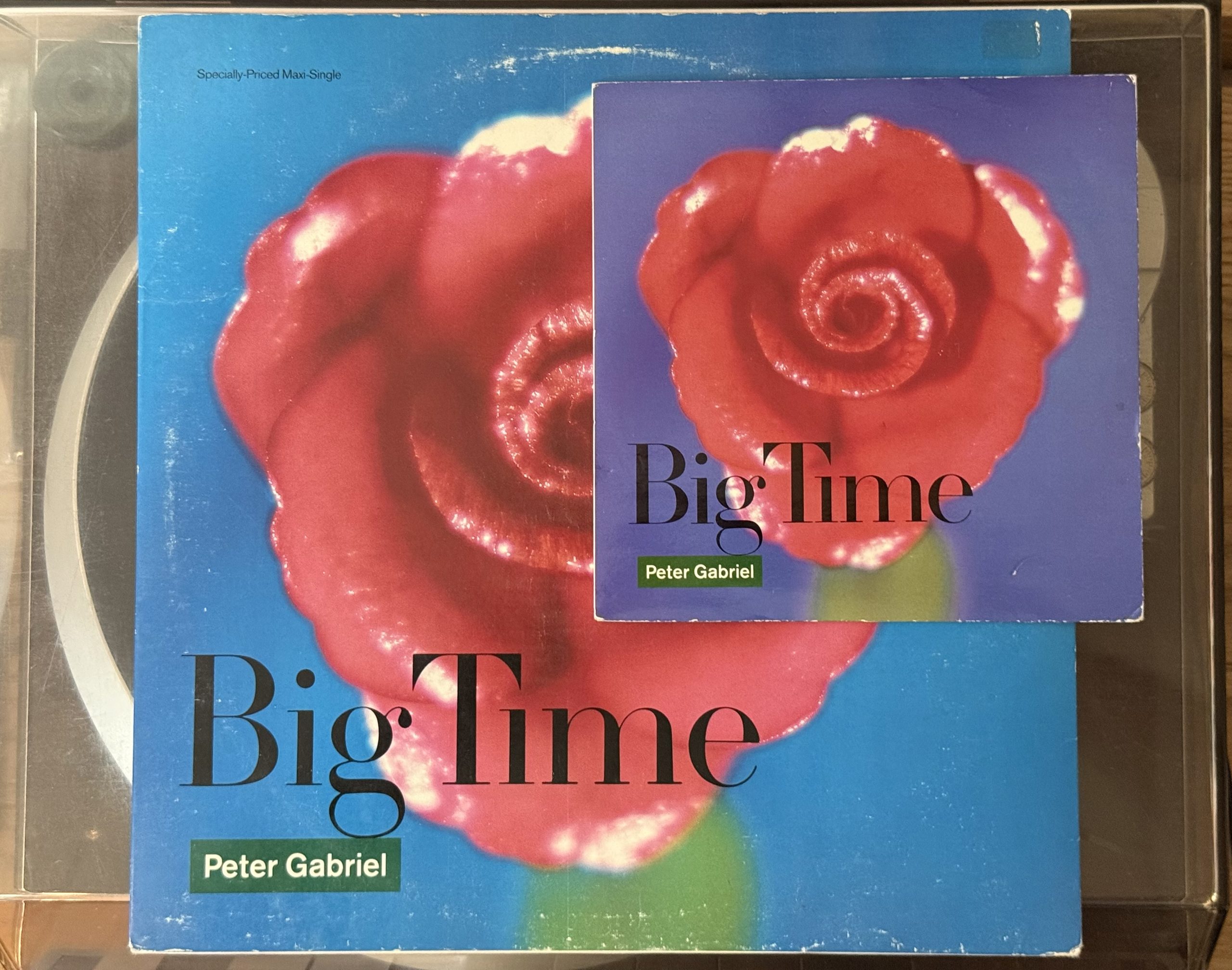
Peter Gabriel, Big Time

Peter’s singles provide a good excuse to linger in the world of “So” a little longer.

Album of the Week, May 23, 2026

The album cycle for Peter Gabriel’s So went on for quite a while. The first single, “Sledgehammer,” hit the streets on April 14, 1986, about a month before the album was released. There followed “In Your Eyes” in August, “Don’t Give Up” in October, “Big Time” in March 1987 and “Red Rain” in June.1 That’s a lot of releases, and by extension a lot of opportunities for B-sides.

I love B-sides.2 They’re a glimpse of what else was happening when the album was recorded (or, sometimes, some other album, as we’ll see today). Sometimes they illustrate where else a song could go. And sometimes they’re just dance mixes. And the great thing about there being huge markets for pop music in both the US and the UK is that sometimes you got completely different B-sides!

If the above discursion and the picture have led you to think that I’m using these facts to just talk about a bunch of Peter Gabriel rarities, you would be correct. I’m going to pull from three different releases of “Big Time”: the 12″ US single, the 7″ UK release, and the CD maxi-single, which is the one that I first owned back in the day. (Shhh.)

The 12″ opens with “Big Time (dance mix),” which is what it says on the tin. It’s mixed by Tom Lord-Alge, a recording engineer who had previously crossed paths with Peter on “No More Apartheid” on the Sun City compilation, and who had also engineered or mixed for the Force MDs, Jeff Beck, Southside Johnny and the Asbury Jukes, David Johansen, Sly Fox, Steve Winwood’s Back in the High Life, OMD’s “If You Leave,” and Billy Crystal’s “You Look Marvelous.” This cavalcade of 1980s sounds perhaps explains the low-end drum machine and handclaps that get spliced onto the beginning of the track. I do love the way that he pulls out and isolates Tony Levin (and Jerry Marotta)’s bass line at the beginning though, as well as letting us hear the nasty (in a good way) David Rhodes guitar riff without vocals over it. The verses are largely untouched—a little extra echo here, an extra-80s guitar in the texture there—but the chorus gets a spacey reinforcement on the backing vocals that’s almost dublike. This is kicked into high gear after the second verse, where it’s just backing vocals, drum machine, and Peter going “huh!” for about 30 seconds. As dance mixes go it’s relatively harmless but also fairly unimaginative.

In Your Eyes (special mix)” is an entirely different story. Produced by Bill Laswell and mixed by Jason Corsaro, the mix shuffles the key bits of the original recording, but also adds an entirely new opening featuring Peter singing over a low synth note, chiming thirds and fourths, and a hi-hat heartbeat: “Accepting all I’ve done and said / I want to stand and stare again / Til there’s nothing left out / All that remains there in your eyes.” The intro is punctuated by a brilliant vocal run by Youssou N’Dour, then the brilliant Ronnie Bright bass vocal. Youssou sings a bit in Wolof: “Sa bet chi lamp, chi tangaay, sa bet maangi ci biir,” meaning “Your eyes are lit, your eyes are bright, it’s in your eyes.” And then, when we think we’re going to get the verse, there’s instead an extended meditation with talking drums and synths, with more incredible Wolof vocals from Youssou and some vocalese from Peter. The chorus finally joins with even more Youssou vocals atop it. There’s an extended reverbful talking drum break, reminding us that Laswell has always been the king of dub. Somehow the complete absence of the verse pulls me into a trance listening to this mix—or maybe that’s just Youssou. This is a masterful mix and still holds up incredibly well, which is why it featured on one of my playlists years later. The twelve-inch single finishes with the album version of “We Do What We’re Told.”

The UK 7″ single, on the other hand, has a single B-side, “Curtains.” The composition here is reminiscent of Peter’s work on Birdy, but with more space around the edges. There’s an extended bit that is just a heartbeat of a talking drum with a tiny whoosh of a cymbal brush, and a panoply of synth textures giving the effect of opening doors, echoing caverns, distant bells, all leading to Peter’s vocals: “Oh, draw the blinds / we can shut out the night.” This is the most erotically direct of his love songs to this point, but even here love is filled with ambiguity and tinged with regret: “And there are lions on our curtains / They lick their wounds / They lick their doubt.” It’s a stunning miniature of a song, and I can only imagine what might have gone through the heads of the casual buyers of the single in 1987 when they flipped it over and listened to it.

“Curtains” also appears on the Big Time CD maxi-single, alongside the album version of “No Self Control.” It’s rounded out by “Across the River,” which was used as a mood-setting opener for the original 1982 WOMAD festival and which was recorded in the studio for the WOMAD benefit Music and Rhythm. It begins as an improvisation by Shankar and Peter, joined by David Rhodes, and then a thundering drum part from Stewart Copeland enters. I’ve always been captivated by the combinations of sounds, particularly the low notes from Shankar’s instrument (not a traditional Western violin), and have long wondered what a full album of collective improvisation from a group like this might have sounded like.

The relatively long period of time between Security and So, combined with Peter’s collaborations in WOMAD and with others, combined to make the experience of following the various offshoots from the album a rich musical journey. We’re going to continue following some of those connections for … well, for a while. Next week we’ll pick back up with one of those collaborators and listen to a unique live album.

BONUS: Peter brought “Across the River” back for his “Secret World Live” tour in the 1990s, with Shankar:

BONUS BONUS: A version of “Curtains” with extended vocals appears in the video game Myst IV, though I’m unsure if these were newly recorded or just an alternate take. Here’s a playthrough video showing the song in context:

Footnotes

  1. Making this the only Peter Gabriel album with a singles-to-non-singles ratio of greater than 2 to 1, regardless of whether you count the LP track listing with eight tracks or the CD with nine. ↩︎
  2. I don’t know if I have to spell this out after four years of writing about vinyl records, but just in case: songs played on the radio used to come on 7″ vinyl records that were played at a faster speed (45RPM rather than 33 1/3). The faster playback speed meant the grooves could be cut deeper for better dynamic range. The records had two sides: the A-side, aka the actual single, and the B-side, which was usually whatever the artist or the label felt like putting on there. ↩︎

Peter Gabriel, Peter Gabriel 2 (1978)

The second PG album finds him experimenting, with sometimes thrilling and sometimes uneven results.

Album of the Week, March 7, 2026

Looking back at Peter Gabriel’s career, some of the consistent themes are perfectionism and painstaking deliberation. We’re talking about a performer who went from 2002 (Up) until 2023 (I/O) — 21 years between releases of original music. (There was other music of merit in that period, but that’s a different story.) So it comes as a surprise to realize that Peter Gabriel’s second album was released only 15 months after his first. Almost all of that is due to his choice of producer for the second album: Robert Fripp.

Fripp was starting to transition in his career from sideman (most notably for David Bowie on “Heroes”) and leader of the intermittently active King Crimson to producer, on the strength of his ingenious guitar work and technological inventiveness (the unique “Frippertronics” system, the first live looping solution for performers, is the best known example). Peter was looking for a specific sound texture, and brought musicians to the record who could provide it, like the redoubtable Tony Levin, drummer Jerry Marotta, and synth player Larry Fast, all of whom would appear in more PG albums. He also admired Fripp’s more improvisational and brisk working methods; he’s said about the album, “Robert Fripp was very keen to try speeding up my recording process, as many people have been since and failed, but he got closest to it.”

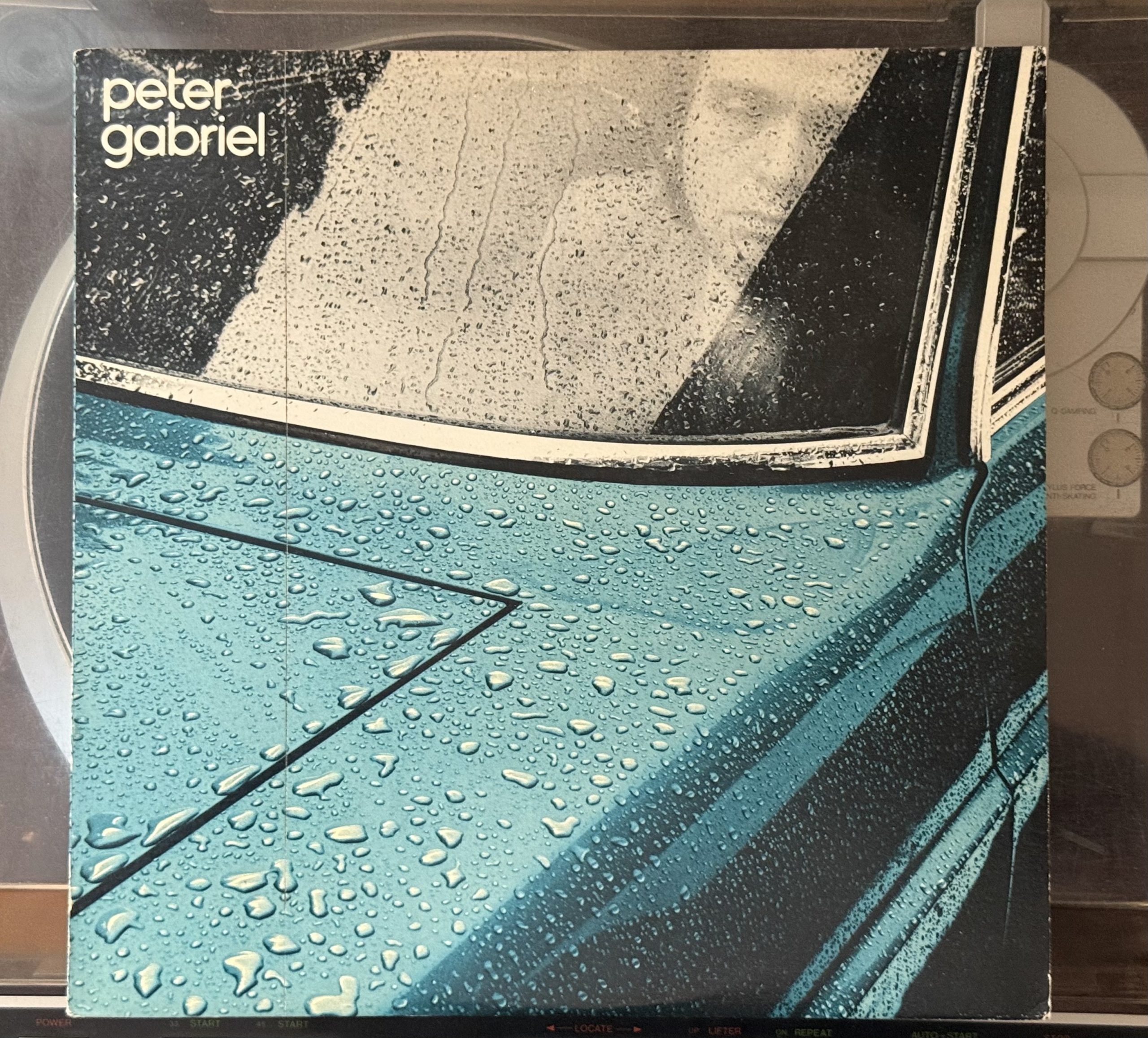
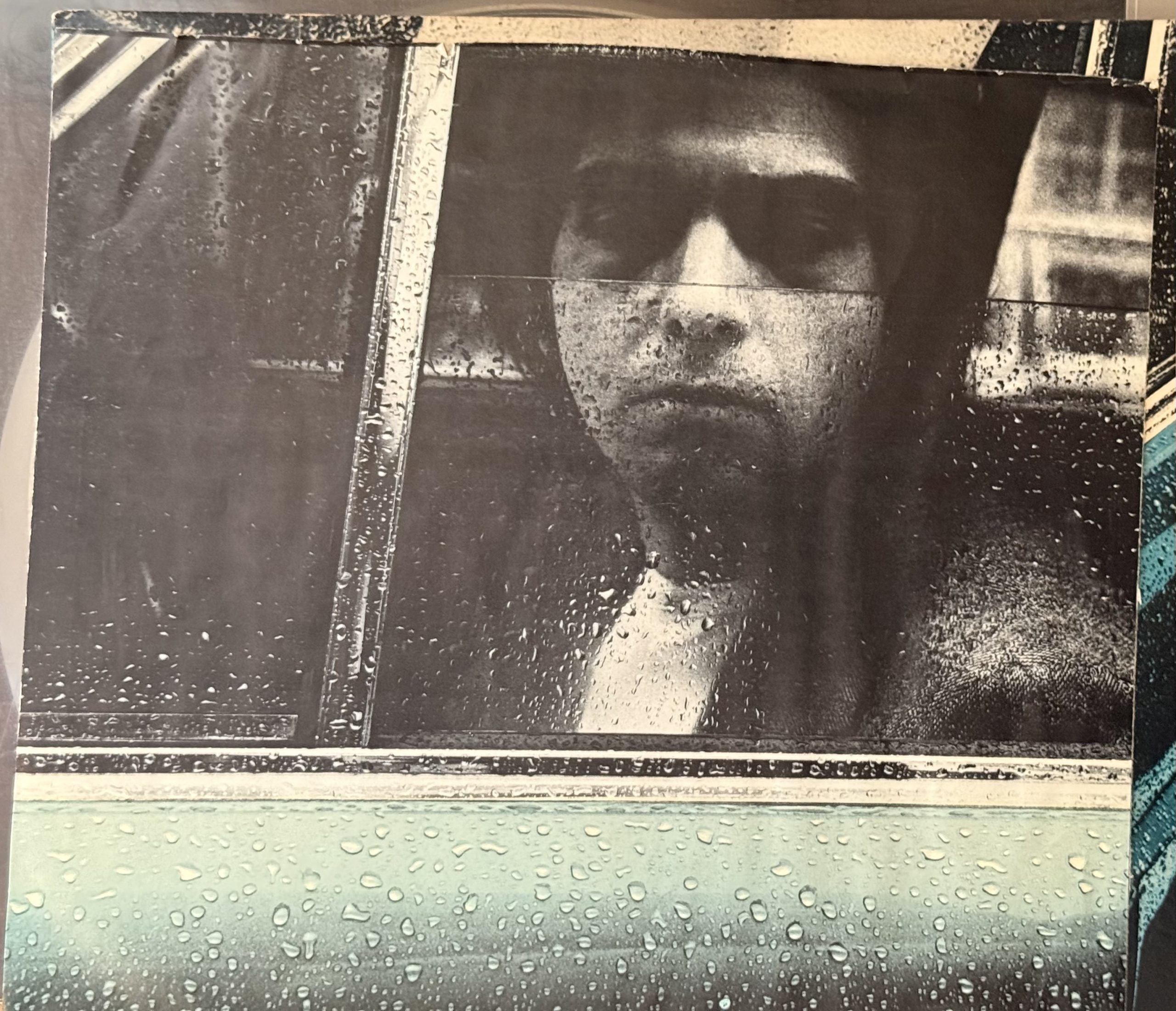
Unusually, the album is the second to be titled Peter Gabriel; Gabriel felt this allowed more attention to be paid to the album artwork by design house Hipgnosis (who also shot the “rainy windshield” on Peter Gabriel (1977)). I’ve also read that he thought of it almost like a magazine or periodical—“here’s the latest Peter Gabriel.” Looking at the entire discography, it’s clear he was never much of a fan of album titles, as we’ll see.

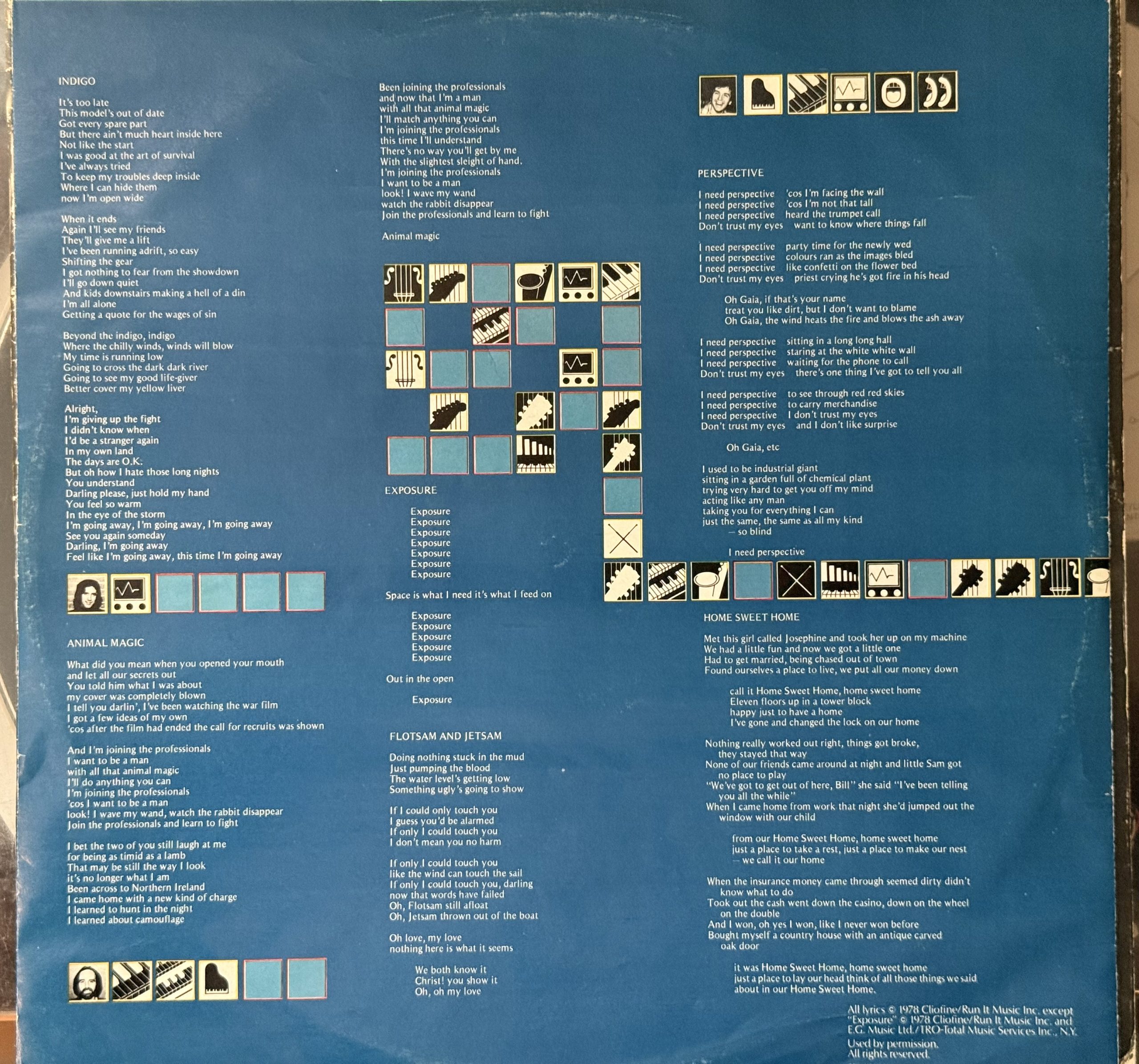
On the Air” starts in a very different sonic landscape from where PG1 left off. Bright synthesizer lines lead to muscular guitar and bass, backed up by the massive drums of Jerry Marotta. The song is a straightforwardly driving 4/4 until the chorus, which drops into 6/8 for a few bars. And the vocals, while rough—you can hear the strain in his high notes, and his sometimes sandy tenor sounds thin and scratchy—are exciting, especially as he soars up the lines of “on the air” in the chorus. Lyrically, the subject—Gabriel’s Mozo character building a radio transmitter so that he can project his psychic energy out to the world—is obscure but the writing is taut: “Built in the belly of junk by the river my cabin stands/Made from the trash, I dug off the heap with my own fair hands/Every night I’m back at the shack and I’m sure no one else is there/I’m putting the aerial up so I can go out on the air.”

D.I.Y.,” driven by a throbbing Tony Levin line on the Chapman Stick, is even more tautly wound. Gabriel says he was listening to punk and new wave at this time, and this song shows the influence even though it’s in 5/4 and has a complex chord change in the pre-chorus. It’s another song dealing with the aftermath of his time in Genesis: “You’re still looking for the resurrection/Come up to me with your ‘What did you say?’/And I’ll tell you, straight in the eye.” It’s short and pointed and a great song.

Mother of Violence” is the only song in Peter’s work with a writing credit by his then-wife Jill. It’s a quiet tune with unusual instrumentation—pedal steel, acoustic piano—and a vocal that sounds a bit like late-1970s Phil Collins and ends with vocalese. It’s all in service of a lyric about difficult family relationships that is one of the more fraught bits of writing on the album.

A Wonderful Day in a One-Way World” is an odd bit of a song, with a vocal that sounds a bit like a scratch take and a slightly proggy reggae feel, and a lyric that is reminiscent of some of the odder corners of Paul Simon, particularly in the dialog with the old man in the second verse. But it also has some of the better vocal harmonies on the album in the chorus, so that’s something in its favor at least. It’s followed with the frustratingly opaque “White Shadow,” which marries an instrumental track that could have been at home on late-1970s Genesis, circa …And Then There Were Three…. The first verse starts promisingly enough—“Ten coaches roll into the dust/Chrome windows turned to rust”—but then we’re rhyming “spirit died” with “Kentucky Fried.” Fripp’s guitar solo at the end is a thing of beauty, though, in duet with Tony Levin’s increasingly virtuosic bass, and there are hints of a synthesizer sound played by Peter that would become an increasingly familiar backdrop in his other albums.

Indigo” is a piano-driven ballad with recorder and pedal steel, a story of an elderly man coming to terms with his impending death. The track seems to have a bunch of different ideas that never quite cohere, but the vocal is one of the finer on the album technically, with properly prepared high notes and controlled dynamics adding to the emotional affect. That’s a contrast with “Animal Magic,” which has one of the rougher vocals on the album and a lyric about proving manhood by becoming a soldier, and an anonymous guitar solo that sounds a bit like generic ’70s rock.

Exposure,” though, is one of the key sonic pieces on the album. Driven by a mean locked in groove from Levin and Marotta, the main event here is the Frippertronics and Peter’s repeated chants of “exposure… space is what I need…” It’s the groove, though, that feels the most like a Peter Gabriel song, and we’ll hear it again in many other contexts.

Flotsam and Jetsam” is a song of lament for a failed relationship. It’s competently written but ultimately forgettable, thanks in part to indifferent vocal recording featuring one of the few instances of an echo or reverb on the album which only serves to underscore the brevity of the song. Peter seems rather in a hurry to get on to “Perspective,” which feels a bit like a downtown 1970s New York number complete with saxophone on the chorus and a repeated “I need perspective” on the verses. Gabriel sings from the perspective of an industrial businessman to his former lover, who may or may not be the earth (“Oh Gaia, if that’s your name/Treat you like dirt, but I don’t want to blame…”)

That leads us to “Home Sweet Home,” which frustratingly sums up all the off characteristics of this second album. The songwriting feels a bit like Peter’s version of Randy Newman (last heard on “Waiting for the Big One”), the pedal steel seems like we’re in a country song, and we have another one of the indifferently recorded scratch vocals. And it’s about a man whose wife commits suicide, killing his child at the same time; despairing, he gambled with the insurance check and won big, buying a country home far away from his eleventh floor walk-up. The last verse features one of Peter’s most challenging-to-listen-to vocals, as his high vocal obbligato provides an impression of the man’s wordless sobs. It feels dark in an exploitive way. We will get much more earned dark passages in future albums, but here it feels like he’s trying on someone else’s pain.

Ultimately 1978’s Peter Gabriel is a frustratingly uneven album. There are some great songs—both “On the Air” and “D.I.Y.” are in the canon of his greatest songs, and “Exposure” is affecting, but many of the others suffer from the rapid approach to recording and writing. He took more time on the next record, and it showed. We’ll listen to that one next time.

You can listen to this week’s album here:

BONUS: Fripp connected a series of albums that he produced in the late 1970s, including Peter Gabriel, Daryl Hall’s Sacred Songs, and his own debut solo album Exposure, as a loose trilogy. He re-recorded “Exposure” for the latter album, and it’s … really something, thanks to vocals by Terre Roche of the Roches:

BONUS BONUS: The band for this tour, with Sid McGinnis in for Fripp, was a tight machine. Here’s a German performance of “On the Air” from 1978 that shows Peter had been watching punk acts:

Peter Gabriel, Peter Gabriel 1 (1977)

A former prog-rock frontman steps out of the machinery and begins the long process of reinventing himself.

Album of the Week, February 28, 2026

In 1977, Peter Gabriel was preparing to put a new face forward. He was no stranger to the spotlight; the band he co-founded, Genesis, had released six albums, with their fifth, Selling England by the Pound, reaching Number 3 on the UK Albums chart. Gabriel, the band’s lead vocalist, had become the visible face of Genesis, with elaborate costumes and stage makeup; the rest of the band grew frustrated on the tour for their last album together, The Lamb Lies Down on Broadway, as fans would bypass the instrumentalists and go straight to Gabriel, praising his theatrics. On Lamb, Gabriel had wanted to tell a coherent story and had taken over writing all the lyrics, where prior songwriting had been more collaborative, raising tensions within the band. Furthermore, the tour for Lamb, consisting of 102 dates, had put a strain on Gabriel’s marriage to Jill Moore. It was time to move on, in other words.

Gabriel took a year off so that it wouldn’t be perceived that he had departed on bad terms. When his self-titled debut album arrived in February 1977, about a week before Mingus and his band entered the studio to start recording Three or Four Shades of Blues, it was a very different kind of record and a different sound than he had achieved with Genesis. Instead of an album-spanning narrative, there were episodes that focused on hallucinatory flashes of insight and personal connections. There was hard rock, arty carnival music, and twisted barbershop that sounded for all the world like Randy Newman. And there was a strange little ditty in 7/4 time.

The musicians weren’t really a band, just a quiverful of studio aces. Producer Bob Ezrin, who was previously known for producing such diverse artists as Alice Cooper (14 albums over the years including School’s Out and Welcome to My Nightmare), Lou Reed (Berlin), Aerosmith (Get Your Wings), Flo & Eddie’s self-titled album, and Kiss (Destroyer)—and later Pink Floyd’s The Wall, would seem to be an odd choice to produce the former Genesis frontman. Ezrin pulled together a group of mostly US studio musicians including guitarist Steve Hunter (who had worked with Ezrin with both Cooper and Reed), Dick Wagner (ditto, also a longtime Reed associate), synth artist Larry Fast, percussionist Jimmy Maelen, keyboardist Josef Chirowski, drummer Allan Schwartzman, and virtuoso bassist Tony Levin, who would go on to a nearly fifty-year career with Gabriel. To this mix Gabriel added King Crimson guitarist Robert Fripp, several months before he collaborated with David Bowie on “Heroes. The London Symphony Orchestra appeared on several tracks as well. A minimalist production this was not.

The opening of the album suggests that this may indeed be an exercise in rock and roll excess, but with a progressive-rock core. “Moribund the Burgermeister” opens with a quietly mysterious verse over squelchy synths, describing an outbreak of disease (possibly St. Vitus Dance) in a medieval village: “Caught the chaos in the market square/I don’t know what, I don’t know why/But something’s wrong down there/Their bodies twisting and turning in a thousand ways/The eyes all rolling ’round and ’round into a distant gaze…” But in the chorus everything swells, the symphony (or at least guitars and synths) enter, and suddenly we’re in the head of the titular burgermeister: “No one can tell/what all this is about/but I will find out.” There’s more than a hint of Dylan’s Mr. Jones in the burgermeister, a figure both threatening and ridiculous, the latter especially in the song’s long fade-out as Gabriel mutters, “I will find out… Mother, you know your son, and you know I will” in an affected deep voice.

And then “Solsbury Hill.” Arguably the most beloved of all Gabriel’s solo work and certainly a highlight of his early career, the twelve-string intro is sunshine and reflection, as Gabriel narrates a story that is either about his transition from Genesis to a solo career, or about a long-stranded extraterrestrial being rescued from a hilltop by his alien friends. Played in 7/4, the longer measures contribute to the sense of reflection, as well as a perpetual feeling of being slightly off-balance.1 It’s not just the 7/4 that contributes this impression; the focal beat shifts within the measure thanks to the dotted rhythm, keeping the listener in motion as Gabriel sings the greatest line ever written about going solo: “I was feeling part of the scenery/I walked right out of the machinery.” But leaving aside all the complex backstory and the prog-rock rhythms, it’s still a joyous anthem to freedom, and clear to see why it remains among his most popular songs.

Modern Love” feels more like it could have come out of another Ezrin production, albeit one with a love for odd metrical structures (the verse here is set with groups of three measures in common time — or one long 12/4 measure). It features a strenuous rock vocal from Peter, particularly on the chorus (“Ah, the pain! Modern love can be a strain”). According to Ezrin, this was method acting; he thought Gabriel’s vocal was too polite, so he asked engineer Brian Christian to take the musician up a ladder and duct-tape him to a pillar by his armpits to record the chorus vocal.

Excuse Me” is easily the oddest song on the album. Opening with a barbershop quartet arranged by Tony Levin and featuring Chirowski and Maelen alongside Levin and Gabriel, the song fairly quickly mutates into a British dance hall number, with a chorus vocal that could have been sung by Randy Newman (and only the second appearance in four years of columns of the Acme siren whistle). It’s weird, and maybe the best example of Gabriel’s free exploration of different sounds on the record, once he was freed from the constraints of Genesis.

Humdrum” feels a bit more like the band he left, if you disregard the samba. There’s a combination of a quiet intro, some Latin percussion which is interesting over the three-quarter time of the verse, odd backing instruments (harmonium!), and sweeping synthesizers on the chorus that take us into a swooning bridge and ultimately into a grand chorus, featuring a grandly disappointing lyric from Peter: “Out of woman comes a man/Spends the rest of his life getting back when he can.” This clunker aside, the rest of the song reads as a moving, if surreal (“Hey Valentina, you want me to beg? You got me cooking, I’m a hard boiled egg”) paean to love.

Slowburn” gives us a massive Ezrin rock banger that alternates massive verse and chorus orchestration with a pre-chorus that pulls way back to focus on Gabriel’s voice and the piano. The lyrics, seemingly about a relationship slowly being eroded by drugs and each other, are opaque, but they lean into that 1970s guitar sound that Steve Hunter did so well, particularly that diminished 6th that could have been a riff from any of Ezrin’s 1970s production. The song seems destined to be unfinished, going to an unresolved supertonic that fades into nothing, but then Peter returns with an unusually direct plea: “Don’t try to make it easy/It’ll cut you down to size/Darling, we’ve got to trust in something/We’re shooting down our skies…” A sort of clockwork instrumental coda really does fade out into nothingness, leaving the plea unanswered…

… because “Waiting for the Big One” is many strange things, but an answer to “Slowburn”’s direct plea it ain’t. It’s a blues, a barroom song, a showpiece for Ezrin’s hired guns to demonstrate their professionalism, the sound of a drunkard waiting at a bar for the end of the world. Peter’s Randy Newman impression is at its peak here; it’s not one of his finest vocal moments. The instrumental breaks are arguably the best thing about the song, and they’re replete with all the bombast Steve Hunter could summon.

The apocalypse finally arrives in “Down the Dolce Vita,” with chocka-chocka rhythm guitars, the London Symphony, and motifs of drowning amid repeated declarations that “You guys are crazy!” The song is patently part of a larger epic, with characters we never really meet (Aeron and Gotham) trying to charter a boat to make it out of the harbor of a fishing village in a storm. The orchestra adds thrilling musical tension to the number, but ultimately it’s a series of empty visions; the story is too obscure and we’re left to guess at what is happening.

Out of the chaos of “Dolce Vita” comes a sublimely quiet, sad moment. “Here Comes the Flood” revisits the summit of Peter’s apotheosis in “Solsbury Hill” but in a decidedly more apocalyptic mood. The jagged imagery—starfish stranded on a beach, an old trail along a seaside cliff, a nail sunk in a cloud—leads up to the third verse, in which Peter sings of an increase in cosmic energy accompanying the nighttime surge in shortwave radio strength that ultimately leads to the dissolving of barriers between minds and the creation of a mass psychic entity. But you don’t need to know any of that; all you need is the quiet prophetic despair in the chorus: “Ah, here comes the flood/we will say goodbye to flesh and blood/If again, the seas are silent, in any still alive/It’ll be those who gave their island to survive/Drink up, dreamers, you’re running dry.” The first recorded version of the song is full of patented Ezrin bombast, with triumphalist electric guitars and soaring strings, turning the vision into something somehow triumphant. Gabriel ultimately was unsatisfied with this version and recorded it several more times (as you’ll hear below).

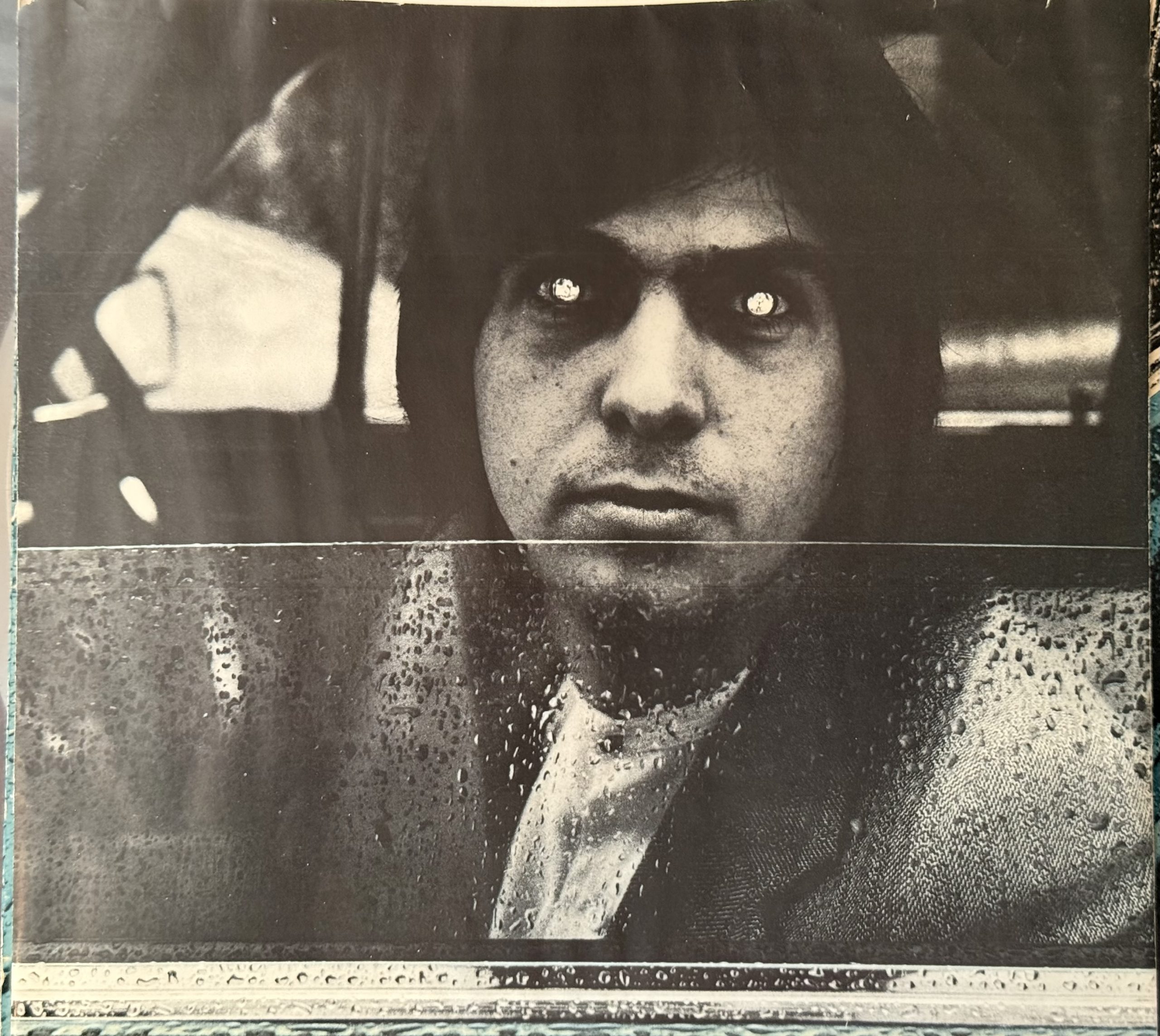
The uncanny metal eyeballs in the inner liner are courtesy a pair of mirrored contact lenses.

Part of the impenetrability of the second half of the album is that we’re only getting fragments of a larger story that Gabriel himself hardly knew. The being who catalyzed the departure of the boats and heralded the arrival of mass consciousness was a character called Mozo, a Mosaic figure who didn’t save people so much as inadvertently bring about massive change. Peter played with the narrative for years but never got it into a coherent shape; that never stopped him from including Mozo in several of his early songs. We’ll hear one of those next time.

You can listen to this week’s album here:

BONUS: Gabriel almost immediately re-recorded “Here Comes the Flood,” this time with Robert Fripp on Fripp’s 1978 album Exposure. This version still has a little of the bombast of the Ezrin version, thanks to Gabriel’s taking the later choruses an octave up, but generally the energy level of the song is more introspective:

BONUS BONUS: In 1978, Peter paid a special visit to Kate Bush on her BBC television Christmas special (which is a good topic for an entirely different post), and stole the show with this stripped down piano and vocal version of “Here Comes the Flood”:

BONUS BONUS BONUS: As any good child of the 1980s knows, Peter did another studio recording of “Flood” for his first greatest hits compilation, 1990’s Shaking the Tree. This one features a freer melody on the verse and is somehow even more pathos-filled:

  1. I’m reminded of Peter Schickele’s line about P.D.Q. Bach’s waltz music, which “suggests that one of his legs was shorter than the other.” ↩︎