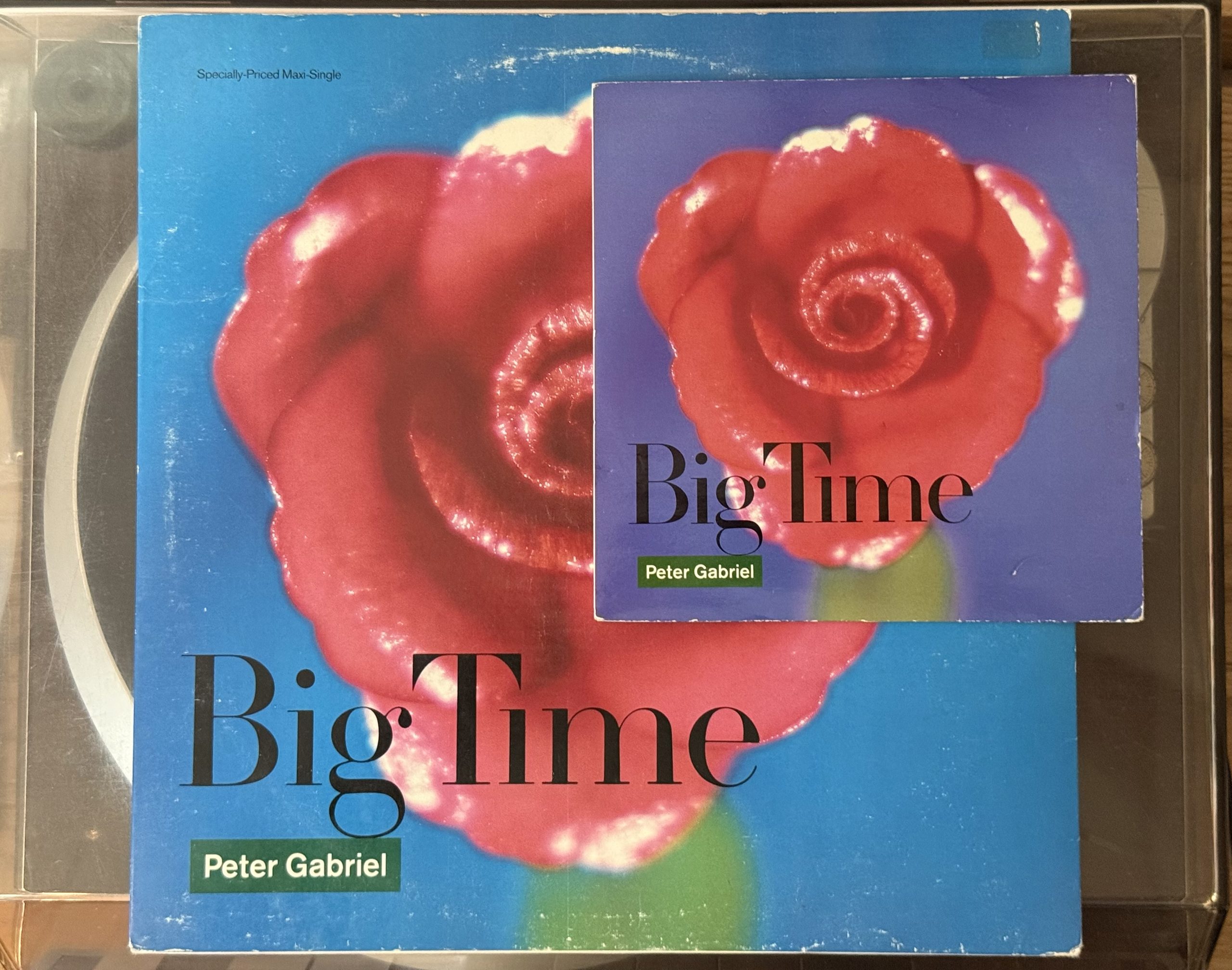
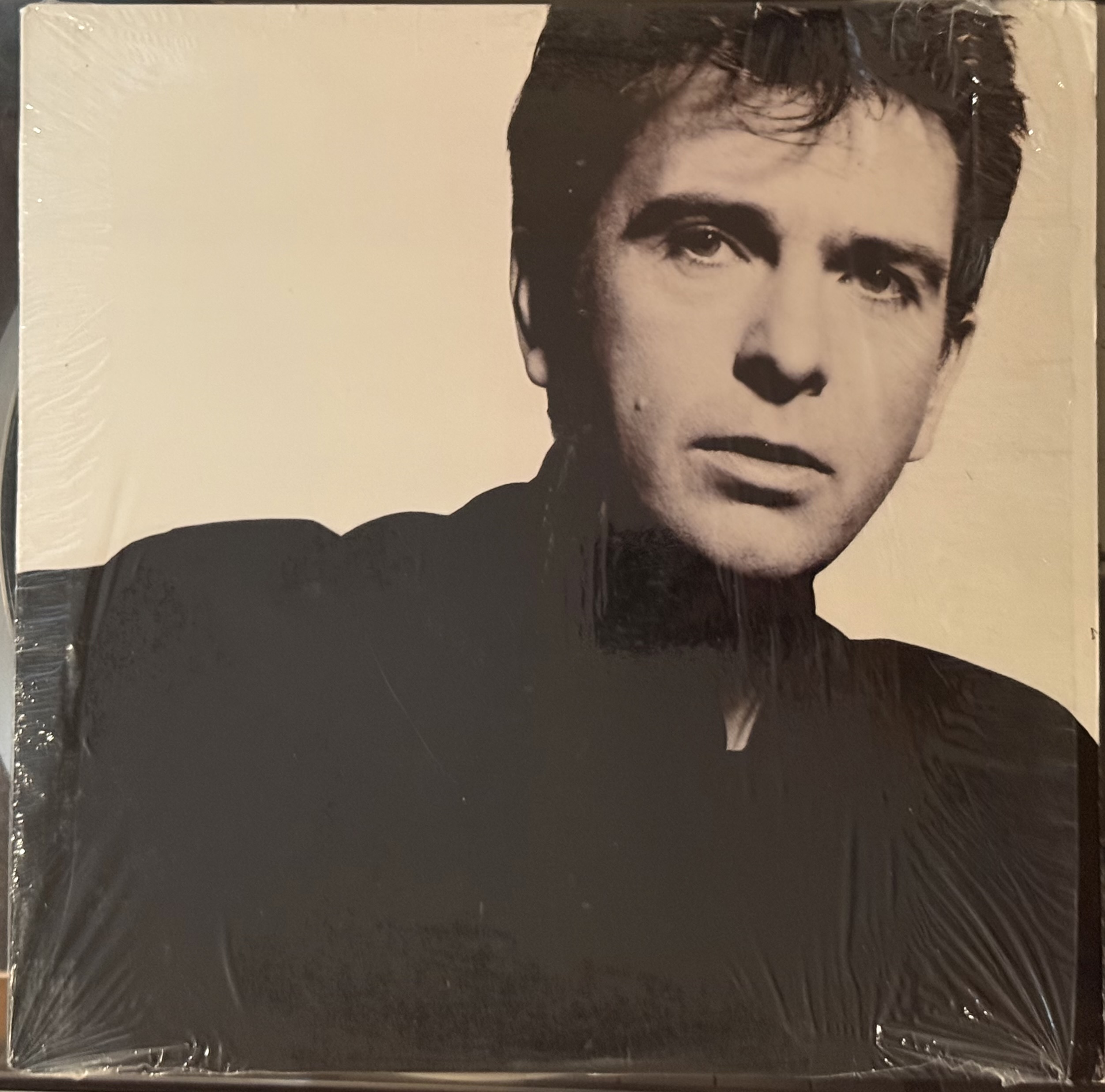
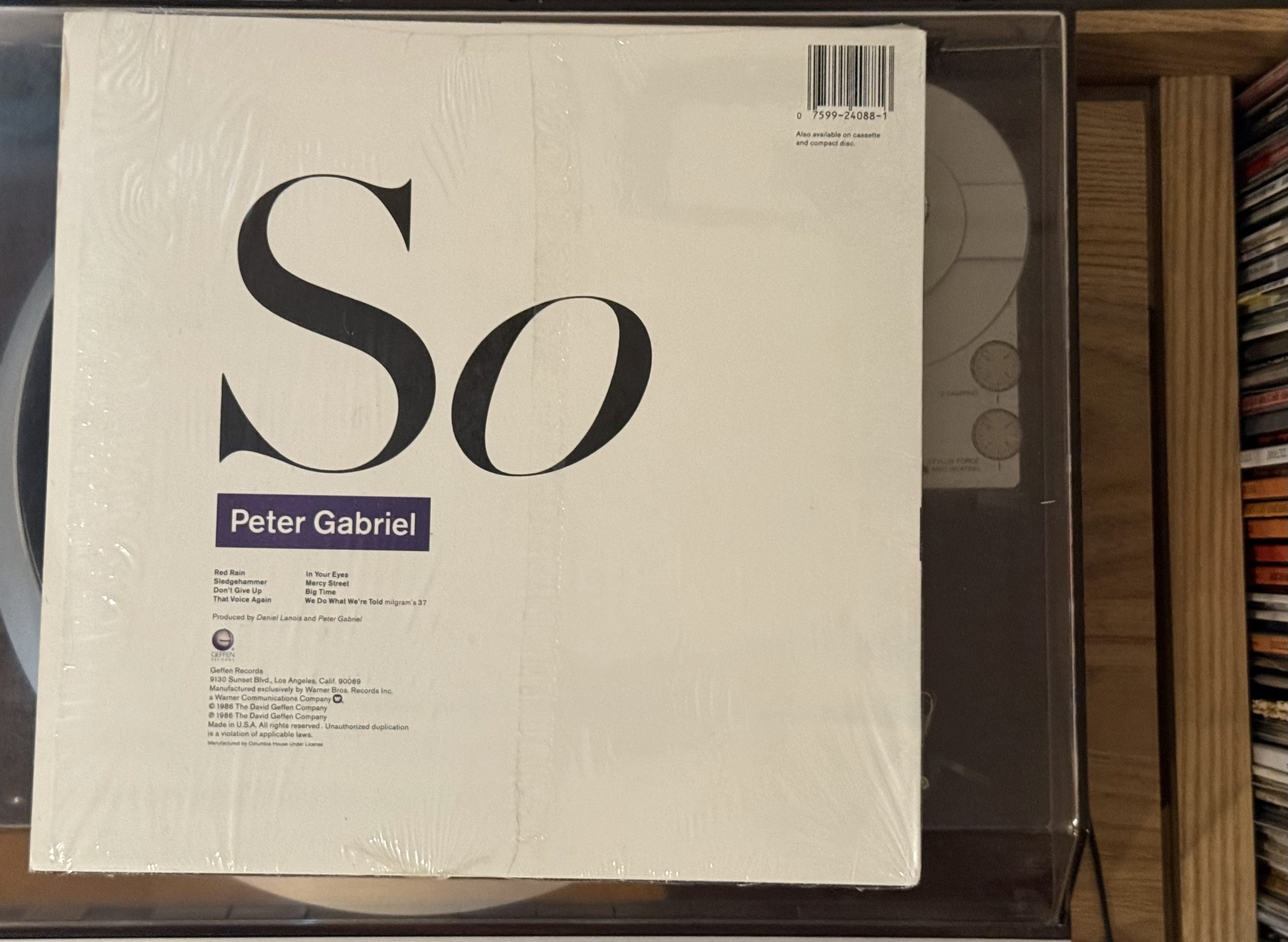
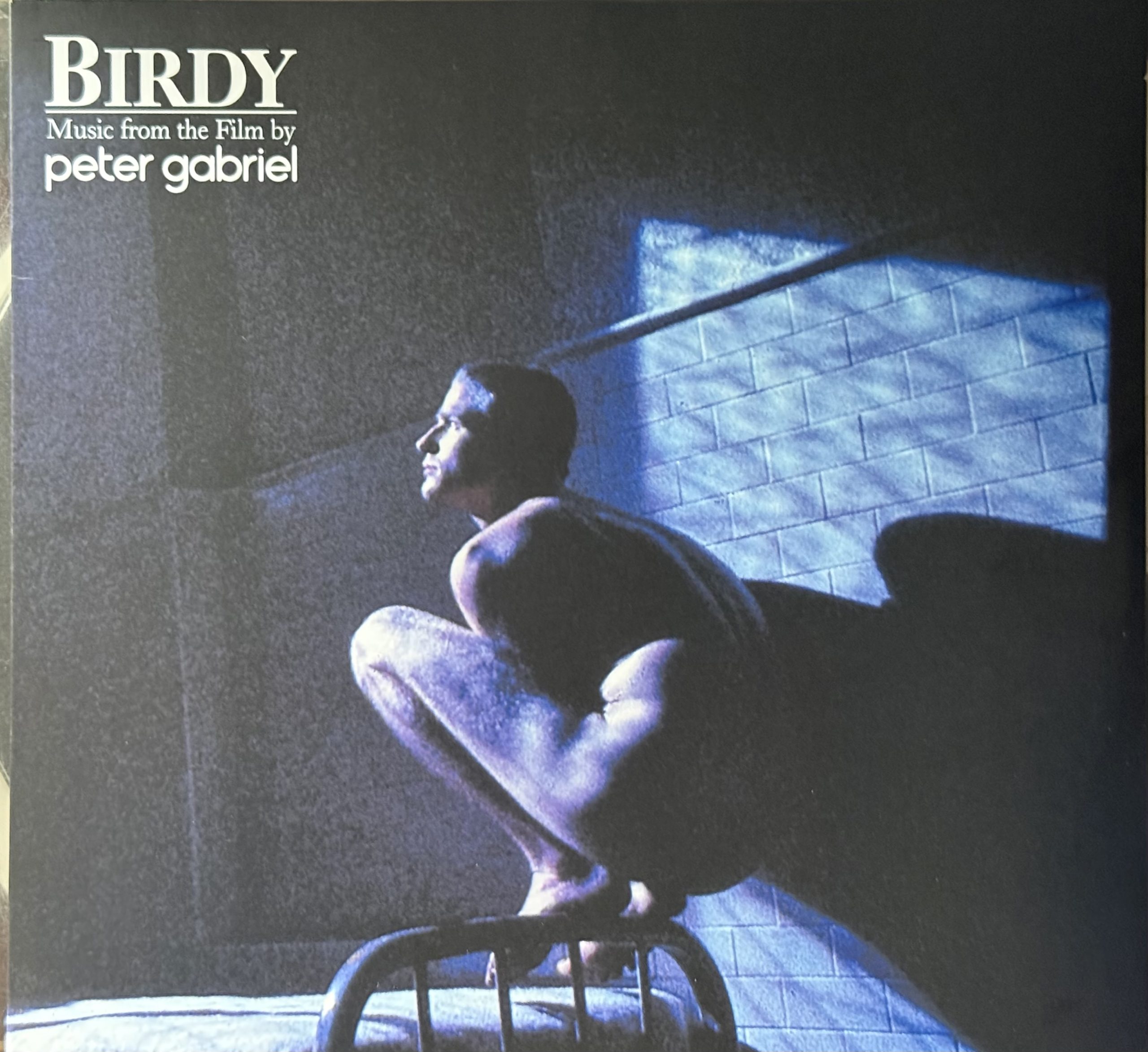
Peter’s singles provide a good excuse to linger in the world of “So” a little longer.
Album of the Week, May 23, 2026
The album cycle for Peter Gabriel’s So went on for quite a while. The first single, “Sledgehammer,” hit the streets on April 14, 1986, about a month before the album was released. There followed “In Your Eyes” in August, “Don’t Give Up” in October, “Big Time” in March 1987 and “Red Rain” in June.1 That’s a lot of releases, and by extension a lot of opportunities for B-sides.
I love B-sides.2 They’re a glimpse of what else was happening when the album was recorded (or, sometimes, some other album, as we’ll see today). Sometimes they illustrate where else a song could go. And sometimes they’re just dance mixes. And the great thing about there being huge markets for pop music in both the US and the UK is that sometimes you got completely different B-sides!
If the above discursion and the picture have led you to think that I’m using these facts to just talk about a bunch of Peter Gabriel rarities, you would be correct. I’m going to pull from three different releases of “Big Time”: the 12″ US single, the 7″ UK release, and the CD maxi-single, which is the one that I first owned back in the day. (Shhh.)
The 12″ opens with “Big Time (dance mix),” which is what it says on the tin. It’s mixed by Tom Lord-Alge, a recording engineer who had previously crossed paths with Peter on “No More Apartheid” on the Sun City compilation, and who had also engineered or mixed for the Force MDs, Jeff Beck, Southside Johnny and the Asbury Jukes, David Johansen, Sly Fox, Steve Winwood’s Back in the High Life, OMD’s “If You Leave,” and Billy Crystal’s “You Look Marvelous.” This cavalcade of 1980s sounds perhaps explains the low-end drum machine and handclaps that get spliced onto the beginning of the track. I do love the way that he pulls out and isolates Tony Levin (and Jerry Marotta)’s bass line at the beginning though, as well as letting us hear the nasty (in a good way) David Rhodes guitar riff without vocals over it. The verses are largely untouched—a little extra echo here, an extra-80s guitar in the texture there—but the chorus gets a spacey reinforcement on the backing vocals that’s almost dublike. This is kicked into high gear after the second verse, where it’s just backing vocals, drum machine, and Peter going “huh!” for about 30 seconds. As dance mixes go it’s relatively harmless but also fairly unimaginative.
“In Your Eyes (special mix)” is an entirely different story. Produced by Bill Laswell and mixed by Jason Corsaro, the mix shuffles the key bits of the original recording, but also adds an entirely new opening featuring Peter singing over a low synth note, chiming thirds and fourths, and a hi-hat heartbeat: “Accepting all I’ve done and said / I want to stand and stare again / Til there’s nothing left out / All that remains there in your eyes.” The intro is punctuated by a brilliant vocal run by Youssou N’Dour, then the brilliant Ronnie Bright bass vocal. Youssou sings a bit in Wolof: “Sa bet chi lamp, chi tangaay, sa bet maangi ci biir,” meaning “Your eyes are lit, your eyes are bright, it’s in your eyes.” And then, when we think we’re going to get the verse, there’s instead an extended meditation with talking drums and synths, with more incredible Wolof vocals from Youssou and some vocalese from Peter. The chorus finally joins with even more Youssou vocals atop it. There’s an extended reverbful talking drum break, reminding us that Laswell has always been the king of dub. Somehow the complete absence of the verse pulls me into a trance listening to this mix—or maybe that’s just Youssou. This is a masterful mix and still holds up incredibly well, which is why it featured on one of my playlists years later. The twelve-inch single finishes with the album version of “We Do What We’re Told.”
The UK 7″ single, on the other hand, has a single B-side, “Curtains.” The composition here is reminiscent of Peter’s work on Birdy, but with more space around the edges. There’s an extended bit that is just a heartbeat of a talking drum with a tiny whoosh of a cymbal brush, and a panoply of synth textures giving the effect of opening doors, echoing caverns, distant bells, all leading to Peter’s vocals: “Oh, draw the blinds / we can shut out the night.” This is the most erotically direct of his love songs to this point, but even here love is filled with ambiguity and tinged with regret: “And there are lions on our curtains / They lick their wounds / They lick their doubt.” It’s a stunning miniature of a song, and I can only imagine what might have gone through the heads of the casual buyers of the single in 1987 when they flipped it over and listened to it.
“Curtains” also appears on the Big Time CD maxi-single, alongside the album version of “No Self Control.” It’s rounded out by “Across the River,” which was used as a mood-setting opener for the original 1982 WOMAD festival and which was recorded in the studio for the WOMAD benefit Music and Rhythm. It begins as an improvisation by Shankar and Peter, joined by David Rhodes, and then a thundering drum part from Stewart Copeland enters. I’ve always been captivated by the combinations of sounds, particularly the low notes from Shankar’s instrument (not a traditional Western violin), and have long wondered what a full album of collective improvisation from a group like this might have sounded like.
The relatively long period of time between Security and So, combined with Peter’s collaborations in WOMAD and with others, combined to make the experience of following the various offshoots from the album a rich musical journey. We’re going to continue following some of those connections for … well, for a while. Next week we’ll pick back up with one of those collaborators and listen to a unique live album.
BONUS: Peter brought “Across the River” back for his “Secret World Live” tour in the 1990s, with Shankar:
BONUS BONUS: A version of “Curtains” with extended vocals appears in the video game Myst IV, though I’m unsure if these were newly recorded or just an alternate take. Here’s a playthrough video showing the song in context:
Footnotes
Making this the only Peter Gabriel album with a singles-to-non-singles ratio of greater than 2 to 1, regardless of whether you count the LP track listing with eight tracks or the CD with nine. ↩︎
I don’t know if I have to spell this out after four years of writing about vinyl records, but just in case: songs played on the radio used to come on 7″ vinyl records that were played at a faster speed (45RPM rather than 33 1/3). The faster playback speed meant the grooves could be cut deeper for better dynamic range. The records had two sides: the A-side, aka the actual single, and the B-side, which was usually whatever the artist or the label felt like putting on there. ↩︎
The bestselling 1986 album seamlessly melds art and pop and marks Peter’s transition to a top tier star.
Album of the Week, May 16, 2026
It’s a challenge to approach an album like So. Easily Peter Gabriel’s most popular album, arguably one of the most talked about and best albums of the 1980s, and it’s not like it’s obscure. But, like the songs themselves, the album is made of layers upon layers, and that’s where our tale begins.
In fact, let’s begin at the beginning. Following the 1982 release of Security and the subsequent tour, you’d be forgiven for thinking that Peter took some time off, save for the soundtrack to Alan Paton’s film Birdy. In fact, he was recording the whole time. The years 1983–1985 were surprisingly fertile given that there was no official album released. In fact, there’s a rich batch of soundtrack appearances from this period, as well as non-album studio tracks: “Walk Through the Fire” (from Against All Odds),1 the studio version of “I Go Swimming,” “Across the River” (a collaboration with Indian violinist L. Shankar and Stewart Copeland), his song “No More Apartheid” from the 1985 Sun City compilation, and of course “Out Out,” Peter’s contribution to the Gremlins soundtrack.2 Unfortunately, around this time Peter’s long-term UK label, Charisma, was being acquired by Virgin Records. Ultimately the acquisition settled out and Charisma/Virgin continued to release Peter’s albums in the UK while Geffen handled releases in the rest of the world, but in the dust of the acquisition some of the wind went out of the sails of a new album.
But his creative juices were still flowing. So in February of 1985 Peter retreated to the recording studio at Ashcombe House, where he had recorded since 1978, and began laying down tracks. He considered working with a number of producers for the album, including Bill Laswell (whom he had crossed paths with in the making of the Laurie Anderson collaboration “Excellent Birds”) and Nile Rodgers, but ultimately decided to stick with Daniel Lanois, his collaborator from Birdy. It would prove a fruitful choice; not only was Lanois an expert in producing the combination of organic and atmospheric sounds that Peter was striving to produce, but he was also surprisingly adept at forcing the famously digressive Peter to finish work. My favorite anecdote: at one point Lanois resorted to locking Peter inside the studio so that he would finish a vocal. Peter wrote the core tracks of the songs with Lanois and guitarist David Rhodes from sketches that he produced using the Prophet-5 polyphonic synthesizer or his Yamaha piano, along with a Linn drum machine. Using this method, Peter built songs up from melodic ideas with nonsense vocal syllables to fully fledged songs, having the trio improvise with his rough demos in their headphones, bouncing the trio recordings into the headphones to bring in the larger band, and so on.
The larger band was built around familiar collaborators—Tony Levin, Jerry Marotta—and French drummer Manu Katché (who would follow this session with Sting’s …Nothing Like the Sun). A host of others would make appearances on the album, most on one or two tracks: Chris Hughes, fresh off producing Tears for Fears’ Songs from the Big Chair; Copeland; Shankar; trumpeter Wayne Jackson from the Stax Records backing band the Bar-Keys; saxophonist Mark Rivera from Billy Joel’s band; pianist Richard Tee, whom we’ve previously seen playing with Hubert Laws and Ron Carter on CTI Records; and guest vocalists Laurie Anderson, Kate Bush, and Youssou N’Dour. The last was a superstar in his native Senegal, but was yet to break out in the consciousness of the broader world; that was about to change.
“Red Rain” opens the album on a massive note, with an indelible riff on the hi-hat from Stewart Copeland and an echo of a keyboard line, then a massive chord through which Tony Levin’s indelible bass snakes. Peter’s apocalyptic lyrics sing of a dream of a rain that covers all those around, imagery that dates back to some of his earliest writings; in fact, the image is the one of the last remnants of the Mozo mythology that had previously informed “Down the Dolce Vita,” “Here Comes the Flood,” and “On the Air.” But Mozo aside, the song also features some deeply personal writing. His marriage to Jill Moore was falling apart—strained by his touring, she was unfaithful, and the resulting divorce sent Peter into a deep depression and to six years of therapy. It’s hard not to read lines like “I come to you, defenses down / with the trust of a child” and “Red rain is coming down all over me / I’m begging you” knowing this context without thinking of metaphors for accusations and retribution.
From the sublime to … “Sledgehammer,” easily Gabriel’s most-remembered song, thanks in no small measure to its innovative Claymation video and unsubtle but good-natured phallic imagery, as well as to the horn section, a first for a Gabriel album. Peter has explicitly called out the song as an homage to Stax-Volt soul singles, an early source of musical inspiration for him, to the point that he asked Wayne Jackson, who as a member of the Mar-Keys played behind Peter’s hero Otis Redding, to assemble the horns for the track, which included Rivera and trombonist Don Mikkelsen, who had played with Ann-Margret and in Louie Bellson’s band. There’s what sounds like a Hammond B-3 organ on the track, which is actually played on Peter’s Prophet-5 synthesizer, and a weird synthetic flute sound, which Peter plays on the E-mu Emulator II, a sampling synthesizer beloved by acts as diverse as Stevie Wonder, Belgian electronic band Front 242, Depeche Mode, and the Pet Shop Boys. The track is tremendous fun, thanks in no small part to its bouncy rhythm section courtesy Levin and Katché, who was literally getting on a bus to the airport when Peter encouraged him to stick around and help re-record the track from its original foundation, which had featured drummer Chester Thompson.
“Don’t Give Up” is another complete stylistic pivot, a hard-luck song constructed in response to Dorothea Lange photographs of starving farmers from the American Depression. It was built around a rhythmic part that Peter transferred from tuned drums to a Tony Levin bassline; Tony achieved a more muted sound by the expedient of placing a diaper that he had packed in his gig bag for his two-month-old child beneath the strings. The track is moving enough, but when the chorus comes and Kate Bush sings “Don’t give up, you still have … friends,” it enters spine-tingling territory. The song changes lives; both Elton John and the late Matthew Perry at different times credited the bridge’s lyric “Rest your head, you worry too much / It’s gonna be all right / When times get rough, you can fall back on us” with encouraging them in sobriety. And Richard Tee’s gospel piano on the second bridge similarly elevates the song to a different place. It was always conceived as a man-woman duet, though originally Peter had Dolly Parton in mind; now it’s hard to imagine the song without Kate’s contributions. This is particularly true with the video, which features Peter and Kate embracing each other and singing the song for the entire video as the sun rises and falls in the background. Though Peter asked Jill’s permission before embarking on the shoot, the video ultimately did not help their marriage.
“That Voice Again” has its origins in Peter’s efforts to write the soundtrack for Martin Scorcese’s The Last Temptation of Christ, believe it or not. Originally the lyrics were written about judgment and Christ’s commandment “Let him who is without sin cast the first stone,” but over several rewrites it became about the inner judgmental voice that “either helps or defeats us.” It is also the very last Mozo song, with the judgmental voice somehow fitting into Peter’s alchemical narrative. Twelve-string guitar from Lanois (the first time that instrument appeared on a Gabriel album since “Solsbury Hill”) and an elaborate drum part from Katché fill out the arrangement.
“In Your Eyes” is a pure love ballad, a form that Peter rarely essayed prior to So. It has several key features in the arrangement: Richard Tee’s piano, a soaring pre-chorus (that “I reach out from the inside” segueing into the wordless vocal bridge always hits me right in the feels), and Youssou N’Dour. That a previously-unknown-to-Westerners Senegalese vocalist would be the secret weapon of this track would seem unusual, especially given the Who’s Who of backup singers also appearing on the track—which included Simple Minds’ Jim Kerr, The Call’s Michael Been, and doo-wop singer Ronnie Bright, who performed the bass vocals on the classic song “Mr. Bass Man.” But that’s only if you don’t reckon with Youssou’s voice; a soaring, resonant instrument with bright edges that spans multiple octaves with heldentenor intensity and is comfortable in Wolof, French and English. More than any other track on the album, the arrangement for “In Your Eyes” is fluid, and live versions and remixes play with the running order of the song; we’ll hear an example of that another time. As a listener who fell in love with the album in 1986, the song sits at Number 5 in the running order for me, but Peter originally intended it to end the album; the limitations of the vinyl format, which made reproducing the low bass tones in the inner grooves a challenge, switched it to start Side Two.
“Mercy Street” is another of the songs on the albums about which I have difficulty being objective. The song introduced me to the writings of Anne Sexton, whose poetry (particularly 45 Mercy Street and The Awful Rowing Toward God) inspired the song. The song is built around a track by Brazilian percussionist Djalma Corrêa, who provided surdo, congas and triangle in a traditional Brazilian forró rhythm. (A different set of track by Corrêa provided the basis for “Don’t Break This Rhythm”, which became the b-side to “Sledgehammer.”) The arrangement, though uncluttered on the album, was painstakingly constructed, with piano parts from Richard Tee added and then removed, a Fairlight CMI-based melody played by Peter by hand instead of sequenced for a more human feeling, and double-tracked vocals, with the lower octave achieved by having Peter stay up all night at the studio and doing a single take at 7am when he was at his most fatigued. All this is in support of a jewel of a song, with bits of Sexton’s poetry turned into a stream-of-consciousness lyric full of confessional details, anchored around the desperate search for home: “Dreaming of Mercy Street / Wear your inside out / Looking for mercy / In your daddy’s arms again.” The final coda lends finality to the searching and despair in the song as Peter turns to images from Sexton’s posthumous book: “Anne with her father is out in the boat / Riding the water, riding the waves / On the sea.” A slightly extended version of the track was used for the official video.
“Big Time” is the other “overtly commercial” track on the album. The horn section from “Sledgehammer” returns over a rhythm track that was notoriously difficult to record; Tony Levin’s bass part was achieved by having Tony finger the notes on the fretboard while Jerry Marotta hit the strings with his drumsticks to achieve a percussion effect, while Stewart Copeland’s ingenious hits and fills didn’t exactly line up with the drum machine, so engineer Kevin Killen sampled his track and created the percussion from the samples. Former Ikette P. P. Arnold led the backing singers, and Peter’s Prophet-5 faux-Hammond organ returned. Where the phallic imagery in “Sledgehammer” is playful, here it’s sardonic, as Peter dismantles the consumerist mentality of the 1980s and ties it to the drive to overcompensate, a point brought home by the closing lyric: “Look at my circumstance / And the bulge in my big, big, big, big, big, big, big, big, big, big, big, big, big, big, big.”
The transition into “We Do What We’re Told (Milgram’s 37)” is abrupt and icy. The song, reminiscent of “Lead a Normal Life,” is mostly constructed around Peter’s synthesizers, with David Rhodes’ guitar and L. Shankar’s violin contributing to the texture over a beat from Jerry Marotta; many of the sounds, including Peter’s vocals, were processed through the Fairlight for extra texture. Peter wrote the lyrics as an attempt to process the results of Stanley Milgram’s experiments in authoritarian behavior, in which 37 of 40 participants continued to administer higher and higher levels of electric shocks to unseen subjects when encouraged to do so by their peers. The repeated “We do what we’re told” lyric repeats like a mantra, expressing the impulse to conformity that drove the awful behavior of the participants. Some listeners found this song the only part of So to their tastes; however one felt, it’s undeniably a direct link to the themes and preoccupations of 1980’s Peter Gabriel 3 (Melt), and in fact the song originated in those sessions.
“This is the Picture (Excellent Birds),” which appears on modern LP versions of the album but not the original, is a re-think of Peter’s 1984 collaboration with Laurie Anderson from Mister Heartbreak, with the groove (including an added talking drum from Manu Katché) brought to the fore and some elements (like Laurie’s idiosyncratic synth line) removed. My poor mother could never get Peter’s word choice in the song; hearing it in my childhood home as I was listening, she asked me not to listen to it again as the line about “bitches of evil” made her uncomfortable. (This was, of course, a mondegreen for “I see pictures of people.”)
It’s hard to overstate how huge So was. Quintuple platinum album sales, Number One on the UK album chart and Number Two on the US, a number one Billboard Top 200 spot (“Sledgehammer”) and nine MTV Video Music Awards (also “Sledgehammer”), number one on Billboard’s Album Rock chart (“In Your Eyes”), top 10 singles in the UK (“Don’t Give Up”) and US (“Big Time”), and number 3 on the Mainstream Rock chart (“Red Rain”). It launched Youssou N’Dour to worldwide fame, further raised the profile of Kate Bush, and most of all completed the transformation of Peter Gabriel from a niche artist for fans of progressive and experimental rock, to a pop artist with serious artistic and experimental bona fides. Because of the album’s long gestation and long singles cycle, many interesting tracks were released alongside as b-sides; we’ll linger in this album’s shadow a bit next week to listen to some of those.
You can listen to this week’s album here, in the original 1986 track order but including “This is the Picture (Excellent Birds)” in its spot on the original CD running order. This is controversial. Ever since 2002, Peter has preferred a revised running order that puts “In Your Eyes” last on side two.
BONUS: Peter’s So sessions sprawled across many months and there were a few songs that were recorded that never made it to the album, or even as a b-side. When the 25th anniversary of the album was released as a box set in 2011, Peter polished up a few of these songs. “Courage” is pretty great! It was released as a 12″ 45 single in the box set, with “Sagrada” and an alternative mix of “Don’t Give Up” as b-sides.
BONUS BONUS: There are a lot of live performances of these songs; they essentially form the core of Peter’s touring repertoire for the rest of his career. But the ones featuring the original performers, such as this 1987 live version of “Don’t Give Up” with Kate Bush, are special. Even if it is an audio-only cleaned-up bootleg:
BONUS BONUS BONUS: “In Your Eyes” was made newly famous through its use in the John Cusack/Ione Skye movie Say Anything, in a scene that is engraved in the hearts of otherwise-cynical GenX kids everywhere:
BONUS X4: The version of “Mercy Street” that was performed in Peter’s 1987 concert in Athens, Greece has always pierced me to the heart, with Peter singing from curled and crouched positions to echo the anguish of the lyrics:
Footnotes
I know that I probably just put the Phil Collins title song from that movie into your head. You’re welcome. ↩︎
We’ll talk about some of Peter’s other soundtrack work another time. ↩︎
Peter Gabriel’s first soundtrack album leans heavily on his past while pointing to the future.
Album of the Week, April 25, 2026
Peter Gabriel has always been an arty performer. From his earliest days in Genesis he leveraged visual presentation to make a bigger impact (think the fox head on Foxtrot, or the flower costume). And we’ve seen how visuals continued to be important with his solo work all the way up through Peter Gabriel 4 and “Shock the Monkey.” So it comes as no surprise that he was attracted to the art of making movie soundtracks. (He’s said on his on website, “I’ve always loved film music and at age seventeen I had the choice to go to the London School of Film Technique or following a career as a musician, and it was quite a difficult decision for me. Ever since, I’ve always wanted to work more in film, not so much at the acting end of it, but more in the creating side.”) That he started doing film soundtracks should not surprise the listener, but how familiar it sounds just might.
Gabriel also notes that he’s “notoriously slow,” which is difficult to reconcile with the time pressures associated with scoring a film. The solution for Birdy was to reuse already-recorded tracks, as well as adding new numbers that he could develop on the Fairlight. For the latter, he got a little help from producer Daniel Lanois, a Canadian guitarist who had produced an album by Martha and the Muffins, played on albums by Raffi and Brian Eno, and had just (on Eno’s invitation) finished co-producing U2’s fourth album, The Unforgettable Fire.1 Lanois brought a depth and added layer of sound to Gabriel’s textures; the combination was potent.
This isn’t a movie blog so I’m not going to try to review the film itself, only to note that: it was based on the debut novel by then-fifty-year-old William Wharton, who also wrote the novel A Midnight Clear; starred Matthew Modine and Nicolas Cage near the beginning of both their careers; and is a traumatic film to watch by yourself in a library viewing booth, as I did the first time I saw the film as a first-year student in Clemons Library at the University of Virginia in 1990 or 1991.
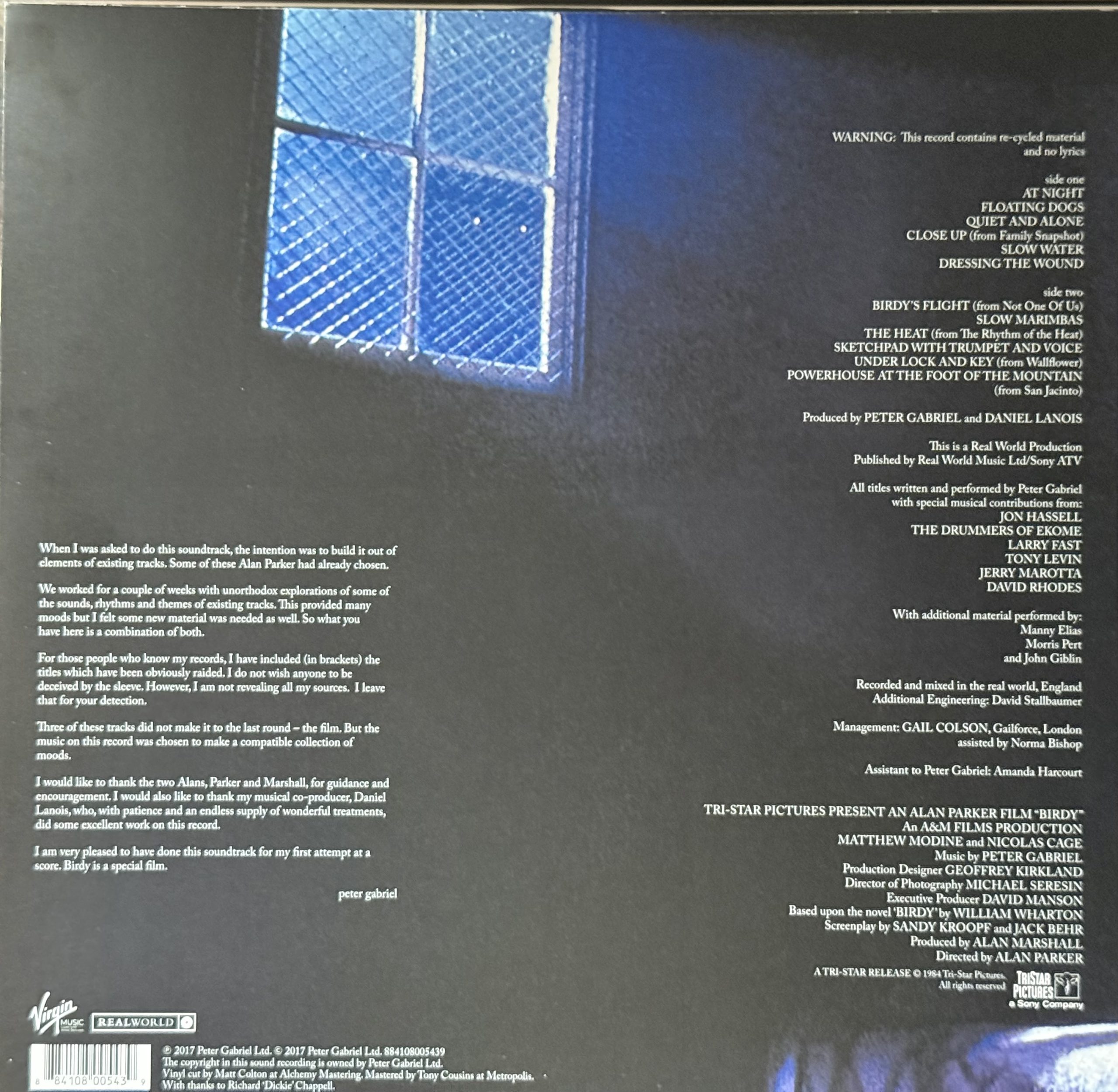
At any rate, “At Night” is an original full of low synth tones, clattering percussion, and a deep throbbing bass tone, with Gabriel’s Fairlight sounding woodwind-like tones over the top. It’s ominous but somehow stately, even as the last minute or so incorporates a version of one of the themes from “Wallflower” (from PG4) into the bridge.
“Floating Dogs” begins with a massive surge, oriented around a half-step downward bend of the pitch of the core synth sound. But it transitions into a sharply rhythmic jam built around Tony Levin and Larry Marotta that might, once upon a time, have provided a foundation track for a PG single. “Quiet and Alone” is driven primarily by a woodwind-like tone in the synth, loping along in waltz time.
One of the most obvious borrowings from Gabriel’s recent discography, “Close Up” isolates the opening piano track from “Family Snapshot” over a subtle background of synth tones; to my ears the track gains a great deal in power for its restraint. It fades out into the low oceanic tones of “Slow Water,” a hypnotic series of pivots between V and IV intervals. The side ends with “Dressing the Wound,” more or less isolated keyboards from Gabriel and Larry Fast to start but swelling into a wordless vocal melody that could have been destined for an album cut some day.2
Side two opens with “Birdy’s Flight,” a fanfare for low and flutelike synths that swells in volume and pivots to the massive synth and drums coda of “Not One of Us.” This track had an afterlife, appearing in multiple films in the A Better Tomorrow series by Hong Kong director John Woo. It’s followed by “Slow Marimbas,” marking the return of Morris Pert to Peter’s albums. The song sets the idiophones over a cumulonimbus of synths that eventually rise to blanket the track.
“The Heat” is probably the most direct lift in the album, comprising almost the entirety of the instrumental track of “The Rhythm of the Heat.” It’s probably the reason that I’ve always found the lyrics of the original song unsatisfactory; hearing the song without words you get all the hair-raising liturgy of the ceremonial abandon, without the explicit lampshading of “drawn into a circle that dances round the fire.” Dude, your music tells us what’s going on; the words are completely unnecessary.
Despite its name, “Sketch Pad with Trumpet and Voice” only uses Jon Hassell’s heavily treated trumpet as color, accompanying another Gabriel wordless vocal over a throbbing synthesized drone. The melody, though, is something else, descending from the seventh degree of the scale downward, it twists around, echoing Islamic song forms in a way that Peter would return to again in another soundtrack. He was clearly listening to some of his fellow performers at his WOMAD festivals.
“Under Lock and Key” has a major-key introduction with a flute-like synthesizer motif, followed by a rendition of the main theme of “Wallflower” (or the second theme of “At Night”) on the electric piano. The song ends before the “Hold on” chorus, fading into ominous synthesizer chords that swell into the instrumental coda from “San Jacinto,” here retitled “Powerhouse at the Foot of the Mountain.” The album ends in an awed suspension, leaving us in an unsettled state of contemplation.
The Birdy soundtrack is not one of Gabriel’s most well-known releases—in the 1980s, I only discovered it thanks to a friend dubbing a copy onto cassette for me. But it contained roots from his past—literally—and important seeds from his future. Both Daniel Lanois and engineer David Bottrill would go on to make more—and more well-known—albums with Gabriel, and that tinge of prayer music belied a significant influence that would play a much more prominent role in his upcoming releases. Specifically, the 1985 WOMAD featured, alongside acts like New Order, the Fall, and the Pogues, a performer from Pakistan who wowed the British audience with his vocal genius and the sounds of traditional Qawwali music. We’ll hear that 1985 live performance next time.
You can listen to this week’s album here:
BONUS: The full length film of Birdy isn’t available for free anywhere, so if you want to see it you’ll have to rent it from your favorite streaming provider. But this trailer does us the (dis)favor of undoing some of the jumble of the film’s narrative arc and telling the story of Birdy in something like chronological order. Plus: young Nicolas Cage.
Footnotes
You don’t ever get to write a sentence like that one in these reviews; I could not resist. ↩︎
Gabriel is known to have written many songs with nonsense syllables while working out his melodies; starting with Birdy these wordless vocalizations started to appear in some of his more ambient compositions. ↩︎
Gabriel gives a definitive send-off to the sound and songs of his first four albums in his first live record.
Album of the Week, April 11, 2026
Live albums serve a different purpose for a rock artist than for a jazz musician. In jazz you’re documenting the spontaneous magic that happened on a particular night, in a particular venue. With rock you sometimes get that, but more often it’s about getting the sound of a certain era, about all the different ways an artist takes music that originated in a studio into a live performance. And sometimes it’s about summing up an era of an artist’s work, getting all the hits performed in front of a screaming crowd as a souvenir of a particular moment.
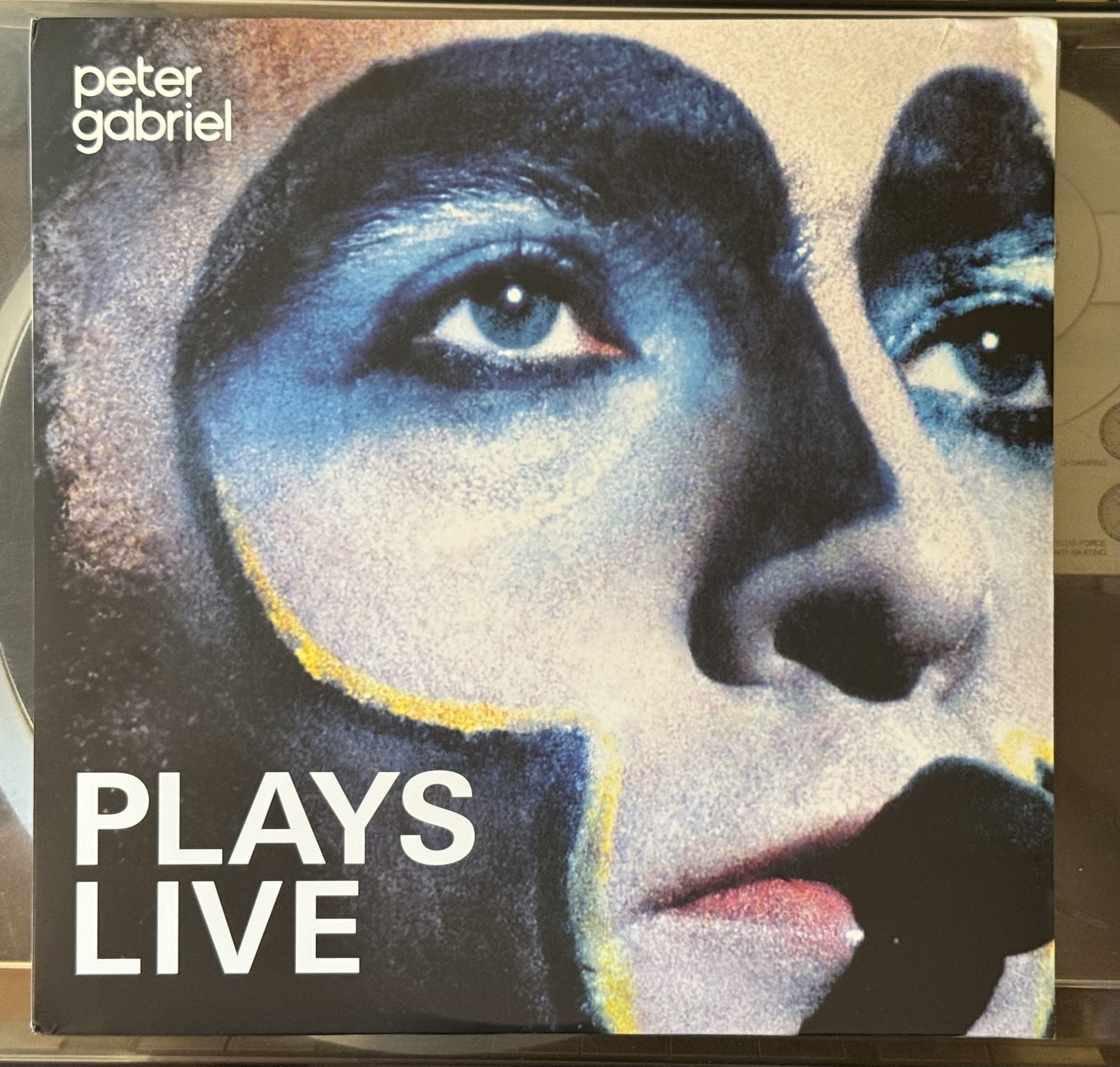
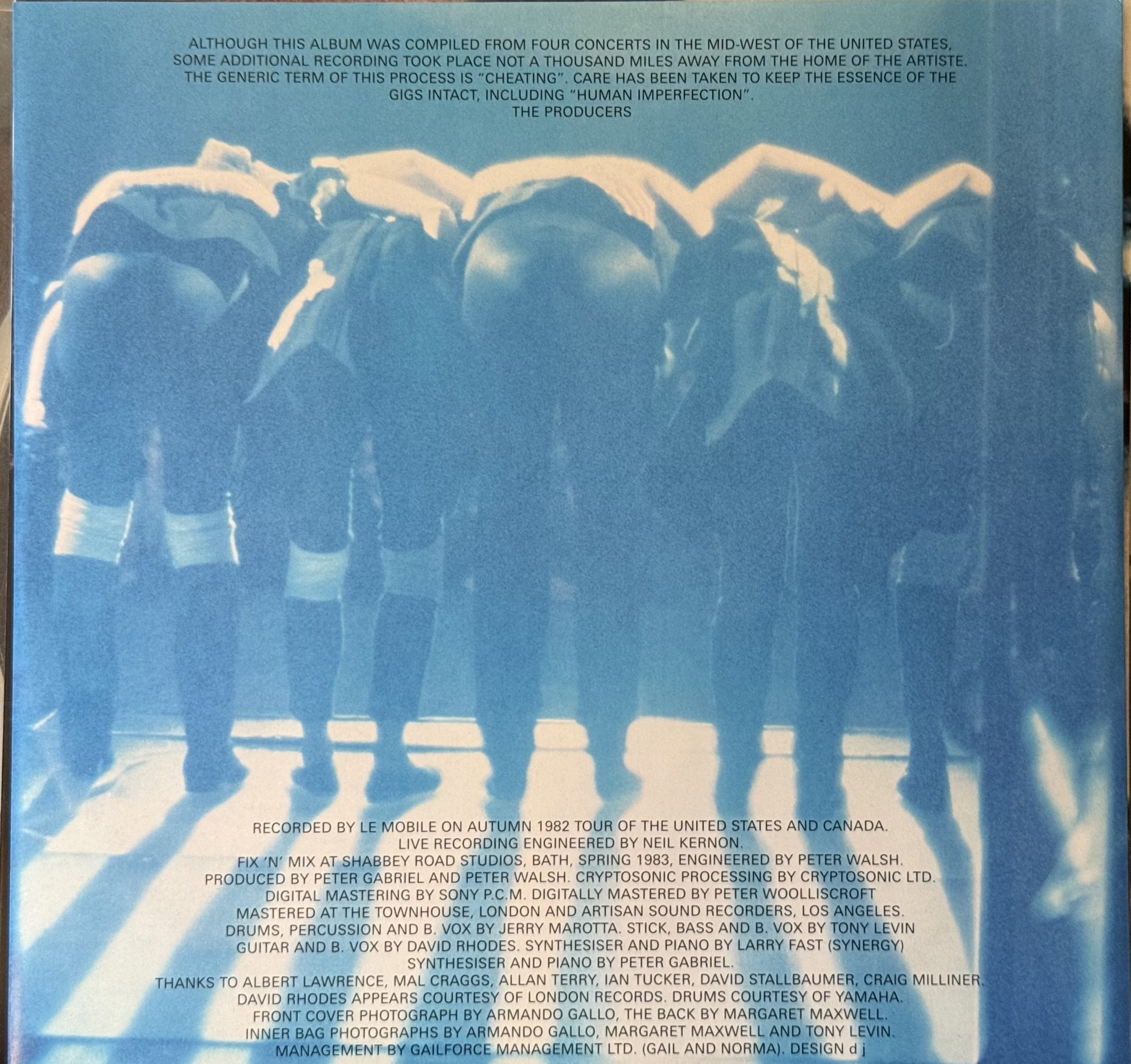
This last category is definitely where Plays Live falls, but there are elements of the other motivations as well. In particular, some early songs are revisited and updated, while others faithfully recreate their studio sound. Some of that “faithful” sound might be due to touch-ups; the notes on one of the dust sleeves say, “Although this album was compiled from four concerts in the mid-west of the United States, some additional recording took place not a thousand miles away from the home of the artiste. The generic term of this process is ‘cheating’.” Whatever the means, the album presents music from four concerts in November and December 1982 that show how Gabriel transformed the music from his first four albums into a coherent stage performance, with the stalwart help of Tony Levin, David Rhodes, Jerry Marotta, and Larry Fast.
“The Rhythm of the Heat” is remarkably faithful to the album original, with Larry Fast and Peter playing the same loops and synths used to construct the studio track. Only at the end does the performance deviate from the original, and that’s only because Jerry Marotta only has four limbs; while his drum performance is appropriately climactic, it doesn’t have the apocalyptic frenzy of the polyrhythms played by Ekome on the original track. “I Have the Touch” is slightly looser, with a combination of drums and synth percussion backing up Peter as he swaggers through the song. Peter’s outro has some vocal improvisations that carry the imprint of Motown, pointing ahead to a change of direction in future albums.
“Not One of Us” is another faithful recreation, with Tony Levin’s bass lines prominently front and center and Jerry Marotta’s drums leading into the massive breakdown at the end of the song. A quiet “Family Snapshot” has the epic arc of the original, greeted with respectful applause to close out the first side.
“D.I.Y.” is the first song of the set to have a substantial revision, with synths standing in for Robert Fripp’s guitar but carrying the same rhythmic intensity. “The Family and the Fishing Net” faithfully recreates the spooky quality of the voodoo and wedding rituals from the original, with some extra synth lines adding slightly polyrhythmic accents at the beginning and a massive choral outro with the band singing backing vocals behind. (This is a good time to shout out appreciation for the collective voices of Levin, Rhodes, Marotta and Fast, who create a great backing sound behind Peter.)
“Intruder” is great live here, with Marotta’s drums ably filling in for Phil Collins’ legendary gated reverb and Fast’s synths somewhat less ably replacing the marimbas in the instrumental. But that’s a note-perfect whistle at the end, over some sort of idiophone, presumably played by Marotta, and a massive finale with Peter taking the final line up an octave to great effect.
“I Go Swimming” is a gift of sorts, the only song here not to have previously appeared on a PG album. It’s a fun tune led off by a locked-in groove by Tony Levin, soon joined by the rest of the band as they play in the chromatic intro. Peter’s vocal on the chorus gives a bit of an Al Green feel, which abruptly switches into a more traditional Gabriel verse in 6/8. The song was apparently a leftover from the 1980 PG3 session that became a live staple, and a great break in the set.
Both “San Jacinto” and “Solsbury Hill” hew closely to their recorded versions, albeit with keys replacing the jubilant twelve-string guitar in the latter plus an extended joyous vocal coda. (Okay, not hewn quite as closely as all that.) “No Self Control” gets the most dramatic retooling of all the back catalog numbers, with a moody synth-driven groove replacing the marimba and dueling guitars of the original. Played about 20% slower than the original, it carries less manic intensity than resignation and despair. “I Don’t Remember” maintains the disco-funk brilliance of its predecessor thanks to Tony Levin’s deft playing and a wordless vocal bridge in the extended outro that raises the hackles on the back of the neck.
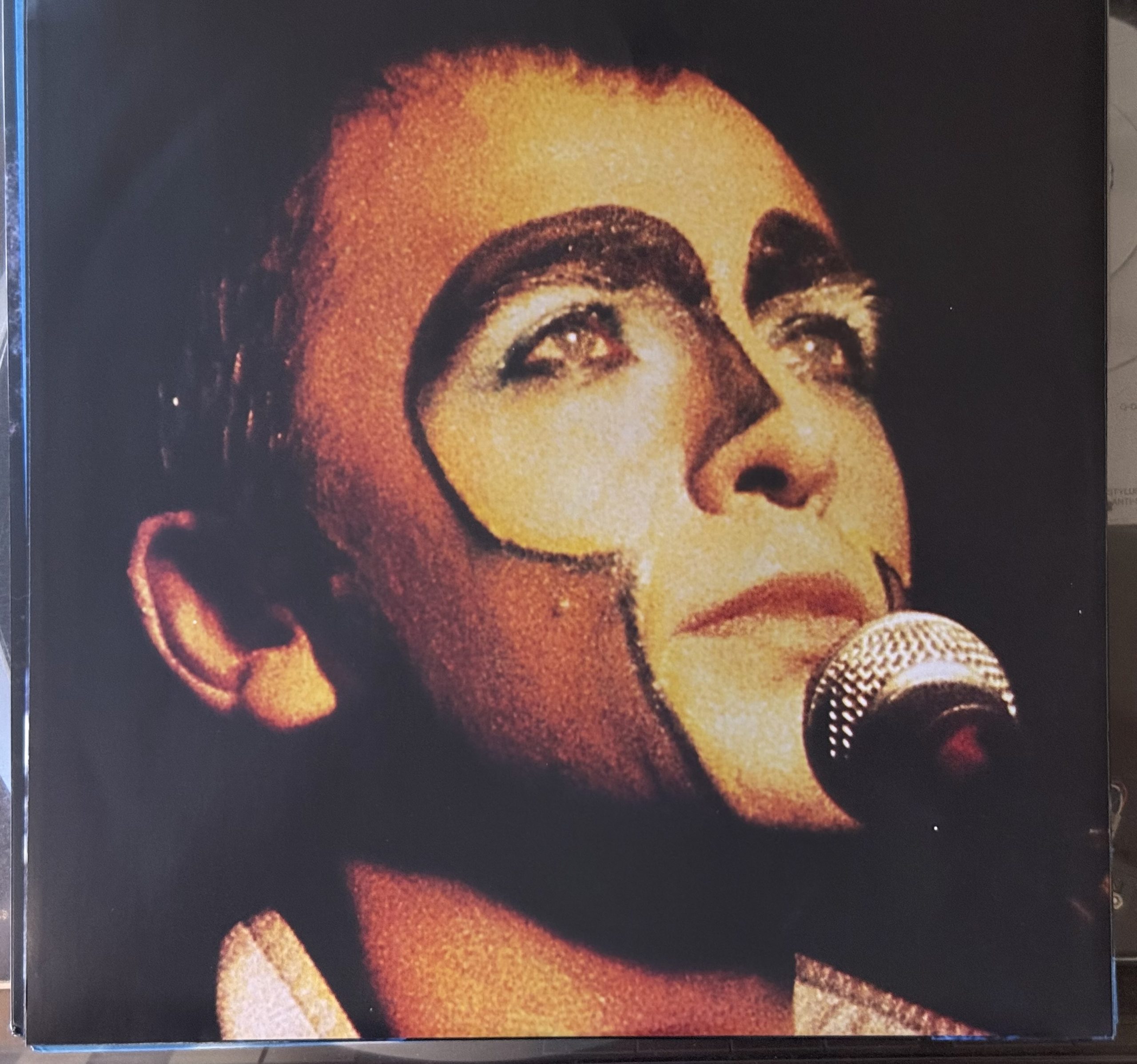
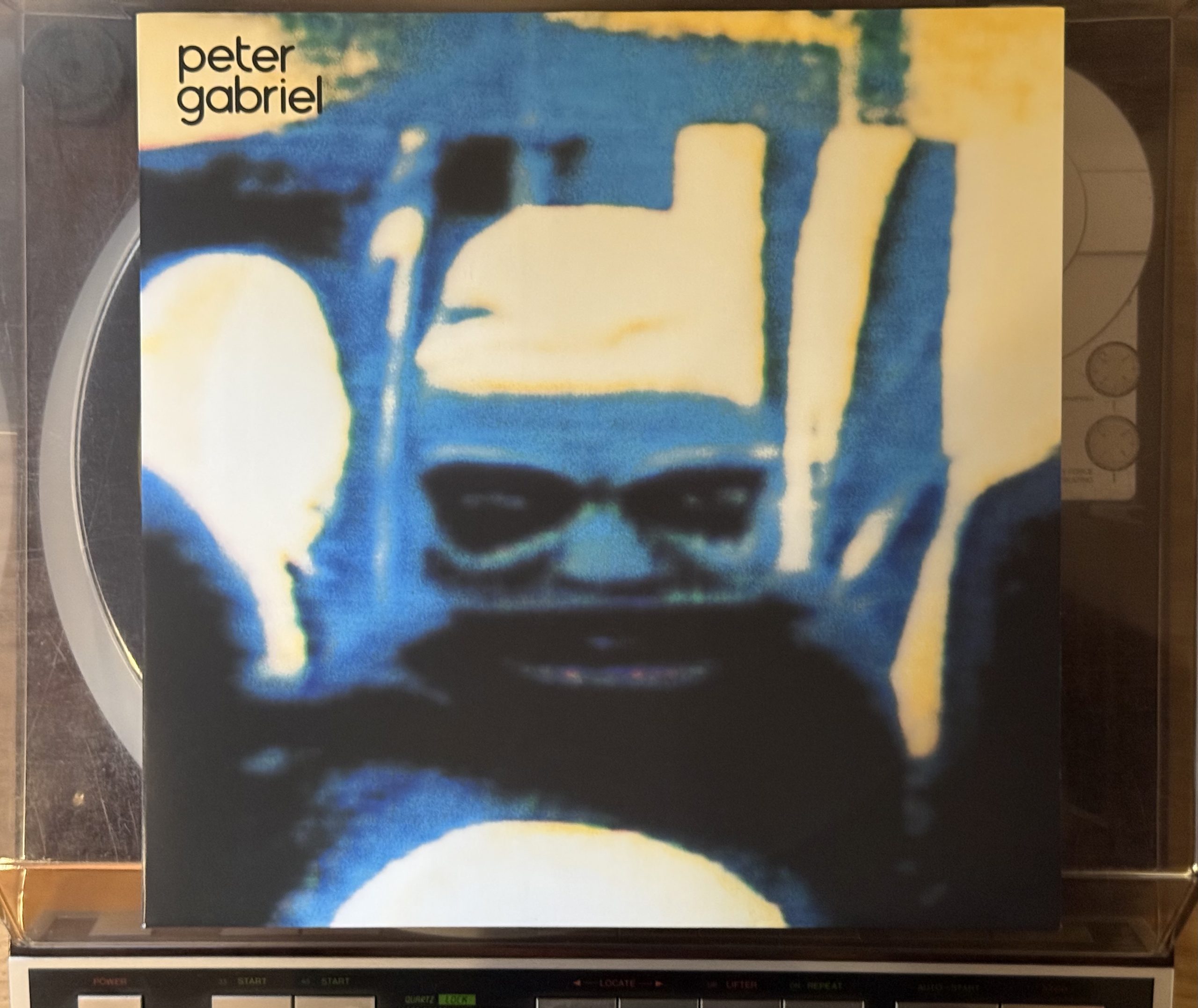
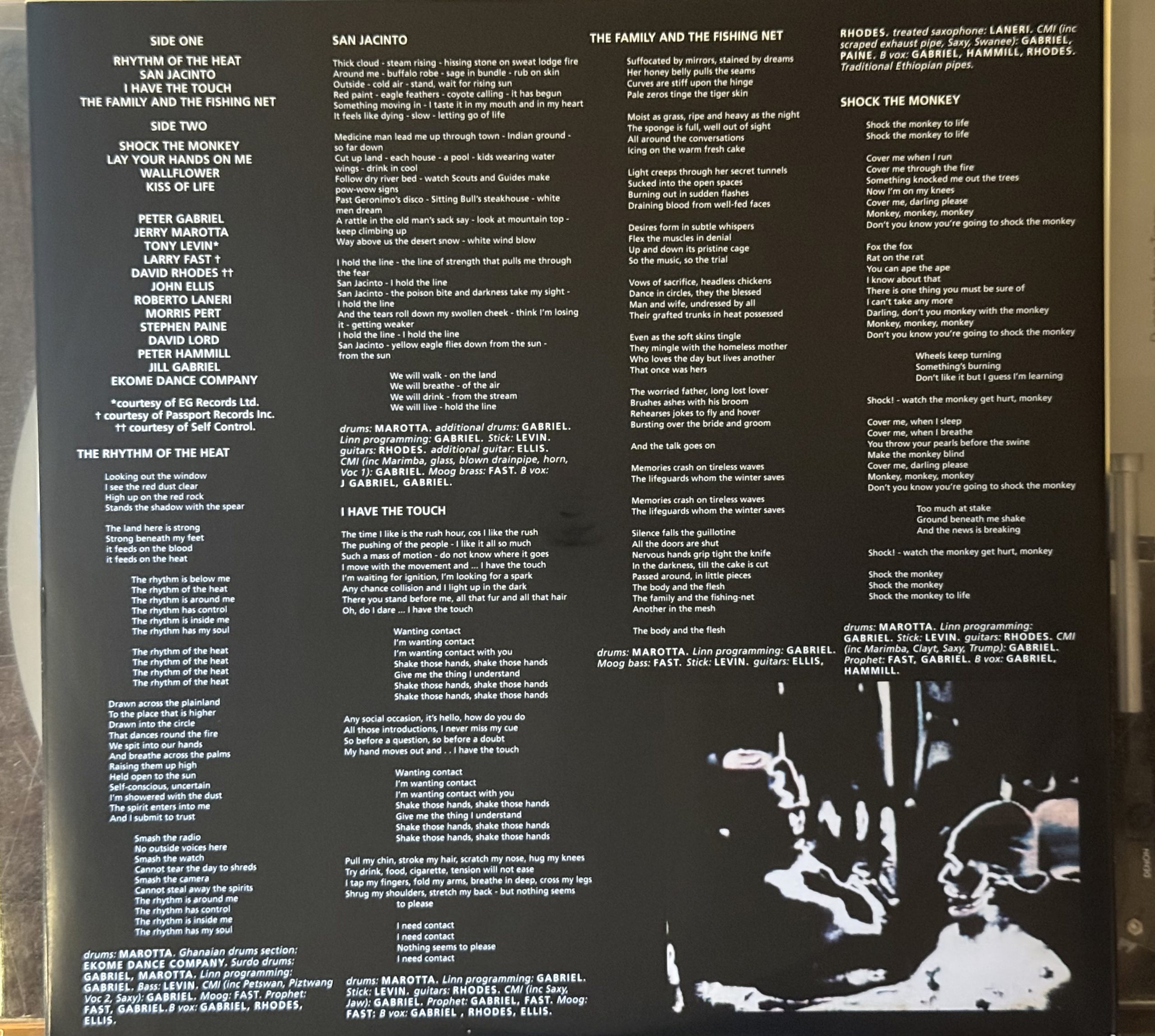
“Shock the Monkey” is a jittery wonder here, all funky high notes above a relentless, mechanical dance rhythm. It’s also arguably the farewell to an early Gabriel practice—the use of face paint to portray different characters in live performance (and videos). The blue make-up on the album cover (and the insert above) is a simplified version of the elaborate ritual monkey make-up used in the video; photographer Armando Gallo recalls it was actually taken during “Lay Your Hands On Me,” a track omitted from the original LP.
“Humdrum” is a pleasant surprise in the running order, a throwback all the way to PG1. The song offers the opportunity to hear how Peter’s vocals evolved during this first six-year stretch of solo performance. His low notes are richer, his high notes with a bit of sandy grit around the edges but with assurance as he takes rhythmic liberties with the line. The vocals are also mixed much further forward than in Bob Ezrin’s original, allowing the lyrics to be more clearly understood; this might be the definitive version as a result. “On the Air” is a last intense workout, with the band lending it more polish than the dry Fripp-produced original and somehow also carrying a greater intensity throughout. The audience is in it all the way, shouting their response to Peter’s sung “on the air” in the chorus. The band gets a great workout in the outro, with an instrumental workout before Peter sings the final chorus as a great shout.
The album ends, as did so many of his concerts, with “Biko.” Stripped of its opening and closing South African hymns, it plays as a more direct protest anthem, with the crowd’s singing along audible under the third verse and the extended outro. The album ends with a long fade-out as Peter calls “Good night!” and the crowd chants “Peter, Peter, Peter” in response.
Plays Live is unique in Peter’s discography for serving as a perfect punctuation mark at the end of his first four-album run. With five tunes each from the third and fourth albums and the hits from the first two, you could be forgiven for never checking back to listen to the originals. (I would strongly recommend making time for 3 and 4, both of which stand as massive accomplishments.)
In a way it was also a farewell to this portion of his career, as what came after would prove a powerful transformation for his sound and his fortunes. But before we get there, he had one last project, albeit a slightly obscure one, that revisited the sound from this period in a more unexpectedly direct way. And before that, we have one of the collaborations that began to shape his new direction; we’ll hear that next week.
You can listen to this week’s album here:
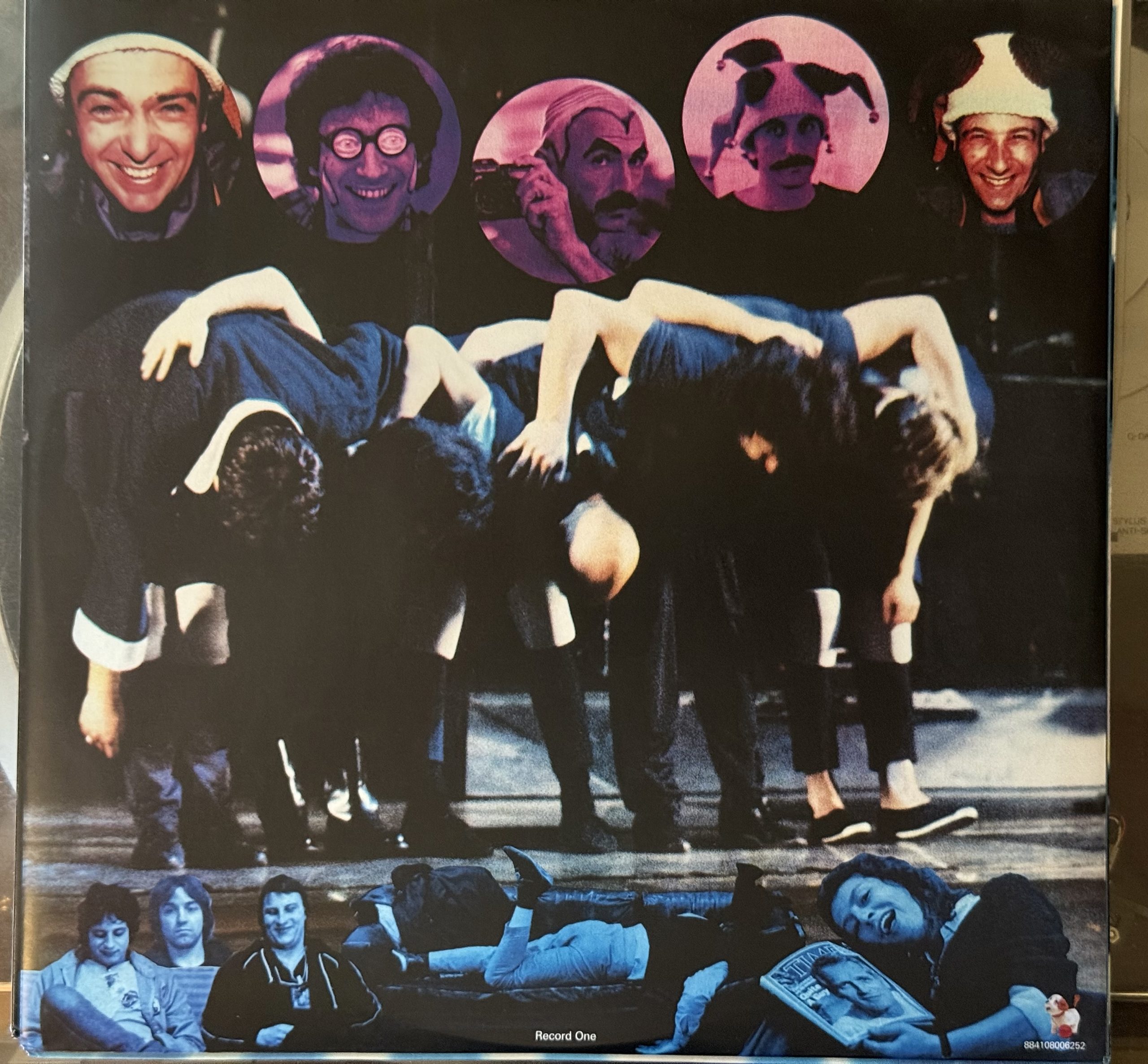
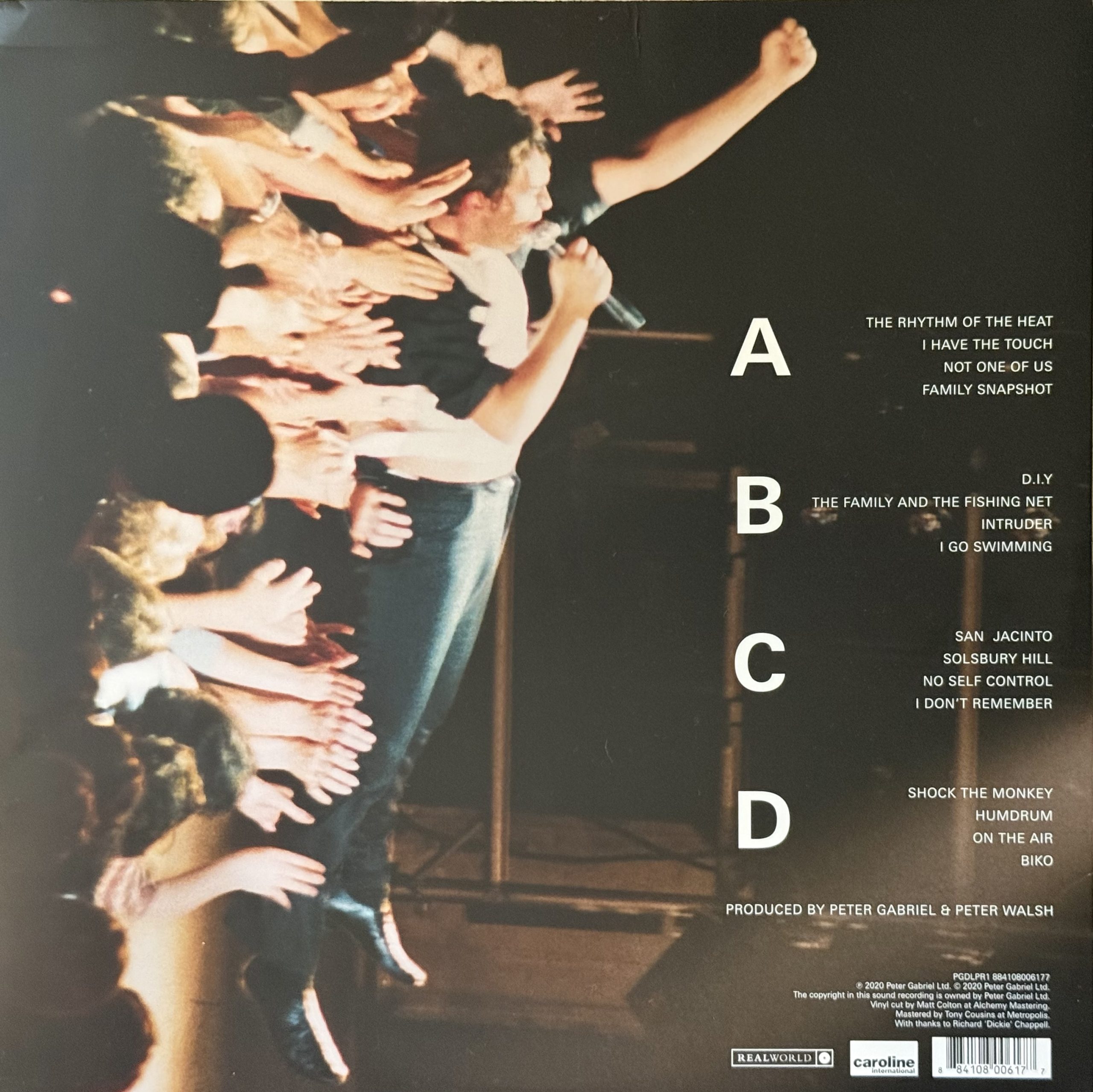
BONUS: While “Lay Your Hands on Me,” with Peter pictured singing while crowd-surfing on the back cover, was part of the set for these concerts, it was never issued on a version of Plays Live. That makes this 1983 video from Gabriel’s performance in Copenhagen all the more interesting, if frustrating for its low resolution and high levels of background chatter at the beginning:
Embracing both musical sounds from around the globe and modern technology produces a pioneering album that is still compelling and strange today.
Album of the Week, April 3, 2026
Two important things happened to Peter Gabriel in the lead up to his fourth self-titled album, which, thankfully for those of us who write or talk about music, his new label Geffen talked him into giving an actual title, Security, in the United States. The first was that the sampling synthesizer, the Fairlight CMI, that he had first encountered in 1979 became more powerful and able to manage up to 64 kilobytes worth of samples in memory. The second was a series of encounters with musicians from outside the UK that led to something that changed his career, and the careers of countless others, forever.
The Fairlight CMI had been invented by Peter Vogel and Kim Ryrie, from an earlier invention by Tony Furse. Struggling to get an instrument that was easier to control than the all-analogue Moog synths which were then the kings of the market, Vogel and Ryrie hit on two important ideas: to use a microprocessor—a digital chip, rather than analog—to control the device; and—a discovery by Vogel while studying the harmonic waveforms of acoustic instrument sounds)—to use samples (short recordings of real instruments) as part of the sonic palette of the instrument. Vogel brought a first-generation Fairlight CMI to Gabriel’s home while he was working on Peter Gabriel 3, and he was smitten, using the sampling feature to record real world sounds—though he used glass breaking and other percussion, rather than piano or strings. Gabriel was so impressed that he and his then-brother-in-law Stephen Paine formed a company to sell the instrument in the UK. It sold like hotcakes, with Kate Bush, John Paul Jones, Trevor Horn, Alan Parsons, Pink Floyd’s Richard Wright, and Thomas Dolby among the early purchasers.1 By 1982, the Series II was released, giving higher-frequency samples. Gabriel famously showed the use of this feature on the BBC’s The South Bank Show in a special on the making of PG4.
The other thread would seem to be the complete opposite pole. Following the release of PG3 and based on Gabriel’s burgeoning interest in African music and politics following the release of “Biko,” he launched the first World of Music, Arts and Dance (WOMAD) festival in 1980. Artistically2 a huge success, it brought performers from India, Burundi, Cameroon and Nigeria together with pop and world music luminaries from the UK.
Gabriel continued to meet with new African musicians, some of whom appeared on his next album. They joined a cast of by-now familiar faces: Tony Levin, Jerry Marotta, David Rhodes, Larry Fast, Morris Pert (here on percussion and Ethiopian pipes)—and also Peter Hammill, who had played at the first WOMAD, and David Lord, who co-produced the album with Gabriel. For this recording they were at Ashcombe House, a 19th century manor in Somerset that had a barn that Gabriel converted to a recording studio, while he rented the main house as a domicile.
The first track, “The Rhythm of the Heat,” combines the synthesizer, sampling, and world music threads of Gabriel’s interests into a single whole. Starting with a sampled loop on the Fairlight, Gabriel utters a cry that seems to swoop from somewhere in a resonant acoustic right up next to the listener, as a giant tone sounds on the tonic against a syncopated beat in the drums. Gabriel sings about losing oneself in rhythm (“the rhythm has my soul”), as neat a summation of the ethos he was exploring in his songwriting from PG3 on as one could hope for. It’s mostly successful here; the rhythms in the main song are careful (“the rhy-thm of the heat”) and feel a little too controlled. But on the last reprise, as he sings “smash the radio… smash the watch… smash the cameras… the rhythm is around me, the rhythm has control/the rhythm is inside me/the rhythm has my soul,” suddenly the heavens break open and an avalanche of drums, courtesy the Ekome Dance Company from Ghana, carry the track away in a massive, reverberating, polyrhythmic frenzy. If Gabriel was looking for transcendence in rhythm, he surely found it.
“San Jacinto” is a different feeling, a careful dance-like pattern in synthesizers that contrasts with the story sung by the narrator, a Native American man feeling despair at the loss of his culture to modernity. Some listeners interpret the lyrics as the narration of a young man coming of age in a ritual involving a rattlesnake bite; I’ve always heard it as the narration of an older man taking his last journey to the mountaintop, where he faces the decision to live or die. The coda (“We will walk on the land/We will breathe of the air/We will drink from the stream/We will live, hold the line”) seems a declaration of revitalized intent in the face of this despair, and is tonally distinct from the rest of the song, almost a hymn to itself.
“I Have the Touch” is one of two more pop-leaning songs on the album, but it doesn’t ease up the thematic intensity; here Gabriel seems to revisit the theme of the outsider that he first explored in the nightmarish “Intruder” on PG3, only this time, instead of maliciously breaking and entering, the narrator is in the street and filled with a yearning for human contact. “I move with the movement and/I have the touch… Only, only/wanting contact/with you”: he finds some respite in the crowd, the “pushing of the people,” but knows that he cannot be happy without true human contact.
The dark reverse of this longing for contact, perhaps the ultimate “be careful what you wish for” song, comes with the last track on the first side. “The Family and the Fishing Net,” which sings of marriage as a dark ceremony that enmeshes the participants through strange rituals, seems to warn of too much of a good thing. In a college poetry seminar I brought the lyrics, with their super-specificity and descriptive language, as an example of pop music as good poetry. I’m not so sure now; the whole thing seems rather over-egged. But “moist as grass, ripe and heavy as the night” is not a good way to describe a bride to be. And the attempted intersection of Christian imagery and voodoo in the last stanza “In the darkness, as the cake is/Cut and passed around/In little pieces/The body, the body and the flesh” doesn’t land for me. Then again, it did for the unmarried me at 18, still anxious about the future, which is maybe all it was supposed to do.
Speaking of anxiety: has there ever been a stranger Top 40 hit than “Shock the Monkey”? With the music track drawing inspiration from Motown and progressive rock in equal measure, there’s a relentless beat driving Peter’s plea to an unknown lover not to “shock the monkey”—that is, not to arouse the creature of jealousy that sits in the core of relationships. But you don’t need to have the psychological background to appreciate the song; it’s a banger, even if it sits uncomfortably high in the vocal range for singalongs. (As the University of Virginia Hullabahoos discovered when they covered it on their first album, years ago.)
In a sort of through-line with “I Have the Touch,” “Lay Your Hands on Me” is a song about finding healing in opening up and being vulnerable to connection with another human. The opening, with skittering percussion and an ominous spoken narrative (that veers into silliness—“fat men play with their garden hoses… sausage speared by the cocktail satellite”), masks a real portrait of alienation, as the narrator seeks to escape the crowds and find solace in being alone, whether out of introversion or fear, or both. But the chorus—“It’s only common sense/There are no accidents round here/I am willing (Lay your hands on me)/I am ready (Lay your hands on me)/I believe (Lay your hands on me)”—roars back into an embrace, literally, of the healing power of touch. Gabriel would ultimately end live performances of the song by standing at the edge of the stage and falling backward into the crowd, trusting them to buoy him up. (I recall reading an interview in the 1980s when one of the band wryly remarked, “We all did it; the problem was, no one wanted to catch the drummer.”) Gabriel has been open over the years about the power of therapy to help heal emotional wounds, and you can hear it starting here—and in true PG fashion it arrives as a massive anthem that delivers an emotional punch with each repetition. And that bass line!
“Wallflower” is in similarly hymnic territory, but with a different subject. Sketches of the melody originated during the recording of PG3, but the lyrics didn’t come together until Peter viewed television programs sponsored by Amnesty International about political prisoners in Eastern Europe and Latin America, particularly the plight of Lech Wałęsa and of dissidents who were imprisoned in mental hospitals. In this way the lyrics feel like a merging of the lyrical concerns of “Lead a Normal Life” and “Biko” and give the former tune an additional layer of universal meaning.
There’s nothing but good times in the closer, “Kiss of Life”—at least in the massive rhythms that spur one to dance in imitation of the “big woman” who dances on the tables at the Easter feast for the fishermen, welcoming each one. And then there’s a turn: in the bridge, we learn that “there’s a body in the sand” which the big woman resuscitates: “With heat from her skin and fire from her breath/She blows hard, she blows deep/In the mouth of death.” Did the narrator have a near death experience? Whatever the narrative truth, there is an inexorable dual meaning in the final chorus of “Kiss of life/kiss of life,” with life and death dancing together—however awkwardly, with alternating 3/4 and 4/4 meter in the opening and outro.
In embracing both modern technology and non-European rhythms, Gabriel found a more consistently adventurous sound that enabled him to span between art rock and pop, and landed him an unlikely top-40 hit—all while staying true to his distinctive artistic vision. It came at a cost: the album was recorded and mixed in sessions spanning from early 1981 through the summer of 1982, with hints of the songs only peeking through in a 1982 WOMAD festival performance in which he premiered seven of the eight tunes. That 1982 performance has recently been released, and is worth a listen in its own right, as the musicians dig into tunes that would seem to be designed only for studio performance and miraculously transform them into riveting live bangers.
Peter’s future albums would gestate even longer, as touring and his growing perfectionism stretched the time between albums further and further. Fortunately for us, his collaborators were also releasing spectacular music in their own right in between these infrequent records, and we’ll hear from one of those next time.
You can listen to this week’s album here:
BONUS: Here’s what might be the first live performance of “The Rhythm of the Heat,” from the 1982 WOMAD festival complete with the original rhythm section:
BONUS BONUS: “Shock the Monkey” is the most coverable of all the songs on the album, so it takes a lot for a new cover of it to surprise me. This one by Local H with both band members sharing a gorilla costume achieves the goal.
BONUS BONUS BONUS: A sort of cover? Here’s Peter Gabriel with Sting performing “Shock the Monkey” live in 2016:
Footnotes
Horn would famously help to popularize one of the key samples from the Fairlight’s built-in set, an orchestral “hit” called ORCH5, in his work with both Yes and Art of Noise. ↩︎
It might have been an artistic success, but it was a financial flop; faced with substantial debt, Gabriel reunited with Genesis for a single show, which put the festival, and his own finances, back on an even keel. ↩︎
In this 1980 recording, a massive drum sound and sharpened songwriting lead to the discovery of a new voice.
Album of the Week, March 14, 2026
It’s the drums that hit you first. The booming sound, enormous and then cut off, of the opening snare on the first track of Peter Gabriel’s 1980 album (also called Peter Gabriel), might be the most iconic of all 1980s percussion sounds, and it immediately arrests your attention—as does the crackling sound of fingernails on guitar strings that follows. You begin to understand why Ahmet Ertegun, founder of Atlantic Records (who had distributed Peter’s first two albums in the States), asked upon hearing the album, “Has Peter been in a mental hospital?” But that rhythm-centered sound and the lyrical unease were the key to unlocking Peter Gabriel’s most successful period of songwriting, and it’s all here in the first few seconds.
Peter was continuing to look for new sounds, and he found them here, starting with the idea that he would write “rhythm first.” Keyboard player Larry Fast had introduced him to the PAiA Programmable Drum Set, which allowed Peter to build his own rhythms so that he could write his songs around them during the songwriting process.
Part of the magic of the album was the cast of musicians. In addition to Collins, the core band of Tony Levin, Jerry Marotta and Larry Fast were all back, joined by David Rhodes, recently of Random Hold. Robert Fripp was out of the producer’s chair but still contributed hot solos on three of the tracks; also in the guest guitarist chair were Dave Gregory of XTC and Paul Weller of The Jam. Jazz artist Dick Morrissey brought saxophone to a number of the tracks. John Giblin, who had joined the British jazz-fusion band Brand X alongside Collins, played a fair amount of electric bass on the album. And appearing on two tracks with guest vocals was Kate Bush (who we briefly met at the end of our discussion of Peter Gabriel 1); at age 21 she had two albums under her belt (including a Number One hit in the UK), and was working on her third.
All together the musicians produced a recording that, while met with puzzlement by Atlantic Records (who distributed Peter’s music in the US and ultimately passed on the release, causing him to switch to Mercury Records), stands as one of his most original and enduring. Let’s dive in.
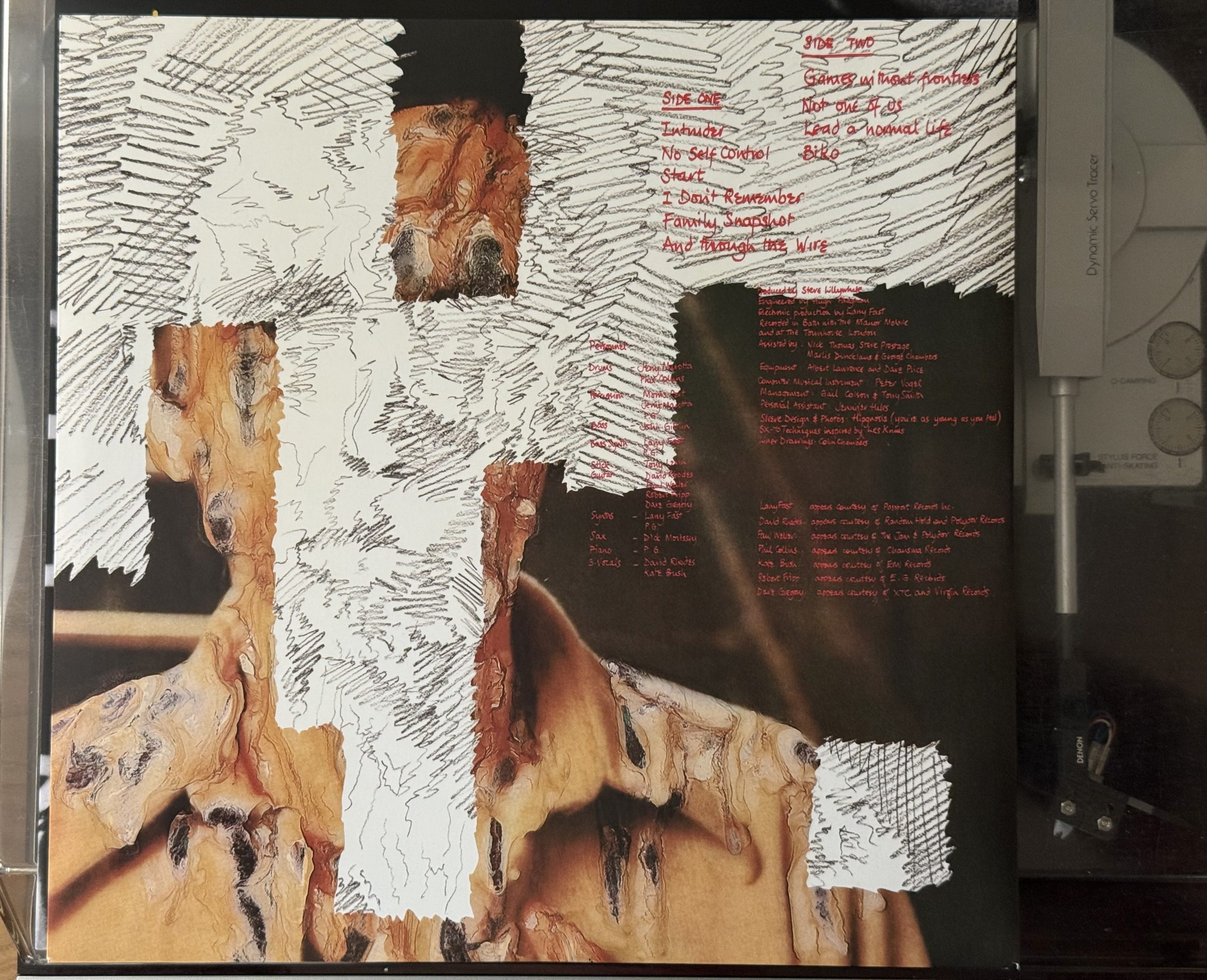
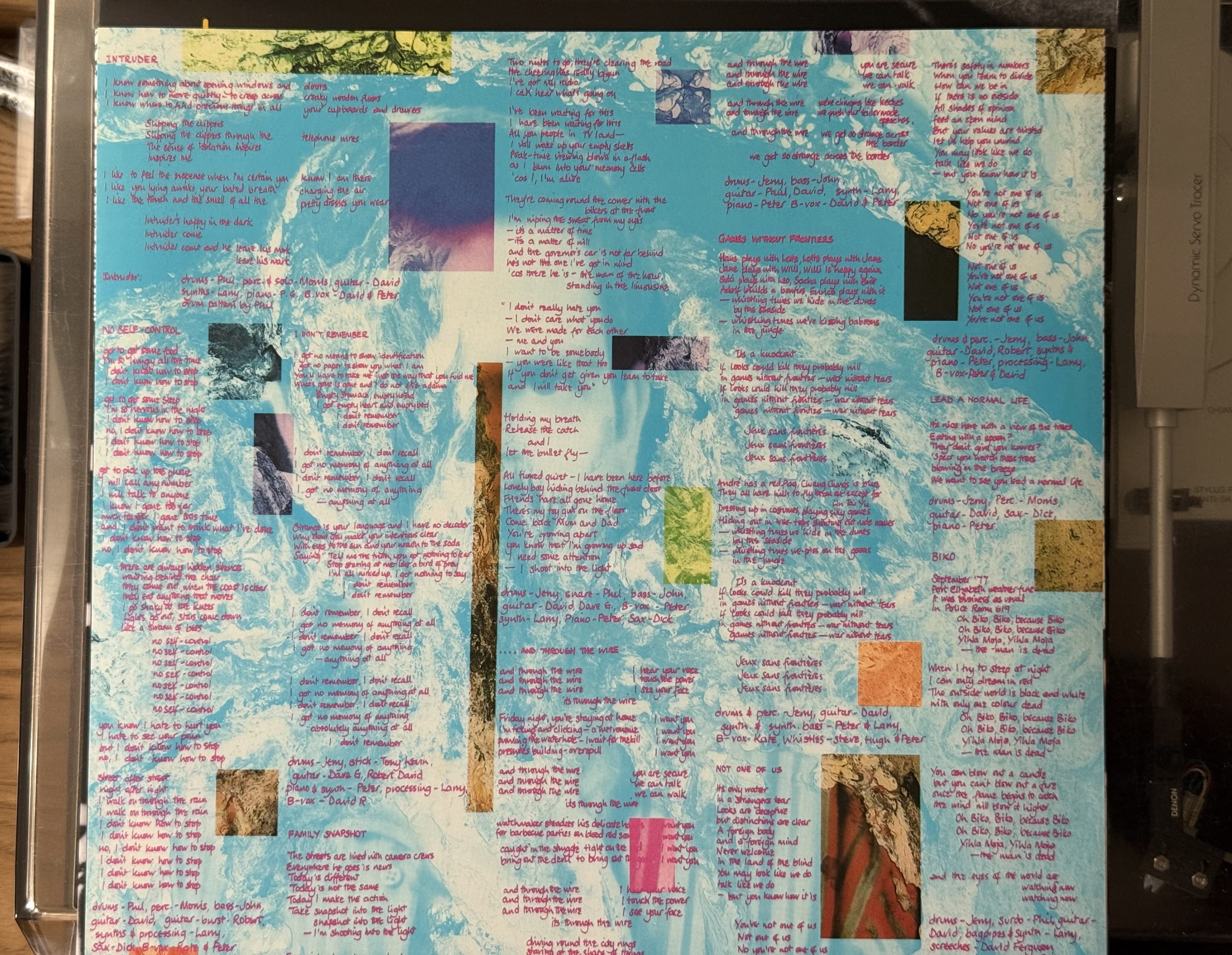
“Intruder” (with Collins on drums) brings forward all the unique aspects of Gabriel’s songwriting that defined this album: the heavy rhythmic focus, the paranoia and alienation, and the painstaking focus on aural textures. Opening with that immense gated reverb sound in the drums, Gabriel’s narrator confesses to disturbing crimes: “I know something about/Opening windows and doors… Slipping the clippers/Slipping the clippers through the telephone wires.” There’s a new sense of artistic confidence in Peter’s voice; the lyrics are terse, the chords stabbing, and that thunderous drum sound all combine to terrifying effect, culminating in the final verse: “I like to feel the suspense/When I’m certain you know I am there.” Also noteworthy is the percussion part in the midst of the song; Peter has said that he was hugely influenced by Steve Reich’s Music for 18 Musicians and its marimba textures, and the sound of the marimba would feature at several other key points in the album (here played by composer Morris Pert, who had also spent some time in Brand X). The whistled melody at the end is the chilling cherry on top.
“No Self Control” opens with a guitar hook that is panned hard in the stereo mix, alternating between the left and right channels, courtesy Robert Fripp. But the main story of the song is the textures behind the verse: Pert’s marimba, wordless choruses of backing vocals from Kate Bush, an unassuming piano part, and then going into the chorus a massive build up in Phil Collins’ gated snare that sounds like the apocalypse arriving. The lyrics reference compulsive behavior (“Got to get so food, I’m so hungry all the time… Got to get some sleep, I’m so nervous in the night/And I don’t know how to stop”), but the real story may be the connecting thread of implied violence in a relationship, picking up where the last verse of “Intruder” left off: “You know I hate to hurt you, I hate to see your pain/But I don’t know how to stop, I don’t know how to stop.” The song is a superb miniature where all the parts work together
We get a breather from the intensity thanks to the jazz interlude of “Start,” which combines synthesizer and sampling keyboards with a grade-A rock saxophone solo from Dick Morrissey. It builds up to a hard cut into “I Don’t Remember,” powered by Jerry Marotta’s thudding backbeat and a killer guitar sound from Dick Gregory, alongside Tony Levin’s Chapman Stick and a falsetto vocal intro that seems equally influenced by disco and Middle Eastern chant. More alienation here, with verses that could be read both as immigration to a strange land and to interpersonal communications breakdowns: “Strange is your language and I have no decoder/Why don’t you make your intention clear/With eyes to the sun and your mouth to the soda/Saying, ‘Tell me the truth, you’ve got nothing to fear.’”
“Family Snapshot” puts us in the mind of an assassin with a twist. There’s a quiet introduction on the keyboard as the narrator surveys the crowded street awaiting the arrival of his target, and anticipating becoming part of the story: “Today is different/Today is not the same/Today I make the action/Take snapshot into the light… I’m shooting into the light.” The band takes off with excitement as the action deepens: “The governor’s car is not far behind/He’s not the one I’ve got in mind/‘Cause there he is, the man of the hour/Standing in the limousine.” It’s at this point that the song takes a twist as the narrator makes it clear his action has nothing to do with his feelings about his target, but about being abandoned and anonymous. By shooting his victim, he reclaims some part of his own narrative, even through infamy. And then the final twist: “All turned quiet, I’ve been here before/A lonely boy hiding behind the front door… Come back mum and dad/You’re growing apart, know that I’m growing up sad.” Gabriel would later write honest songs about the pain in his relationship with his father; here for the first time he explores that dynamic of interpersonal relationships leading to tragic outcomes in one five-minute epic. It’s deeply moving and instantly memorable. Small wonder that when Gabriel’s nascent Internet fan club asked members to write in their favorites for his 2001 WOMAD performance in Redmond, Washington, that this song made the cut.
“And Through the Wire” stays focused on relationships, this time through the lens of communication and introduced by the crunch of Paul Weller’s guitar lead. Though it has the sharper focus and songwriting characteristic of this higher level of Gabriel’s artistry, its combination of 7/4 and triple meter is a reminder of his progressive rock roots. But with that insane guitar and Marotta’s drumming, you hardly notice the rhythmic complexity. It’s a breath following “Family Snapshot” and an effective closer for a stunning Side 1.
Side 2 doesn’t let up, either. Peter counts in the intro and “Games Without Frontiers” kicks off with a vaguely disco-feeling drum machine, heightened by the combination of David Rhodes’ lead guitar, Marotta’s percussion and, most of all, Kate Bush’s high backing vocals as she sings “jeux sans frontières.” The lyrics are playful with an undercurrent of menace as “Hans plays with Lotte/Lotte plays with Jane” yields to “Adolf builds a bonfire/Enrico plays with it.” But it’s all somehow danceable and weirdly singable, and it yielded his first top 10 UK hit.
“Not One of Us” starts with Peter’s ululating vocals and a Robert Fripp guitar solo that sounds like shredded glass. John Giblin’s bass is a lead character in the song as Peter sings about racism, first telling the immigrant “A foreign body and a foreign mind/Never welcome in the land of the blind,” then telling the racist “All shades of opinion feed an open mind/but your values are twisted.” Between the two verses, the chorus—“You may look like we do, talk like we do/But you know how it is/You’re not one of us”—inverts its meaning. In the coda, the last minute-plus of the song becomes a monster driven by a massive four-note hook in the guitar and bass and Jerry Marotta’s frenetic, polyrhythmic drumming. It’s among the most intense music Peter had ever created to that point, and he would return to it later in the 1980s.
After the climax, “Lead a Normal Life” seems to offer a respite in the cool tones of Morris Pert’s marimba. But the marimba pattern refuses to settle in tonality, playing on an open fifth indefinitely, and the synth lead is similarly unsettled, wandering past but never landing on the tonic. A distorted cry accompanies the bridge but then we return to the music of confinement, which repeats three times and then suddenly drops into tonality. But what initially sounds like a refuge reveals itself to be even more of a trap: “It’s nice here with a view of the trees/Eating with a spoon, they don’t give you knives/‘Spect you watch those trees blowing in the breeze/We want to see you lead a normal life.” And the menacing music of what is now revealed to be an institution returns, with a reprise of the distorted cry, with guitar distortion that subliminally builds in the background into a constant weeping. It’s masterful and deeply discomforting.
The final track, “Biko,” prompted Ahmet Ertegun’s other unfortunate comment about the album: “What do people in America care about this guy in South Africa?” Peter had been deeply moved by the story of the death of anti-apartheid activist Steve Biko in the custody of the South African police in 1977, and wrote the final song of the album as a eulogy. It opens with an excerpt of “Ngomhla sibuyayo” and segues into a massive two-tone drumbeat on the Brazilian Surdo drum (played by Collins), with an emphatic David Rhodes guitar drone above which Peter sings about Biko’s death: “September ’77, Port Elizabeth weather fine/It was business as usual in Police Room 619.” He sings in Xhosa “Yila moja” (Come Spirit), invoking the continued presence of Biko’s cause even as he sings “The man is dead” over the sounds of bagpipes. In the last verse he warns, “You can blow out a candle/But you can’t blow out a fire/Once the flames begin to catch/The wind will blow it higher… And the eyes of the world are watching now.” This first Western protest song against the inhumanity of the South African apartheid system would have been sufficiently noteworthy; its incredible anthemic quality and singability made it a totem of a new movement.
Gabriel found his voice on this third self-titled album, and found a connection to the broader outside world. “Biko” in particular led to performances with Amnesty International later in his career, but it would also bring him into contact with a world full of musicians who would radically shape his music even as he brought them to wider attention. We’ll explore some of those connections in a few weeks. But next week we’ll listen to the work of a future Gabriel collaborator who brought a different kind of artistic sensibility to the unlikely world of pop music.
You can listen to this week’s album here:
BONUS: Peter had found German audiences receptive on his late-1970s tours, apparently, because he did a version of Peter Gabriel (1980) in German, with him singing translated lyrics over the original backing tracks from the album. Here’s “Keine Selbskontrolle”:
BONUS BONUS: “Biko” became an enduring part of Peter’s musical legacy and has been played many, many times live. Here’s an early one from the very first WOMAD festival in 1982 (about which, more later…):
BONUS BONUS BONUS: Peter’s 2010–2013 project of cover songs yielded a bunch of fascinating Peter Gabriel cover versions of some great songs (Scratch My Back), and some reciprocal covers. In exchange for Peter’s cover of the Talking Heads song “Listening Wind,” David Byrne recorded this fascinating take on “I Don’t Remember” which led off the compilation And I’ll Scratch Yours:
The second PG album finds him experimenting, with sometimes thrilling and sometimes uneven results.
Album of the Week, March 7, 2026
Looking back at Peter Gabriel’s career, some of the consistent themes are perfectionism and painstaking deliberation. We’re talking about a performer who went from 2002 (Up) until 2023 (I/O) — 21 years between releases of original music. (There was other music of merit in that period, but that’s a different story.) So it comes as a surprise to realize that Peter Gabriel’s second album was released only 15 months after his first. Almost all of that is due to his choice of producer for the second album: Robert Fripp.
Fripp was starting to transition in his career from sideman (most notably for David Bowie on “Heroes”) and leader of the intermittently active King Crimson to producer, on the strength of his ingenious guitar work and technological inventiveness (the unique “Frippertronics” system, the first live looping solution for performers, is the best known example). Peter was looking for a specific sound texture, and brought musicians to the record who could provide it, like the redoubtable Tony Levin, drummer Jerry Marotta, and synth player Larry Fast, all of whom would appear in more PG albums. He also admired Fripp’s more improvisational and brisk working methods; he’s said about the album, “Robert Fripp was very keen to try speeding up my recording process, as many people have been since and failed, but he got closest to it.”
Unusually, the album is the second to be titled Peter Gabriel; Gabriel felt this allowed more attention to be paid to the album artwork by design house Hipgnosis (who also shot the “rainy windshield” on Peter Gabriel (1977)). I’ve also read that he thought of it almost like a magazine or periodical—“here’s the latest Peter Gabriel.” Looking at the entire discography, it’s clear he was never much of a fan of album titles, as we’ll see.
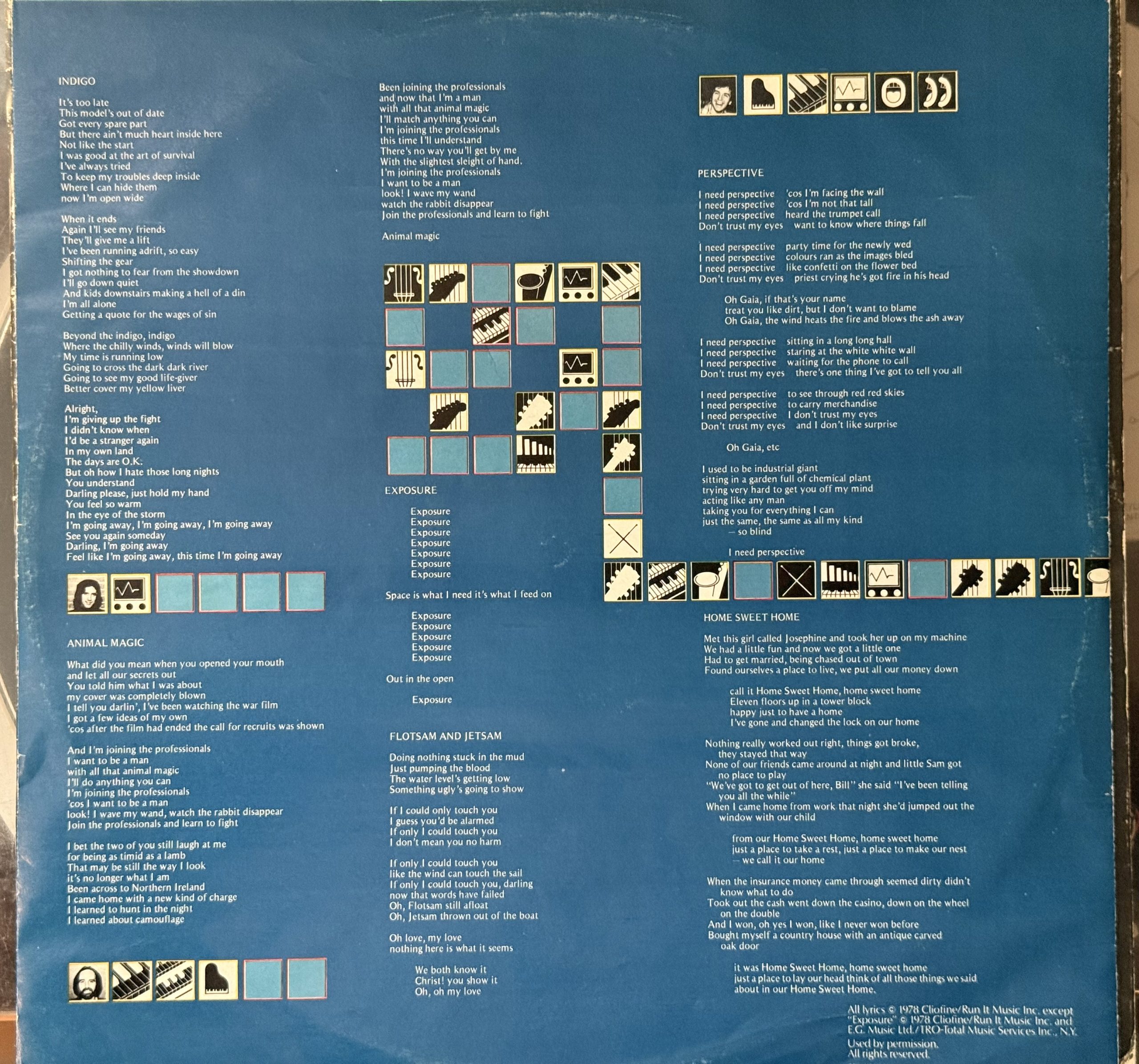
“On the Air” starts in a very different sonic landscape from where PG1 left off. Bright synthesizer lines lead to muscular guitar and bass, backed up by the massive drums of Jerry Marotta. The song is a straightforwardly driving 4/4 until the chorus, which drops into 6/8 for a few bars. And the vocals, while rough—you can hear the strain in his high notes, and his sometimes sandy tenor sounds thin and scratchy—are exciting, especially as he soars up the lines of “on the air” in the chorus. Lyrically, the subject—Gabriel’s Mozo character building a radio transmitter so that he can project his psychic energy out to the world—is obscure but the writing is taut: “Built in the belly of junk by the river my cabin stands/Made from the trash, I dug off the heap with my own fair hands/Every night I’m back at the shack and I’m sure no one else is there/I’m putting the aerial up so I can go out on the air.”
“D.I.Y.,” driven by a throbbing Tony Levin line on the Chapman Stick, is even more tautly wound. Gabriel says he was listening to punk and new wave at this time, and this song shows the influence even though it’s in 5/4 and has a complex chord change in the pre-chorus. It’s another song dealing with the aftermath of his time in Genesis: “You’re still looking for the resurrection/Come up to me with your ‘What did you say?’/And I’ll tell you, straight in the eye.” It’s short and pointed and a great song.
“Mother of Violence” is the only song in Peter’s work with a writing credit by his then-wife Jill. It’s a quiet tune with unusual instrumentation—pedal steel, acoustic piano—and a vocal that sounds a bit like late-1970s Phil Collins and ends with vocalese. It’s all in service of a lyric about difficult family relationships that is one of the more fraught bits of writing on the album.
“A Wonderful Day in a One-Way World” is an odd bit of a song, with a vocal that sounds a bit like a scratch take and a slightly proggy reggae feel, and a lyric that is reminiscent of some of the odder corners of Paul Simon, particularly in the dialog with the old man in the second verse. But it also has some of the better vocal harmonies on the album in the chorus, so that’s something in its favor at least. It’s followed with the frustratingly opaque “White Shadow,” which marries an instrumental track that could have been at home on late-1970s Genesis, circa …And Then There Were Three…. The first verse starts promisingly enough—“Ten coaches roll into the dust/Chrome windows turned to rust”—but then we’re rhyming “spirit died” with “Kentucky Fried.” Fripp’s guitar solo at the end is a thing of beauty, though, in duet with Tony Levin’s increasingly virtuosic bass, and there are hints of a synthesizer sound played by Peter that would become an increasingly familiar backdrop in his other albums.
“Indigo” is a piano-driven ballad with recorder and pedal steel, a story of an elderly man coming to terms with his impending death. The track seems to have a bunch of different ideas that never quite cohere, but the vocal is one of the finer on the album technically, with properly prepared high notes and controlled dynamics adding to the emotional affect. That’s a contrast with “Animal Magic,” which has one of the rougher vocals on the album and a lyric about proving manhood by becoming a soldier, and an anonymous guitar solo that sounds a bit like generic ’70s rock.
“Exposure,” though, is one of the key sonic pieces on the album. Driven by a mean locked in groove from Levin and Marotta, the main event here is the Frippertronics and Peter’s repeated chants of “exposure… space is what I need…” It’s the groove, though, that feels the most like a Peter Gabriel song, and we’ll hear it again in many other contexts.
“Flotsam and Jetsam” is a song of lament for a failed relationship. It’s competently written but ultimately forgettable, thanks in part to indifferent vocal recording featuring one of the few instances of an echo or reverb on the album which only serves to underscore the brevity of the song. Peter seems rather in a hurry to get on to “Perspective,” which feels a bit like a downtown 1970s New York number complete with saxophone on the chorus and a repeated “I need perspective” on the verses. Gabriel sings from the perspective of an industrial businessman to his former lover, who may or may not be the earth (“Oh Gaia, if that’s your name/Treat you like dirt, but I don’t want to blame…”)
That leads us to “Home Sweet Home,” which frustratingly sums up all the off characteristics of this second album. The songwriting feels a bit like Peter’s version of Randy Newman (last heard on “Waiting for the Big One”), the pedal steel seems like we’re in a country song, and we have another one of the indifferently recorded scratch vocals. And it’s about a man whose wife commits suicide, killing his child at the same time; despairing, he gambled with the insurance check and won big, buying a country home far away from his eleventh floor walk-up. The last verse features one of Peter’s most challenging-to-listen-to vocals, as his high vocal obbligato provides an impression of the man’s wordless sobs. It feels dark in an exploitive way. We will get much more earned dark passages in future albums, but here it feels like he’s trying on someone else’s pain.
Ultimately 1978’s Peter Gabriel is a frustratingly uneven album. There are some great songs—both “On the Air” and “D.I.Y.” are in the canon of his greatest songs, and “Exposure” is affecting, but many of the others suffer from the rapid approach to recording and writing. He took more time on the next record, and it showed. We’ll listen to that one next time.
You can listen to this week’s album here:
BONUS: Fripp connected a series of albums that he produced in the late 1970s, including Peter Gabriel, Daryl Hall’s Sacred Songs, and his own debut solo album Exposure, as a loose trilogy. He re-recorded “Exposure” for the latter album, and it’s … really something, thanks to vocals by Terre Roche of the Roches:
BONUS BONUS: The band for this tour, with Sid McGinnis in for Fripp, was a tight machine. Here’s a German performance of “On the Air” from 1978 that shows Peter had been watching punk acts: