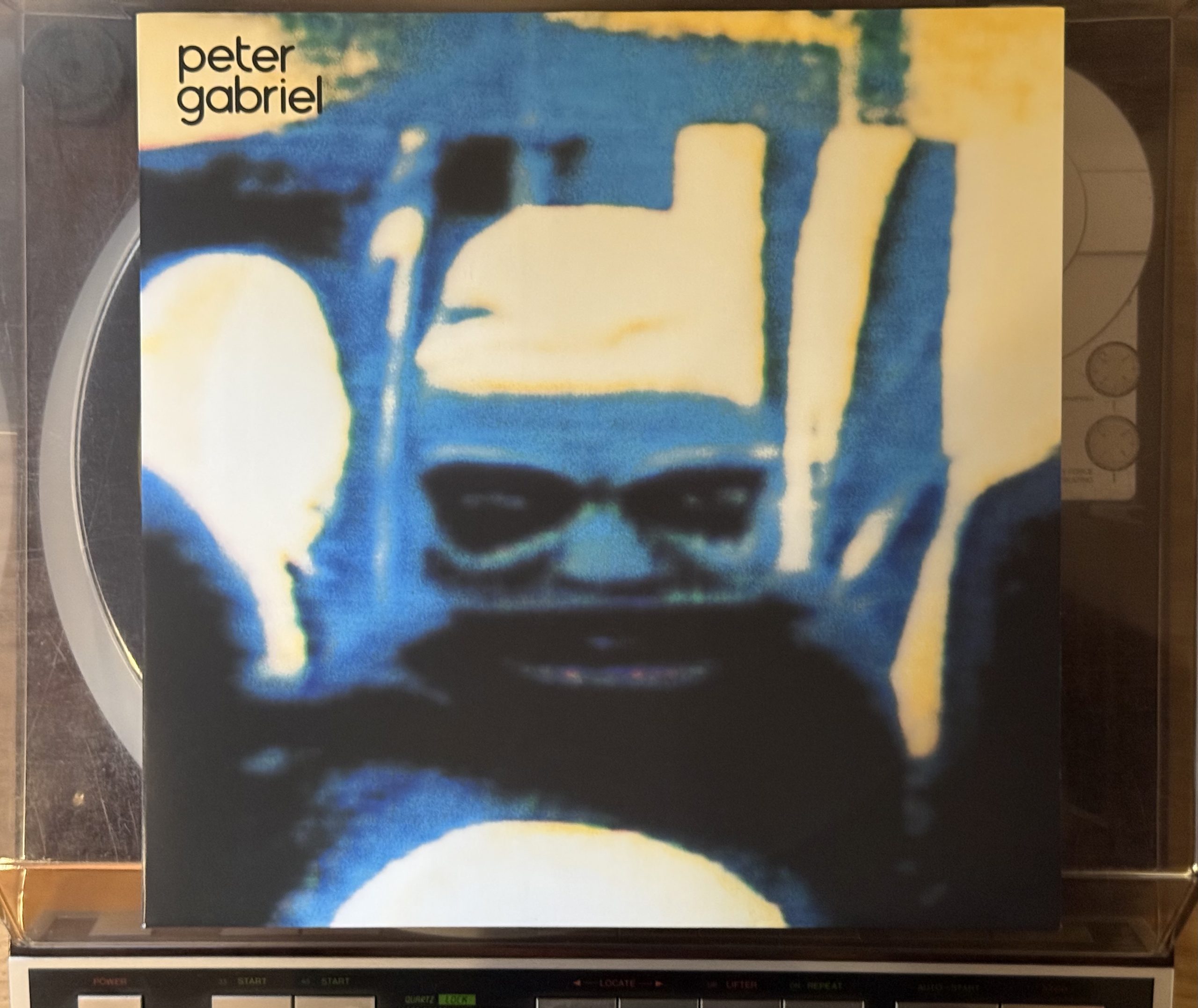
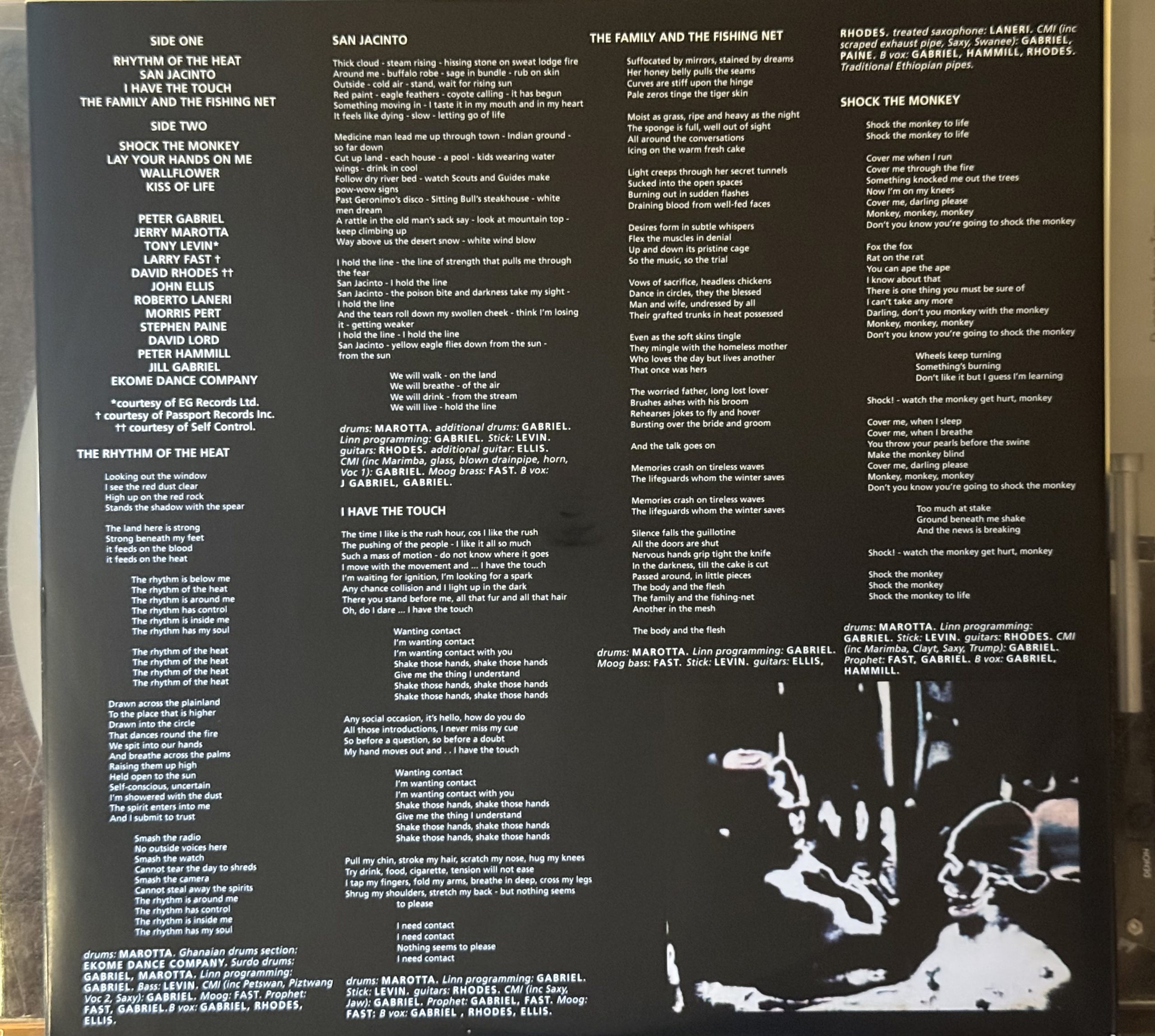
Album of the Week, August 15, 2026
When Peter Gabriel released his new album Us on September 28, 1992, it seemed like an eternity had passed since his last pop album, So, in 1986. (How little we knew!) Over the past weeks we’ve looked into some of what he was doing during the period—the Passion soundtrack and sister album Passion – Sources, massive world tour, WOMAD, and starting the Real World label and launching the western careers of some of his key contributors. But it has to be said that part of what he was doing was recalibrating. For the former art-pop auteur, life could never be the same after So. He had to find a new way to make music.
He also had to come to terms with himself. His marriage to Jill Gabriel, long strained, ended in divorce in 1987 in the middle of the massive world tour. He was famously linked with actress Rosanna Arquette for some time after his divorce, but the relationship was not long lasting. The dissolution of his marriage resulted in depression and therapy, which continued for six years. The divorce and his therapy both influenced the songwriting on Us, his most personal album to date.
To make the album real, he turned to a group of collaborators both familiar and new, many drawn from the sessions in the massive state-of-the-art studio he built in a former mill building complex in Box, Wiltshire, England. There was the core band, by now familiar: Tony Levin, Manu Katché, David Rhodes, producer Daniel Lanois, engineer David Bottrill; frequent collaborators like Shankar and Peter Hammill; collaborators from Passion including Hossam Ramzy, Doudou N’Diaye Rose, Kudsi Erguner, Assane Thiam, Manny Elias, and the Babacar Faye Drummers; and collaborators drawn from the nascent Real World label including many of the Passion names, the Dmitri Pokrovsky Ensemble, and Ayub Ogada. There were also some brand new faces, including Meters guitarist Leo Nocentelli, Lanois’ producing partner Brian Eno, ascendant electronic producer William Orbit, duduk player Levon Minassian, and incandescent vocalist Sinéad O’Connor.

“Come Talk to Me” begins in a silence that builds to a shout: layers of keyboards crescendo up to a bagpipe solo over the bass, thundering drums courtesy of the combined forces of Katché, the Babacar Faye Drummers, and a 1980 drum loop from Doudou N’Diaye Rose, and a response on the duduk. Peter’s vocals are direct and intimate, reaching out to someone who has been incommunicado, asking for a bridge over which they can rebuild a relationship; he’s subsequently disclosed that the rift was with one of his daughters. The chorus features harmony vocals from Sinéad; Peter had met her doing an Amnesty concert in Santiago, Chile in 1990 and invited her to the studio, and having her very present voice on the opening track effectively signals that this album is about dialog and communication. It’s also a showcase for his collaborative work with the artists of Real World: that choir that enters after the bridge, the storied Dmitri Pokrovsky Ensemble, were recording their album for the label, The Wild Field, at the same time Gabriel was working on Us.
The contrast as the album flows into “Love to Be Loved” is marked. Cool where “Come Talk to Me” is hot, the second track is all about minimal groove, with both the late William Orbit and the legendary Brian Eno contributing programming and keys. Katché’s drum programming and Hossam Ramzy’s tabla (as well as Daryl Johnson’s hand drum) anchor the rhythm along with Tony Levin’s bass. And the lyrics take us on an emotional journey, starting from talking about the need for contact (echoes of “I Have the Touch”) to a startling transition in the bridge in which Peter confesses, “This old familiar craving / I’ve been here before, this way of behaving… Let it pass, let it go, let it leave / From the deepest place I grieve / This time, I believe.” But even that isn’t the end, and we get to the root of it: “Though it takes all the strength in me / And all the world can see / I’m losing such a central part of me / I can let go of it… I recognize how much I’ve lost / And I cannot face the cost / ‘Cause I love to be loved.” The track’s stark honesty about the need for physical relationships and letting go of destructive behaviors, even as other relationships are falling apart, is striking; one really feels those years that Peter spent in therapy at work here. And it’s a jam.
That brings us to “Blood of Eden,” which feels like the most primal, innocent love song Peter has ever written. It comes out of an idyllic opening with the doudouk over layers of keyboards, and Peter sings about the darkness in his heart and the “heated and the holy.” The song is surely one of the best known from the album thanks in no small part to Sinéad O’Connor’s pure vocals in the chorus duet (and the face morphing of the two singers in the video), but the lyrics are a bit of a hodgepodge, with the heated and the holy looking down from on high “so secure with everything they’re buying.” The narrator returns to “the union of the woman and the man” as a retreat to paradise even as he acknowledges the worm at the heart of the apple: “All the while the distance grows between you and me.” There are echoes here of “Don’t Give Up,” both in the duet structure of the song and the plight of the narrator, but the catastrophe seems more emotional than economic here. This was one of the songs that underwent the longest gestation, with multiple versions and arrangements extant; the liner notes hint at this when they credit Richard Chappell for the mix from which the bridge section was drawn, and another version of the song appeared even before the album was released on a soundtrack (see the bonus section below). Other versions have been released to Peter’s fan club on Bandcamp.
“Steam” underwent a similar evolution, with a stunning “Quiet Steam” appearing as a b-side to the album’s first single. But there’s plenty to recommend the released version, starting with the funky guitar of Leo Nocentelli of the Meters. The horns aren’t given quite as much prominence as they are in the song’s spiritual predecessor “Sledgehammer,” but they’re still pretty tasty, and the Babacar Faye Drummers add an edge to the percussive energy that is otherwise all Motown. One fun thing to listen for is Peter’s keys, here easily distinguished because he’s switched from the airy synth sounds of the Prophet to a fairly convincing Hammond organ soundalike, adding to the sweaty funk of the mix.

“Only Us” returns to a more open, idyllic sound, with a duet between Peter and Kenyan musician Ayub Ogada. This is another track with contributions from William Orbit, but here the vibe is organic rather than chill. Shankar and ney flautist Kudsi Erguner contribute to the feeling of limitless nature, and Peter’s lyrics signal the song’s centrality to the album’s overall concept as he refocuses on relationships and people: “Seduced by the noise and the bright things that glisten / I knew all the time I should shut up and listen / And I’m finding my way home from the great escape… Yes I can read you loud and clear … The further on I go, oh the less I know / Friend or foe, there’s only us.” I realized as I was relistening to the album that this was a track that had slipped under my radar, but it repays listening to again.
The second half of the album starts with “Washing of the Water,” easily Peter’s most gospel song starting with just bass, snare and piano accompanying Peter’s unvarnished vocals. This too has echoes of “Don’t Give Up”—we could be over the same river that flowed through the earlier song. But here the protagonist gives in to the lure of the water, choosing to accept the call to immerse himself in grief as he mourns the loss of the relationship. The horns under the bridge as Peter sings “Letting go, it’s so hard / The way it’s hurting now / To get this love untied / So tough to stay with this thing / ‘Cause if I follow through / I face what I’ve denied / I’ll get those hooks out of me / and I’ll take out the hooks that I’ve sunk deep in your side.” The acceptance of the dissolution of the relationship, the unhooking and the desire to finally sleep, feels like a brutally sad step, but also like emotional honesty and progress as the narrator names the pain that is at his core.
The progress of Peter’s emotional journey is most vivid in “Digging in the Dirt,” a metaphor for the hard work of therapy as Peter allows himself to express anger as well as sadness and grief. The rage of the narrator boiling over in the chorus—“Don’t talk back, just drive the car”—is shocking when it comes to the surface, the “something in me / dark and sticky” rising like Sting’s monster crawling to the surface of a dark Scottish loch. Significantly, though, the narrator doesn’t stay stuck in this moment of rage; he takes a step back, asking, “Stay with me, I need support,” and goes digging to “find the places I got hurt.” By the end of the song (a fantastic slow groove built atop Babacar’s djembe, Assane Thiam’s tama, and Hossam Ramzy’s surdu, with Leo Nocentelli joining David Rhodes, Manu Katché, and Tony Levin plus more background vocals from Ogada, this time joined by Peter Hammill and Richard Macphail), the narrator has even opened up his area of concern to “find the places we got hurt,” acknowledging the difficulties he’s caused his partner. I remember watching the video for this song live, introduced by Gabriel on MTV, in a student lounge and thinking, “I guess Peter’s been in therapy”; the vivid claymation of Peter sinking into the grass covered by insects and worms is among the most memorable video images of him in his entire ouevre.

“Fourteen Black Paintings” follows. The longer CD format allowed Gabriel to expand beyond the 45-50 minute limit of an LP, and this composition, which reads like a cross between Passion and “We Do What We’re Told (Milgram’s 37),” is the beneficiary, as it surely would have been cut for time otherwise. Yet it’s significant in its own way; Peter’s only known collaboration with Led Zeppelin’s John Paul Jones, the song is an echo of “Biko” in its call for the people to embrace their power and bring about change. There’s also some vivid percussion from Babacar and Assane Thiam alongside the doudouk and electric violin that build the atmosphere of the song.
All of which makes “Kiss That Frog” even more of a shock. A playful metaphor-song that plays as a straightforward fairy tale, Peter’s lyrics have rarely been so direct, and his singing is unusually free, especially in the scat choruses at the beginning and end of the song. If “Steam” is a lesser shadow of “Sledgehammer,” I’d rate “Kiss That Frog” as a superior successor to “Big Time.” Both more open and more generous in its worldview, it’s also downright funny: “Let him sit beside you / Eat right off your plate / You don’t have to be afraid / There’s nothing here to hate.” When Gabriel shifts perspective from the narrator to the frog, croaking “Kiss that frog / You may get your prince,” it’s a laugh-out-loud moment. When I was a cynical, critical teen I disliked the song for exactly the same characteristics that make it enduring (and endearing) now: the extended metaphor, the straightforward pop, the echoes of gospel and R&B in Peter’s harmonica and “fake organ” and Marylin McFarlane’s backing vocals. This is one of the few songs on the record that doesn’t have an extensive list of guest musicians, just programming by David Bottrill and Richard Blair, a percussion loop from the Adzido Drummers and shakers from Manny Elias, and David Rhodes’ guitar.
The album closes with “Secret World,” another contender for the theme song, as Peter sings with open regret, but “no guilt and no shame, no sorrow, no blame,” about the dissolution of the relationship and about moving on: “All the places we were hiding love / What was it we were thinking of?” The song, again built on a drum loop from Doudou N’Diaye Rose (the album’s secret MVP), is an open ballad sung with regret but also with forgiveness, and with a sort of intimacy not present in the singer’s earlier works: “So I watch you wash your hair / Underwater, unaware / And the plane flies through the air / Did you think you didn’t have to choose it? / That I alone could win or lose it?” After many works berating himself for the dissolution of the relationship, Peter dispassionately observes that it wasn’t only up to him, and allows himself to absolve some of the guilt, shame, sorrow and blame. It’s probably the most mature reflection on the end of a relationship in pop music, certainly in Peter’s work, and it puts truth to Peter’s dedication to Jill and to Rosanna Arquette in the liner notes: “To Jill, for giving up so much in all the time we were growing up together. To Rosanna for all her love and support that I didn’t properly acknowledge.” And it’s all wrapped in a tasty groove, with one of Tony Levin’s most sinuous bass lines as the foundation.

Us in many ways is clearly a direct successor to So in terms of the ambition, artistic scope, and stadium-readiness of its sound. But where its 1986 predecessor is the slickest thing Gabriel has ever recorded, Us embraces the organic, acoustic, and human side of music making. The collaborations from Passion and the experiences producing and recording—and singing alongside—so many great world musicians seem to have opened Peter up to a more human way of making music. It also evolved his songwriting in ways that opened new opportunities in his career; when we check back with some of his later work we’ll explore that thought some more. But first we’ll listen to another voice on his Real World label, one who didn’t participate in the making of Us.
You can listen to this week’s album here:
BONUS: “Blood of Eden” appears in a different version, based on an earlier approach to the song, in Wim Wender’s great 1991 film Until the End of the World, accompanying a scene that hints at nuclear catastrophe — or at least an EMP. Here’s that scene (but you should really watch the whole movie):
BONUS BONUS: “Washing of the Water” would seem to be a non-obvious choice to perform on “The Tonight Show with Jay Leno” to promote this album, but that’s where Peter went in this incredible performance with Shankar, Joy Askew on keyboards, Tony Levin on acoustic bass—and with Branford Marsalis, who was music director for Jay’s band at the time, sitting in on soprano sax:
BONUS BONUS BONUS: Much of the b-side material that came from the Us sessions consists of alternate takes of the album tracks, but “Bashi-Bazouk” is the exception. An instrumental that feels a bit like Passion given a dance floor treatment, it’s got a shocking opening and a mean groove:
BONUS X 4: Just as Passion – Sources served as a Real World sampler for the artists appearing on Passion, so there was Plus From Us. Sadly the compilation has never been released on vinyl, but there’s a lot to like here: Ayub Ogada, the Meters, solo tracks from Rhodes, Levin, and Katché, and more.