
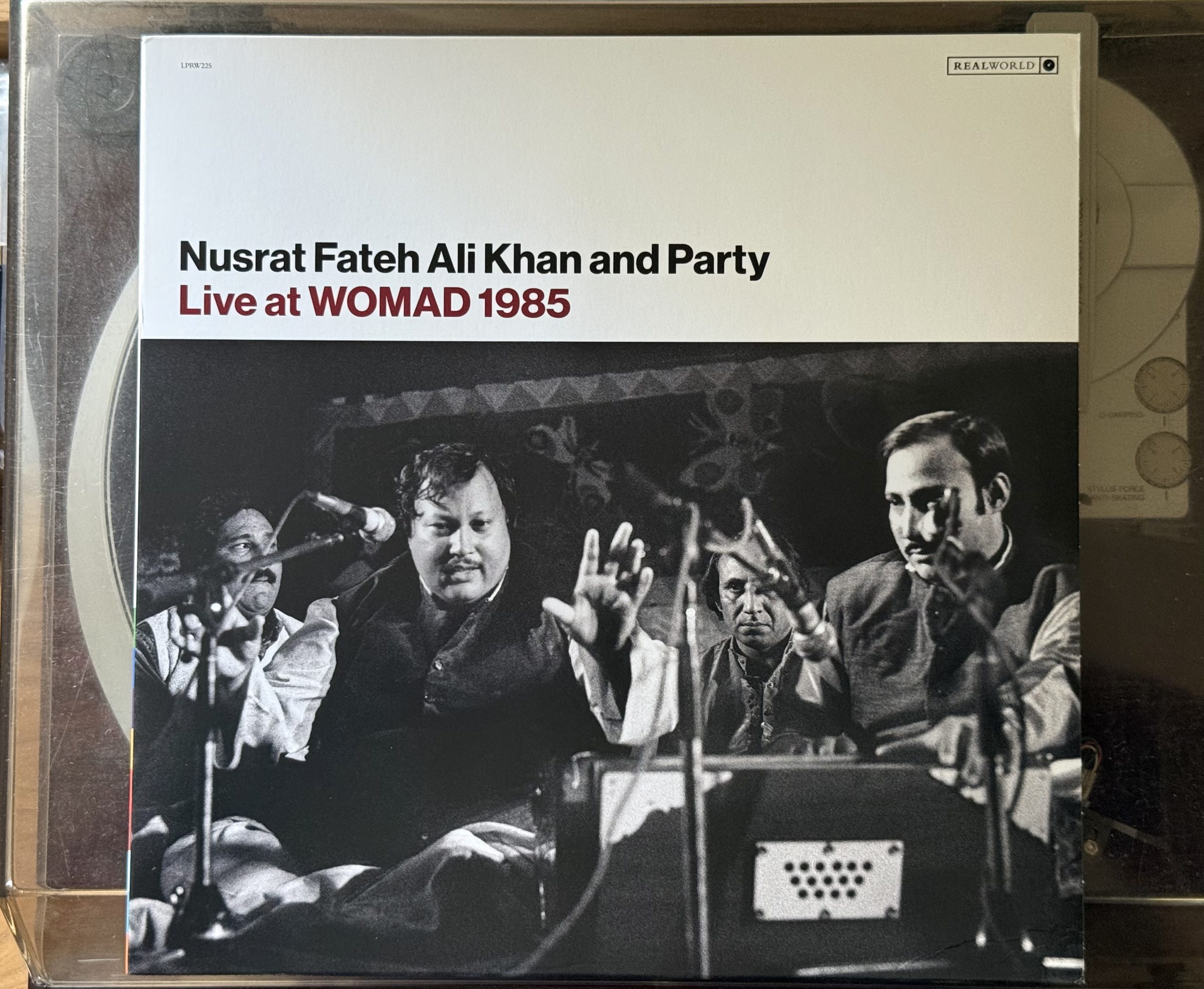
Album of the Week, May 2, 2026
A traditional religious singer from Pakistan who performed with a harmonium player, percussionists, and a group of singers that included two students, one of whom was his nephew, would seem an unlikely choice for a superstar. The rise of Nusrat Fateh Ali Khan, about whom Jeff Buckley once famously remarked “Nusrat, he’s my Elvis,” is the story of a musician who was already acknowledged to be the greatest artist in his field before most Western listeners ever heard of him. And that journey to worldwide fame began with a midnight concert 41 years ago this year, at Peter Gabriel’s 1985 WOMAD festival, on a bill that also featured New Order, the Pogues, Toots and the Maytals, and The Fall.
Ustad Nusrat Fateh Ali Khan (“Ustad” means “master” or “craftsman” in Urdu, Persian and a host of other languages) was born in 1948 in western Pakistan. His family were practitioners of the art of qawwali, or Sufi devotional music, with their musical heritage going back at least 600 years. Nusrat’s father Fateh Ali Khan wanted Nusrat to follow a more reputable profession like engineering or medicine, but the young musician’s playing on the tabla earned praise from master qawwali artists and convinced his father to let his son follow in his footsteps. At age 16, following the death of his father, Nusrat became the lead singer of his father’s party alongside his uncle Mubarik Ali Khan; in 1971 his uncle died and he rose to leadership of the party at age 23.
A qawwali party is a band optimized for traveling performances. The instrumentation is light—tabla or other percussion instruments and a harmonium—and is primarily there to support the singers. In Nusrat’s party this included Mujarad Mubarik Ali Khan (son of Nusrat’s uncle), Farrukh Fateh Ali Khan (younger brother), two pupils, Kaukab Ali and Rahat Fateh Ali Khan (Nusrat’s nephew) and a five-voice chorus. This group of musicians crowded onto a stage on Mersea Island in Essex for an audience that at first sat politely, but by the end of the first song were on their feet, clapping and chanting along.
“Allah Hoo, Allah Hoo” begins with a several-minutes long instrumental solo with the harmonium and the tabla as the group settles in, then Nusrat intones the initial verse melody in something like a plainchant style, alternating with the other vocalists of the party in higher and higher vocal lines, and finally segueing into the chorus with its repeated exhortations of “Allah Hoo, Allah Hoo” after over six minutes of introductory material. From this point forward the party improvises over several main melodic lines: the “Allah Hoo” melody, the verse melody “Ye zamee’n jab na thi, ye jahaa’n jab na tha,” and a stretch of free improvisation in which each of the singers takes turns ascending and descending octaves, a practice called sargam. This section is particularly notable for the interchanges between Nusrat and his young nephew Rahat (now Ustad Rahat Fateh Ali Khan), who was young enough in this record that his voice had not yet attained his adult range. The overall song is a hymn of praise: “O God, O God… When the earth was not, when this world was not / When the moon and the sun had not been created / When even the secret of Truth was hidden from all / There was nothing here / But still, You alone existed.” The overall performance runs for more than twenty minutes.
Nusrat introduces the next song for the festival audience after the instrumental introduction, saying “This is very famous tune—very famous tune ‘Shahbaaz Qalandar laalmeri pat rakhiyo bal’.” The tune, a hymn to the Sufi mystic “Hazrat Lal Shahbaz Qalendar” (literally “Prophet of God, Red-Robed, Falcon King, Sufi Saint”) who sought to bring peace between the Hindi and Muslim populations in Pakistan and who was regarded by the Hindi people as as an incarnation of God. He was also known as “Jhulelal,” and both the Shahbaaz and Jhulelal names recur in many of Nusrat’s songs of praise. The song itself features a strong melodic pattern that circles between the fifth and tenth tones of the scale. There are fewer sangam passages in this performance, but an extended instrumental break on harmonium and tabla brings cheers and whistles from the crowd. By the end the singers of the party are singing the chorus in overlapping waves, ultimately stopping only as one of the singers suffers an audible coughing fit.
“Biba Sada Dil Mor De” is the sole non-religious song on the album, a ghazal, or love song, that can be translated as “Darling, give me my heart back” or, in the liner notes to one of Nusrat’s later albums, “If you cannot remain before my eyes please give me back my heart.” For the most part the party repeats the refrain over and over again, but after about six minutes they start a series of vocal improvisations, ranging from high obbligato to highly rhythmic sangam utterances from Nusrat. The record ends in a fade out on the cheers of the crowd.
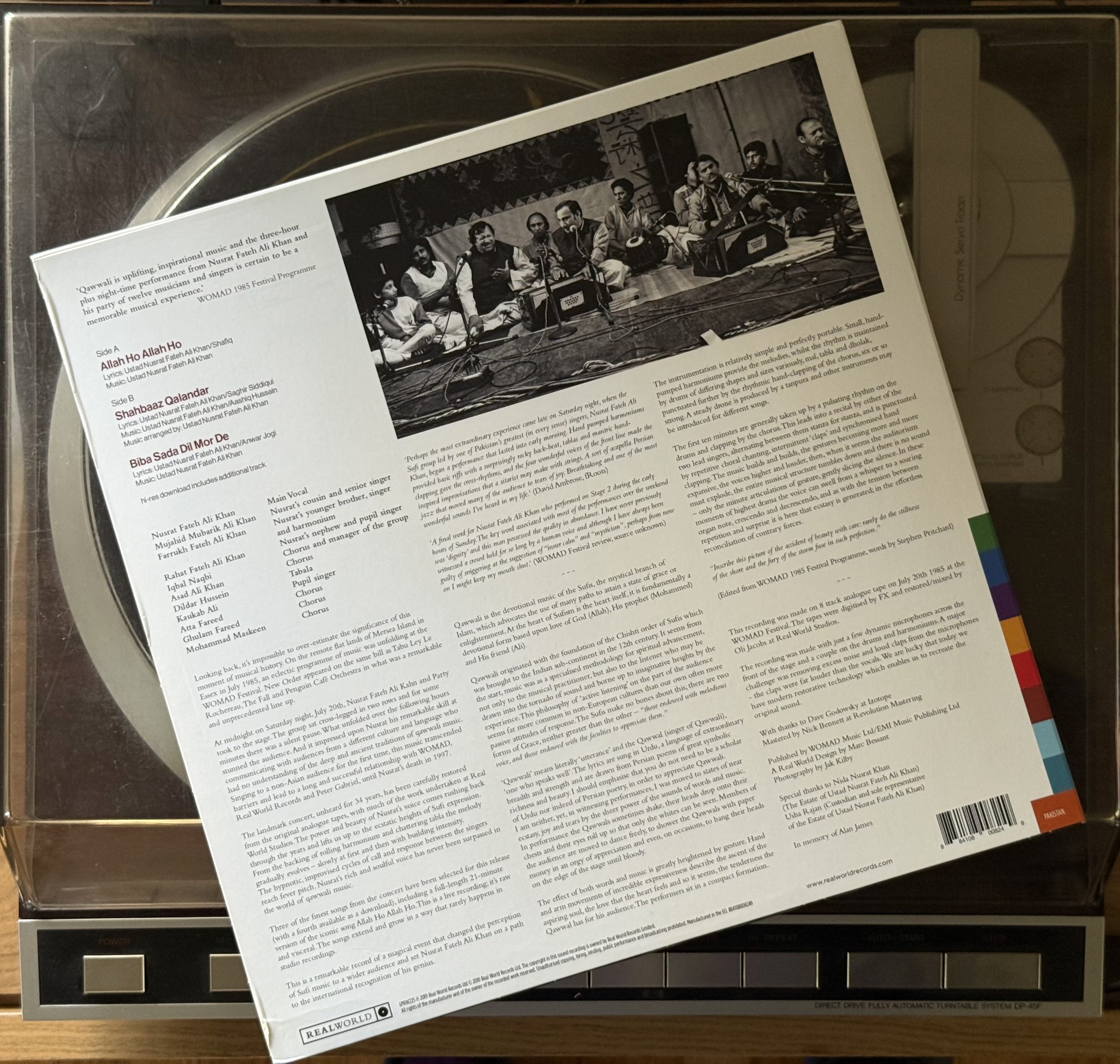
This performance was legendary but not broadly circulated until 2025, when improvements in digital technology made it possible to adjust the levels in a way that permitted the vocals to be appropriately prominent; on the original tapes the sound of the handclaps of the chorus dominated the sound. The release reopens an old question: would Nusrat have found his way to world prominence without the 1985 WOMAD appearance? We will never know, but this first experience led to many later collaborations with Peter Gabriel and a bigger platform for his solo works. We’ll listen to some of those later, but next week we’ll hear from a different Peter Gabriel collaborator on an album that was itself a breakthrough.
You can listen to this week’s album here, including a bonus performance of Nusrat’s famous “Haq Ali Ali”:
BONUS: The recording, amazing though it is, doesn’t fully convey what this band could do. This crowd video of “Shahbaaz Qalandar” shows it all: the polite listening, then the rhythm starts to grab them, then everyone is on their feet. That’s more or less exactly how it happened to me when I saw Nusrat in the mid-1990s in Washington, DC: