
For me, the American Bicentennial celebrations in 1776 came and went without leaving much of an impact. I was not yet four years old, so am unsure of what I do remember, though certain impressions (crowds, heat, loud sounds) persist. I do remember the atmosphere of the year: lots of red, white, and blue kitsch. A resurgence in Holly Hobbyized “Colonial” fashion. Wrought iron plaques on garage doors and the siding of split level ranches, indicating the inhabitants’ connection to the Colonial era.
What I remember happened five years later, during the celebration of the Yorktown Bicentennial, celebrating the final battle of the Revolutionary War and the surrender by General Cornwallis to the American forces. We visited during that four day period when the crowds of adults weren’t there, as part of a crowd of schoolchildren bussed in on massive field trips. In early October in Tidewater it was still hot; the grass of the field was scratchy; and the event struck the right balance between celebration and sober reflection—the latter mostly at how big the battlefield was and how far we had to walk.
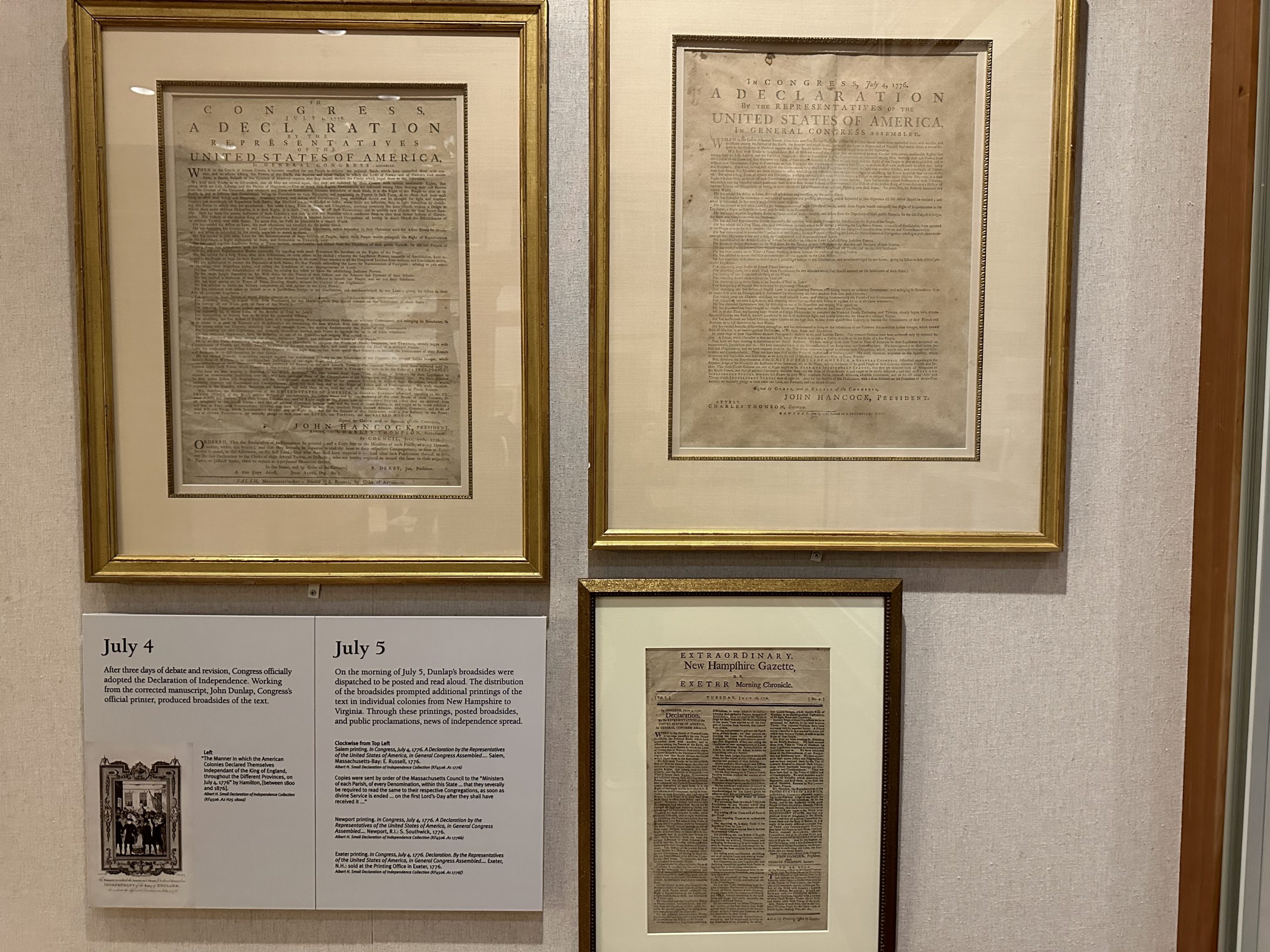
I feel the same about the Declaration of Independence that was announced on July 4. We all remember the engrossed copy, but the one we remember is an 1820s facsimile of an original that was then already fading, now almost completely illegible. But the versions the country first saw were like the ones in the photo above: printed hastily by John Dunlap in Philadelphia and distributed throughout the 13 colonies, who then went on to print their own versions to spread the news far and wide. (Albert Small collected these and other copies of the Declaration; the photo above is from the Small Special Collections Library at the University of Virginia.) Our country’s birth was announced by mass media and by word of mouth, and we remember the fancy souvenirs rather than the original announcement.

We seek consolation in these moments from the past, and also inspiration. Last year I quoted Jefferson’s letters: “The flames kindled on the Fourth of July…” and “The spirit of 1776 is not dead.” This year I think of another quote (coincidentally also used in the Testament of Freedom): “I shall not die without a hope that light and liberty are on a steady advance.” Of a potential eclipse of reason in Europe, he also wrote, “even should the clouds of barbarism and despotism again obscure the science & liberties of Europe, this country remains to preserve and restore light and liberty to them.” Here’s hoping it goes both ways.
The quote I’m thinking of is Leonard Cohen:
“It’s coming through a hole in the air
From those nights in Tiananmen Square
It’s coming from the feel
That this ain’t exactly real
Or it’s real, but it ain’t exactly there
From the war against disorder
From the sirens night and day
From the fires of the homeless
From the ashes of the gay
Democracy is coming to the U.S.A.”