Peter Gabriel, Peter Gabriel 1 (1977)

A former prog-rock frontman steps out of the machinery and begins the long process of reinventing himself.

Album of the Week, February 28, 2026

In 1977, Peter Gabriel was preparing to put a new face forward. He was no stranger to the spotlight; the band he co-founded, Genesis, had released six albums, with their fifth, Selling England by the Pound, reaching Number 3 on the UK Albums chart. Gabriel, the band’s lead vocalist, had become the visible face of Genesis, with elaborate costumes and stage makeup; the rest of the band grew frustrated on the tour for their last album together, The Lamb Lies Down on Broadway, as fans would bypass the instrumentalists and go straight to Gabriel, praising his theatrics. On Lamb, Gabriel had wanted to tell a coherent story and had taken over writing all the lyrics, where prior songwriting had been more collaborative, raising tensions within the band. Furthermore, the tour for Lamb, consisting of 102 dates, had put a strain on Gabriel’s marriage to Jill Moore. It was time to move on, in other words.

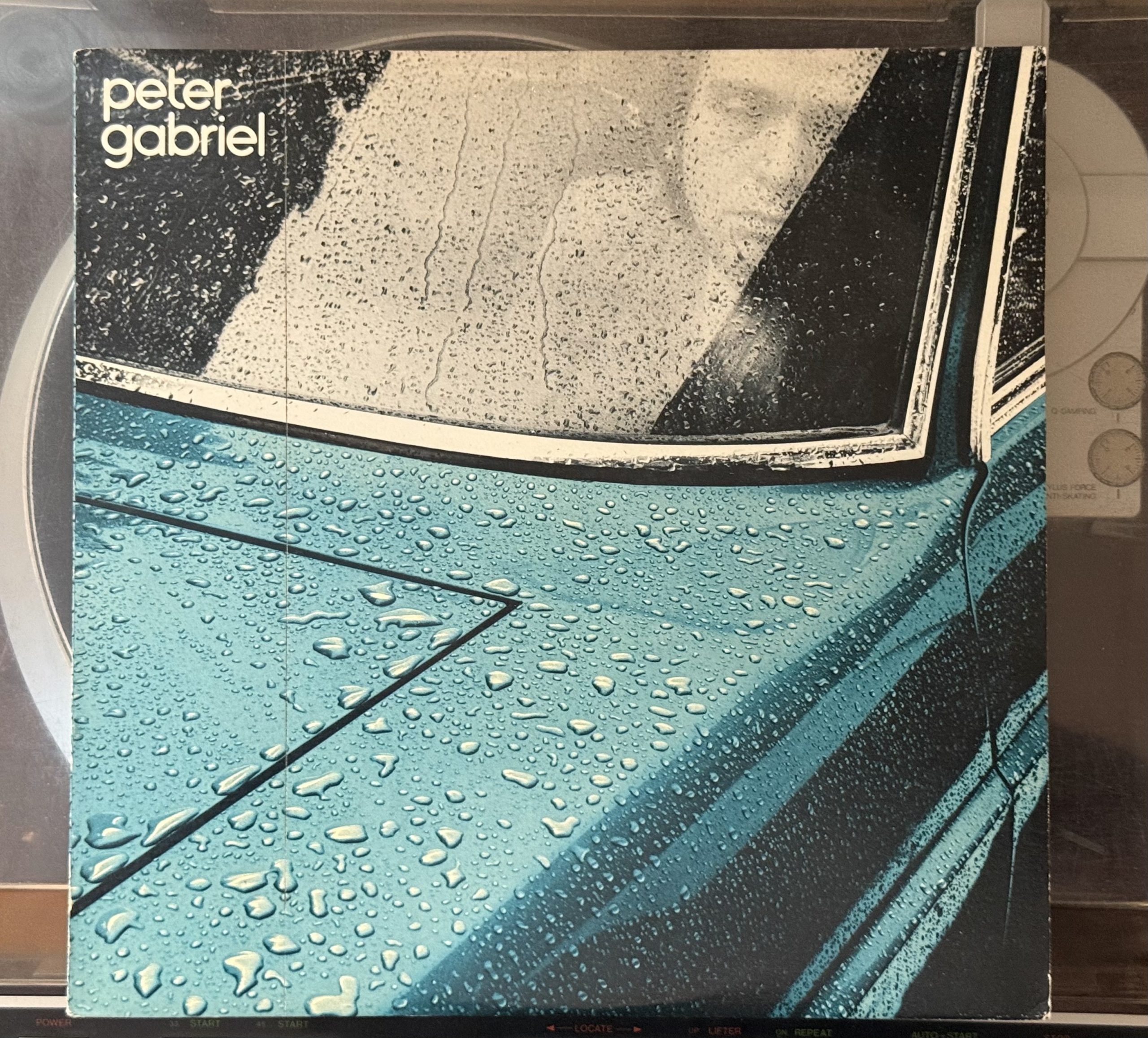
Gabriel took a year off so that it wouldn’t be perceived that he had departed on bad terms. When his self-titled debut album arrived in February 1977, about a week before Mingus and his band entered the studio to start recording Three or Four Shades of Blues, it was a very different kind of record and a different sound than he had achieved with Genesis. Instead of an album-spanning narrative, there were episodes that focused on hallucinatory flashes of insight and personal connections. There was hard rock, arty carnival music, and twisted barbershop that sounded for all the world like Randy Newman. And there was a strange little ditty in 7/4 time.

The musicians weren’t really a band, just a quiverful of studio aces. Producer Bob Ezrin, who was previously known for producing such diverse artists as Alice Cooper (14 albums over the years including School’s Out and Welcome to My Nightmare), Lou Reed (Berlin), Aerosmith (Get Your Wings), Flo & Eddie’s self-titled album, and Kiss (Destroyer)—and later Pink Floyd’s The Wall, would seem to be an odd choice to produce the former Genesis frontman. Ezrin pulled together a group of mostly US studio musicians including guitarist Steve Hunter (who had worked with Ezrin with both Cooper and Reed), Dick Wagner (ditto, also a longtime Reed associate), synth artist Larry Fast, percussionist Jimmy Maelen, keyboardist Josef Chirowski, drummer Allan Schwartzman, and virtuoso bassist Tony Levin, who would go on to a nearly fifty-year career with Gabriel. To this mix Gabriel added King Crimson guitarist Robert Fripp, several months before he collaborated with David Bowie on “Heroes. The London Symphony Orchestra appeared on several tracks as well. A minimalist production this was not.

The opening of the album suggests that this may indeed be an exercise in rock and roll excess, but with a progressive-rock core. “Moribund the Burgermeister” opens with a quietly mysterious verse over squelchy synths, describing an outbreak of disease (possibly St. Vitus Dance) in a medieval village: “Caught the chaos in the market square/I don’t know what, I don’t know why/But something’s wrong down there/Their bodies twisting and turning in a thousand ways/The eyes all rolling ’round and ’round into a distant gaze…” But in the chorus everything swells, the symphony (or at least guitars and synths) enter, and suddenly we’re in the head of the titular burgermeister: “No one can tell/what all this is about/but I will find out.” There’s more than a hint of Dylan’s Mr. Jones in the burgermeister, a figure both threatening and ridiculous, the latter especially in the song’s long fade-out as Gabriel mutters, “I will find out… Mother, you know your son, and you know I will” in an affected deep voice.

And then “Solsbury Hill.” Arguably the most beloved of all Gabriel’s solo work and certainly a highlight of his early career, the twelve-string intro is sunshine and reflection, as Gabriel narrates a story that is either about his transition from Genesis to a solo career, or about a long-stranded extraterrestrial being rescued from a hilltop by his alien friends. Played in 7/4, the longer measures contribute to the sense of reflection, as well as a perpetual feeling of being slightly off-balance.1 It’s not just the 7/4 that contributes this impression; the focal beat shifts within the measure thanks to the dotted rhythm, keeping the listener in motion as Gabriel sings the greatest line ever written about going solo: “I was feeling part of the scenery/I walked right out of the machinery.” But leaving aside all the complex backstory and the prog-rock rhythms, it’s still a joyous anthem to freedom, and clear to see why it remains among his most popular songs.

Modern Love” feels more like it could have come out of another Ezrin production, albeit one with a love for odd metrical structures (the verse here is set with groups of three measures in common time — or one long 12/4 measure). It features a strenuous rock vocal from Peter, particularly on the chorus (“Ah, the pain! Modern love can be a strain”). According to Ezrin, this was method acting; he thought Gabriel’s vocal was too polite, so he asked engineer Brian Christian to take the musician up a ladder and duct-tape him to a pillar by his armpits to record the chorus vocal.

Excuse Me” is easily the oddest song on the album. Opening with a barbershop quartet arranged by Tony Levin and featuring Chirowski and Maelen alongside Levin and Gabriel, the song fairly quickly mutates into a British dance hall number, with a chorus vocal that could have been sung by Randy Newman (and only the second appearance in four years of columns of the Acme siren whistle). It’s weird, and maybe the best example of Gabriel’s free exploration of different sounds on the record, once he was freed from the constraints of Genesis.

Humdrum” feels a bit more like the band he left, if you disregard the samba. There’s a combination of a quiet intro, some Latin percussion which is interesting over the three-quarter time of the verse, odd backing instruments (harmonium!), and sweeping synthesizers on the chorus that take us into a swooning bridge and ultimately into a grand chorus, featuring a grandly disappointing lyric from Peter: “Out of woman comes a man/Spends the rest of his life getting back when he can.” This clunker aside, the rest of the song reads as a moving, if surreal (“Hey Valentina, you want me to beg? You got me cooking, I’m a hard boiled egg”) paean to love.
Slowburn” gives us a massive Ezrin rock banger that alternates massive verse and chorus orchestration with a pre-chorus that pulls way back to focus on Gabriel’s voice and the piano. The lyrics, seemingly about a relationship slowly being eroded by drugs and each other, are opaque, but they lean into that 1970s guitar sound that Steve Hunter did so well, particularly that diminished 6th that could have been a riff from any of Ezrin’s 1970s production. The song seems destined to be unfinished, going to an unresolved supertonic that fades into nothing, but then Peter returns with an unusually direct plea: “Don’t try to make it easy/It’ll cut you down to size/Darling, we’ve got to trust in something/We’re shooting down our skies…” A sort of clockwork instrumental coda really does fade out into nothingness, leaving the plea unanswered…

… because “Waiting for the Big One” is many strange things, but an answer to “Slowburn”’s direct plea it ain’t. It’s a blues, a barroom song, a showpiece for Ezrin’s hired guns to demonstrate their professionalism, the sound of a drunkard waiting at a bar for the end of the world. Peter’s Randy Newman impression is at its peak here; it’s not one of his finest vocal moments. The instrumental breaks are arguably the best thing about the song, and they’re replete with all the bombast Steve Hunter could summon.

The apocalypse finally arrives in “Down the Dolce Vita,” with chocka-chocka rhythm guitars, the London Symphony, and motifs of drowning amid repeated declarations that “You guys are crazy!” The song is patently part of a larger epic, with characters we never really meet (Aeron and Gotham) trying to charter a boat to make it out of the harbor of a fishing village in a storm. The orchestra adds thrilling musical tension to the number, but ultimately it’s a series of empty visions; the story is too obscure and we’re left to guess at what is happening.

Out of the chaos of “Dolce Vita” comes a sublimely quiet, sad moment. “Here Comes the Flood” revisits the summit of Peter’s apotheosis in “Solsbury Hill” but in a decidedly more apocalyptic mood. The jagged imagery—starfish stranded on a beach, an old trail along a seaside cliff, a nail sunk in a cloud—leads up to the third verse, in which Peter sings of an increase in cosmic energy accompanying the nighttime surge in shortwave radio strength that ultimately leads to the dissolving of barriers between minds and the creation of a mass psychic entity. But you don’t need to know any of that; all you need is the quiet prophetic despair in the chorus: “Ah, here comes the flood/we will say goodbye to flesh and blood/If again, the seas are silent, in any still alive/It’ll be those who gave their island to survive/Drink up, dreamers, you’re running dry.” The first recorded version of the song is full of patented Ezrin bombast, with triumphalist electric guitars and soaring strings, turning the vision into something somehow triumphant. Gabriel ultimately was unsatisfied with this version and recorded it several more times (as you’ll hear below).
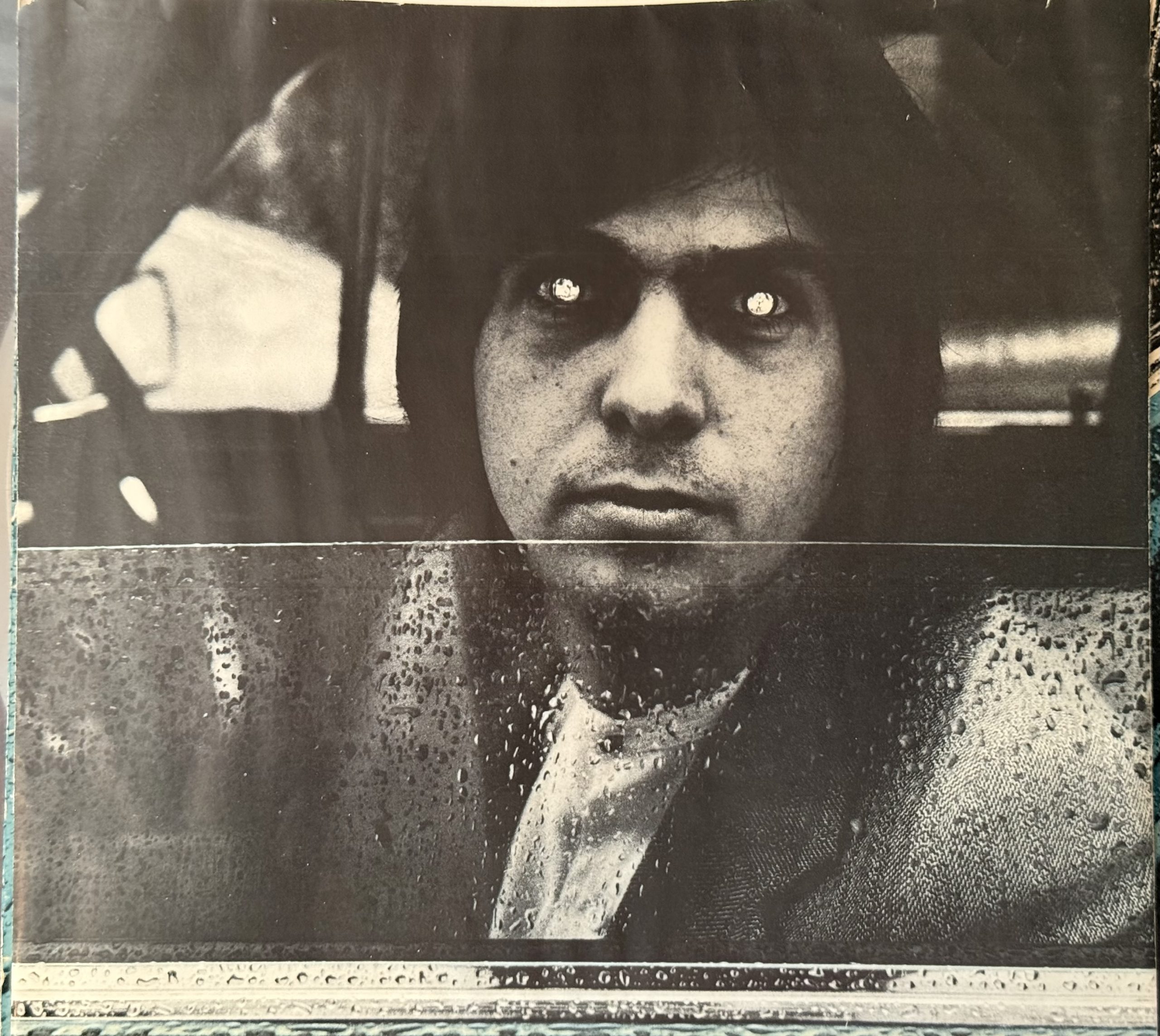
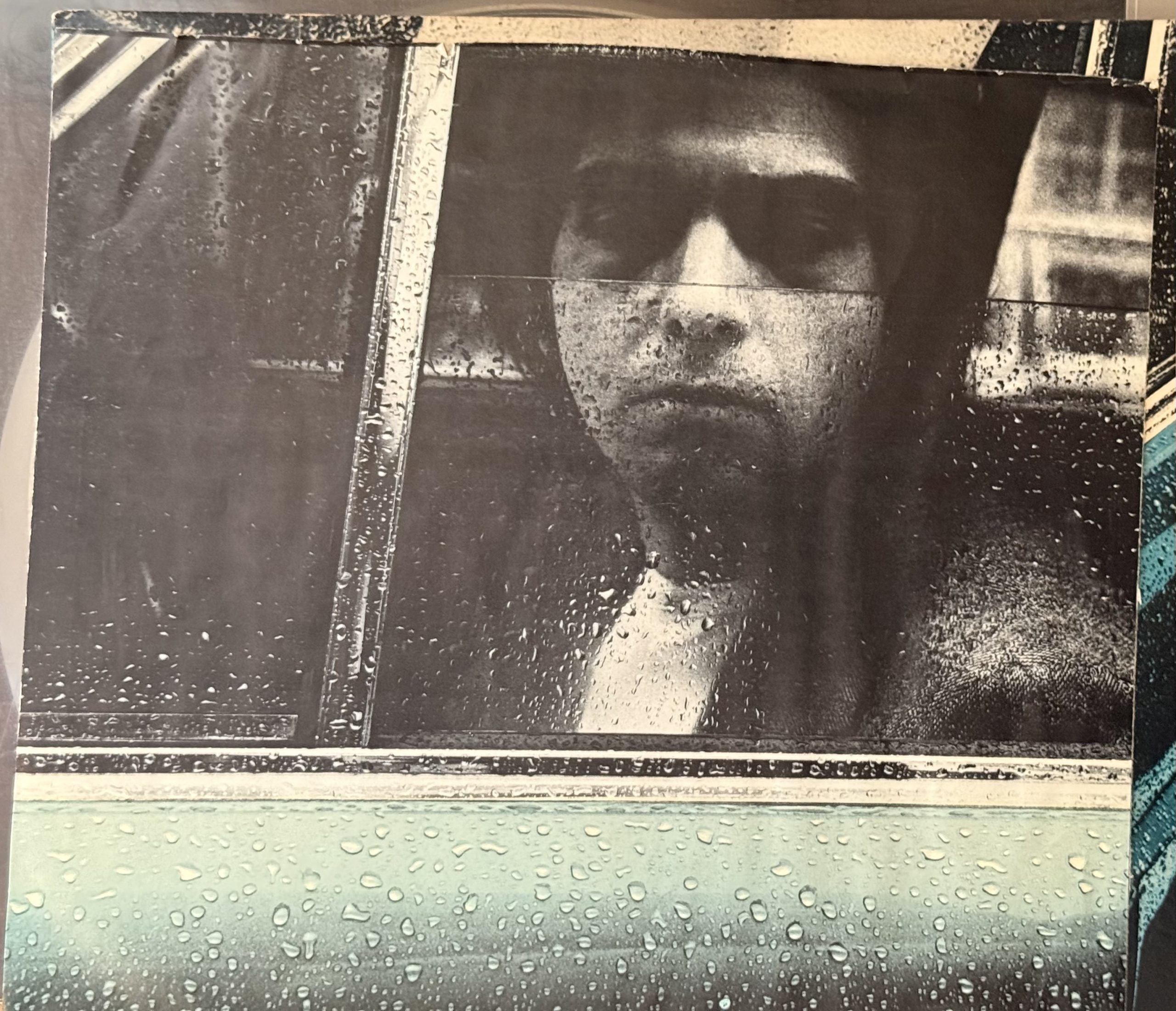
The uncanny metal eyeballs in the inner liner are courtesy a pair of mirrored contact lenses.

Part of the impenetrability of the second half of the album is that we’re only getting fragments of a larger story that Gabriel himself hardly knew. The being who catalyzed the departure of the boats and heralded the arrival of mass consciousness was a character called Mozo, a Mosaic figure who didn’t save people so much as inadvertently bring about massive change. Peter played with the narrative for years but never got it into a coherent shape; that never stopped him from including Mozo in several of his early songs. We’ll hear one of those next time.

You can listen to this week’s album here:

BONUS: Gabriel almost immediately re-recorded “Here Comes the Flood,” this time with Robert Fripp on Fripp’s 1978 album Exposure. This version still has a little of the bombast of the Ezrin version, thanks to Gabriel’s taking the later choruses an octave up, but generally the energy level of the song is more introspective:

BONUS BONUS: In 1978, Peter paid a special visit to Kate Bush on her BBC television Christmas special (which is a good topic for an entirely different post), and stole the show with this stripped down piano and vocal version of “Here Comes the Flood”:

BONUS BONUS BONUS: As any good child of the 1980s knows, Peter did another studio recording of “Flood” for his first greatest hits compilation, 1990’s Shaking the Tree. This one features a freer melody on the verse and is somehow even more pathos-filled:

  1. I’m reminded of Peter Schickele’s line about P.D.Q. Bach’s waltz music, which “suggests that one of his legs was shorter than the other.” ↩︎
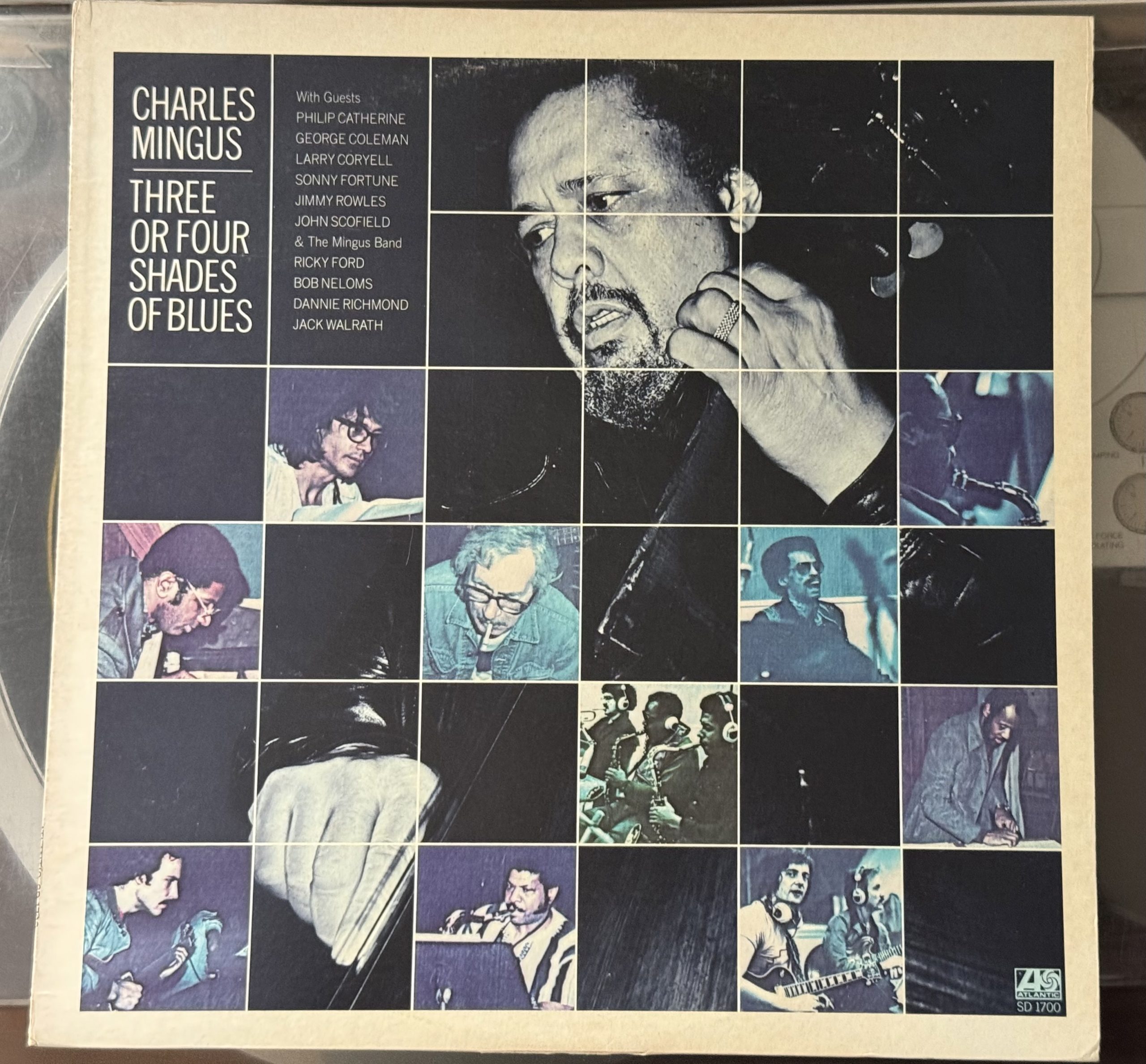
Charles Mingus, Three or Four Shades of Blues

An electrifying, bluesy late work from the great bassist takes us on a sort of survey of the many forms of the blues.

Album of the Week, February 21, 2026

Charles Mingus was unwell. The cruel progression of ALS had robbed him of most of his technique on the bass, and of his ability to stand. But he could still play, a bit, and he could lead a band. And so he brought a nonet (and later a, um, tentet) to a New York City studio on March 9-10, 1977 to record tracks for what would become one of his last albums.

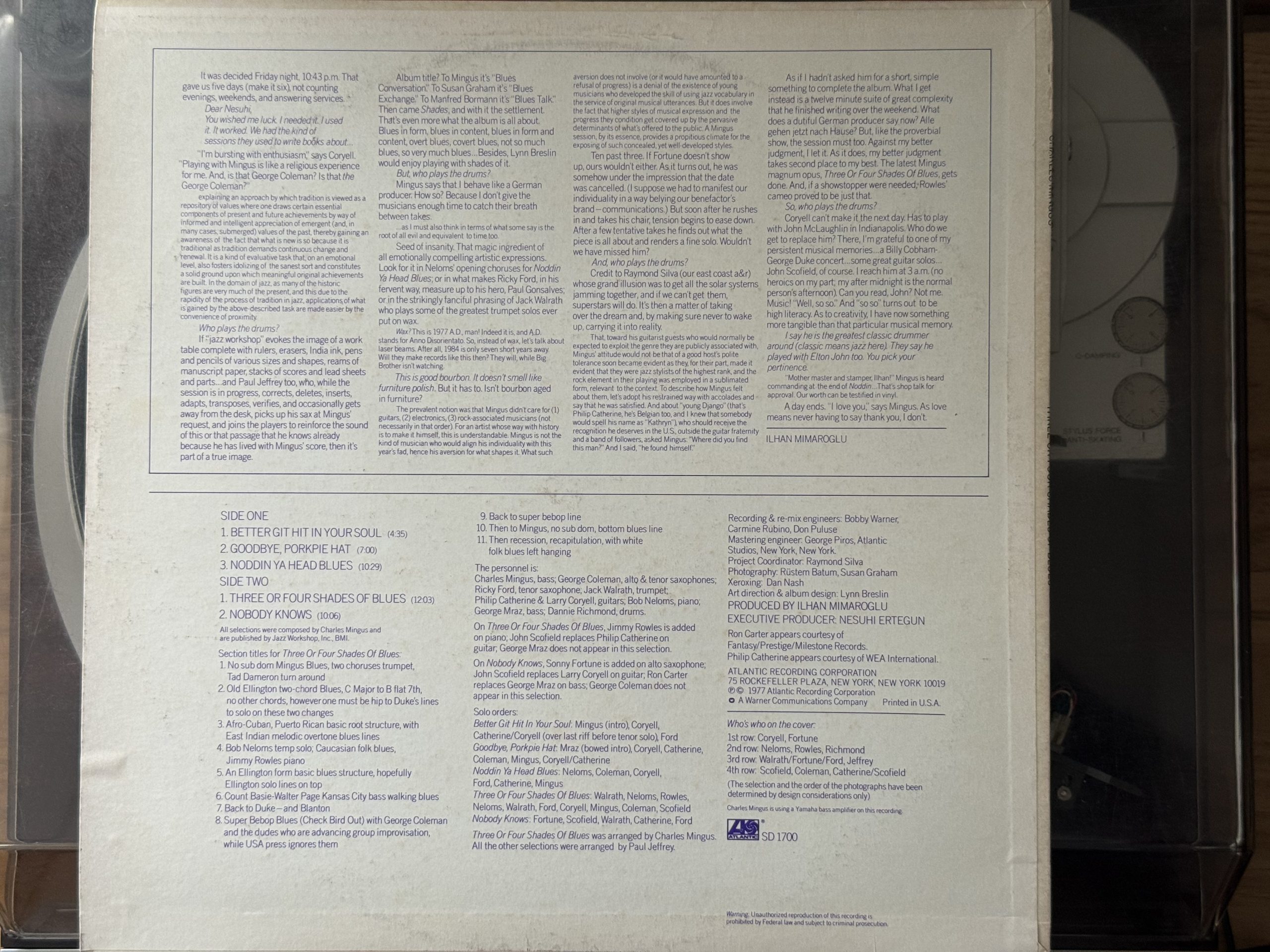
Behind the drums sat the redoubtable Dannie Richmond; almost every other musician was a new face for this column, though he had been touring with some of them for years. Jack Walrath (trumpet) and Ricky Ford (tenor sax) were part of his regular touring band, but Bob Neloms was a new face at the piano. Bowing to necessity, George Mraz sat in at bass for the first three tracks, supporting Mingus. Not one but two electric guitarists, Philip Catherine and Larry Coryell, play on the majority of the tracks; John Scofield replaces Catherine on one track and Coryell on another. A second sax player was there too: George Coleman, who after leaving Miles’ band in February 1964 had become an in-demand player, to the point that Coryell is quoted in the liner notes as saying “Is that George Coleman? Is that the George Coleman?” A second piano player, Jimmy Rowles, appears on the long track “Three or Four Shades of Blues,” and Sonny Fortune’s alto sax is on the last number, along with Ron Carter who replaces Mraz.

One could look at the track list, see the first two tunes, and assume that this was another “greatest hits” set with a different band. But there’s a completely different energy here from Mingus Mingus Mingus Mingus Mingus. Better Get Hit In Yo’ Soul” gets a better recording of Mingus’s opening bass line, for one thing, which he rips into with alacrity. And the whole temperature is elevated about ten degrees (Fahrenheit) by the two guitarists, particularly Coryell, whose solo is electrifying. There is also, unusually for this tune, a fully sung lyric on the chorus, by the entire band: “He walked on water. He ministered to the blind. He healed the sick. And he raised the dead. Talkin’ ’bout Jesus!” Ricky Ford’s tenor gives a down-home and gutsy R&B solo before taking off into a Trane-inspired series of glissandi over general mayhem in the band. Neloms hammers the keys into the last bridge as the two guitarists play blasts of chords and Jack Walrath lets loose with an apocalyptic squawk. This is Mingus as gateway to the universe; probably why this was the only track of his that made it onto one of my mix tapes as a college student.

Goodbye Pork Pie Hat” is given a subtler read. George Mraz introduces the tune, arco; and the guitarists play the melody alongside him. The guitarists are playing classical style this time, and Coryell’s virtuosity here is gorgeous but quieter; Catherine’s is practically Spanish in its precision. George Coleman provides an impeccably brilliant tenor solo leading into a key change and Mingus’s harmonically rich exploration. The two guitarists play in duet to close the solo section, leading into the final chorus and a long coda that is both wearily beautiful and impossibly sad.

Noddin’ Ya Head Blues” takes us into a twelve-bar blues by way of a gospel-inspired Neloms piano solo, punctuated by bursts of Coryell and leading into the melody stated by the two guitarists. Coleman gets a flutteringly beautiful solo that he passes virtuosically to Coryell, who does a combination of Hendrixesque flourishes and dirty Delta blues. Ricky Ford’s solo is restrained by comparison here, but yields to Philip Catherine for a twelve-bar Spanish romp that falls away for Mingus’s slow and low solo, accompanied by Mraz and Richmond up to the final chorus.

Three or Four Shades of Blues” is programmatic music, with the program helpfully spelled out in the liner notes: “No sub dom Mingus Blues; Old Ellington two-chord blues; Afro-Cuban; Caucasian folk blues; An Ellington form basic blues structure; Count Basie – Walter Page Kansas City bass walking blues; Back to Duke – and Blanton; Super Bebop Blues (Check Bird Out); Back to super bebop line; Then to Mingus, no sub dom, bottom blues line; Then recession, recapitulation, with white folk blues left hanging.” At least three or four shades of blues, indeed. There are some ingenious twists and turns in this music, especially the pivot into Afro-Cuban blues and the cheeky quote of the Mendelssohn wedding march (the Caucasian blues!). For my money this is not one of Mingus’s most essential long-form works, but it might be among his most approachable, particularly in the “super bebop” section.

Nobody Knows” is credited to Mingus, but it incorporates bits of “Nobody Knows the Troubles I’ve Seen” and “Down by the Riverside” in its brisk melody. Sonny Fortune’s sweet alto soars across the band, leading to John Scofield’s precise blues and Jack Walrath’s trumpet, here brisker and more precise than in his other featured spots. Solos from Philip Catherine and Ricky Ford round out the tune in a valedictory send-off.

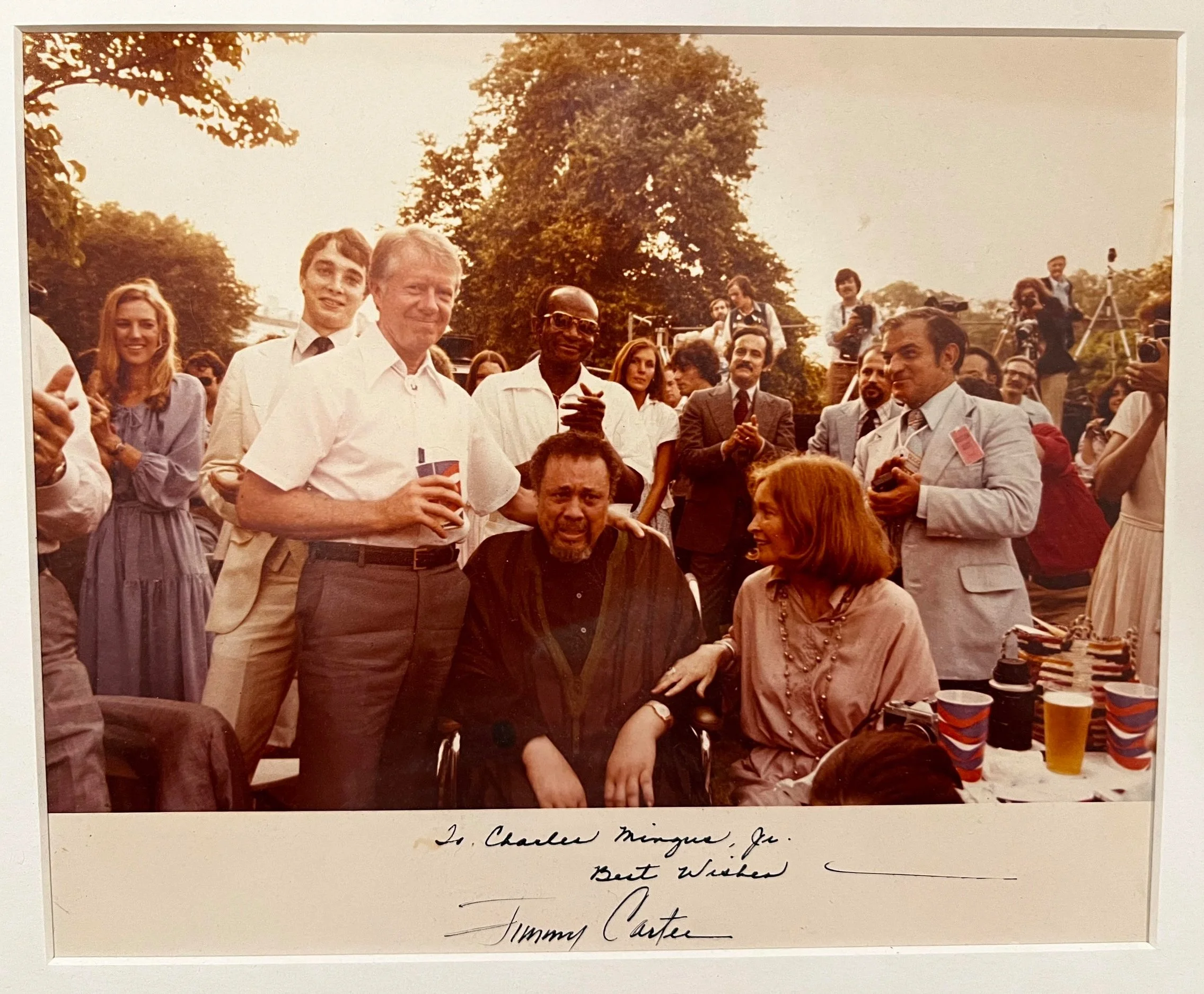
Mingus at the White House, June 18, 1978. Courtesy CharlesMingus.com

Mingus recorded two more albums following this one, but his health was going downhill fast. In 1978 he was invited to the White House as part of a ceremony honoring 25 years of the Newport Jazz Festival, where he was lauded by an enthusiastic Jimmy Carter; the moment moved Mingus, now confined to a wheelchair, to tears. He worked in his last days on a project with Joni Mitchell, which she completed after his death as her album Mingus. In late 1978 he traveled to Cuernavaca, Mexico to seek treatment and rest from his disease, and he died there on January 5, 1979. He was only 56 years old.

Mingus stands alone for many reasons: his fierce iconoclasm, his dogged insistence in pursuing his own vision, and the degree to which he succeeded in realizing that artistic direction during his short lifetime. Next week we’ll pick up a different thread that begins with another 1977 album, following the life of another iconoclastic musician who might be as well known for his knack of finding and promoting brilliant collaborators as his own distinct genius.

You can listen to this week’s album here:

BONUS: A short segment from a longer documentary about the Newport Jazz Festival featured these moments of broadcast video about the White House reception, including a few precious seconds of Mingus, overcome by Carter’s praise of his work.

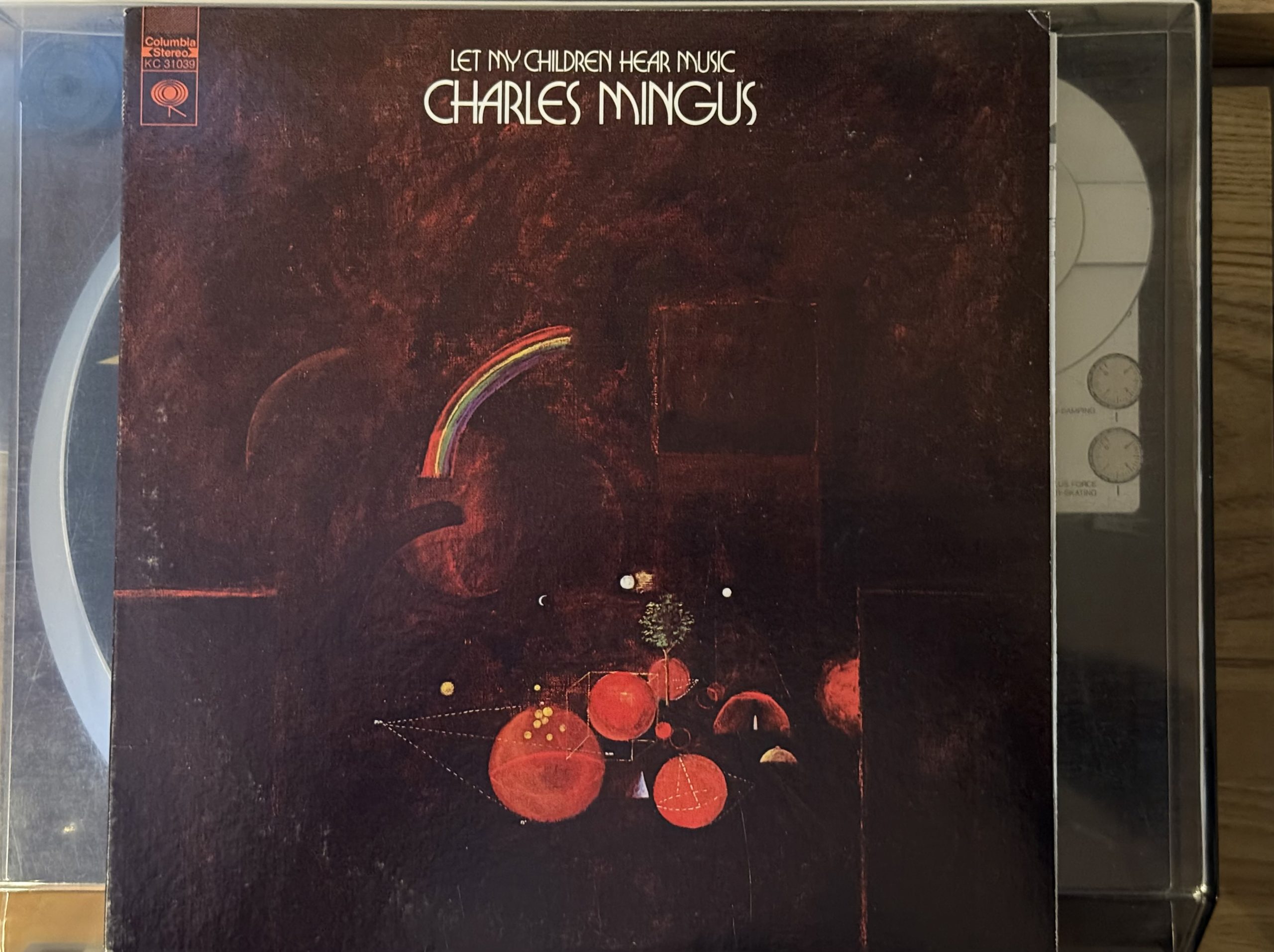
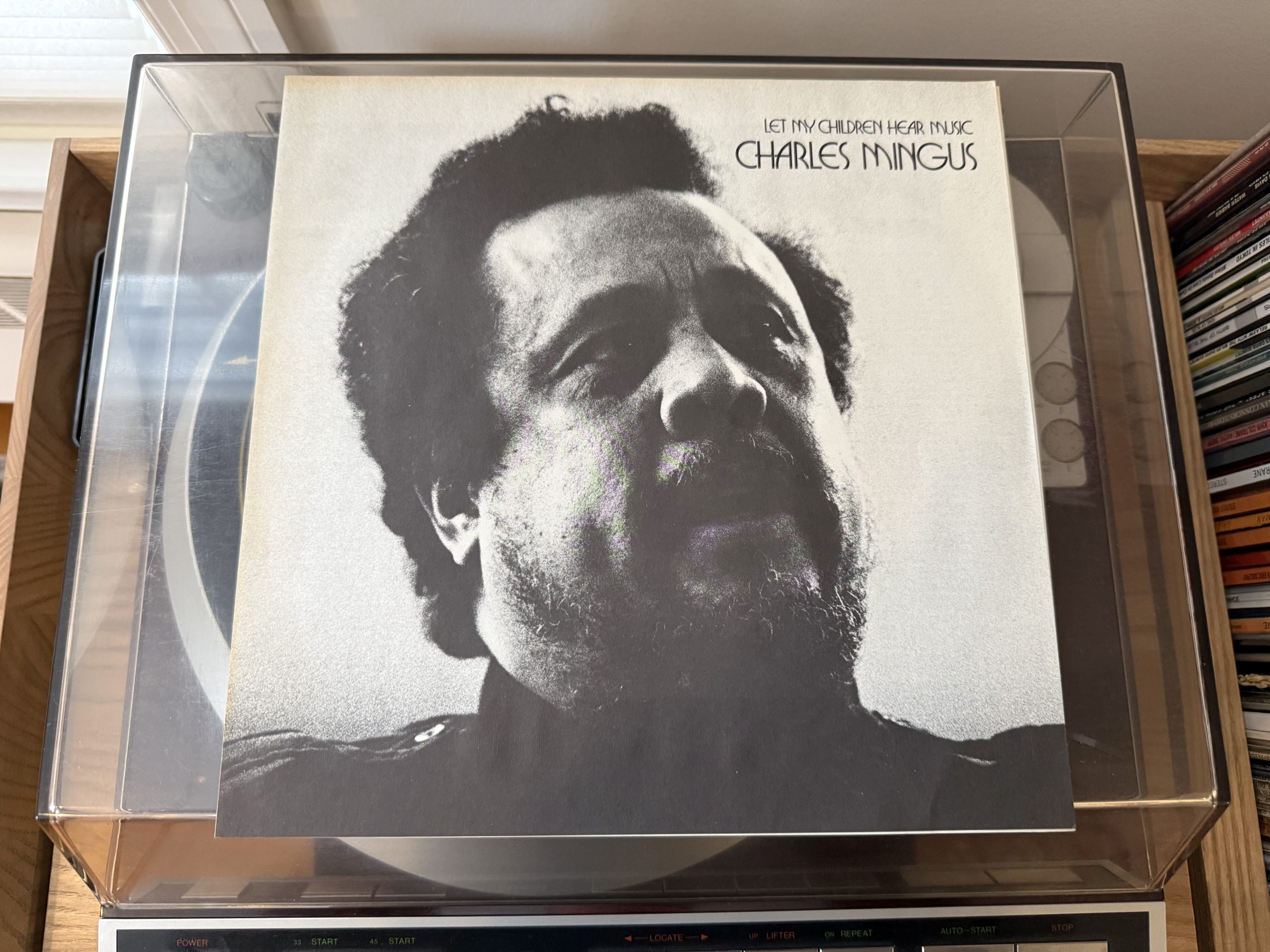
Charles Mingus, Let My Children Hear Music

The last great composition from Mingus sums up all his contradictions into a single masterpiece.

Album of the Week, February 14, 2026

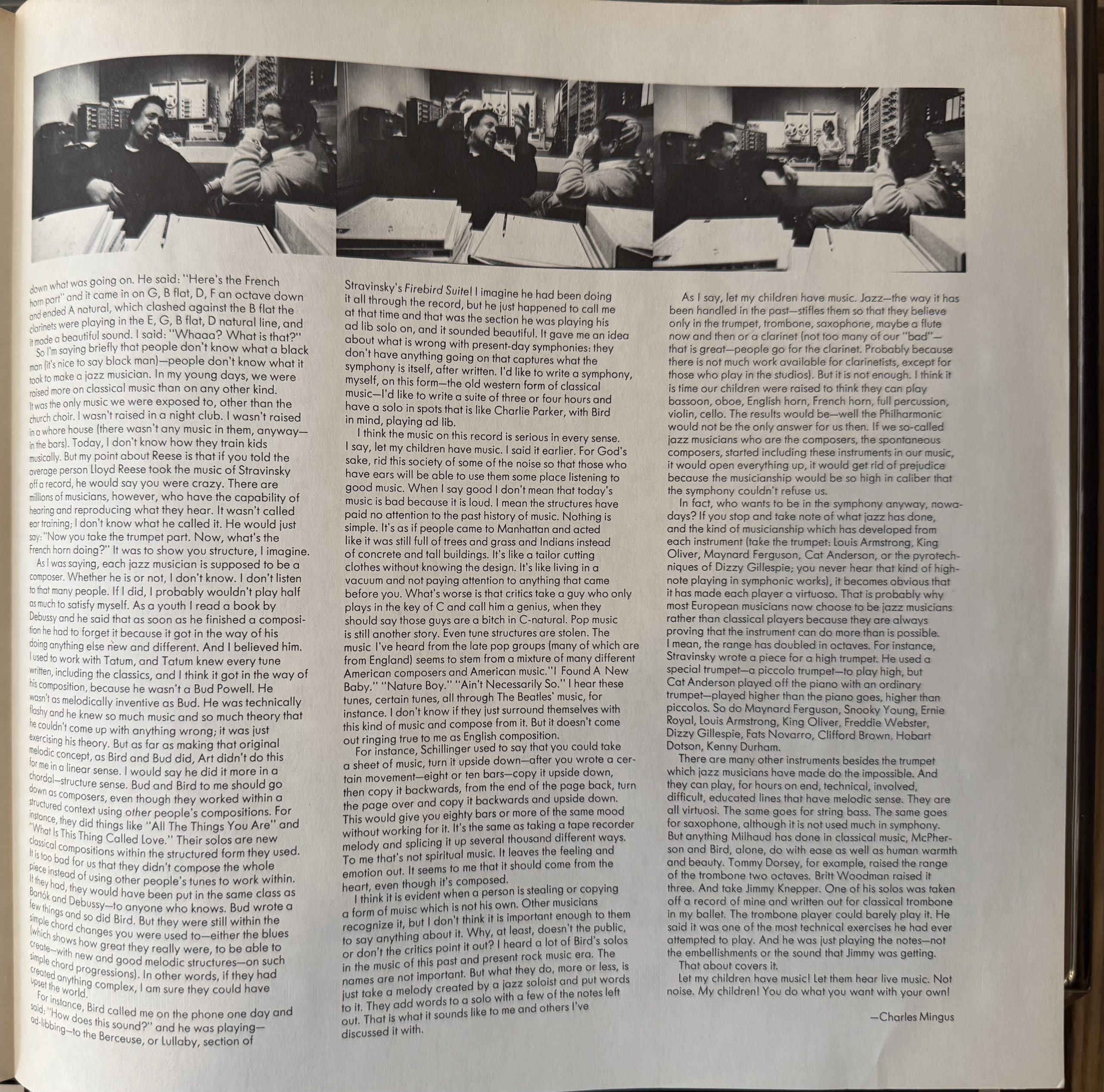
When we last checked in with composer and bassist Charles Mingus, he was on a career high that was about to enter a downturn. Following Mingus at Monterey, he toured heavily but was without a recording contract, and was evicted from his apartment for nonpayment of rent in 1966. But Mingus seems to have always had the ability to convince the labels to place a bet on him, and the fall of 1971 found him working again with Columbia’s Teo Macero on a big-band recording of all-new compositions.

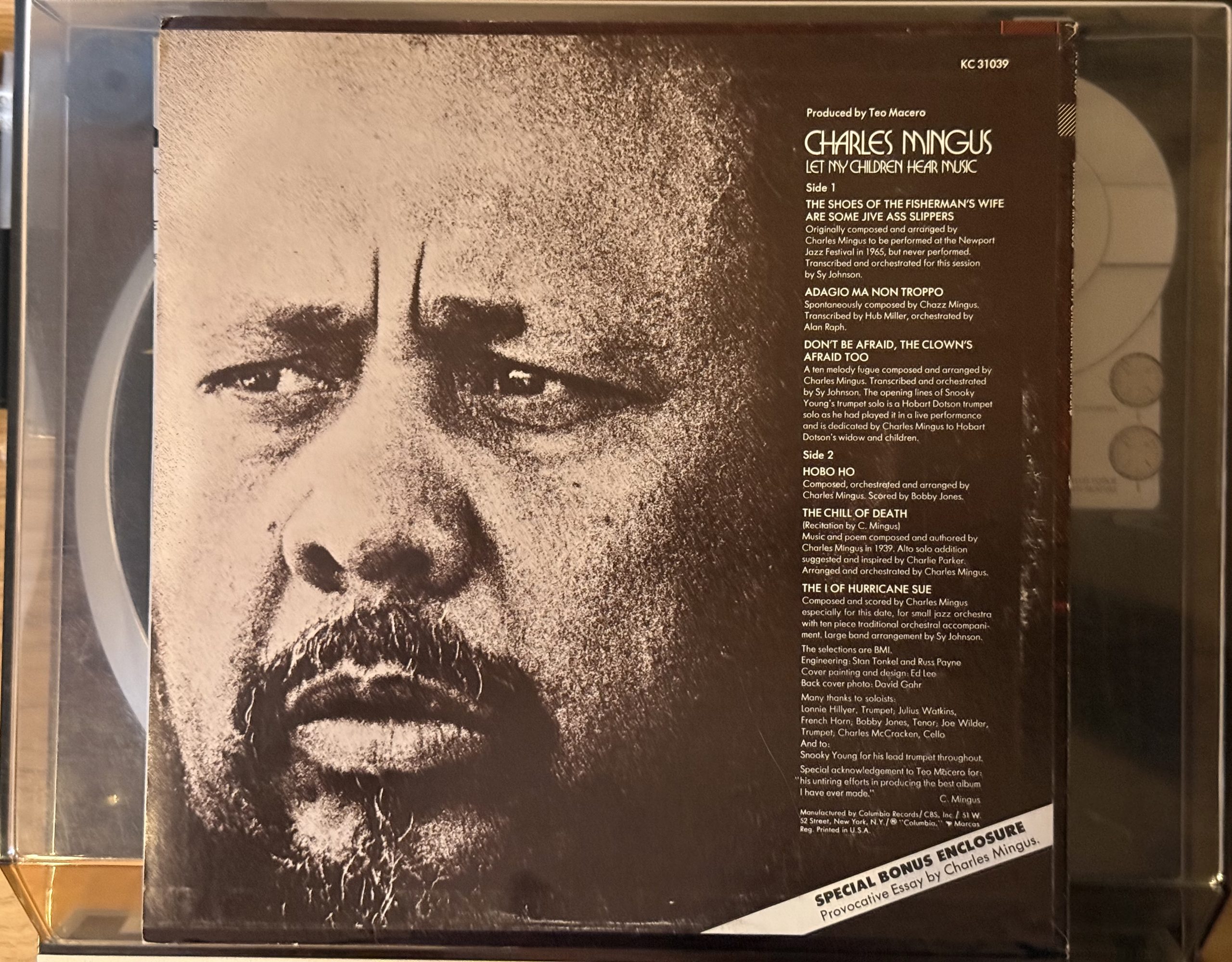
And what a band! Across six recording sessions between September 23 and November 18, a small army of musicians worked on the recording that became Let My Children Hear Music, including Lonnie Hillyer, Jimmy Nottingham, Joe Wilder, and Snooky Young on trumpet, Jimmy Knepper on trombone, Julius Watkins on French horn, Charles McPherson on alto sax, Jerry Dodgion, Bobby Jones, Hal McKusick and James Moody on reeds; Charles McCracken on cello; Jaki Byard, John Foster, and Roland Hanna on piano; and Dannie Richmond on drums. Teo not only produced but also conducted the orchestra and played some alto sax. And alongside Mingus’s bass were three additional bass masters—no less than Ron Carter, Richard Davis, and Milt Hinton. And those are only the musicians we know about—some remain uncredited on the recording due to contractual issues. Collectively they gave Mingus’s music a sound that he had never gotten on record before, with a combination of power and polish.

The Shoes of the Fisherman’s Wife Are Some Jive-Ass Slippers” might be my favorite Mingus title of all time, even considering that this is the man who wrote “All the Things You Could Be By Now If Sigmund Freud’s Wife Was Your Mother.” From the very beginning of the track we get two impressions: this music is ambitious, and this band is tight. The horns and reeds play the opening melody slowly against a chromatic scale in the bass and low instruments; there’s a coda of sorts to this part signaled by an “Also Sprach Zarathustra” timpani roll, a series of chord changes, and then we’re into a brisk waltz that pauses, then shifts into 6/8 time. The horns and reeds introduce a descending motif that keeps interrupting the waltz until the piano signals another transition and a recapitulation of the top melody. This time the band picks up a new version of the slow theme in a fast 4/4 time, that builds in intensity up the chromatic scale until there’s a sudden swoon and lapse back into waltz time. We’re left to wonder how many of the sudden shifts were scored and how many were the product of Teo Macero’s genius editing skills. All throughout the chord progressions and gestures are wild and free (that timpani glissando against the descending motif at the end!) and the band swings as hard as anything Ellington ever did.

Adagio, Ma Non Troppo” begins with a lone reed followed by a lone flute, playing music that seems birthed from “Sketches of Spain.” There are interludes of piano and guitar, rafts of flutes and clarinets, and a fast dance with three arco basses all soloing at the same time. True to the title, some moments are downright symphonic here; this section is probably the least swinging on the record, but those bowed bass solos keep us grounded at the same time that they reach for the stars. When the saxophones take the theme it feels like a moment from a Keith Jarrett European quartet composition.1 The whole thing is breathtaking in both composition and performance.

Don’t Be Afraid, The Clown’s Afraid Too” starts in the circus, with recorded lion roars and elephantine trumpet blasts, before the band swings into a circus theme underscored by oompa bass and tuba and a brilliant walking bass line. The simultaneous solos between tenor sax (right channel) and alto sax (left) stretch the brain to hear all the passing harmonies as the players cross over and solo past each other. Another circus interlude and a brisk Mingus pizzicato solo sets up a chorus of twittering bird flutes, and the rest of the track tosses the theme from section to section before returning to the oompa theme once more before returning to the circus again to take us out of Side A.

Hobo Ho” opens with a gutsy, funky bass line that anchors us firmly in the tonic. The tenor sax sets up the first melody with almost subsonic support in the lowest instruments. There are horn bursts that wouldn’t have been out of place on The Cat. This is music for a rumble, standing alongside “II B.S.”/“Haitian Fight Song” as some of Mingus’s most groove-driven work.

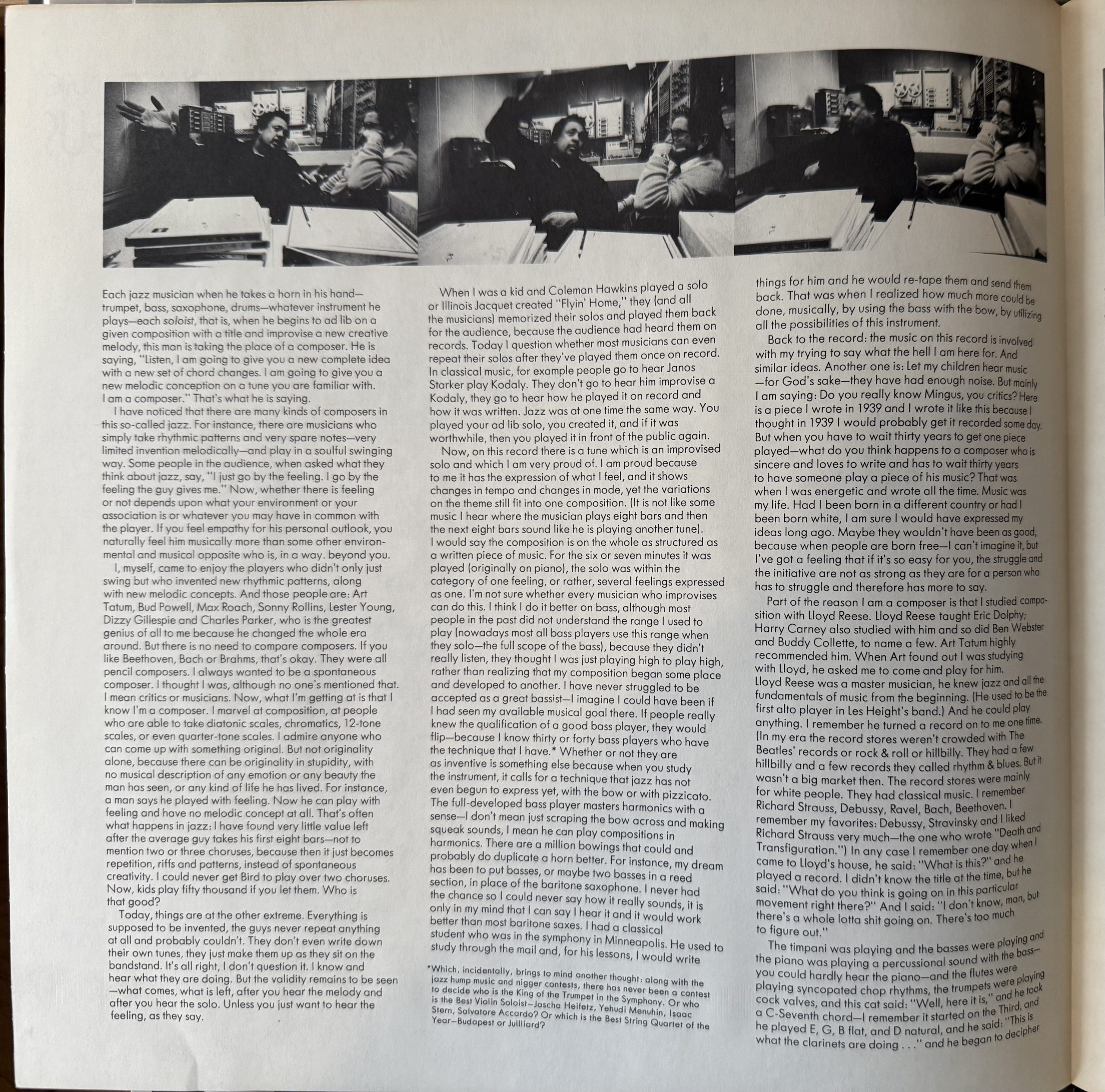
The Chill of Death” begins with a Mahlerian moment, a tremolo from the basses over a timpani hit and the orchestra. Mingus recites a poem that dates from the beginning of his career; written in 1939, it captures the constant tension in his work between wild life and the fear of being forgotten in death. After the recitation there’s a sustained organ tone and a free alto sax solo by Charles McPherson over a shifting, uneven instrumental background—sometimes marching to the graveyard, sometimes joyfully dancing, sometimes anxiously peering around the corner. The piece ends with a rare audible splice as McPherson plays into a descending glissando and crescendo by the rest of the band; I wonder how much improvisation was left on the cutting room floor by Macero.

The I of Hurricane Sue” ends where we began, the second piece recorded in the very first session. There are wind effects and corrugaphones beneath a free intro before the band snaps into a tightly wound, swinging melody. The work ends with dueling pianos, Jaki Byard vs. Roland Hanna, as the whirly tube and winds blow us away. This characteristic of alternating chaos and gorgeously played symphonic jazz is what ultimately sets Let My Children Hear Music apart as a work of staggering genius and an apex of Mingus’s compositional career.

The brilliance and tragedy of Mingus’s life wasn’t yet done. He had a few epochal albums for Atlantic Records, Changes One and Two, ahead of him, but he also had a deeper challenge—ALS, which began to rob him of his mobility and his ability to perform. As a composer and bandleader, he still had some milestone records ahead and we’ll hear one last one next week.

You can listen to this week’s album here:

BONUS: There is an honest-to-goodness bonus track, in the original CD reissue sense, on Let My Children Hear Music. Recorded on the second recording date (September 30) following “Hobo Ho,” “Taurus in the Arena of Life” was first issued in 1992 on the first CD release of the album. It’s a nifty hybrid between a classical sonata in the piano and a blues in the horns, who take a trip to Mexico where things get marvelously strange.

BONUS BONUS: There are a few attempts to play this music live out there, but not many—which is why it came as a shock to find this sextet performance from a jazz ensemble in the University of Virginia’s Old Cabell Hall Auditorium, of all places! I don’t think that’s any of the main faculty up there, but I can’t see the bassist so it just might be Pete Spaar.

  1. Don’t worry, you didn’t miss a week. We’re not to Keith yet, but we’ll get there eventually. ↩︎

Charles Mingus, Mingus at Monterey

From Mingus’s golden year, a spectacular live set with something old, something new, something borrowed, and something blue.

Album of the Week, February 7, 2026

Last week we witnessed Charles Mingus solidifying his place in the pantheon with an album that realized some of his greatest compositions with definitive performances (and contractually required placeholder titles). As we noted, Mingus Mingus Mingus Mingus Mingus marked the reunion of the great bassist and his avant-garde compatriot Eric Dolphy. Mingus took the band on tour to Europe; Dolphy stayed there and died in a diabetic coma.

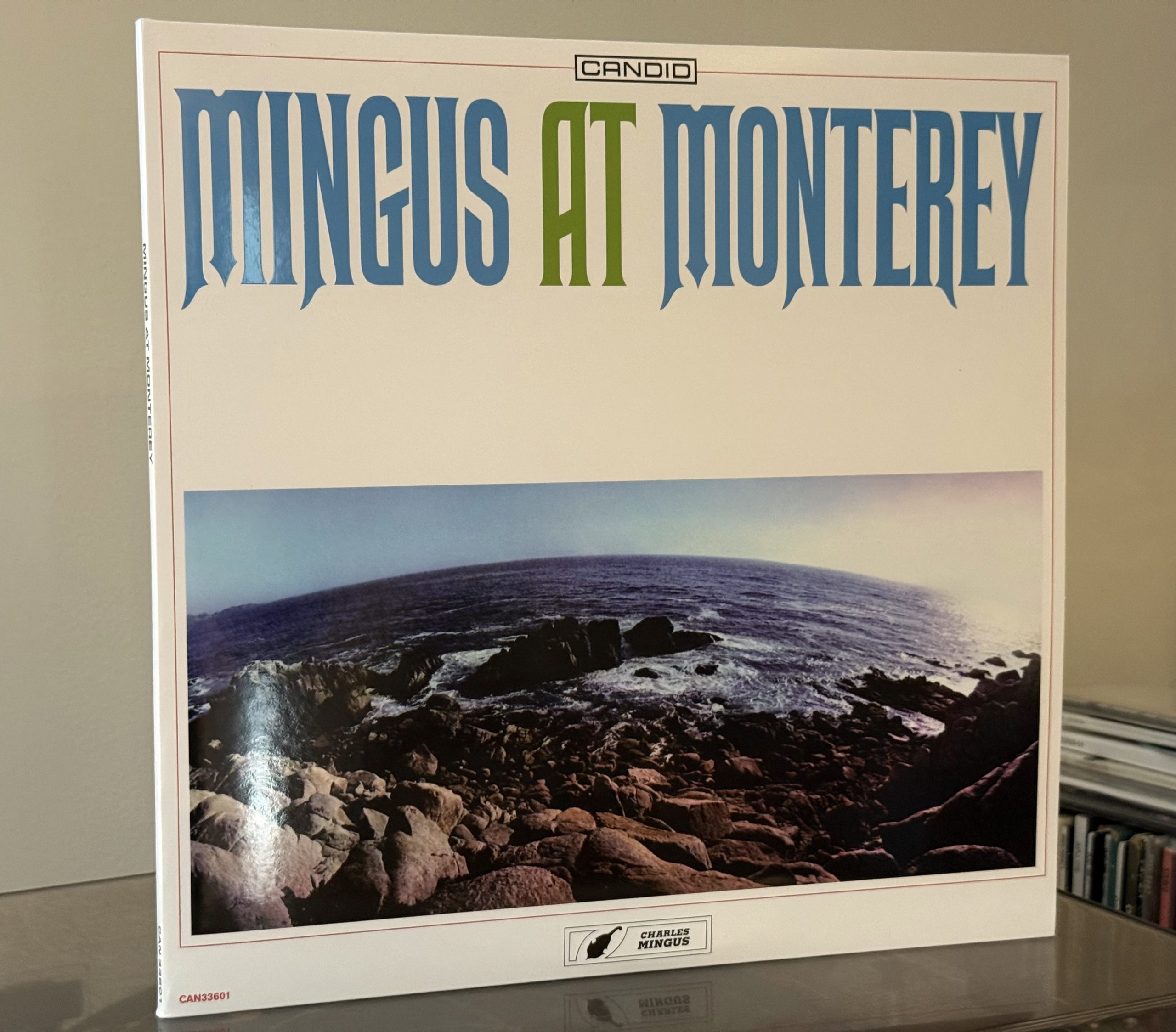
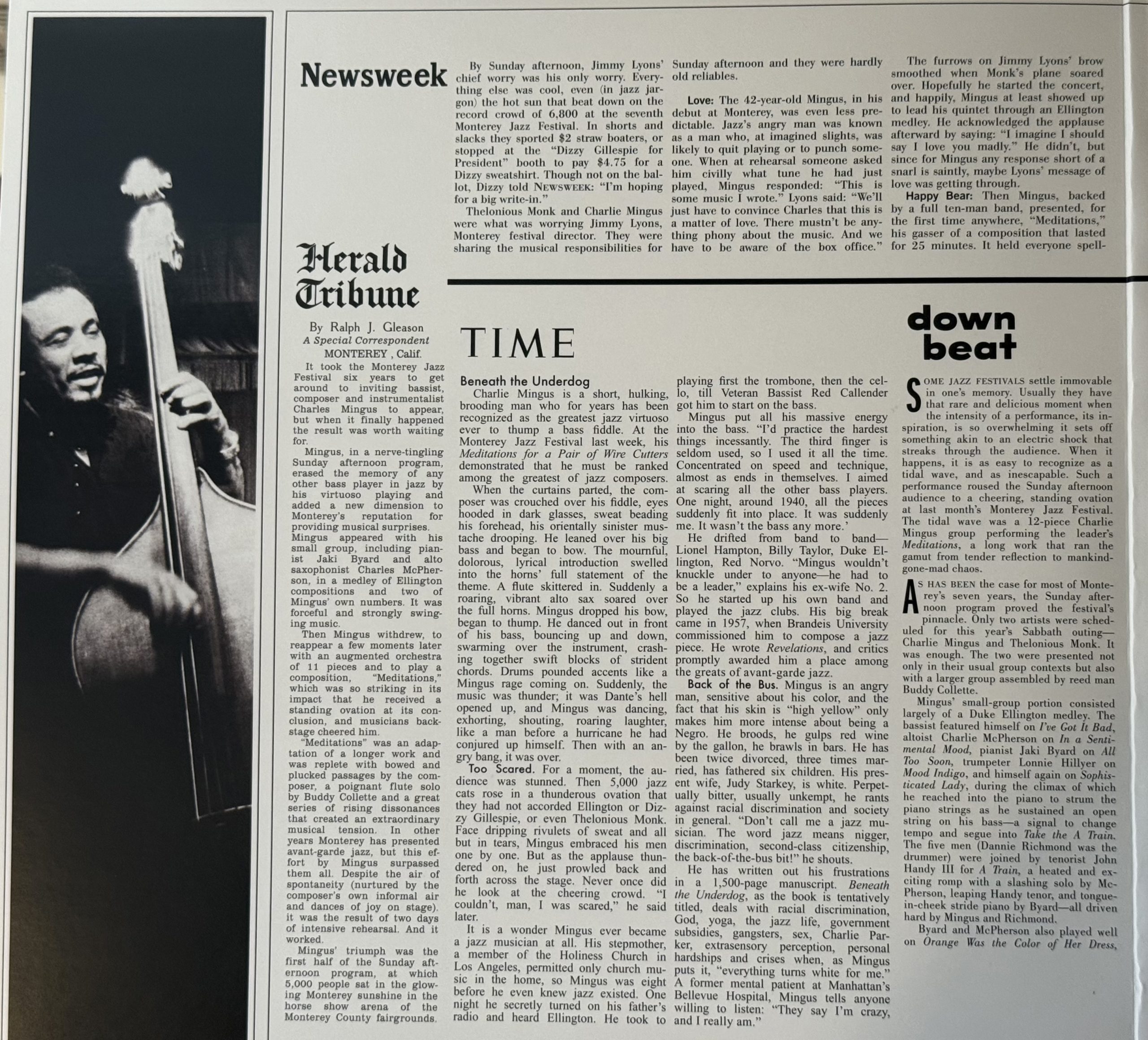
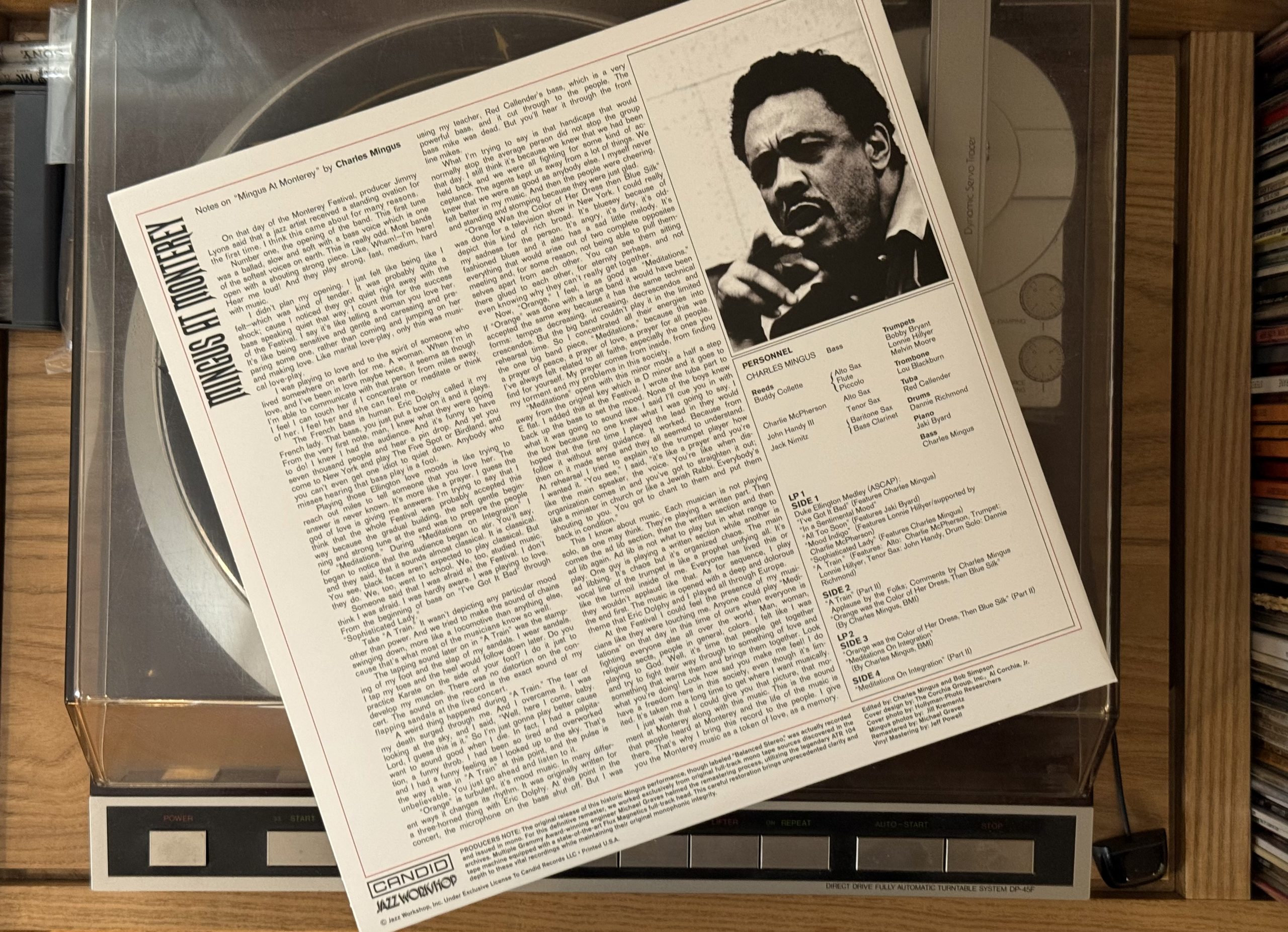
Given these facts, one could forgive Mingus for falling back to the familiar and focusing on that “greatest hits” repertoire, or from pulling back from touring and performing. Fortunately for us, the way Mingus dealt with challenges was to work and to create. His performance at the Monterey Jazz Festival on September 20, 1964 captured him doing both, with a band that had a rhythm section of Mingus stalwarts (Jaki Byard, Dannie Richmond) and a horn line consisting of Lonnie Hillyer on trumpet, Charles McPherson on alto and John Handy on tenor; Handy, an old Mingus band hand, rejoined at the last minute after Booker Ervin was hospitalized. For the last number, the band expanded into a big band formation, with Bobby Bryant and Melvin Moore on trumpet, Lou Blackburn on tuba, Red Callender on trombone, Buddy Collette on flute, piccolo and alto, and Jack Nimitz on bass clarinet and baritone sax. The performance gives us something old and borrowed, something new, and something blue (and orange).

The “Ellington Medley: I’ve Got It BadIn a Sentimental MoodAll Too SoonMood IndigoSophisticated LadyA Train” is our “old and borrowed” segment, continuing Mingus’s exploration of the compositions of his inspiration, one-time boss and sometime sparring partner Duke Ellington. The band is relaxed; there’s a little stage chatter before Mingus takes a solo intro to “I’ve Got It Bad” with sparse accompaniment from Jaki Byard, and sensitive solos from McPherson and Byard. One Ellington classic flows into the next, all commented on from Mingus’s bass.1 Until, with a sudden break, we are taking the A Train. The band is jubilant to the point of almost unhinging, particularly Lonnie Hillyer’s imaginative trumpet and Handy’s tenor (the only shortcoming in the live recordings: the tenor saxophone is somehow overpowered by Byard’s piano). At the end there’s an unaccustomed solo from Richmond, showing that not only was he frequently the glue that held the adventuresome band’s performances together, but he could also blast a mean drum solo. The end dissolves into almost-dissonance, the band gasping over the final diminished chord. To the enthusiastic applause of the crowd, Mingus notes, “I imagine I should say ‘I love you madly’ at this point… Because, ah, if there is a recording, all the money will go to Duke Ellington, which is about due him; I’ve stole enough.”

Mingus announces “Orange Was the Color Of Her Dress, Then Blue Silk”; it’s a blues introduced with a shivering run in the bass over a stride influenced piano line. The trumpet and alto state the tune (Handy, from Mingus’ announcement, sat this one out because he had only had one day to learn the material!). Then suddenly we’re leaving the blues behind, falling into a woozy delirium that improvises on the chords and promptly lands us right back into the blues. McPherson’s solo continues to explore the tune in free time, but always coming back to the blues at the end, stretching the twelve-bar form to untold lengths. Byard’s statement anchors firmly in stride and the gospel blues, with the band smearing glissandi and shouting behind him, until everyone drops out and he plays something closer to a sonata. The kaleidoscope shifts again; Hillyer is here with something halfway between New Orleans and the Village Vanguard, then the band returns to that stretched out blues once more, leaning into it until the penultimate bar stretches out the seconds, finally turning into an unresolved sigh. (On the two record set, the composition splits between the back half of Side B and into the first half of Side C.)

Mingus announces “We’ll be back with more musicians,” and with the full band on stage launches into the arco solo that opens the premiere of “Meditations on Integration.” Out of a brief tune-up moment comes Mingus’ opening arco solo, sounding like a combination of the Beethoven 9 basses and the hora. The band enters with a busy line that Buddy Collette’s flute flies and darts above; McPherson’s alto answers with an anguished cry above the ongoing Stravinskyan rhythm of Mingus, Richmond and Byard and the stabs of horns from the rest of the band. Things threaten to dissolve into formlessness as Byard thunders on the low tonic and the band plays the chords of the melody in sequence, almost as choral interjections. McPherson returns to the melody as the band recapitulates the opening, rising to a chaotic crescendo out of which a duet of flute and low piano emerges. The band continues in this vein for some time, with Collette’s flute signaling turns in the melody and changes in the solo.

At almost 14 minutes into the tune there is a breathtakingly high bowed bass solo that sounds for all the world like a cello has appeared on the stage. Mingus plays a low stretto on the tonic and diminished supertonic as Byard speaks once more with moments of Liszt and Bud Powell; the duet between the two is an elegy from which Collette’s flute emerges once more, Ravel-like. A tremolo from Byard and rapt applause from the audience seem to signal another shift, but the interplay between Byard, Mingus and Collette continue until Mingus’s high shout calls Hillyer forward. The liner notes report a rehearsal conversation between Mingus and Hillyer, in which the composer tells him, “It’s like a prayer and you’re like the main speaker… Everybody’s shouting to you. You got to chant to them and put them back in condition.” And so the final portion goes, with the whole band hollering and Hillyer’s voice conjuring order forward. When the final chord comes, the audience gives Mingus a thundering standing ovation, the first in the entire history of the festival.

1964 was a career peak for Mingus; unfortunately, tough times were ahead. In 1966 he was evicted from his New York home; the only recordings to appear for the rest of the decade were older session recordings (Tonight At Noon, from 1957 and 1961 sessions for Atlantic records, is a classic) and live recordings from tour dates in Europe and America. That long drought would end in the early 1970s with a recording we’ll listen to next time.

You can listen to this week’s album here:

BONUS: Mingus’s tour of Europe with Eric Dolphy yielded early performances of “Meditations on Integration” and “Orange Was The Color of Her Dress, Then Blue Silk,” including this audio recording from the Salle Wagram in Paris on April 17, 1964:

  1. I believe one of the inspirations for Mingus’s bass technique is the contrabass recitative at the beginning of the fourth movement of Beethoven’s 9th Symphony. Like Beethoven’s basses, he was always observing the performance and the melody closely, and always, always opining. ↩︎