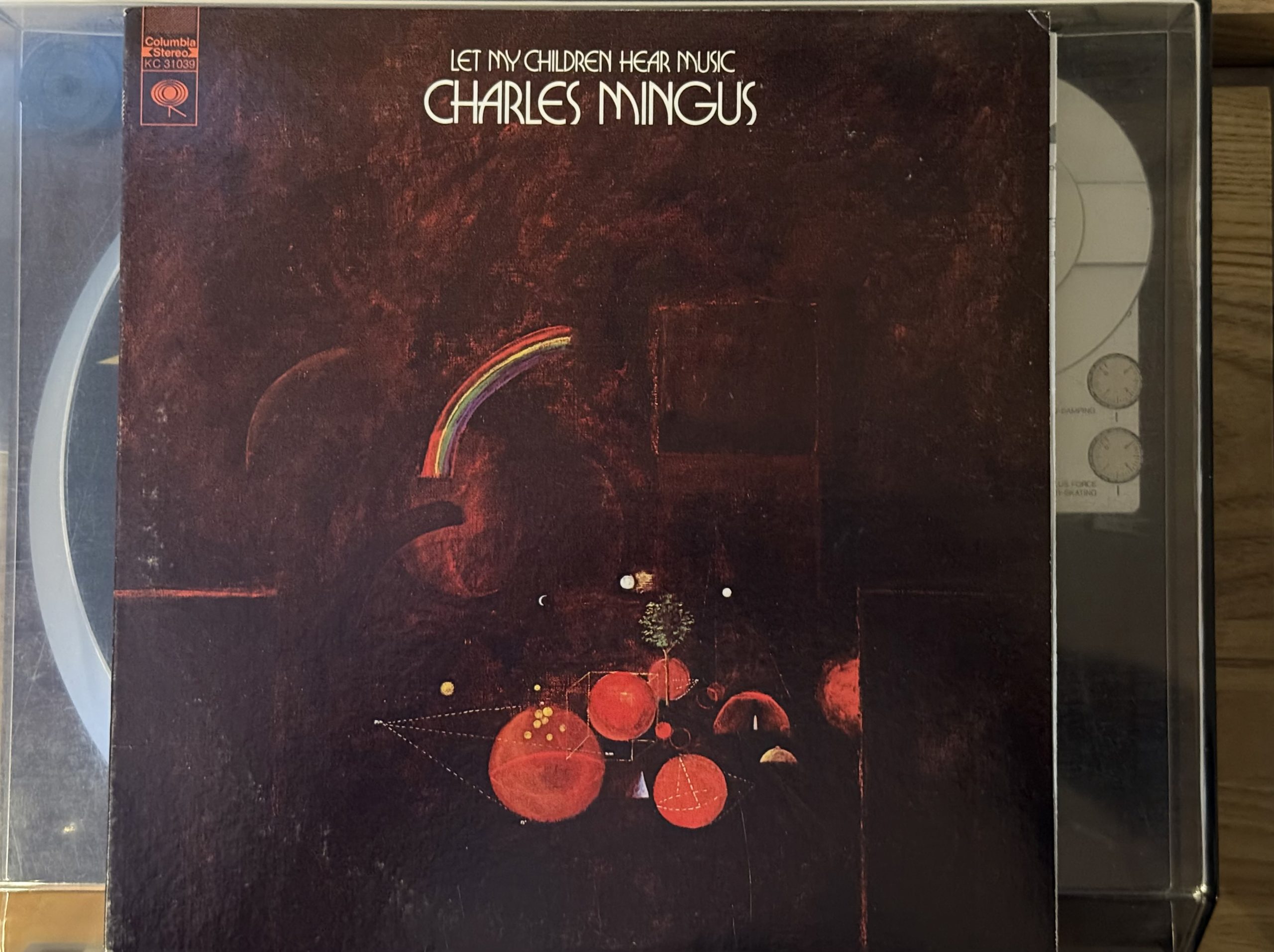
Charles Mingus, Let My Children Hear Music

The last great composition from Mingus sums up all his contradictions into a single masterpiece.

Album of the Week, February 14, 2026

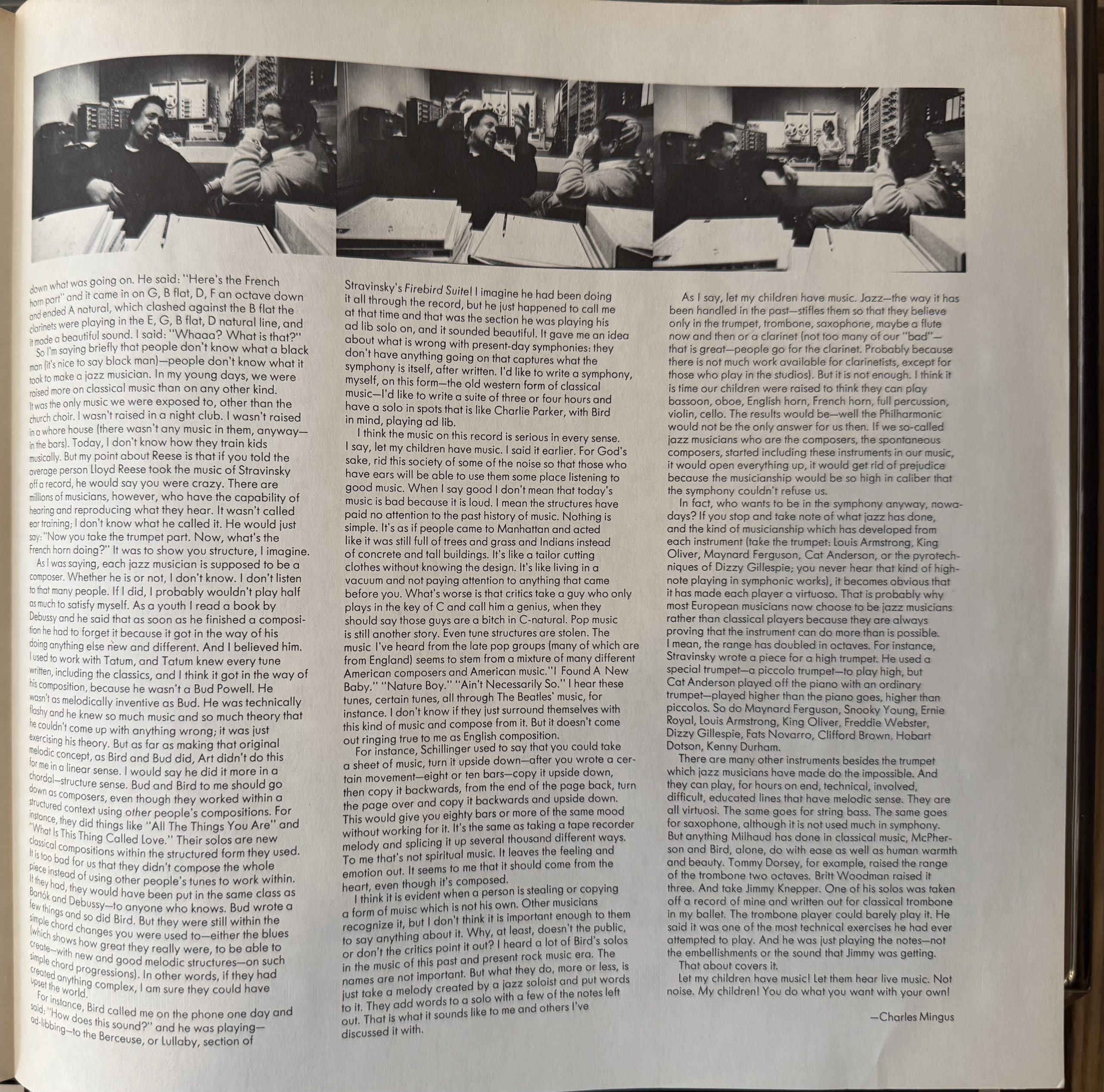
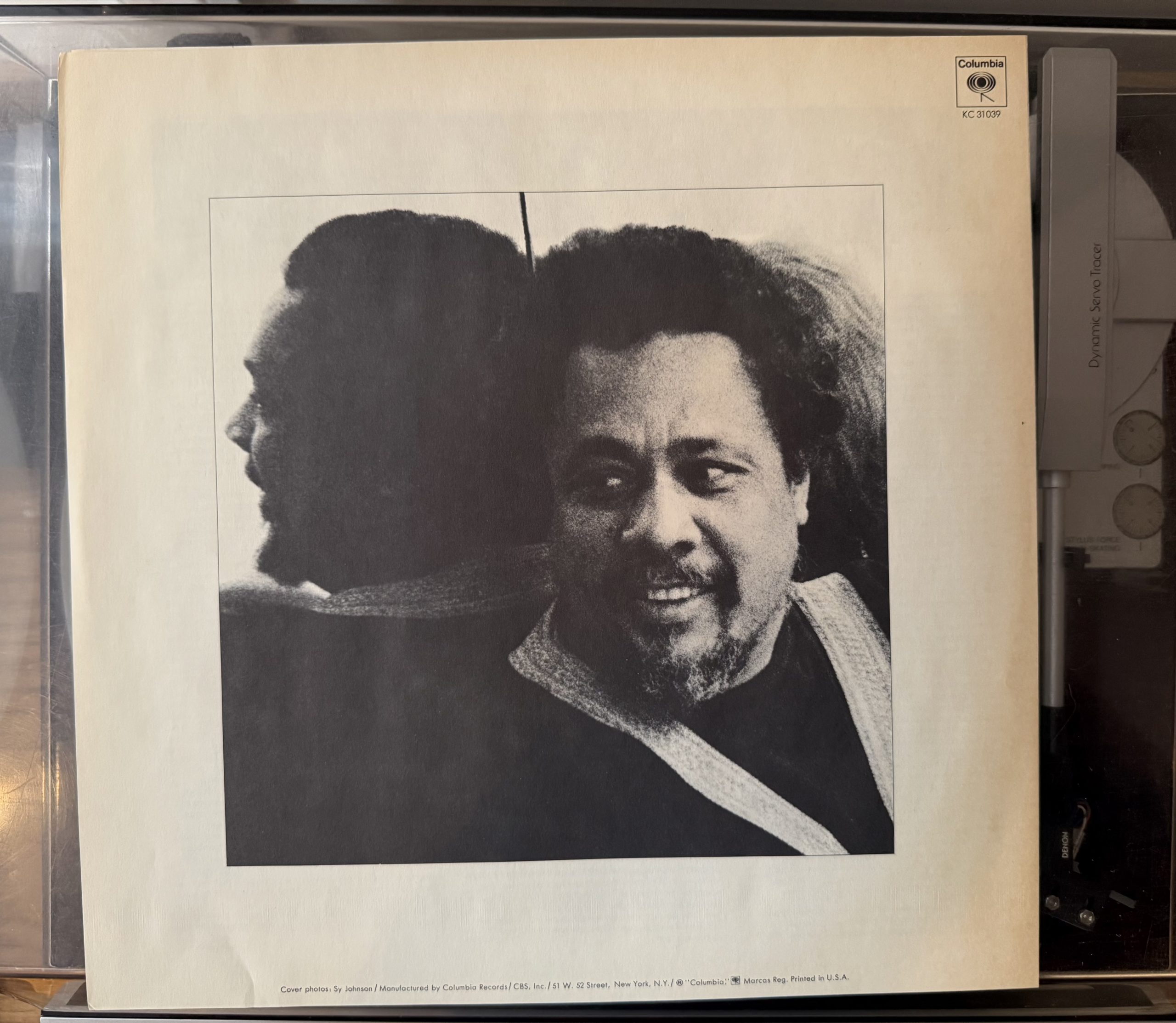
When we last checked in with composer and bassist Charles Mingus, he was on a career high that was about to enter a downturn. Following Mingus at Monterey, he toured heavily but was without a recording contract, and was evicted from his apartment for nonpayment of rent in 1966. But Mingus seems to have always had the ability to convince the labels to place a bet on him, and the fall of 1971 found him working again with Columbia’s Teo Macero on a big-band recording of all-new compositions.

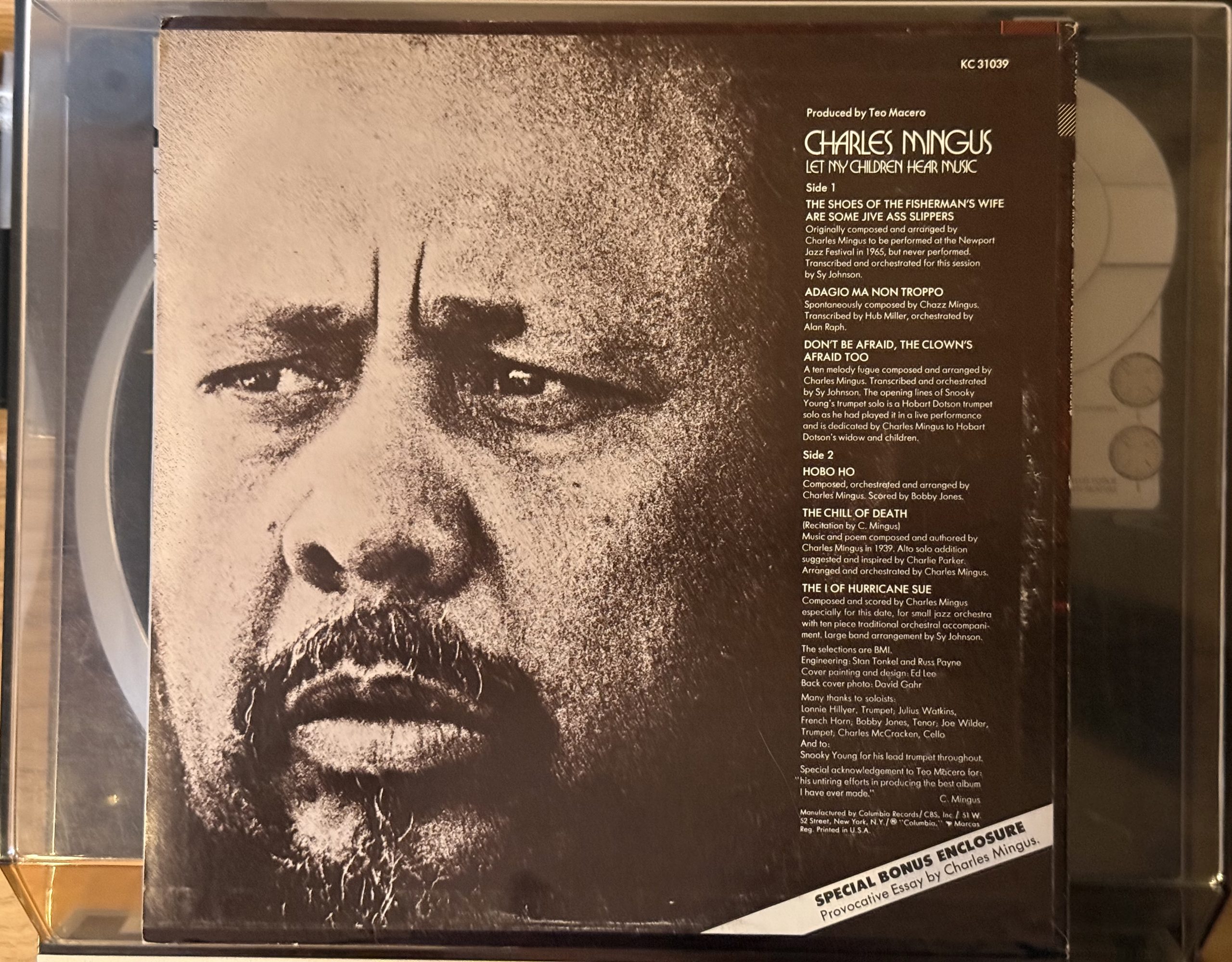
And what a band! Across six recording sessions between September 23 and November 18, a small army of musicians worked on the recording that became Let My Children Hear Music, including Lonnie Hillyer, Jimmy Nottingham, Joe Wilder, and Snooky Young on trumpet, Jimmy Knepper on trombone, Julius Watkins on French horn, Charles McPherson on alto sax, Jerry Dodgion, Bobby Jones, Hal McKusick and James Moody on reeds; Charles McCracken on cello; Jaki Byard, John Foster, and Roland Hanna on piano; and Dannie Richmond on drums. Teo not only produced but also conducted the orchestra and played some alto sax. And alongside Mingus’s bass were three additional bass masters—no less than Ron Carter, Richard Davis, and Milt Hinton. And those are only the musicians we know about—some remain uncredited on the recording due to contractual issues. Collectively they gave Mingus’s music a sound that he had never gotten on record before, with a combination of power and polish.
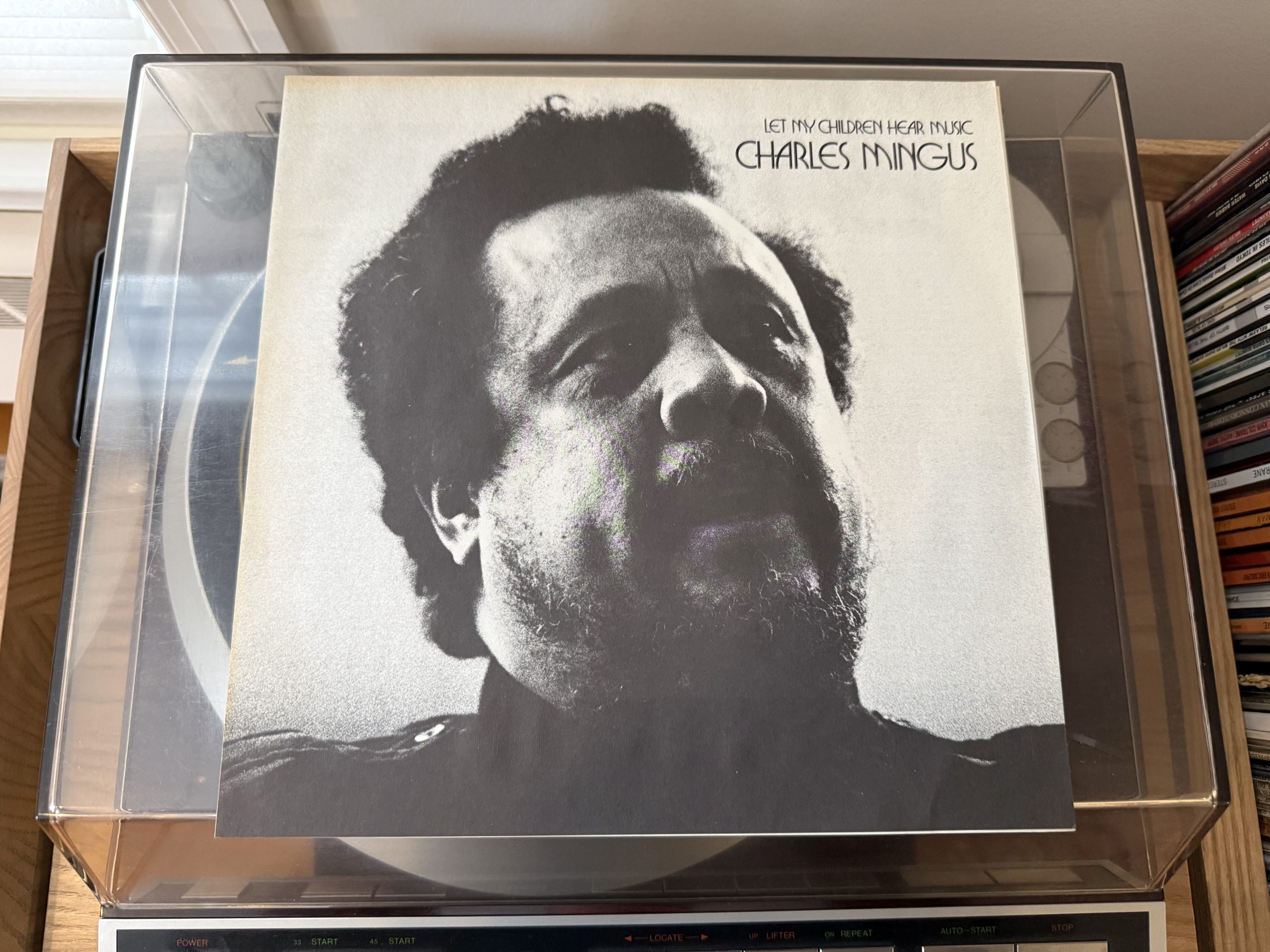
The Shoes of the Fisherman’s Wife Are Some Jive-Ass Slippers” might be my favorite Mingus title of all time, even considering that this is the man who wrote “All the Things You Could Be By Now If Sigmund Freud’s Wife Was Your Mother.” From the very beginning of the track we get two impressions: this music is ambitious, and this band is tight. The horns and reeds play the opening melody slowly against a chromatic scale in the bass and low instruments; there’s a coda of sorts to this part signaled by an “Also Sprach Zarathustra” timpani roll, a series of chord changes, and then we’re into a brisk waltz that pauses, then shifts into 6/8 time. The horns and reeds introduce a descending motif that keeps interrupting the waltz until the piano signals another transition and a recapitulation of the top melody. This time the band picks up a new version of the slow theme in a fast 4/4 time, that builds in intensity up the chromatic scale until there’s a sudden swoon and lapse back into waltz time. We’re left to wonder how many of the sudden shifts were scored and how many were the product of Teo Macero’s genius editing skills. All throughout the chord progressions and gestures are wild and free (that timpani glissando against the descending motif at the end!) and the band swings as hard as anything Ellington ever did.

Adagio, Ma Non Troppo” begins with a lone reed followed by a lone flute, playing music that seems birthed from “Sketches of Spain.” There are interludes of piano and guitar, rafts of flutes and clarinets, and a fast dance with three arco basses all soloing at the same time. True to the title, some moments are downright symphonic here; this section is probably the least swinging on the record, but those bowed bass solos keep us grounded at the same time that they reach for the stars. When the saxophones take the theme it feels like a moment from a Keith Jarrett European quartet composition.1 The whole thing is breathtaking in both composition and performance.
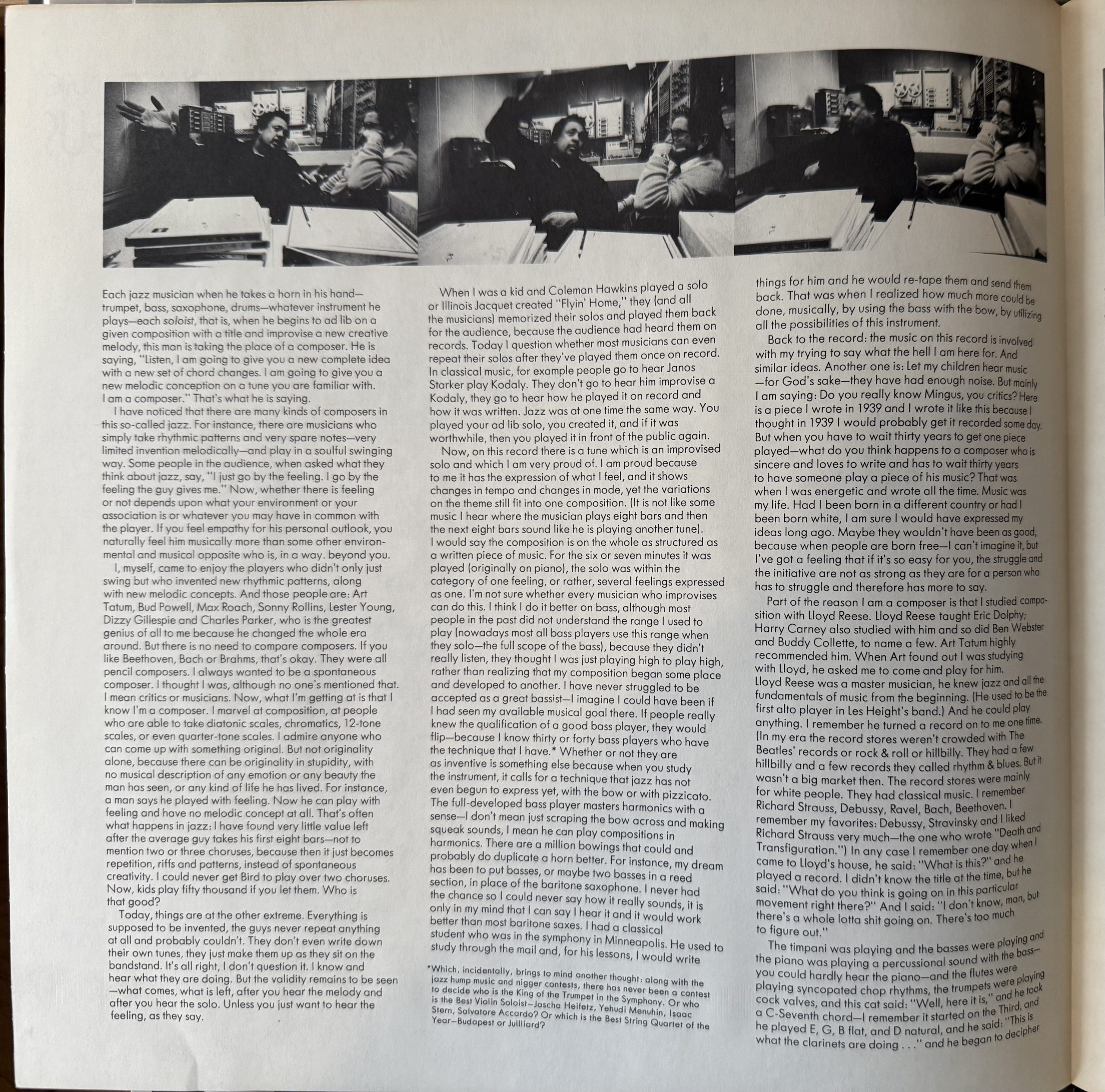
Don’t Be Afraid, The Clown’s Afraid Too” starts in the circus, with recorded lion roars and elephantine trumpet blasts, before the band swings into a circus theme underscored by oompa bass and tuba and a brilliant walking bass line. The simultaneous solos between tenor sax (right channel) and alto sax (left) stretch the brain to hear all the passing harmonies as the players cross over and solo past each other. Another circus interlude and a brisk Mingus pizzicato solo sets up a chorus of twittering bird flutes, and the rest of the track tosses the theme from section to section before returning to the oompa theme once more before returning to the circus again to take us out of Side A.

Hobo Ho” opens with a gutsy, funky bass line that anchors us firmly in the tonic. The tenor sax sets up the first melody with almost subsonic support in the lowest instruments. There are horn bursts that wouldn’t have been out of place on The Cat. This is music for a rumble, standing alongside “II B.S.”/“Haitian Fight Song” as some of Mingus’s most groove-driven work.
The Chill of Death” begins with a Mahlerian moment, a tremolo from the basses over a timpani hit and the orchestra. Mingus recites a poem that dates from the beginning of his career; written in 1939, it captures the constant tension in his work between wild life and the fear of being forgotten in death. After the recitation there’s a sustained organ tone and a free alto sax solo by Charles McPherson over a shifting, uneven instrumental background—sometimes marching to the graveyard, sometimes joyfully dancing, sometimes anxiously peering around the corner. The piece ends with a rare audible splice as McPherson plays into a descending glissando and crescendo by the rest of the band; I wonder how much improvisation was left on the cutting room floor by Macero.

The I of Hurricane Sue” ends where we began, the second piece recorded in the very first session. There are wind effects and corrugaphones beneath a free intro before the band snaps into a tightly wound, swinging melody. The work ends with dueling pianos, Jaki Byard vs. Roland Hanna, as the whirly tube and winds blow us away. This characteristic of alternating chaos and gorgeously played symphonic jazz is what ultimately sets Let My Children Hear Music apart as a work of staggering genius and an apex of Mingus’s compositional career.
The brilliance and tragedy of Mingus’s life wasn’t yet done. He had a few epochal albums for Atlantic Records, Changes One and Two, ahead of him, but he also had a deeper challenge—ALS, which began to rob him of his mobility and his ability to perform. As a composer and bandleader, he still had some milestone records ahead and we’ll hear one last one next week.

You can listen to this week’s album here:

BONUS: There is an honest-to-goodness bonus track, in the original CD reissue sense, on Let My Children Hear Music. Recorded on the second recording date (September 30) following “Hobo Ho,” “Taurus in the Arena of Life” was first issued in 1992 on the first CD release of the album. It’s a nifty hybrid between a classical sonata in the piano and a blues in the horns, who take a trip to Mexico where things get marvelously strange.

BONUS BONUS: There are a few attempts to play this music live out there, but not many—which is why it came as a shock to find this sextet performance from a jazz ensemble in the University of Virginia’s Old Cabell Hall Auditorium, of all places! I don’t think that’s any of the main faculty up there, but I can’t see the bassist so it just might be Pete Spaar.

  1. Don’t worry, you didn’t miss a week. We’re not to Keith yet, but we’ll get there eventually. ↩︎
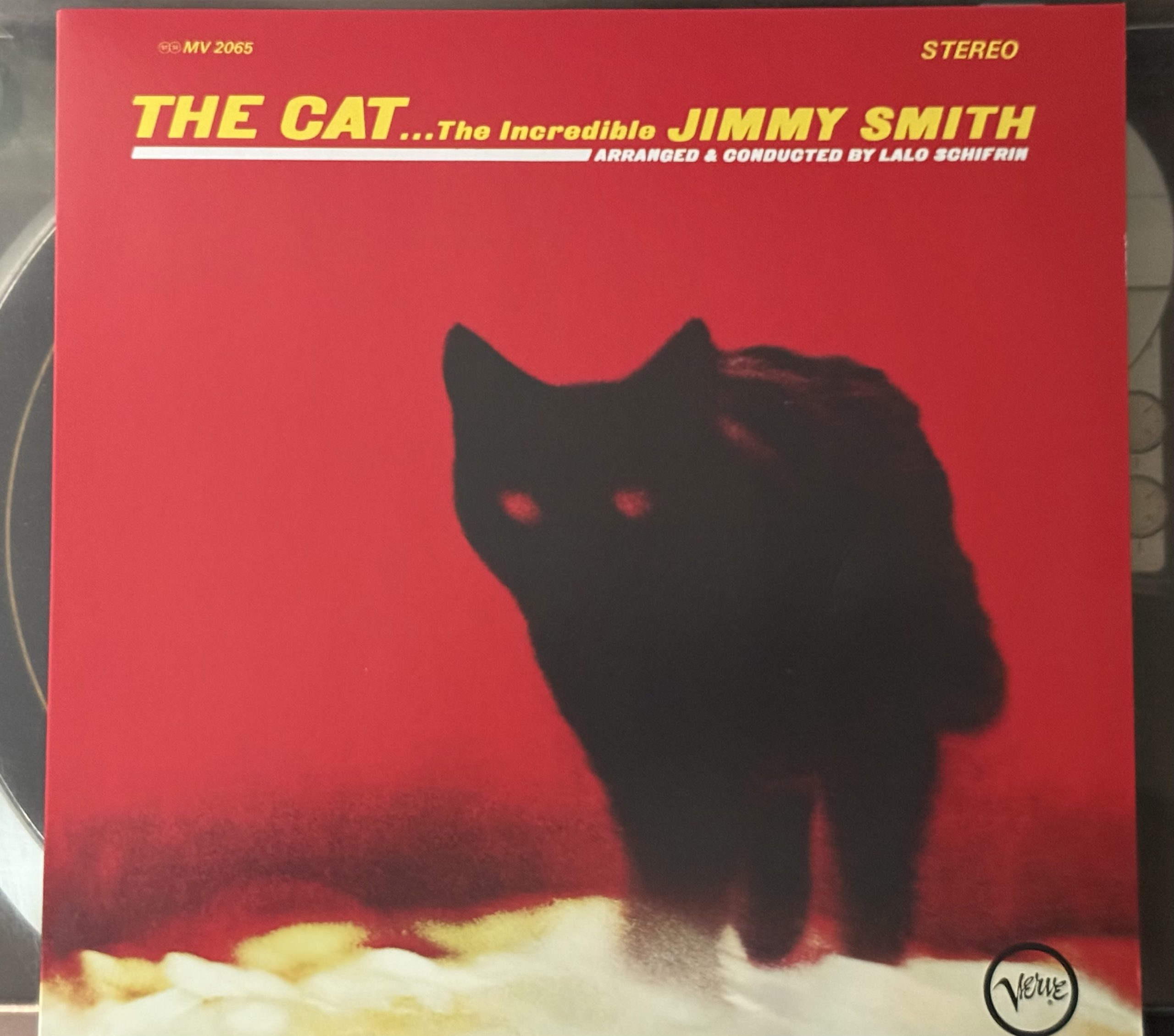
Jimmy Smith, The Cat

Jimmy Smith’s soulful Hammond B3 meets the ingenious arrangements of Lalo Schifrin in this hot album for Verve.

Album of the Week, August 9, 2025

There’s a world in which Jimmy Smith kept making cool, soulful organ trio and quartet albums like Prayer Meetin’ for his whole career. In that world, we’d be listening to a lot more laid back small combo jazz with Smith’s impeccable harmonic sense to lend a little excitement. But that’s not the world we live in. Shortly after he recorded last week’s session for Blue Note, Smith moved to Verve Records, and before long he began recording a series of records that dramatically broadened what the jazz organ could do, in collaboration with two mad geniuses of jazz… one of whom we’ve met before.

1962 was the prime of Creed Taylor’s years as jazz impresario at Verve. We’ve told the story of his post-Verve years in the history of his own label CTI, starting with his late-1960s collaboration with Antonio Carlos Jobim, Wave (and you can find the rest of that series, along with my other writings, in the Album of the Week archives). In the early 1960s, he was still experimenting with some of the ingredients that would come to define his CTI sound, especially the combination of jazz musicians with imaginative orchestral arrangements. In this case, the arrangements came courtesy of Argentine-American pianist/composer/arranger/conductor Lalo Schifrin.

Schifrin, who passed away earlier this year, had done some arranging for Dizzy Gillespie’s big band, and came to New York to join Dizzy’s small group; he went on to a notable career in film and television composing, including the themes for Mission: Impossible, Mannix, Cool Hand Luke, Dirty Harry, and Enter the Dragon. Taylor put Schifrin with Jimmy Smith, and Schifrin formed a jazz orchestra for the album that included the likes of Thad Jones and Snooky Young on trumpet, Urbie Green on trombone, Don Butterfield on tuba, and a rock solid trio of Grady Tate on drums, George Duvivier on bass, and Kenny Burrell on guitar. Thad Jones, the middle of the Jones brothers (elder brother Hank, younger brother Elvin), started his career with Count Basie, formed a long-running orchestra with Mel Lewis, and transformed the Danish Radio Big Band into one of the finest in the world before taking over leadership of the Count Basie band in 1985. Snooky Young had played in the Thad Jones/Mel Lewis band but was best known for his work in the Tonight Show band under Doc Severinson. Butterfield was a great session player who had performed with Dizzy, Sinatra, Mingus, and Rahsaan Roland Kirk. Duvivier worked with a Who’s Who of musicians including Bud Powell, Oliver Nelson, Sinatra, and a few others that we’ll come across in the weeks to come. And Kenny Burrell, who is still kicking at 94, played with everyone as well as leading his own great sessions on Blue Note, Prestige and Columbia.

Theme from Joy House” is the first of two Schifrin film soundtrack compositions on the album. The French thriller, starring Jane Fonda among others, has a bonkers plot, and Schifrin apparently responded with a bonkers score. The orchestration builds from bass and percussion, with a subdued organ part playing the main theme as the lower horns provide support. Then the trumpets blare and we’re truly off to the races. The second verse gives us the melody in the horns, with bursts of vibraphone providing punctuation. Smith’s solo, unlike his combo work, stays mostly in the upper ranges of the organ, the better to play against the wall of horns. But we still get some of his trademarks, like leaning on the tonic to build suspense—here echoed in Schifrin’s arrangement by the horns. The final repetition is a full on horn blast, with Smith’s high organ tone cutting through.

The title track, “The Cat” is the second Schifrin selection, also from Joy House. In form it’s a blues, but in spirit it belongs alongside Quincy Jones’ “Soul Bossa Nova” (aka the Austin Powers theme) as an exemplar of the most bonkers kind of ’60s instrumental pop. Schifrin doesn’t spend much time warming up to his theme; we get four syncopated eighth notes of introduction, blasted from the horns, and then the bass (and tuba?) and guitar are off to the races, with Smith’s easy statement of the melody soon yielding to high arpeggios. You could easily imagine this one soundtracking a manic chase scene, especially when the horns return to play the theme over some of Smith’s more wild improvisations. Smith takes the lead in the bridge, with bubbling tremolos building up to a reprise of the melody. The full band shuffles to the fade-out, led particularly by Grady Tate’s drumming, replete with well placed tom hits and cymbals. The tune clocks in a few seconds shy of 3:30, but packs quite a wallop; it’s deservingly the best-known cut from the album and I would have known it even if KEXP hadn’t regularly played it under their DJs reading concert calendar listings when I lived in the Seattle suburbs.

The classic “Basin Street Blues” is another one that starts deceptively coolly, before the horns burst over organ, bass, and low vibraphone like fireworks, but this track keeps its cool a little longer, and ultimately settles into a pocket, with the horns acting mostly as a high chorus that briefly kick Smith into a sort of higher orbit. Ultimately they draw him out into a more extroverted solo that leans into the higher range of the instrument and arpeggios up and down the keyboard, as the middle and low horns state the melody and finally the whole band blasts the chorus. Their part done, the horns retreat to providing emphatic punctuation at the edges of Smith’s final solo, before coming back for a wild climax, full of diminished sevenths and razzmatazz.

Main Title from the Carpetbaggers,” a theme by Elmer Bernstein and Ray Colcord for the 1964 drama starring George Peppard and Alan Ladd, starts with Latin percussion, then the double bass enters in triple meter before the tuba starts doubling. The horns state the theme with much growling from the trombones and tuba over a consistent pounding on the tom (or possibly even timpani). Finally, after two iterations of the melody, Smith enters on the organ, riffing on the blue notes in the melody as Phil Kraus’s congas and Grady Tate’s drums propel the melody forward. The horns provide accents over the top, but this is mostly Jimmy Smith and his rhythm section, smoking along the slow burn of the piece—at least until Schifrin’s magnificent French horn section (four horns, including Jimmy Buffington, who played on Miles Ahead and Sketches of Spain) blasts off. The work ends as it began with the horns playing through the melody, but this time Smith is wailing alongside the full band.

Chicago Serenade,” starting off the B side of the record, is by the great Eddie Harris, who also wrote “Freedom Jazz Dance,” later recorded by Miles on Miles Smiles. There’s little of the rhythmic complexity of the latter piece here, but some great pop sensibility in the tune, here stated in Kenny Burrell’s guitar with accents from Jimmy and the horns. Jimmy plays a high flourish on the organ to transition out from the horns but brings his solo down into the baritone range, providing a more intimate sound. There’s some great antiphonal writing for the horns throughout, and some magnificent French horn playing, but the crunchy organ arpeggio at the end is by itself worth the price of admission here.

W.C. Handy’s classic “St. Louis Blues” gets a swift intro from Jimmy, Tate and Duvivier that makes it sound like the band was already cooking when Rudy Van Gelder started rolling the tape. The horns can do little else than punch up the chorus; Jimmy is on fire, shifting meter and tonality and insinuating the melody under the band. The horns finally find their footing at the very end, giving a rousing send off, but Jimmy’s rolled chords get the last word, as always.

Delon’s Blues” is the one Jimmy Smith original on the record, and it’s much more relaxed, but still tightly arranged, with accents first from Burrell and then from the horns over Jimmy’s melody. The more spacious arrangement of the verse gives us an opportunity to hear what Grady Tate is doing to punch up the rhythm under everything, with syncopated punches and stumbling rolls on the snare for interest. Throughout Burrell drops little zingers to keep things lively.

The final blues, Harold Arlen and Johnny Mercer’s “Blues in the Night,” picks up with just guitar, drums and bass accompanying Smith’s introduction. When the horns come in, they lean on a weary suspension to emphasize the blue notes. Tate and Smith threaten to bring things to a boil on the introduction, but they keep the heat to a simmer, letting Burrell provide textural interest. Finally three pounded beats from Tate tip things over and the horns take a high screaming chorus. Smith lowers the temperature once more to a fast simmer, again racing his tremolo across a whole verse as the band vamps. The engineer sadly fades out just as Smith’s solo gets interesting, but we are left with the impression that the blues continue forever.

In the team from Verve, Smith had found collaborators who could take his basic brilliance and turn up the dials on all the arrangements without compromising the basic elegance of his vision for the organ’s role in jazz. As at Blue Note, he made a series of records in quick succession for Verve; unlike at Blue Note, these charted. His last Blue Note albums cracked the Billboard 200, but The Cat went all the way to Number 12 on the album chart, and “The Cat” cracked the Hot 100, finishing at # 67. His other 1964 release would also perform well, albeit with a very different collaborator; we’ll hear that one next time.

You can listen to this week’s album here:

BONUS: Jimmy would take this material on the road with a smaller combo. Here’s an undated performance for German TV with just drums and guitar (and a tenor sax player who sits this one out), burning on “The Cat”: