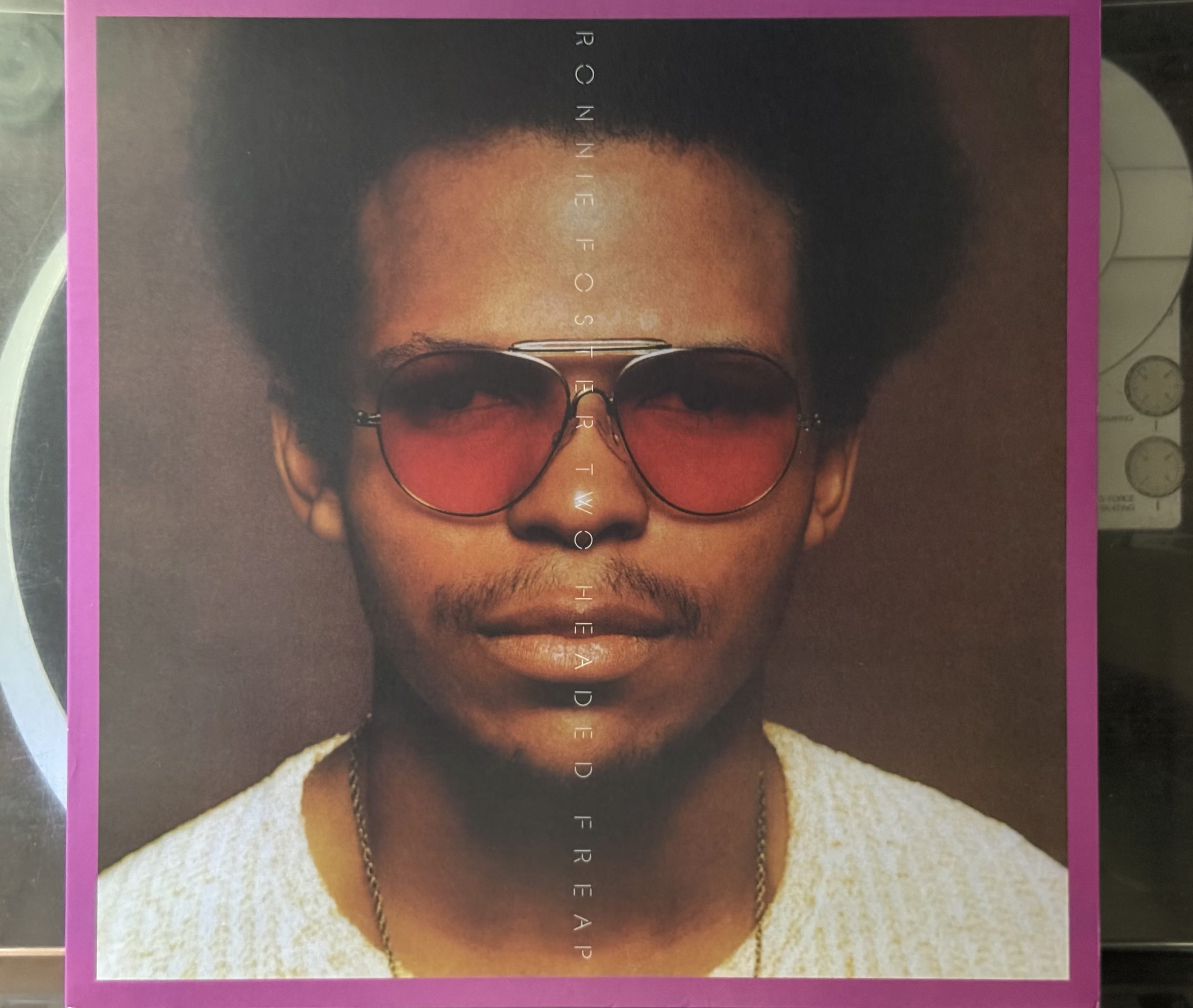
Ronnie Foster, Two Headed Freap

The debut recording from Foster puts funk, soul, R&B and jazz into a blender and comes out with a “brew” that’s a genuine classic.

Album of the Week, October 11, 2025

Blue Note Records in 1972 was not the same label that it had been in , or even in 1963. Duke Pearson’s run as head of A&R had shifted the label from the straight-ahead jazz favored by his predecessor Ike Quebec to something a little more au courant. But even Duke was gone, leaving the label in 1971, the same year that label co-founder and famed album cover photographer Francis Wolff died. The label’s corporate parent, Liberty Records, was absorbed by United Artist Records the same year. And A&R executive George Butler took over the label, coming from United Artists, and sponsoring a number of projects aimed at crossing over between the jazz and soul audiences to build more market momentum for the label. Among the artists crossing over in this way were flautist Bobbi Humphrey, guitarist Earl Klugh, trumpeter Donald Byrd, and today’s artist, Ronnie Foster.

Foster grew up in Buffalo, New York and was interested in music from an early age, playing his first show (in a strip club) at age 15. He was not formally educated in jazz, receiving only a month of musical instruction—on the accordion. For this, his first record, he assembled an assortment of musicians that included George Duvivier on bass, Gene Bertoncini on guitar, Gordon Edwards on bass guitar, Jimmy Johnson on drums, Eugene Bianco on harp, George Devens on percussion and vibes, and Arthur Jenkins on congas. Motown producer Wade Marcus, who also had arranged Blue Note sessions for Bobbi Humphrey, Grant Green, Horace Silver, and Marlena Shaw, did the arrangements.

Chunky” starts out hard with distorted guitar over a four-four beat from Johnson, followed by a syncopated figure from Foster on the Hammond, a long vamp over a four-chord sequence. A sudden shift to a different minor chord provides a quick four-measure bridge and we’re off to the races. Foster’s improvisation is primarily in the right hand, playing runs, venturing out into different tonalities, even quoting the “Love Supreme” progression at one point. His solo goes into runs, chromatic up and down figures that are played so that they smear together, and sustained notes that transition into out-of-tempo arpeggios. The track fades out, leaving us with just a hint of Foster’s rhythmic and improvisational imagination.

Drowning in the Sea of Love,” a hit written for Joe Simon by Kenny Gamble and Leon Huff, is played as a straight cover of the bluesy soul hit, with lots of color from Bertoncini and George Devens’ vibes. Foster’s playing shows off his harmonic ear, as he harmonizes with the melody and then gives a couple blasts on the organ to introduce the solo proper. He has a pattern here and in “Chunky” of playing with time and meter in a way that seemingly breaks his improvisation free of the groove, right up until the fade-out.

The introduction to “The Two-Headed Freap” could have been titled “Chunky Pt. 2,” with the same pattern of blasting chords almost to the same rhythm. But the chords are a different progression, almost discordant, and things change quickly into a bluesy salsa-inflected solo with a nine-beat turnaround. Foster’s solo gives us a nasty (in a good way) breakdown in the last minute that calls to mind some of Jimmy Smith’s work.

Summer Song” is an original with melody played by Bertoncini and Devens, over a growling bass line, before Foster’s solo. Here his technique is very different as he works with sustained suspended notes and chords as well as a right hand solo line that stays in the upper octave. The basic materials are fairly static, with vamps over chords that rock back and forth, but George Duvivier’s bass part (not quite a solo) is worth the price of admission.

Let’s Stay Together” is a cover of Al Green’s hit, which again benefits from Duvivier’s bass as Foster tosses riff after riff off in his solo. The organ seems to have irrepressible energy, riffing at double speed over the groove, right up to the fade-out. “Don’t Knock My Love” is another cover, this one of Wilson Pickett’s last number one hit. Where the original benefited from a measured funky groove, Foster’s cover seems to lack some of the funk of the original even as it speeds up the tempo by a click or two. The fuzz distortion on the guitar doesn’t help matters here as the band threatens to come unglued during the endless wind out.

The fade-out takes us into “Mystic Brew.” Easily the most memorable track on the album, certainly the most sampled, the track opens with a double bass line from both Duvivier and Gordon Edwards, forming a bedrock for the entire song. Bertoncini and Devens’s vibes repeat the tonic together with Eugene Bianco’s harp. Bertoncini doubles Foster as he plays the relaxed main theme, which seems content to hang out on the tonic as Devens and Bertoncini elaborate around the edges. Foster’s solo is more disciplined here, with the first iteration playing with multi-measure suspensions, the second with syncopated eighths, the third evolving into triplets and then rolling sixteenth and even 32nd notes. The performance, in addition to being a complete pleasure, illustrates the ingenuity and athleticism that Foster brings to the table.

Kentucky Fried Chicken” closes out with a slightly funky riff on a minor third over a funky bass, then shifts gears over a series of odd suspended chords for a moment. Bertoncini gets a brief solo before Foster plays his games with meter and time, at one point chattering like a hen, changing keys, and ripping through a set of arpeggios. So we end as we began, with Foster improvising straight into the fade-out.

Foster cut a series of albums for Blue Note as a leader, including a pretty great Live at Montreux in 1973. He was less successful after leaving the label for Columbia, recording two albums there and one for Pro Jazz between 1978 and 1986. But he produced almost 100 records and had hundreds of sideman credits, including a collaboration with George Benson that began on 1975’s Good King Bad. We’ll hear from him once more, from later in his career. But next week we’ll hear a famous record from an artist who went through a remarkable shift of his own in the early 1970s.

You can listen to this week’s album here:

BONUS: Foster’s live performances of material from this and other albums are spectacular. You can find some on the officially-released Ronnie Foster Live: Cookin’ with Blue Note at Montreux. Here’s “Chunky”:

BONUS BONUS: “Mystic Brew” became an unlikely standard of sorts through sampling and latter-day covers. Notably, A Tribe Called Quest sampled it for “Electric Relaxation” from their 1993 album Midnight Mauraders:

BONUS BONUS BONUS: Maybe the most unlikely cover of all is the way I first heard “Mystic Brew,” in a version by Vijay Iyer’s trio on his 2009 album Historicity:
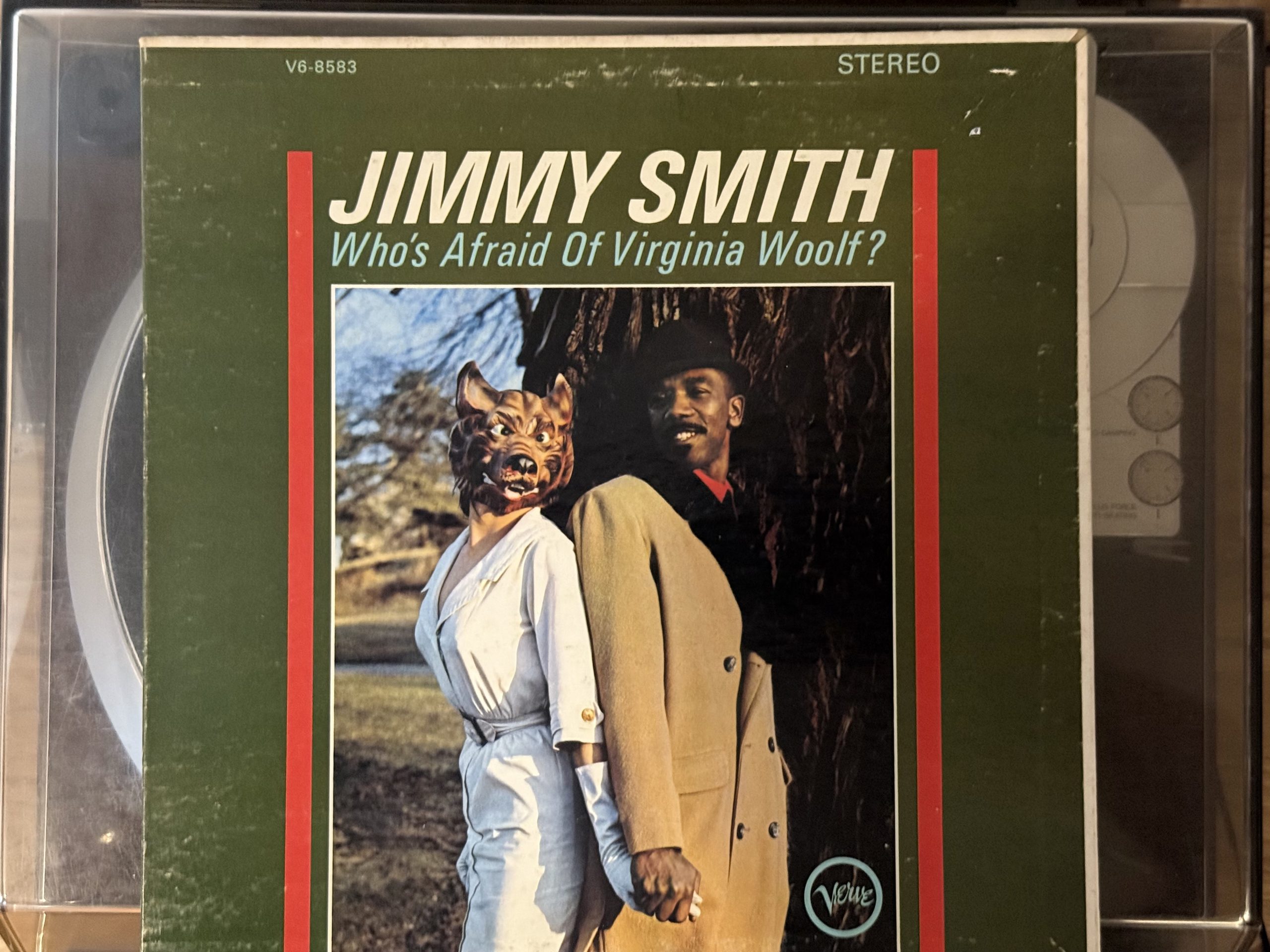
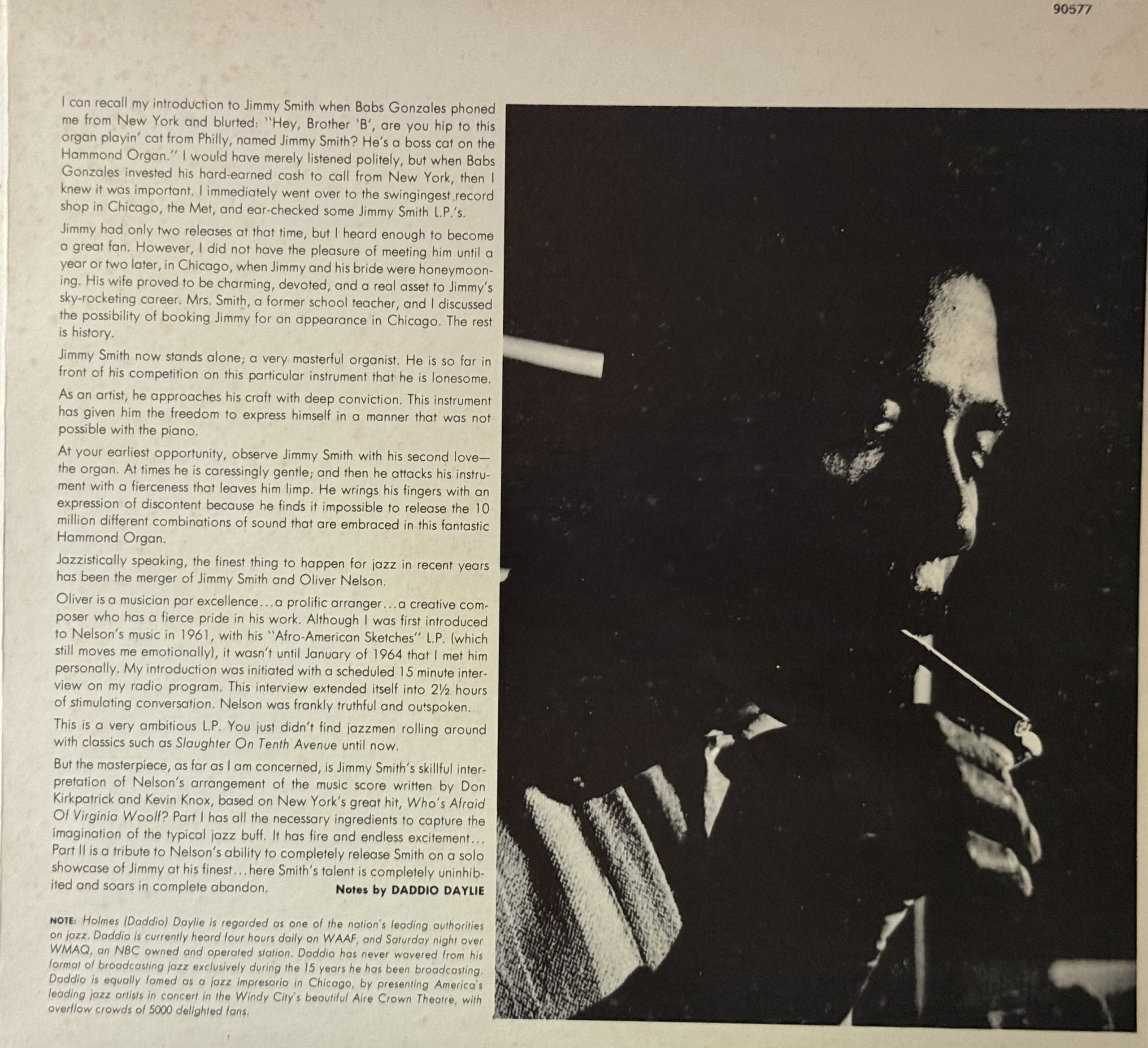
Jimmy Smith, Who’s Afraid of Virginia Woolf?

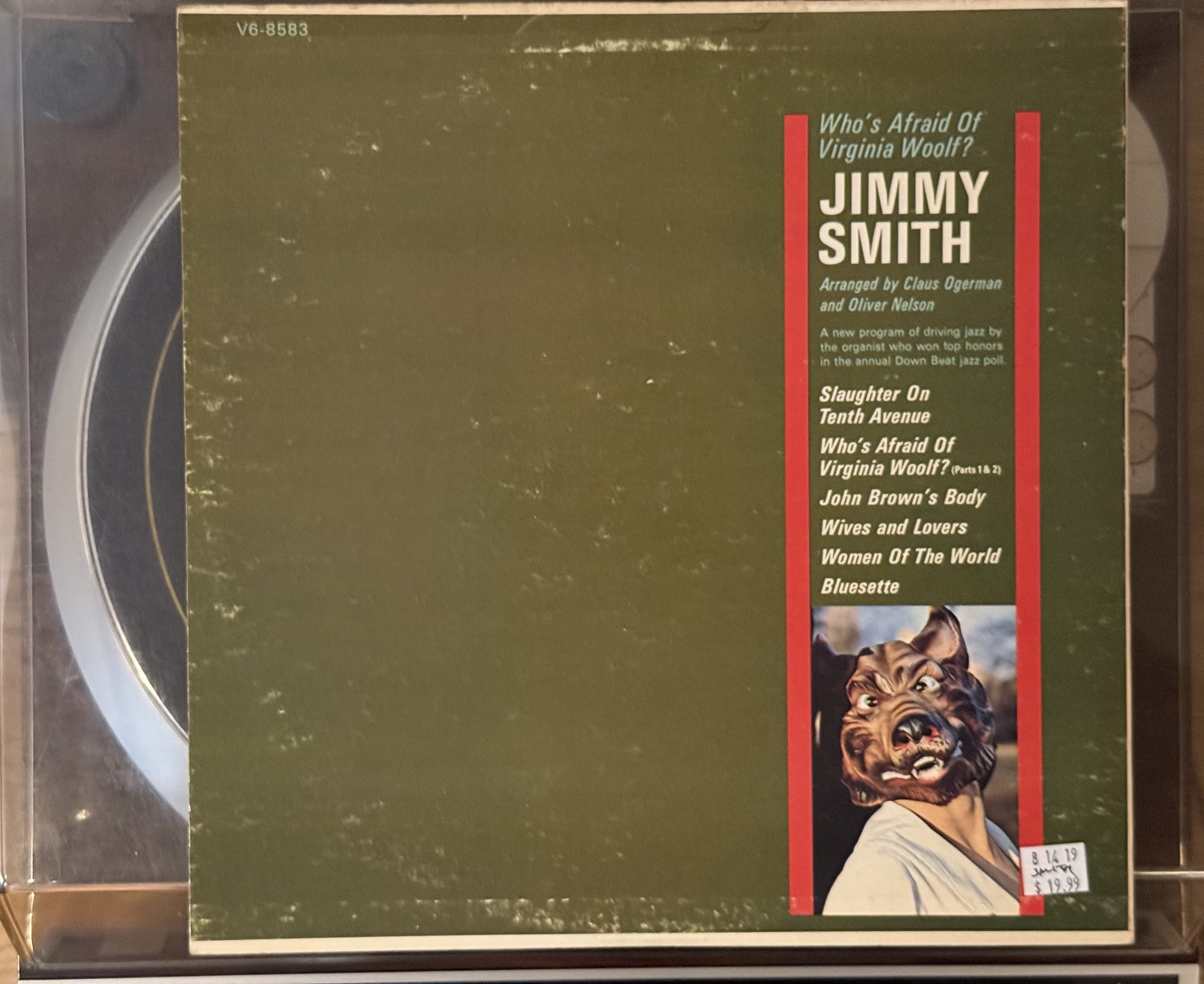
Behind the frankly weird cover photo lurks a brilliant Jimmy Smith classic, featuring arrangements by Oliver Nelson and Claus Ogerman.

Album of the Week, August 16, 2025

I mentioned when writing about The Cat, Jimmy Smith’s 1964 Verve album with Lalo Schifrin, that it wasn’t his only album released for Verve that year. That might understate the weirdness of Who’s Afraid of Virginia Woolf? just a little bit. Not only did the album come the same year, and not only did it also pair the great jazz organist with a renowned composer/arranger (or two!), but the title songs for both records bear a certain… relationship to one another. In fact, as the late lamented Professor Peter Schickele would say, “The name of that relationship is identity.”

I’m not quite sure how it is that “Who’s Afraid of Virginia Woolf” and “The Cat” got to have an identical orchestral arrangement, but in other ways the two records, conceptually similar on paper, are very different. To begin with, The Cat is still an organ trio album, albeit with lots and lots of horns. Who’s Afraid of Virginia Woolf is really an orchestral pop album with a jazz organ soloist. And it was arranged by two of the best. We’ve written about Claus Ogerman before, in his later work with Verve and Creed Taylor on Antônio Carlos Jobim’s Wave. And Oliver Nelson, who arranged the first side of the record, would be well known as a jazz composer and arranger even without a great 1961 album he cut with Creed Taylor on Impulse… but that’s a story for another time. Also joining, though not credited, were the same rhythm section as The Cat—George Duvivier on bass, Grady Tate on drums, and Kenny Burrell on guitar. Photographer Roy DeCarava is credited with the nightmarish cover; since he also photographed Miles’ version of Porgy and Bess, Bill Evans’ Conversations with Myself, and Branford Marsalis’ Renaissance, among other masterworks, we can only assume that someone put him up to it. The maker of the wolf’s head is uncredited.

Slaughter on Tenth Avenue” opens the record with an expansive Oliver Nelson arrangement of the Richard Rodgers ballet score. There’s a lot going on in the first few seconds—intelligent use of lower brass and woodwinds, a pointillistic xylophone, thundering timpani. The tuba and low trombone give us an ominous introduction to Jimmy Smith stating the theme on the Hammond. And the horns give us the great chorus hook, the syncopated III – V – III – V – VI – V – III melody that then sets up Smith’s solo. This is where the arrangement really takes off, as it swings into a fast 6/8 that climbs into the stratosphere, pushing Smith to high riffs and flourishes as the orchestra plays the theme slowly behind him. The end seems to dissolve in spreading rings of dissonance as the timpani and drums beat louder and louder, until the orchestra finally brings us to closure with a diminished seventh chord. It’s quite a transition…

…into a very familiar theme. “Who’s Afraid of Virginia Woolf?” (parts 1 and 2), composed by jazz pianist Don Kirkpatrick, opens with a version of the same flourish as “The Cat,” here treated with slightly more care and less mayhem than Lalo Schifrin’s arrangement. If Nelson’s arrangement and tempo takes some of the edge off the theme, Smith puts the edge right back. Indeed, though there are some fantastically crunchy chords from the orchestra, Part 1 seems at its best when it’s just the interchange between Smith, Burrell, and Tate. The orchestra seems invigorated by the long collective improvisation when they return, and Smith returns the favor, with a rippingly fast improvisation that takes it right up to the end. Part 2 is even more intriguing, with a bouncy drums and claves introduction leading into a trumpet statement of the theme, then a groovy solo turn by Smith that’s notable for how much space is left to appreciate that ongoing groove. Another wall of dissonance (one imagines Smith pulling out a bunch of stops and leaning on the keyboard) transitions into a more active solo with punctuation from the horns. As the second part draws to an end, it seems to circle back to something more like the Part 1 arrangement, closing with the full arrangement of the hook and one more high velocity solo, in a sort of ecstatic exhaustion.

John Brown’s Body” gets a throbbing introduction from the low brass before Smith gives us an offbeat statement of the famous theme. There’s a little more air in this Claus Ogerman arrangement, with enough room around the brass for Kenny Burrell to contribute the occasional stab of a chord to move things along, then to play alongside as a sort of persistent Greek chorus. Grady Tate’s unshowy timekeeping is an understated star here; it’s only as he sneaks an occasional cymbal hit in around the edges that you really hear his steady genius at work. Ogerman brings the jam to a slow fade-out; you can imagine the band going on here ad infinitum.

Wives and Lovers” returns us to a slow swing, with the melody stated in the winds, as Jimmy plays the Burt Bacharach melody down in the baritone range of the organ. This is a brief arrangement that is mostly about hearing Smith’s melodic imagination work its way around the brilliant Bacharach chords; Ogerman seems content to fade this one out, perhaps to get to “Women of the World” faster. This sixties pop groover by Riziero Ortolani is given a samba backbeat by Grady Tate, but seems to circle around the melody without much motion. Smith makes the most of the slim material, accelerating into a faster tempo in the midst of his solo and urging the percussionists and Tate to follow, before drawing it to a mantra-like close.

Bluesette” closes us out with a swinging rendition of the 1962 Toots Thielemans hit. Jimmy keeps the solo in a slightly higher register, perhaps to echo Thielemans’ whistling melody, as he rips into an extended solo following the brief orchestral introduction. Tate and Burrell cook right along with him through the improvisation. When the orchestra comes back in, they take us to a coda of sorts, staying suspended on a minor third to fourth riff as Jimmy heads right off into infinity.

There’s no disputing that the work Smith did with Nelson and Ogerman, as well as Lalo Schifrin, expanded his sound; there are some purists who would use a more pejorative verb in that sentence. But as we’ve heard, there are pleasures to be had from the combination of the well-crafted arrangements with Smith’s impeccable organ playing. Incredibly, this album and The Cats weren’t the only two albums the incredibly prolific Smith recorded in 1964; they were perhaps not even the best-known of those albums. But we’re going to save his last 1964 selection for another time. Next week will find us with an album from the following year that saw him returning to a more familiar configuration, with spectacular results.

You can listen to this week’s album here:

BONUS: Here’s Smith playing the title track live in 1965 with Quentin Warren on guitar and Billy Hart on drums:

BONUS BONUS: Following its release on this album, “Who’s Afraid of Virginia Woolf” was covered by a variety of artists, including this memorable instrumental cover by James Brown’s band, with none other than Brown himself at the keys:

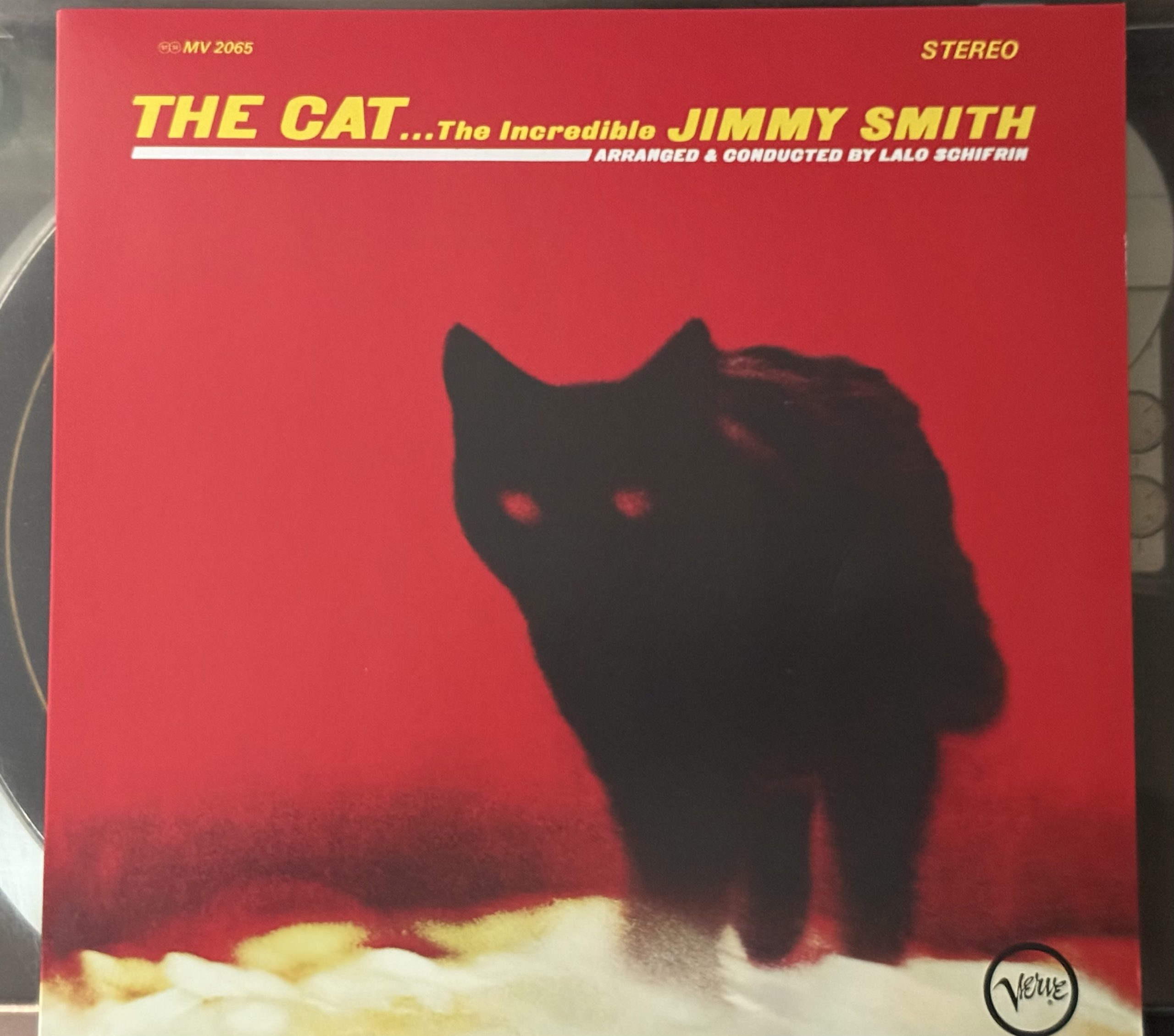
Jimmy Smith, The Cat

Jimmy Smith’s soulful Hammond B3 meets the ingenious arrangements of Lalo Schifrin in this hot album for Verve.

Album of the Week, August 9, 2025

There’s a world in which Jimmy Smith kept making cool, soulful organ trio and quartet albums like Prayer Meetin’ for his whole career. In that world, we’d be listening to a lot more laid back small combo jazz with Smith’s impeccable harmonic sense to lend a little excitement. But that’s not the world we live in. Shortly after he recorded last week’s session for Blue Note, Smith moved to Verve Records, and before long he began recording a series of records that dramatically broadened what the jazz organ could do, in collaboration with two mad geniuses of jazz… one of whom we’ve met before.

1962 was the prime of Creed Taylor’s years as jazz impresario at Verve. We’ve told the story of his post-Verve years in the history of his own label CTI, starting with his late-1960s collaboration with Antonio Carlos Jobim, Wave (and you can find the rest of that series, along with my other writings, in the Album of the Week archives). In the early 1960s, he was still experimenting with some of the ingredients that would come to define his CTI sound, especially the combination of jazz musicians with imaginative orchestral arrangements. In this case, the arrangements came courtesy of Argentine-American pianist/composer/arranger/conductor Lalo Schifrin.

Schifrin, who passed away earlier this year, had done some arranging for Dizzy Gillespie’s big band, and came to New York to join Dizzy’s small group; he went on to a notable career in film and television composing, including the themes for Mission: Impossible, Mannix, Cool Hand Luke, Dirty Harry, and Enter the Dragon. Taylor put Schifrin with Jimmy Smith, and Schifrin formed a jazz orchestra for the album that included the likes of Thad Jones and Snooky Young on trumpet, Urbie Green on trombone, Don Butterfield on tuba, and a rock solid trio of Grady Tate on drums, George Duvivier on bass, and Kenny Burrell on guitar. Thad Jones, the middle of the Jones brothers (elder brother Hank, younger brother Elvin), started his career with Count Basie, formed a long-running orchestra with Mel Lewis, and transformed the Danish Radio Big Band into one of the finest in the world before taking over leadership of the Count Basie band in 1985. Snooky Young had played in the Thad Jones/Mel Lewis band but was best known for his work in the Tonight Show band under Doc Severinson. Butterfield was a great session player who had performed with Dizzy, Sinatra, Mingus, and Rahsaan Roland Kirk. Duvivier worked with a Who’s Who of musicians including Bud Powell, Oliver Nelson, Sinatra, and a few others that we’ll come across in the weeks to come. And Kenny Burrell, who is still kicking at 94, played with everyone as well as leading his own great sessions on Blue Note, Prestige and Columbia.

Theme from Joy House” is the first of two Schifrin film soundtrack compositions on the album. The French thriller, starring Jane Fonda among others, has a bonkers plot, and Schifrin apparently responded with a bonkers score. The orchestration builds from bass and percussion, with a subdued organ part playing the main theme as the lower horns provide support. Then the trumpets blare and we’re truly off to the races. The second verse gives us the melody in the horns, with bursts of vibraphone providing punctuation. Smith’s solo, unlike his combo work, stays mostly in the upper ranges of the organ, the better to play against the wall of horns. But we still get some of his trademarks, like leaning on the tonic to build suspense—here echoed in Schifrin’s arrangement by the horns. The final repetition is a full on horn blast, with Smith’s high organ tone cutting through.

The title track, “The Cat” is the second Schifrin selection, also from Joy House. In form it’s a blues, but in spirit it belongs alongside Quincy Jones’ “Soul Bossa Nova” (aka the Austin Powers theme) as an exemplar of the most bonkers kind of ’60s instrumental pop. Schifrin doesn’t spend much time warming up to his theme; we get four syncopated eighth notes of introduction, blasted from the horns, and then the bass (and tuba?) and guitar are off to the races, with Smith’s easy statement of the melody soon yielding to high arpeggios. You could easily imagine this one soundtracking a manic chase scene, especially when the horns return to play the theme over some of Smith’s more wild improvisations. Smith takes the lead in the bridge, with bubbling tremolos building up to a reprise of the melody. The full band shuffles to the fade-out, led particularly by Grady Tate’s drumming, replete with well placed tom hits and cymbals. The tune clocks in a few seconds shy of 3:30, but packs quite a wallop; it’s deservingly the best-known cut from the album and I would have known it even if KEXP hadn’t regularly played it under their DJs reading concert calendar listings when I lived in the Seattle suburbs.

The classic “Basin Street Blues” is another one that starts deceptively coolly, before the horns burst over organ, bass, and low vibraphone like fireworks, but this track keeps its cool a little longer, and ultimately settles into a pocket, with the horns acting mostly as a high chorus that briefly kick Smith into a sort of higher orbit. Ultimately they draw him out into a more extroverted solo that leans into the higher range of the instrument and arpeggios up and down the keyboard, as the middle and low horns state the melody and finally the whole band blasts the chorus. Their part done, the horns retreat to providing emphatic punctuation at the edges of Smith’s final solo, before coming back for a wild climax, full of diminished sevenths and razzmatazz.

Main Title from the Carpetbaggers,” a theme by Elmer Bernstein and Ray Colcord for the 1964 drama starring George Peppard and Alan Ladd, starts with Latin percussion, then the double bass enters in triple meter before the tuba starts doubling. The horns state the theme with much growling from the trombones and tuba over a consistent pounding on the tom (or possibly even timpani). Finally, after two iterations of the melody, Smith enters on the organ, riffing on the blue notes in the melody as Phil Kraus’s congas and Grady Tate’s drums propel the melody forward. The horns provide accents over the top, but this is mostly Jimmy Smith and his rhythm section, smoking along the slow burn of the piece—at least until Schifrin’s magnificent French horn section (four horns, including Jimmy Buffington, who played on Miles Ahead and Sketches of Spain) blasts off. The work ends as it began with the horns playing through the melody, but this time Smith is wailing alongside the full band.

Chicago Serenade,” starting off the B side of the record, is by the great Eddie Harris, who also wrote “Freedom Jazz Dance,” later recorded by Miles on Miles Smiles. There’s little of the rhythmic complexity of the latter piece here, but some great pop sensibility in the tune, here stated in Kenny Burrell’s guitar with accents from Jimmy and the horns. Jimmy plays a high flourish on the organ to transition out from the horns but brings his solo down into the baritone range, providing a more intimate sound. There’s some great antiphonal writing for the horns throughout, and some magnificent French horn playing, but the crunchy organ arpeggio at the end is by itself worth the price of admission here.

W.C. Handy’s classic “St. Louis Blues” gets a swift intro from Jimmy, Tate and Duvivier that makes it sound like the band was already cooking when Rudy Van Gelder started rolling the tape. The horns can do little else than punch up the chorus; Jimmy is on fire, shifting meter and tonality and insinuating the melody under the band. The horns finally find their footing at the very end, giving a rousing send off, but Jimmy’s rolled chords get the last word, as always.

Delon’s Blues” is the one Jimmy Smith original on the record, and it’s much more relaxed, but still tightly arranged, with accents first from Burrell and then from the horns over Jimmy’s melody. The more spacious arrangement of the verse gives us an opportunity to hear what Grady Tate is doing to punch up the rhythm under everything, with syncopated punches and stumbling rolls on the snare for interest. Throughout Burrell drops little zingers to keep things lively.

The final blues, Harold Arlen and Johnny Mercer’s “Blues in the Night,” picks up with just guitar, drums and bass accompanying Smith’s introduction. When the horns come in, they lean on a weary suspension to emphasize the blue notes. Tate and Smith threaten to bring things to a boil on the introduction, but they keep the heat to a simmer, letting Burrell provide textural interest. Finally three pounded beats from Tate tip things over and the horns take a high screaming chorus. Smith lowers the temperature once more to a fast simmer, again racing his tremolo across a whole verse as the band vamps. The engineer sadly fades out just as Smith’s solo gets interesting, but we are left with the impression that the blues continue forever.

In the team from Verve, Smith had found collaborators who could take his basic brilliance and turn up the dials on all the arrangements without compromising the basic elegance of his vision for the organ’s role in jazz. As at Blue Note, he made a series of records in quick succession for Verve; unlike at Blue Note, these charted. His last Blue Note albums cracked the Billboard 200, but The Cat went all the way to Number 12 on the album chart, and “The Cat” cracked the Hot 100, finishing at # 67. His other 1964 release would also perform well, albeit with a very different collaborator; we’ll hear that one next time.

You can listen to this week’s album here:

BONUS: Jimmy would take this material on the road with a smaller combo. Here’s an undated performance for German TV with just drums and guitar (and a tenor sax player who sits this one out), burning on “The Cat”: