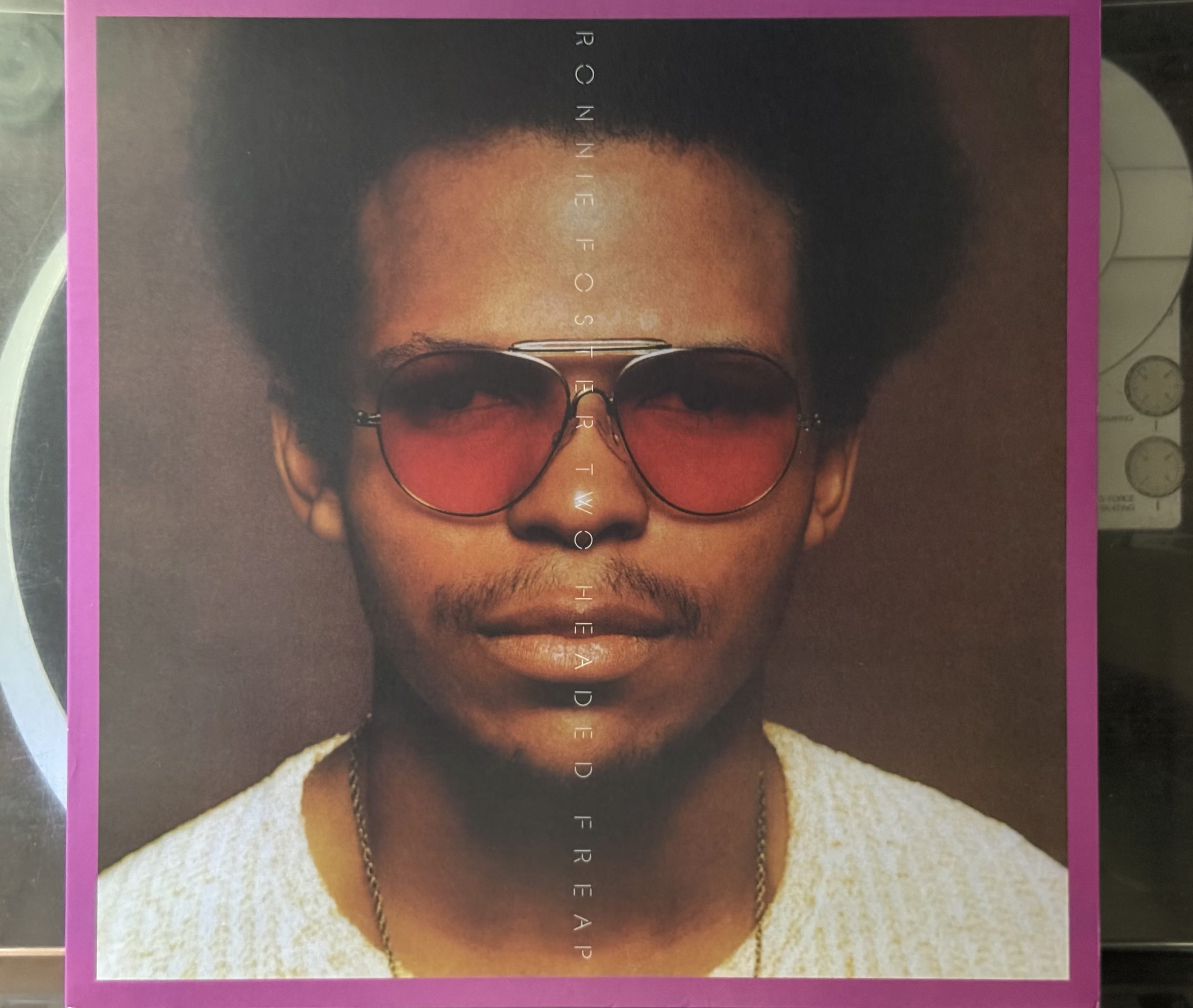
Ronnie Foster, Two Headed Freap

The debut recording from Foster puts funk, soul, R&B and jazz into a blender and comes out with a “brew” that’s a genuine classic.

Album of the Week, October 11, 2025

Blue Note Records in 1972 was not the same label that it had been in , or even in 1963. Duke Pearson’s run as head of A&R had shifted the label from the straight-ahead jazz favored by his predecessor Ike Quebec to something a little more au courant. But even Duke was gone, leaving the label in 1971, the same year that label co-founder and famed album cover photographer Francis Wolff died. The label’s corporate parent, Liberty Records, was absorbed by United Artist Records the same year. And A&R executive George Butler took over the label, coming from United Artists, and sponsoring a number of projects aimed at crossing over between the jazz and soul audiences to build more market momentum for the label. Among the artists crossing over in this way were flautist Bobbi Humphrey, guitarist Earl Klugh, trumpeter Donald Byrd, and today’s artist, Ronnie Foster.

Foster grew up in Buffalo, New York and was interested in music from an early age, playing his first show (in a strip club) at age 15. He was not formally educated in jazz, receiving only a month of musical instruction—on the accordion. For this, his first record, he assembled an assortment of musicians that included George Duvivier on bass, Gene Bertoncini on guitar, Gordon Edwards on bass guitar, Jimmy Johnson on drums, Eugene Bianco on harp, George Devens on percussion and vibes, and Arthur Jenkins on congas. Motown producer Wade Marcus, who also had arranged Blue Note sessions for Bobbi Humphrey, Grant Green, Horace Silver, and Marlena Shaw, did the arrangements.

Chunky” starts out hard with distorted guitar over a four-four beat from Johnson, followed by a syncopated figure from Foster on the Hammond, a long vamp over a four-chord sequence. A sudden shift to a different minor chord provides a quick four-measure bridge and we’re off to the races. Foster’s improvisation is primarily in the right hand, playing runs, venturing out into different tonalities, even quoting the “Love Supreme” progression at one point. His solo goes into runs, chromatic up and down figures that are played so that they smear together, and sustained notes that transition into out-of-tempo arpeggios. The track fades out, leaving us with just a hint of Foster’s rhythmic and improvisational imagination.

Drowning in the Sea of Love,” a hit written for Joe Simon by Kenny Gamble and Leon Huff, is played as a straight cover of the bluesy soul hit, with lots of color from Bertoncini and George Devens’ vibes. Foster’s playing shows off his harmonic ear, as he harmonizes with the melody and then gives a couple blasts on the organ to introduce the solo proper. He has a pattern here and in “Chunky” of playing with time and meter in a way that seemingly breaks his improvisation free of the groove, right up until the fade-out.

The introduction to “The Two-Headed Freap” could have been titled “Chunky Pt. 2,” with the same pattern of blasting chords almost to the same rhythm. But the chords are a different progression, almost discordant, and things change quickly into a bluesy salsa-inflected solo with a nine-beat turnaround. Foster’s solo gives us a nasty (in a good way) breakdown in the last minute that calls to mind some of Jimmy Smith’s work.

Summer Song” is an original with melody played by Bertoncini and Devens, over a growling bass line, before Foster’s solo. Here his technique is very different as he works with sustained suspended notes and chords as well as a right hand solo line that stays in the upper octave. The basic materials are fairly static, with vamps over chords that rock back and forth, but George Duvivier’s bass part (not quite a solo) is worth the price of admission.

Let’s Stay Together” is a cover of Al Green’s hit, which again benefits from Duvivier’s bass as Foster tosses riff after riff off in his solo. The organ seems to have irrepressible energy, riffing at double speed over the groove, right up to the fade-out. “Don’t Knock My Love” is another cover, this one of Wilson Pickett’s last number one hit. Where the original benefited from a measured funky groove, Foster’s cover seems to lack some of the funk of the original even as it speeds up the tempo by a click or two. The fuzz distortion on the guitar doesn’t help matters here as the band threatens to come unglued during the endless wind out.

The fade-out takes us into “Mystic Brew.” Easily the most memorable track on the album, certainly the most sampled, the track opens with a double bass line from both Duvivier and Gordon Edwards, forming a bedrock for the entire song. Bertoncini and Devens’s vibes repeat the tonic together with Eugene Bianco’s harp. Bertoncini doubles Foster as he plays the relaxed main theme, which seems content to hang out on the tonic as Devens and Bertoncini elaborate around the edges. Foster’s solo is more disciplined here, with the first iteration playing with multi-measure suspensions, the second with syncopated eighths, the third evolving into triplets and then rolling sixteenth and even 32nd notes. The performance, in addition to being a complete pleasure, illustrates the ingenuity and athleticism that Foster brings to the table.

Kentucky Fried Chicken” closes out with a slightly funky riff on a minor third over a funky bass, then shifts gears over a series of odd suspended chords for a moment. Bertoncini gets a brief solo before Foster plays his games with meter and time, at one point chattering like a hen, changing keys, and ripping through a set of arpeggios. So we end as we began, with Foster improvising straight into the fade-out.

Foster cut a series of albums for Blue Note as a leader, including a pretty great Live at Montreux in 1973. He was less successful after leaving the label for Columbia, recording two albums there and one for Pro Jazz between 1978 and 1986. But he produced almost 100 records and had hundreds of sideman credits, including a collaboration with George Benson that began on 1975’s Good King Bad. We’ll hear from him once more, from later in his career. But next week we’ll hear a famous record from an artist who went through a remarkable shift of his own in the early 1970s.

You can listen to this week’s album here:

BONUS: Foster’s live performances of material from this and other albums are spectacular. You can find some on the officially-released Ronnie Foster Live: Cookin’ with Blue Note at Montreux. Here’s “Chunky”:

BONUS BONUS: “Mystic Brew” became an unlikely standard of sorts through sampling and latter-day covers. Notably, A Tribe Called Quest sampled it for “Electric Relaxation” from their 1993 album Midnight Mauraders:

BONUS BONUS BONUS: Maybe the most unlikely cover of all is the way I first heard “Mystic Brew,” in a version by Vijay Iyer’s trio on his 2009 album Historicity:

George Benson, Good King Bad

Album of the Week, September 2, 2023

When I was growing up in the bucolic suburbs of Newport News, Virginia, listening to my parents’ music on the kitchen radio and in our car, the radio was generally on one of two stations. One, WGH, was the local independent classical radio station (which later moved its programming to WHRO). The other, WFOG, was the “easy listening” one. I didn’t mind it at first, but in time I grew to mock it, hearing the uncomplicated, dumbed-down orchestral arrangements of pop standards everywhere—dentist’s offices, malls, grocery stores. When I first heard “smooth jazz,” courtesy of Kenny G, I knew exactly where it had come from.

And when I started listening to CTI Records, I thought that was what I’d be getting, thanks to the label’s reputation for heavy string arrangements and jazz-funk hybridization. (I’ve had record collectors proudly tell me they avoid the label entirely for this reason.) As this series has hopefully shown, I was almost completely wrong.

But then there’s George Benson and Good King Bad. A technically brilliant player with a great melodic imagination, on this record he surrounded himself with a small army of studio musicians and smothered much of the material in major key, uncomplicated string arrangements. (I don’t know how to describe the unique tonality of so much of the smooth jazz adjacent recordings that I’ve heard except to observe that they are almost always in major keys and almost never use modes or complex modulations. But I always imagine some of the blissful jazz announcers I heard in Washington DC, who never seemed to let a cloud cross their minds and who seemed to always be speaking through a permanent smile, when I hear it.) The good news is that alongside the smooth jazz there is a fair amount of jazz-funk as well, in a way that lives up to Benson’s considerable prowess with the guitar.

About that small army: the musicians here are no slouches. There’s David Sanborn, Michael and Randy Brecker, and James Brown stalwart Fred Wesley, for starters, as well as Joe Farrell, Roland Hanna, Ronnie Foster, Eric Gale, and Steve Gadd, along with a bunch of other horn and string players. But there’s not a “band” to speak of as each of the tracks features a different line-up.

Theme from Good King Bad” is not a soundtrack, just the opening number. Written by arranger David Matthews (no relation), the uncomplicated pop number has not an ounce of swing in the chart, just straight ahead seventies jazz rock with horns and Eric Gale’s insistent chukka chukka on the rhythm guitar.. The funk in the performance is brought by Benson, whose guitar redeems the track with his usual precise yet soulful melody sense, as well as a sense of rhythm that swings all over the precise backing beats of the chart. Listening to the track, recorded in 1975, is a reminder that disco was already here, just not evenly distributed yet.

Matthews also authored “One Rock Don’t Make No Boulder,” which plays with the smooth formula by bringing in some crunchy minor chord progressions. Benson’s solo finds some grime and soul in the chart, which swings a bit more than in the first track, and the clarinet solo by Don Grolnick is a notable contribution to the overall mood. It’s a more complex sound that hearkens back to jazz-funk works like Farrell’s Penny Arcade.

Em” continues in this vein. A slightly blues-inflected jazz-funk track written by Philip Namanworth, it edges even closer to the disco line. Benson’s guitar work is unremarkable here.

Vince Guaraldi’s classic “Cast Your Fate To The Wind” is a different story. Here remade in a technicolor arrangement that brings strings around the edges of the tune, Benson is otherwise left largely to his own devices over the backing group, and he both renders the wistful side of Guaraldi’s melody as well as bringing out a hint of the bravado lurking beneath. Joe Farrell’s flute is a lovely complement to the track, and taking the second solo he brings a celebratory cadence to the music. The only misstep in the arrangement is an unnecessary key change in the bridge, but that is quickly rectified. The two soloists play in dialogue to close out the track.

Matthews’ “Siberian Workout” again seeks to shed the major-key stereotype, centering its composition in a minor mode instead. The same chicken-scratch guitar, horns and flute apply here; it’s probably the least distinguished track on the disk. “Shell Of A Man,” on the other hand, is a standout. Written by Eugene McDaniels, it’s an uptempo ballad enlivened by Dave Friedman’s vibes and Ronnie Foster’s keyboards. A tinge of blues in the chorus keeps things moving along. The coda, which swings into a fade-out, sees Benson take flight, exploring some of the changes of the set. It’s a seriously interesting track.

I wanted to dislike this album on the strength of the smooth jazz overtones, especially in the first track, but there are enough nuggets of gold in it to earn a recommendation from me. The more commercial sound was no mistake, however; it marked a period where Creed Taylor’s label was consciously seeking more and more pop-oriented sounds in the vain hopes of recapturing the chart successes they had earlier in the 1970s. We have one more record in the CTI series for this column, and it goes even further afield, with some players we haven’t heard from yet … but who may surprise you. That’s coming up next time.

You can listen to this week’s album here:

New mix: Exfiltration Radio, Cooking With Fat

It’s a Veracode Hackathon, so it must be time for an Exfiltration Radio playlist! This time, naturally, the musical choices were influenced by all the Miles-related jazz I’ve been writing about over the last few months, as well as an unlikely source: my Apple Music library maintenance.

So, when you source your library from iTunes Store purchases, third-party high-res music providers like HDTracks and Bandcamp, and CD and vinyl rips, you end up with pretty big music files and a lot of music. Too much music to fit on the internal hard drive of most Macs. I’ve been using an external drive for my media for many years now. Mostly it works fine. When it doesn’t, though, it’s disastrous. There is some kind of error condition in Apple Music that causes it to freak out when the external drive is temporarily unavailable and re-download all the music in the iCloud library. Which is OK, I guess, except when the external drive comes back online, you now have two copies of all the music in your library. Or, if it happens again, three.

I’ve figured out a rubric for cleaning this up, which will be the subject of another post. But I’ve been going through all the music in my library album by album, and in the process creating new genres to make it easier to find some types of music. In particular, the genres that inspired this mix were Jazz Funk and Fusion. The latter needs no explanation due to our journey with Miles; jazz funk is just the hybrid of a bunch of different strains of African American music with a heavy focus on improvisation over a funky beat. The end mix combines some tracks I’ve already written about with some more modern jazz from my collection; I’ll provide notes for each track below.

“Wiggle-Waggle,” from Fat Albert Rotunda: the track that got the most comments from my write-up of Herbie Hancock’s TV show soundtrack, with friends noting how it sounds like this track dropped in from another dimension.

“Chunky,” from Live: Cookin’ with Blue Note at the Montreux Jazz Festival, by Ronnie Foster. I’ve programmed Foster’s great “Mystic Brew” in past Exfiltration Radio segments, including the Hammond special. This is a live version of the opening track from the same album, Foster’s great Blue Note debut Two Headed Freap. There’s a lot that’s different about his approach to the Hammond organ compared to earlier artists, but all I can say is: he funky.

“Flat Backin’,” from Moon Rappin’ by Brother Jack McDuff. Speaking of earlier artists, a lot of McDuff’s early work was squarely in the “soul jazz” category (like his great Hot Barbecue), but by the time of this 1969 album McDuff was on another planet, and the electric guitar and bass land the music in Funklandia.

“Funky Finger,” from The Essence of Mystery by Alphonse Mouzon. We have seen Mouzon on the first Weather Report album, but his solo debut for Blue Note is another thing entirely. Despite the name, it’s got less of the mystery of Weather Report and more of the funk, and this track is a great example.

“Sugar Ray,” from Champions by Miles Davis. “That’s some raunchy sh*t, y’all.” Listen to how the chord changes are so wrong, the way they just walk over to an adjacent major key and then settle back into the original as though nothing happened. Also note the remarkable Wayne Shorter solo.

“Superfluous,” from Instant Death by Eddie Harris. Sampled on “What Cool Breezes Do” from Digable Planets’ Reachin’, this is an instant classic.

“The Griot,” from Henry Franklin: JID014 by Henry Franklin, Adrian Younge and Ali Shaheed Muhammad. Composer Younge and former Tribe Called Quest member Shaheed Muhammad have been having a blast recording albums with their jazz idols in the Jazz is Dead series, and this newer release with bassist Franklin, who played with Freddie Hubbard, Bobbi Humphrey, Archie Shepp, Willie Bobo, Stevie Wonder and others, is a tasty slice of funk anchored by his acoustic double bass.

“Tell Me a Bedtime Story,” from Fly Moon Die Soon by Takuya Kuroda. This funky cover of Herbie Hancock’s original from Fat Albert Rotunda is a great example of latter-day jazz-funk, with the arrangement draped (or smothered, depending on your taste) in layers of Fender Rhodes, synths, and electric bass. Kuroda’s incisive trumpet anchors the arrangement and lifts the funk to another level.

“Timelord,” from Inflection in the Sentence by Sarah Tandy. A great 21st century London jazz album, featuring Tandy on both acoustic piano and electric keys, the latter notably apparent in this moody track.

“Where to Find It,” from SuperBlue by Kurt Elling. I’ll write more about this track another time, but it’s worth noting that Elling is one of the few vocalists to brave the task of putting lyrics to modern jazz tracks like this one, Wayne Shorter’s Grammy award winning “Aung San Suu Kyi.”

Enough words. “We have taken control as to bring you this special show, and we will return it to you as soon as you are exfiltrated.”