
The Tanglewood Festival Chorus just finished a run of John Adams’ “Harmonium” (alongside the Beethoven 9th Symphony), for the first time in thirty-five years. I wasn’t a member the only previous time the chorus performed Adams’ early masterwork (under the direction of Sir Simon Rattle, no less!), but there were nine choristers who did perform the piece back then with us this time.
“Harmonium” is a massive piece, one of the true masterworks of minimalism. But tagging it with that undersells the harmonic and melodic attractions of the piece. True, it does open with two hundred or so measures of chanted “no no no”s1 and other syllables of negation, demonstrating with the human voice the same approach to building with rhythm previously done with marimbas, keyboards, or other instruments in works by Philip Glass and Steve Reich. But then the text of Donne’s poem breaks through like a ray of light—“I never stooped so low”—and you’re in a completely different world. The work is full of surprises and earworms; I found myself saying “rowing, rowing, rowing” under my breath as I walked, in rhythm, down the sidewalk to my car after one rehearsal, and a number of us have half-jokingly agreed that we’ll work on a carol arrangement that uses the melody of the second movement, “Because I could not stop for Death,” to set “O Little Town of Bethlehem” and see if Keith Lockhart will do it for Holiday Pops.
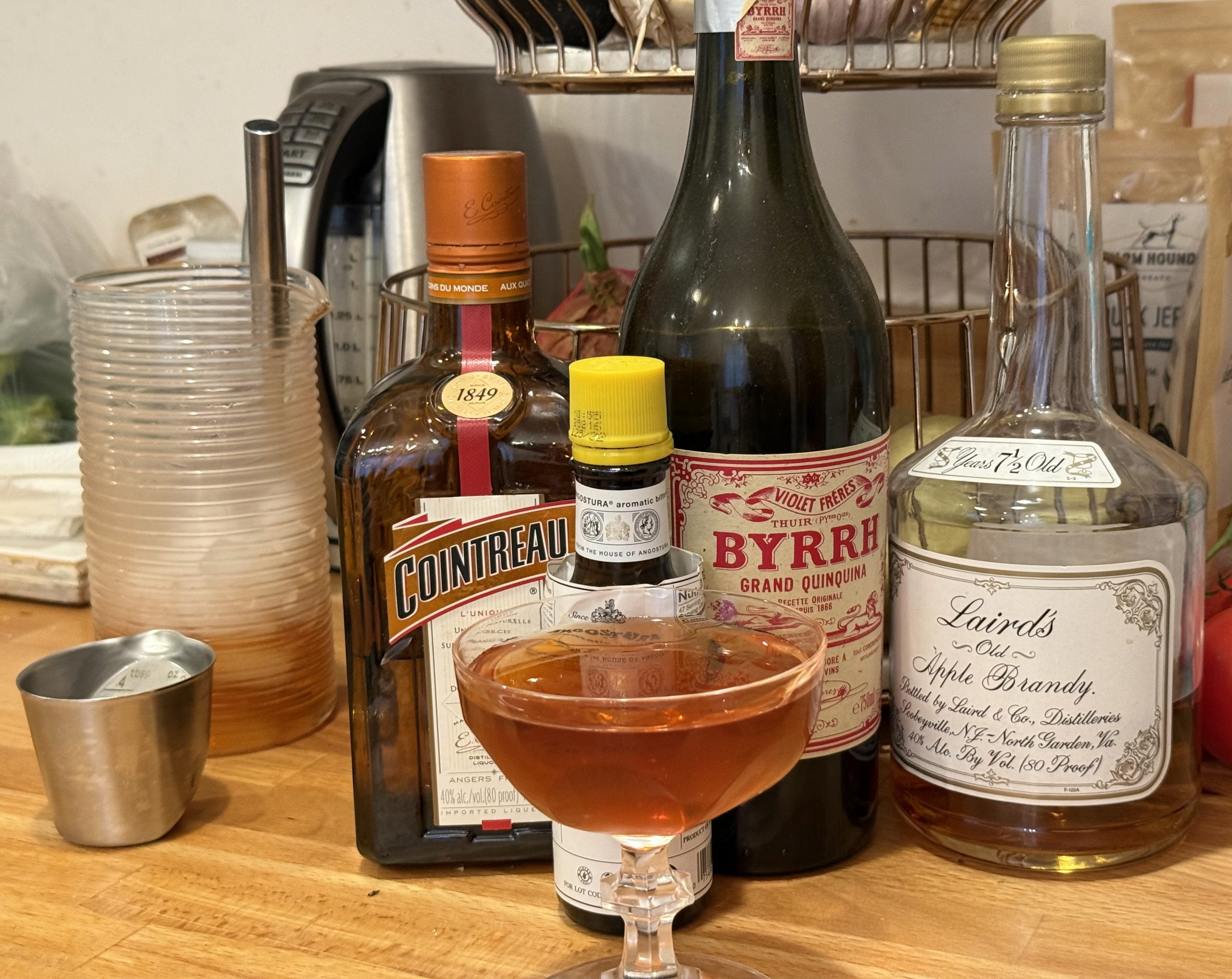
But I digress. Back to “rowing”; as I tried to decide on a cocktail for this run, that rhythm and its ultimate culmination “rowing in Eden” kept going through my head, and so I decided the cocktail had to be “Cointreauing in Eden.” I rifled through some of my old cocktail lists for inspiration and found a jumping off point, the Ante Cocktail. It’s a classic, included by Harry Craddock in his seminal 1930 Savoy Cocktail Book, but it calls for an apertif wine called Hercules.
How obscure is Hercules? Obscure enough that my source app starts the write-up with “Here’s what we know about Hercules…”, which perhaps explains enough to make me curious about this attempt to recreate it from a few years back. But the app helpfully suggested that I could substitute Byrrh, which I for some reason have in my inventory. Both Hercules and Byrrh are quinquinas, sweetened fortified apertif wines containing quinine (for bittering and presumably for health reasons) and spices; the family also contains Lillet and Dubonnet. Byrrh in particular is a French quinquina, made with red wine, mistelle (a mixture of ethanol and partially fermented grape juice), and quinine, that was originally sold as a health drink to avoid competition from neighboring apertif makers in the Pyrenees. Some day I’ll write about the intersection of cocktails and patent medicines… Anyway, the flavor is a tad sweet and deeply bitter in a pleasant way.
Cointreau is of course the legendary triple sec formulation produced in Saint-Barthélmy-d’Anjou. I suppose one could use other orange liqueurs, but I don’t recommend a substitution of Grand Marnier; I grabbed the wrong bottle by mistake last night to make this and the orange flavor was far too subdued. Regarding the apple brandy, you can substitute Calvados; I used Laird’s Old Apple Brandy, an aged 80 proof liqueur. Be careful with other substitutions; Laird’s Applejack contains neutral spirits and lacks the punch of real apple flavor.
As always, you can use the recipe card with Highball. Enjoy!

- There’s a story that, at the choir party following that 1991 performance, members of the choir gifted both founding TFC director John Oliver and Simon Rattle with the same gag gift: a pair of boxers with the words “NO NO NO NO NO” printed on them… and a different message printed in glow-in-the dark letters that could be read when the lights are out. This is one of many moments that I wish that JO had actually finished writing his memoirs. ↩︎