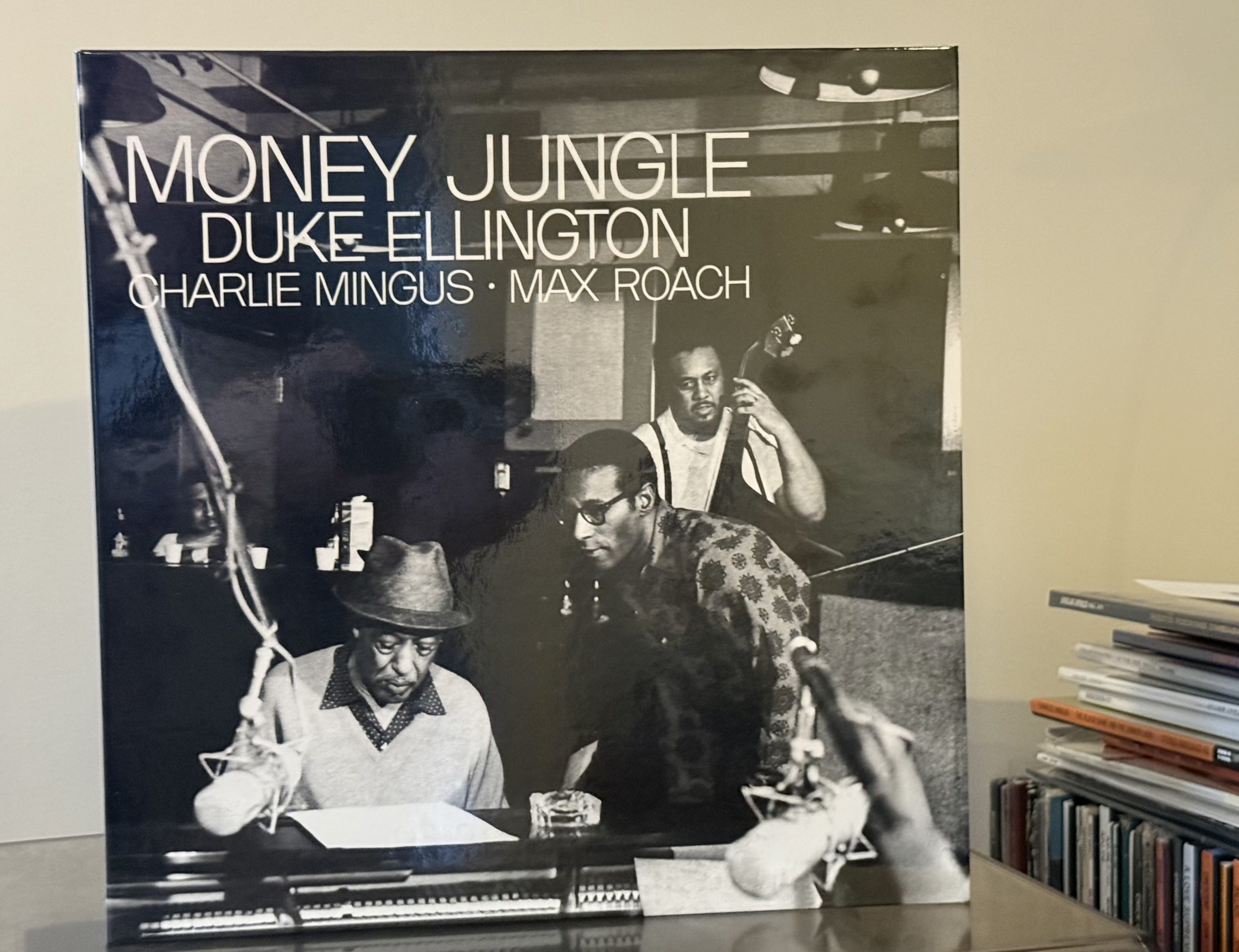
Duke Ellington/Charles Mingus/Max Roach, Money Jungle

Legendarily tense and extraordinarily beautiful, this rare Mingus trio album repays close listening.

Album of the Week, January 17, 2026

If you listen to enough music, you’ll inevitably hear about those albums that almost never happened because of drama during the recording sessions. The bands who come up in this kind of conversation might be the Beatles, Metallica, or Fleetwood Mac; it’s less common to hear about jazz players coming to blows. And then, there’s Charles Mingus. Never an easygoing guy at the best of times, Mingus’ legendary temper almost ended what turned out to be one of his most legendary sessions prematurely.

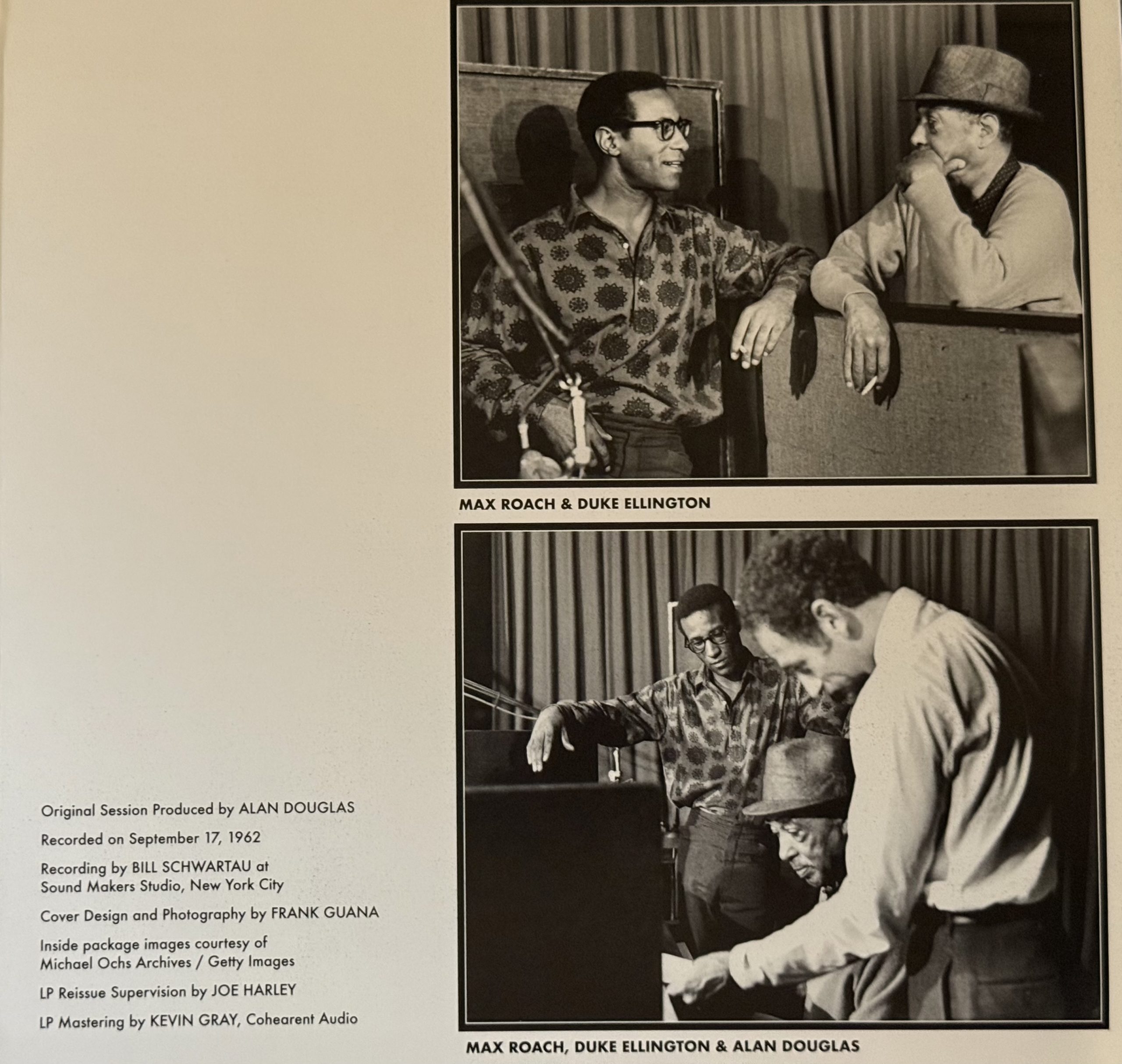
It started with the logistics of the session. In 1962 Duke Ellington came to producer Allen Douglas, who was then working at United Artists Records, to see about doing a piano trio session. Douglas was excited and suggested Charles Mingus, who had been in Ellington’s band, as the bassist; Ellington agreed, and Mingus suggested bringing in Max Roach, with whom he had worked in Charlie Parker’s band, as drummer. Ellington didn’t have a recording contract at the time, so they used Mingus’s contract. Ellington suggested to the men that they think about what tunes they might like to record, and said they needn’t be Ellington compositions.

On the day of the session, Ellington came in with a sheaf of scores, including four new tunes written for the occasion. History doesn’t record Mingus’s reaction, but one suspects he could feel the session slipping away from him and he was frustrated. As the session got more and more tense with each song, he reportedly argued, with Ellington, Roach, or both, eventually leaving the studio. Stories vary about whether Ellington caught up with him at the elevator or the street, but Mingus was eventually persuaded to return and finish the session.

To say you can hear the tension in “Money Jungle,” the opening track in the album’s running order as released,1 is an understatement. Mingus opens with four bars, opening with the low subdominant of the minor scale followed by two hard pizzicati an octave up. Hard is also an understatement; he bends the strings so hard that the pitch distorts. Ellington follows with explosive, dissonant chords as Roach plays a circular pattern on the drums. Eventually all the players lock in on a blues, but it’s not an easy journey. Mingus alternates more conventional walking parts, stuttering stabs, and high runs on the bass as Roach drops snare rolls, fills and other surprises in his part. At the end, Mingus abandons any pretense of conventional playing, hammering a series of suspended chords; the pianist waits him out eventually tolling a series of low notes to signal the end. If Mingus was attempting to assert dominance, Ellington appears to have showed that he could go toe-to-toe with him. (It’s thought that Mingus attempted to quit the session after this number.)

Which makes “Fleurette Africaine” all the more surprising. Like the opener, it was written for the album; unlike the opener, it’s a classic Ellington ballad. Mingus plays much more sympathetically here, but still adds new dimensions to the composition, playing shuddering arpeggi to which Roach reacts with polyrhythmic heartbeats and fills. Mingus plays alternate harmonies under the bridge, and the whole thing comes together just above a hush. It’s gorgeous.

Very Special” is another twelve-bar blues, this one far less combative. Here Mingus’s bass improvisations are primarily in the space at the end of the twelve-bar repeat, or under Ellington’s third and fourth solo verses. That’s not to say he’s not innovating; some of the rhythmic patterns are quite striking, and the trio locks in on an improvised secondary rhythm during the bridge. But compared to the apocalyptic feel of “Money Jungle” it’s left in a supporting role on the album. It’s followed by “Warm Valley,” with the first verse played solo by the pianist. A classic Ellington composition, named after a landscape feature he saw from the train in Oregon that reminded him of a reclining woman, here it’s a duet with the bassist, with only subtle brush work by Roach adding atmosphere.
Wig Wise” is the last of the newly written works for this session. A classic Ellington tune, it unfolds at first like a Bach improvisation, all pieces in place, but slowly Mingus starts to sound as though he’s slipping a gear, shifting the emphasis on the beat, leaving deliberate holes in the texture, moving the rhythm. He finds a second melody entirely in the bridge, and responds to the gap left by Ellington at the end of each verse with a different fill each time, finally ending the tune with a plucked glissando up to the highest note on his fingerboard.

Caravan” was written by Juan Tizol, he of the fight that got Mingus kicked out of the Ellington band. It’s unclear whether it’s the association with Tizol or the fact that the number was recorded late in the session, with temperatures already high, but this one also feels like a raised-voice discussion between Ellington and Mingus. The bassist is imaginative in his fills, but there are places where he continues to run in his pattern rather than following the changes in the music, and at the end he and Ellington alternate attempts to close the track out. This is probably Roach’s high point on the album, with explosive statements from the drums and a variety of tonalities from his kit. (I included this track on an Exfiltration Radio show featuring noteworthy bass performances a few years ago.)

The set closes with “Solitude,” again with Ellington opening the tune solo. Whether to offset the explosive nature of the rest of the recording, or just as a reflection of the innate quietude of the track, it feels almost like an interior monologue at the beginning. Mingus supports the pianist with single notes in the second chorus, but as he modulates the tune into another melody the bassist falls silent, rejoining along with Roach as the composer reenters the melody, now forthright and triumphant. At the end, Mingus plays a rolling fanfare over Ellington’s final chords; Ellington puckishly refuses to resolve the harmonies so Mingus finally does it for him as the album draws to a close.
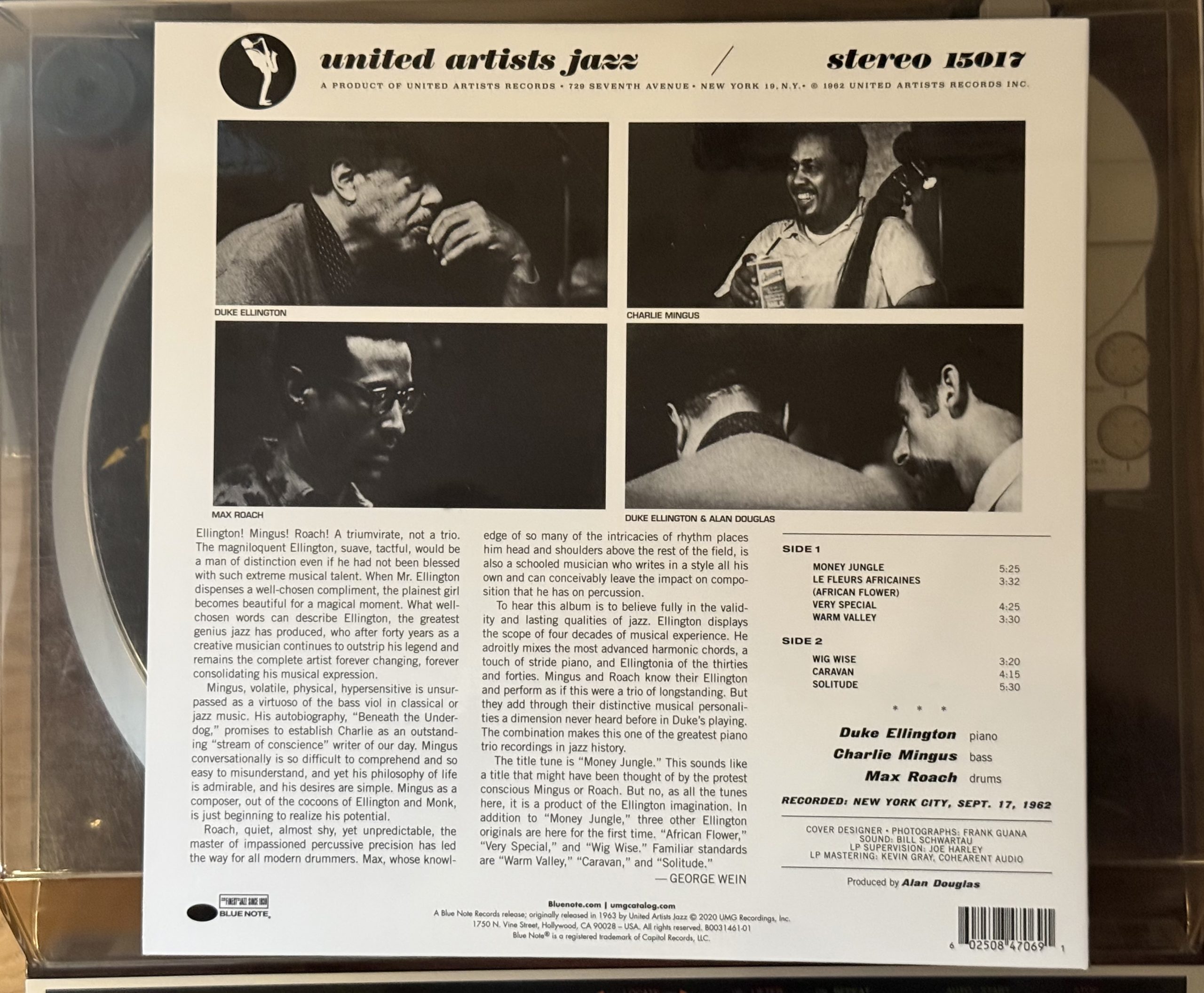
Whatever the tension in the room, Money Jungle is a complete artistic success, a portrait of music being made amid conflict and frustration. It’s also an opportunity to hear Mingus as a performer, apart from his compositions and his band, and to hear his rhythmic and harmonic imagination at play. Next week we’ll hear those qualities in the context of his compositions once more.

You can listen to this week’s album here:

BONUS: The great drummer Teri Lyne Carrington played the whole Money Jungle album live during the 2014 Internationale Jazzwoche (jazz week) in Burghausen, with a sextet that included Aaron Goldberg on piano, Tia Fuller on saxophone, flute and vocals, Antonio Hart on saxophone and flute, Claus Reichstaller on trumpet, and James Genus on bass. Here’s the title track:

BONUS BONUS: “Fleurette Africaine” has entered the repertoire, with recordings by Gary Burton, Horace Tapscott, Vijay Iyer, and many others. Here’s a 2017 version with Norah Jones on piano and vocals, Brian Blade on drums, and Chris Thomas on bass, from Ronnie Scott’s jazz club in London:

  1. A 1980s reissue sequenced the album by recording order and added alternate takes and bonus tracks; this version is what’s available on the CD. ↩︎

Thelonious Monk, Brilliant Corners

The genius of Monk is in full flower here in his third recording for Riverside Records in 1956.

Album of the Week, July 12, 2025

Thelonious Monk followed up the 1955 pair of standards albums (recorded as his first for Riverside Records) with a bang. Brilliant Corners consists of five Monk originals, of which only “Bemsha Swing” was previously recorded, and with a title track so complicated that producer and Riverside founder Orrin Keepnews had to assemble it from multiple takes. But unlike previous Monk outings that were doomed to obscurity, Corners was a critical smash hit, with Nat Hentoff calling it “Riverside’s most important modern jazz LP to date.”

The album was recorded in a trio of late 1956 sessions, with slightly different personnel. The October 9 and 15 sessions featured a quintet with Sonny Rollins and Ernie Henry on saxophone, Oscar Pettiford on bass, and mighty bebop drummer Max Roach. A follow-up session on December 7 saw trumpeter Clark Terry replacing Henry and bass giant Paul Chambers replacing Pettiford.

Brilliant Corners” begins slowly, as if the band is learning the melody by rote, following Monk’s initial solo statement, and then taking it through a series of key changes until it gets back to the beginning. But once that initial statement is underway, they restate the theme in double-time, demonstrating the band’s virtuosity as well as the difficulty of the composition. Rollins takes the first solo, playing ahead of and behind the beat in the single time section and unleashing a series of blisteringly fast improvisations in the double-time. Monk’s solo plays through the melody and demonstrates an unconventional solo technique on the fast passage: he plays a few bars, drops out, then reenters a few bars later with a blistering attack. Ernie Henry’s solo is fat, soulful, and not nearly as facile with the material as Rollins; the story goes that Monk dropped out under his solo to keep from distracting the alto player. He was not the only one to explore silence in the complex tune; the story goes that Orrin Keepnews had to check the microphones on Pettiford’s bass after one take, only to find that the otherwise highly skilled bassist was actually miming. The magnificent Max Roach seems fully at ease here, unleashing a blistering, melodically rich solo before the last chorus. Notoriously, the group never finished a complete take of the number; Keepnews assembled the version on the record from several fragmentary takes of the number. That may be so, but it’s a brilliant (no pun intended) assemblage.

Ba-Lu Bolivar Ba-Lues-Are” (Monk’s phonetic rendering of the “Blue Bolivar Blues”) is named after the Bolivar Hotel, the Manhattan home ground of his patroness, the Baroness Pannonica de Koenigswarter. The tune starts as a simple enough blues, but Ernie Henry’s smeary bebop improvisation over Roach’s precise stumble of a drum accompaniment quickly shifts it into something more. Monk’s imaginative and complex solo illustrates both his genius and his flat-fingered playing style, which often resulted in his hitting seconds and famously led to his assertion that “there are no wrong notes on the piano.” As if to underscore the genius of his approach, there are also virtuosic passages that introduce completely new melodies, one of which Sonny Rollins takes as a point of departure for his own solo. As before, Roach unleashes fusillades of snare sound under Rollins’ flights of improvisational fancy. Pettiford demonstrates his usual aplomb in an extended solo that leans into the blue notes of the tune.

Pannonica” is an example of that most underappreciated of compositional categories: the Monk ballad. Played on the celeste rather than the piano by the composer, Monk introduces the melody dedicated to his patroness before the full ensemble joins and states the theme. Monk plays it more or less straight, with a few flourishes around the edges and the sliding chromaticism of the tune the only clues that we are in his genius realm. Sonny Rollins takes the first solo, seemingly at double tempo, though in reality the chords of the tune move at the same tempo as of the introduction; it’s just that he switches from quarter to eighth notes, as it were. Underneath him, Monk switches to the piano more or less undetected; one wonders whether this magic was accomplished with a swiveling chair or by the keen editorial hand of Keepnews. That it’s all live is eventually given away (and described in the liner notes) as Monk plays the second 16 bars of his solo with left hand on the piano keyboard and right hand on the celeste, before returning to all-piano to close out his solo. He moves back and forth between the two instruments in the final reprise, throwing high accents on the celeste and closing out with a repeated high arpeggio on a suspension, as we end the side.

I Surrender Dear” is a pure Monk solo, recorded during the December recording session. Written by Harry Barris with lyrics by Gordon Clifford, the song appears to have struck a spark in Monk’s imagination, as he covered it several times in his recording career. We get all the Monk highlights here: the shift from stride into an almost hesitating rubrato that occurs even during the first statement of the theme; the introduction of an out-of-time series of arpeggios to accent the dramatic shape of the melodic line; and of course the Monkian splatted seconds that add so much to the color of the playing. At the end, Monk seems to drift away into a reverie of a different song altogether. For a cover song, it’s as pure a statement of Monk’s method on record as I know.

Bemsha Swing,” the other song from the second session, brings Terry’s brilliant trumpet to the group. Terry had previously played for Charlie Barnet and Count Basie, but he was in Duke Ellington’s band at the time of this recording. (He would later be in the Tonight Show band for ten years and play with Oscar Peterson for an astonishing 32 years; he’d outlive most of the players on this session, dying in 2015.) This is the only of Monk’s compositions from this record to have appeared previously, recorded for his Thelonious Monk Trio record for Prestige in 1952. Monk essays the melody as a series of rising fourths in a sort of stumbling fanfare, then firmly states it in the opening proper. There’s both stumbling (virtually, via some impressive syncopation) and firmness in what follows, particularly from Roach, who seems to be playing cymbals and snare with one hand and foot and tympani with the other hand throughout. Chambers is completely unfazed by the melodic complexity, sliding through the changes without breaking a sweat. Likewise, Rollins appears completely at home here, essaying a series of improvised double-timed thoughts that unroll as a continuous melody over the chords. Terry follows Rollins’ lead but switches it up with some longer held notes and some judicious rhythmic pauses between phrases. Monk’s solo occasions both some out-there high improvisation and some of Roach’s finest work on the record, as he alternates some fine snare work with emphatic pronouncements on the timpani, both in time and in hemiola. Chambers takes a solo that alternates walking the changes with statements of the melody, and Rollins picks things up in media res. Monk joins Rollins for the second verse of his solo with his own improv, and Terry comes in seamlessly to single the final chorus. There are many fine examples of collective improvisation in recorded jazz history, but I’m fairly certain there are no finer moments in Monk’s recordings to this point.

With Brilliant Corners, Monk had finally tipped the balance on the critical appraisal of his works, and his compositions and recordings began attracting more favorable notice. This affected not only his freedom to record but also the players he attracted. It was two short months after the April 1957 release of the record that he recorded Monk’s Music with John Coltrane and Coleman Hawkins. There followed a series of studio and live recordings for Riverside that ended in a royalty dispute. But Monk wasn’t done yet; his biggest selling recordings were ahead of him. We’ll hear one of those next week.

You can listen to this week’s album here:

BONUS: Thanks to the archival work done to assemble various biopics of Monk, we have a recording of Monk playing “Pannonica” for his patroness shortly after he wrote it, including his spoken introduction. There’s so little of Monk’s spoken voice out there that this is a rare treat indeed.