
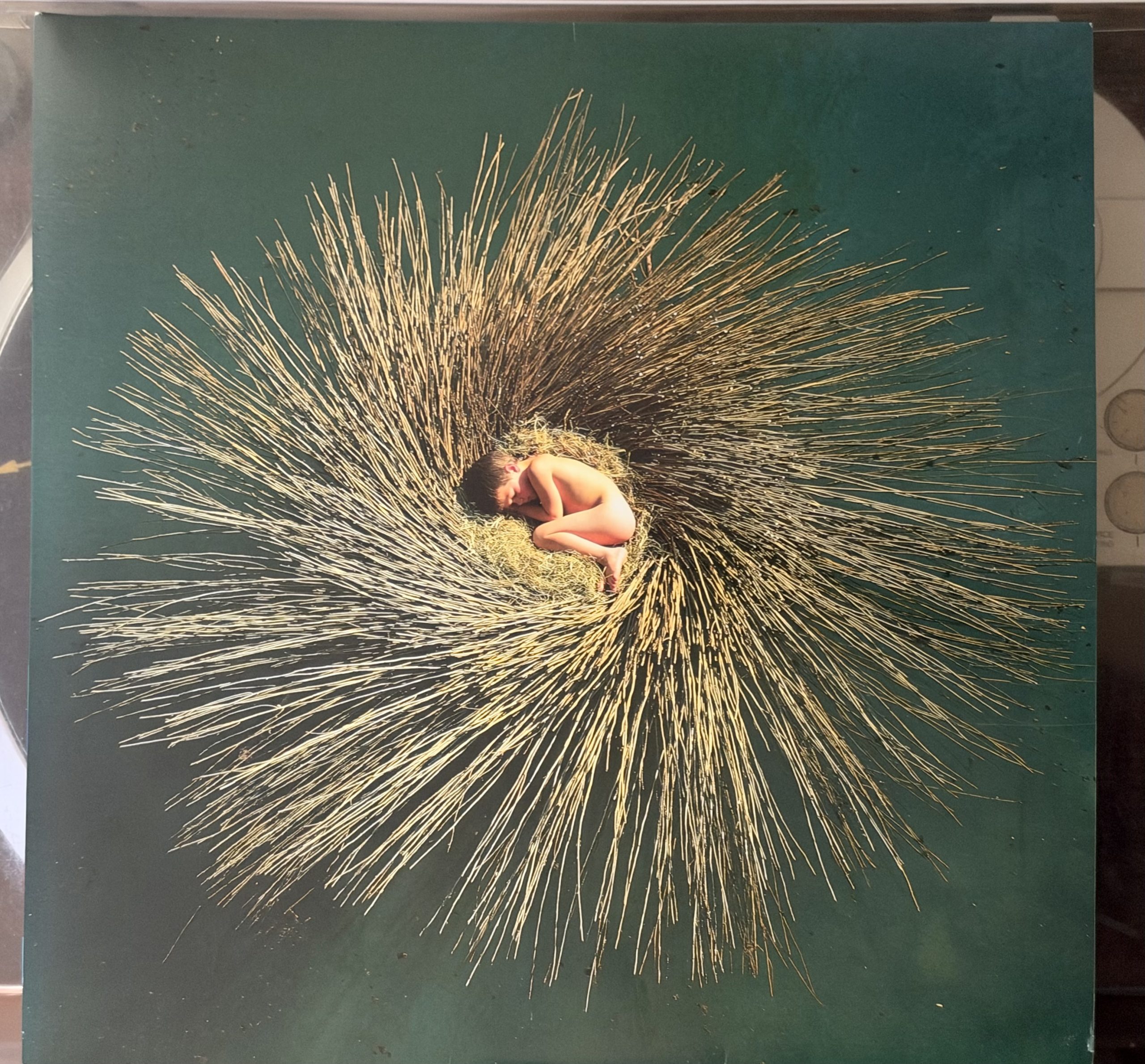
Album of the Week, October 10, 2026
Even in the moment, in the mid-1990s following the release of Us, it seemed like Peter Gabriel was all over the place while simultaneously being invisible. Interactive computer entertainment via the then-new medium of the CD-ROM? He was there, with XPlora 1: Peter Gabriel’s Secret World (reviews now differ: was it a computer game or an extended advertising campaign? Having played it back in the day, I can say with confidence: it was slow) and Eve. There were talks about a theme park. But new music under his name was slow to appear, until in 2000 an odd album appeared. A soundtrack, but for a live show rather than a movie; a concept album with an impossible-to-describe concept; and a Peter Gabriel album with almost everyone except Peter Gabriel on lead vocals. What, exactly, was OVO?
First of all, it was the soundtrack to the Millennium Dome Show, intended as a massive multimedia event but remembered today mostly as an expensive flop. The show, built inside a massive dome on London’s Greenwich Peninsula near Canary Wharf that now houses the O2 Arena, was meant to commemorate the Millennium and, not coincidentally, to announce to the world that Tony Blair’s New Labour was creating fabulous things in Great Britain. Ultimately the show, which ran for a year, did not draw the crowds the organizers anticipated; though the 6.5 million visitors who saw one of the 999 shows were reportedly happy with the experience, organizers had planned for more than 10 million.
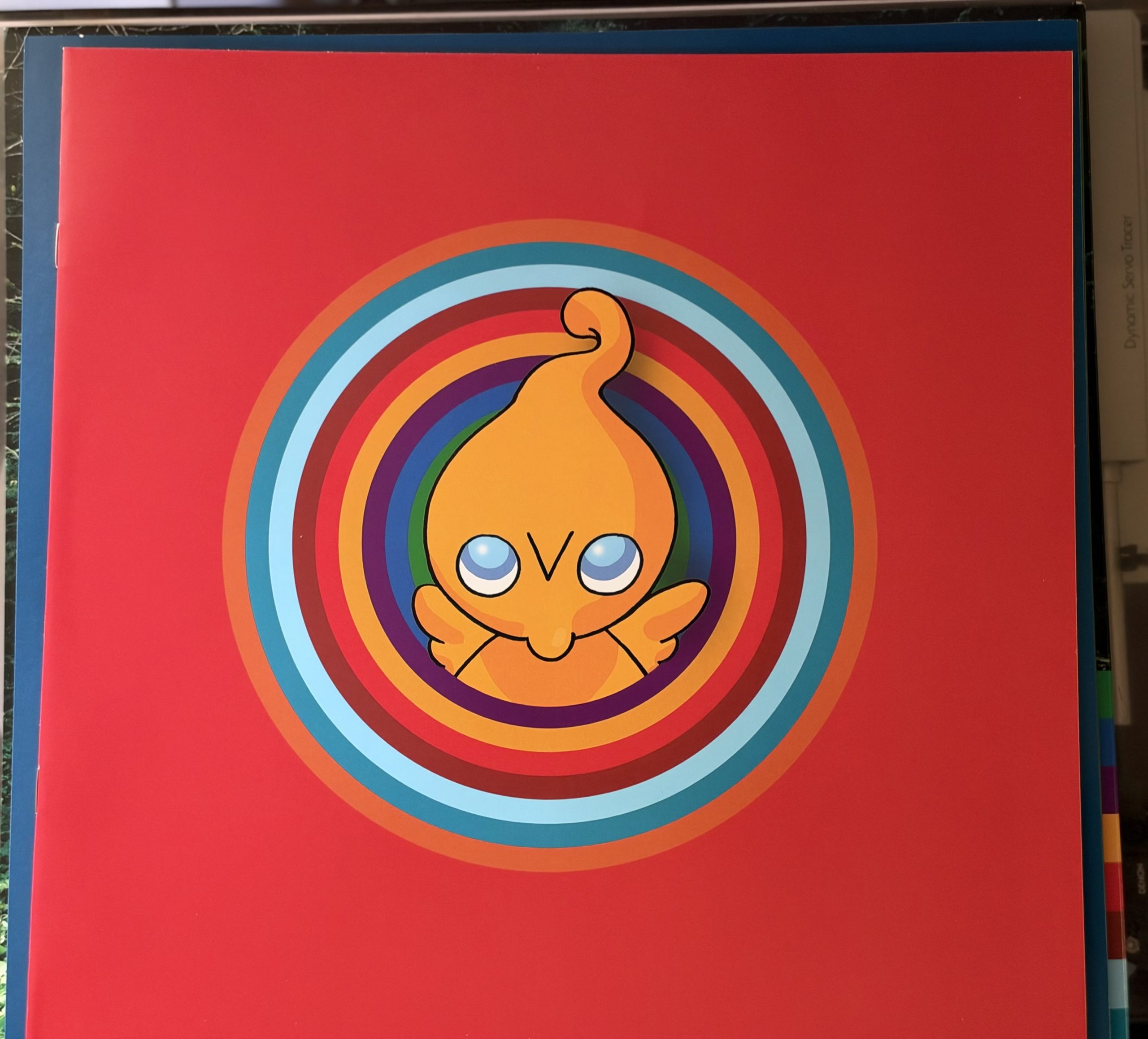
Second, it was a concept album, but a meandering one. The Skypeople live in the trees, while the Earth People were originally agrarian but develop iron technology, creating alienating cities in towers, such as the Tower That Ate People. Sofia of the Earth People nevertheless falls in love with Skyboy of the Skypeople. Sofia’s brother, who built the tower, grows paranoid about the Skypeople and jealous of Skyboy, and imprisons him in the tower. The desperate Skypeople attack the tower and free Skyboy; Sofia’s brother, understanding at last his folly, dies atop the tower, and the Skypeople bring it down, killing Sofia’s mother in the rubble. Sofia, bereft, finally finds Skyboy again and goes with him above the clouds, ultimately bearing his child, a boy named OVO (the caps are in the score); at his birth a tree springs from his grandmother’s grave, rapidly growing into a giant oak. When catastrophic rains come and endanger earth and Skypeople alike, Sofia has a dream that the world is upside down and that one can sail away to safety into the sky. Inspired by the dream, she places OVO in a nest and sends him sailing into the sky to find hope and a safer place. While the story has deeper emotional resonance than Mozo’s radio-born revolution, it’s plenty bonkers.
But last, OVO contains some of Peter’s most personal writing, with some melodies dating back to So, and some truly gorgeous sonic landscapes, even if he doesn’t sing most of it. It’s all delivered in something that’s more musical theater than rock album, complete with recurring themes, big set numbers, and a broad cast of characters.

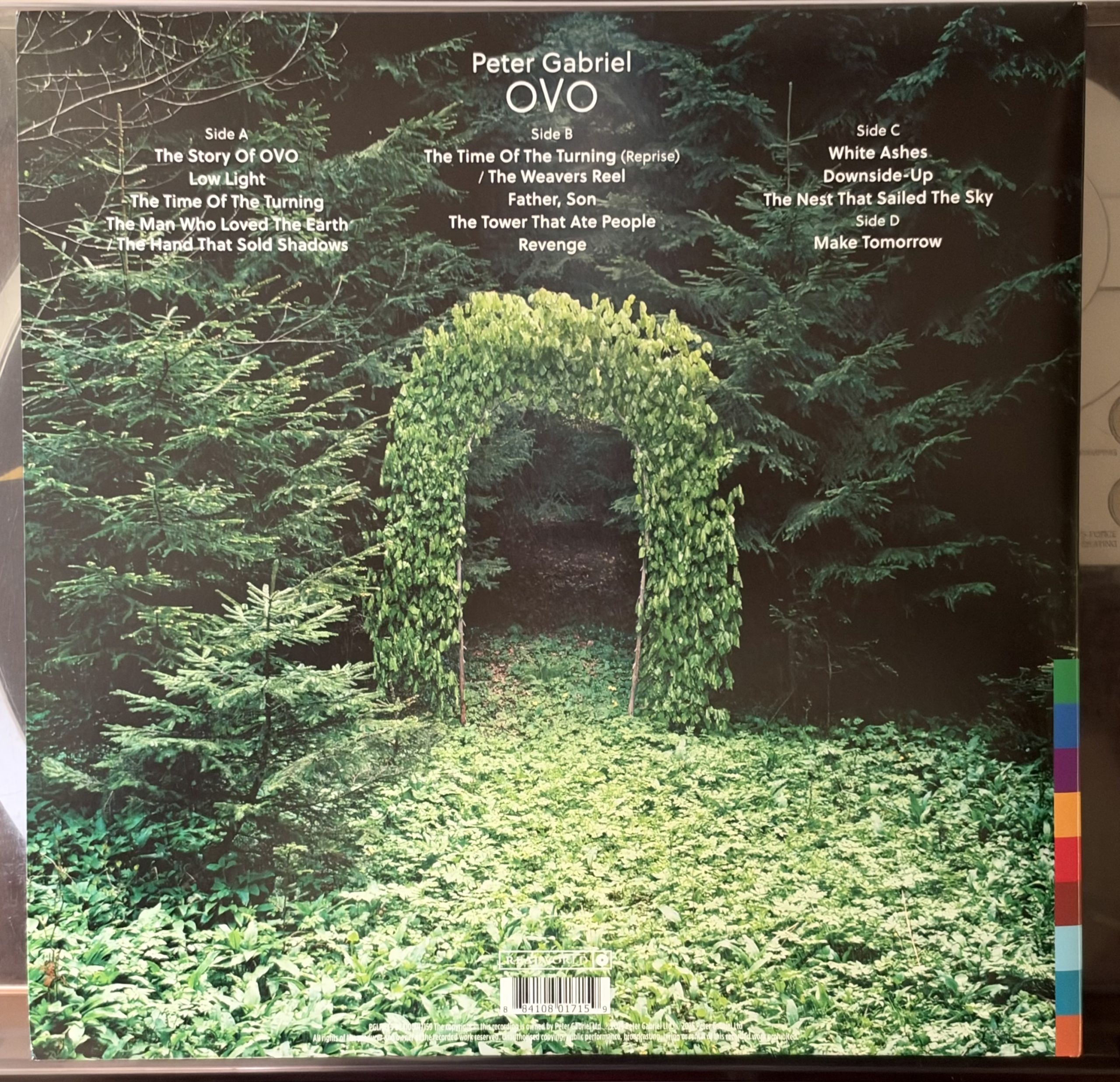
“The Story of OVO” opens with a grimy groove which immediately subverts the listener’s expectation: yes, that’s rap, and yes, that’s Neneh Cherry, alongside American rapper Rasco. Gabriel apparently chose this approach because he wanted to interest a broader range of listeners in the material, and he knew “kids listened to rap.” Hamilton it ain’t, but the track does what it needs to do, which is to move the plot along atop the deepest beats on the album.
We subvert expectations once again with “Low Light,” which immediately turns aside from the groove into an ambient soundscape that wouldn’t have been out of place on Passion but is even deeper and more enveloping. The stunning Irish voice on the latter half of the track belongs to Iarla Ó Lionáird, a sean–nós singer who had released his first solo album on Real World in 1997 and was also a member of the beat-driven Irish and West African crossover ensemble, the Afro Celt Sound System. There are undercurrents throughout the work of musical themes that will appear later in the album, including the “Downside-Up” theme.
“The Time of the Turning” is something else again, an acoustic ballad with vocals by electronica singer Alison Goldfrapp, a few years away from her star turns on the album Black Cherry and the hit single “Ooh La La.” Alongside Goldfrapp is none other than singer-songwriter Richie Havens, voicing the perspective of Sofia’s father and his traditional agrarian ways. But Goldfrapp warns us, “It’s the time of the turning/And we’d better learn to say our goodbyes.”
“The Man Who Loved the Earth/The Hand That Sold Shadows” revisits the groove from the opening track as an instrumental, so you can hear the play of the buzzing didgeridoo against the bass line and thundering drums. The only problem with the arrangement is the odd interjections from the villagers as they build their constructions of iron, which sounds like something in between the didgeridoo and scratching. In the last minute and 30 seconds there’s a hard cut to a more ominous percussive rhythm, driven forward by a hooky, whistling synth and David Rhodes’ monster guitar.
“The Time of the Turning (Reprise)/The Weaver’s Reel” brings Goldfrapp back for one more chorus, accompanied by a brass band, before we abruptly transition into a frantic Celtic dance, anchored by the redoubtable Richard Evans but also by the Dhol Foundation (a South Asian drumming ensemble based in London), Johnny Kalsi and James McNally (members of the Afro Celt Sound System), and a host of Celtic musicians. The net effect is a thesis statement that will be familiar to listeners of Sheila Chandra: that there is a through-line among the music of the Irish, the South Asians, and West African cultures. It’s the adrenaline climax of the album, and it pointed the way to where the Afro Celts and others were heading in blending these musics into something you’d want to dance to.
“Father, Son” is a rare introspective moment, and a rare instance of Gabriel’s vocals on the record. As the industrialist Ion mourns the death of his father, he reflects on their relationship in a piano-driven ballad. It stands completely apart from the rest of the material, and was written earlier. The lyrics, as the two men have an emotional breakthrough while doing yoga together, are both concrete (“spine against spine”) and incredibly moving. Emotionally it feels of a piece with other introspective Gabriel songs like “I Grieve,” which had appeared on the soundtrack to the movie Philadelphia some years prior, and it continued in Gabriel’s set lists for years after; I remember being struck by its impact at Gabriel’s 2001 WOMAD performance in Redmond, Washington.


“The Tower That Ate People” introduces a new theme driven by snarling guitars courtesy of David Rhodes and tight drums from Manu Katché. Gabriel’s vocals here are treated and, in his own words, influenced by Dr. John as he snarls out his paranoia in the role of Ion. The music would fit well alongside earlier songs like “Steam” and some of Gabriel’s forthcoming projects, which we’ll hear more of later.
“Revenge,” as the Skypeople attack the Tower, is a massive drum number with the Dhol Foundation playing alongside programmed drums and a thrumming keyboard line. It’s brief and leads into the grief-filled “White Ashes,” anchored by vocals from Omi Hall as the villagers sort through the rubble of the Tower.

“Downside-Up” opens the third act with one of the most thoroughly realized and dramatic tracks on the album, a duet between the Cocteau Twins’ Elizabeth Fraser and the Blue Nile’s Paul Buchanan. Fraser doesn’t get the opportunity to do much of her trademark vocal acrobatics here, but Skyboy’s part was written for Buchanan’s haunted baritone and he sounds fantastic here. It’s a full-blown PG song, with his full band joined by former Super Étoile de Dakar members Assane Thiam and Babacar Faye—in fact it’s really two PG songs in one, with the gentle “Downside-Up” theme grafted to the more rhythmic “Ovo” theme in the second half as they celebrate the infant’s arrival.
“The Nest That Sailed the Sky” gives us one last instrumental, with the brass band joined by Shankar and a string and synth-driven soundscape for another track that wouldn’t have been out of place on Passion. It leads into the cast finale, “Make Tomorrow,” as we hear from Buchanan, Fraser, Richie Havens and Gabriel in their grief and hope as they send OVO into the sky, and snippets of the “Downside-Up” and “Ovo” themes blend into moments of percussion that recall the more conflict-driven moments of the album. When the percussion and growling didgeridoo re-emerge to underpin the “Make Tomorrow” theme, we get a sort of synthesis moment that gives us hope that all the forces can actually work together, which one suspects was the narrative point.
Gabriel’s grand musical may not have ultimately congealed into a fully coherent statement, but it still stands as a unique point in his repertoire as the only musical theatre in his solo repertoire and his first major concept album since Genesis’ The Lamb Lies Down on Broadway. Gabriel would make more soundtrack albums following this, including The Long Walk Home (soundtrack to The Rabbit-Proof Fence), but he would also finally release more original songs. In fact, simultaneously with OVO he was working on another album, a proper sequel to Us, which would finally be released two years after the ambitious concept. We’ll hear that one next week.
You can listen to this week’s album here:
BONUS: Peter performed some of the music live with the musicians on the project on the promotional circuit. Here he is with Fraser and Buchanan on the Jools Holland show a few weeks before the album was released:
BONUS BONUS: Peter took the material from OVO into live performances through the 2000s, and in his 2010 orchestral project New Blood. Here’s a performance from his “Growing Up” tour, and from the New Blood concert film Taking the Pulse:
BONUS BONUS BONUS: This wouldn’t be Peter’s last collaboration with the Afro Celt Sound System. It was with delighted disbelief that I heard his voice on their song “When You’re Falling” on the air in 2003. Here’s a live version of the song from an unspecified television program: