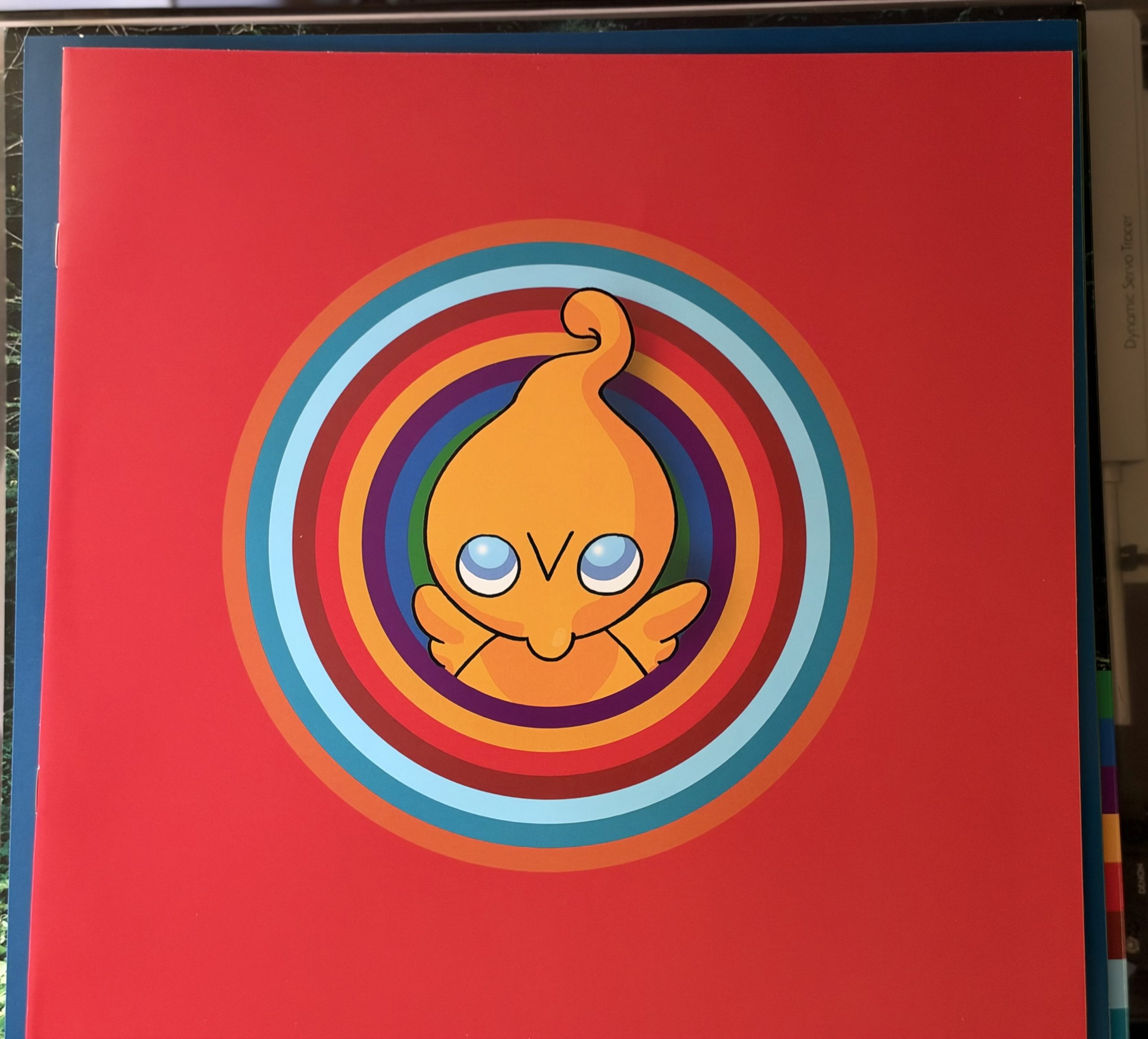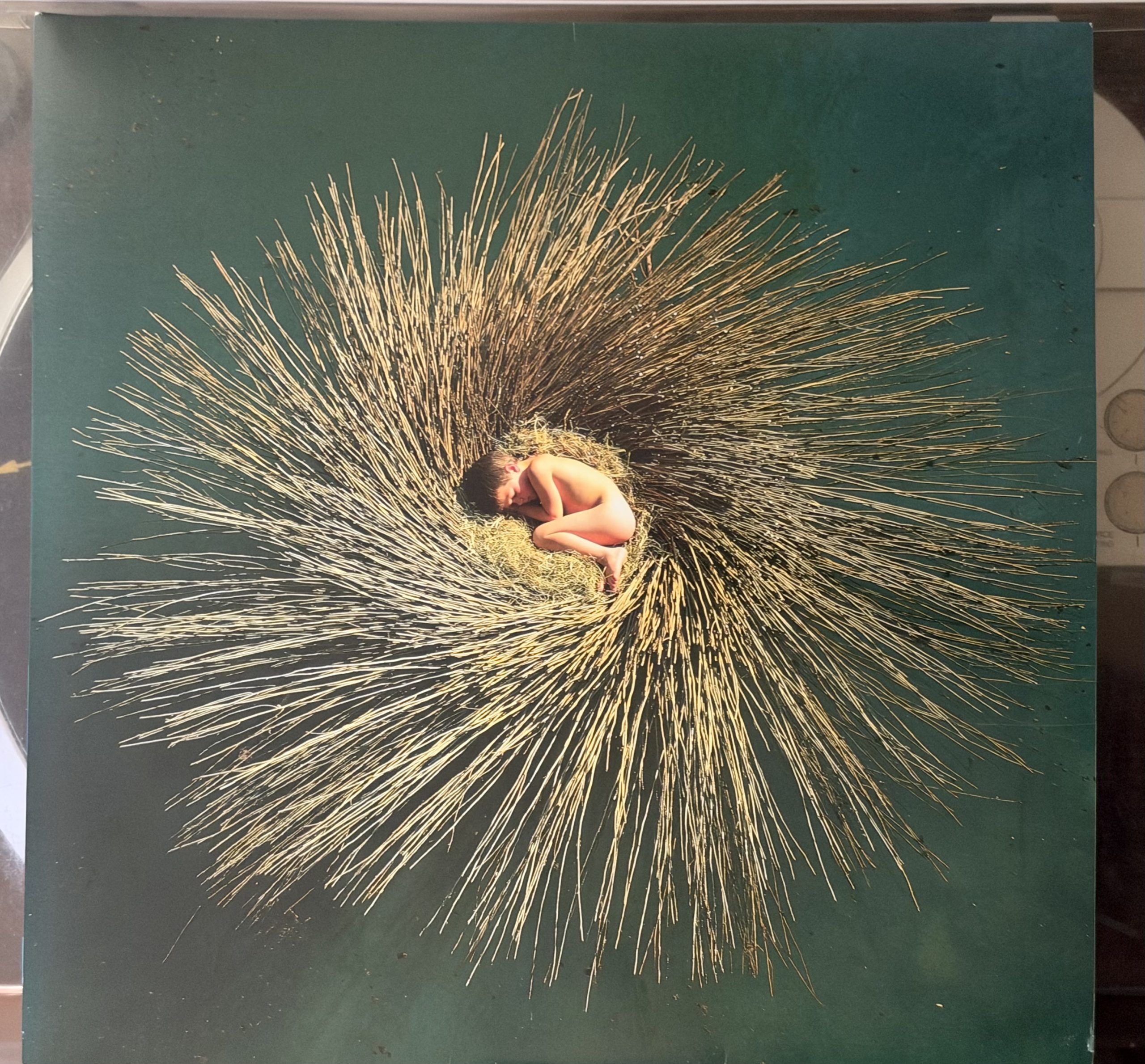
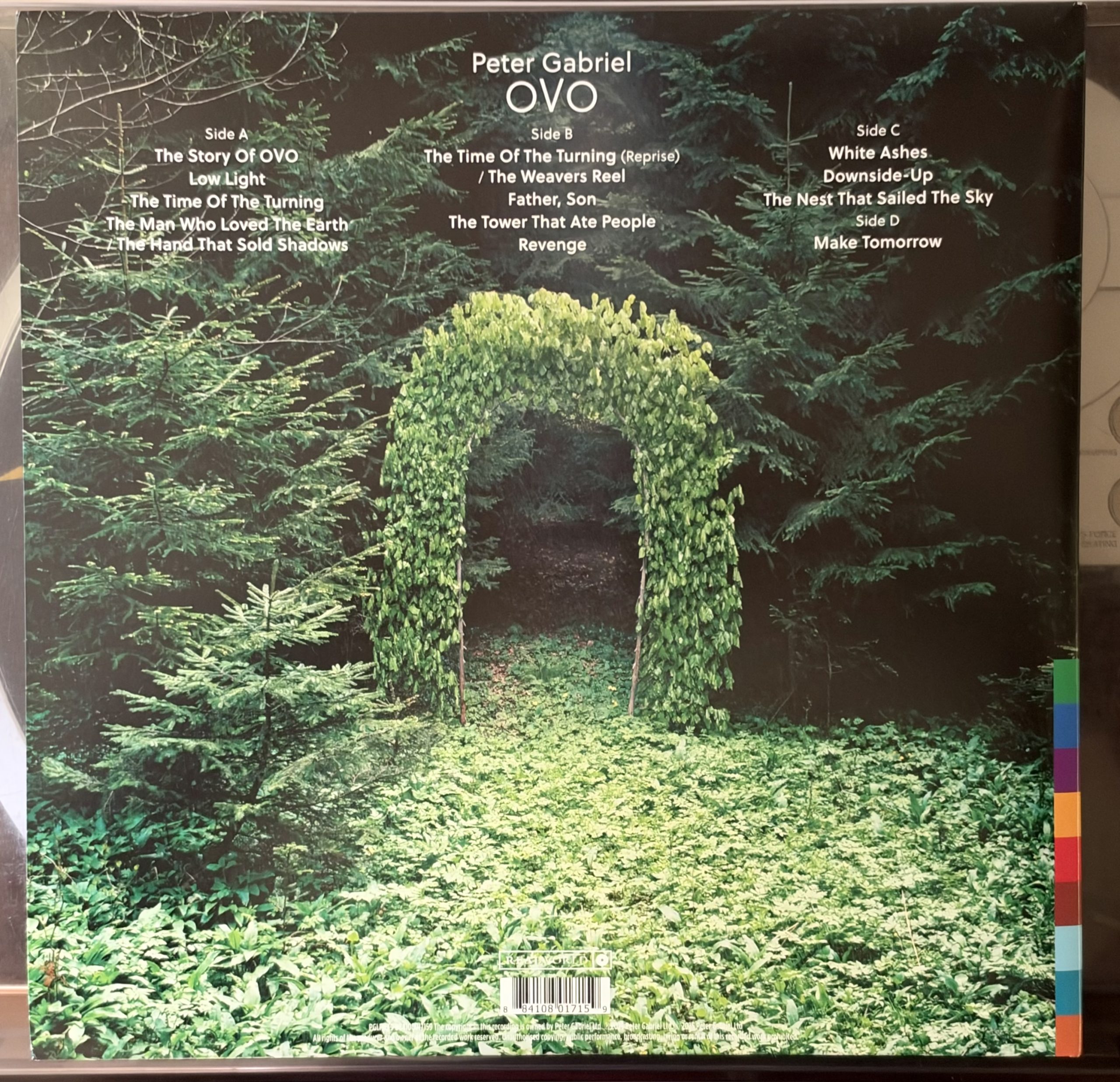
Peter Gabriel, OVO

An unlikely source for the great musician’s most personal song, in a cast album for a musical that had 999 performances in the Millennium Dome.

Album of the Week, October 10, 2026

Even in the moment, in the mid-1990s following the release of Us, it seemed like Peter Gabriel was all over the place while simultaneously being invisible. Interactive computer entertainment via the then-new medium of the CD-ROM? He was there, with XPlora 1: Peter Gabriel’s Secret World (reviews now differ: was it a computer game or an extended advertising campaign? Having played it back in the day, I can say with confidence: it was slow) and Eve. There were talks about a theme park. But new music under his name was slow to appear, until in 2000 an odd album appeared. A soundtrack, but for a live show rather than a movie; a concept album with an impossible-to-describe concept; and a Peter Gabriel album with almost everyone except Peter Gabriel on lead vocals. What, exactly, was OVO?

First of all, it was the soundtrack to the Millennium Dome Show, intended as a massive multimedia event but remembered today mostly as an expensive flop. The show, built inside a massive dome on London’s Greenwich Peninsula near Canary Wharf that now houses the O2 Arena, was meant to commemorate the Millennium and, not coincidentally, to announce to the world that Tony Blair’s New Labour was creating fabulous things in Great Britain. Ultimately the show, which ran for a year, did not draw the crowds the organizers anticipated; though the 6.5 million visitors who saw one of the 999 shows were reportedly happy with the experience, organizers had planned for more than 10 million.

Second, it was a concept album, but a meandering one. The Skypeople live in the trees, while the Earth People were originally agrarian but develop iron technology, creating alienating cities in towers, such as the Tower That Ate People. Sofia of the Earth People nevertheless falls in love with Skyboy of the Skypeople. Sofia’s brother, who built the tower, grows paranoid about the Skypeople and jealous of Skyboy, and imprisons him in the tower. The desperate Skypeople attack the tower and free Skyboy; Sofia’s brother, understanding at last his folly, dies atop the tower, and the Skypeople bring it down, killing Sofia’s mother in the rubble. Sofia, bereft, finally finds Skyboy again and goes with him above the clouds, ultimately bearing his child, a boy named OVO (the caps are in the score); at his birth a tree springs from his grandmother’s grave, rapidly growing into a giant oak. When catastrophic rains come and endanger earth and Skypeople alike, Sofia has a dream that the world is upside down and that one can sail away to safety into the sky. Inspired by the dream, she places OVO in a nest and sends him sailing into the sky to find hope and a safer place. While the story has deeper emotional resonance than Mozo’s radio-born revolution, it’s plenty bonkers.

But last, OVO contains some of Peter’s most personal writing, with some melodies dating back to So, and some truly gorgeous sonic landscapes, even if he doesn’t sing most of it. It’s all delivered in something that’s more musical theater than rock album, complete with recurring themes, big set numbers, and a broad cast of characters.

“The Story of OVO” opens with a grimy groove which immediately subverts the listener’s expectation: yes, that’s rap, and yes, that’s Neneh Cherry, alongside American rapper Rasco. Gabriel apparently chose this approach because he wanted to interest a broader range of listeners in the material, and he knew “kids listened to rap.” Hamilton it ain’t, but the track does what it needs to do, which is to move the plot along atop the deepest beats on the album.

We subvert expectations once again with “Low Light,” which immediately turns aside from the groove into an ambient soundscape that wouldn’t have been out of place on Passion but is even deeper and more enveloping. The stunning Irish voice on the latter half of the track belongs to Iarla Ó Lionáird, a sean–nós singer who had released his first solo album on Real World in 1997 and was also a member of the beat-driven Irish and West African crossover ensemble, the Afro Celt Sound System. There are undercurrents throughout the work of musical themes that will appear later in the album, including the “Downside-Up” theme.

“The Time of the Turning” is something else again, an acoustic ballad with vocals by electronica singer Alison Goldfrapp, a few years away from her star turns on the album Black Cherry and the hit single “Ooh La La.” Alongside Goldfrapp is none other than singer-songwriter Richie Havens, voicing the perspective of Sofia’s father and his traditional agrarian ways. But Goldfrapp warns us, “It’s the time of the turning/And we’d better learn to say our goodbyes.”

“The Man Who Loved the Earth/The Hand That Sold Shadows” revisits the groove from the opening track as an instrumental, so you can hear the play of the buzzing didgeridoo against the bass line and thundering drums. The only problem with the arrangement is the odd interjections from the villagers as they build their constructions of iron, which sounds like something in between the didgeridoo and scratching. In the last minute and 30 seconds there’s a hard cut to a more ominous percussive rhythm, driven forward by a hooky, whistling synth and David Rhodes’ monster guitar.

“The Time of the Turning (Reprise)/The Weaver’s Reel” brings Goldfrapp back for one more chorus, accompanied by a brass band, before we abruptly transition into a frantic Celtic dance, anchored by the redoubtable Richard Evans but also by the Dhol Foundation (a South Asian drumming ensemble based in London), Johnny Kalsi and James McNally (members of the Afro Celt Sound System), and a host of Celtic musicians. The net effect is a thesis statement that will be familiar to listeners of Sheila Chandra: that there is a through-line among the music of the Irish, the South Asians, and West African cultures. It’s the adrenaline climax of the album, and it pointed the way to where the Afro Celts and others were heading in blending these musics into something you’d want to dance to.

“Father, Son” is a rare introspective moment, and a rare instance of Gabriel’s vocals on the record. As the industrialist Ion mourns the death of his father, he reflects on their relationship in a piano-driven ballad. It stands completely apart from the rest of the material, and was written earlier. The lyrics, as the two men have an emotional breakthrough while doing yoga together, are both concrete (“spine against spine”) and incredibly moving. Emotionally it feels of a piece with other introspective Gabriel songs like “I Grieve,” which had appeared on the soundtrack to the movie City of Angels some years prior, and it continued in Gabriel’s set lists for years after; I remember being struck by its impact at Gabriel’s 2001 WOMAD performance in Redmond, Washington.

“The Tower That Ate People” introduces a new theme driven by snarling guitars courtesy of David Rhodes and tight drums from Manu Katché. Gabriel’s vocals here are treated and, in his own words, influenced by Dr. John as he snarls out his paranoia in the role of Ion. The music would fit well alongside earlier songs like “Steam” and some of Gabriel’s forthcoming projects, which we’ll hear more of later.

“Revenge,” as the Skypeople attack the Tower, is a massive drum number with the Dhol Foundation playing alongside programmed drums and a thrumming keyboard line. It’s brief and leads into the grief-filled “White Ashes,” anchored by vocals from Omi Hall as the villagers sort through the rubble of the Tower.

“Downside-Up” opens the third act with one of the most thoroughly realized and dramatic tracks on the album, a duet between the Cocteau Twins’ Elizabeth Fraser and the Blue Nile’s Paul Buchanan. Fraser doesn’t get the opportunity to do much of her trademark vocal acrobatics here, but Skyboy’s part was written for Buchanan’s haunted baritone and he sounds fantastic here. It’s a full-blown PG song, with his full band joined by former Super Étoile de Dakar members Assane Thiam and Babacar Faye—in fact it’s really two PG songs in one, with the gentle “Downside-Up” theme grafted to the more rhythmic “Ovo” theme in the second half as they celebrate the infant’s arrival.

“The Nest That Sailed the Sky” gives us one last instrumental, with the brass band joined by Shankar and a string and synth-driven soundscape for another track that wouldn’t have been out of place on Passion. It leads into the cast finale, “Make Tomorrow,” as we hear from Buchanan, Fraser, Richie Havens and Gabriel in their grief and hope as they send OVO into the sky, and snippets of the “Downside-Up” and “Ovo” themes blend into moments of percussion that recall the more conflict-driven moments of the album. When the percussion and growling didgeridoo re-emerge to underpin the “Make Tomorrow” theme, we get a sort of synthesis moment that gives us hope that all the forces can actually work together, which one suspects was the narrative point.
Gabriel’s grand musical may not have ultimately congealed into a fully coherent statement, but it still stands as a unique point in his repertoire as the only musical theatre in his solo repertoire and his first major concept album since Genesis’ The Lamb Lies Down on Broadway. Gabriel would make more soundtrack albums following this, including The Long Walk Home (soundtrack to The Rabbit-Proof Fence), but he would also finally release more original songs. In fact, simultaneously with OVO he was working on another album, a proper sequel to Us, which would finally be released two years after the ambitious concept. We’ll hear that one next week.

You can listen to this week’s album here:

BONUS: Peter performed some of the music live with the musicians on the project on the promotional circuit. Here he is with Fraser and Buchanan on the Jools Holland show a few weeks before the album was released:

BONUS BONUS: Peter took the material from OVO into live performances through the 2000s, and in his 2010 orchestral project New Blood. Here’s a performance from his “Growing Up” tour, and from the New Blood concert film Taking the Pulse:

BONUS BONUS BONUS: This wouldn’t be Peter’s last collaboration with the Afro Celt Sound System. It was with delighted disbelief that I heard his voice on their song “When You’re Falling” on the air in 2003. Here’s a live version of the song from an unspecified television program:

Exfiltration Radio: say what you mean

Wolf Alice.

With great Veracode hackathons come more Exfiltration Radio episodes. This time around, I have a playlist of indie/alternative/etc. rock with female voices that I’ve been building for a few years. Only I didn’t realize it.

The original version of this playlist had basically the same intro as the final version but segued into a hip-hop and funk set halfway through. While it made sense from a musical and beat perspective, something bugged me about it, and that something revealed itself over the past few weeks as the half-forgotten memory of an observation my sister made about some of my mixes twenty years ago: that they were heavy on dudes with guitars, or dudes, period.

I’d say the rethinking of this playlist was worth it, as it made me listen more closely to what the songs had to say. And they aren’t shy. Let’s begin with Caroline Polachek. In her 2020 solo spot on KEXP, she comes across as thoughtful, deep, a little shy. There’s all of that in “Welcome to My Island,” but there’s also a huge self-confidence on display, along with a magnificent set of pipes and what she has called “brattiness,” a.k.a. a well-earned swagger.

I have been listening to Dum Dum Girls for almost ten years—long enough for lead singer Dee Dee (née Kristin Gundred) to release her solo debut in the meantime. I came on board with the Too True album, and it’s a piece of work. It reminds me of William Gibson’s description of AIs battling AIs in Neuromancer, in a passage that seems prescient now: “He … swung the program in a wide circle, seeing the black shark thing through her eyes, a silent ghost hungry against the banks of lowering cloud.” Which is to say, the song is sleek, fast-moving, and ready to take precious things from the unwary.

“Headspins” has been in my playlists for almost as long. Forming in 2012 and breaking up in 2018, the band (formed in London by Australian ex-pats) does a fine job of updating the sound of the Breeders and bringing them into the 21st century.

If you haven’t heard “Chaise Longue” by Wet Leg, you’re welcome. If you’ve heard it a million times, this is your opportunity to revel again in the slyly dadaesque innuendo of the verses, as well as the sheer joy of the guitar work.

It took me a while to get into the latest St. Vincent, a deeply personal work about her father’s release from prison, partly because of her artistic choice to lean into a 1970s-inspired set of styles throughout the record. But there’s nothing wrong about the funk that drives “Pay Your Way in Pain,” to say nothing of the deep discomfort just below the surface of the lyrics.

“So Unreal” is the oldest track on the mix. Post-punk has been a reliable well of inspiration for me, albeit one that gives me no small amount of impostor syndrome. After all, I was alive and listening to music when the Creatures formed their splinter group off of Siouxsie and the Banshees, but wasn’t nearly hip enough to know they existed.

Originally, “Kyoto” was the pivot point of this mix, and a different version of it followed up Phoebe Bridgers’ meditation on jet lag and alienation set to a brass section straight out of an old Beulah record with Thundercat’s “Tokyo” and a general pivot into 21st century funk and electronica. But I decided against taking what was, for me, the easy path; hopefully you’re as glad as I am.

“Silk” has been on this mix since it came up on a random shuffle through my music while I was blowing snow one bright winter day. I dearly love Wolf Alice on the basis of this early album and am almost afraid to listen future iterations of their sound. I might have said the same of Neneh Cherry, having been a huge fan of her first few albums but not closely following her since then. Broken Politics is a pretty darned impressive follow-up, albeit one more closely related to the remixes of “Move With Me” than to the funk of “Buffalo Stance,” and “Black Monday” is a pretty spectacular representation of the album’s pleasures.

Soccer Mommy (aka Sophia Allison) made one of the quintessential albums of the early pandemic years with Color Theory, and a slightly brighter version of the same introspective sound is in her latest release. By contrast, Liz Phair’s Soberish appears to have come and gone without an impact, which is a shame as I think the songwriting on it is as strong as anything since Whitechocolatespaceegg.

And then there’s Sales, whose “Pope is a Rockstar” probably would have languished in limbo were it not for TikTok, where mondegreen readings of the title as “go little rockstar” made the song go viral. But on its own it’s a woozy hybrid between indie pop and, maybe, surf rock? There’s something in those guitars, is what I’m saying.

I fell in love with Laura Marling a few years ago, on her album Once I Was an Eagle, which featured prominently on my 2013 mix “Something Other Than Regret.” Her most recent album, Song for Our Daughter, takes the stark template of that sound and layers on Laurel Canyon harmonies that go on for days, especially on this track.

Lavender Diamond, aka Becky Stark, is another artist who appeared on that 2013 mix, and promptly disappeared until their 2020 album Now is the Time. All the hallmarks of the sound are there — the high vocals, the chord progressions out of an evolved version of the American Songbook — but where their 2012 album Incorruptible Heart dwelt in heartbreak, the new album seems to seek out hope behind horror.

One of the newest tracks on the album, boygenius’s “$20” from their debut LP The Record is a sublime and angry tune about the desperate need to escape the ordinary, with layered and shifting vocals from Bridgers, Lucy Dacus and Julien Baker. It’s stunning. The following tune, from the final Low album before Mimi Parker’s tragic death from cancer last year, underscores and reinforces all the themes with its own harmonies, but the anger is replaced with resignation and sadness. “Always looking for that one sure thing/Oh, you wanted so desperately.”

The final track is something of a lost gem: the final cut from the debut album of Eggplant, released in 1996. While most of the songs on the London trio’s indie rock driven album nod to punk with short run times and brisk beats, the final song, “We Only Wanted to Be Loved,” is a heartbreaker of a ballad. The trio deserved better than the oblivion their records found on initial release; here’s hoping they get a good afterlife via the Bandcamp rerelease of their music.

I hope this show brings you some sounds you haven’t heard before and makes you think—or move your booty, or both. The full track list is below:

  1. Welcome To My Island – Caroline Polachek (Desire, I Want To Turn Into You)
  2. Rimbaud Eyes – Dum Dum Girls (Too True)
  3. Headspins – Splashh (Comfort)
  4. Chaise Longue – Wet Leg (Wet Leg)
  5. Pay Your Way In Pain – st. vincent (Daddy’s Home)
  6. So Unreal – The Creatures (A Bestiary of (Spectrum))
  7. Kyoto – Phoebe Bridgers (Punisher)
  8. Silk – Wolf Alice (My Love Is Cool)
  9. Black Monday – Neneh Cherry (Broken Politics)
  10. Feel It All The Time – soccer mommy (Sometimes, Forever)
  11. In There – Liz Phair (Soberish)
  12. Pope Is a Rockstar – SALES (Sales Lp)
  13. Held Down – Laura Marling (Song For Our Daughter)
  14. This Is How We Rise – Lavender Diamond (Now Is The Time)
  15. $20 – boygenius (the record)
  16. Days Like These – Low (HEY WHAT)
  17. We Only Wanted To Be Loved – EGGPLANT (Catboy/Catgirl)

We have taken control, and we will return it to you as soon as you are exfiltrated.

Old mix: We have no heads

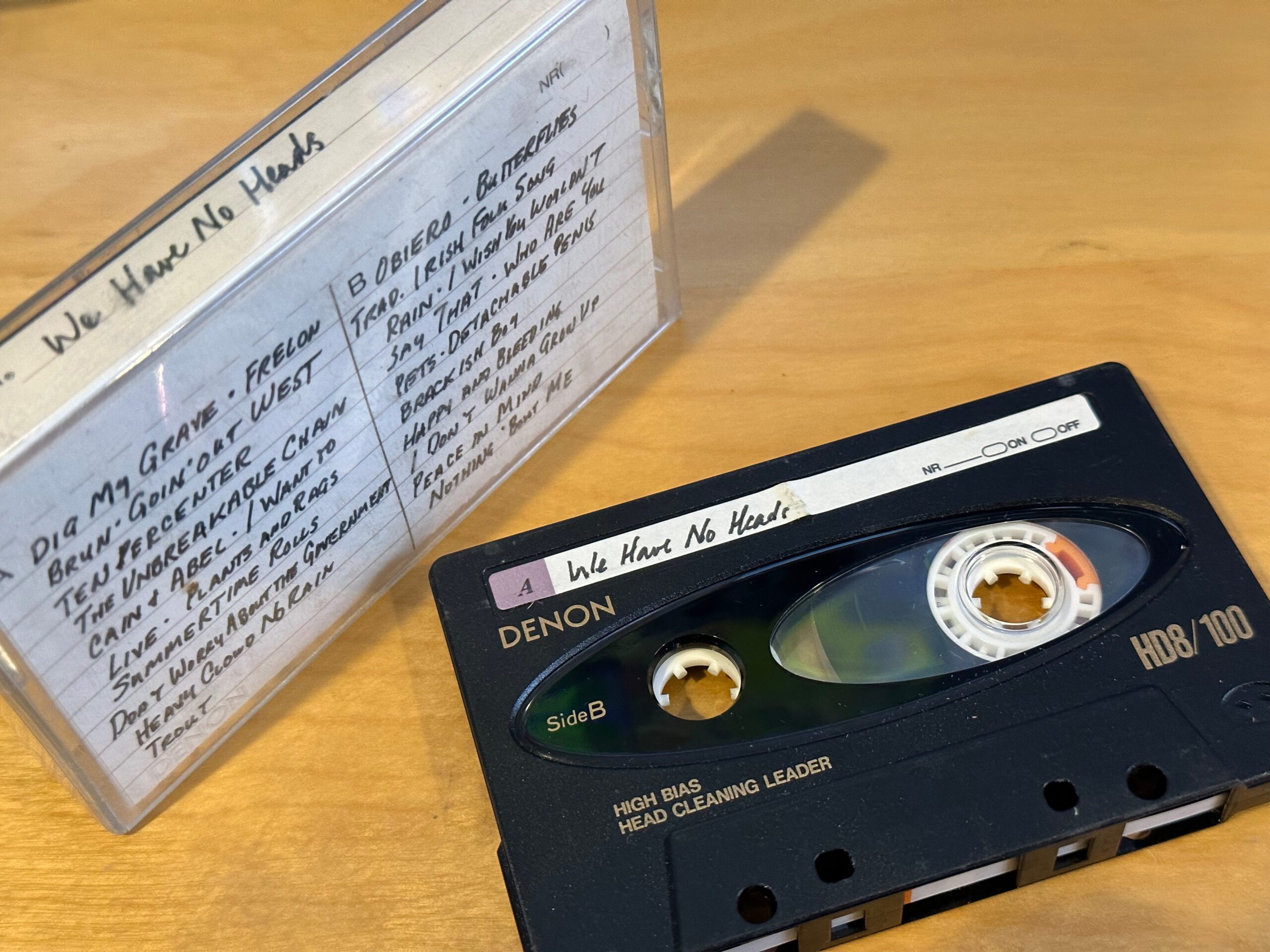
Sometimes my early mixes are what might charitably be described as “all over the place.” (Heck, sometimes my late mixes are too.) This one, which was assembled sometime around May of 1993, definitely fits that description.

There comes a time in every young music head’s life when they discover Tom Waits. For me, that was clearly happening right about the time this mix was made. It was fortuitous that Apollo 18 by They Might Be Giants had come out about six months previously, as the frenetic energy of the opening track plays nicely with “Goin’ Out West.” (Side note: because I bought a lot of my CDs through music clubs at this stage in my life, I was almost always late to the party when a new album was released. If I recall correctly, it could be a few months before a new release was available in the mail order catalog. —And yes, mail order catalog, because this was right before the Internet began to eat that business model.)

Between those two tracks is “Frelon Brun,” from Filles de Kilimanjaro. I had just picked up this CD, having fallen in love with the title track, which appeared on Miles’ The Columbia Years anthology (another box set I snagged at a discount). “Frelon Brun” is probably the most rock-oriented of the performances on that album; for one, it’s the only track that is under 6 minutes long. It’s funky and powerful and fun. On this album it punctuates the ferocious energy of the tracks on either side.

Side 2 opens with Ayub Ogada’s “Obiero,” a track that appears in slightly different forms on both his own En Mana Kuoyo and Peter Gabriel’s Plus from Us anthology; it’s the latter that appears here (and coincidentally helps to date the mix, since Plus from Us was released on May 16, 1993). That’s followed by “Rain” by An Emotional Fish, which was on the Spew 2 promotional compilation (which I’ve since lost), alongside King Missile’s dryly hilarious “Detachable Penis” (which also appears on this mixtape). And then comes “Traditional Irish Folk Song,” from Denis Leary’s comedy album No Cure for Cancer. Like I said, charitably described as all over the place.

This mixtape also memorializes the beginning of my interest in PJ Harvey, having picked up Dry based on word of mouth from the crew in the basement of Peabody Hall, i.e. the publications staffs of the Declaration and The Yellow Journal. I was still digesting the Talking Heads, having picked up the Sand in the Vaseline compilation earlier that year. And, having bought Neneh Cherry’s great Homebrew on a whim earlier that spring, I discovered the seductive pleasures of “Peace in Mind” by blasting the album out my Monroe Hill window one Sunday afternoon as we played an impromptu volleyball game.

  1. Dig My Grave – They Might Be Giants (Apollo 18)
  2. Frelon Brun (Brown Hornet) – Miles Davis (Filles De Kilimanjaro)
  3. Goin’ Out West – Tom Waits (Bone Machine)
  4. Ten Percenter – Frank Black (Frank Black)
  5. The Unbreakable Chain – Daniel Lanois (For The Beauty Of Wynona)
  6. Cain & Abel – Branford Marsalis Trio (The Beautyful Ones Are Not Yet Born)
  7. I Want To Live – Talking Heads (Sand In The Vaseline Popular Favorites 1976-1992)
  8. Plants And Rags – PJ Harvey (Dry)
  9. Summertime Rolls – Jane’s Addiction (Nothing’s Shocking)
  10. Don’t Worry About the Government – Talking Heads (Talking Heads: 77)
  11. Heavy Cloud No Rain – Sting (Ten Summoner’s Tales)
  12. Trout – Neneh Cherry (Homebrew)
  13. Obiero – Ayub Ogada (Plus From Us)
  14. Butterflies – Toad the Wet Sprocket (Fear)
  15. Traditional Irish Folk Song – Denis Leary (No Cure For Cancer)
  16. Rain – An Emotional Fish (Junk Puppets)
  17. I Wish You Wouldn’t Say That – Talking Heads (Talking Heads: 77)
  18. Who Are You – Tom Waits (Bone Machine)
  19. Pets – Porno For Pyros (Porno for Pyros)
  20. Detachable Penis – King Missile (Happy Hour)
  21. Brackish Boy – Frank Black (Frank Black)
  22. Happy And Bleeding – PJ Harvey (Dry)
  23. I Don’t Wanna Grow Up – Tom Waits (Bone Machine)
  24. Peace In Mind – Neneh Cherry (Homebrew)
  25. Epilogue (Nothing ‘Bout Me) – Sting (Ten Summoner’s Tales)

You can listen to (most of) the mix via Apple Music here: