
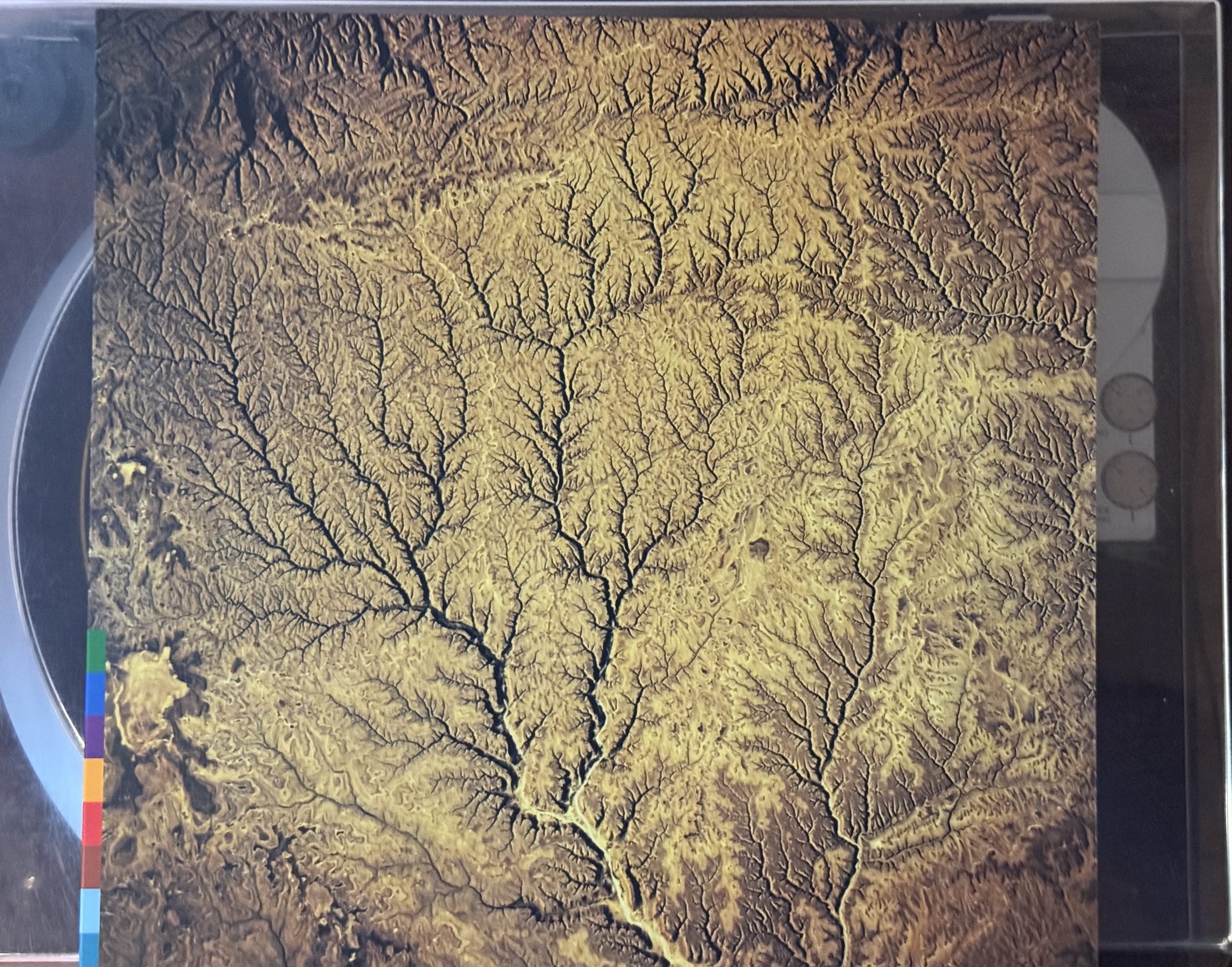
Album of the Week, June 27, 2026
In the late 1980s, there was an upwelling of interest in world music. We had Paul Simon working with South African musicians on Graceland, Sting incorporating Latin sounds on …Nothing Like the Sun, Talking Heads incorporating Brazilian rhythms and sounds on Naked (followed by an even more direct partnership by frontman David Byrne on his first solo album, Rei Momo), and of course Peter Gabriel working with the likes of Youssou N’Dour and others on So and Passion. For some onlookers it started to have the whiff of exploitation; I distinctly remember a 1990 article in one of the college papers I wrote for that called out the musicians above as “carpetbaggers,” stealing world sounds for pop.
But as we’ve seen, for Peter Gabriel at least the connection to world rhythms and sounds went back further—as far back as 1982, at least, where on the strength of his song “Biko” he started the WOMAD festival to bring these artists to the public, and featured musicians like the Ekome Dance Company, L. Shankar, Manu Katché, and of course Youssou and Nusrat Fateh Ali Khan. He also, notably, launched Passion as the first record on his Real World label and gave many of these musicians record deals that allowed them to get their music in front of Western audiences. And he put out a label sampler, of a sort, in the form of Passion – Sources, a compilation album that gave space for both the musicians who had collaborated live in the studio on the making of Passion, and for some of the archival tracks that served as the foundation for the sonic explorations on the soundtrack.

We’ve written extensively about Nusrat Fateh Ali Khan’s “Shamas-Ud-Doha Bader-Ud-Doja,” from his first Real World album Shahen-Shah; it opens this compilation in edited form, running just a touch over five minutes and fading out in the middle reprise of the verse. It leads into “Call to Prayer,” by Baaba Maal. Like Youssou N’Dour, Maal, who appeared on the Passion track “Of These, Hope (Reprise),” is an incredible vocalist from Senegal; unlike N’Dour, he is a griot, deeply steeped in the traditions of the Pulaar people, who were among the earliest African peoples to embrace Islam. Here he performs a traditional call to prayer as improvised over accompaniment from Lakshminarayana (L.) Shankar and a low drone; the work appeared in the movie The Last Temptation of Christ during its depiction of the Last Supper.
Shankar performs the next track, “Sankarabaranam Pancha Nadai Pallavi,” with his group the Epidemics, consisting of Zakir Hussain on tabla, Viku Vinayakram on ghatam, and British composer and musician Caroline Morgan on tanbura. Here, as in most of his 1980s work, Shankar plays the double violin, also known as the LSD (L. Shankar Double Violin), an electric string instrument of his own design that covers a wide chromatic range. The music here is a traditional southern Indian Carnatic raga.
Turkish master of the ney flute Kudsi Erguner performs the track “Ulvi,” a brief solo work in the Mevlevi Sufi tradition. If you suspect, based on the brief excerpt here, that a longer selection of ney music would be both hypnotic and slightly soporific, you would be correct, at least judging from the excellent German CD of his work I found in college. But this track is delightful and mysterious to listen to, and about as understated an expression of Sufi spirituality as Nusrat’s qawwali is extroverted.
Master Egyptian percussionist Hossam Ramzy multitracks the tabla, dufi, doholla, and tambourine on “Fallahi,” alongside the mazhar tambourine played by Joseph Alexander, building a tight polyrhythmic pattern that is both dance-worthy and trance-inducing. This is followed by two excerpts from earlier compilations, a “Sabahiya” or traditional morning nuptial serenade from an anthology, The Folk Music of Egypt, produced by Tiberiu Alexandra and credited to “Banga (Tanta-Suaag),” and a dervishlike “Tejbeit” by unknown Egyptian musicians, taken from an Ocora Records compilation with overdubbed percussion by Hossam Ramzy and tin whistle by Richard Evans. Here you can feel the slightly frantic atmosphere of the bar in which the original was recorded.
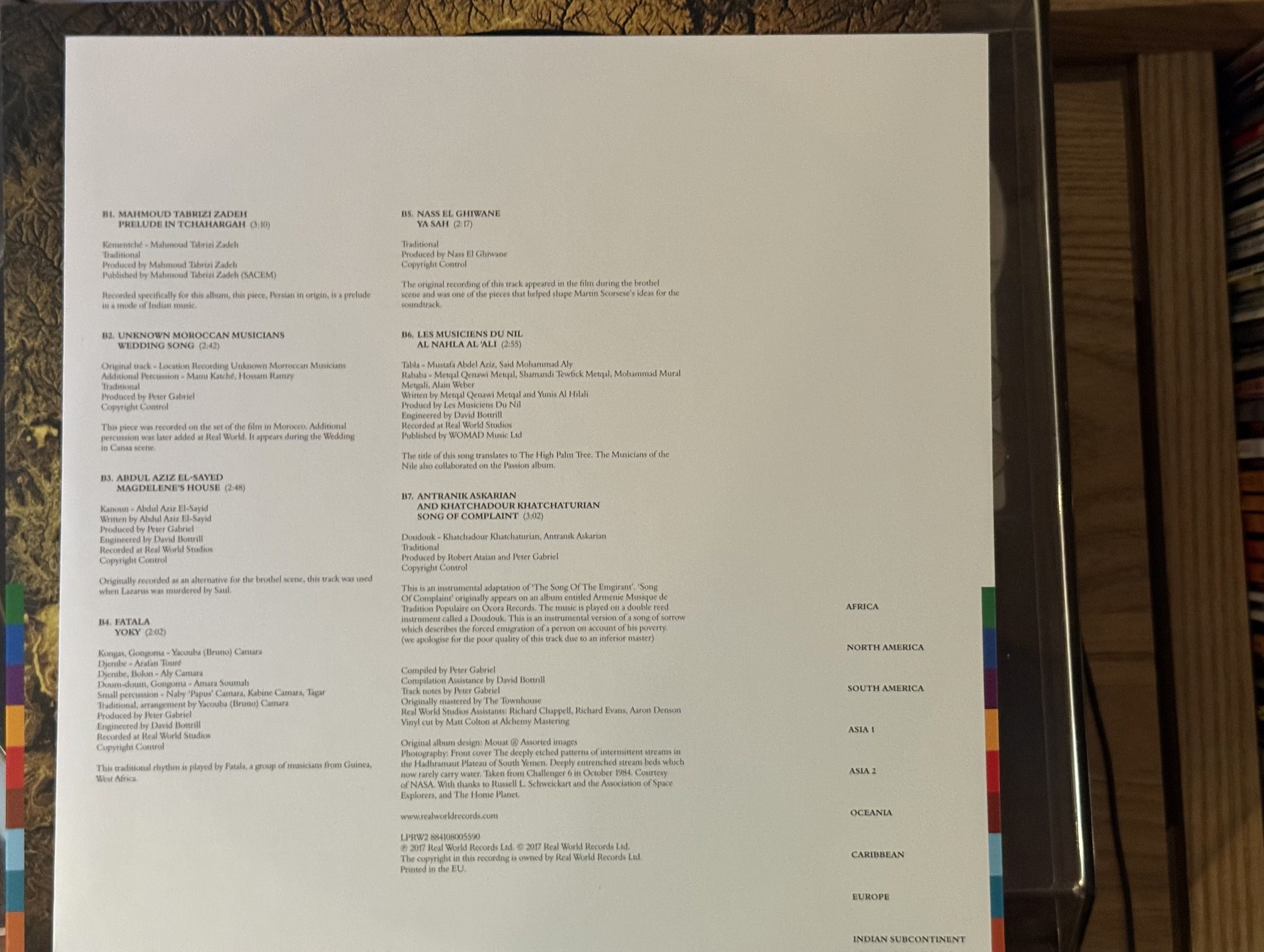
“Prelude in Tchahargah,” recorded by Mahmoud Tabrizi Zadeh on the kementché with tabla accompaniment, is a traditional Persian piece that displays some of the underlying affinities between Persian and Indian music. There’s very much a hybrid of dance and spiritual focus here, particularly in the unaccompanied improvisation that ends the work.
“Wedding Song” is a location recording of unknown Moroccan musicians from the set of the film, with percussion added by Ramzy and Manu Katché, that soundtracks the film’s recreation of the Wedding at Cana. It’s appropriately celebratory and hypnotic, with a repeated ten-bar call and response phrase.
“Magdalene’s House” gives us a listen to a musician whose work did not appear on Passion but did appear on the soundtrack of the movie. Abdul Aziz El-Sayed plays unaccompanied kanoun, a large zither-like instrument that allows the player to sound microtones. Here he plays flourishes and rapid runs in octaves along a modal scale, mostly sticking to a recognizable western mode but here and there throwing in some unusual tones for emphasis. The effect is spellbinding; one regrets the track’s short length, as it seems to end just as he finds a theme that could have made a magnificent Bach fugue.
An all-percussion track from the Guinean drum and dance troupe Fatala, “Yoky,” follows. Led by Yacouba (Bruno) Camara on congas and the gongoma drum (made from saw blades attached to a calabash gourd), the ensemble adds a pair of djembes and more gongoma for a hypnotic polyrhythm. Sadly, the ensemble only seems to have recorded one full album, a self-titled release in 1988.
“Ya Sah” is a trancelike number from Moroccan ensemble Nass El Ghiwane, which uses a Western banjo to produce an unusually disorienting cross-cultural effect — just as you think you’re in a foreign place entirely, suddenly the ring of the banjo places the sound squarely in an Appalachian string band tradition. Another number that doesn’t appear in Passion but does appear in the soundtrack, Gabriel says that its sound, which appears in a brothel scene in the movie, was one of the influences on his and Scorcese’s decision about the sound world of the movie.
Les Musiciens du Nil, who appeared on the Passion album in the track “Wall of Breath,” here play a more traditional Egyptian sound on “Al Nahla Al’Ali,” which features percussion and microtonal melodies in a rondo-like dance form that gradually accelerates into a crescendo then slows to a coda, leading to the slow “Song of Complaint” which is played on the Armenian doudouk by Antranik Askarian and Khatchadour Khatchaturian. Askarian appeared on the original recording on the Ocora Records label that was sampled for the opening track of Passion, “The Feeling Begins.” Without the massive drum hit, the traditional Armenian tune is a meditative reverie that completes the transition to another sound world.

As a “thank you” to the musicians whose work was incorporated into the Passion soundtrack, Passion – Sources can be read as a magnificent gesture. That it also functions as a sort of sampler for the mission of Gabriel’s new Real World label, opening ears to new sounds and new artists, is an intended second mission. As a seventeen-year-old listener newly moving beyond the relatively constrained sound worlds of my upbringing, it was revelatory. We’ll continue to explore the sounds of the world through the lens of Real World in the future. But over the next few weeks we’ll check in on some of Peter’s other collaborators as they make music through the end of the 1980s.
You can listen to this week’s album here:
BONUS: Here’s a live performance, with vocals, from Les Musiciens du Nil which gives you an idea of the traditional instrumentation used.
BONUS BONUS: Here’s a 1983 broadcast of Nass El Ghiwane in concert in Paris, playing for a very enthusiastic dancing crowd.
BONUS BONUS BONUS: Baaba Maal has had a long and fruitful career. Here’s his band from an astonishing 2024 performance that combines traditional and modern instrumentation to bring the crowd into a rhythmic trance:
BONUS x4: Kudsi Erguner has also had a long and vital career. Here’s a performance from 2013 that showcases the hypnotic power of the ney flute: