
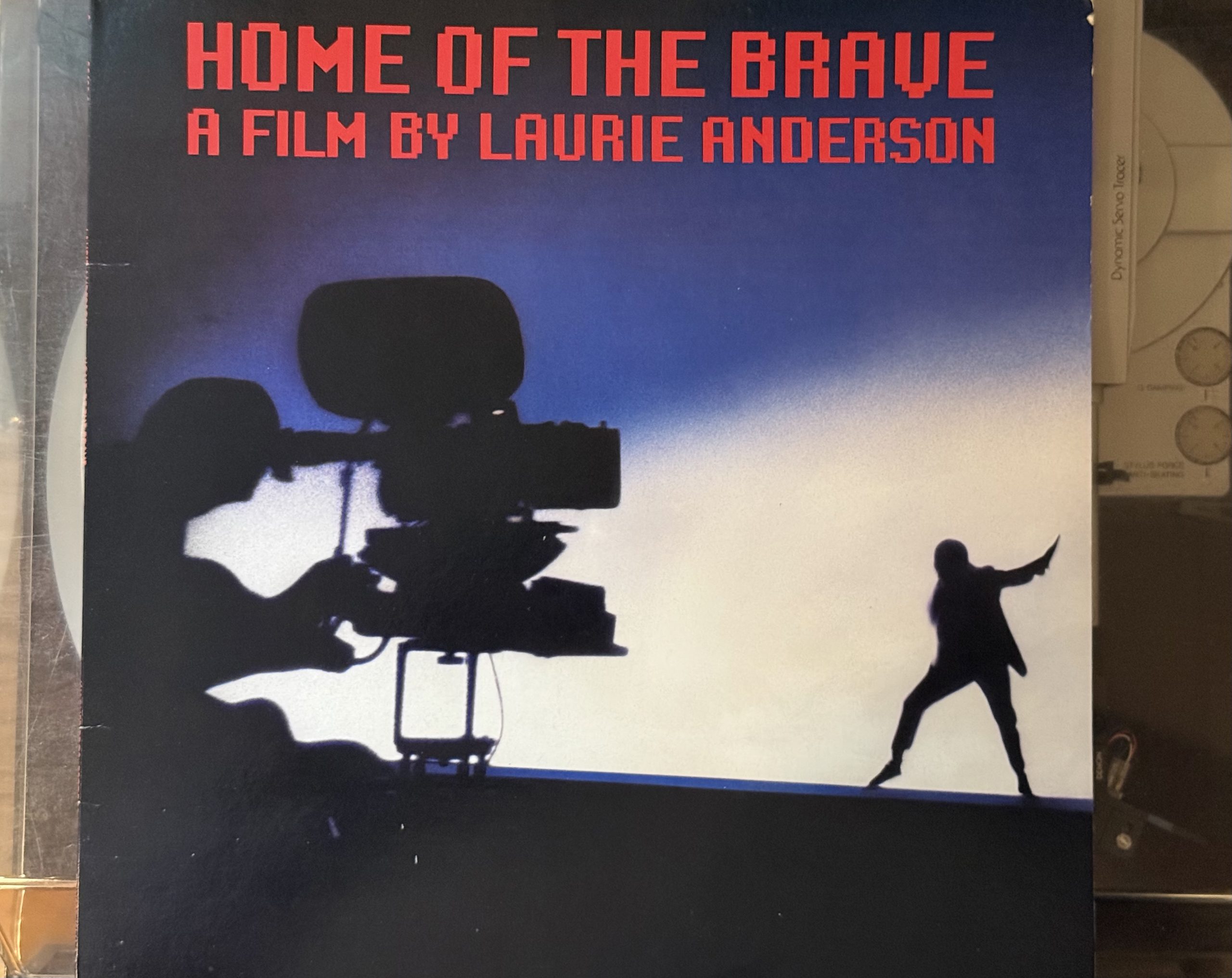
Album of the Week, May 30, 2026
Following Mister Heartbreak, Laurie Anderson continued to develop and tour shows based around her unique combination of performance art and music, as well as technology. In 1986 that led to an unexpected place: a theatrical release of a movie capturing the touring show that she mounted in support of the 1982 album. The movie flopped, grossing only $1.25 million at the box office, but it spawned a video release and a soundtrack, which provide a fascinating picture of how her art evolved alongside the technology she used to produce it.
The tour featured a subset of the musicians who had contributed to Mister Heartbreak, including Adrian Belew on guitar, David Van Tieghem on percussion, and William S. Burroughs as himself (he appears on stage only in a brief nonspeaking role); they were joined by keyboardist Joy Askew and backing vocalists Dolette McDonald and Janice Pendarvis, fresh from performing with Sting on his Dream of the Blue Turtles tour. Five of the soundtrack’s eight tracks were drawn directly from the performance captured in the film; the other three were recorded in the studio and featured additional musicians including Bill Laswell, Nile Rodgers, and others. Only “Sharkey’s Night” repeats from Mister Heartbreak, here in a greatly extended form; the rest of the songs are new.
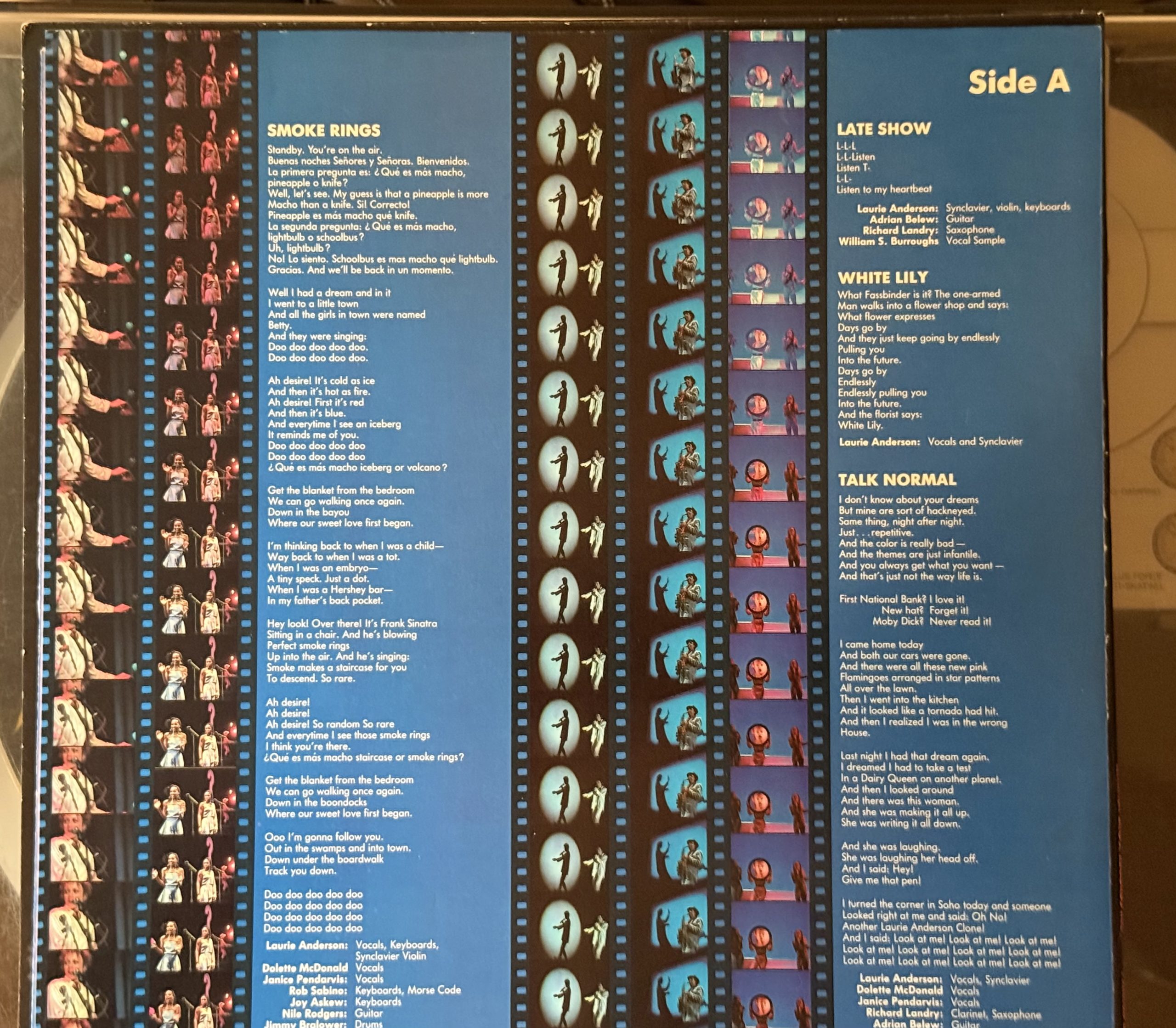
“Smoke Rings” starts with a descending synth line slightly reminiscent of “From the Air,” but quickly veers into surrealist territory with a Spanish game show establishing what is more macho. This idea, while promising, is quickly abandoned for a dream about “a little town… and all the girls in town were named Betty.” As she moves past the humor of the opening image, though, we get to the song’s serious core: “Ah, desire! It’s cold as ice and then it’s hot as fire… And every time I see an iceberg it reminds me of you.” The music itself is driven by a pulsing drum + synth groove and punctuated by the gorgeous backing vocals of McDonald and Pendarvis and the high reverberating sampled soprano note, as well as the sounds of dense beasts from Belew’s guitar. It’s a dizzying introduction to the album.
After this we get a quiet moment, driven by a skittering synthesizer line, in which Laurie asks “What Fassbinder film is it? The one-armed man walks into a flower shop and says: What flower expresses Days go by / and they just keep going by endlessly / pulling you into the future… and the florist says, ‘White Lily.’” As gnomic moments, this one is high on the list of Anderson’s most quotable aphorisms, but it’s married to a texture that’s mostly throwaway.
The same can’t be said for “Late Show,” a hypnotic 9/8 riff over which Laurie plays an electric violin, first with a conventional bow and then with something very different. She had been experimenting with the idea of a “tape bow,” a violin bow in which a length of recorded tape replaces the hair of the bow and passes over a magnetic pickup on the violin to play fragments of the recorded sound, since the late 1970s. Here, this instrument acts instead as a MIDI controller, playing back a sample of William S. Burroughs’ voice at different speeds and timbres as he intones “Listen to my heart beat.” You kind of have to see it to believe it.
“Talk Normal,” one of the tracks recorded in the studio. is a scene of pure chaos, with a doo-wop backing vocal behind different improvisations: a wild saxophone line, screeching Adrian Belew guitar noises played on a guitar with a flexible neck, and a set of odd stories from Laurie, including my favorite: “I turned the corner in Soho today and someone / Looked right at me and said: / Oh No! Another Laurie Anderson clone!” I like the idea that there is an alternate reality version of the 1980s in which the streets of the world were full of Laurie Anderson lookalikes — at least elsewhere than in SoHo. The version in the movie is even more extended and surreal, with jugglers, weightlifters, and a giant projected head of Laurie behind the stage. (There’s an image of that on the back of the album cover.)

“Language is a Virus” is another studio recording, this one produced by Nile Rodgers, who also contributes guitar, keyboards and Synclavier to the track. The track riffs off William Burroughs’ line “Language is a virus from outer space,” and Laurie plays with the disconnect between words and intentions throughout: “I was talking to a friend/And I was saying: I wanted you / And I was looking for you / But I couldn’t find you. I couldn’t find you / And he said: Hey! / Are you talking to me? / Or are you just practicing / For one of those performances of yours?” But the stories here feel a little flip, a little forced, as though the words have been squeezed to fit the pop song format. (Though I do confess to quoting the last stanza to myself whenever visiting a tourist attraction: “And there was a beautiful view / that nobody could see / Cause everybody on the island / Was saying Look at me! Look at me!”)
“Radar” is a brief snippet of wordless song against a crashing synth chord; if Laurie didn’t have another piece called the “Difficult Listening Hour,” the first minute of this would be a contender. But a synth melody punctuated by birdsongs provides an achingly beautiful bridge into “Sharkey’s Night,” here performed by Anderson using the Voice of Authority1 filter. This version loses the unforgettable William S. Burroughs “Paging Mr. Sharkey, white courtesy telephone please” tag from the original, but remixes in the vocal harmonies from “Talk Normal,” a bit that sounds a lot like a Prince song, an extended saxophone solo from Richard Landry, and a riff on World War III accompanied by an Adrian Belew guitar freakout that will upset your dog. Anderson gives us a backslapping moment with the “Big Boys in room 1003” who are “talking Big B, little O, little M, silent B” and then moments later asking “Hey, what’s that big noise from the sky? … It’s just those angels walking / They’re clomping around again / Wearing those big clumsy shoes we got for them.” Sharkey’s closing “ah, ah, ah, you’ve already paid for this / listen to my heart beat” feels at the end more like a threat, an implied standoff with the bomb as the payoff.
The song ends in a haze of klaxons, segueing into “Credit Racket,” an instrumental that harmonizes its guitar and synth parts from the sound of the sirens; the same track played over the closing credits of the film.
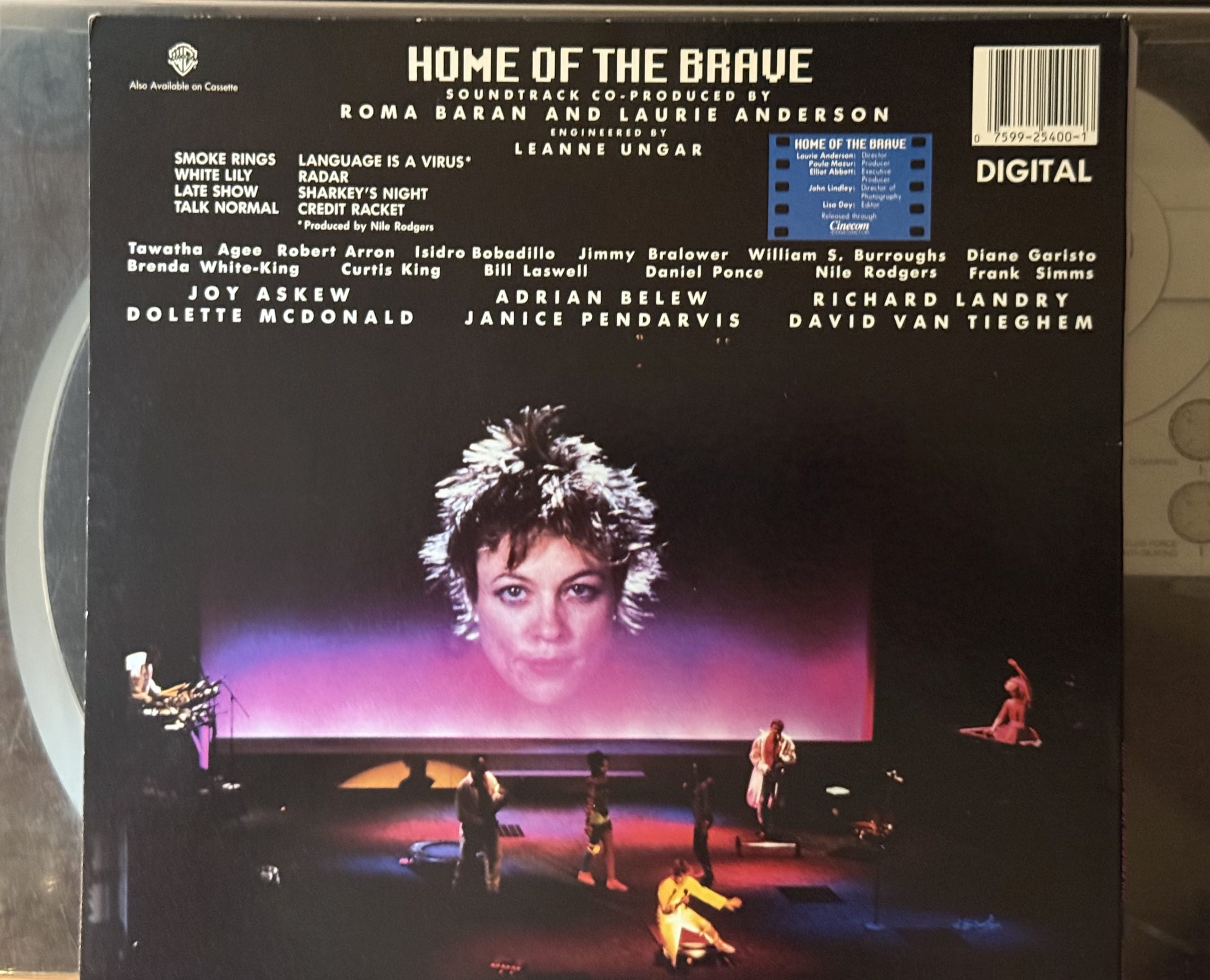
For me, part of the wonder of revisiting Laurie’s work is the ways in which her art, though undeniably limited by the technology available at the time, embraced those limitations (for example, the use of the Mac bitmapped system font Chicago as the title type for the record).2 As Anderson’s art evolved, the technology got more integrated into the work and the musical parts stepped forward more, leaving questions: was she a performance artist who sang or a singer who told stories? Her next album would deepen that confusion in strange and interesting ways. But first we’ll hear from another artist exploring the collision between technology and music with a completely different outcome.
You can listen to this week’s album here:
BONUS: The full concert film is available on YouTube, somehow. Watch it for Laurie’s tape bow, the waltz between her and Burroughs, the drum dance, the “¿Que es mas macho?” game show, and more:
Footnotes
- Years later, Lou Reed, who married Laurie in 2008, named the persona that she adopted with the Voice of Authority filter “Fenway Bergamot.” ↩︎
- There are a variety of free revivals of the original bitmapped Chicago font, which is a good thing because the scalable vector TrueType version was pretty awful. ↩︎