

Album of the Week, July 11, 2026
Laurie Anderson might have started the 1980s as the definitive performance artist who also happened to sing, but her last album of the decade posited her as a singer who also happened to be a performance artist. Like Kate Bush’s The Sensual World, released just a week before Strange Angels, the album centered Laurie the person in an emotional space that she had never really occupied, showing her with fewer electronic tricks and more heartfelt songwriting in an album adorned by a stunningly intimate cover portrait.
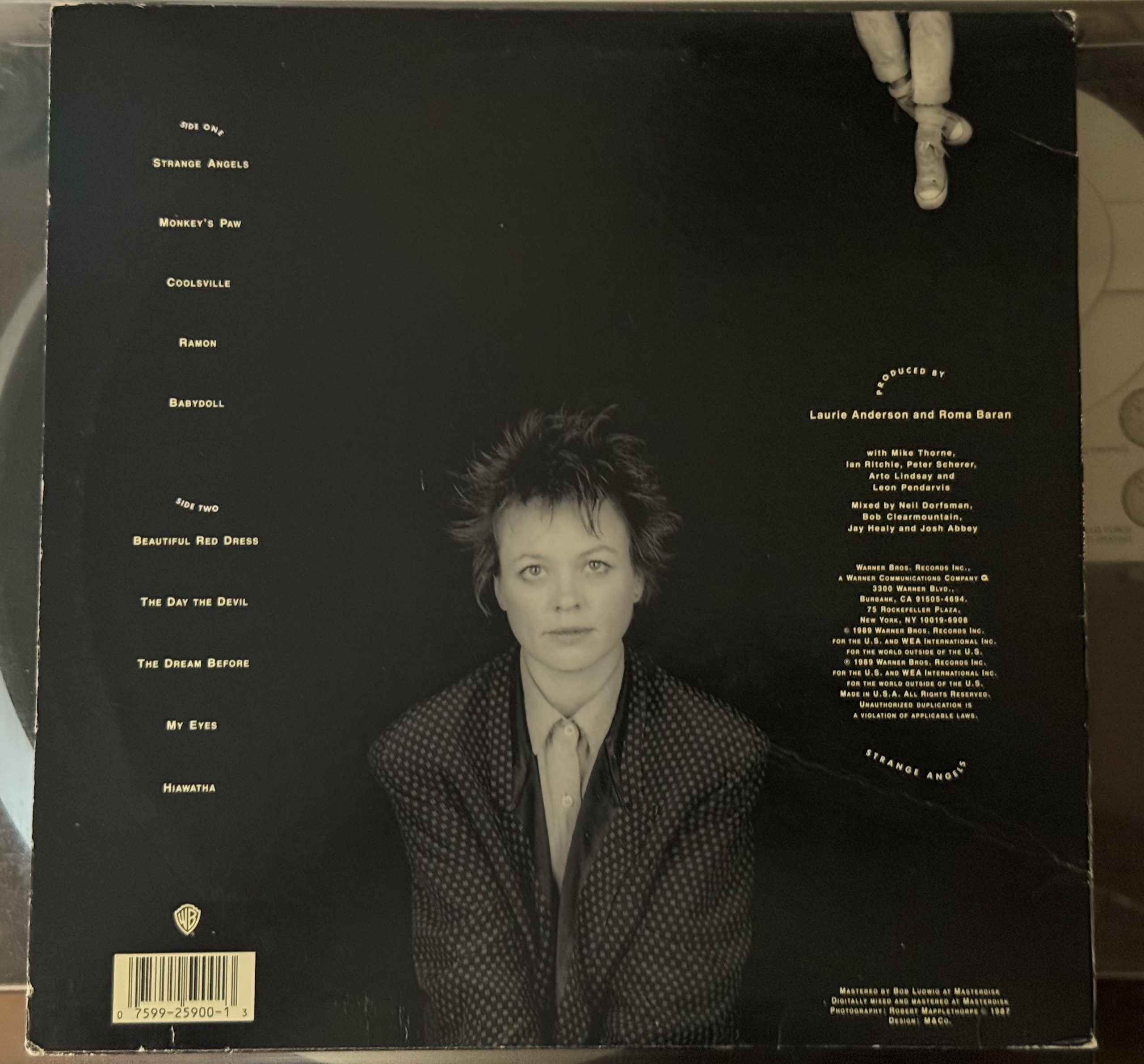
That cover was taken by famed photographer Robert Mapplethorpe, who near the beginning of his career had captured the great Patti Smith for her first album Horses. In the earlier photo he portrayed someone both confrontational and delicate in a way that played with gender conventions. Here, near the end of his life (Mapplethorpe died several months before the album’s release, of AIDS), he imbued Anderson, previously careful to present herself through a sort of hip androgyny, with a sort of uncanny beauty, presenting her in a way that was still undeniably artistic and avant-garde but somehow unavoidably feminine.
The cover photo was a good metaphor for the music contained inside, as an artist who had previously relied on an electronic pitch-shifter to give her “The Voice of Authority” now leveraged a new voice, an unexpectedly clear and beautiful soprano. She has told a story about realizing that a song needed to be actually sung instead of talked, going to take voice lessons, and discovering that voice had been waiting for her the whole time. And while there are certainly familiar collaborators, including producer Roma Baran and percussionist David Van Tieghem, most of the musicians on the record are most familiar for having collaborated with someone else: the Golden Palominos’ Anton Fier; trumpeter Earl Gardner, trombonist Steve Turre, drum programmer Leon Pendarvis (Janice’s husband) and accordionist Tom “T-Bone” Wolk from the Saturday Night Live band; session drummer Steve Gadd (“50 Ways to Leave Your Lover”); Tony Levin; guitarist Ray Phiri and bassist Bakithi Kumalo (Graceland); minimalist tape loop composer Scott Johnson; bassist Mark Dresser (Anthony Braxton); drummer Joey Baron and percussionist Cyro Baptista (John Zorn); and a host of well-known voices lending backing vocals including Meat Loaf, Bobby McFerrin, outsider artists The Roches, and Lisa Fischer (Rolling Stones, Luther Vandross).
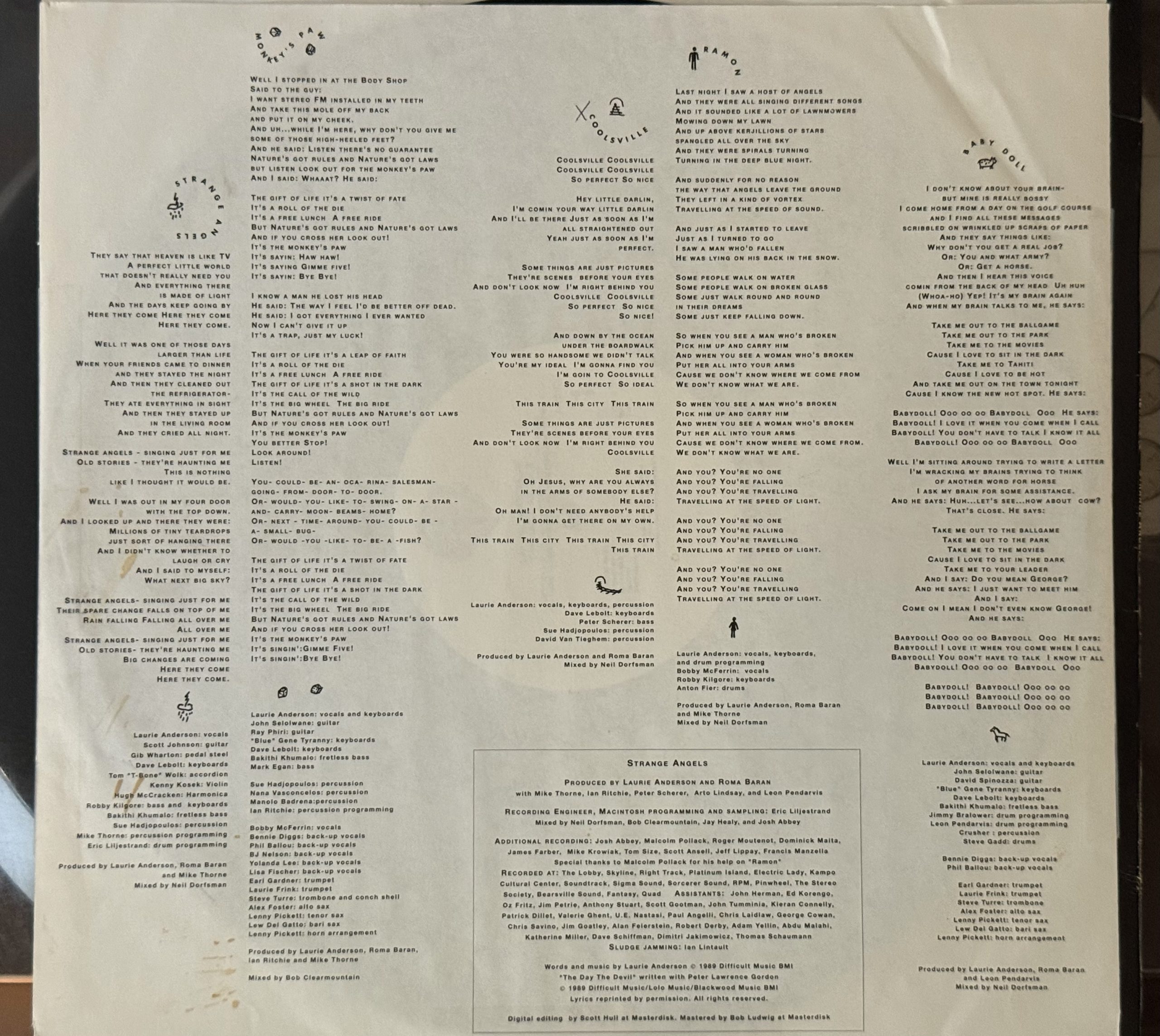
“Strange Angels” begins as a classic Laurie Anderson lyric: “They say that heaven is like TV,/A perfect little world/That doesn’t really need you.” But it’s sung, not wryly spoken, and the combination of instruments that joins as she intones “here they come” – guitar, accordion, bass, crisp percussion – tells us we are in for a different sort of experience. I always loved the lyric that leads off the second verse: “Well it was one of those days / Larger than life / When your friends came to dinner /And they stayed they night/ And then they cleaned out the refrigerator / They ate everything in sight / And then they stayed up in the living room / And they cried all night.” Possibly I feel this way because the first time I heard the album was in the living room of a Mount Holyoke choir member, where I was crashing overnight on the floor while we were on tour. I don’t make friends easily but that night we stayed up until two, and would have cleaned out the refrigerator had there been one. (Some of these reviews are not impartial.) Perhaps, though, I like the tune so much because, as the chords swing from major to minor, the band creates an undercurrent of melancholy underneath the main story, and we understand that we’re looking backwards at a visitation from the angels that can never occur again.
“The Monkey’s Paw” is a different thing, a fable about not messing with Mother Nature in the form of a song. The setup—Laurie going to a retail establishment and requesting modifications—is not particularly novel, but the salesman pushing back on her warning of the unintended consequences is: “Please. There’s no guarantee. Cause nature’s got rules, and nature’s got laws, and if you cross her look out — it’s the monkey’s paw.” The musical track is light, thanks to Ray Phiri and Bakithi Kumalo, and the gorgeous falsetto vocalise of Bobby McFerrin.
“Coolsville” is a song built over an effect, a delayed reverb circuit providing a sort of call and response effect behind Laurie’s vocals. That’s the gimmick, and on the initial listen when she intones “Coolsville” into this thing it can be overwhelming. But the song itself, with its longing for perfection that doesn’t exist, is somehow deeply moving nevertheless.
That brings us to “Ramon,” which for me is the emotional center of the album. Opening with a deceptive drum pattern that always makes me think the beat is dislocated by half a measure, Laurie is back to clouds of angels: “Last night I saw a host of angels, and they were all singing different songs/And they sounded like a lot of lawnmowers/Mowing down my lawn/And up above kerjillions of stars spangled all over the sky…” But the visitation of angels leaves us and there’s a man fallen on his back in the snow. Laurie’s verse centers this man in the broader cosmos: “some people walk on water/some people walk on broken glass/some just walk round and round in their dreams/some just keep falling down.” There’s something deeply human, almost a humanist form of Christian ethics, in these lyrics: regardless of which kind of person you’re dealing with, when you see a man who’s broken, pick him up and carry him! To put this into context, this was coming at the end of an eight year period where the culture had encouraged a kind of spiritual self-centeredness, amid the rise of televangelism and the rapid removal of societal support for the homeless, as well as at the end of a period where the Reagan administration’s refusal to do anything about the AIDS crisis had meant the loss of tens of thousands of people, with the population of artists in New York with whom Anderson collaborated (including Mapplethorpe) hit especially hard. So for me, hearing these lyrics against this context, it came as a sort of moral call to arms. For Anderson, this isn’t an explicitly Christian moment, more a humanist one, since we are all in this together: “We don’t know where we come from/We don’t know what we are.”
The first side closes out with “Babydoll,” which is for me one of the songs on the album that would have done better as spoken word. The concept, about a brain that stops functioning on behalf of its owner because it wants to have fun, is pretty good, and the music is rich, but they somehow don’t seem to reinforce each other. Still the song is worth it for its extremely 1989 moment, in which the brain says, “Take me to your leader/And I say: do you mean … George?”
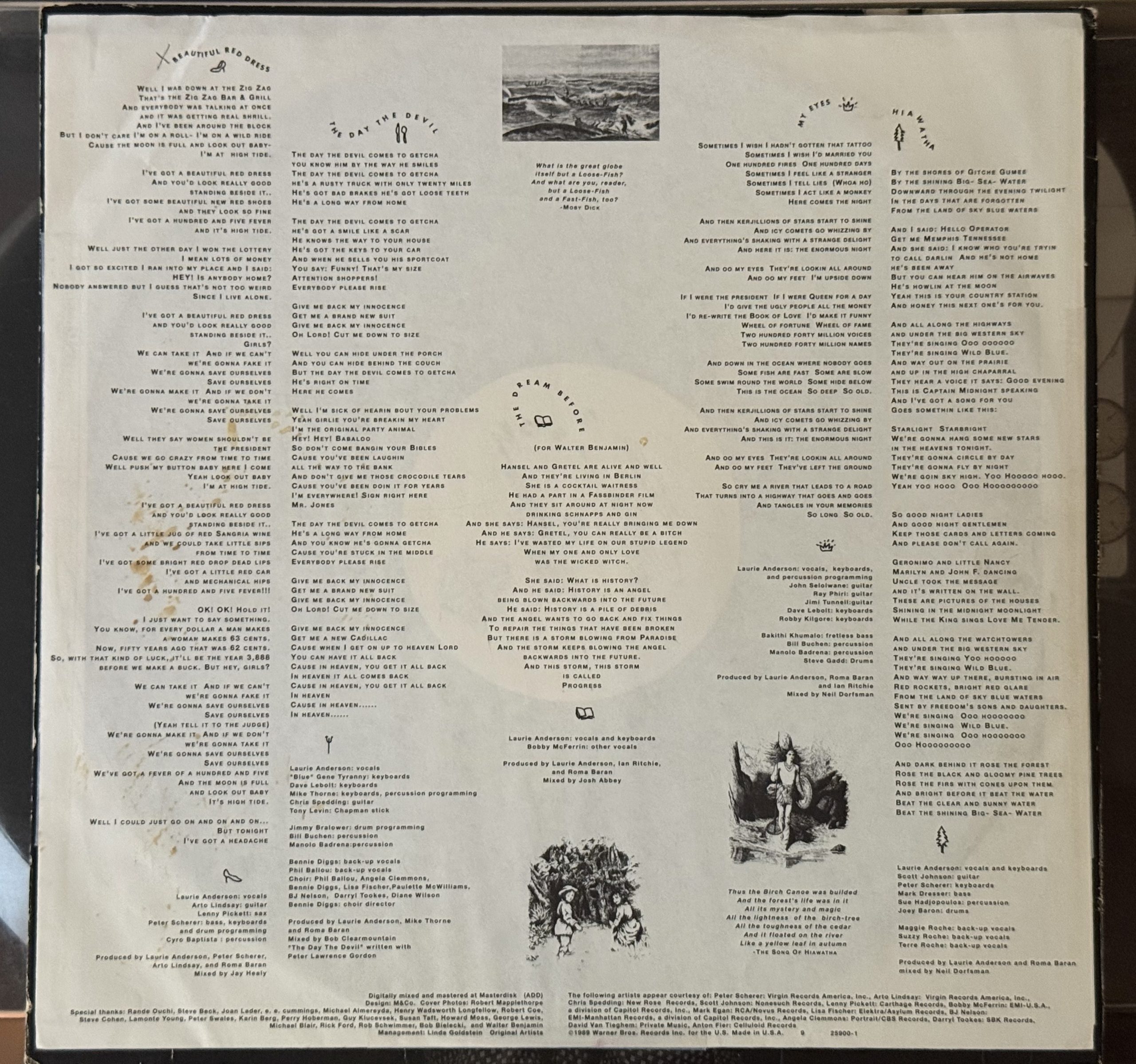
“Beautiful Red Dress” flips the tropes of women’s roles (shrill, decorative, emotionally unstable, dependence) on their heads, starting from the first chorus: “I’ve got a beautiful red dress/And you’d look really good/Standing beside it…” Lenny Pickett gets to play some spectacular 1980s saxophone all over the track, and there’s a great moment in which Laurie quiets the track down with the observation, “You know, for every dollar a man makes, a woman makes 63 cents. Now, fifty years ago, that was 62 cents. So, with that kind of luck, it’ll be the year 3,888 before we make — a buck.”
“The Day the Devil” flips the script on blaming external forces for your problems, with the devil being blamed for knowing you inside out before sneering, “Don’t come banging your Bibles/Cause you’ve been laughing all the way to the bank.” It’s not, to my hearing, entirely coherent, but the gospel chorus covers a multitude of sins in this song for me: “Give me back my innocence… ‘Cause when I get on up to heaven Lord/You can have it all back.”
The other emotional center for me comes next. “The Dream Before” is an unvarnished story of dashed hopes and unhappy outcomes. Hansel says, “I’ve wasted my life on our stupid legend/When my one and only love was the wicked witch.” The second half of the brief functions as sort of an ultimate Zen koan, with Anderson and Bobby McFerrin laying down some high-grade philosophy: “History is an angel being blown backwards into the future… and the angel wants to go back and fix things, to repair the things that have been broken, but there is a storm blowing from Paradise … and this storm, this storm, is called Progress.” Really listening to this as an about-to-graduate college student did something to the wiring of my brain. (I centered this song on a mix tape in 1993.)
“My Eyes” is somehow the perfect blend of Laurie’s tart observations and her new musical fluency, all the more so because there’s no pat moral or punchline. She confronts the enormous night, the kerjillions of stars, the “ocean, so deep, so old,” and simply exists in it: “Everything’s shaking in strange delight.” The track is underpinned by that spectacular one-two combo of Bakithi Khumalo’s fretless bass and Ray Phiri’s guitar.
The album ends with a valediction for the departed in “Hiawatha,” as Laurie invokes the spirits of Elvis, JFK, and Marilyn Monroe to welcome newly departed souls: “Well, starlight, starbright, we’re going to hang some new stars in the sky tonight.” The combination of Scott Johnson’s guitar and the understated backing vocals of the Roches turns the overall effect into a simultaneous groove and valediction.
Laurie’s experiment with leaning more fully into the musical side of her art was well received by the critics, with Robert Christgau giving the album an A. After the album it took a while for her to find her next voice, but find it she did after about five years, and we’ll hear that sound another time. Next week, though, we’ll swerve back over into what was being called “world music” to hear the next album from one of Peter Gabriel’s other collaborators.
You can listen to this week’s album here:
BONUS: Here’s Laurie performing “Strange Angels” live in San Remo in 2001, during an award ceremony in which she was awarded the Premio Tenco for songwriting:
BONUS BONUS: “Strange Angels” soundtracks a moving moment in the William Hurt/Elizabeth Perkins 1991 film The Doctor, in which the characters, playing cancer patients, embrace a moment of grace:
BONUS BONUS BONUS: Laurie originally didn’t pursue the traditional music video route to promote the album, instead opting to produce a series of short videos, called “Personal Service Announcements,” in which she did her version of stand-up comedy. A few of these have surfaced over the years, including these: