
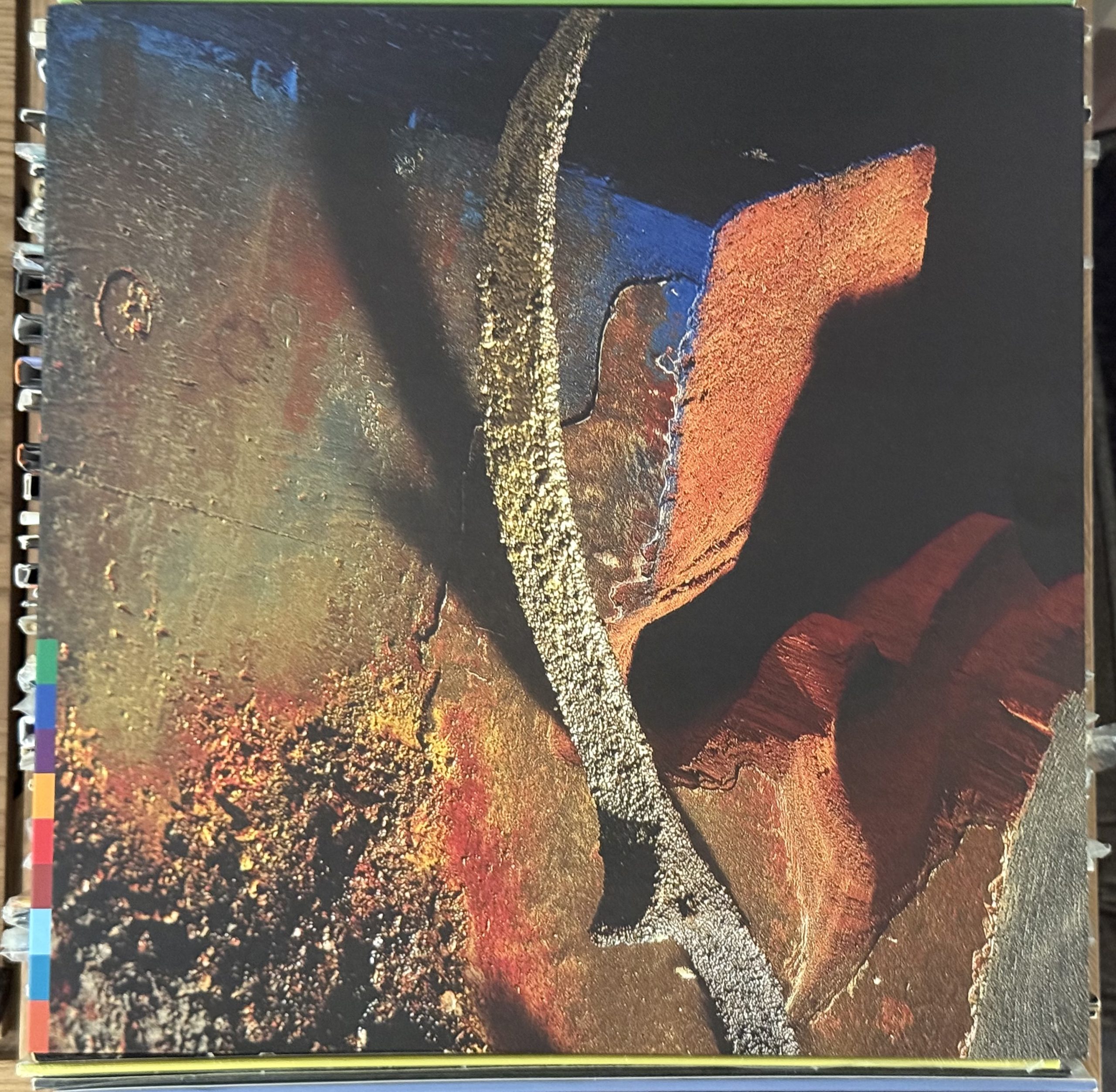
Album of the Week, July 26, 2026
We’ve heard several albums by the great Pakistani singer Nusrat Fateh Ali Khan, featuring the hallmarks of the qawwali tradition: accompanied by harmonium and tabla plus a chorus, extended introductions, vocal improvisation, performances stretching anywhere from eight minutes to half an hour. We’ve also heard him in modern contexts collaborating with Peter Gabriel and others. But we haven’t heard his traditional work directly adapted for a wider Western audience. That’s where producer Michael Brook came in.
We met Brook last week, as the producer on Youssou N’Dour’s Set. But the Canadian guitarist had been in the music industry for years previously, working as an engineer at Daniel and Bob Lanois’ Grant Avenue Studio, where he worked with musical polymath Brian Eno, composer Harold Budd, and U2 guitarist The Edge, among others. It was during this period that Brook invented a kind of infinite sustain device that allowed an electric guitar to hold a continuously sustained note.1 Brook had a background in ambient music through his collaborations with Eno, Budd and Lanois, and his ideas for this collaboration with Nusrat were twofold: bring some hallmarks of modern music to Nusrat’s sound, and explore what happened if you slowed down the pace and allowed Nusrat to just explore sound rather than perform with his customary vocal pyrotechnics. At both, Mustt Mustt succeeds admirably.
Brook brought a handful of Western musicians to the session, including bassist Darryl Johnson (Neville Brothers, Lanois, Bob Dylan’s Oh Mercy), engineer David Bottrill (Peter Gabriel), and percussionist James Pinker (Dead Can Dance), but members of Nusrat’s party including Farrukh Fateh Ali Khan (harmonium) and Dildar Hussein (tabla) were there as well.

“Mustt Mustt (Lost in His Work)” is a song of praise to the Sufi saints (“Upon my breath and in my intoxication is the great Qalandar…my worship and upon my breath is the great name Ali”) that is westernized with the interplay of Johnson’s bass and Brook’s guitar over the tabla and harmonium. What emerges is a mix of devotion and groove. It’s still fully recognizable as qawwali; Nusrat sets up the chorus, improvises vocally with the harmonium, unleashes strings of sangam syllables. But there’s that fat bass line throughout, interplaying with the tabla and harmonium to create something completely new. It’s also more concise than a traditional qawwali performance, thanks to Brook’s careful editing (though the liner notes indicate that Brook and Nusrat had to compromise on some of the edits so as not to affect the meaning of the traditional syllables).
“Nothing Without You (Tery Bina)” starts with percussion first, then harmonium, again bringing rhythm to the traditional Qawwali forms. There’s more of Nusrat’s chorus here, and the tune is slower and more deliberate than it might be in a qawwali performance. Brook’s guitar is used to add small amounts of harmonic complexity while still keeping the song anchored in its traditional form.
“Tracery” is where the ambient starts, with Brook and Johnson laying a gentle foundation upon which Nusrat builds up sound in dialog with himself just as the guitar builds up patterns on patterns in a hypnotic swirl. The liner notes observe that the form is complex, building on one cycle that has nine beats and another with eleven. Here Nusrat embraces the challenge, issuing vocal runs across the patterns. It’s a gorgeous collage of sound as Nusrat finds ways to bring more and more expressive vocal sounds into the mix.
“The Game” begins with sustained guitar tones that yield to a Western rhythm courtesy of a drum machine pattern that Peter Gabriel contributed. Darryl Johnson lays down a bass line on the Moog and plays piano to build the melodic core of the backing track. Across all of this is Nusrat’s improvised vocal, combining runs of syllables with soaring vocal lines.
“Taa Deem” is built from the interchange between Nusrat and his party on vocals over the harmonium, then with a complex rhythmic backing with Dildar Hussein on tabla, Michael Brook on the surdu, and James Pinker and Darryl Johnson on djembe. Brook also contributes some low searing guitar lines and the whole thing becomes a dark explosion of melodic interchange.
Brook and Johnson create a synthesized soundscape to open “Sea of Vapours,” against which Nusrat vocalizes low in his range. There’s no percussion, just multiple layers of drone. By contrast, “Fault Lines” builds from a hypnotic low vocal introduction into a rhythmic back and forth between a multitracked Nusrat and members of the party thanks to James Pinker’s percussion. There’s a wonderful bit at the end where all the percussion falls away and it’s just a gentle hint of Nusrat’s voice. “Tana Dery Na” feels like a continuation of “Fault Lines” on a simpler percussion line and with a more prominent guitar part, and with only Nusrat’s voice over the top.
“Shadow” is just Nusrat and harmonium, an extended sangam improvisation. It serves as a sort of extended prelude to “Avenue,” a group live-in-studio jam with Brook’s guitar, Johnson on clay drums, Pinker on djembe joining the harmonium and tabla. The three percussionists lock in on a groove while Nusrat and Farrukh reinforce each other and the guitar adds ecstatic high notes. It fades out just as Nusrat finds a new vocal pattern to throw into the mix. Someday there’ll be an extended anniversary edition of this album that restores some of the longer bits from this session that were edited out; I’ll be first in line.
Unusually for 1990, the album ends with a remix track. “Mustt Mustt (Massive Attack Remix)” is a dub-style remix that suspends bits of the original track in reverb, heavy percussion and synthesized bass, courtesy of the legendary Bristol collective a year before they released their debut album.

No one had combined East and West in quite this way prior to the release of Mustt Mustt, and the use of tablas with western sounds became a pivotal moment for British music, opening doors for many more musicians to mix Asian inspiration with the dance floor. It also raised Nusrat’s profile even further and gave him a wider base of fans and admirers. We’ll talk about some of the folks he influenced in the future and hear more music from him. Next week, though, we’ll hear from another artist who got his first exposure to Western audiences through Gabriel’s Real World label.
You can listen to this week’s album here:
BONUS: Here’s a more traditional rendition of “Mustt Mustt” from WOMAD Yokohama in 1992. This is how I heard the work when I saw Nusrat and party perform in Washington DC in 1996:
Footnotes
- Brook made three Infinite Guitars: one for himself and one each for Daniel Lanois and the Edge. You’ve heard the sound of the Infinite Guitar on U2’s The Joshua Tree, including on “With or Without You.” ↩︎