Exfiltration Radio: Monk’s Time

Exfiltration Radio returns with an hour of Thelonious Monk.

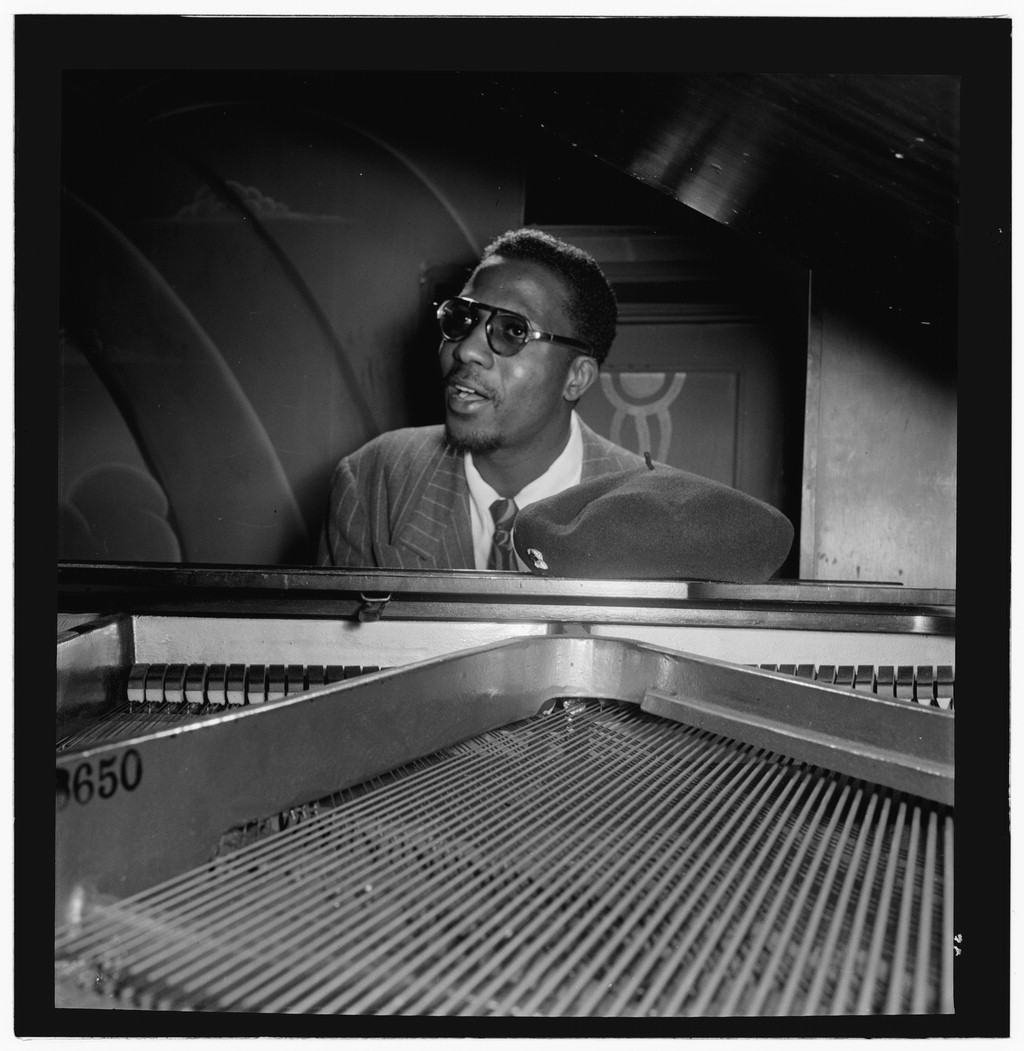
William P. Gottlieb: Thelonious Monk, Minton’s Playhouse, ca. 1947, courtesy Library of Congress

It’s time for a new Exfiltration Radio, and this time out we’re going deep into the wonderfully weird world of Thelonious Monk. This show is an hour of Monk compositions, played by a variety of his bands and also covered by other artists.

We open with a portion of a story Charles Lloyd tells about Monk in the late 1960s, here excerpted from the Billy Taylor radio show ca. 1999. That leads into Monk’s ensemble playing “Well, You Needn’t,” from Monk’s Music, which I wrote about a few years ago. Still fantastic for the sound of the ensemble, which included both Coleman Hawkins and John Coltrane as well as Gigi Gryce, Art Blakey, Wilbur Ware, and Ray Copeland.

The earliest of the recordings on this set, “Bemsha Swing” dates from Monk’s first album for Prestige Records, 1954’s Thelonious Monk Trio, with Max Roach and Gary Mapp. It’s the earliest performance of this tune as well, and it’s interesting to see some of the places that Monk takes the melody, as well as to hear his joyous vocalizations as he plays. This is followed by a later live track, “Bye-Ya” from the 1963 Copenhagen live session recently issued as Mønk. This is Monk’s great swinging quartet with Charlie Rouse, John Ore and Frankie Dunlop. From “Bye-Ya” we go back to Monk’s Music for his “Ruby, My Dear,” here played with Ware, Blakey, and Hawkins, whose solo on this one is a thing of beauty.

The second half of the mix features notable performances of Monk’s music by other artists, starting with another run at “Bemsha Swing,” this time by Keith Jarrett’s great standards trio with Gary Peacock and Jack DeJohnette, on the live album The Cure. I love what Jarrett (as far as we know, at most a very distant relation!) does with Monk’s melody, turning the rhythm into a boogying, churning perpetual motion machine. The performance also features Jarrett’s own vocalizing, which is an acquired taste, so be forewarned.

Following this, there’s a spectacular take on Monk’s composition “Ask Me Now” by a group led by McCoy Tyner and featuring Joe Henderson on tenor, Ron Carter, and Al Foster on drums, live in performance from 1991. The extended solos by Henderson at the beginning and end of the track are worth the price of admission by themselves.

This is in turn followed by a take on “Blue Monk” with scat vocals by Kurt Elling and piano by Christian Sands. There are a number of essays of Monk’s tunes with lyrics out there, including another version of “Blue Monk” by the great Abbey Lincoln and a gorgeous “Round Midnight” by Samara Joy. But I like this version, part of a session laid down and released digitally in a single day, for the spontaneity and joy that the two players have with the work; as Elling says after one spectacular solo by Sands, “That’s the happiest that piano has been all day.” A brief tag of Monk’s “Epistrophy,” from a recently issued performance in Paris in 1966, brings the set to a close.

It’s hard to fit all the great things about a composer and performer like Monk in a single hour, so I focused on tunes that featured great playing by the entire ensemble. You can easily get lost in Monk’s world; this set provides a happy introduction.

Do not attempt to adjust your set…

  1. “Well, every night, Monk would drink the orange juice”Charles Lloyd (Exfiltration Radio: the bumpers)
  2. Well, You Needn’tThelonious Monk (Monk’s Music)
  3. Bemsha SwingThelonious Monk Trio (The Thelonious Monk Trio (Rudy Van Gelder Remaster))
  4. Bye-YaThelonious Monk (Mønk (Live, 1963))
  5. Ruby, My DearThelonious Monk (Monk’s Music)
  6. Bemsha SwingKeith Jarrett, Gary Peacock, Jack DeJohnette (The Cure)
  7. Ask Me NowMcCoy Tyner (New York Reunion)
  8. Blue MonkKurt Elling, Christian Sands (Wildflowers Vol. 3)
  9. EpistrophyThelonious Monk (Live in Paris (1966))

Tony Williams, Life Time

Album of the Week, October 5, 2024

Of all the members of Miles’ second great quintet, the one we’ve written the least about is the youngest member, drummer Tony Williams. Just 17 when he joined the quintet in the spring of 1963, he was already a modern jazz veteran, having begun playing with brilliant free jazz saxophonist Sam Rivers when he was just 13 years old. A gig with Jackie McLean at age 16, during which he recorded on Jackie’s pivotal album One Step Beyond, brought him to the attention of Miles Davis, and the rest is history.

Or so the story goes. But Williams continued to record sessions with other Blue Note artists, and shortly after he joined Miles’ quintet, he recorded his own sessions at Rudy Van Gelder’s home studio in Englewood Cliffs, New Jersey, on August 21 and 24, 1964. The earliest of those sessions, collected as Life Time, are our subject today, and they make for more adventurous listening than the work his bandmates in Miles’ group were recording (though some of those same bandmates joined him). The record features Sam Rivers on tenor sax (four months before Williams would join Rivers on his pivotal Fuchsia Swing Song), Bobby Hutcherson on vibes and marimba, and Herbie Hancock on piano, with Ron Carter, Richard Davis, and Gary Peacock joining on bass with the different configurations of players.

Album opener “Two Pieces of One,” true to its title, comes in two parts, “Red” and “Green,” that comprise the entirety of side one. A sparely led group featuring just Williams and Rivers backed by both Peacock and Davis on bass, the work highlights Williams the composer rather than the virtuoso drummer. It opens with the sax and basses playing the opening melody chords, opening up to a repeating figure in Richard Davis’s arco bass, and then closing down again with a splash of Williams’ cymbals. The two bassists duet, with Peacock’s fierce pizzicato over Davis. Then finally something approaching a “normal” post-bop sound, with Rivers improvising over a steady yet kaleidoscopically evolving beat from Williams. This segment closes with another duet between the basses, who seem to be discussing what’s just transpired, and a repetition of the opening chorus.

“Green” opens with a duet between Rivers and Williams, in which Rivers throws out at least six or seven melodic ideas around the central progression. Williams falls back to cymbals and accompanies Rivers as he slows in contemplation, then surges forward when Rivers finds a major melody. Williams takes a solo next that’s notable both for the rhythms and the timbres he explores across his snares, toms and cymbals. At the very end the basses rejoin as Rivers recapitulates what originally seemed to be an improvised idea from the opening but which actually turns out to have been the composed melody; the track closes with a fiercely propulsive solo from Williams.

Tomorrow Afternoon” has something much more like a traditional melody, performed as a trio by Rivers, Williams and Peacock. Rivers leads the charge with a bright melodic statement, but underneath Williams and Peacock are constantly shifting, and a pulsing pattern from Peacock leads into his rapid solo, which is joined by Rivers before Williams swings the trio back into the opening theme. It’s a concisely argued bit of free jazz.

Memory” is a different beast entirely. Williams and Bobby Hutcherson play polyrhythmically, trading ideas and beats, for the first part of the piece. Herbie Hancock steps in about three minutes in, improvising along Hutcherson’s melody in the right hand before jumping to another pattern. Hutcherson takes a solo that sounds like something out of Steve Reich’s “Six Marimbas,” which Hancock responds to with another idea, which seems to spur another recollection from Williams. The whole work plays out as these interchanges of ideas and melodies bounce from one instrument to the other.

Hancock introduces “Barb’s Song to the Wizard” with the telepathic Ron Carter, who plays the melody as Hancock provides a rhythmic chord progression in the upper octaves of the piano. The players switch roles as they break into something like a somber waltz, then a ballad. Ultimately the track comes to a delicate close as you realize that Williams only appears as the composer here—an unexpectedly generous gesture from the young artist on his first album.

Williams reveals himself on this inaugural outing to be an inspired composer, albeit not in a traditional mode. His other album for Blue Note, Spring, is perhaps better known precisely because it has more recognizable song structures, but it’s still more “out” than most of what the Second Great Quintet recorded during this time… at least until later in the decade. Next up, we’ll hear more from a Williams bandmate who made a practice of blending approachable and ambitious.

You can listen to this week’s album here:

Bill Evans, Trio 64

Album of the Week, February 4, 2023

Bill Evans was having a good year (or two) in 1962 and 1963. Following the sessions that produced Moon Beams and How My Heart Sings!, his contract was picked up by Verve Records, where Creed Taylor was still in full swing. He recorded a handful of additional sessions for Riverside in , including material that appeared on Interplay and on the great posthumous release Loose Blues. He then started his Verve recording career in two sessions as a sideman, one backing West Coast drummer Shelley Manne and one with the Gary McFarland Orchestra. He recorded a set of solo piano sessions, with overdubs, that became the Grammy award winning Conversations with Myself. And he played on some clunkers of albums with orchestra, performing current movie themes (hey, nobody’s perfect).

But he was never too far from his trio. In mid-1963 he recorded live sessions with Chuck Israels and Paul Motian at Manne’s club, “Shelly’s Manne-Hole,” that were later released on Milestone as Time Remembered. And on December 18, 1963, he entered Verve’s studios in New York City with Motian and the 28-year-old bassist Gary Peacock to record what would become Trio 64.

I haven’t been able to find any information to explain why these sessions had Peacock on bass, rather than Israels. The latter continued to work with Evans for several more years, as we’ll see in next week’s recording. And while Peacock went on to have a long career, recording many albums with Motian and (most notably) anchoring another piano trio, the famous Keith Jarrett Standards Trio with Jack DeJohnette, he only did this one session with Evans. (A possible reason: he went on to join Miles Davis’ band, but briefly, in early 1964.) But because Peacock did record this session, we have a rare opportunity to compare and contrast the difference that his style makes in Evans’ trio. Answer: not much, and a lot.

One thing you’ll hear immediately in the performances is that Peacock’s bass has a woodier, more percussive sound, possibly due to Taylor’s production choices. But Peacock also performs, on this outing, much more like a traditional bassist, anchoring the bottom of the harmonies rather than the more vocal-style countermelodies that Israels provided. In this trio, Evans was fully in charge, and there’s less of the give and take that characterizes his performances with Israels.

The repertoire on the album is also slightly unusual. Unlike the last sessions for Riverside, which featured Evans’ own compositions alongside standards from the Song Book, this album is entirely comprised of standards, albeit a few that are a little less than standard. For instance, the opening track — the theme to the “Little Lulu” cartoon shorts from Paramount that aired between 1943 and 1948 — has rarely been heard in other jazz contexts. And the trio’s performance of J. Fred Coots and Haven Gillespie’s “Santa Claus is Coming to Town” reminds us that, as I’ve written before, most memorable 20th century Christmas songs are not only de facto part of the Great American Song Book, they’re often by Song Book songwriters.

Trio 64 is overall an engaging, even-keeled listen. While I don’t consider it essential in the way its predecessor albums are, it’s still fun—buoyant, even. Sadly, it was to be Paul Motian’s last performance with the trio. We’ll hear from a different incarnation of the group next time.

You can listen to the album here: