“The Business Manager … arranged a tour…”

"The Virginia Boys," Atlanta Constitution, January 28, 1894, p. 24.
“The Virginia Boys,” Atlanta Constitution, January 28, 1894, p. 24.

It was a busy fall. I gave my first public speech about the history of the Virginia Glee Club at last fall’s Glee Club banquet, and in the process did a little new research. I wanted to share a few notes from the background of that talk (slides here), which focused on the Glee Club’s tours beginning with its first off-Grounds concerts in the 1890s.

To do that, I’m including a short excerpt from a book I’ve been writing off and on on the history of the Glee Club. I’d love any feedback on the content below. The question I tried to answer was: given the Club’s spotty history for the first 20 years of its existence, why did it come roaring back in the late 1880s and early 1890s, going from virtual quiescence to mounting extensive tours? Here’s an excerpt that gives some of the background.

That the Glee Club’s early history should be bound to the Grounds of the University is unsurprising, if one considers both the fragile civil life and convalescing infrastructure of post-Reconstruction Virginia. That just 22 years after its founding it would be touring major Southern cities in four states staggers the mind until one thinks about one aspect of that badly injured infrastructure: the railroad.

Prior to the Civil War, the railroad did not enjoy the same rise to prominence in the South as in the North. In Virginia particularly, the spread of the railroad was hampered by the political power of the planters, who were suspicious of transportation initiatives that did not directly help get their goods to market faster, and of the elite in Richmond, who, starting with George Washington, had championed river transportation for goods, with an eye to keeping commerce in Virginia ports rather than sending it down the Mississippi to the port of New Orleans (under Spanish control until the Louisiana Purchase). In this spirit, the canal building enterprise that created the still-visible Chesapeake and Ohio Canal between Georgetown and Cumberland, MD and the James River and Kanawha Canal in Richmond sought to create water links from major plantations to ports. When railroads first started to be built in a significant way in Virginia, they were likewise viewed as ways to market for the planters; there was no vision of a network of rails that could assist with transit of goods over land and across state lines, much less comparable carriage of passengers.

After the Civil War, this began to change. The railroad company eventually known as the Chesapeake and Ohio bought smaller rail companies and began to connect the lines to out of state networks, beginning in the Reconstruction years. Following Reconstruction, the C&O was purchased by Northern rail barons and expanded still further.

And passenger trains became more widely available. In 1885, the Charlottesville Union Station, a passenger depot serving the C&O, the Virginia Midland Railway, and the Charlottesville and Rapidan Railroad opened on West Main Street in Charlottesville, where it still sits (serving Amtrak) today. Before this point, distance travel relied on horse power; afterwards, students could – and did – ride the rails.

So it was that the Glee Clubs of 1889–90, 1891–92 and 1892–93 mounted their first performances outside Charlottesville – albeit in the relatively close-to-hand locales of Staunton, Norfolk, Richmond and Petersburg. As we have seen, the Glee Club of 1889–90 had held a concert in the Public Hall in the Rotunda Annex, on April 11, 1890, and followed it that same weekend with performances in Lynchburg and Staunton. Two years later the Glee Club returned to the Public Hall on December 17, 1891, with a program that featured song in less than half the performance’s 15 numbers, the balance being devoted to banjo, guitar and mandolin works; the following night found them in Staunton, and a performance in Norfolk followed on April 20. The 1892–93 Club broadened its horizons still further, with a performance in “town” in the Levy Opera House in January, and a three city tour with appearances in the Richmond Theatre, the Norfolk Opera House, and the Academy of Music in Petersburg in February.…

After 1892–93, the group decided to travel much more ambitiously. Led by Bernard W. Moore and with help from a few graduating alumni, including George Ainslie, the group mounted its first major tour outside the state of Virginia. The 1894 Corks and Curls dramatically illustrates the growth of the group’s accomplishments, with the modest touring of 1891 through 1893 together taking up less than the space allotted to 1894.

Even before the tour proper, the Glee Club held performances in the Levy Opera House and the Staunton Opera House in mid-January 1894. The tour proper kicked off with a performance in Fayerweather Gymnasium on Tuesday, January 30, and was off to the Mozart Academy in Richmond the next day. Thursday saw the group in the Lexington (Kentucky) Opera House, and they continued in Kentucky with an engagement in the Louisville Masonic Temple on Friday. Saturday was the Grand Opera House in Nashville. The group took a day off for travel (and the Sabbath) but performed in DeGive’s Grand Opera House in Atlanta on Monday, February 5. Turning north again, they were in Chattanooga’s New Opera House Tuesday to conclude the tour on February 6. A performance in the Lynchburg Opera House on March 29 concluded the season.

How was such an elaborate and lengthy tour possible? Again, the railroad not only facilitated but was the only conceivable way to travel the miles from state to state so rapidly. Here the group had the assistance of the general passenger agent of the Chesapeake and Ohio Railroad, John D. Potts. Apparently having no UVa connection, Potts nevertheless worked closely with the group through the 1890s, to the point of being named business manager of the group in 1895–96.

Note: This post contains an excerpt from an unpublished work and — unlike the rest of this Creative Commons licensed blog — is copyright © Timothy Jarrett 2016. All rights reserved.

On not forgetting

s-l400

As a fourth year undergrad student, I entered Julian Bond’s course on the history of the Civil Rights movement in the fall of 1993 not knowing what was going to happen to me. I didn’t really realize how much the class was changing me until I worked on my class project, which ended up being a paper on Virginia’s Massive Resistance laws.

Learning that my home state had, not fifteen years before my birth, decided that closing public schools was preferable to having to integrate them was mindboggling. Learning that a superintendent who still has an elementary school named after him in my home town could cite the small number of black applicants to a school as a reason not to desegregate it was shameful. Understanding the perfectly legal mechanisms that were used by segregationists and racists to avoid, subvert, and delay the implementation of the Supreme Court’s Brown vs. Board decision made me aware that there were more dimensions of evil than just cartoonish Klansmen.

In that context, it’s easy to understand why university students would want to remove the name of slaveowners from  buildings. And why there have been calls to tear down monuments to Confederate soldiers. I find myself looking on such calls with mixed emotions, however.

As the historian of the Virginia Glee Club, I’ve had to grapple with the University’s mixed legacy on slavery and race. I learned about the Movement there, and the Glee Club was integrating truck stops on tours during the 1960s, but many of the Lawn buildings were probably built with slave labor, and as late as Faulkner’s first year as writer in residence, his proposal (in “A Word to Virginians“) of going along with integration met with an outcry there.

One cannot change history by removing names, and one cannot remove the stain of slavery’s original sin from the United States by removing monuments. Until one understands that one’s parents or grandparents felt no shame in putting out an issue of the student magazine with a triumphant Lee standing over Grant in front of the stars and bars (see above), one can’t understand the forces that shaped the culture that exists today.

“A musical entertainment in the Town Hall”

It’s been some time since I’ve posted any narrative about my work researching the history of the Virginia Glee Club. That’s honestly because a lot of it has been fairly uninspiring heavy lifting: looking up death dates of alumni from the 1930s, transcribing rosters from bad photocopies of Corks and Curls, and so on. But this week, as I tried to put some narrative around the first decade of the Glee Club’s history (which for this purpose we’ll describe as 1871 to 1880), I ran into another one of those interesting corners that pops up from time to time.

This time the question that I found myself asking was: what were all the musical students at the University of Virginia doing between the demise of the Claribel Club in 1875 and the coming of Woodrow Wilson’s incarnation of Glee Club in 1879?

Turns out, they were putting on minstrel shows.

To summarize: between 1876 and 1878, the Virginia University Magazine published notes about three different minstrel performances. The first note, published in October 1876, noted that some students intended to form a “negro minstrel troup” to perform for the local audience and also for the “young ladies, orphans and lunatics” of Staunton, Virginia. The following year, we are told that a “repetition with slight variations of the long-to-be remembered minstrel performance of last year” will be held in the Town Hall, for the benefit of the Rives Boat Club. (The Town Hall, later known as the Levy Opera House, would be the site of a Glee Club performance in 1894; the Rives Boat Club was in existence at least through 1889 and appears to be the distant forerunner of UVa’s crew team.) In 1878, the performance returned and once again benefited the Rives, though the Magazine noted that attendance had fallen off the previous year. There is no mention of a show in the years following, during which the Glee Club returned, though there is evidence, in the form of a program, that a troupe re-formed and performed in 1886 or 1887.

This isn’t the first time we’ve bumped up against minstrel traditions in researching the history of the Glee Club, and it likely won’t be the last. But it’s fascinating to me to see how the threads intertwine, and see the Glee Club in a larger context. That 1886 program lists Glee Club president Sterling Galt as one of the performers in the minstrel program, along with J.R.A. Hobson and W.P. Brickell.

I’ve looked for minstrel troupe programs in the library catalog; while the 1886 program is there, there’s no record of the 1870s performances—they may have been lost in the Rotunda fire. But I hope to find more information about the performances some day. The dividing line between outright minstrelry and the banjo and mandolin performances—and membership—of the Glee Club appears to be pretty faint. Understanding the complexity of the interplay between Southern culture, race, and music in the formation of the early group provides a fascinating glimpse into student life in the dawn of the Glee Club’s years.

A dream of Christmas: the Glee Club Christmas Concert’s first ten years

Oldest known Glee Club Christmas Concert program, from 1943

This year marked the 74th annual Christmas concerts of the Virginia Glee Club. Started during wartime in 1941 by Glee Club conductor Harry Rogers Pratt and continued through to the present day without interruption, this concert series has been the longest running musical tradition at the University of Virginia. I thought I’d look back and see what we know about these concerts and their evolution.

The first Glee Club Christmas concert was held in 1941 under the direction of Harry Rogers Pratt. We don’t have any documentary evidence of this concert; somehow no one associated with the University saved the program, at least not that we’ve found. But we have a College Topics (forerunner of the Cavalier Daily) article documenting the existence of the second concert, in 1942. The concert was to include a procession down the Lawn, “several Wassail songs,” and an audience singalong.

The 1942 concert was Pratt’s last performance as Glee Club director; he resigned the following spring to focus on war efforts. His successor, Stephen Tuttle, continued the tradition during wartime and arguably made the Glee Club Christmas concert what it is today, with a mix of audience carols, familiar and new holiday music, and interesting collaborations. We have the program from the 1943 concert, and it’s interesting reading. Arguably a little heavy on Holst and Bach, there are a few jewels among the items chosen, including a Tuttle arrangement of the Spanish carol “Hasten, Shepherds” that would show up performed by the Virginia Gentlemen in the 1967 Christmas performances. While composer and music department head Randall Thompson was accompanist for the performances, none of his works were programmed; that would change in years to come.

The other noteworthy thing about the 1943 performance is the inclusion of the Madrigal Group. Comprised of women associated with the University community, this group of thirteen women appears to have been UVa’s first women’s chorus! (I previously wrote about the Madrigal Group in 2011; sadly nothing came of my appeal for information.)

We don’t have a program from 1944, but the performance is attested in College Topics, including a roster of the Madrigal Group (which included a few members who had sung in 1943). 1945 continues in much the same vein, including a performance of Randall Thompson’s Alleluia (first performed by the Glee Club in its fall concerts that year).

The postwar years saw a massive swell of membership in the Glee Club, but the Christmas Concert formula remained remarkably stable, albeit with one major change, the departure of the Madrigal Group — there’s no attestation of the group’s existence after Christmas 1945 (save for a brief revival of the name in 1957). Over time, as Tuttle’s tenure in the directorship lengthened, his influence on the repertoire increased, with Renaissance composers like Orlando di Lasso and Josquin appearing alongside the customary Bach in 1947. This concert was also the oldest for which a recording survives, according to the UVA Special Collections library.

In 1948, during Tuttle’s Harvard sabbatical, Henry Morgan stepped in and delivered a fine entry in the canon, with a program that differed in specifics (a new Peter Warlock carol, a new carol by Morgan himself) but overall fit the general formula that was by now well established. I don’t have the 1949 program in the Glee Club archives, but 1950 continued along the same track, with new carols (“How Still and Tiny,” a Polish carol, makes its first appearance this year) joining the well established English and French numbers.

In the first ten years, the formula for the Virginia Glee Club Christmas Concert was well established: audience carols, familiar and unfamiliar tunes, larger works, guest groups, and lots of reflective holiday works. That you could take any of these programs from the first ten years and perform them without modification today suggests the longevity of the formula, and helps to drive home why these concerts became an annual tradition.

“Rugby Road” revisited

Thanks to the horrific article in Rolling Stone detailing the alleged gang rape of a University of Virginia student at Phi Kappa Psi, I’ve been thinking a lot about my alma mater this week. As part of that, I’ve revisited a piece I wrote in 2011 about the song used as a framing device for the article, “From Rugby Road to Vinegar Hill.” I spent some more time thinking about the piece last night after my Virginia Glee Club Wiki article about the song was linked from the New York Times yesterday.

Late last week, the current president of the Virginia Glee Club announced that he had taken an executive action to ban the performance of the song during his presidency. Left unreported in the Cavalier Daily article was the fact that he had also called for a vote of the membership to consider a permanent ban on the song; the ban was instead reported as “temporary,” prompting a storm of comments accusing the president of disingenuity or worse.

I wrote a letter to the president of Club and to other Club alumni last night about the issue and my thoughts regarding the prospect of a permanent. On reflection, I’m opening up the letter to a broader audience. I welcome reasoned discussion in the comments or elsewhere.

I have long jokingly said that those who criticize “Rugby Road” for sexism miss the point, since the first stanza celebrates the sort of conflict between faculty and student that led to the murder of John A.G. Davis by a rioting student. But of course, Davis’s shooting in 1842 led to a very public examination of the issues of student behavior, lawlessness, and entitlement that led to the tragedy, and to major changes in the course of the University’s history. By contrast, the issues raised in the second stanza, to say nothing of the apocryphal subsequent stanzas, are just now being publicly examined by the entire University community. This may well be this generation’s equivalent of the John A. G. Davis moment.
My feelings as an alum? By the time I came along, “Rugby Road” was only performed after midnight at the Clubhouse – we knew it wasn’t made for daylight. While there is a case to be made for celebrating history and for songs of revelry, my personal belief is that times have changed and the time for this song has passed. I am usually one to argue for preserving tradition, but not now. I am glad you retired the song; as a Club alum and the brother of a Women’s Chorus alumna, I hope it stays retired.
That said, the thing that makes me most proud of you guys and that gives me most hope for the University is that fact that you acted as a student leader, and not on the orders of an administrator or faculty advisor, to retire the song. The culture of self governance that grew from the tragedy in 1842 can still act in positive ways. Indeed, it is the only possible force for long term changes to student behavior. Thanks for showing that it still works.
The whole University is struggling to understand how the events alleged at Phi Kappa Psi, and especially the lukewarm response of the administration, could have happened at Mr. Jefferson’s University. In the process of our self-reflection, I think many of us, myself included, are becoming aware of aspects of the culture long taken for granted that contribute to a culture that protects attackers and blunts justice. I think it’s important to support the University, and particularly its current student population, as they work with best intentions to address those aspects of the culture, and not to tear them down.

1895 Map of the University of Virginia Grounds

1895 map of the University of Virginia from the YMCA Student Handbook

It’s not every day that you get to see a picture of the world just before it changed. But that’s what I found in my latest eBay finding, a copy of the Y.M.C.A. Student’s Hand Book to the University of Virginia, 1895–’96. Inside the book, after the title page and opposite the calendar of the year (more on that in a second), is a fold-out map of the University as it existed at the beginning of the 1895 school year.

It’s literally a peek backwards in time. The infirmary (now Varsity Hall) is on the map where it was built and stood until its move in 2005 to make way for the expansion of Rouss Hall for the McIntire School of Commerce (and Rouss, Cocke, and Cabell are not on the map at all). The original Dawson’s Row buildings dot the map in an arc leading away from Monroe Hill. The lost Jefferson Anatomical Building, here labeled “Biological Laboratory,” stands on the map alongside a pair of more modern buildings for Anatomy and Chemistry, both now lost to time. Memorial Gym is still the skating pond. Carr’s Hill is a set of wooden dwellings, with no sign of the president’s home that Stanford White built — of course, this was before the University had a president. Madison Bowl, and the original Madison House building, are just the “YMCA Campus.”

And of course, the Rotunda only has one set of east-west wings, and it has a big Annex.

It’s all poised on the brink of a monumental event: the destruction of the Rotunda Annex and the burning out of Jefferson’s Rotunda on October 27, 1895. In a day the University was turned upside down. Two years later the Rotunda would be rebuilt in a grand style, three academic buildings would close off Mr. Jefferson’s Lawn, and the unprecedented fundraising challenge would prove the last straw for the old faculty government model. Within ten years the University’s first president would take office. It’s a fascinating look back into a lost world.

2014 UVA Reunion, Part III: The people

Diane, Lara, Julianne, Don, Erika, and myself

The best part of any reunion is the people, and I’ve learned an important lesson this time: get here early. I was never rushed, had enough time to spend with everyone, and lowered my blood pressure probably 20 or so points.

The shenanigans of our group of friends shall mostly be lost to the mists of time (or behind private walls on Facebook), but a few things stand out:

After Saturday’s banquet, I had reached my quota of extroversion, and my claustrophobia kicked in. So I took my leave of my friends and walked up East Lawn, then cut across to West. As I passed Pavilion V, I was hailed by strangers sitting outside one of the Lawn Rooms, who pointed out my absence of beverage and rectified same; we exchanged pleasantries and University personal histories. Walking back down East Lawn again, I was stopped by alumni of the class of 1974, sitting outside another Lawn room drinking bourbon and smoking cigars. They pointed to my orange and blue bow tie and said, “Now that’s how it’s supposed to be done!”

Photos from the Grounds are on Flickr.

2014 UVA Reunions, Part II: The Rotunda

Rotunda Capital
Rotunda Capital

I got a special behind-the-scenes tour of the Rotunda on Saturday. The Rotunda, Jefferson’s library and the centerpiece of his Academical Village, just got done with a roof replacement and now enters the second, more extensive phase of its renovations as they redo the mechanical systems and get ready to return it to a building more integrated with student life. The guide said that they were inspired by the way students took to the McGregor Room in Alderman when it was turned into study space after Special Collections moved into its new dedicated building, and hope to recreate that effect in the oval room across from the Board of Visitors meeting room on the second floor. I can’t think of anything better.

The tour itself was fascinating. We stood in the lower oval rooms on the ground floor and learned what they’ve reconstructed about the larger role of the chemistry labs in the earliest days of the university, when the Rotunda was not just library but also science classroom. We marveled at the graffiti left by builders in the portland cement  lining the cistern buried in the east courtyard, long hidden under a fountain. And we got to ascend both tiers of balcony above the Dome Room floor, which have long been off limits to regular tours.

The last part was the most special. Behind an opened panel on the north wall was a small chamber housing the machinery for the north clock. There was a 1970s era unfinished wood structure around the clock mechanism. And the wood structure was covered by signatures of probationary classes of the University Guide Service. The Guides’ secret hideaway had long been a legend, and seeing it in broad daylight was surprising at first. But as I wrote to a friend, I felt that the Guides found a way to become part of the historic fabric of the building in an intimately familiar and ultimately respectful way, just like the builders who left their names in the cement of the cistern. Seeing the signatures meant that my friends had found a way to become a deep part of the history of the University.

Check the Flickr photoset for more.

2014 UVa Reunions, part 1: The Library

Alderman Library reference room.

My 20th reunion has been a great time to connect with friends, gawk at the architecture (again), and disappear into the library. —Wait, what?

I got into Charlottesville on Thursday for reunions weekend, and headed straight to the library. I was on the trail of the mysterious Glee Club concert program. I found the mention of William Wood Glass‘s correspondence with Ada Bantz Beardsworth in January of this year, and one sentence in the finding aid was electrifying: “He also included programs for the University of Virginia Glee Club.” 

In the end, the discovery was simple. I went to Special Collections, requested the box of correspondence, opened it, and there it was: a program for the February 12, 1894 Glee Club concert. Featuring E.A. Craighill, author of the Good Old Song,  and the same concert program that the Club took on that 1893–1894 tour, the program formed the second earliest record we have of an actual Glee Club performance. It also had a human dimension: Glass wrote a letter to Ada on the front and back, describing the concert and its aftermath. He notes, “We had a fine time, but not as large a house as we anticipated. I made a great mash on one of Miss Baldwin’s girls.”

I’m getting the program scanned properly. It should be part of our permanent record of Club’s history.

I returned to Alderman on Friday to dig through other holdings. I finally laid eyes on the January 1871 copy of the Virginia University Magazine, which fixes our earliest date for the Glee Club, and made my way through much of the collection of Corks and Curls. I’ll post about some of those findings another time.

Virginia Glee Club History: Wanted

As I go through the process of researching the history of the Virginia Glee Club, occasionally I run across sources that are hard to get to from my home in Massachusetts but that would lend enormous value to our search. I’m posting the current list of sources in the hope that someone can help me find a copy of the source so I can fill in the blanks in our understanding of the past.

Why are some sources hard to find? There are usually a couple of reasons–either the item hasn’t been digitized (but thanks to references in other sources we know that it exists), or the item has been digitized but Google, in its infinite wisdom, isn’t making a full copy of the source available.

The current list:

  1. Corks and Curls volume 1 (1888). According to the snippet view search, Page 92 contains a description and information about that year’s Glee Club, about which we have very little information.
  2. Corks and Curls volume 2 (1889). Again, tantalizing glimpses indicate that pages 10, 96, and 97 reference the Glee Club. This is especially tantalizing because our only prior evidence about the group says that it did not organize in 1888-1889.
  3. Corks and Curls volume 3 (1890). Page 106ff appears to supplement what little we know about the group in 1889-1890.
  4. Additional papers of Ada Bantz Beardsworth, Box folder 23:2. This is a funny one, but apparently the subject had a former boyfriend in the Virginia Glee Club (William Wood Glass), who sang in the Glee Club in the 1895-1896 season. And they corresponded, and he sent her concert programs! We only have one concert program of the Club prior to 1900 so this item, in the UVA Library Special Collections, would be quite a find.
  5. Programs from the 1980s and the 2000s. For whatever reason, we have more knowledge about concerts in the 1940s through the 1970s than we do about the 1980s, 2000s, and even 2010s (thanks to a few generous alums we have the 1990s mostly covered). Anyone holding a cache of concert programs from these eras?

So if there are any sleuths out there with access to the UVA Library or other repositories of rare Virginiana, who can help me out with a scanner, I’d be eternally grateful.

Virginia Glee Club history: the University Band and the Arcadians

Virginia Glee Club recording with the University Band, 1947 (courtesy UVA Visual History archives)

I’ve devoted some of my Virginia Glee Club historical research time to non-Glee Club topics in an effort to better understand the life of the average Club guy across the decades of the group’s existence. In the process, I’ve learned some interesting things about Club itself.

First, other musical groups, namely the University Band. If you think the Club has had a checkered history, what with multiple potential founding dates and occasional fallow years, then check out the band! Though instrumental music has an earlier start date than organized glee clubs, with the first reference to student instrumental groups coming in 1832, there were not only many starts and stops but also outright faculty opposition. In a foreshadowing of this year’s performance space flap, students were forbidden in the late 1830s from practicing instruments except between the hours of 2 and 3 in the afternoon, or from four to eight o’clock at night—and never on Sunday. So formal bands died out, to be replaced by the Calathumps — not a good tradeoff for order at the University. New organized bands sprouted in the early 20th century but seemed always to die away, so you had a founding of a band in 1908–09, another in 1910–11, another in the 1920s, another in 1934, a dwindling to almost nothing in the early 1960s, and then a resurgence with significant donor money in 2004. The last refounding of the Band, with the clear goal of the extinguishing of the Pep Band, doesn’t reflect well on student self governance, but at least it got a band that had instruments and practice space.

Second, the Arcadians. I’ve written about them before, but it’s interesting to study this group in a little more detail. The University had had a small dramatic group, the VVV Club, in the early 1900s, but the Arcadians were something else—seriously organized, putting on big shows, and apparently sucking in all the musical talent. In 1904 the University only had 662 students, not reaching over 1000 until 1915–16, and the pool of available students wasn’t big enough to support both a Glee Club and a dramatic group that performed musicals. So, after five musicals, the Arcadians were bankrupt and no student groups remained to put on entertainments. Enter the Glee Club of 1910–11. And, given that there were only a few additional fallow years from this season forward, we can really thank the poor financial management skills of the Arcadians with giving the Glee Club the opportunity to get back on its feet for good.

Careless Love: The Virginia Glee Club in the 1950s

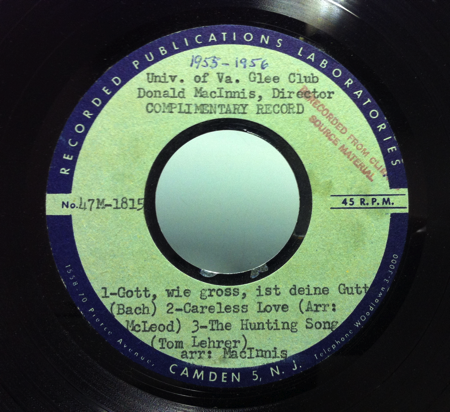
Glee Club 1956 promo acetate

There’s not a lot to say about the Virginia Glee Club in the later 1950s, seemingly. The group lost one of its more influential directors, Stephen Tuttle, to Harvard in 1952, and saw two directors alternate during the remaining years. There were tours, sure; legend has it there were even panty raids on other campuses. But no LP survives from the period between 1952 for almost 20 years; no big commissioned work exists; nothing remains but a bunch of concert programs.

Except this. The image above is of an acetate recording that was made as a promo record and sent to radio stations. Seems that Donald MacInnis didn’t spend much time with his group recording because they spent time trying to get on live radio. We know they were broadcast on WTVR radio, probably as a result of this acetate.

(Aside: an “acetate” is actually made of aluminum—or, in the WWII years, glass—coated with a thin layer of lacquer. You could cut one live, and some did, but you could also copy prerecorded music onto it. It was common to use acetates for promotional recordings when the number of playbacks was unlikely to be high. You can see the aluminum under the black lacquer of this disk around the hole of the record.)

The repertoire on the disk is interesting, too. The Bach is pretty straightforward, but it’s followed up by a downright woozy version of “Careless Love,” and then by MacInnis’s own version of Tom Lehrer’sThe Hunting Song.” I’m trying to imagine that on a Glee Club program today. In fact, I’d pay money to see this paean to hunting, in which the protagonist bags 7 hunters, two game wardens, and a cow, on a modern day program.

It’s a fun recording, albeit short, at around 6 and a half minutes. 

Cousin Frantz

NewImage

As these things tend to go, my Virginia Glee Club history project has ebbs and flows. Sometimes there’s not a lot to write about; sometimes there’s too much. Like this past week, when I nailed down the identity of a few presidents of the Glee Club and discovered one was a third cousin.

I should have known that when I found someone named Frantz Hershey, he would turn out to be a relative. It turns out that not only do I know him, I have him in my genealogy. Ezra Frantz Hershey, Jr. was the president of the Glee Club in 1938–1939; he was also the son of E.F. Hershey, first cousin of Milton Hershey and treasurer of the Hershey Chocolate Company for over 40 years. Frantz is therefore my third cousin, twice removed.

As they say, you can’t make this stuff up.

I also confirmed Dan Vincent and Thad Polk as presidents of the Club in 1984-85 and 1985-86, thanks to a newly available Cavalier Daily article that showed up in Google News since the last time I checked. Surprisingly, even with those discoveries, I know less about the 1980s presidents than almost any other decade: I’m still missing information about 1980–81, 1981–82, and 1986–87. Always more work to do…

1938 Virginia Football Songbook

Footballsongs 1938

Amidst disappointing news from the University of Virginia this week, I received an unexpected pleasure in the mail today: a 1938 University song book meant for football games and boxing matches.

As with the 1911 song book I posted about a few years ago, this one contains the lyrics (but no music) to commonly known songs for the student body to sing at sporting events. Unlike the previous edition, 27 years later the repertoire had shrunk to just four songs: “Virginia, Hail, All Hail,” “The Cavalier Song,” “Hike, Virginia” (with the Carolina lyrics), and of course “The Good Old Song”–first and second verse.

The advertisers list had shrunk too. The sponsoring businesses were just two: Bruton’s Barber Shop (Charlottesville’s Finest!) and Valley View Greenhouses, both near what is now the Downtown Mall.

For me, as with the previous version, it makes me happy to think about generations past of UVa students singing these song at sporting events. The full photo set is on Flickr: enjoy!

“Must be able to carry a tune”

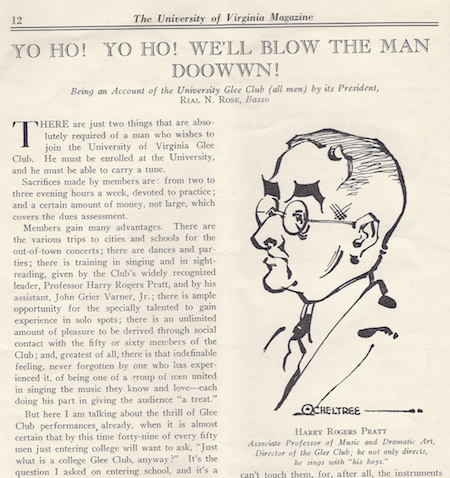
1935uvamag

In the process of putting together the Virginia Glee Club Wiki, containing the history of that illustrious 171-year-old assemblage, I’ve made my way through just about every official archive of Glee Club history. But there are gaps to be filled, so I’ve resorted to eBay. I’ve picked up yearbooks, magazines, and other ephemera trying to find information on missing years. And in the process, I’ve gotten hooked on the convenience and the thrill of it all. I’ve also grown a little blasé about it, paradoxically enough–one too many speculative purchases of Virginiana has ended in a cold trail, historically speaking.

So I wasn’t expecting much when I won an auction for the September 1935 edition of the University of Virginia Magazine (winning bid: $1.50). To my surprise, though, I hit pay dirt. This was the “new student” issue of the magazine, and it featured essays from each of the leaders of the (non-fraternity) student groups introducing to prospective students such Virginia institutions as Corks & Curls, the UVA Band, the Jefferson Society …. and the Glee Club.

I’ve posted the top half of the article above, including a pretty fair pen-and-ink caricature of the Club’s raconteur director from the 1930s, Harry Rogers Pratt. The rest of the article and a transcription have been posted to the wiki on the biography page of its author, Glee Club president Rial Rose. The article is pretty modest about the group’s requirements and ambitions:

There are just two things that are absolutely required of a man who wishes to join the University of Virginia Glee Club. He must be enrolled at the University, and he must be able to carry a tune.

But Rose does a spectacular job of defining the college glee club of the 1930s and painting a picture of what’s involved:

Now, a College Glee Club, in these days, is a very ambitious organization. It attempts to combine the best of all these various kinds of music. The religious and folk music of the negroes and Cossacks appear on the same programs with the popular and “pretty” music of the “Pennsylvanians,” and with the strong, soul-stirring music of the great composers. In 1934-35, for instance, the University Glee Club sang music of America, England, Germany, Russia, Finland, the Netherlands, and the Latin Church, while a quartet sang negro songs, on a typically arranged program. And, not content with merely singing the music, we attempted to perform it nearly as possible in the various styles of the peoples it represented.

For me, this is what’s so fascinating about the history of this group. Save for one or two phrases, this could be a description of the Glee Club I sang in, or the one that is under the direction of Frank Albinder today. But then in the middle, there’s that reminder that the Glee Club, like the University, was a creature of its times: “negro songs.”  At least this incarnation of the Glee Club wasn’t performing them in blackface.