The Glee Club Army at 145

13043393_10153584686551551_4189140640567859727_n

I’m still coming down off the high of last weekend. What an amazing 145th anniversary celebration for the Virginia Glee Club. And yet it was comfortable and relaxed in a way that I didn’t think it could possibly have been. We had friends and family there, and alums from the early 1950s all the way up through last year in attendance.

Things that were surprisingly great: having older fossils (and Glee Club honorary grandmother Bonnie Ford!) in the Glee Club House on Friday night, and not having the house fall down under her; in fact, the house didn’t even smell bad. Showing up as alums for the party with a keg and a dozen College Inn pizzas. Watching the eyes of the older alums light up as they experienced the magic of “songs on the bar.”

Getting up early on Saturday morning and watching the Lawn wake up, then watching all the alums spontaneously appear. Don Loach showing real fire as he led us briskly through “Hark, all ye lovely saints” and two numbers from “Summer Songs.” Singing the first movement of Testament of Freedom with alums from seven decades. Watching John Liepold absorb what Club tradition had done to “Winter Song,” which he introduced into active repertoire almost 25 years ago, then conveying everything he wanted done with rubato and dynamic without saying a single word. Singing the James Erb “Shenandoah” facing the back of the hall and hearing John’s occasional finger snaps clarifying the beat as we listened closely to each other. Singing the Shaw/Parker “What Shall We Do With the Drunken Sailor” at maximum velocity and finding it lay ready for me, more than 20 years after we toured it. Hearing the conductors trade stories about having sung with Shaw. And doing the Biebl with over a hundred current Glee Club members and alums.

Marching a crowd of alums over to the Small Special Collections Library and watching them absorb a small portion of the treasures from the Glee Club’s archives there. Seeing Tyler along with a crowd of 1990s alums at the Biltmore. Choking up during Don Webb’s toast at the banquet. Watching the current Virginia Gentlemen sing “Perfidia” with three alums from the 1950s, including two of the original eight members. Jumping up with them and the current Club to perform “Shenandoah” as an entire Glee Club army.

I’ll post more but wanted to get a few thoughts out today. And the great thing is that we get to do it again in five years!

Librarians of note

There have been two interesting appointments (or proposed appointments) in the world of librarians recently, one at the Library of Congress and one at the University of Virginia. Interestingly, both appointments revolve around the transformation of libraries from physical to digital.

First, UVA’s selection of John Unsworth as the next University Librarian and Dean of Libraries (UVA Today, Cavalier Daily). Unsworth’s selection makes sense on a number of levels. Back when I was an undergraduate, he was a founder of digital library sciences and the use of digital technologies in research at UVa with the Institute for Advanced Technology in the Humanities. More recently, as the dean of libraries at Brandeis he oversaw a large library system. Interestingly, from the CD article, it seems he’s stepping into a student-led debate over the role of libraries and the transition from physical to digital, with students protesting the sending of books from the stacks to long-term storage. I can’t think of too many other people I’d like to have thinking through the considerations in that debate.

Second, President Obama’s nominee for Librarian of Congress, Carla D. Hayden, got her Senate hearing yesterday (New York Times, Washington Post). As expected, the nominee’s bona fides as both a librarian and her capabilities in extending libraries into the digital future went unchallenged by the committee, though the relationship of the Copyright Office to the LOC was raised as a possible issue. Her smooth hearing was a nice update to her previous history in 2004 with the federal government, when in her role as head of the ALA she went toe to toe with then-Attorney General John Ashcroft over the library records provision in Section 215 of the PATRIOT Act. In fact, aside from the usual partisan carping in right wing blog circles, there seems to be remarkably little argument with the position that Dr. Hayden is precisely the right candidate for the job.

Why do issues of digital literacy and concerns about transitioning to digital humanities figure so largely in both these selections? I’d argue that they are the right questions for all libraries and other professions which rely on data, which these days includes just about … everyone.

The Glee Club on Founders Day, 1943-1993

13002345_10102653046829696_1055916147325180702_o
The Virginia Glee Club meeting Bill and Hillary Clinton at the Jefferson Memorial, Founders Day, 1993 (Thomas Jefferson’s 250th birthday)

The Virginia Glee Club has a long history with the celebration of Founder’s Day, the anniversary of the birth of Thomas Jefferson, founder of the University of Virginia. While the Glee Club does not dress up in purple robes for dawn rituals (at least, not that we’re aware of), the group has been associated with the holiday for decades, and some of the Club’s most significant moments date to Founder’s Day celebrations. A few examples are below.

1943: The Testament of Freedom

Concert program from the 1943 premiere of Randall Thompson's Testament of Freedom
Concert program from the 1943 premiere of Randall Thompson’s Testament of Freedom

The 1943 Founder’s Day concert was one of the Glee Club’s earliest Founder’s Day triumphs. The Club’s 1930s impresario, Harry Rogers Pratt, had resigned as director in 1942 to contribute to the war effort, and Randall Thompson, the head of the music department, had stepped in. He also brought along one of his young professors, Stephen Tuttle, who would become the permanent director of the Glee Club in 1943. Thompson was approached by the president of the University, John Lloyd Newcomb, to write a work for the celebration of Jefferson’s birthday. He responded with The Testament of Freedom, which set passages of Jefferson’s writing to music for men’s chorus and orchestra, and dedicated it to the Virginia Glee Club.

The first performance was recorded by CBS for nationwide broadcast, since the work’s text provided an uplifting message of patriotism and resolve, and it was subsequently transmitted over shortwave to Allied servicemen stationed in Europe.

1976: Founder’s Day Bicentennial

Bicentennial Founder's Day concert program
Bicentennial Founder’s Day concert program

The Testament continued to be an important part of the Glee Club’s repertoire—it appears on 1972’s A Shadow’s on the Sundial—and reappeared with some frequency at Founder’s Day concerts. One such occurrence was in 1976, when Club performed the work at the University on the Bicentennial Founder’s Day alongside Elliott Carter’s “Emblems.” This wasn’t the first time the group performed the work; they had previously sung it with the Norfolk Symphony and at the Kennedy Center.

1981: Seven Society award and donation

Letter from the Seven Society announcing a donation to the Glee Club tour fund

By 1981, the Glee Club had undertaken three international tours in less than a decade and was starting to see the necessity of establishing a fund to support members who could not afford to pay their own way. In the late 1970s the Glee Club endowment had been established to support touring activities, and it received a boost in 1981 when the Seven Society, following their award of the James E. Sargeant Award to the Glee Club (given for organizations who made outstanding contributions to the University), made a donation to the fund of $777.77.

1993: Thomas Jefferson’s 250th Birthday

Probably the most spectacular Founder’s Day (other than 1943) was the 1993 celebration of Thomas Jefferson’s 250th Birthday. On that day the Glee Club rolled out of bed early, put on our orange and blue ties, khakis and blue blazers, and took a bus up the mountain to Monticello to join a live broadcast of the Today Show. There we stood on risers in the pre-dawn moonlight with Jefferson’s home in the background and sang several numbers from Neely Bruce’s “Young T.J.,” commissioned for the day.

There was a certain amount of standing around and waiting, and at one point several of us had to make a trip to the restroom, where we found ourselves standing next to Willard Scott making awkward small talk. A few guys had an encounter with another Today Show personality when they met UVA alumna Katie Couric after the taping and gave her a VMHLB hat.

12998595_10102653037807776_3649697776534045070_n

12973128_10102653038052286_2230707243040167663_o

After Monticello, everyone piled into the bus (and an overflow car) and drove like crazy. We only had two hours to get to DC and the Jefferson Memorial, where we were to sing for the President. Traffic mostly cooperated and we arrived later than planned but in time to sing in the ceremony. I’ve written about that part of the day before.

We closed the day with a bus ride to Richmond, where we sang for a group of UVA donors at the Jefferson Hotel, somehow changing into our tuxedoes somewhere along the way.

Finding no takers

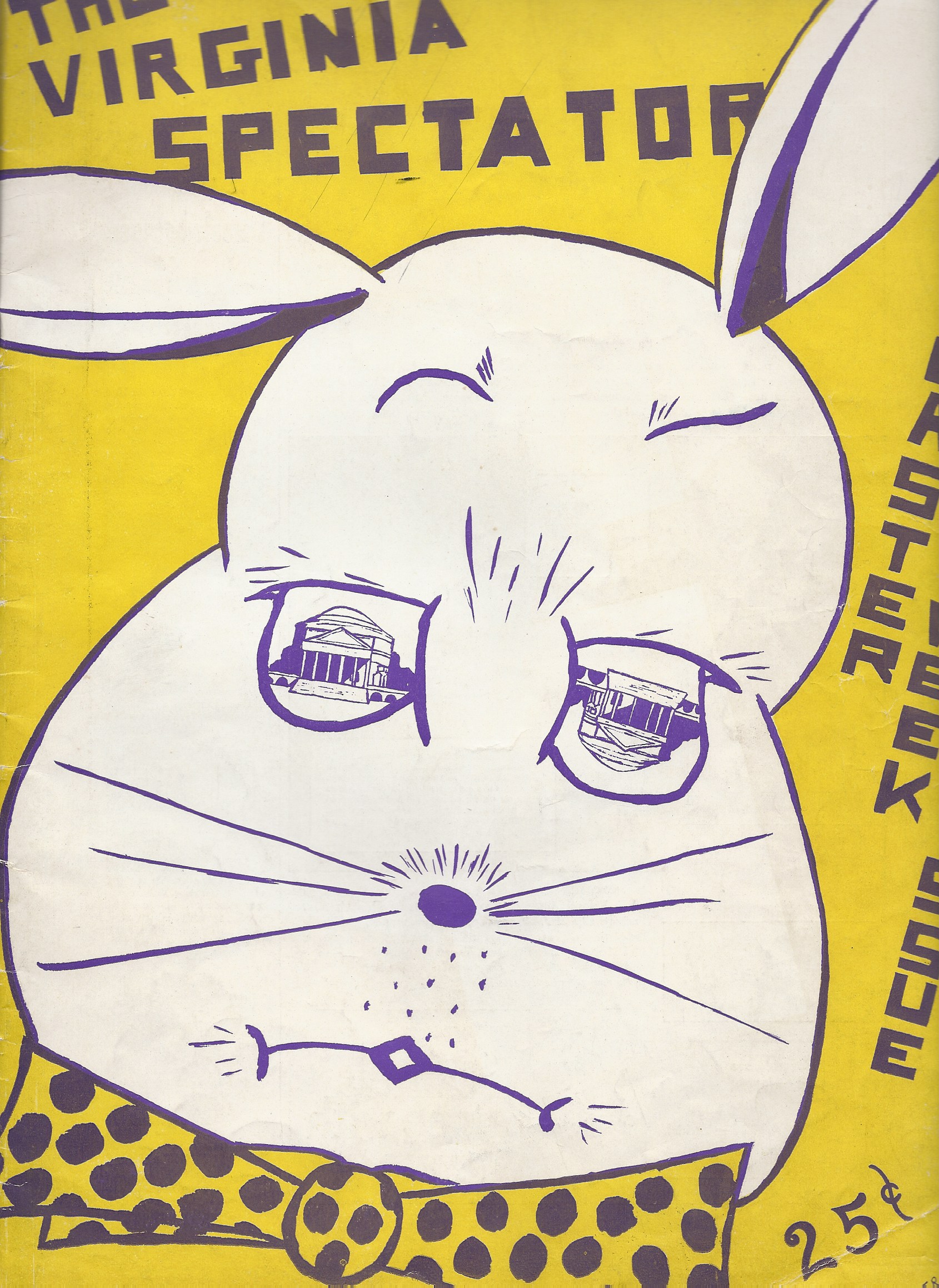
WaltKelly_VirginiaSpectator_Feb1952_100

Doing my look back post, I found one link I never followed up, in which I talked about a plan to restore the Pavilion gardens (wonder what happened to that?), and noted a rare Walt Kelly cover for the Virginia Spectator that I had seen reproduced in black and white but not (yet) in color. In the intervening years, fantastic Pogo blog Whirled of Kelly posted a high resolution scan of the cover, which I include here to close the loop on my reference all those years ago.

This is one of two issues of the University of Virginia’s magazine (variously titled the Spectator, the Virginia University Magazine, etc.) for which I would pay a high high price. The other, of course, would be a copy of the January 1871 edition that gives us the founding date for the Virginia Glee Club.

That strange fragile feeling

This has been a winter of illness, unusually so for me. Between Thanksgiving and New Years I was down for almost six weeks with a hacking cough that started with a week of fever and was so hard-pressed to clear stuff from my lungs that I ended up fracturing (or at least pulling) a rib. And now at the end of the winter or beginning of spring I was laid low for several days with another fever + upper respiratory condition, just in time for Easter.

And man, I had forgotten how logy I get when I have a fever. I’m three days on from the last fever and still tired around the edges.

It reminds me of the summer after my third year at the University of Virginia. I had just finished my first summer away from home, doing a lab internship, and I headed back to my family home and slept. For like a day. That in itself was not so unusual, but the fever was. The doctor confirmed that I had finally contracted mono. My third year roommate had had a bad case of it before we went home for break, so apparently it incubated over the summer and then started out slowly.

The end result was brutal. I had enough energy to do a few things, if I forced myself, but then had to sleep for hours. I pulled myself together well enough to get back to the University of Virginia, where the truly painful part of the sickness revealed itself: I was going to have to tough it out without air conditioning, since I was living that fall in a Lawn room in Mr. Jefferson’s original part of the University Grounds. So there were a great many afternoons spent exhausted, sweating, sleepless. And, reinforcing the ambience, I was reading Gabriel Garcia Marquez’s The General In His Labyrinth, about Simón Bolívar’s dying journey down the Magdalena River. Languishing in the August (and September) Charlottesville heat, I felt as the Liberator must have felt.

I still feel little echoes of that day any time I spend more than a few days sick, as though I’m preparing to return to that sweat-dampened bed with barely enough energy to stand. At this point in my life I know that one day, I hope many years from now, it’ll be a return for good. These illnesses, inconsequential as they are, are just brief glimpses of that ultimate end.

—And that’s why men have a reputation for being bad patients.

Fossils on the bench

As I celebrate the appointment of a fellow Glee Club alum to the bench of the fifth judicial district in Virginia, I thought it would be fun to take a look at the company he joins of fossils who’ve been judges.

John W.G. Blackstone (1879–1880 season). Blackstone (1858–1911) was one of the more notable politicians of the 1879–1880 class (Wilson aside), serving in the Virginia State Senate from 1884 to 1896 when he was appointed the county judge for Accomac and serving as a judge on the Eighth and Eleventh Judicial Circuits until his retirement in 1908.

Oliver Whitehead Catchings (1891–1892 season). At Virginia, he was a law student, captain and quarterback of the football team, member of Phi Kappa Psi, the Z Society and Eli Banana, and editor of both Corks and Curls and College Topics. He completed law school at Virginia and practiced law in Washington, DC while his father, Thomas Clendinen Catchings, was in Congress, then returned with his father to Vicksburg to establish the practice of Catchings & Catchings. He was appointed judge of the 9th Mississippi District in 1905, and died unexpectedly of heart disease in 1916.

Duncan Lawrence Groner (between 1894 and 1896). As Wikipedia records, Groner served as a judge of the Eastern District of Virginia and as chief justice for the United States Court of Appeals for the DC Circuit, as well as serving six years in the United States Senate for Virginia.

George Latham Fletcher (seasons between 1895 and 1898, music director 1897–1898). A member of the Z Society and Eli Banana, he practiced law, served as judge of the 28th Judicial Circuit of Virginia in Warrenton, and served two terms as a state senator. Possibly the most memorable case over which he presided as judge was the divorce of future Duchess of Windsor Wallis Simpson from her first husband, in 1927.

Frederick Garner Duval (1905–1906 season). A member of T.I.L.K.A. and the dramatic troupe the Arcadians while at Virginia, Duval was an attorney in Alexandria and later became civil police justice there.

Sheffey Lewis Devier (1917–1918 season). Devier practiced law in Harrisonburg, and served as both a justice of the peace and judge of the juvenile and domestic relations court for Rockingham County. He later served a term as mayor of Harrisonburg.

Absalom Nelson Waller (from 1922 to 1925). Vice president of the Glee Club, he served as a county judge in Spotsylvania County for 32 years.

Robert Fitzgerald (1939–1940 season). An engineering student at Virginia, he served in the US Marine Corps during World War II at the Pacific front and and was discharged a second lieutenant. He practiced law in Falls Church, was appointed a trial judge in Fairfax County, and was later elected to the Virginia Senate.

Charles Stevens Russell (from 1945 to 1948). A Raven, he was appointed to the Seventeenth Judicial Court of Virginia in 1962, and served there until he joined the Virginia Supreme Court in 1982, retiring in 1991.

Edward Earle Zehmer (from 1949 to 1951). Another Marine, Zehmer practiced law for 23 years before his appointment to the First District Court of Appeal in Florida in 1983.

There are probably other still-living Glee Club fossils who sit on the bench, but those are the ones we know of for now. So my friend is in very good company!

The fabric of the University

 
Members and alumni of the Virginia Glee Club have contributed many things to the University, from musical theater to classical performances to “The Good Old Song.” But until this weekend I didn’t know that they had also contributed a piece of the University’s facilities.

I read through the 1905 edition of Corks and Curls in the San Francisco airport Friday morning. (I know, I know: the high life.) I found a page on the 1904-1905 Glee Club that I had previously missed. It listed two Humes, Howard and John, as among the officers of the combined Glee and Mandolin Clubs. Over the weekend I did some research on them.

Howard Hume, it turns out, was quite the adventurer. A physician, he got an officers’ commission in the Army Reserves in 1913 and went to Europe as a surgeon attached to the British Army during World War I. He was head of surgery and later head of the hospital at a series of camps, forts and other army posts for the next few years, even spending a few years on Corregidor in the 1930s. He continued to serve in Army hospitals across the American south in his early 60s during World War II.

His brother John Edmund Norris Hume worked as an engineer for GE. We know less about his background, except for one sentence in the finding note for the archives of the president of the University, John Newcomb: “J.E.N. Hume-Memorial Fountain.”

John and Howard were the sons of Frank Hume, Civil War veteran and noted producer of whiskey in Alexandria at the turn of the century. And apparently John was the major donor for the fountain and wall—the Hume Memorial Fountain, with its whispering wall—that once sat in front of Monroe Hall and now is at the end of Newcomb Plaza.

So Glee Club alumni have contributed not only song, but also physical monuments to the University.

Virginia secret societies and North Korea

On Sunday, details emerged in the case of Otto Warmbier, a University of Virginia student being detained in North Korea after an arrest two months ago as he prepared to depart the country. In a televised press conference, Warmbier confessed to attempting to steal a banner bearing a North Korean revolutionary slogan. He apologized for his “severe” crime and said that he was encouraged to commit the crime by the Friendship United Methodist Church, the Z Society, and the CIA. He begged for mercy, saying, “I beg that you see how I was used and manipulated. My reward for my crime was so much smaller than the rewards that the Z Society and the Friendship United Methodist Church get from the United States administration.”

Let me be clear: I’m very worried for Warmbier and don’t mean to make fun of his captivity, and hope he is returned soon. But to be honest, were the stakes not so high, this would read like world class trolling. For one thing, it’s pretty unlikely that the UMC is involved in funding petty theft of the sort practiced by university students with road signs on their walls all over the world. But what is the likelihood that the Z Society is involved?

Answer: pretty low. While you can choose to accept or not the Z Society’s denial of contact with Warmbier, the likelihood of their encouraging international hooliganism is quite low. The Z Society has always been the most staid of the University’s semi-secret societies, especially when compared with Eli Banana and their tradition of public processions with a huge bass drum, or the IMPs and their devil costumes and pyromania (not to mention their predecessors’ fun with taxidermy).

So: I think Warmbier is being forced to confess to his crime by a North Korean government that employs scriptwriters with overactive imaginations and inadequate research. If you’re going to frame an undergraduate for espionage, at least blame the right secret society.

Hot Feet: Lewis D. Crenshaw

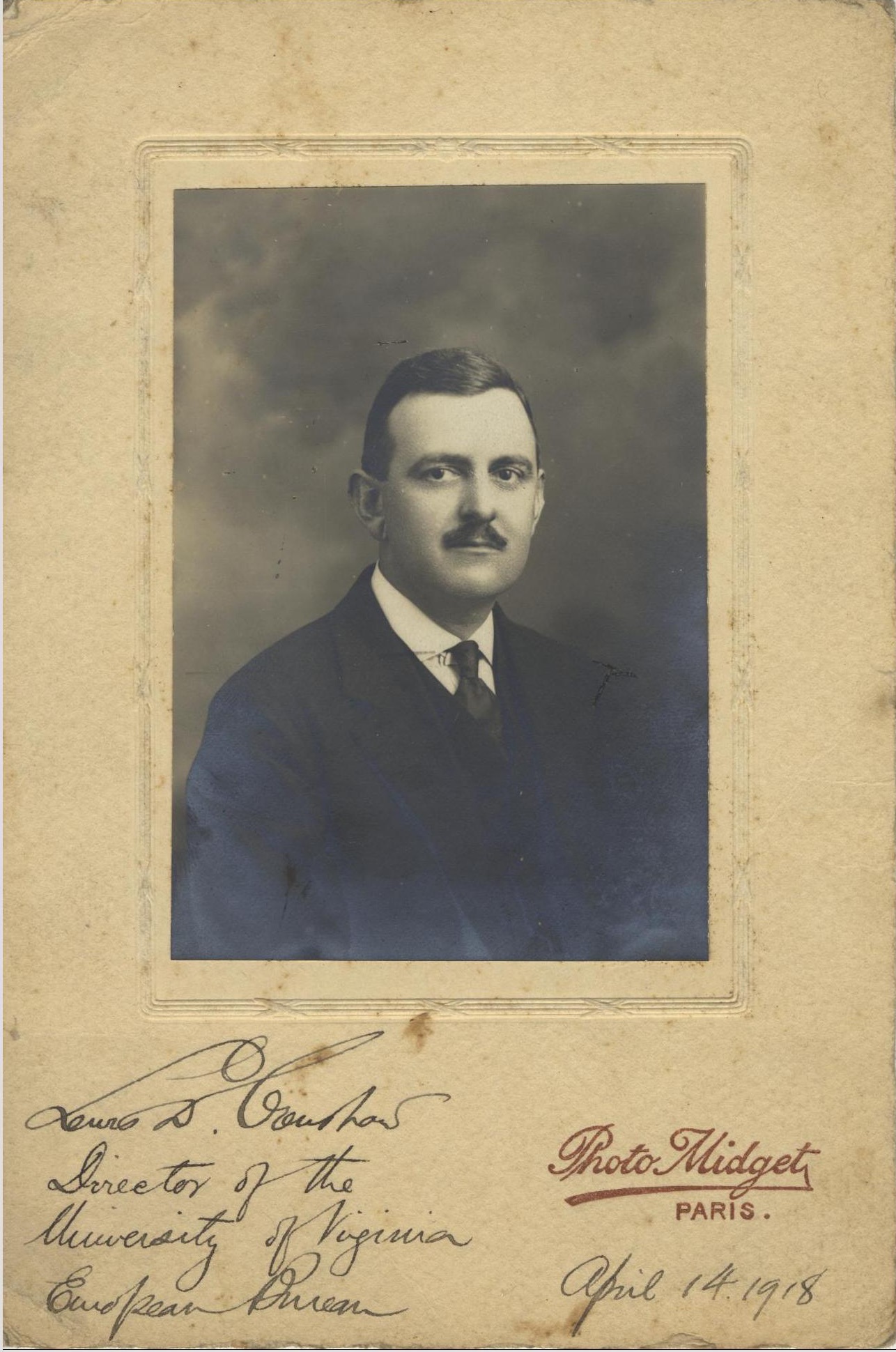
Lewis Dabney Crenshaw, Paris 1918, courtesy UVA Special Collections.

On an airplane flight yesterday that had (extremely slow) WiFi, I did a little research and came across some more information about Lewis D. Crenshaw, the UVa alum who co-authored the football song “Hike, Virginia” and put together the first modern UVa reunions in 1914.

I remain awed by his tireless energy as UVA Alumni Association Secretary, particularly by his work as the director of the University’s European Bureau during World War I. But I hadn’t fully appreciated his student involvement. In a career that included a law degree, he was at one time or another a member of Delta Tau Delta, Phi Delta Phi, Lambda Pi, the O.W.L., P.K., the Raven Society, vice-president of the Arcadians, on the board of the Athletic Association, and King of the Hot Feet.

If that last one doesn’t resonate with you, the Hot Feet were the predecessor group of the University’s IMP Society, given to elaborate rituals and a certain degree of hooliganism. According to University historian Virginius Dabney, they were apparently disbanded after a 1911 prank:

One of their more raucous nighttime performances consisted of removing the stuffed animals, snakes, and other varmints from the Cabell Hall basement, where they were stored, and stationing them behind the professors’ classroom desks and in front of their residences on the Lawn. This assemblage, which included a kangaroo, a tiger, an ostrich, a moose, boa constrictor, threetoed emu, and other animals, fowls, and reptiles, greeted the dumbfounded citizenry on Easter Sunday morning. On top of this, some well-lubricated Hot Feet bulled their way into a student’s room, roughed him up, and carried off a beer stein.

But at the time of Crenshaw’s Kingship, the Hot Feet were known mostly for their elaborate public coronations, costumes, and their public singing. Bringing it back to the Glee Club, the tune of their “Hot Feet Song” is the tune to the football song “Hike, Virginia”—unsurprising, given that both Crenshaw and his co-author Charles S. McVeigh were Hot Feet!

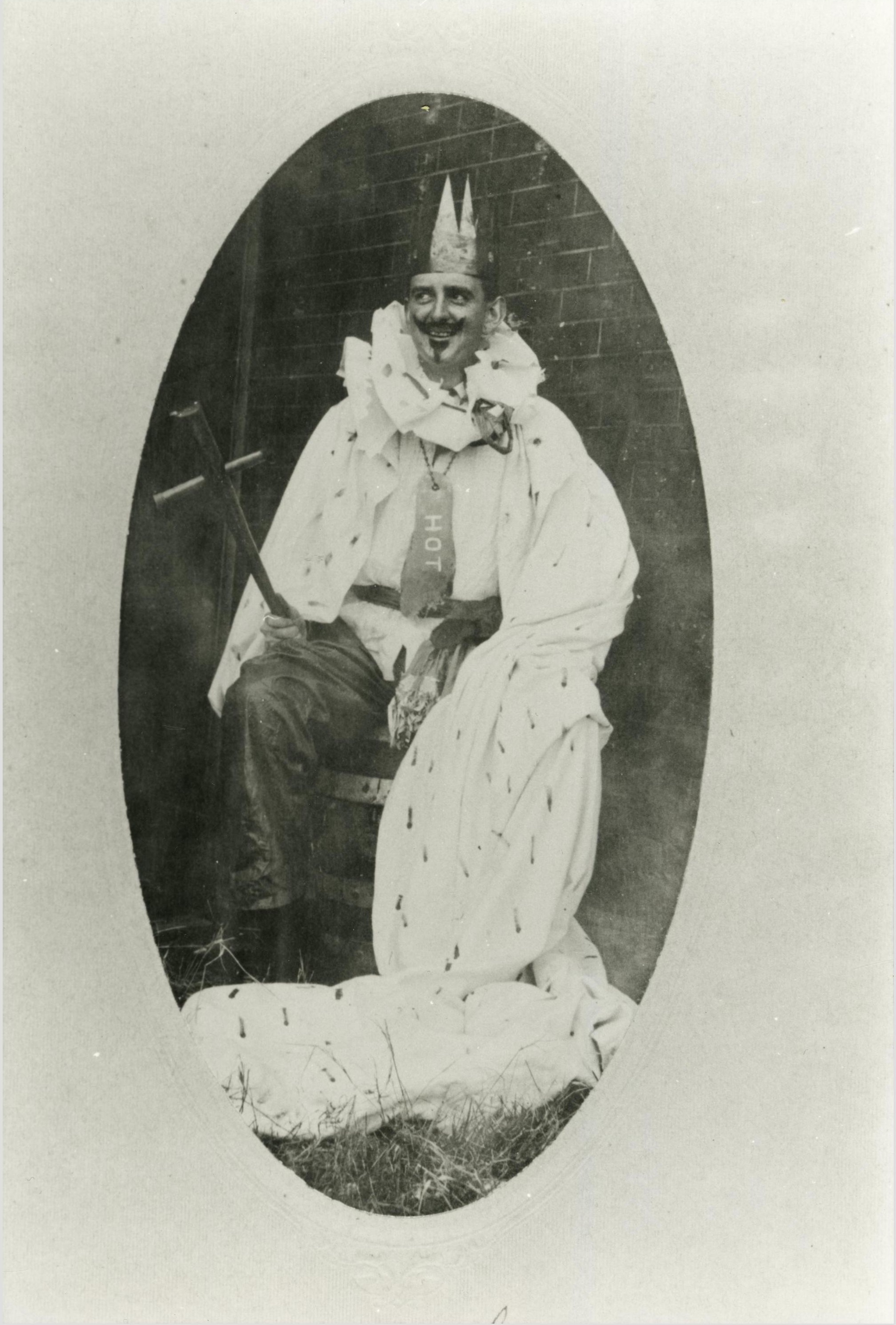
I close with an image of Crenshaw in full “King of the Hot Feet” regalia, presumably dating from long after his Kingship. I will say this: whatever the mischief that the Hot Feet got into, it looks like they had a hell of a lot of fun.

lewisDabneyCrenshaw_HotFeet

The first Glee Club reunion

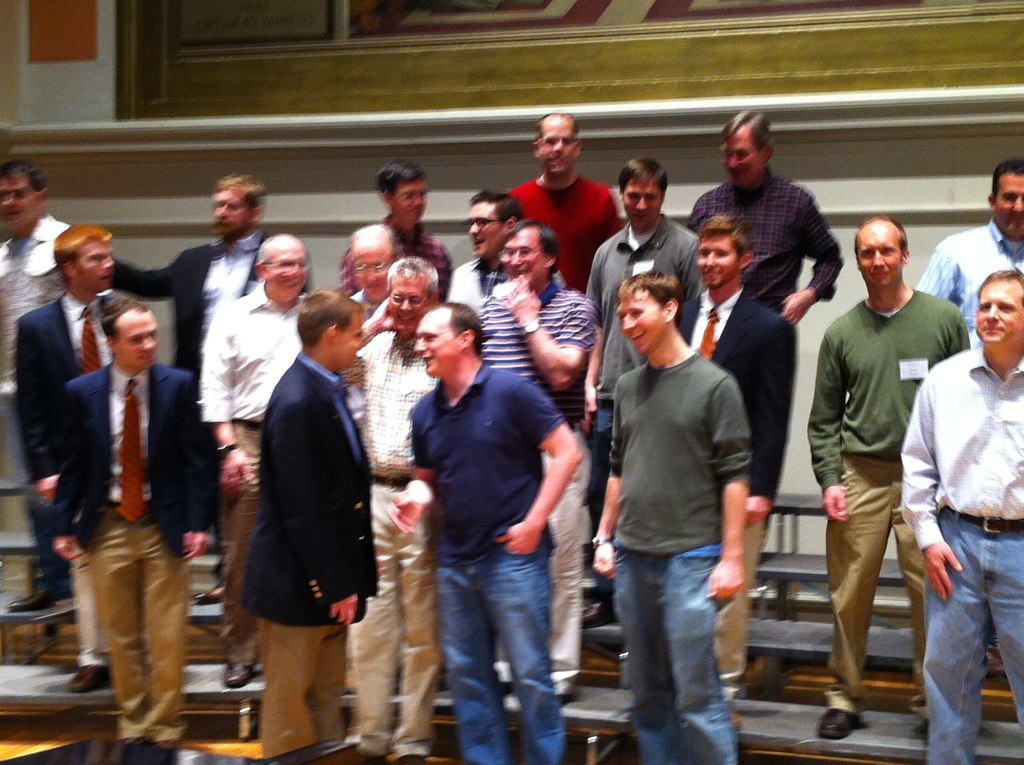
Virginia Glee Club presidents at the 140th anniversary alumni sing (2011) — photo courtesy Jeff Slutzky

We’re in the run-up to the Virginia Glee Club 145th Anniversary Reunion, and that has me thinking about the history of Glee Club reunions.

The earliest record of Glee Club involvement in a reunion activity predates both the Glee Club as a well-established organization and formal reunions at the University of Virginia. In an article published in the Virginia University Magazine in October 1882 describing the final exercises of the previous June, this description occurs:

In the afternoon came the Alumni dinner whereat many of the young initiates forgot themselves and waxed uproarious–especially to be noticed was a sober minded one who insisted on drinking to the health of the “Glee Club” after every song in which performances his stentorian lungs did effective service.

So before there were Glee Club reunions, there were alumni at University functions who were involved with the Glee Club.

The next reunion was likely the 50th Anniversary concert in 1936. I say “likely” because we don’t have a record of an actual reunion event, but we do have evidence that there was going to be, thanks to the listing of the Glee Club’s Alumni Advisory Board in the 1935 Annual Concert program.

After that the record is murky. The next one for which we have a record is the 125th Anniversary in 1996 (in between these two we changed the founding date from 1886 to 1871 based on better evidence). This established the format for future reunions: a Glee Club performance, an alumni sing, a banquet.

Regular five year reunions began in 2006 with the establishment of the Virginia Glee Club Alumni and Friends Association and the 135th anniversary. Reunions have followed at five year intervals since then. If you haven’t done so, it’s fun to check out the photos, video, and audio from the 140th.

“In the evening, by the moonlight”

1938-virginiaspectator-1
Cover to the April 1938 issue of the Virginia Spectator

I had a lucky eBay find last week: a copy of the April 1938 issue of the Virginia Spectator, the successor to the University of Virginia Magazine and the original University of Virginia literary mag. These magazines aren’t especially valuable, though they only turn up infrequently. What made this one stand out was an article by a Virginia Glee Club member, Daniel Jenkins, about the state of song at the University.

Jenkins is an alum I’ve known about for some time. When I was an undergrad, he sent us a letter about his experience as a Glee Club member in the 1930s. I subsequently discovered that he had been a member of the Tin Can Quartet (which I wrote about a while ago) He is, I believe, still with us and still supporting the Glee Club’s endeavors, though I don’t know much about his whereabouts.

This article provides one of the earliest existing descriptions of Glee Club alumni singing:

On Saturday nights of Finals, however, a minor miracle took place. Gathered in and around a certain room on East Lawn were a goodly number of dark conspirators; six members of the class of 1912 had slipped away from their comrades, bearing with them a huge Mason jar containing a mint julep, and were on their way to join the group lurking in the shadows of East Lawn. Three members of the Tin Can Quartet, a dozen members of the Glee Club, past and present, and an odd assortment of dates waited expectantly as the six alumni approached. And then, a short five minutes later—ah, shades of the mighty Caruso!—it had been a long year—the soft, harmonious tones of “Sweet Adeline” once again rolled up and down the Lawn. The same moon shimmered through the trees and the same purple shadows mingled with the ghostly figures that stood grouped beneath a stately oak. A prominent and dignified New York attorney gazed up at the stars and hit notes of which he had never before believed himself capable. A notorious “big business man” drowned the sorrows of a troubled world in his Mason jar and gazed down at the green sod beneath his feet, rumbling a potent bass that seemed to mingle with the very roots of the mighty oak which towered above him.

For three hours the singing continued. They sang every song that ever graced a barbershop of old. Juleps were plentiful and so were first tenors—happy coincidence. But finally, at four o’clock in the morning, and when voices were so hoarse that anything above a whisper was an effort, the small crowd began to break up. The six alumni, their eyes tired but shining, stumbled wearily across the Lawn, speaking in reverent tones of the song-fests that used to be so common and now are so rare. The others, lingering for a brief moment over the dregs, said good-night and went their separate ways. The Lawn was once again cloaked in silence.

I was unsurprised, but a little disappointed, to find that even this memory carried the taint of the South’s original sin, though, with the inclusion of the minstrel show song “In the Evening, By the Moonlight.” Again, a reminder that the Glee Club was like every Southern cultural institution and carried the seeds of slavery’s past with it into the twentieth century.

But the article gives me hope, too, that the power of song can still bridge generations and tap deeper reserves of humanity in the singer and the listener. It’s a timely reminder, given the Glee Club’s upcoming 145th Reunion celebration in April. I hope the juleps are plentiful then too.

Glee Club history: Edward Addison Craighill Jr.

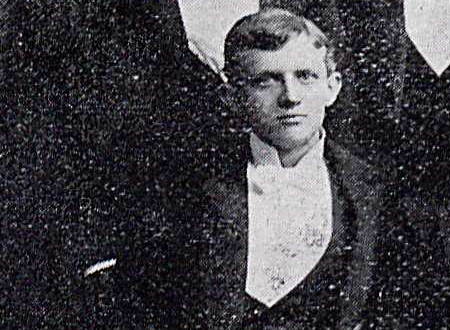
E.A. Craighill, 1893 Corks and Curls

I’ve written a few times about one of the Virginia Glee Club’s more notable alumni, Edward Addison Craighill, Jr., who is principally credited with the authorship of the “Good Old Song,” the de facto alma mater song of the University of Virginia. But I thought it might be worth looking at his life beyond this song.

Craighill was born in 1873 in Lynchburg, Virginia. His namesake, his uncle, surgeon Edward Addison Craighill, had been at age 17 the youngest doctor to serve in the Medical Department of the Confederate Army, and wrote a memoir of his experiences. Craighill entered the University of Virginia to study law in 1892, and was there to greet the football team in the fall of 1893 as they returned triumphant from a victory. Out of the crowd came what is now the first verse of “The Good Old Song.” Craighill subsequently wrote a second and, for an alumni banquet in 1910, a third verse for the song. But in a 1922 article in the University of Virginia Magazine, he disclaimed authorship of the first stanza, noting that “no one man should be credited with the authorship.” During his time at Virginia he was a member of the Virginia Glee Club and participated in the 1894 tour.

Craighill graduated in 1895 from the Academic Department and finished his law degree in 1896, gaining employment as a writer for a law encyclopedia before joining the firm of Fletcher, McCutcheon and Brown in New York. He died in 1948.

I think there’s something touching about Craighill’s insistence, 30 years after the debut of the song, that he deserved no credit for the “Good Old Song.” It’s not clear that, after the 1922 article, he was included in alumni outreach. He’s not mentioned in a 1935 “Alumni Advisory Board” that included other past presidents and luminaries of the group, for instance. But his name remains one of the most cited in Glee Club programs, and I believe he deserves more credit than he gave himself for the song. After all, in the drunken crowd that came up with “it cheers our hearts and warms our blood to hear them shout and roar,” someone had to remember the words well enough to write them down.

Winter Song

Speaking of eight years in, I missed a day of posting yesterday due to the Veracode sales kickoff, so I’m going to do a two-fer today to make up.

With the past weekend’s killer storm in DC and Charlottesville (as well as most of the rest of the mid-Atlantic), I couldn’t help but thinking about ice gnomes. One of the great fun songs of my Virginia Glee Club days was singing “The Winter Song,” an odd little tune that… well, look at the lyrics:

Ho, a song by the fire;
Pass the pipes, pass the bowl.
Ho, a song by the fire
With a skoal, with a skoal.
Ho, a song by the fire;
Pass the pipes with a skoal,

For the wolf-wind is wailing at the doorways,
And the snow drifts deep along the road,
And the ice gnomes are marching from their Norways,
And the great white cold walks abroad.

But, here by the fire, we defy frost and storm;
Ha, ha we are warm, and we have our heart’s desire.
For here, we’re good fellows, and the beechwood and the bellows;
And the cup is at the lip in the pledge of fellowship.

I had always wondered about the tune, so did a little research. Turns out “The Winter Song” is a collegiate song, but it originally comes from Dartmouth, not Virginia. The poetry collection Dartmouth Lyrics prints the poem “Hanover Winter Song” by Richard Hovey, who in 1898 convinced his college friend Frederic Field Bullard to write the music.

The tune lived on in Dartmouth fraternity singing, until that tradition died away, and in Dartmouth singing groups such as the Aires. But it took John Liepold to bring it to the University of Virginia, where it’s become a favorite of the Glee Club.

The Grass-Hopper Cantata

grasshopper

Every now and then, in the course of researching the Virginia Glee Club’s history, I find myself following up loose threads that take me to some unusual places. This week I paged through old issues of the Madison Hall Notes, the weekly journal of the University of Virginia YMCA. The journal was published from around 1905 through about the start of the first World War, at the height of the Y’s influence over the student body, and contain a wealth of information about student life—including the Glee Club.

During this period, the Glee Club ebbed and flowed, but during three of its most active years (1905-06, 1910-11, and 1915-16) it was closely associated with the YMCA, and actually rehearsed in Madison Hall. As a result, its rehearsals and performances were listed in the Madison Hall Notes. I learned about a few concerts in Lynchburg and at Sweet Briar and Hollins… and about the Grass-Hopper Cantata.

Seems that in April 1911 the Glee Club did a joint benefit for the King’s Daughters (a hospital charity) and the UVA General Athletic Association, and performed the “Grass-Hopper Cantata.” What the heck is that? Apparently an 1878 takeoff on Italian opera by Innes Randolph, which was still being performed thirty years later… There’s a copy in the University of Virginia Library for those who feel inclined to dig deeper; I am just amazed to learn such a thing existed.

The machinery of slavery

Out of the Box: Virginia Untold: Certificates of Importation. Out of the Box, the blog of the archives of the Library of Virginia, has consistently been one of my favorite reads for the windows it offers into the state – er, commonwealth – of my birth. And, honestly, into the past of our nation. Today’s post, by Greg Crawford, is a good illustration of why.

What is both fascinating and revolting about the history of slavery (and its descendants, white supremacy and institutionalized racism) is the level of legal, statutory, bureaucratic, and judicial machinery required to keep the enslavement of human beings “orderly” and “civil.” The example in this post, certificates of importation, were a bureaucratic invention that sought to ensure compliance with the law barring importation of slaves for sale into Virginia. Said law was enacted in 1778, not for humanitarian reasons, but apparently to ensure that England and British ships would not profit from the slave trade during the Revolutionary War.

(It’s worth noting that the original draft of the bill would have explicitly linked the barring of importation of slaves to the suppression of slavery more broadly. The final language of the bill contained no such linkage.)

An exception in the 1778 law permitted slave owners permanently relocating to Virginia to import their slaves to the commonwealth, provided they swore an oath that they did not intend to sell any of them. The oath became part of a legal document, the certificate of importation, that provided names, ages, and physical descriptions of the slaves, where they were acquired, and from where they were being relocated. The certificate was filed in court. (The Library of Virginia is in the process of digitizing these court documents, and they’ve made a spreadsheet of the digitized records.) If a slave was illegally brought into the commonwealth, they could sue for their freedom; the presence of the certificate of importation was a closed door to a slave seeking to escape an unfair master, but failure to file the paperwork gave the slave grounds to file a freedom suit.

To summarize: slaves imported into Virginia had to have paperwork documented by a local magistrate containing an oath from their owner and filed in their county courthouse so that they were in compliance with a Revolutionary War era law preventing British profiteering, and the absence of such paperwork allowed a slave to sue for freedom. The amount of bureaucracy devoted to the peculiar institution, of which this is only a small piece, must have been completely mindboggling. And it gives me a renewed appreciation for the artifacts of history.