Dr. Edwin S. Williams passed away last week at the age of 81. In addition to being the first Black member of the Virginia Glee Club, where he was denied service by a truck stop manager while on tour in an event leading to the desegregation of similar businesses between Charlottesville and Washington on Route 29, he was only the second Black student to graduate from the College of Arts and Sciences at the University of Virginia.
Williams’s career in medicine, following his medical degree from the Medical College of Virginia, lasted fifty years. He was a patron of the arts, supporting the Washington National Opera. And he was a reader of my book, in which I was fortunate enough to be able to tell part of his story. His niece was kind enough to let me know he had enjoyed the book; in the ultimate “small world,” she and I not both only attended UVa but also went to the same high school, where we both played in the high school orchestra.
In 2025, we are a nation that is increasingly inimical to the rights of Black people and seeking to actively dismantle measures taken to redress the many years spent denying them access to higher education. When I was growing up, it seemed unthinkable that—just a few years before my birth—my state was shutting down the public school system to resist integration. Dr. Williams entered UVa three years later. It must have seemed like unbelievable progress at the time. We must stay vigilant against attempts to regress our society to those days; as measured by the life and contributions of those like Dr. Williams, the cost of such a regression would be immeasurably high.
If one Hammond organist is good, two are somethin’ else.
Album of the Week, October 25, 2025
The way I have structured this series is inherently unfair to some of the artists I write about. Basically, unless I have the album on vinyl, I don’t write about it. This means that I’ll never write about some artists, and others will be represented by albums that don’t represent their most significant work.
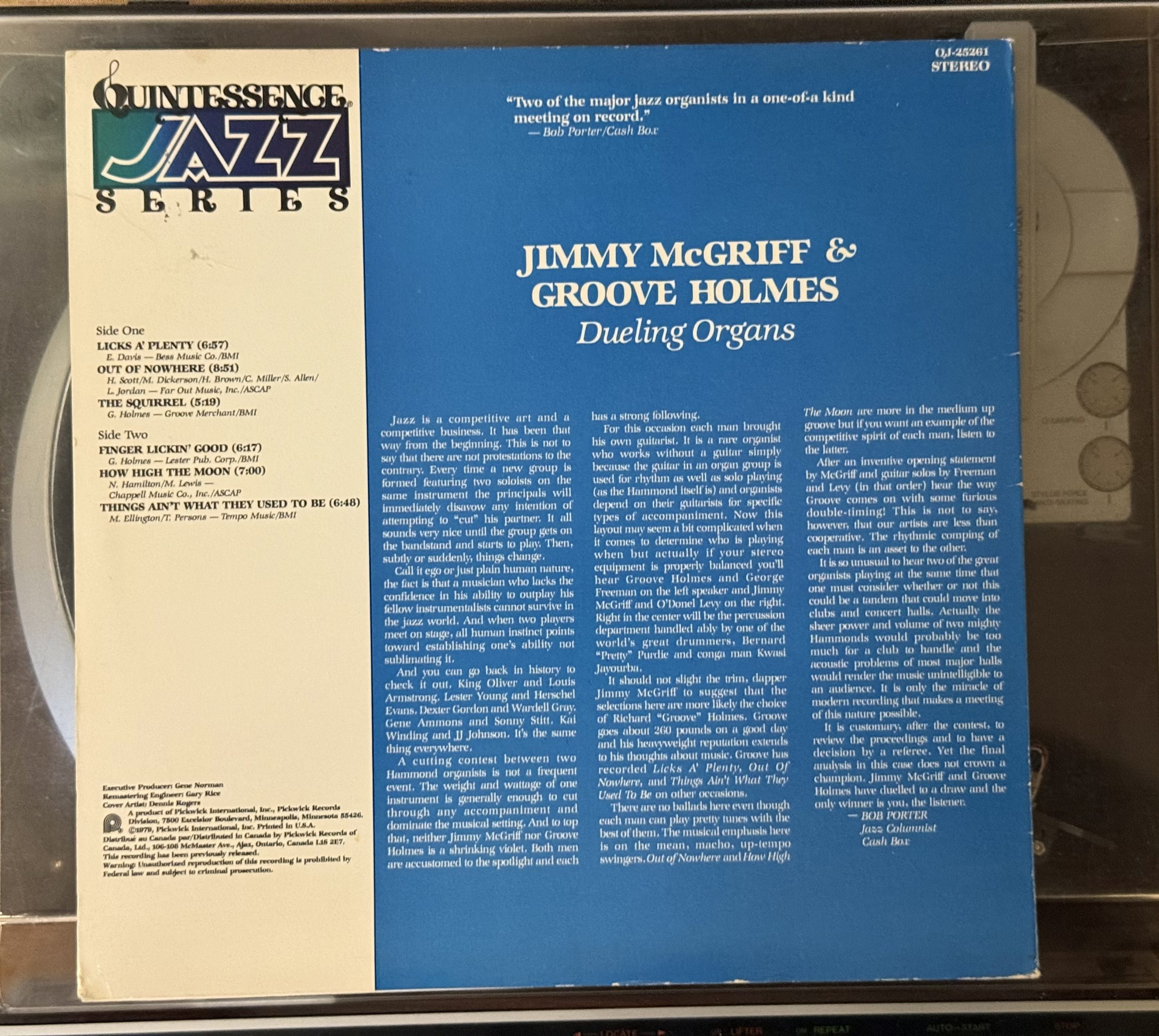
Such is the case with this week’s album. Originally released in 1973 on the famed Groove Merchant label as Giants of the Organ Come Together, it was gifted with a bizarre cover illustration and a much shorter (and inadvertently suggestive…) title when Pickwick’s subsidiary label Quintessence re-released it as part of their Quintessence Jazz Series. Both organists featured on the record had long careers of their own. Jimmy McGriff cut over sixty records on a variety of labels from the early 1960s to the early 2000s, including Blues for Mister Jimmy and Groove Grease. He got his start with the Hammond B-3 organ when he heard one played at his sister’s wedding by a man who turned out to be Richard “Groove” Holmes. Holmes had about forty records to his own credit, from 1961 to 1991 when he passed away from a heart attack; his most famous was a 1965 version of “Misty” that hit the Hot 100.
The liner notes correctly point out that recording two Hammond organs at the same time is challenging; the instrument isn’t subtle (or light), and a two-organ setup would have been challenging to mike in the studio—but still easier than getting two organs into the average nightclub or concert hall. But the producer, Sonny Lester, persevered. He placed Groove Holmes and his guitarist, George Freeman, in the left channel, and Jimmy McGriff and his guitarist, O’Donel Levy, in the right. Straight down the middle were conga player Kwasi Jayourba and redoubtable funky drummer Bernard Purdie.
“Licks A’Plenty” is what it says on the package, a battle of dueling voices. Here we hear both organists start out, followed by the mellow tones of Jimmy McGriff’s instrument and O’Donel Levy. It’s interesting to compare their approach to Jimmy Smith with Kenny Burrell; where Burrell answered Smith’s licks, Levy plays alongside McGriff, playing runs and chords as a kind of counter-solo and showing why the organist brought his own guitarist. Groove Holmes plays a series of chords and then lets George Freeman take a solo, while McGriff supports with rhythm from the other channel. Holmes returns the favor for Levy’s solo as well. There’s lots of back and forth here, with some supportive work as well as spotlights for Purdie and Jayourba, and even an Acme siren whistle at one point. Everyone appears to be simultaneously having a great time and trying to outdo his neighbor, which is what the best cutting contests are all about.
“Out of Nowhere” starts with a Jimmy McGriff solo and rolls from there, with Holmes supporting him with chord stabs at the turns of each phrase. Freeman takes a laid-back solo with repeated notes on the dominant that builds through the repetition; Levy’s no-nonsense solo is more rapid but similarly relaxed. Groove Holmes takes a solo in a higher octave that builds tension through sustained notes; McGriff does a blast of rapid vibrato that eggs him on.
“The Squirrel” is one of two tunes credited to Holmes and McGriff. It’s a tune that features the band with McGriff playing what almost amounts to commentary after each phrase. Again, Freeman builds a minimalist solo with repeated licks; Levy is positively extroverted by comparison, with notes scampering over the fretboard.
“Finger Lickin’ Good,” the other original on the album, is sadly not the song sampled by the Beastie Boys in their song of the same name, though they clearly had this album in the studio given that Check Your Head also features a song called “Groove Holmes.” But this one is an instantly recognizable classic, with chord stabs from Holmes answered by running notes from McGriff and the guitars. The band takes this cheery blues around the world, with each organist and guitarist taking a solo as the other players support them. There’s a moment at the end of the song where Holmes’s organ makes a sound as though it’s being run through a wah-wah pedal, and the whole band shifts into a hemiola as things fade out.
“How High the Moon” is as close as this record gets to a ballad, with both organists playing swoony turns on the classic melody. Holmes in particular shines here with a solo that swoops up into the high corners of the tune. The record concludes with a briskly virtuosic take on “Things Ain’t What They Used to Be,” replete with stabs on the organ from Holmes, laid back licks from McGriff and Levy, and a bluesy guitar solo from Freeman. Groove Holmes takes a full twelve bars of tremolo that builds to a screaming climax, then trades licks with McGriff all the way to the end.
Under whatever name you refer to this collaboration, it’s an oddly fun one, hearing the two masters of the organ trade ideas and licks back and forth, and as a bonus has one genuine classic in the form of “Finger Lickin’ Good” that sits alongside “The Cat” in the ranks of organ combo standards. It’s definitely worth seeking out the records that each organist made under his own name, but this session is a lot of fun to listen to as well.
There were some dry years for organ combos over the next little bit, but younger players have come along to claim the mantle of these greats. We’ll spend a bit of time with one of them over the next few weeks as we draw nearer to the end of this series.
You can hear this week’s album here (under its original title):
BONUS: The duo of McGriff and Holmes also cut a live album with this set-up. Here’s “The Preacher’s Tune” from Giants of the Organ in Concert:
Root down, and get it, with this milestone live recording by the master and a young band with connections to the Jackson 5, Motown and Quincy Jones.
Album of the Week, October 18, 2o25
When last we heard from Jimmy Smith, he had just started to build a new trio after years of relative stability with Grady Tate. During the late 1960s and early 1970s the personnel for his bands continued to change, and his live sets continued to blow minds even as his recorded work continued in the same groove it always had. But a live session from February 1972 went to new heights and effectively immortalized him for a later generation.
As we’ve heard, even famously conservative labels like Blue Note were leaning harder into the jazz-funk stream. Jimmy had always had a healthy dollop of R&B in his sound, but the band of younger players he brought to the Bombay Bicycle Club on February 8, 1972 went much farther in that direction. Drummer Paul Humphrey had played sessions with Wes Montgomery, bluesman Mel Brown, Quincy Jones, Merry Clayton, and organists “Groove” Holmes and Charles Kynard. Wilton Felder was a founding member fo the Jazz Crusaders who had played bass on the Jackson 5’s “I Want You Back” and “ABC.” Conga player Buck Clarke had performed with Les McCann, Willis Jackson and Cannonball Adderley. And guitarist Arthur Adams had performed with Quincy Jones, the Jackson 5, the Crusaders, and others, as well as releasing his own material as a leader with Motown. The band were steeped in funk and soul, and just as the arrival of the Collins brothers had turbocharged James Brown’s funky side a year earlier, the young collaborators did incredible things for Jimmy’s sound that night.
Paul Humphrey, Wilton Felder, and Buck Clarke begin with a fierce rhythm over which Adams begins to lay down a scratch guitar line as Jimmy plays the opening lick and descending chromatic chords of “Sagg Shootin’ His Arrow.” Adams gets the first solo, making heavy use of a wah-wah pedal to alter the sound. Jimmy’s solo uses sustained tones over which he plays a frantically fast organ part; as Adams keeps going with sustained tension on a minor third in the mid-range of the guitar, Jimmy keeps his solo higher so that it can be better heard above the band. When Adams drops back to the funk “scratch” effect, Jimmy drops an octave, but not for long as his intense energy continues to drive his solo forward. Note: the version of the tune linked above is the unedited version from the 2000 reissue of the album. The original LP has a seven-minute edit instead.
“For Everyone Under the Sun,” written by Peter Chase, kicks off with a mellower introduction, but Jimmy brings an enormous amount of energy to even this ballad, with the melodic line rolling like waves. Arthur Adams takes a brief solo but then it’s back to Jimmy. He embellishes almost every line with rolling chords, blue flourishes, and secondary melodies; the ideas seem to just pour forth. If his studio solos were sometimes predictable on earlier albums, here he’s anything but.
“After Hours” is a deeply bluesy original that starts with just Humphrey and Felder backing up a triple-time rolling blues solo by Jimmy. Steve Williams, who seems to have just been hanging around the club, gives a few licks on the harmonica that serve mostly as color underneath both Jimmy and Adams; this track is his sole recording credit (Discogs thinks otherwise, but I doubt he’s the same Steve Williams on that 2009 Australian blues record). Buck Clarke gets a feature alongside Jimmy on his second solo, his polyrhythmic hits helping to fan the fire already burning under Jimmy’s solo as the organist leans into the tonic as a drone under his solo. The band leans into the slow blues at the close, at what must have been the break in the set (and the end of Side 1); the audience in the club is audible in their appreciation.
Side 2 opens with “Root Down (And Get It),” which is to say it opens with Felder. His opening note on the bass is a slide into the tonic an octave up, followed by a bluesy descent down to the subtonic an octave down. The theme on the bass: subtonic to repeated tonic, subtonic to repeated tonic, up to a minor third, at the lowest reach of the bass, is some seriously, deeply stanky funk all by itself. When Humphrey hits a series of syncopated beats on the tom and snare, it builds to a rhythm that immediately has the audience clapping along. Arthur Adams arrives with a deeply wah-wah’d, scratched intro, the congas percolate along, and Jimmy’s organ plays mostly on the tonic and subtonic, laying into a funky groove that builds up to rising chromatic chords. Structurally we’re in twelve-bar blues land, but artistically speaking we are in some deep funk. What makes “Root Down” more funky than “Sagg Shootin’ His Arrow”? In my mind it’s the space in the arrangement. “Sagg” feels frantic, almost overloaded, like the band has something to prove, but “Root Down” breathes even as it consistently, insistently circles back to those rising chords. The moment late in the song where the players drop back and you can hear just Humphrey and Buck Clarke’s rhythm is magic.
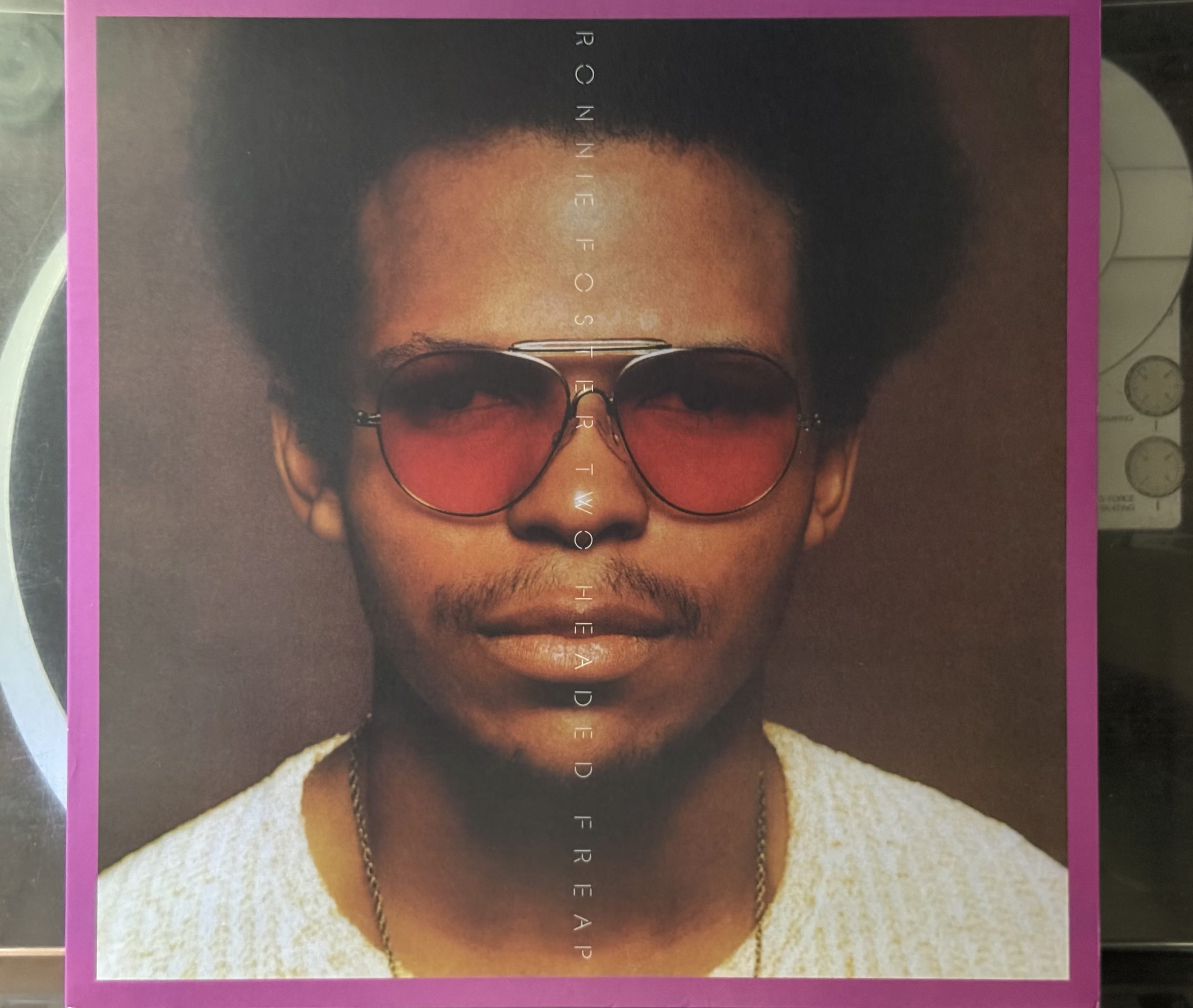
The band rolls right into “Let’s Stay Together”; the Al Green song must have been on many minds, considering its cover on Two Headed Freap last week. Jimmy’s solo here is exuberant and extroverted, and the band’s hard backbeat and groove make this version one to listen to. If the beat is relaxed here, it is only in preparation for its double time recapitulation of the opening number, retitled “Slow Down Sagg.” Here Arthur Adams takes a walk down Main Street in Funkytown, both in his solo and in his accompaniment of Jimmy’s frantically Terpsichorean boogie. Paul Humphrey gets his moment in the spotlight, as do both Buck Clarke and Wilton Felder, in what seem to be made-for-sampling breaks. At the end, Jimmy changes both key and mode into something out of the Arabian Nights as the band finally stops, acknowledging the cheers of the crowd.
Jimmy continued to record into the 1990s, making his last studio album, Dot Com Blues, for Verve just a few years before he passed away in 2005. By the 1970s, he had been around that even his imitators had built up significant traction and recording careers of their own. We’ll hear from a few of these peers next week.
You can listen to this week’s album here:
BONUS: There are a lot of live covers of “Root Down” out there, but this one by Chris Thile’s band is a pretty darned good funkgrass rendition:
BONUS BONUS: Not gonna lie: even as a terribly uninformed hip-hop novice I knew about the Beastie Boys a long time before I heard Jimmy Smith. So in that regard this song was my gateway to this album. It was absolutely mind blowing when Verve released the Jimmy Smith album on CD in (checks notes) 2000 and I could hear what the Beasties were listening to:
So why move? Well, Pagely’s business model shifted to a more professional customer base. They were very kind to grandfather me in—for years!—at something close to the rate I was paying when I joined. But it became clear that their service offerings were no longer aimed at individual bloggers. No shade, and good on them for focusing on more lucrative segments.
I was trying to figure out what to do when Doc Searls serendipitously pointed to his host, Pressable. I asked a few questions on the site, their staff was instantly responsive, and they provided a fully automated migration path that even moved non-Wordpress content from my site to their staging, all in less than 15 minutes. A little white-knuckle DNS work yesterday and I was all set.
So farewell Pagely, and hi Pressable. This blog has been around for more than 24 years, and I’m glad it has a home that will keep hosting it for many more.
The debut recording from Foster puts funk, soul, R&B and jazz into a blender and comes out with a “brew” that’s a genuine classic.
Album of the Week, October 11, 2025
Blue Note Records in 1972 was not the same label that it had been in , or even in 1963. Duke Pearson’s run as head of A&R had shifted the label from the straight-ahead jazz favored by his predecessor Ike Quebec to something a little more au courant. But even Duke was gone, leaving the label in 1971, the same year that label co-founder and famed album cover photographer Francis Wolff died. The label’s corporate parent, Liberty Records, was absorbed by United Artist Records the same year. And A&R executive George Butler took over the label, coming from United Artists, and sponsoring a number of projects aimed at crossing over between the jazz and soul audiences to build more market momentum for the label. Among the artists crossing over in this way were flautist Bobbi Humphrey, guitarist Earl Klugh, trumpeter Donald Byrd, and today’s artist, Ronnie Foster.
Foster grew up in Buffalo, New York and was interested in music from an early age, playing his first show (in a strip club) at age 15. He was not formally educated in jazz, receiving only a month of musical instruction—on the accordion. For this, his first record, he assembled an assortment of musicians that included George Duvivier on bass, Gene Bertoncini on guitar, Gordon Edwards on bass guitar, Jimmy Johnson on drums, Eugene Bianco on harp, George Devens on percussion and vibes, and Arthur Jenkins on congas. Motown producer Wade Marcus, who also had arranged Blue Note sessions for Bobbi Humphrey, Grant Green, Horace Silver, and Marlena Shaw, did the arrangements.
“Chunky” starts out hard with distorted guitar over a four-four beat from Johnson, followed by a syncopated figure from Foster on the Hammond, a long vamp over a four-chord sequence. A sudden shift to a different minor chord provides a quick four-measure bridge and we’re off to the races. Foster’s improvisation is primarily in the right hand, playing runs, venturing out into different tonalities, even quoting the “Love Supreme” progression at one point. His solo goes into runs, chromatic up and down figures that are played so that they smear together, and sustained notes that transition into out-of-tempo arpeggios. The track fades out, leaving us with just a hint of Foster’s rhythmic and improvisational imagination.
“Drowning in the Sea of Love,” a hit written for Joe Simon by Kenny Gamble and Leon Huff, is played as a straight cover of the bluesy soul hit, with lots of color from Bertoncini and George Devens’ vibes. Foster’s playing shows off his harmonic ear, as he harmonizes with the melody and then gives a couple blasts on the organ to introduce the solo proper. He has a pattern here and in “Chunky” of playing with time and meter in a way that seemingly breaks his improvisation free of the groove, right up until the fade-out.
The introduction to “The Two-Headed Freap” could have been titled “Chunky Pt. 2,” with the same pattern of blasting chords almost to the same rhythm. But the chords are a different progression, almost discordant, and things change quickly into a bluesy salsa-inflected solo with a nine-beat turnaround. Foster’s solo gives us a nasty (in a good way) breakdown in the last minute that calls to mind some of Jimmy Smith’s work.
“Summer Song” is an original with melody played by Bertoncini and Devens, over a growling bass line, before Foster’s solo. Here his technique is very different as he works with sustained suspended notes and chords as well as a right hand solo line that stays in the upper octave. The basic materials are fairly static, with vamps over chords that rock back and forth, but George Duvivier’s bass part (not quite a solo) is worth the price of admission.
“Let’s Stay Together” is a cover of Al Green’s hit, which again benefits from Duvivier’s bass as Foster tosses riff after riff off in his solo. The organ seems to have irrepressible energy, riffing at double speed over the groove, right up to the fade-out. “Don’t Knock My Love” is another cover, this one of Wilson Pickett’s last number one hit. Where the original benefited from a measured funky groove, Foster’s cover seems to lack some of the funk of the original even as it speeds up the tempo by a click or two. The fuzz distortion on the guitar doesn’t help matters here as the band threatens to come unglued during the endless wind out.
The fade-out takes us into “Mystic Brew.” Easily the most memorable track on the album, certainly the most sampled, the track opens with a double bass line from both Duvivier and Gordon Edwards, forming a bedrock for the entire song. Bertoncini and Devens’s vibes repeat the tonic together with Eugene Bianco’s harp. Bertoncini doubles Foster as he plays the relaxed main theme, which seems content to hang out on the tonic as Devens and Bertoncini elaborate around the edges. Foster’s solo is more disciplined here, with the first iteration playing with multi-measure suspensions, the second with syncopated eighths, the third evolving into triplets and then rolling sixteenth and even 32nd notes. The performance, in addition to being a complete pleasure, illustrates the ingenuity and athleticism that Foster brings to the table.
“Kentucky Fried Chicken” closes out with a slightly funky riff on a minor third over a funky bass, then shifts gears over a series of odd suspended chords for a moment. Bertoncini gets a brief solo before Foster plays his games with meter and time, at one point chattering like a hen, changing keys, and ripping through a set of arpeggios. So we end as we began, with Foster improvising straight into the fade-out.
Foster cut a series of albums for Blue Note as a leader, including a pretty great Live at Montreux in 1973. He was less successful after leaving the label for Columbia, recording two albums there and one for Pro Jazz between 1978 and 1986. But he produced almost 100 records and had hundreds of sideman credits, including a collaboration with George Benson that began on 1975’s Good King Bad. We’ll hear from him once more, from later in his career. But next week we’ll hear a famous record from an artist who went through a remarkable shift of his own in the early 1970s.
BONUS BONUS: “Mystic Brew” became an unlikely standard of sorts through sampling and latter-day covers. Notably, A Tribe Called Quest sampled it for “Electric Relaxation” from their 1993 album Midnight Mauraders:
BONUS BONUS BONUS: Maybe the most unlikely cover of all is the way I first heard “Mystic Brew,” in a version by Vijay Iyer’s trio on his 2009 album Historicity:
In which we create a cocktail to accompany Beethoven’s massive Missa Solemnis.
I have gotten something of a reputation among my fellow members of the Tanglewood Festival Chorus for creating cocktails that go with our major performances. So the speculation started early about what the cocktail would be that would go with this week’s performances of the Beethoven Missa Solemnis. This post is an attempt to document my creative process for these cocktails, in case any brave souls want to follow in my footsteps.
Name: Almost always, the name comes first, and almost always it’s a quote or a pun from the text of the piece. (Cf: Promisistini, Veni Creator Spiritous, Aufersteh’n, Sugar Rum Cherry No. 1 and 2.) So with this piece, it had to be “Et Vitam Venturi,” the part of the “Credo” that supports not one, but two fugues. And through the process of elimination, it became “Et Vitam Martuni,” because it was funnier than either “Et Vitam Martini” or “Et Vitam Negroni” (the two leading contenders).
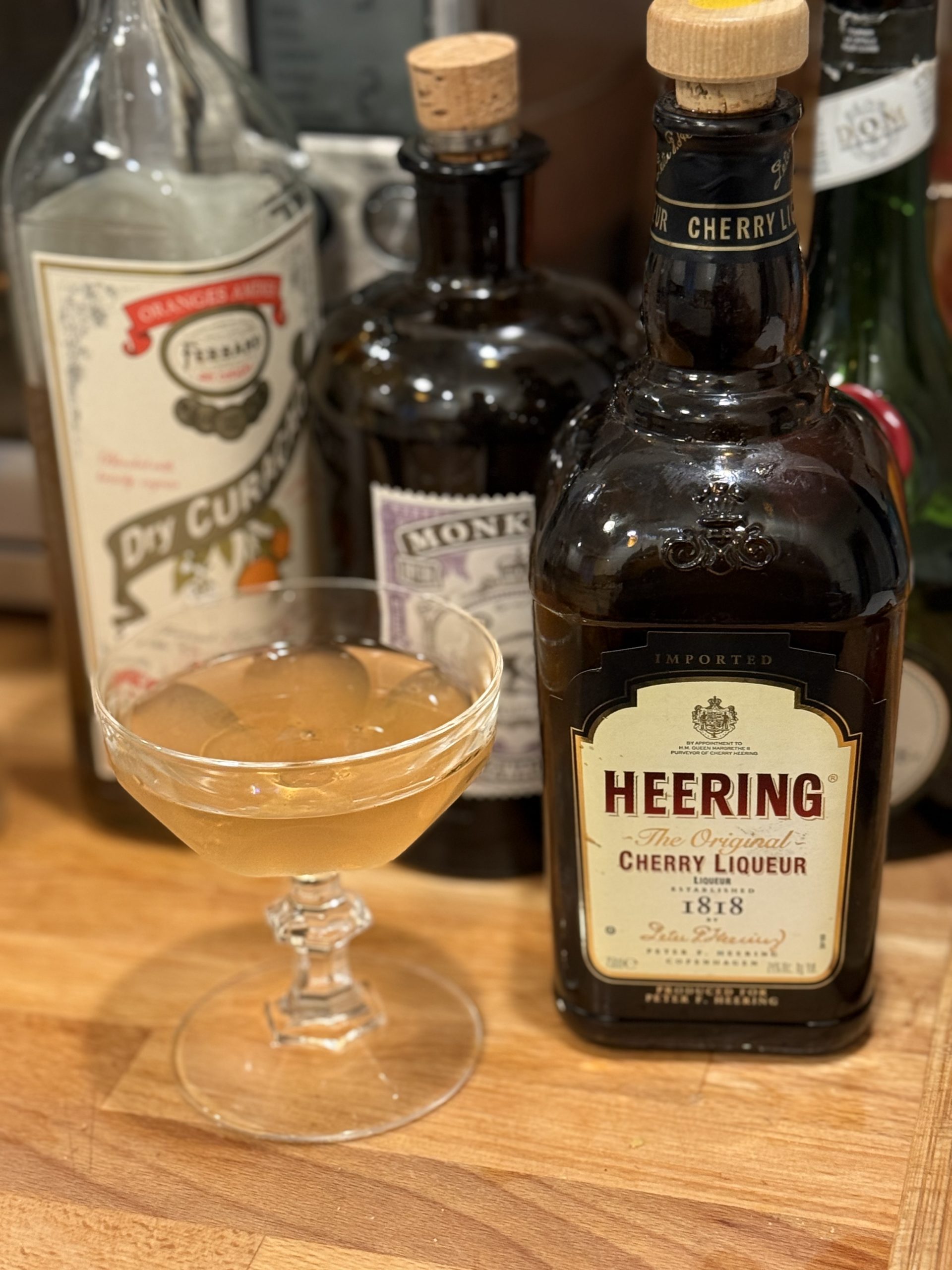
Composition: So what was an “Et Vitam Martuni”? I started out using the Martini as a base, but it turns out that the liqueurs I pulled off my shelf did not go well with the Martini. At first I blamed it on the liqueurs; as I wrote to my collaborators on this cocktail, “The combination of vermouth and Cherry Heering does not work at all. I should have known better; with Beethoven, the Heering is never good.”
But it turns out I was blaming the wrong ingredient, and a shift in focus was beneficial. By reformulating the drink as an approximation of the Martinez—i.e. not requiring white Vermouth—I was able to make the ingredients work, even the Cherry Heering. So here’s to the “Et Vitam Martuni,” the drink so good you’ll want to have it twice, once slow and once damned fast.
Special thanks to my collaborators on this one, the Schlammonds, who suggested the name and were my rubber duck as I thought through the combinations. And special thanks to the TFC and our guest conductor, Anthony Blake Clark, who is the reason that the drink recommends a pair of something for the garnish.
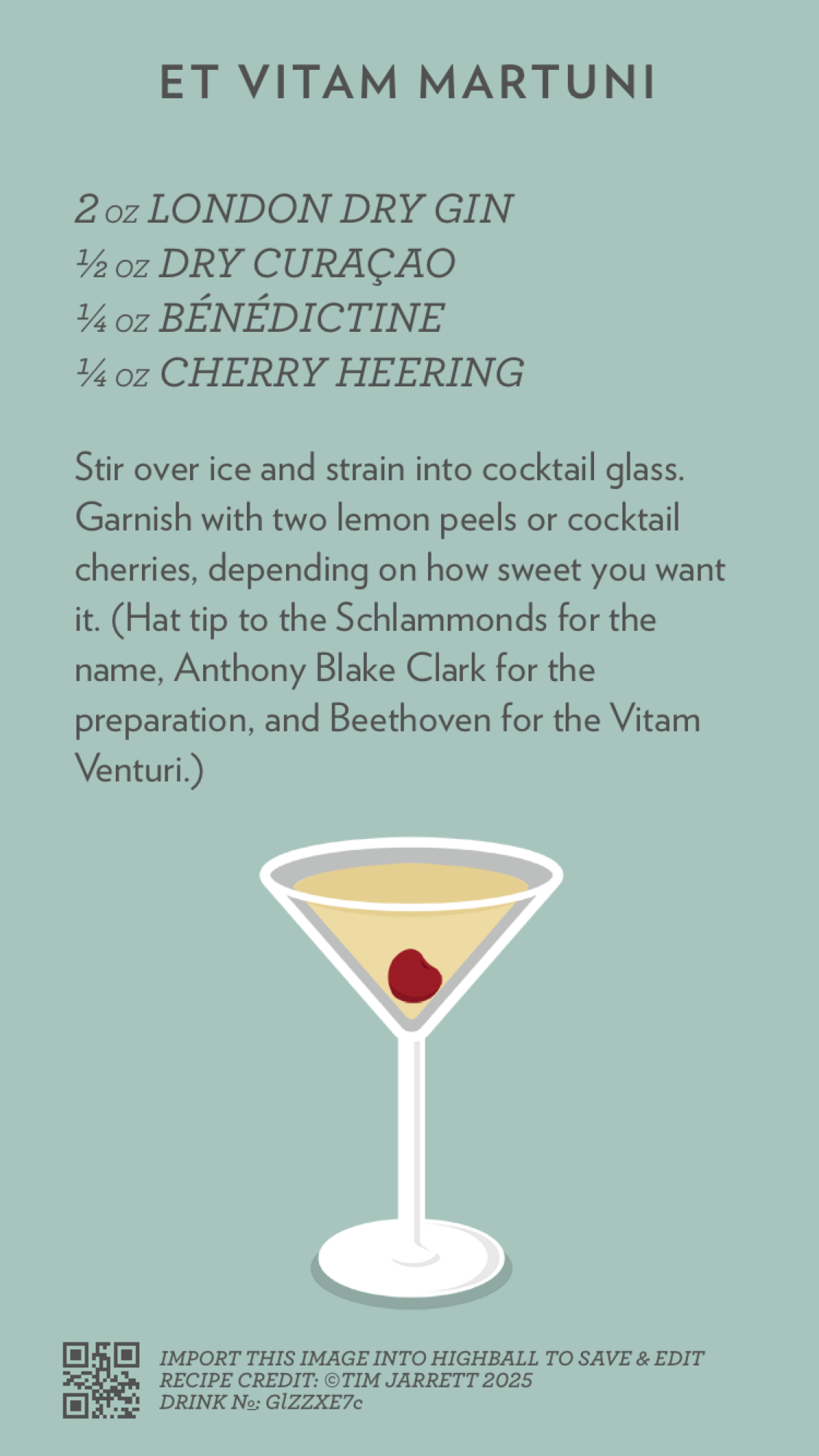
As always, you can use the recipe card with Highball. Enjoy!
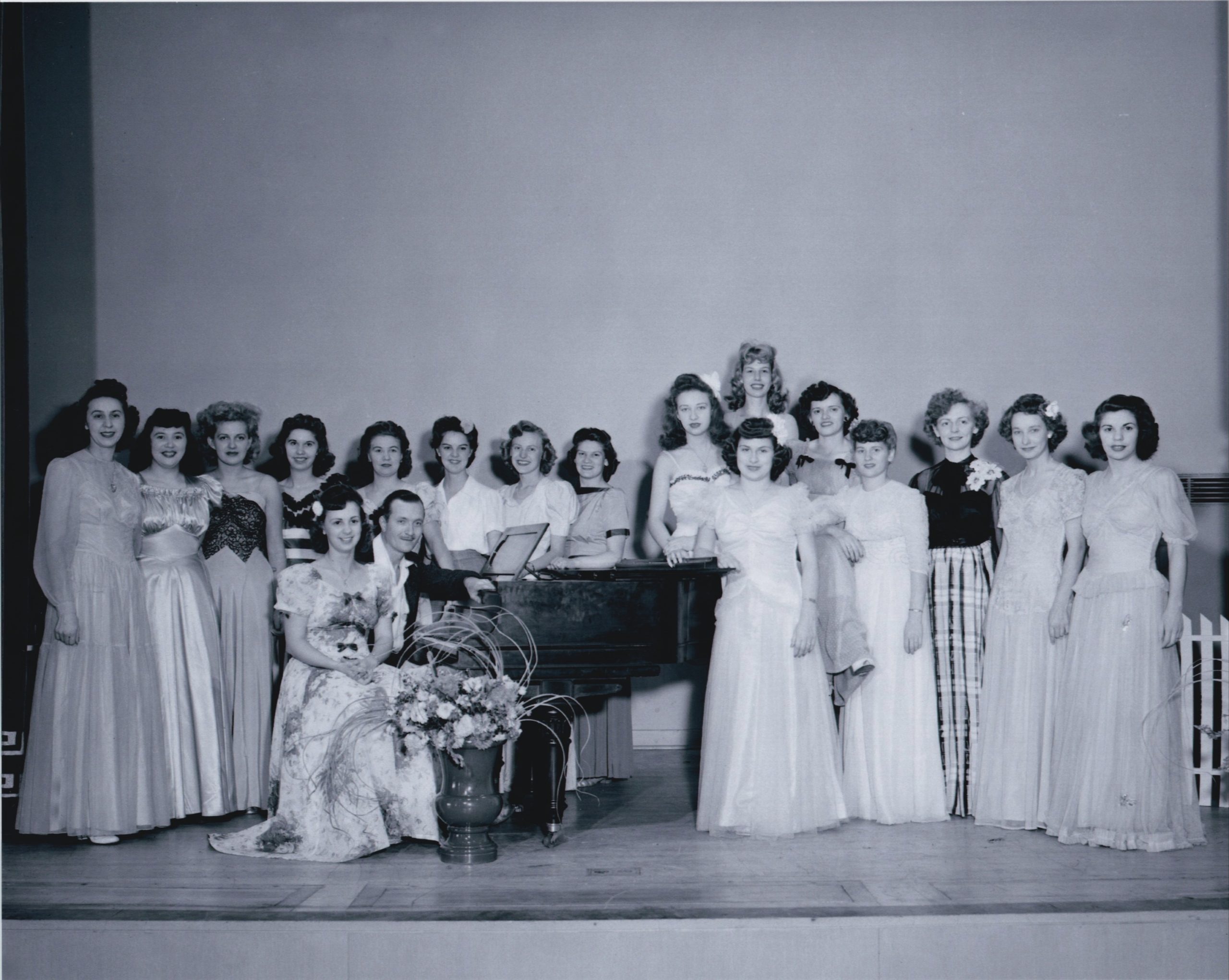
A potential glimpse of a moment in the history of choral music at the University.
University of Virginia Madrigal Group, early 1940s
Some eleven years ago, I wrote that I was “Seeking the UVA Madrigal Group,” looking for more information about a group of women who formed the University of Virginia’s first known vocal performing group. They are first known to exist in 1943, when they joined the Virginia Glee Club in the annual Christmas Concert. We know about the group thanks to concert programs—Christmas in 1943 and 1944, Spring in 1945 and again in 1957—but otherwise have had no information about the group save their existence and their names.
Until last week, when the photo above turned up on eBay. Under the title “University of Virginia Glee Club,” the photo shows what is supposed to be an image of the UVA Madrigal Group, circa 1944. If true, it would be an incredibly valuable piece of history, filling in a blank not only in the history of the UVA choral experience, but also in the historic experience of women at the University.
I say “if true” because I’m still working to trace the provenance of the photo and date it. There are a few challenges that I’m trying to reconcile:
Count of members: There are 16 women in the photo. The 1943 group had 13, and the 1944 group had 30.
Location: Rehearsal and performance spaces with stages were rare at UVa in the 1940s, and would likely either have had a painting (The School of Athens in Old Cabell Hall) or a blackboard (any of the Music Department’s practice rooms or any lecture halls) behind the group. Where was this taken?
Accompanist: The accompanist in 1943-1944 was none other than Randall Thompson. Edwin Guernsey was the assistant accompanist in 1945, but the blurry photo I have of him from Corks and Curls does not exactly resemble the man in the photo above.
Nevertheless, the photo is a tantalizing piece of history, even if it does raise more questions than it answers.
Note: I wrote about the Madrigal Group in Chapter 16 of Ten Thousand Voices, my history of the Virginia Glee Club. You can find it at your bookstore of choice through the link in the right hand side of this page.
Today I learned that the Virginia Glee Club has a far longer history with the “Winter Song” than I originally thought. Modern performance of the song, with its “ice gnomes marching from their Norways,” dates to the John Liepold years in the early 1990s. But today I found a newspaper article that dates the first performance to 1915!!!
The “Winter Song” was on a concert program at Randolph-Macon College on April 17, 1915, some seventy-plus years earlier than previously known. 1914-1915 was the first year that there was a “modern” Glee Club, conducted by a UVA faculty member (Alfred Lawrence Hall-Quest), and took place a day after a concert in Richmond. The concert was well received; the student newspaper mentioned that the concert “turned our minds to music, men and laughter” and that “almost every number was encored.”
The “Winter Song,” written by Frederic Field Bullard, was originally titled “Hanover Winter Song” and first appeared in an 1898 book, Dartmouth Songs.
An interesting debut from an organist who became better known for his work with Santana, and an album that crosses the organ combo format with James Brown funk.
Album of the Week, October 4, 2025
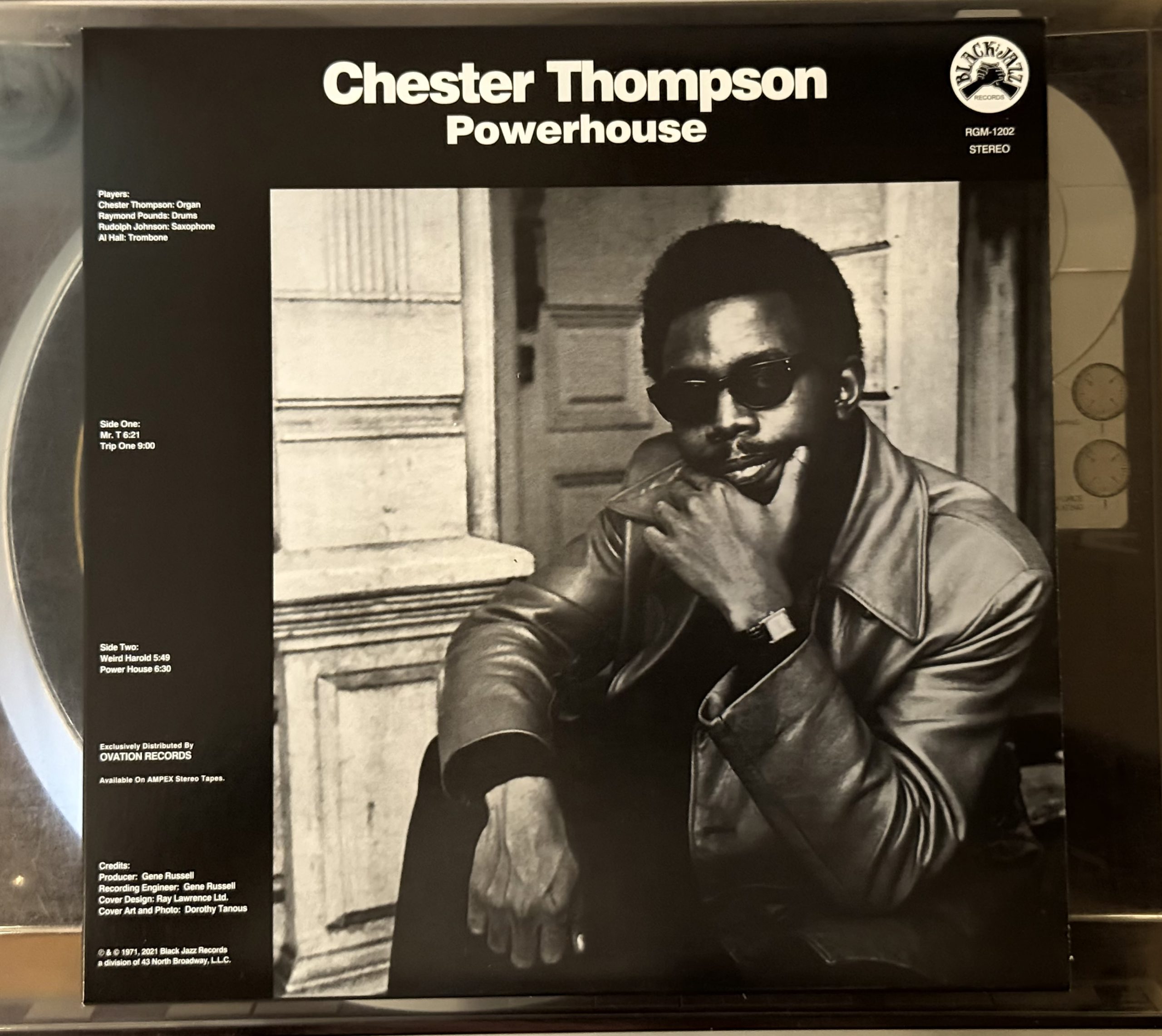
As jazz organ combos led by Jimmy Smith, Johnny Hammond and others notched record sales and hits, there were more and more young musicians who followed the format. Inevitably some of these played jazz and rock; one of these was Chester D. Thompson, a keyboard player from Oklahoma who started on piano at age 5 and is remembered today for his ten-year association with funk group Tower of Power and his 26-year-long tenure as a member of the Santana band (confusingly enough, sometimes alongside drummer Chester C. Thompson!). But he had plenty of sideman credits to his name in pop and jazz, appearing on tracks with Elton John, Freddie Hubbard, John Lee Hooker, Everlast, Eagle-Eye Cherry and others. And at the very beginning of his career, he cut this album, a straight-ahead jazz record in an unusual organ combo format.
Appearing alongside Thompson on this release are Raymond Pounds, a session drummer who performed with Blue Mitchell, Stevie Wonder (Songs in the Key of Life), Deniece Williams, Quincy Jones, Chaka Khan, Bob Dylan (Knocked Out Loaded) and others; this was his first recording. Tenor sax Rudolph Johnson had played with Jimmy McGriff (about whom more later) and Bill Cosby. And trombonist Al Hall, also making his debut, would have a career playing with Johnny Hammond, Freddie Hubbard, and other jazz-funk acts.
“Mr. T” starts out as a horn driven tune, with both Johnson and Hall blowing strong solos over Thompson’s organ. Thompson’s solo takes the tune into the blues, with increasingly elaborate improvisations over a steady organ bass line. Pounds takes a flourish on the drums at the end but otherwise is here as support.
“Trip One” alternates between two modes through the verse and shifts into a third on the chorus. The band takes a beat between verse and chorus, just enough for Johnson to wind up his sax into orbit. He’s not quite in “sheets of sound” territory here, but it’s a pretty great solo nevertheless, energizing the entire band and taking it through multiple tonalities. Hall’s trombone follows with a slightly more conventional approach, laying back into a more relaxed tone. It’s Johnson’s conception that Thompson follows for his solo, with chromatic runs that shift to different tonalities. The wrap up is slightly spoiled by uneven harmonies in the horns, putting an odd edge on an otherwise cool tune.
Speaking of Bill Cosby, the second side opens with “Weird Harold.” Cosby’s Fat Albert and the Cosby Kids television show was still a year away when this album was recorded, but Cosby had told stories about his childhood friends for years previously in his standup routines, and Old Weird Harold had debuted in “9th Street Bridge” on Cosby’s Revenge album in 1967. This track shares a little of the funky flavor that Herbie Hancock used for his own take on the Cosby kids in Fat Albert Rotunda, but with a considerably higher James Brown quotient. Pounds is the star on this track; listening to the way he used the cymbals on the two as emphasis, you can imagine his future work with Stevie Wonder and Quincy Jones. Johnson’s sax is solidly bluesy and funky throughout, and Thompson’s fiery solo features flourishes and sustained notes that would make Jimmy Smith proud. Hall is confined to the chorus, where he again muffs the harmony parts but plays with great funkiness.
The band as a whole is tighter on “Powerhouse,” triggering off a fiercely funky Pounds drum part and a simmering low organ part. The horns wisely stay in unison and simple harmonies for the head to far greater effect. Johnson’s solo is tight but is only a setup for Thompson, who rips a set of stern modal runs and chords while staying close to the minor third throughout, all while keeping an incredibly tight bass line going in the lower range of the organ.
This was the only recording by the “Powerhouse” band, but Thompson didn’t sit still. By 1973 he had joined Tower of Power during that band’s commercial peak, staying with the band into the early 1980s before joining Carlos Santana’s group in 1983. He kept performing for a long time, turning up at the 2018 40th anniversary celebration of Tower of Power, but primarily stayed outside the organ combo format for rock and roll.
Another young player was about to radically redefine what an “organ combo” could sound like. We’ll hear his debut recording next week.
You can listen to this week’s album here:
BONUS: One of Thompson’s better known Tower of Power songs was “Squib Cakes” from the Back to Oakland album; here he is in a small combo playing the song in 2011.