Brother Jack McDuff, Moon Rappin’

Brother Jack gives us an album that’s alternately spacey and bluesy, and hints at where jazz organ was about to go.

Album of the Week, September 27, 2025

By 1969 a few things had changed in the jazz world. Some of the old formulas for how jazz worked on albums like Brother Jack McDuff’s Hot Barbeque had started to morph, influenced by what was happening in rock and roll (and responding to the shift of youth attention from jazz to rock music). In particular, Miles Davis was listening to Jimi Hendrix, and the music he made in response on records like Filles de Kilimanjaro and Bitches Brew brought a different conception of the role of guitar in improvised music. But other genres were colliding with jazz, particularly funk.

We’ve talked about jazz-funk before in the context of CTI Records and of Herbie Hancock’s glorious Fat Albert Rotunda. By 1969, Blue Note Records had started to embrace this sound in a significant way. Jack McDuff had signed to Blue Note after a brief stint with Atlantic Records, and for this, his second album, he brought together a small army of younger musicians, including Joe Dukes on drums (and a guest appearance from Richard Davis on bass for two tracks) and dove into some truly strange, but truly glorious, jazz-funk explorations.

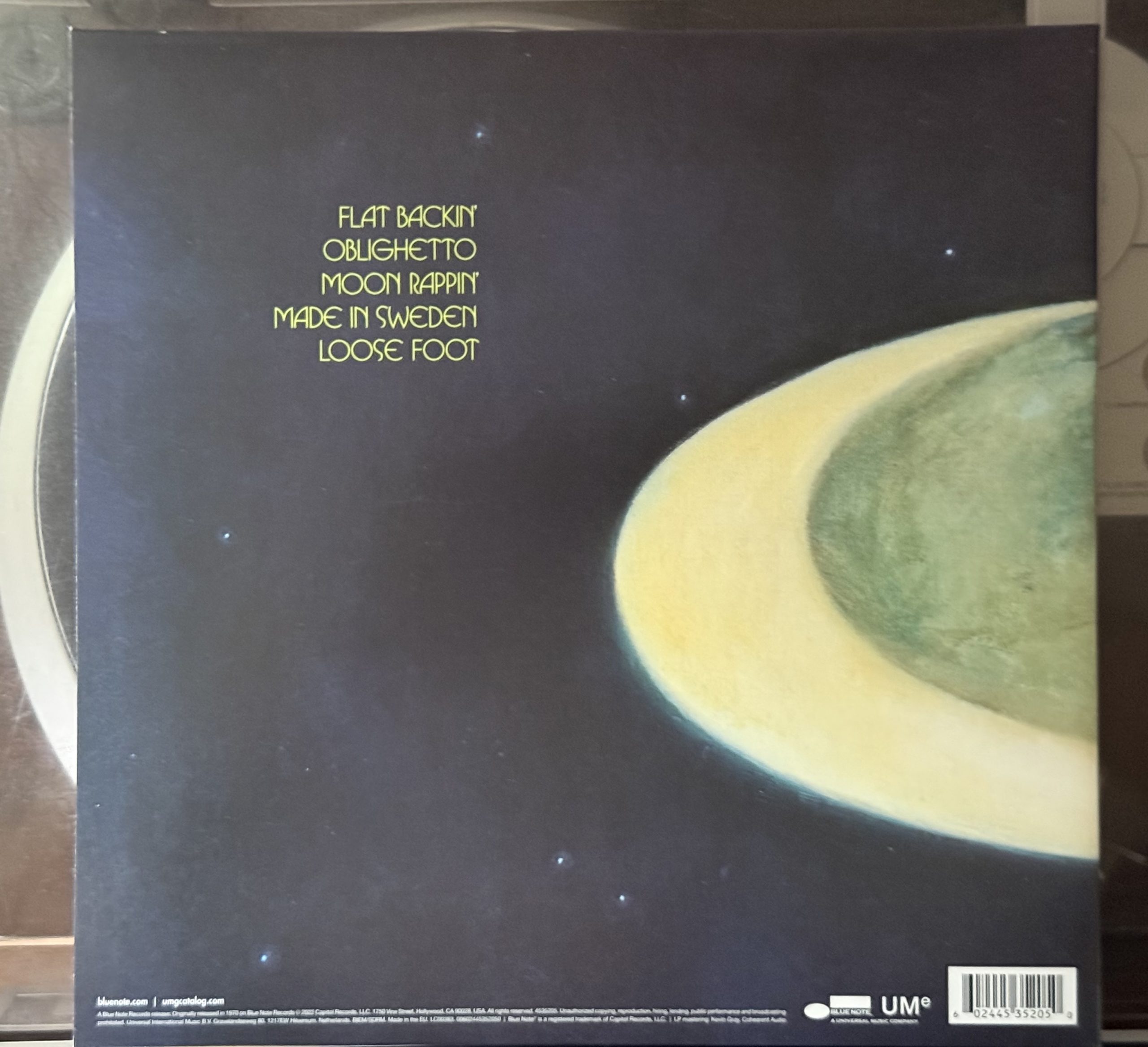
Flat Backin’” starts us off in fine form, with the melody stated by Richard Davis’ funky, funky bass and a flourish on the drums from Spider Bryce, and a spiraling guitar line from Melvin Sparks that pans right to left. When McDuff enters on the Hammond, he’s right in the middle of everything, including a horn section that appear for a moment and then back away as the cymbal and bass restate the groove. And then—zowie!—it’s as though the track travels back in time at least ten years as the bass groove falls back into a swinging fast four and the band gives us a scampering improvisation, only to fall back to that groovy bass and an echo-laden guitar freak out, followed by a Hammond solo. Structurally the track keeps returning to that bass groove. It’s undeniably cool—not as out there as Bitches Brew but still fun to listen to.

Oblighetto” is a more straightforward blues, given juice by Sparks’ guitar, right up until we get four measures of unexpected chords from McDuff and a spacey vocal in a minor mode, à la Star Trek. And then we shift gears again into a fast four as McDuff and drummer Vince DiLeonardi give us a little boogaloo, only to return to the minor mode and vocals once more. The band finishes with a return to the boogaloo, and one more minor chord.

Moon Rappin’” is another jazz-funk workout, with a Richard Davis bass line and a winding chord progression that exercises both McDuff and the horns. After the lead, the band settles into a groove around a fifth, on which the horns unfortunately blow a little out of tune. But the reverby McDuff piano solo makes it all worthwhile. We then get a tasty minor blues that adjusts the bass line melody from “Flat Backin’” into something anticipatory and deeply funky, especially as Melvin Sparks’ guitar seems to reverb into outer space.

Made in Sweden” threatens to invade “Take Five” territory, but it’s in six rather than five, and the melody goes in a slightly different direction, staying more closely wedded to the groove. Ron Park’s flute is a great addition to the theme, but the real star is McDuff’s Hammond, which threatens to levitate into outer space throughout his solo. A drum break separates the second half of the tune, in which a two-note riff moves from the organ to the horns and back “Loose Foot” picks up where “Made in Sweden” left off, but it’s a more straightahead tune and a showcase for Ron Park’s tenor sax. McDuff gives us a blues-forward solo in which he displays his virtuosic touch on the organ. The band closes out the outer-space album in a most grounded way, with the blues.
McDuff was a survivor; he kept on recording through the ’70s, even as commercial interest in jazz collapsed, and enjoyed a career renaissance in the late 1980s and 1990s, recording albums for Muse and Concord Jazz. He died in January 2001, less than a year after touring Japan at age 73. While he certainly picked up influences from the jazz-funk movement, he never tipped over into the sound wholesale. But other jazz organists did, and in a few weeks we’ll hear one of the most famous examples of the genre. Before we get there, though, there are a few other interesting corners of the jazz organ world to explore; we’ll hear one next week.

You can listen to this week’s album here:

BONUS: I included “Flat Backin’” in my “Cooking with Fat” episode of Exfiltration Radio, an hour-long exploration of jazz-funk. You can listen to that radio show below:
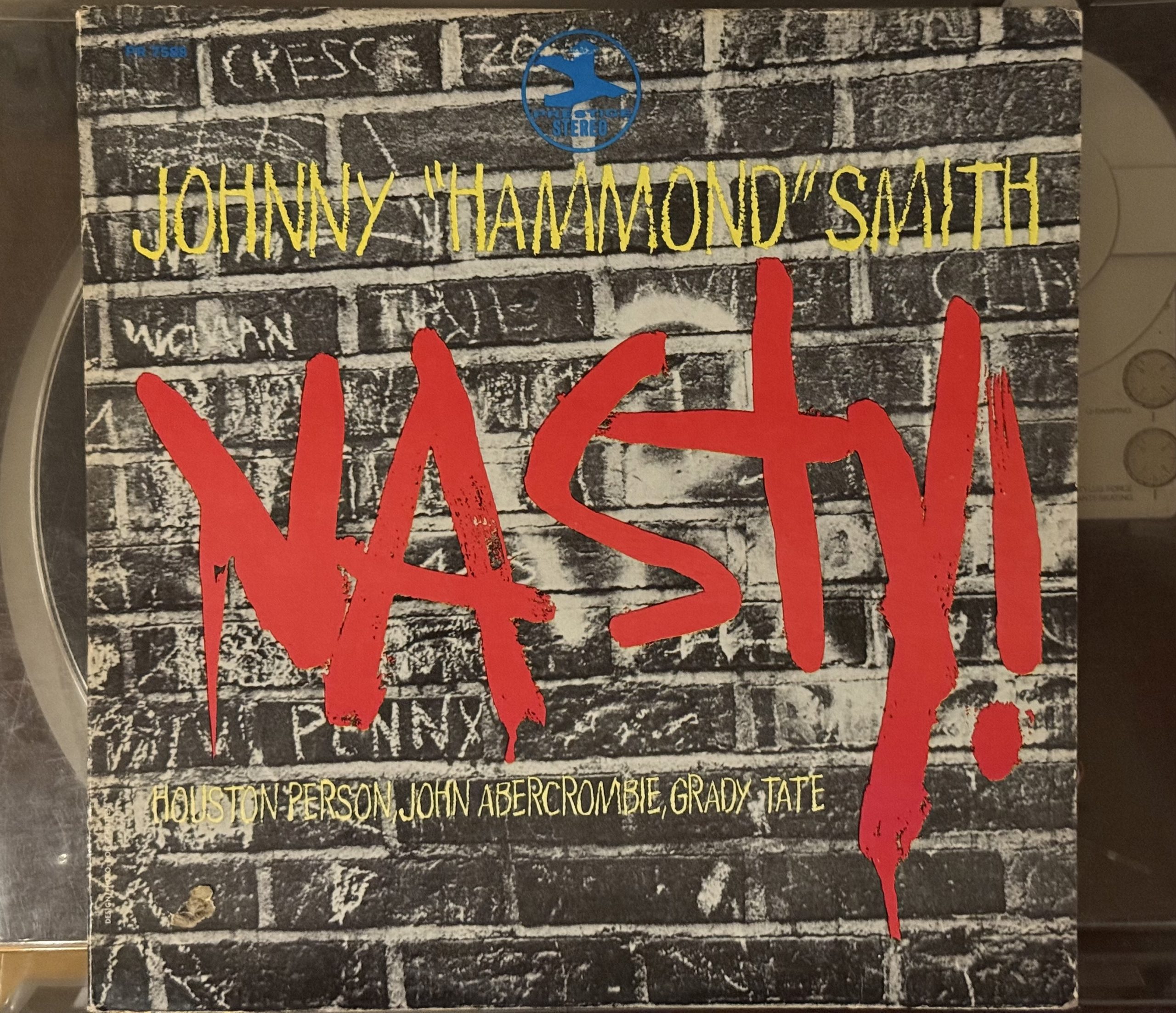
Johnny “Hammond” Smith, Nasty!

Another master of the jazz organ gives us a coolly simmering combo record, featuring John Abercrombie’s record debut.

Album of the Week, September 20, 2025

If you are a jazz performer, but there’s already another jazz performer with your name, giving yourself a stage name is a common practice. In the case of Johnny Smith from Louisville, Kentucky, he adopted his instrument of choice as part of his nickname, to avoid being confused with guitarist Johnny Smith from Alabama. His first album appeared in 1958 on small label Arrow Records, followed by two albums on the slightly less small New Jazz label in 1959. On the second New Jazz label, he was Johnny “Hammond” Smith. He moved to Prestige in 1961 and recorded a series of organ combo albums, leading up to today’s album.

For this 1968 session Smith was joined by an interesting group of musicians. We’re very familiar with Grady Tate from his work with Jimmy Smith; he had parted ways with Smith’s group following 1967’s Respect. Saxophonist Houston Person came from Florence, South Carolina, and had been recording as a leader for Prestige for much of the 1960s. And John Abercrombie was an American jazz guitarist who had just graduated from the Berklee School of Music in Boston, where he had played shows at Paul’s Mall, leading to his meeting Smith; this was his first non-student recording. Abercrombie would go on to have a long career as both sideman and leader, recording for ECM among other labels; we will get to one of those other recordings one of these days.

The opening track, Frank Loesser’s “If I Were a Bell,” is given a very different treatment from Miles Davis’ version on Relaxin’. Here Grady Tate’s syncopated drumming gives the tune a heavy swing feel as Smith outlines the opening “bells” and the melody on the Hammond, with a good amount of ornamentation around the edges. Smith’s opening statement is pretty “cool” and stays in the baritone range. Abercrombie takes the first solo and gives it a cool fire, with a swinging arpeggiated run at the tune. Smith keeps things relaxed and cool at first, but starts to lean into the blue notes at the end of his solo, which Person picks up with a straight-ahead blues. Smith brings things back to a simmer at the end; the listener is surprised to realize that in the relaxed session, a full eight and a half minutes go by.

Horace Silver’s “Song for My Father,” which we’ll hear again one of these days, is a classic of the post-bop jazz repertoire, with Brazilian rhythms and Cape Verdean Portuguese folk roots. Here Smith gives it a slower, deeper reading, with the melody down in the lower octave and leaning into the grace notes and turns of the descending tune. Tate’s drums and Abercrombie’s guitar provide a solid bed for Silver’s exploration. When Abercrombie’s solo enters, we get a bluesy hybrid between samba and boogie. Person’s solo is R&B flavored but played with great restraint throughout; overall the band keeps the lid on even as the pot nears the boil.

Speak Low,” Kurt Weill’s ballad to lyrics by Ogden Nash from the musical One Touch of Venus1, is here turbocharged with crashing drums from Tate and a ripping solo from Abercrombie, whose virtuosity is on full display. Smith takes the lid off here and gives us a rollicking turn through the tune. “Unchained Melody,” by contrast, is bright and laid-back, almost conversational, with none of the drama of the 1965 Righteous Brothers version. Weighing in at less than four minutes, the take still has a little room for Smith to be playful as he slips in a quote from Simon and Garfunkel’s “We’ve Got a Groovy Thing Goin’” (!).

Nasty,” one of two Smith originals on the album, is the standout tune, a forty bar blues (which relaxes into a more conventional twelve bar blues in the solos) featuring a rippling trill in the melody line. Each of the players in turn lean into the blues note hard, earning the name of the tune. Tate’s drums here are a thing to behold, a seamless combination of march rhythm and swing that shuffles along under the solos.

Four Bowls of Soul” is a more straightforward blues from Smith to close us out. Abercrombie’s solo has a few non-blue notes around the edges but otherwise delivers the promised soul. So does Smith, who sets aside reserve and gives us a solo that, if lacking some of the mojo of Jimmy Smith, still has plenty up its sleeve, including an eyebrow raising detour into waltz time. Person plays the blues, bringing his solo up into the high end of the tenor sax’s range with a satisfying wail. The tune fades out on Smith’s recapitulation, sounding as if he could play these coolly soulful blues forever.

Smith had a long recording career, with over forty albums to his credit as leader, most for Prestige. Later in his career, changing his stage name to Johnny Hammond, he recorded for Creed Taylor’s Kudu label (his album Breakout was the first release on the soul jazz label) and for Milestone, where he made a series of jazz-funk albums including the great Gears. At the core of all his recordings were an impeccable sense of harmony and rhythm. There haven’t been a lot of reissues of his work, so grab it if you find it—I feel lucky I was able to score a copy of Nasty from a used record store in Asheville.

The Hammond players we’ve heard so far have stuck pretty close to the organ combo formula as introduced and perfected by Jimmy Smith. One of the folks we’ve heard before is about to change that in a pretty big way. We’ll listen to that album next week.

You can listen to this week’s album here:

BONUS: I would bet money that Sly Stone was listening to this album when he was working on Stand!; just listen to the instrumental break following the opening chorus at about 0:56. (This part of the song shows up in a lot of hip-hop, including “Because I Got It Like That” by the Jungle Brothers.)

  1. It’s sentences like that one that make the history of popular music in the 20th century so great. ↩︎

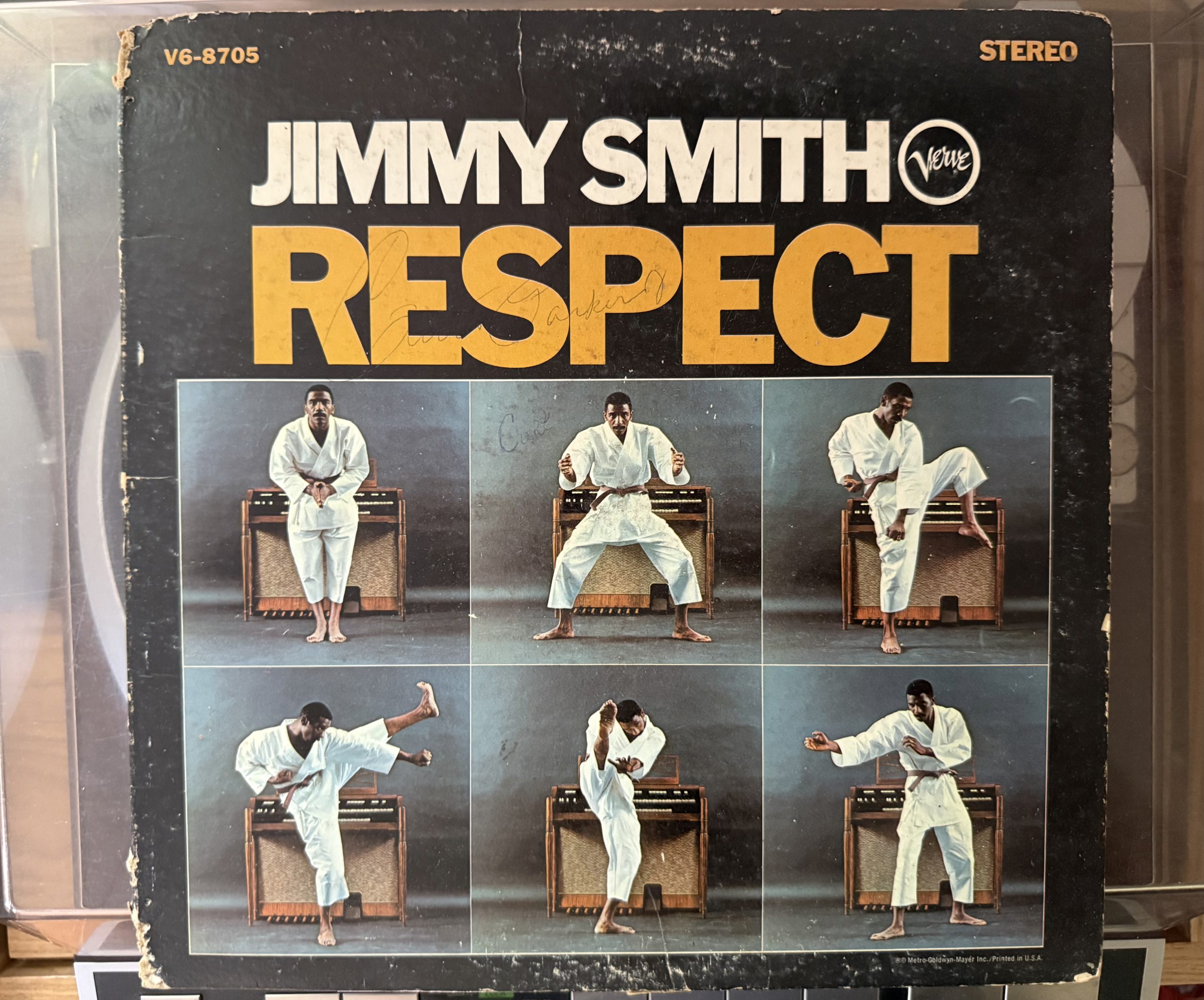
Jimmy Smith, Respect

Even on an album that seeks to hitch a ride on Aretha Franklin’s rising star, Jimmy Smith brings the heat and some incredibly funky originals.

Album of the Week, September 13, 2025

When you’re Jimmy Smith, making two or three albums a year, sometimes you make masterpieces, and sometimes you make a party album that doesn’t have a huge impact on the musical world, but is fun to listen to anyway. Respect follows two huge releases from Jimmy and guitarist Wes Montgomery (we’ve written about some of the latter’s later work before). With a title like Respect the motivation for the album is pretty clear, recorded as it was not two months after Aretha Franklin’s hit, but it also has some excellent Jimmy originals. It might not quite reach the heights of Organ Grinder Swing or The Cat, but Jimmy Smith was incapable of phoning in a record date, as this hot session shows.

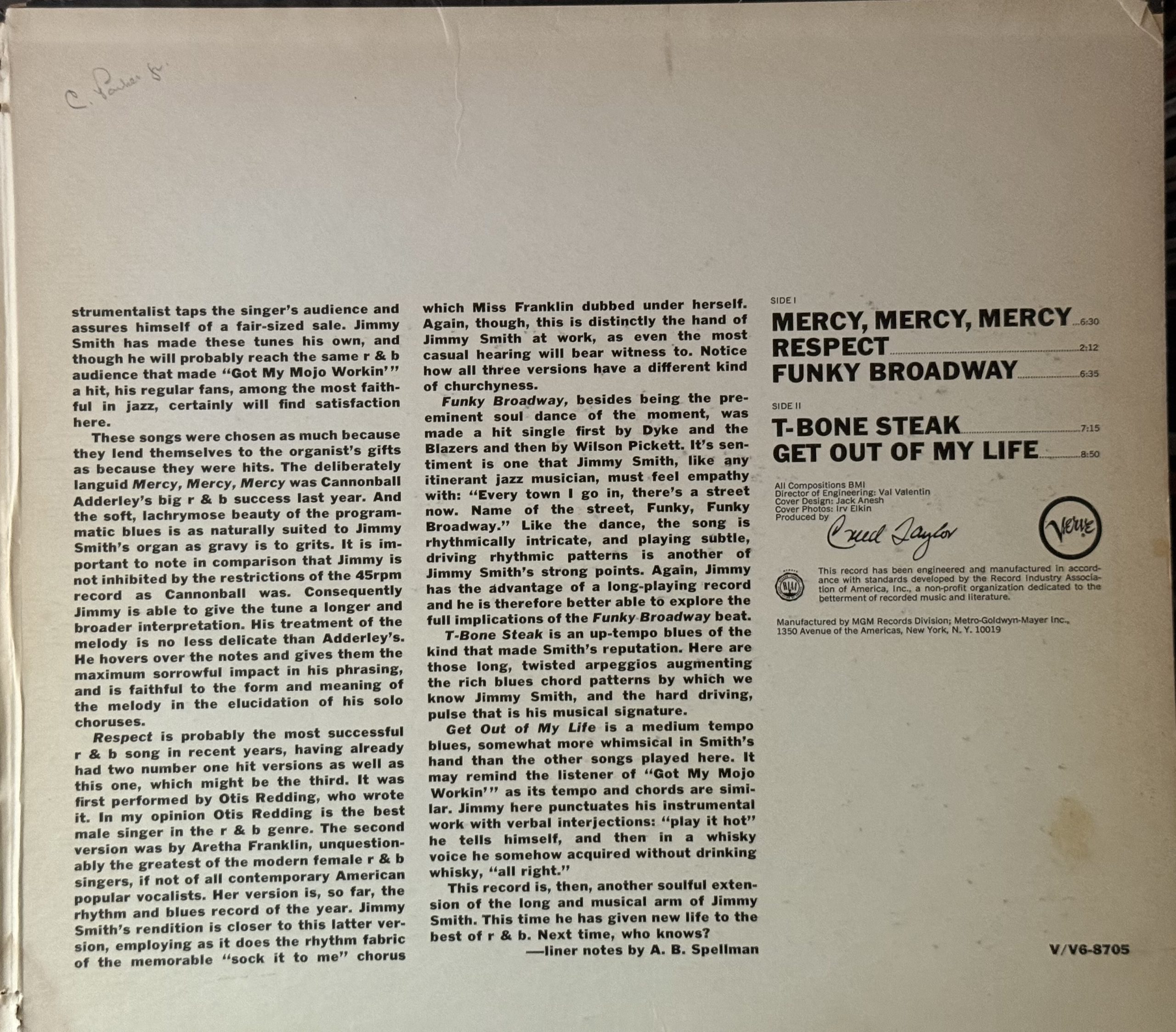
The album was recorded on June 2 and June 14, 1967 at Rudy Van Gelder’s studio in Englewood Cliffs, New Jersey. One session featured Smith’s long-time drummer, Grady Tate, alongside Eric Gale on guitar and the redoubtable Ron Carter on bass. The other had funky drummer Bernard Purdie with Thornel Schwartz on guitar and Bob Bushnell on bass. Regarding the two guitarists, we’ve reviewed some of the work Gale did alongside George Benson, Yusef Lateef and Freddie Hubbard on CTI. Schwartz made a career out of playing in jazz organ combos, working alongside Johnny “Hammond” Smith, Jimmy McGriff, and “Groove” Holmes, about all of whom more later. And Bob Bushnell had a widely varied career, playing on many Verve and Impulse releases, as well as dubbing the bass part on the “electric” hit version of Simon and Garfunkel’s “The Sound of Silence.”

Mercy, Mercy, Mercy” is the song for which Joe Zawinul would have been known best, had he not gone on to work with Miles and to found Weather Report. The tune, which he wrote when he was in Cannonball Adderley’s band in 1966, was a hit, going to #2 on the Billboard Soul Chart and all the way to #11 on the Hot 100. Jimmy’s version grooves along in the same relaxed pocket as the original, coming off the simmer with the groove of Bernard Purdie’s funky drumming even before Jimmy starts his solo. Schwartz and Bushnell keep it in the soulful side of things as the band makes its relaxed way through the tune, accompanied by a fair amount of studio chatter from Jimmy.

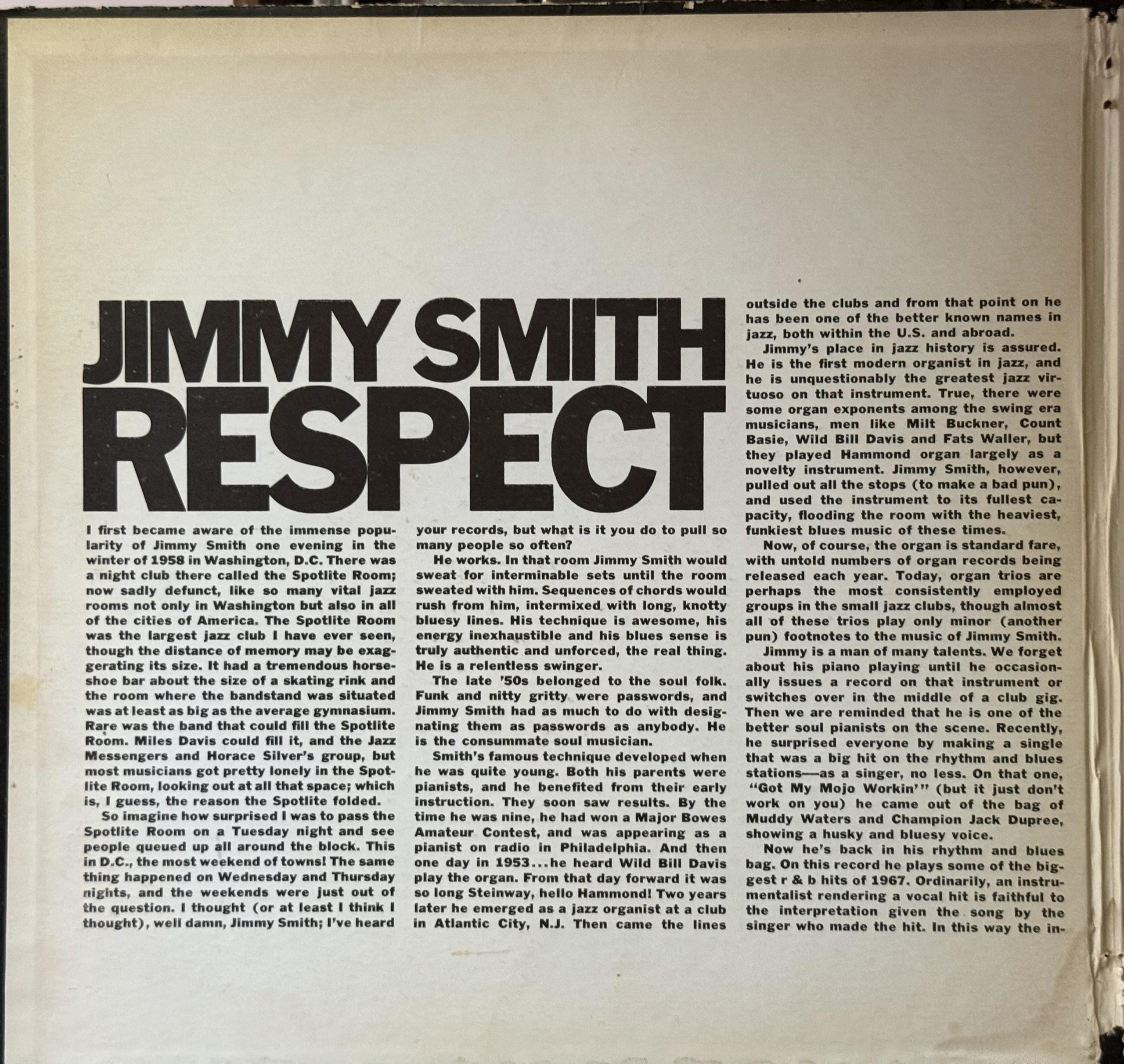
Respect” had burned up the charts just months before Smith went into the studio to record these sessions. The 1965 Otis Redding original had been gender-flipped in Aretha Franklin’s burning cover version, released on April 10, 1967, and had spent two weeks atop the Billboard Pop Singles Chart and 10 weeks on the Black Singles Chart. Schwartz and Purdie bring some of the insouciance of the Aretha version to the opening here, and Jimmy’s improvisation blends aspects of both Aretha’s blazing solo vocals and the backing vocals, so brilliantly sung by her sisters Emma and Carolyn that the liner notes for Smith’s album by A.B. Spellman incorrectly assume that Aretha had dubbed her own voice for the back-up part. “Respect” was clearly recorded for single release; it fades out after 2:12, just as Jimmy seems to be getting warmed up!

Funky Broadway,” a Smith original, is backed by the Carter/Tate/Gale combo, and is an interesting evolution in Smith’s writing. Where many of the originals we’ve heard from him so far have been blues or loose jams, “Funky Broadway” is a tight groove with a slinky guitar line over Ron Carter’s reliable heartbeat, with Eric Gale and Smith taking turns playing syncopated diminished seventh chords under each others’ solos. The whole thing is a pretty magnificent exercise in James Brown-style funk. Smith calls out “Funky Broadway” at the end, I suspect naming the seven-minute-long jam for posterity.

T-Bone Steak” is the second Jimmy original here, again with the Carter/Gale/Tate group, and we’re back in the twelve-bar blues. But it’s hard to complain about Jimmy returning to this particular well, since he jumps immediately into the deep end from the first notes of his solo. The double-speed runs followed by the hemiola, followed again by his leaning on the tonic for 36 bars or so as he rips improvisation after improvisation, might be some of the hottest, most concentrated brilliance he recorded. Grady Tate sounds a bit like Bernard Purdie here with the power of his hits on the tom, though not with his rhythmic approach.

Get Out of My Life, Woman” closes the record, with Jimmy yelling, “Ow! Get out my life!” at the top as the band begins the Allen Touissant/Lee Dorsey standard. Here they play it as a tight New Orleans blues—a blues with more than a hint of shuffle underneath. The guitarist (I think this is Schwartz, Purdie and Bushnell, though without credits it’s hard to tell) unreels a steady, controlled funk throughout his solo, leaving Smith to take the lid off the pot as it hits the boil. The track finishes with Smith and the guitarist exchanging ideas right into the fade-out, as if reluctant to let the jam end.

I haven’t talked about the album’s cover so far, mostly because it nonplussed me, but apparently Smith was, in fact, a karate aficionado. In an excerpt from Bill Milkowski’s Rockers, Jazzbos and Visionaries, Smith said he had been into karate for about 25 years and responded to Milkowski calling his gi a “kung fu outfit”: “Not kung fu, motherf–. That’s shotokan. And that means sho-kill-yo’-a–. I studied that particular method.” What is clear is that, even on a collection of mostly R&B covers designed to hit the charts, Jimmy’s playing remains as intense and vital as on the more significant albums in his discography. The commercial success of his work—the album hit Number 60 on the Billboard 200, spending 20 weeks on the chart—continued to attract others to the Hammond, and we’ll hear from another of those players next week.

You can listen to this week’s album here:

BONUS: Here’s a live rendition of “Mercy, Mercy, Mercy” in medley with “Country Preacher” by Cannonball Adderley’s band from 1970 , with Zawinul on the Fender Rhodes:

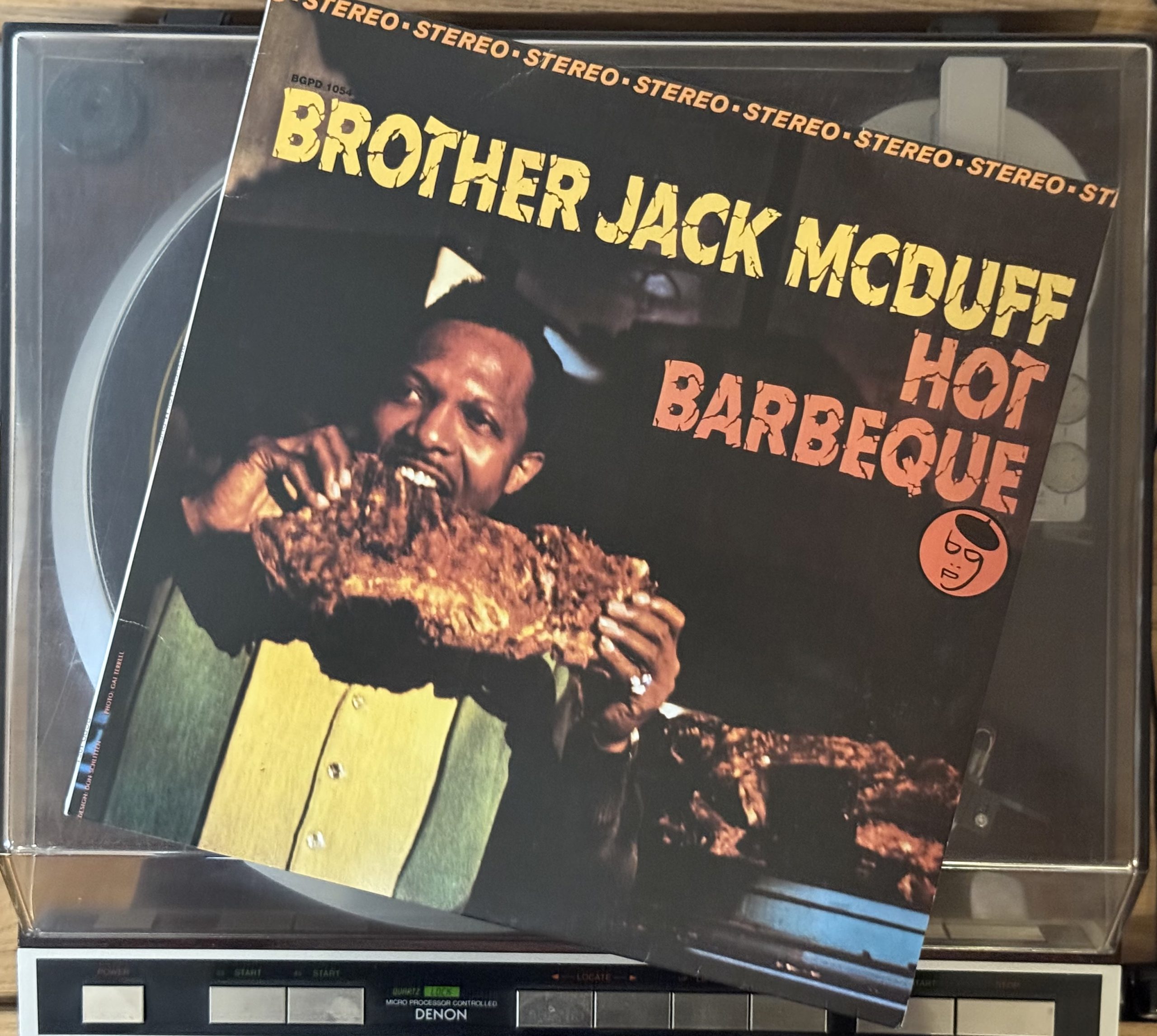
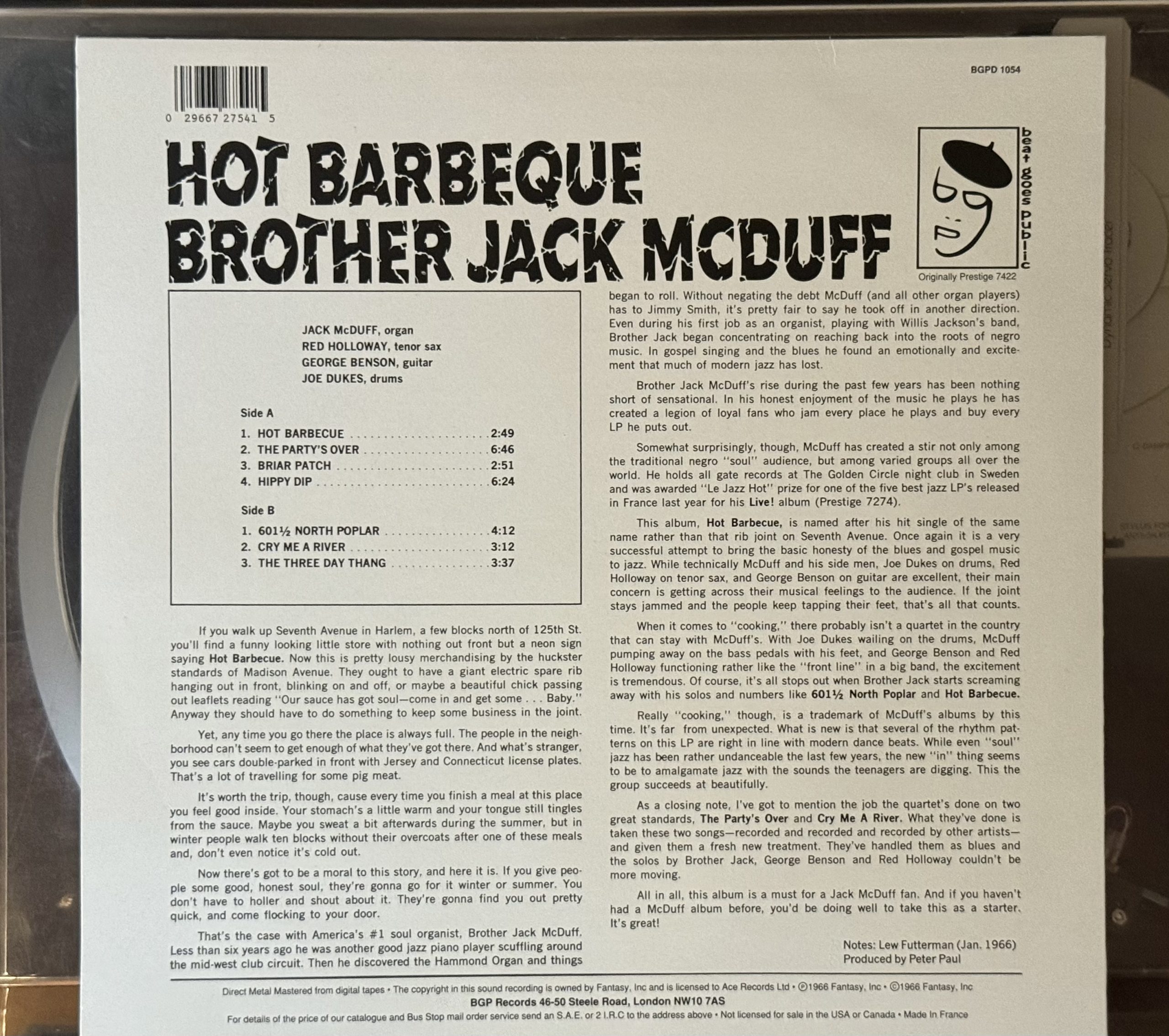
Brother Jack McDuff, Hot Barbeque

A deceptively skillful romp through Latin-tinged soul jazz, with jaw-dropping moments hidden inside.

Album of the Week, September 6, 2025

We’ve heard how Jimmy Smith pioneered the jazz organ trio, and how his sound evolved from the earliest days into his brilliantly orchestrated works for Verve, all without losing the brilliance of the fundamental sound of the instrument. His approach to the instrument drew fans, and also other musicians who put their own spin on the jazz organ. One such player was “Brother” Jack McDuff.

McDuff, born Eugene McDuffy in Champaign, Illinois in 1926, started out playing the bass in an early incarnation of Joe Farrell’s band, but switched to organ at the suggestion of tenor saxophonist Willis “Gator” Jackson. Jazz organists were rare in the late 1950s and early 1960s, and Blue Note had Jimmy Smith sewn up at the time, so the young McDuff must have been a draw for labels looking to capitalize on the sound. He ultimately landed at Prestige, where he played with Grant Green, Sonny Stitt, Gene Ammon and others. By 1963 he pulled together a quartet with Red Holloway on tenor saxophone, Joe Dukes on drums, and a 19-year-old Pittsburgh based guitarist named George Benson, who made his debut with the McDuff band. Holloway was a versatile saxophonist from Helena, Arkansas who had played with Yusef Lateef, Dexter Gordon, and Billie Holiday, but also with R&B and blues acts like Willie Dixon, B.B. King, Aretha Franklin, Junior Parker, and Etta James. Joe Dukes, born 1937 in Memphis, played for most of his career with McDuff, but also recorded sessions with Idris Muhammad and Lonnie Smith. And we’ve written about George Benson before.

Hot Barbecue” opens in an unexpected place, with a samba rhythm and the band shouting out “Hot barbecue… today!” before proceeding into an extended blues. The point of departure for the brisk McDuff original appears to be Smith’s The Cat; there is some of the same rhythmic drive in Benson’s guitar and the drum part, and in Holloway’s solo, which has more than a little boogaloo about it. Benson’s solo, by comparison, is economically funky; both players only get one verse. If you had your eyes closed, you’d be hard pressed to tell the difference between McDuff’s approach on the organ and Smith’s, though the former leans more into expressive runs where the latter tends to favor suspensions. For this song McDuff even uses the Smith tone, which involves pulling out the first three drawbars on the “B” preset on the top manual of the organ, giving a rich, bluesy sound. But where Smith might have jammed on this fun tune for a while, McDuff is in and out in only three minutes.

By contrast, “The Party’s Over” demonstrates a completely different tone, with McDuff playing the melody on a high flute-like setting. The Camden/Green/Styne classic here gets an amiable, ambling treatment, with McDuff and Holloway playing chordal stabs in unison as if to suggest an entire horn section. Benson’s solo keeps to his trademark clean tone while still taking opportunities to elaborate the harmonies. Dukes trades eights with the rest of the band, and McDuff takes two high solo verses and leans into a fade-out.

We’re back into a Latin influence for the fast-driving “Briar Patch,” a sort of soul rhumba that gives Benson and Holloway the opening melodic statement in parallel fifths and sixths before McDuff takes a quick solo on the tonic and the blues note. Benson’s solo is noteworthy here, a casually whipped-off flurry of triple and syncopated meter. The tag is punctuated by exclamations from the organ, and again we’re in a fade-out.

Tempos are considerably more relaxed for “Hippy Dip,” but don’t be fooled; the chromatic descending bit in the second half of the theme will make you sit up straight and grab your headphones. By the time we come back around to the chromatic ascent at the end, you might be saying “What the heck was that?” This is a lot more than the casual soul jazz that we’ve heard so far, and the changes keep things interesting throughout the solos, with Holloway suggesting a little Cannonball Adderley in his approach. Benson’s cooler approach is deceptive, as he rips off a set of ascending tones that show his mind at work. McDuff leans into the tonal shifts with such abandon that you can be forgiven if you lose track of what key we’re in. This McDuff original is one that should be in rotation more, but relatively few acts have covered it. (Though “few” is not “none”; see below.)

601 1/2 North Poplar” takes us back into an animated boogaloo, with a a fierce group chorus and a fiery Benson solo to start things off. Holloway’s solo roots around in the corners of the soul kitchen and takes us down into the basement before McDuff fires up the afterburner, leaning hard on the submediant for an entire two verses as he rips improvisation after improvisation. The band repeats the descending line from the theme into the fade-out.

Arthur Hamilton’s “Cry Me a River” is introduced by Benson harmonizing with Holloway, with punctuation by McDuff. This is clearly Holloway’s show, though, and he gives us a deeply soulful run through the melody before turning it over to McDuff. Brother Jack takes some rhythmic liberties as he leans into the crying corners of the song, and continues to give little shouts at the edges of the outro. The band takes a breath and launches into “The Three Day Thang,” which reads like an uptempo version of some of the chromatic edges of “Hippy Dip” but is really a fast blues. McDuff is on fire throughout his solo, taking off some of the restraint that characterizes the rest of the record. The group leans into a suspension to finish.

Hot Barbeque, with its rib-eating cover and Latin intro, sets itself up as a casual piece of soul jazz. But the expressively restrained solos and, especially, harmonic sophistication of the performance belie that first impression. Brother Jack had a lot on his mind, and the album is a memorable subversion of the organ combo genre. When we hear from him again, he will have subverted it even further. Next week, though, we’ll check in on how Jimmy Smith was evolving along with the 1960s.

You can listen to this week’s album here:

BONUS: Here’s a live performance of McDuff’s quartet from the RTF Festival in France in 1964, just a year or so before this album was recorded:

BONUS BONUS: While my dreams of a full-on “Hippy Dip” revival may be in vain, there are a few pretty good modern covers out there, including this one by a quintet led by guitarist Sam Dunn here: