So here we are, on the eve of the last Virginia football game of 2011. At the beginning of the season, I had no hopes for a bowl game, in only the second season of the Mike London era. And yet here we are, in the Peach Bowl (now called the Chik-Fil-A Bowl) against Auburn.
As the historian of the Virginia Glee Club Alumni and Friends Association, I’ve had a special place in my heart for the football songs of the University, and I’ve written many posts about the origins of the songs. In honor of the game tonight, here’s all the posts in one convenient list. Enjoy!
The Good Old Song: I wrote most of the article on Wikipedia, and have written a bit about the credited author of the song, E. A. Craighill.
Vir-ir-gini-i-a: A lesser known song with connections to early and modern Glee Club history (words by Arthur Kyle Davis Jr., who sang in the 1916-17 season, harmonization by long time Glee Club conductor Donald Loach)–and indirectly to Bob Dylan!
Hike, Virginia: written by a man who had a major impact on Cavaliers abroad during World War I, Lewis D. Crenshaw, with Glee Club member Charles S. McVeigh.
Virginia Yell Song: written by the second ever Jewish professor at the University of Virginia, and the first in the 20th century, Linwood Lehman.
Oh, Carolina: One of Virginia’s few songs about a specific rival.
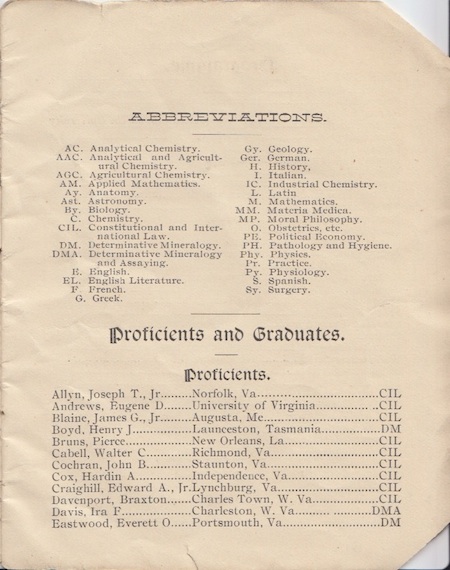
Page 3 of the 1895 Public Days program showing E.A. Craighill, Jr.
A while ago, I picked up an interesting historical keepsake from eBay–the program from the University of Virginia’s 1895 Public Days, aka graduation. I was hoping to find some Glee Club value here, and I got it. The program lists 1895-96 Glee Club president McLane Tilton, Jr. as completing his undergraduate degree, and also has a familiar face picking up his Law degree–E. A. Craighill, otherwise known as the author of “The Good Old Song.”
It’s fun to look at the document and realize how different the University was then. Most of the degrees are professional or graduate degrees because the four-year bachelors degree was virtually unknown then. It wouldn’t be until a few years later that curriculum reform at Virginia and other universities standardized the four-year undergraduate degree that we are all familiar with today.
It’s Saturday, so it’s time for another post about UVa’s football song heritage. This week’s contest isn’t one of those like the South’s Oldest Rivalry that has inspired its own set of songs—Virginia has only played Southern Mississippi a handful of times in the history of the program. The contest against Southern Miss in 2009 did not have the best outcome for UVa, so this week’s song is to inspire those members of the Cavaliers community to redouble their energies in supporting the team.
Stephen M. O’Brien, who graduated from the University in 1902 and went on to the Kentucky House of Representatives in 1914, would have appreciated having “Just Another Touchdown for U.Va.” used in this context. His song, written to the tune of “Just A Little Bit Off The Top” (the same tune as “When Johnny Comes Marching Home”), has been used to marshal the spectators against Carolina, Norfolk, and Georgetown at various times. The third verse in the oldest printing of the lyrics extant (Songs of the University of Virginia, 1906) is as follows:
We’ve just come from Norfolk for the day–the day,
To-morrow we’ll go back to U.Va., V-a,
We’ll gather in Carolina’s tin, Virginia’s sure to win,
Ray! ray!! ray!!! then, and make a mighty din.
But in the 1911 University of Virginia football songbook, it’s transformed to:
We’ve just come to Georgetown for the day–the day,
Tomorrow we’ll go back to U.Va.,
We’ll gather in old Georgetown’s tin, Virginia’s sure to win,
Yell like hell then and make a mighty din.
And in the version performed by the Virginia Glee Club (arranged by Club’s conductor Arthur Fickenscher sometime between 1920 and 1933), the third verse is omitted entirely, but in the second verse the song has “Carolina’s mighty lame” (sometimes “Maryland’s mighty lame”) instead.
So I’d propose this set of words for this week:
Just another touchdown for U.V-a, V-a,
Just another touchdown for U.V-a, V-a,
Carry the ball a yard or two, we’ll tell you when to stop,
Yell, boys, yell, boys, Virginia’s on the top.
Just watch the men whose jerseys bear the V, the V
If up-to-date football you want to see, to see,
They stop the bucks, they block the kicks, the Golden Eagles are lame,
And the ball goes over, Virginia’s got the game.
Unidentified North Carolina crowd at the UVa Thomas Jefferson statue; photo by studio of Rufus Holsinger
Last Saturday wasn’t the best day in the Jarrett household. Having taught my four year old daughter to sing The Good Old Song, it was a disappointment to lose to Carolina, 28-17. But you have to have a long view in these things. The fight with Carolina is The South’s Oldest Rivalry, after all, and in the long view we’re only back four games (58 Carolina victories, 54 Virginia victories, and 4 ties).
Being a member of the Virginia Glee Club gives some unique perspective on the longevity of the rivalry. One of the songs on the most recent Glee Club CD, Songs of Virginia (available for purchase on Amazon! and on the Glee Club’s site!), reflects the rivalry. “Oh, Carolina” is one of the few numbers on the disc that manages to be both edgy and funny at once:
See the Tar Heels, how they’re running
Turpentine from every pore.
They can manufacture rosin,
But they’ll never, never score.
While there’s no good record to indicate how long the song has been around, it may date almost to the beginning of the rivalry. The author of the lyrics, William Roane Aylett, Jr., graduated from the University in 1895 with his medical degree and was in his first autumn on Grounds in 1892 when the first match was played (Virginia won the first match that year in Charlottesville, Carolina the second in Atlanta). Eleven years later, the song was still in circulation, as evidenced by its presence in A. Frederick Wilson’s collected Songs of the University of Virginia (published 1906). It also appears in a 1911 football program book along with other song texts. And after that, nothing until the Songs of Virginia recording.
There’s no evidence that the song was ever performed in a Glee Club concert, for instance–though there would have been lots of opportunities. UNC was the Virginia Glee Club’s oldest partner in its annual fall openings concerts (later “kickoff concerts”), with joint performances with the UNC Glee Club in 1953, 1954, 1955, 1956, and 1977 and with the UNC Women’s Chorus in 1988 (from the records we have handy); none of the programs mention anything about the smell of turpentine.
But the song is handy as a reminder: not only did (do) UVa students take this hundred-plus-year rivalry with the Tar Heels seriously, they also sang about it. In the bleachers. At football games.
Say, maybe it’s time to make up a song about the Hokies…
Gearing up for today’s UVa football game against Indiana is a lot more fun now that my daughter is old enough to enjoy the game. Since last week she’s been imploring me to “sing ‘The Good Old Song,’ daddy! –and the second verse!” I’ve also started to teach her “Virginia, Hail, All Hail.”
One Virginia song that I won’t be teaching her is “From Rugby Road to Vinegar Hill.” This most problematic, often hand-wrung-about of the Virginia songs is unlike any of the other ones I’ve written about because there is no clear author–as well as little among the lyrics that can be sung in public. But I think that if you put on a different hat, that of the folk song collector, it’s easy to find something to admire in the song, even sober.
One of the Glee Club’s past officers was Arthur Kyle Davis, Jr., about whom I’ve written before. His Traditional Ballads of Virginia shows how folk songs change as they are passed from person to person, and even how some lyrics move from song to song; for instance, verses of “Lady Isabel and the Elf-Knight” (known in Virginia as “Pretty Polly”) fetch up in “Young Hunting” (known as “Lord Henry” or, in Bob Dylan’s rendition, “Love Henry”). Also, melodies tend to get reused from song to song, with lyrics appropriate for the occasion being fit to much older tunes.
So it is with “From Rugby Road to Vinegar Hill.” Let’s start with the tune. Like many Virginia songs–“The Good Old Song” from “Auld Lang Syne,” “Oh Carolina” from “Clementine,” “Hike Virginia” from “Hot Feet,” “Just Another Touchdown for U.Va” from “Just a Little Bit Off the Top”–“Rugby Road” recycles another tune. In this case, the roots of the tune reach back to Charles Ives’ “Son of a Gambolier,” penned in 1895, and maybe even to “The Bonnie Blue Flag,” a Confederate marching tune, but the immediate antecedent is “Ramblin’ Wreck from Georgia Tech.” The history of college songs generally is full of this sort of campus-to-campus transmission of melody, arguing for college songs as a special form of folk song.
Then there are the lyrics, and here the similarity to transmitted ballad songs is even more apparent. While the first verse is highly topical to Virginia, with echoes of the shot that killed John A. G. Davis on the Lawn in 1841 ringing through “The faculty are afraid of us, they know we’re in the right,” and the traditional poles of Grounds (“Rugby Road”) and downtown Charlottesville (“Vinegar Hill”) serving as the site of the revels, the second traditional verse is more timeless. The second verse of “Rugby Road” begins:
All you girls from Mary Washington and R.M.W.C.,
Don’t ever let a Virginia man an inch above your knee
Far from being a waggish invention of some Wahoo or other, this line is practically a lock-stock-and-barrel lift from “The Dundee Weaver” (2022 note: the original site is now dead, so here’s an archive link), a bawdy Glaswegian street song:
Come aa ye Dundee weavers an tak this advise fae me
Never let a fellae an inch abune yer knee
Does knowing the history of the song make it any less offensive to a modern, coeducational University? Maybe not, especially considering how very offensive are some of the other verses that have been dreamed up over the years. But I think trying to throw the song out in its entirety misses an important clue to how the college songs that Wahoos sing as they watch football–and drink–came about and why some persist.
Excerpt from the manuscript of the Fickénscher arrangement of “Virginia, Hail, All Hail”
Here it is, the best part of most UVa seasons–that time when the first game hasn’t started yet and the air is still full of anticipation. I’ve been playing UVa songs, mostly Virginia Glee Club repertoire, since earlier this week, and can’t wait to see what the new year’s football team will bring.
In honor of the week, here are a few past articles I’ve written about UVa football songs:
UVa’s second Jewish professor and the Virginia Yell Song. “Lehman’s humor is present in the “Virginia Yell Song,” written when he was an undergraduate. The only UVa football song with a parenthetical interjection, it sounds in places like a conversation between slightly jaded onlookers who will only cheer a winning team…”
Glee Club football songs: “Hike, Virginia”. “As I noted earlier this year, spectators used to sing at Virginia football games. And not just “The Good Old Song”–there were songs for every occasion and for every foe. A 1911 football song book that has come into my possession indicates part of how they were able to pull this off, by having lyrics in front of every fan, but there was much more required to make it happen, from the presence of a band (or the Glee Club) at games to Virginia fans who would write songs to be sung by the crowd. One of these fans was L. D. Crenshaw, and the song was “Hike, Virginia,” cowritten by Crenshaw and C.S. McVeigh.”
Glee Club history: from “The Cavalier Song” to McCarthy. “the University’s two official songs were chosen through a contest sponsored by College Topics (now The Cavalier Daily) in 1923. Seeking official University songs, the contest netted “Virginia, Hail, All Hail!“, byGlee Club alum John Albert Morrow, and “The Cavalier Song,” by English instructor Lawrence Lee and Glee Club alum Fulton Lewis, Jr. While most alums are familiar with “Virginia, Hail, All Hail!” only, if at all, through Glee Club performances, “The Cavalier Song” has been played at Virginia sports events by the various bands (University Band, Pep Band, Cavalier Marching Band) during the school’s history since its introduction. Because it’s typically performed as an instrumental, its lyrics have faded into obscurity, meaning that it is Fulton Lewis Jr.’s tune that we know best about the song.”
“Vir-ir-gin-i-a”: from the UVa iPhone app to Bob Dylan. “Featuring an arrangement by long-time Club conductor Donald Loach based on a tune by Handel, the text is by UVa professor Arthur Kyle Davis, Jr. (1897-1972). Davis himself sang in the Glee Club shortly after the group’s reformation by Alfred Lawrence Hall-Quest, serving as secretary during the group’s 1916-1917 season (during which Club performed the blackface musical “Oh, Julius!,” a minstrel-show story of life in ancient Rome)….”
The Good Old Song of … The Virginia Glee Club. “Here’s the guy credited with writing the lyrics to “The Good Old Song” between 1893 and 1895—in an 1893 Glee Club photo! The guy who wrote the freakin’ “Good Old Song” was in Club!!!!”
Let’s put that in context for a second. This concert happened a mere 20 years after the Glee Club’s founding, and a few years before its first significant tours in 1893. It was before the authoring of the Good Old Song. It was before Thomas Jefferson’s original Rotunda burned to the ground. In fact, the concert was held in the Public Hall, which was the large auditorium in the Annex that was totally consumed by the fire and never rebuilt.
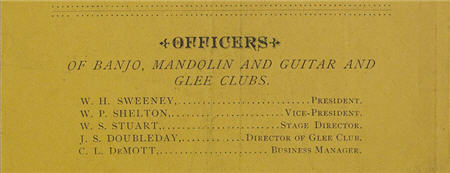
I had known that the concert program existed, because a scan from it was used to illustrate a library exhibit on American song. But that scan was only of the cover. The library digitized both sides for us, including the program and list of members. In doing so, it gave us one of our earliest full Glee Club rosters, and a rare glimpse at the repertoire performed back in the banjo & mandolin days.
Oh–I’ve also been able to do some mini-bios of the Club members listed as officers. See the articles on W. H. Sweeney, W. P. Shelton, W. S. Stuart, Charles L. DeMott, and O. W. Catchings. I particularly like the history on DeMott’s involvement with the founding of the Natural Bridge Appalachian Trail Club.
While there are a few glitches in the performances here and there (unsurprising given only a morning’s rehearsal), what’s moving to me is hearing voices from multiple Glee Club eras come together on both Club standards (“Shenandoah”, the Biebl “Ave Maria,” the “Winter Song”) and one or two that were new to many. I think for me the standout performance is the Fenno Heath arrangement of “Sometimes I Feel Like a Motherless Child” with Morgan Whitfield reprising a solo he had sung almost twenty years previously. You’d never know that most of the alums had never sung the work with John Liepold.
The banquet speeches are good too, if you’re into that sort of thing. Of particular interest to me was the description by Patrick Garner about how the Club’s first European tour came to be. But the whole thing is well worth a listen.
Next project: sort through a few gigs of high resolution photos from the weekend and get them up on the site.
I’ve often complained that the founding era of the Virginia Glee Club is the most obscure, the hardest to get information on, the time most shrouded in mystery. (The uncertainty around the founding date of the group is just one example here.) Part of the challenge for the first twenty years of the group’s existence is the lack of primary materials: Corks and Curls came along in 1888, and College Topics (later the Cavalier Daily) was first published in January 1890. So where does the UVa historian turn for information about anything earlier than 1888?
Fortunately, students were still writing about their own activities in the 1880s and 1870s, in the only venue at hand: the Virginia University Magazine. Founded in the 1850s as the University Magazine, it continued under the sponsorship of the Jefferson and Washington societies as the V.U.M. or the University of Virginia Magazine through the 1920s. Up until the publication of Corks and Curls, it was one of the few outlets that talked about student activities in print, and its column “Collegiana” provides snapshots of student life during the period.
Now that Google has added quite a few issues of the Magazine to Google Books (most pertinently, 1870; 1877; 1878; 1879; 1880; 1886–1887; 1888; 1890, among others), we have a better view of the life of the Glee Club during those first twenty years. In particular, we now know:
The Glee Club faded in and out of existence in the 1870s, with its prototype emerging in 1870, the first official group forming in 1871 and the emergence of the “Claribel Club” in 1874 and 1875
We now also know that Glee Clubs went away entirely during the 1876-1877 and 1877-1878 seasons, then re-emerged in 1879-1880 (the year Woodrow Wilson was a member). Reassuringly, the Cornell Glee Club went through a similar patch in its early years, according to chronicler (and one-time Virginia Glee Club conductor) Michael Slon.
In 1886-1887 the Glee Club got more ink in the Magazine than any year before or since, probably explaining why in the 1930s they thought that this was its founding year. The group (re-)formed and went on tour in the “Northern states,” though nothing else is known about this tour.
1886 is also the earliest year where we know the name of a Glee Club president: Sterling Galt. (Alas, we know almost nothing else about him.)
The group had a moderately successful 1887-1888, apparently enough so to swell their heads, since the magazine joked that, regarding the proceeds from an upcoming concert, that “Some think that the club will give the Ladies’ Chapel Aid Society enough to complete the chapel, and that all the rest, excepting probably a small amount which will be given to purchase four or five boats for the boat club, will be used to construct a Glee Club building. The building will be located at the foot of the Lawn.”
After 1887-1888, the group fell back into a swoon during 1888-1889 and did not organize at all, according to the Magazine.
This backsliding was remedied in 1889-1890, with a group that toured as far as Lynchburg and Richmond. This time things caught in earnest, and, save minor hiatuses in 1906-1909 and 1912-1914, things kept going from here.
It’s taken a lot of digging to build this timeline, and there are still quite a few blanks to be filled in. But I think at this point that things are relatively solid regarding the earliest history of the Virginia Glee Club.
Thanks to the contributions of Jeff Slutzky, the archive of information about the Virginia Glee Club of the 1990s is now nearly complete. It stands at 90 articles, including concert articles, information about tours and rolls, and information about members of the group. For an alum who was a member of the group during this formative time, the archive should stir quite a few memories. If you’re inclined, please go and check it out and leave some impressions.
Incidentally, the places where the archive comes up short is in the 1990-1991 season, and the 1999-2000 season. I believe we have concert programs at a minimum for every home concert and most of the away concerts in the other seasons.
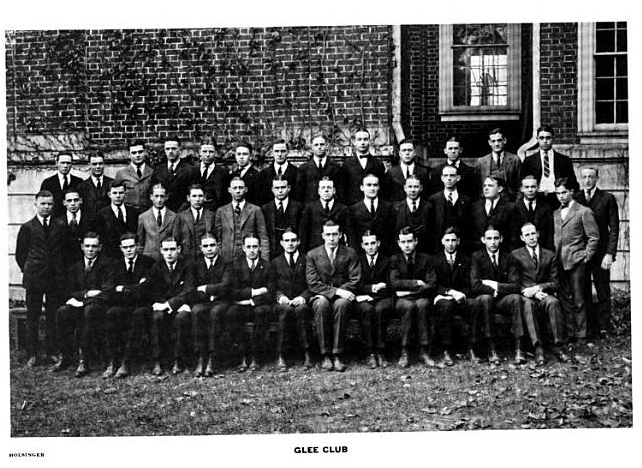
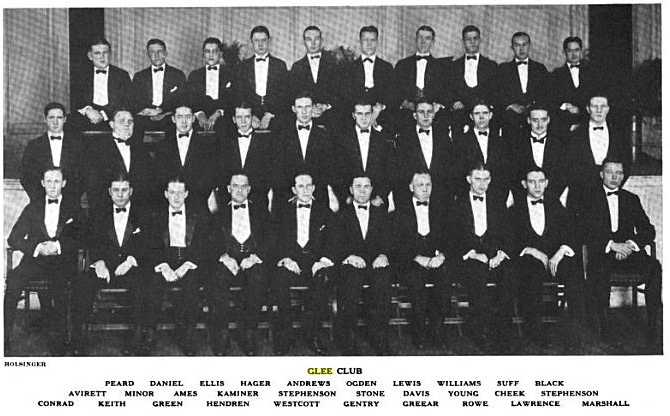
If you do research on a topic that has useful materials in Google Books, it pays to periodically check again to see what else has turned up. Yesterday, I happened to try my customary search term (“university of virginia” “glee club”) and was pleased to find a full five editions of Corks and Curls from the late 1890s through the 1920s that had previously been unavailable, and which shed light on five Glee Club seasons which had previously been obscure. So we have:
Glee Club of 1897-1898. This group was conducted by George Latham Fletcher and had John Lawrence Vick Bonney as its president. Both were in Eli Banana and the Z Society; Bonney was also captain of the baseball team and voted “most popular man in college.” Note Francis Harris Abbot in the back row; the man who would later be French professor “Monsieur Abbo'” would also conduct the Glee Club in the following season.
Glee Club of 1911-1912. This season was previously thought to have ended in failure (the group actually disbanded in the fall of the following year), so it is interesting to see a picture of the group looking hale, if not entirely cheerful. Arthur Fairfax Triplett was president that year, and the still-mysterious M.S. Remsburg was conductor. Three of the four officers who disbanded the Club in the fall of 1912 were in the group in the 1911-1912 season.
Glee Club of 1920-1921. This yearbook entry cleared up a misapprehension perpetuated by the 1921 Yellow Journal: while John Koch (Skull and Keys, Eli Banana, College Topics) was the president of the Glee Club this year, he was not its conductor. That was Nevil Henshaw, class of 1902, novelist, short story writer, and author of The Visiting Girl, written in 1907 for UVa theatrical group The Arcadians and performed by the Glee Club to no few brickbats in 1920-1921.
This yearbook also provides the first documentary evidence proving what was once conjecture: that John Albert Morrow, author of “Virginia, Hail, All Hail,” had been a member of the Glee Club (though he was not during the 1920-1921 season).
Glee Club of 1921-1922. Interestingly, no conductor is listed for the group this year (Arthur Fickenscher became conductor the following season), but the president, Frederick R. Westcott, was a graduating student that year who served in the German Club.
Finally, looking at the accomplishments of our forebears, it’s tempting to judge later generations of Glee Club officers as, to use the modern vernacular, a bunch of nons. It’s hard to imagine anyone covering all the bases of Greek, secret society, yearbook, newspaper, drama club, athletics, and Glee Club today, at least while still graduating.
I gave Jeff Slutzky, who was in the Virginia Glee Club with me starting in 1992 and continued on and off in the group throughout the 1990s, a lift back from the 140th reunion weekend last week. He had offered to lend me a set of Glee Club programs from his time in the group to scan for the archives. We listened to Glee Club recordings across about six decades and chatted for a long time. When we got into New York, he asked if I wanted to come in for a minute to go through his collection of programs.
And thus it was that I had delivered into my hands a nearly complete set of Glee Club programs from the entire 1990s–filling in all the blanks in my personal archives from the early 1990s, and carrying on through the late 1990s and the beginnings of the Bruce Tammen years. And I thought I was a packrat, until I saw Jeff’s collection, which included not only programs from tour performances but even set lists from Lawn Concerts. Well done, Jeff. I’ve been scanning the archive all week and have plenty more to go; you can watch the progress here.
Coincidentally, Jeff’s materials arrived at the same time as two other bodies of material: a set of scanned posters from the Glee Club’s capable arts administrator covering the same period, and a set of programs, tour photos, and even recordings from the late 1970s courtesy of Dr. Anthony Gal. The posters are on the wiki already, the materials from Tony Gal will follow. The great thing about this is that just as we run out of the archives that were readily available to the Glee Club, its alumni are stepping up to provide more materials. So now I’m going to start tagging materials by donor as I post them, as a way of thanking contributors to the project.
I drove down from Massachusetts to DC on Thursday, where I spent time at the Jefferson Memorial before catching up with my first year roommate Greg Greene. The next morning, I hopped back in the car and drove down, spending the morning and early afternoon in the Small Special Collections Library doing research before going on to the first cocktail party of the weekend.
After spending months and months building up the Virginia Glee Club history wiki, it was nothing short of astonishing to meet so many alums–and to be able to talk intelligently with them about what they did during their time in Club. We had a splendid meeting of alums in the Colonnade Club before moving on to the Glee Club concert, in which Club acquitted themselves nobly.
The concert also raised awareness of just how powerful this collection of singing alums and students could be. When Frank Albinder called alums to stage to sing the alma maters of the University (“Virginia, Hail, All Hail” and “The Good Old Song“), the 130 voices pretty much blew the roof off Old Cabell Hall. Afterwards, we all fetched up on the Corner, where we learned that the Trinity Pub (née the Greenskeeper, née Jabberwock, née many others) was too loud for some of the 90s era old timers (though not, surprisingly, for the 70s era guys). We relocated to St. Maartens, home of many an inaugural drinking experience on 21st birthdays, where at least one Club alum still had a mug hanging at the bar, and closed the night at Littlejohns, home of much late night gastric distress.
The next morning was transcendental, as Club members reunited with old (and new-to-us) directors to review repertoire, then performed on stage. Don Loach’s alumni performance of “A Shadow’s on the Sundial” was probably the most emotional, as he confessed, “The ending of that song gets me every time!” The group then repaired to the Rotunda; on the way, a group of current Club guys gathered to sing “Coney Island Baby” and other works. By the time they were at the Rotunda, they had moved on to “Loch Lomond,” in which many an alum joined in. We then took our collective 130+ voices to the portico of the Rotunda to serenade the startled onlookers with “Virginia, Hail, All Hail” and “The Good Old Song.”
The evening banquet featured more activities, including announcement of a details-pending initiative to fund scholarships for students to engage in Club’s keynote activities of musicianship, leadership, and fellowship; speeches from several including former University president John Casteen, who pointed out that Club’s custodianship and performance of the University songs including “The Good Old Song” constitute one of its most important contributions to the University; and announcement of a digital remaster of the Shadow’s on the Sundial album (available to donors). The evening concluded with many visiting various Corner bars and washing up at The White Spot.
The Glee Club has come a long way since 1899, when Corks and Curls memorably published a fake notice stating that it could “furnish funeral music on short notice.” The extended Fraternity of Talent embraces more than 2000 named alumni of the group to date, and I think that the 100+ that attended the reunion would agree that the more often all could come together, the better.
Over the weekend I did some curation of the Virginia Glee Club history wiki, pulling together some previously posted images into new categories and scanning a few large format posters. You can now see all the posters and program covers that we’ve scanned in one place.
Looking at all of them in order, I’m reminded of my own role in the evolution of the graphic look of the Glee Club as expressed through its posters, programs, and tape jacket covers. From about late 1991 through late 1993/early 1994, I was either the “typesetter” (aka Quark Xpress jockey) or designer of all the Glee Club’s printed matter, and it’s interesting now to remember that we really had a firm (if amateur) idea about the direction in which we were going, graphically speaking. And looking at it in the context of what came before, it’s interesting just how different that direction was from what the Glee Club’s visual identity had been before.
I think it’s fair to say that, based on the evidence that has survived, that there was really no distinctive graphic identity for the Glee Club prior to the mid-1960s. While it’s hard to say for sure–posters and other large printed ephemera are rarer in the historian’s archives than programs–all the printed matter I have before 1965 is simple, generally typeset, and consistent, probably in a University “house” style. This started to change once Donald Loach took over leadership of the group. As early as Christmas 1965, and maybe earlier, the glyph to the right started to appear on Glee Club printed matter. Designed in the International style, the icon was clear and recognizable, and put a new graphic element into the Club’s printed materials. The “Y conductor” icon appears often through the 1960s and 1970s, most strikingly as the central design element in the poster for the 1971 Concert on the Lawn. But it was not used consistently, and in fact by the mid-1970s had largely disappeared in favor of more visual graphic elements intended to reinforce the theme of each individual concert: woodcuts for concerts of medieval and Renaissance music, sheet music for a concert of Viennese works, silhouettes of Jefferson and images of the Lawn for University functions.
By the 1980s, a more hand drawn style had begun to emerge. The iconic Christmas wreath, as shown on the cover of the Christmas program from 1982, is colorful, hand drawn, and generally less formal than the 1970s programs. The Kickoff Concert cover from 1988 is even less formal, looking sketchy and even cartoony. Both of these designs would persist into the early 1990s, and both were around when I began as “computer dude” for the Club in the fall of 1991. While I didn’t save the posters or programs, I remember this design for the Kickoff Concert being in use in both 1990 and 1991, and certainly the Christmas wreath stayed throughout this period.
When John Liepold came on board as a fresh new conductor in 1991, he took a hands on approach with the design of programs, letterhead, and other printed matter. He probably was the designer of the distinctive Virginia Glee Club letterhead–Palatino bold, with the word “the” in small caps, a thick rule beneath, always either black on white or white on black–and its use and design was the one consistent rule graphically during those years, along with the use of Palatino as the standard font. The intention was to be more visually bold and to get our name out more, and–given the limited typographic palette available in 1991 even on a Macintosh–I think it was pretty successful.
My contribution, other than general typographic contributions, was to add more photographic and representational imagery to the mix. Some of the posters I produced were simple retreads of designs that were already in use when I came on board (the Finals Concert poster is in this camp) but others were complete redesigns. The Kickoff Concert, which was my first poster the year I was vice president, was my first target, and I decided to go with an image from the archives that would be visually bold, memorable, and tied into the history of the University. That I happened to see this photo in the Special Collections archives a few months after seeing this poster for the first time was a happy graphical accident. We used it again in 1993 but I don’t think the poster reappeared since then. But the basic themes–striking imagery, ties to the history of the University to reinforce our claim as the oldest musical group on Grounds, fun–were to appear again in other posters. (I wrote about this poster once before a few years ago.)
The other major redesign I presided over was the Christmas concert. Wanting to freshen the wreath, I asked Craig Fennell to help me design a replacement, and he obliged with the “quarter-wreath” treatment we used on the 1992 and 1993 Christmas concert materials. I think this design was less punchy than some of the other posters we did, but the overall effect was still good.
The other contribution I made was the “letterpress homage poster”–posters that mimicked presentation forms and styles from the letterpress era. Inspired by an English playbill poster that had been recreated in the Colonial Williamsburg printing office with honest to goodness movable type, I designed three posters in this style: a poster for the joint U Singers/Glee Club Messiah Sing-In in the style of an 18th century English playbill, a Lawn Concert flier in the style of a 19th century advertisement, and the poster for the Spring Concert in 1994. Of the three, the Messiah one is probably my favorite as graphic art–clean, dramatic, colorful, and correct use of the long “s”–but the Lawn Concert flier was probably the most effective at getting bodies to the show. Something about the little Porte Crayon student seems to strike a chord with viewers even today.
I’m sadly short on examples of work after I left–hope to scan some this weekend–though I would be remiss if I didn’t point out that Craig Fennell, Matt Vanderzalm, and others kept the artistic streak of our poster work alive through at least the late part of the 1990s.
The UVA Magazine posted a great collection of stories from women at the University of Virginia. One area that they didn’t dive into was the history of women’s choral music at the University.
The earliest reference we have to women of the University community participating in Glee Club performances comes in 1944, when a “Madrigal Group” made up of women from the University joined the Glee Club in its fourth annual Christmas concert. The Madrigal Group lasted two seasons, disbanding after the end of World War II, and except for a brief reinstatement in the 1950s there is no further word about a women’s choir until the formation of the University of Virginia Women’s Chorus in 1974. So while the Glee Club collaborated in virtually every home concert with a women’s chorus, they always had to reach outside the University community for their collaborations.
It would be great if any of the original members of that Madrigal Group could share their stories. According to the December 15, 1944 “College Topics,” they included Kathryn Bell, Barbara Bishop, Phyllis Black, Joyce Blume, Adele Chauvenet, Mary Costello, Virginia Cummings, Nancye Jane Davis, Renee Gretcke, Barbara Harris, Mary Lamb, Jeanne Mills, Margaret Neale, Betty Pritchett, Roberta Richman, Catherine Spencer, Doris Spradlin, Mae Thacker, Virginia Ware, Anna Witt, Mary Broyles, Dudley Burruss, Priscilla Calmer, Calise Chauvenet, Mary L. Forbes, June Kittleson, Betty Newton, Nancy Spicer, Patsy Walker, and Mary Wheat.






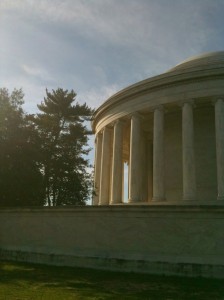 I drove down from Massachusetts to DC on Thursday, where I spent time at the Jefferson Memorial before catching up with my first year roommate Greg Greene. The next morning, I hopped back in the car and drove down, spending the morning and early afternoon in the Small Special Collections Library doing research before going on to the first cocktail party of the weekend.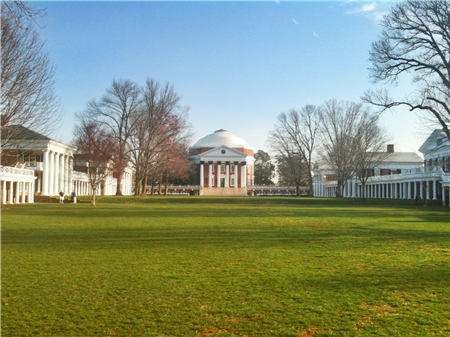

 I think it’s fair to say that, based on the evidence that has survived, that there was really no distinctive graphic identity for the Glee Club prior to the mid-1960s. While it’s hard to say for sure–posters and other large printed ephemera are rarer in the historian’s archives than programs–all the printed matter I have before 1965 is simple, generally typeset, and consistent, probably in a University “house” style. This started to change once Donald Loach took over leadership of the group. As early as
  By the 1980s, a more hand drawn style had begun to emerge. The iconic Christmas wreath, as shown on the
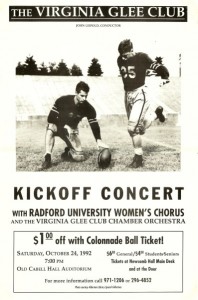 My contribution, other than general typographic contributions, was to add more photographic and representational imagery to the mix. Some of the posters I produced were simple retreads of designs that were already in use when I came on board (the
  The other contribution I made was the “letterpress homage poster”–posters that mimicked presentation forms and styles from the letterpress era. Inspired by an English playbill poster that had been recreated in the Colonial Williamsburg printing office with honest to goodness movable type, I designed three posters in this style: a poster for the


