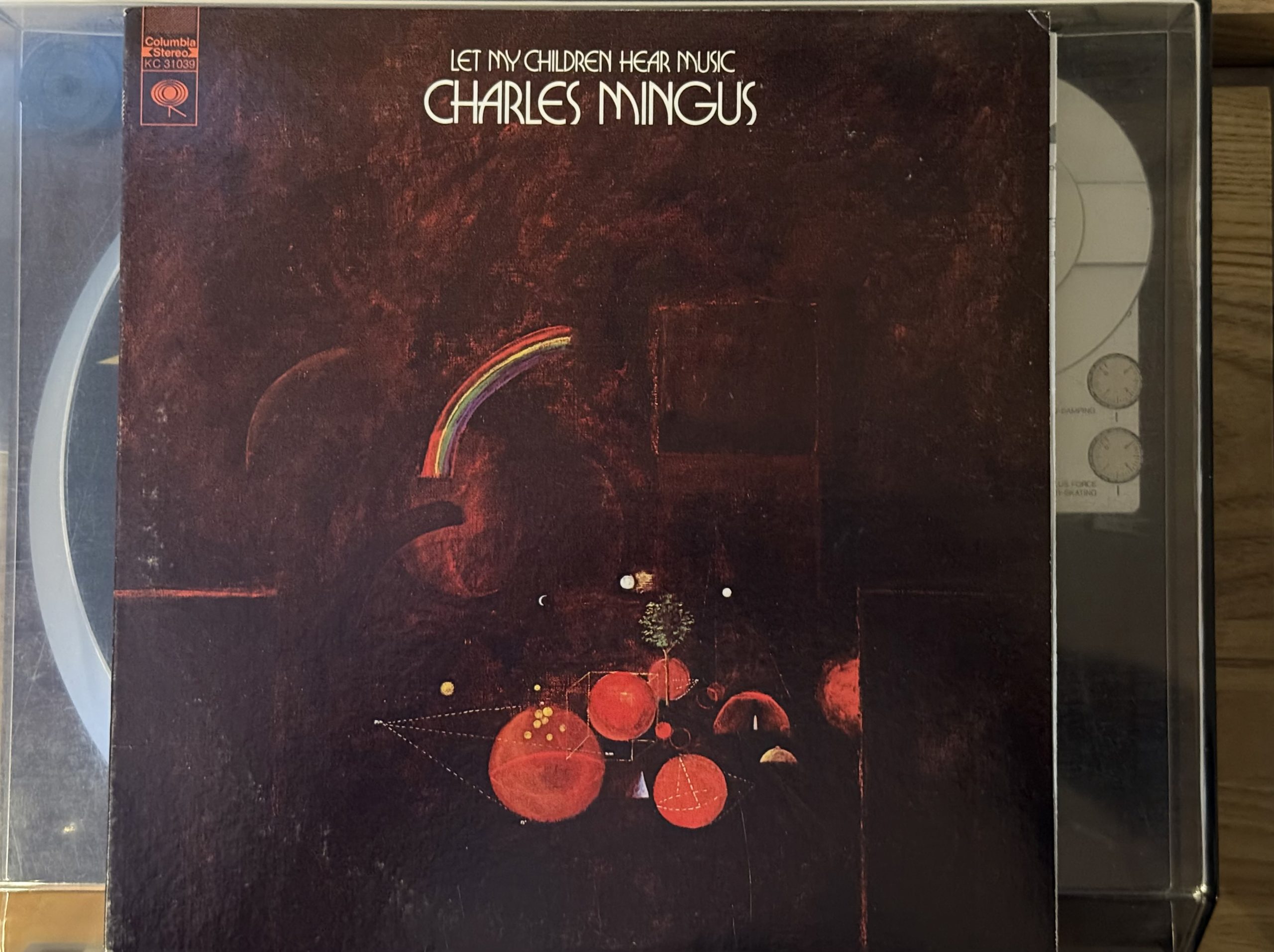
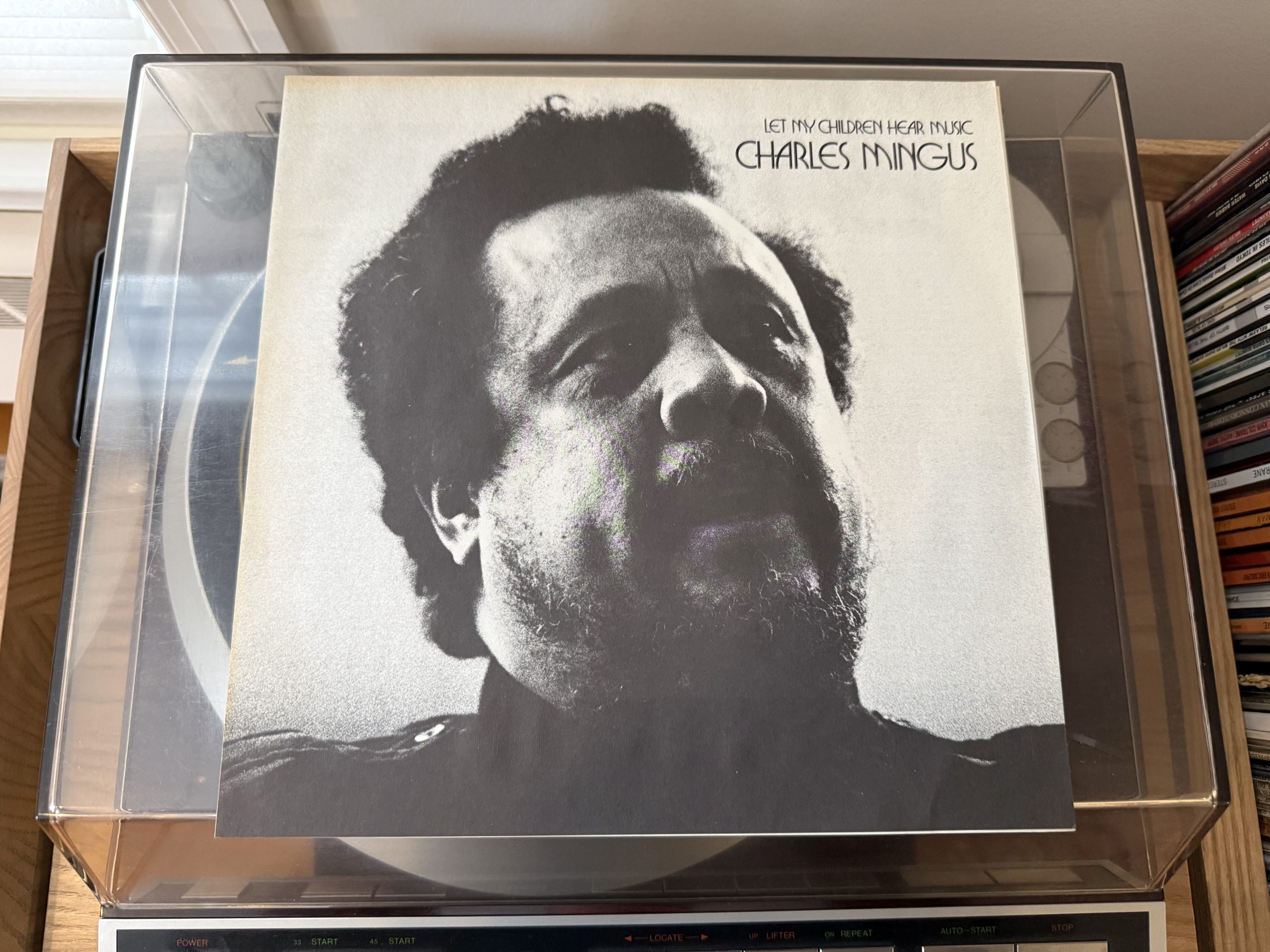
Charles Mingus, Let My Children Hear Music

The last great composition from Mingus sums up all his contradictions into a single masterpiece.

Album of the Week, February 14, 2026

When we last checked in with composer and bassist Charles Mingus, he was on a career high that was about to enter a downturn. Following Mingus at Monterey, he toured heavily but was without a recording contract, and was evicted from his apartment for nonpayment of rent in 1966. But Mingus seems to have always had the ability to convince the labels to place a bet on him, and the fall of 1971 found him working again with Columbia’s Teo Macero on a big-band recording of all-new compositions.

And what a band! Across six recording sessions between September 23 and November 18, a small army of musicians worked on the recording that became Let My Children Hear Music, including Lonnie Hillyer, Jimmy Nottingham, Joe Wilder, and Snooky Young on trumpet, Jimmy Knepper on trombone, Julius Watkins on French horn, Charles McPherson on alto sax, Jerry Dodgion, Bobby Jones, Hal McKusick and James Moody on reeds; Charles McCracken on cello; Jaki Byard, John Foster, and Roland Hanna on piano; and Dannie Richmond on drums. Teo not only produced but also conducted the orchestra and played some alto sax. And alongside Mingus’s bass were three additional bass masters—no less than Ron Carter, Richard Davis, and Milt Hinton. And those are only the musicians we know about—some remain uncredited on the recording due to contractual issues. Collectively they gave Mingus’s music a sound that he had never gotten on record before, with a combination of power and polish.
The Shoes of the Fisherman’s Wife Are Some Jive-Ass Slippers” might be my favorite Mingus title of all time, even considering that this is the man who wrote “All the Things You Could Be By Now If Sigmund Freud’s Wife Was Your Mother.” From the very beginning of the track we get two impressions: this music is ambitious, and this band is tight. The horns and reeds play the opening melody slowly against a chromatic scale in the bass and low instruments; there’s a coda of sorts to this part signaled by an “Also Sprach Zarathustra” timpani roll, a series of chord changes, and then we’re into a brisk waltz that pauses, then shifts into 6/8 time. The horns and reeds introduce a descending motif that keeps interrupting the waltz until the piano signals another transition and a recapitulation of the top melody. This time the band picks up a new version of the slow theme in a fast 4/4 time, that builds in intensity up the chromatic scale until there’s a sudden swoon and lapse back into waltz time. We’re left to wonder how many of the sudden shifts were scored and how many were the product of Teo Macero’s genius editing skills. All throughout the chord progressions and gestures are wild and free (that timpani glissando against the descending motif at the end!) and the band swings as hard as anything Ellington ever did.

Adagio, Ma Non Troppo” begins with a lone reed followed by a lone flute, playing music that seems birthed from “Sketches of Spain.” There are interludes of piano and guitar, rafts of flutes and clarinets, and a fast dance with three arco basses all soloing at the same time. True to the title, some moments are downright symphonic here; this section is probably the least swinging on the record, but those bowed bass solos keep us grounded at the same time that they reach for the stars. When the saxophones take the theme it feels like a moment from a Keith Jarrett European quartet composition.1 The whole thing is breathtaking in both composition and performance.
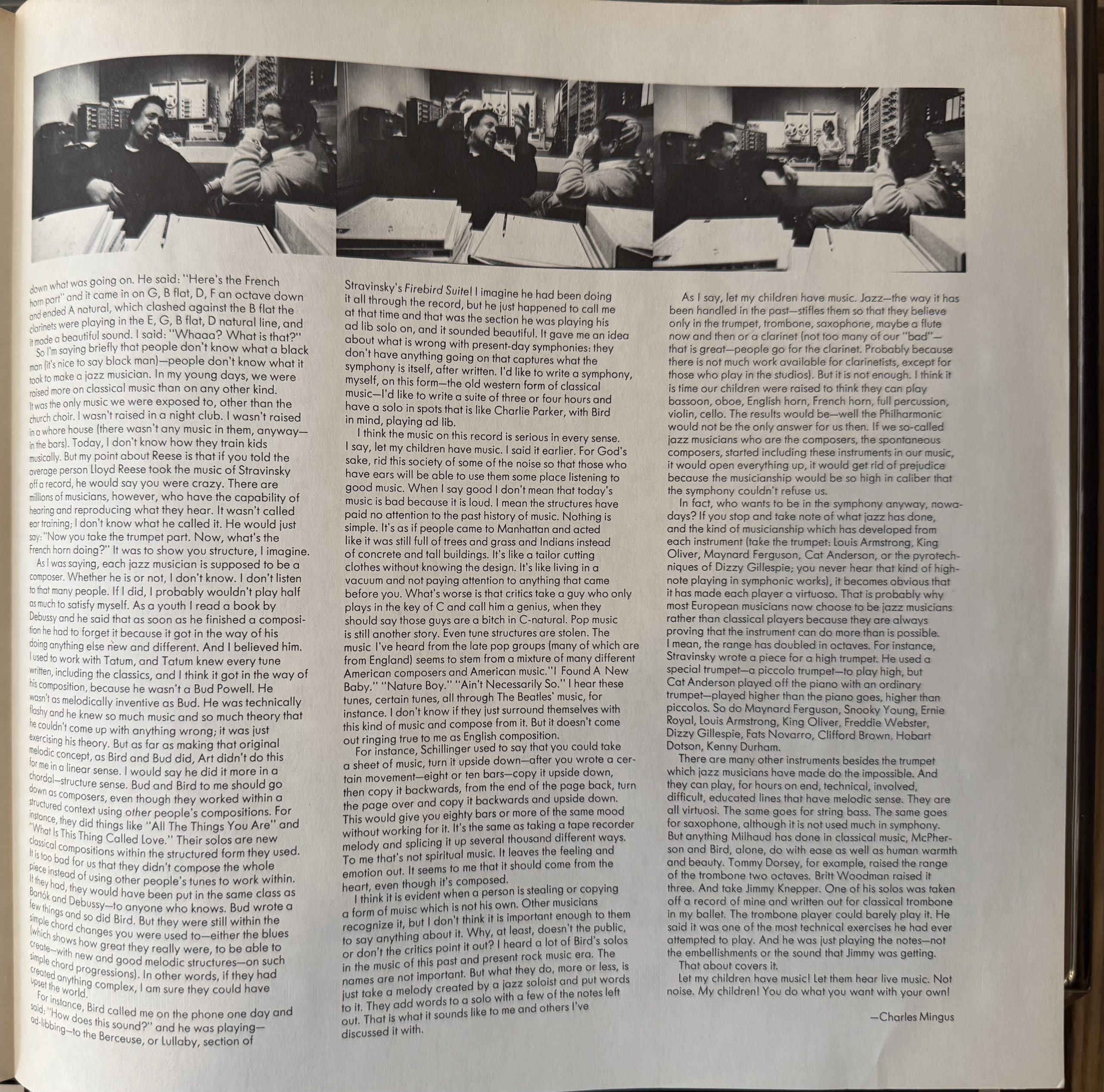
Don’t Be Afraid, The Clown’s Afraid Too” starts in the circus, with recorded lion roars and elephantine trumpet blasts, before the band swings into a circus theme underscored by oompa bass and tuba and a brilliant walking bass line. The simultaneous solos between tenor sax (right channel) and alto sax (left) stretch the brain to hear all the passing harmonies as the players cross over and solo past each other. Another circus interlude and a brisk Mingus pizzicato solo sets up a chorus of twittering bird flutes, and the rest of the track tosses the theme from section to section before returning to the oompa theme once more before returning to the circus again to take us out of Side A.

Hobo Ho” opens with a gutsy, funky bass line that anchors us firmly in the tonic. The tenor sax sets up the first melody with almost subsonic support in the lowest instruments. There are horn bursts that wouldn’t have been out of place on The Cat. This is music for a rumble, standing alongside “II B.S.”/“Haitian Fight Song” as some of Mingus’s most groove-driven work.
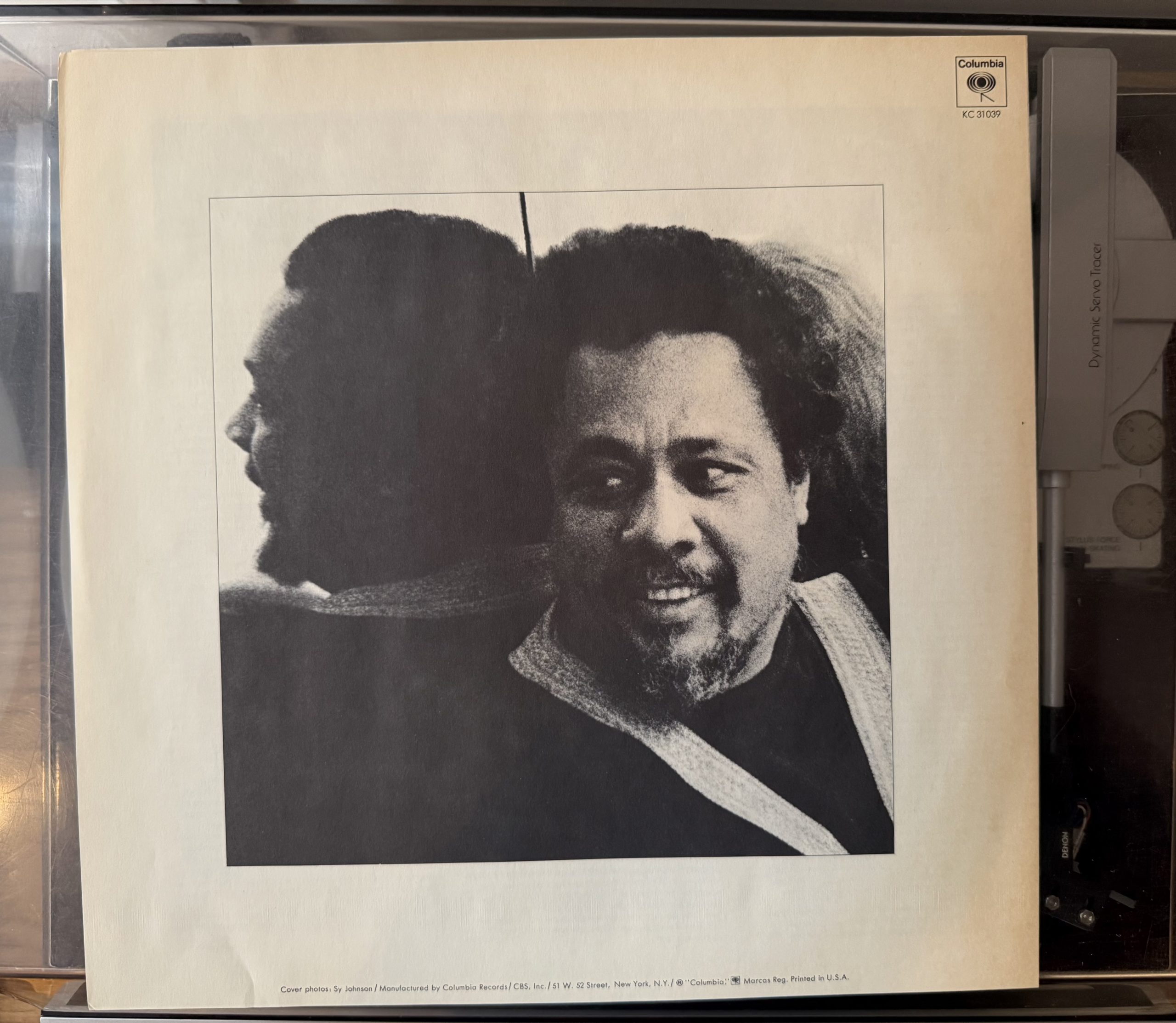
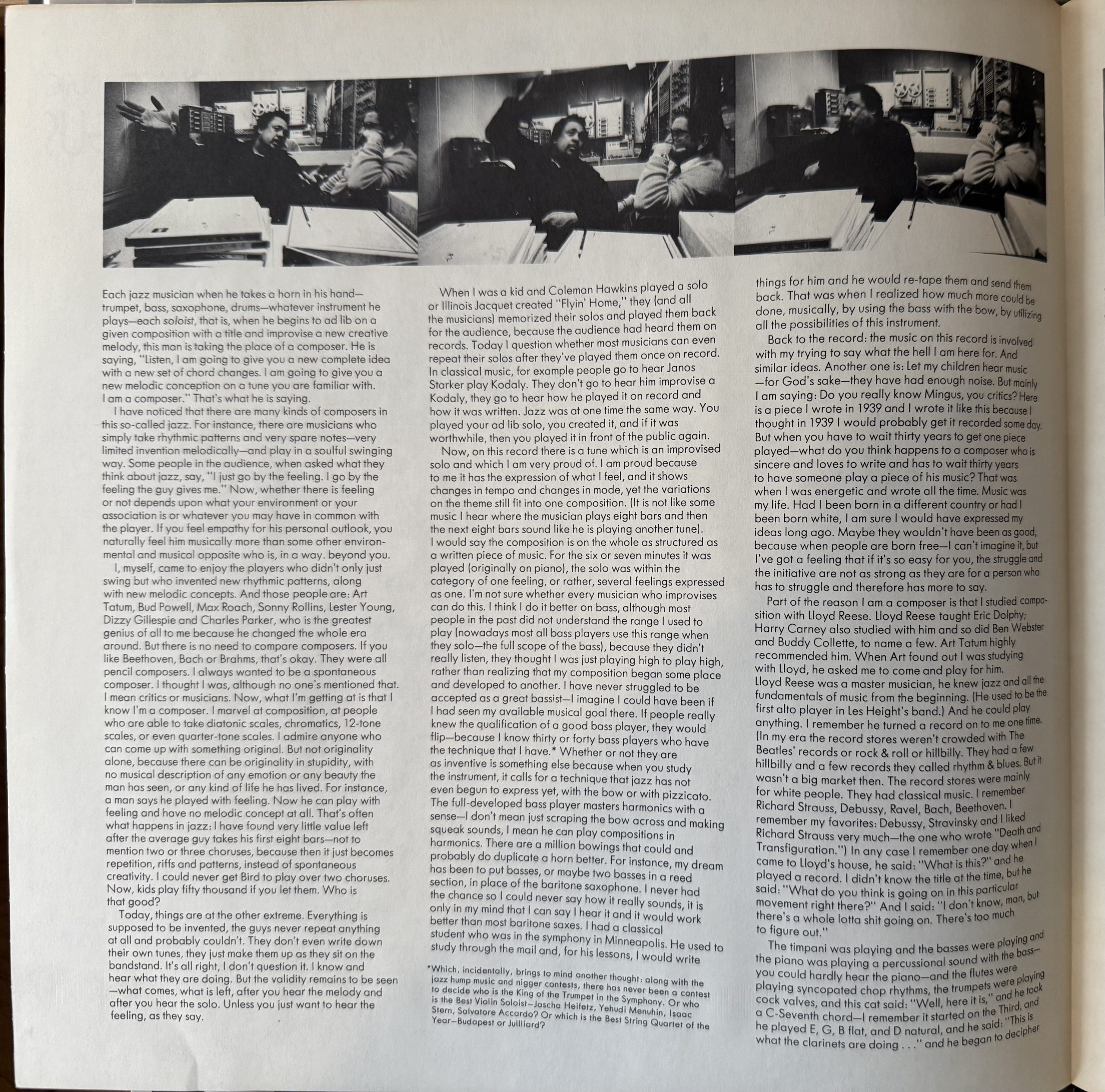
The Chill of Death” begins with a Mahlerian moment, a tremolo from the basses over a timpani hit and the orchestra. Mingus recites a poem that dates from the beginning of his career; written in 1939, it captures the constant tension in his work between wild life and the fear of being forgotten in death. After the recitation there’s a sustained organ tone and a free alto sax solo by Charles McPherson over a shifting, uneven instrumental background—sometimes marching to the graveyard, sometimes joyfully dancing, sometimes anxiously peering around the corner. The piece ends with a rare audible splice as McPherson plays into a descending glissando and crescendo by the rest of the band; I wonder how much improvisation was left on the cutting room floor by Macero.

The I of Hurricane Sue” ends where we began, the second piece recorded in the very first session. There are wind effects and corrugaphones beneath a free intro before the band snaps into a tightly wound, swinging melody. The work ends with dueling pianos, Jaki Byard vs. Roland Hanna, as the whirly tube and winds blow us away. This characteristic of alternating chaos and gorgeously played symphonic jazz is what ultimately sets Let My Children Hear Music apart as a work of staggering genius and an apex of Mingus’s compositional career.
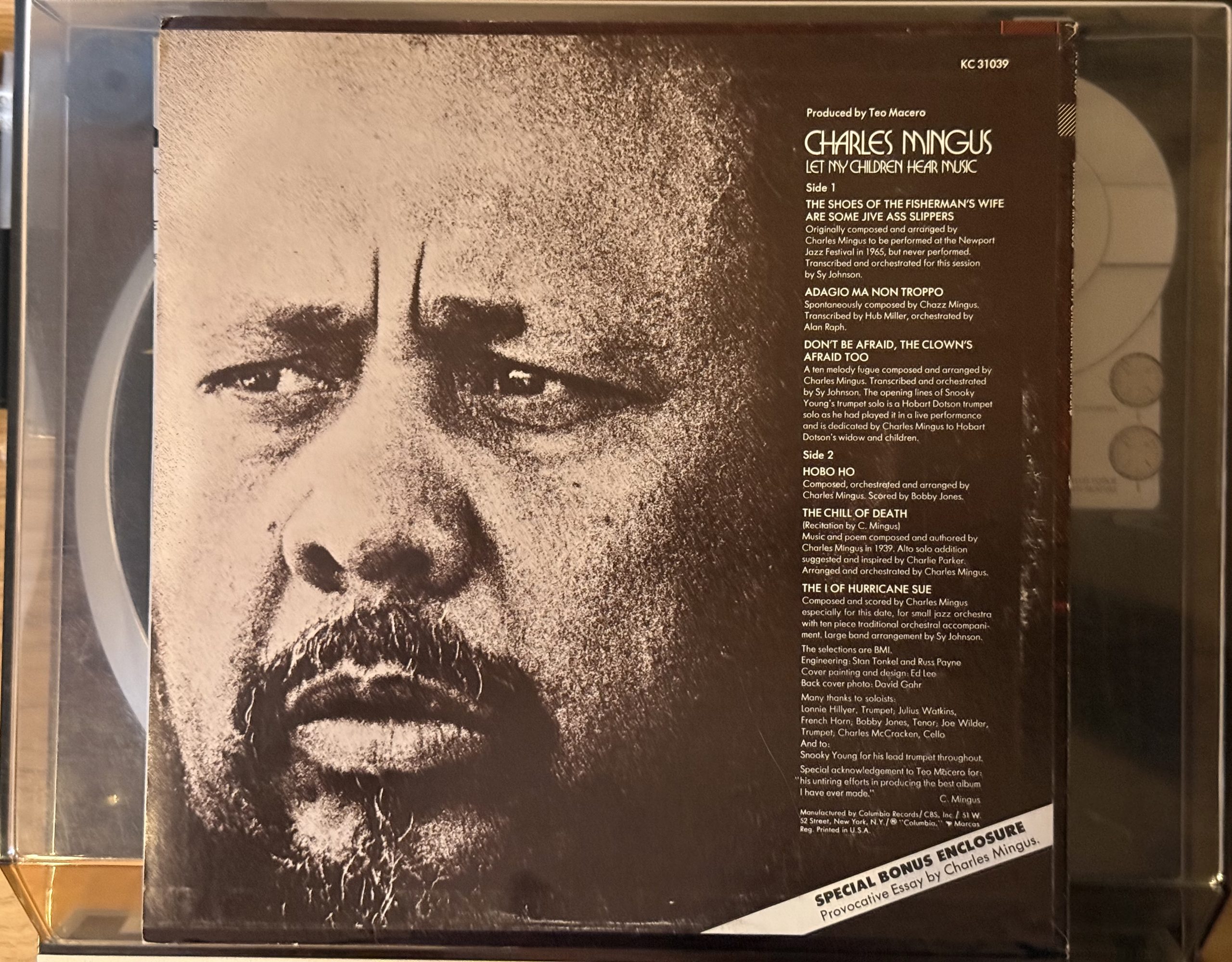
The brilliance and tragedy of Mingus’s life wasn’t yet done. He had a few epochal albums for Atlantic Records, Changes One and Two, ahead of him, but he also had a deeper challenge—ALS, which began to rob him of his mobility and his ability to perform. As a composer and bandleader, he still had some milestone records ahead and we’ll hear one last one next week.

You can listen to this week’s album here:

BONUS: There is an honest-to-goodness bonus track, in the original CD reissue sense, on Let My Children Hear Music. Recorded on the second recording date (September 30) following “Hobo Ho,” “Taurus in the Arena of Life” was first issued in 1992 on the first CD release of the album. It’s a nifty hybrid between a classical sonata in the piano and a blues in the horns, who take a trip to Mexico where things get marvelously strange.

BONUS BONUS: There are a few attempts to play this music live out there, but not many—which is why it came as a shock to find this sextet performance from a jazz ensemble in the University of Virginia’s Old Cabell Hall Auditorium, of all places! I don’t think that’s any of the main faculty up there, but I can’t see the bassist so it just might be Pete Spaar.

  1. Don’t worry, you didn’t miss a week. We’re not to Keith yet, but we’ll get there eventually. ↩︎

George Benson, Good King Bad

Album of the Week, September 2, 2023

When I was growing up in the bucolic suburbs of Newport News, Virginia, listening to my parents’ music on the kitchen radio and in our car, the radio was generally on one of two stations. One, WGH, was the local independent classical radio station (which later moved its programming to WHRO). The other, WFOG, was the “easy listening” one. I didn’t mind it at first, but in time I grew to mock it, hearing the uncomplicated, dumbed-down orchestral arrangements of pop standards everywhere—dentist’s offices, malls, grocery stores. When I first heard “smooth jazz,” courtesy of Kenny G, I knew exactly where it had come from.

And when I started listening to CTI Records, I thought that was what I’d be getting, thanks to the label’s reputation for heavy string arrangements and jazz-funk hybridization. (I’ve had record collectors proudly tell me they avoid the label entirely for this reason.) As this series has hopefully shown, I was almost completely wrong.

But then there’s George Benson and Good King Bad. A technically brilliant player with a great melodic imagination, on this record he surrounded himself with a small army of studio musicians and smothered much of the material in major key, uncomplicated string arrangements. (I don’t know how to describe the unique tonality of so much of the smooth jazz adjacent recordings that I’ve heard except to observe that they are almost always in major keys and almost never use modes or complex modulations. But I always imagine some of the blissful jazz announcers I heard in Washington DC, who never seemed to let a cloud cross their minds and who seemed to always be speaking through a permanent smile, when I hear it.) The good news is that alongside the smooth jazz there is a fair amount of jazz-funk as well, in a way that lives up to Benson’s considerable prowess with the guitar.

About that small army: the musicians here are no slouches. There’s David Sanborn, Michael and Randy Brecker, and James Brown stalwart Fred Wesley, for starters, as well as Joe Farrell, Roland Hanna, Ronnie Foster, Eric Gale, and Steve Gadd, along with a bunch of other horn and string players. But there’s not a “band” to speak of as each of the tracks features a different line-up.

Theme from Good King Bad” is not a soundtrack, just the opening number. Written by arranger David Matthews (no relation), the uncomplicated pop number has not an ounce of swing in the chart, just straight ahead seventies jazz rock with horns and Eric Gale’s insistent chukka chukka on the rhythm guitar.. The funk in the performance is brought by Benson, whose guitar redeems the track with his usual precise yet soulful melody sense, as well as a sense of rhythm that swings all over the precise backing beats of the chart. Listening to the track, recorded in 1975, is a reminder that disco was already here, just not evenly distributed yet.

Matthews also authored “One Rock Don’t Make No Boulder,” which plays with the smooth formula by bringing in some crunchy minor chord progressions. Benson’s solo finds some grime and soul in the chart, which swings a bit more than in the first track, and the clarinet solo by Don Grolnick is a notable contribution to the overall mood. It’s a more complex sound that hearkens back to jazz-funk works like Farrell’s Penny Arcade.

Em” continues in this vein. A slightly blues-inflected jazz-funk track written by Philip Namanworth, it edges even closer to the disco line. Benson’s guitar work is unremarkable here.

Vince Guaraldi’s classic “Cast Your Fate To The Wind” is a different story. Here remade in a technicolor arrangement that brings strings around the edges of the tune, Benson is otherwise left largely to his own devices over the backing group, and he both renders the wistful side of Guaraldi’s melody as well as bringing out a hint of the bravado lurking beneath. Joe Farrell’s flute is a lovely complement to the track, and taking the second solo he brings a celebratory cadence to the music. The only misstep in the arrangement is an unnecessary key change in the bridge, but that is quickly rectified. The two soloists play in dialogue to close out the track.

Matthews’ “Siberian Workout” again seeks to shed the major-key stereotype, centering its composition in a minor mode instead. The same chicken-scratch guitar, horns and flute apply here; it’s probably the least distinguished track on the disk. “Shell Of A Man,” on the other hand, is a standout. Written by Eugene McDaniels, it’s an uptempo ballad enlivened by Dave Friedman’s vibes and Ronnie Foster’s keyboards. A tinge of blues in the chorus keeps things moving along. The coda, which swings into a fade-out, sees Benson take flight, exploring some of the changes of the set. It’s a seriously interesting track.

I wanted to dislike this album on the strength of the smooth jazz overtones, especially in the first track, but there are enough nuggets of gold in it to earn a recommendation from me. The more commercial sound was no mistake, however; it marked a period where Creed Taylor’s label was consciously seeking more and more pop-oriented sounds in the vain hopes of recapturing the chart successes they had earlier in the 1970s. We have one more record in the CTI series for this column, and it goes even further afield, with some players we haven’t heard from yet … but who may surprise you. That’s coming up next time.

You can listen to this week’s album here:

Jim Hall, Concierto

Album of the Day, August 26, 2023

We’ve met guitarist Jim Hall before, several times—once with Bill Evans in arguably his most famous recording, once with the Kronos Quartet years later revisiting that material—but never as a leader. He recorded a lot of sessions on small labels in the years leading up to today’s 1975 session, but almost always in duos or as a sideman; his first proper solo album, after a 1957 record on Pacific Jazz, came in 1969 on tiny label MPS (which we’ll hear another day), and another followed in 1972 on Milestone. But his best work came with collaborators, and for Concierto, his only solo headlining session on CTI Records, Creed Taylor surrounded him with some of the best: alto saxophonist Paul Desmond, trumpeter Chet Baker, pianist Roland Hanna, drummer Steve Gadd, and the redoubtable bassist Ron Carter. Don Sebesky is here as arranger, but the record is straight-ahead jazz untouched by orchestra, and that’s just fine.

Hall’s touch on the guitar is always lyrical and melodic even when he’s navigating challenging chord changes, and that’s in evidence on the opening track, “You’d Be So Nice to Come Home To.” Hall opens the tune with Gadd, Hanna and Carter accompanying, then spins into a solo that exercises all the rhythmic flexibility and complexity in the tune before handing over to Paul Desmond. Desmond’s trademark romanticism and restraint are both on display for his short solo, which takes a second verse with Chet Baker’s accompaniment underneath. Baker then takes a proper straight-ahead solo, handing off to Roland Hanna, who takes his own run at the tune while playing with its rhythm and articulation. Carter has his own moment to stretch out, accompanied only by Hall, who picks up his pattern and enters into a duo seemingly simultaneously as Gadd enters on cymbals. At over seven minutes, the track isn’t exactly short, but it feels like it flies by.

Two’s Blues” is what it says on the tin, a straight ahead blues that features Hall trading lines with Chet Baker. We haven’t come across Baker before in these posts, but his legend precedes him: coming up at the same time as Miles and with (initially) a similar trumpet sound, he cut many “cool jazz” classics as both a trumpeter and a vocalist, but wasn’t able to overcome his addiction to heroin. Here he’s in fine form, providing a melodic solo, but Hall’s solo is blistering, laying down a run of chords that take the song through multiple key changes, then switching it up to a pure melody again.

The Answer is Yes” is played here as a straight ballad with a solo introduction by Hall, and then an opening in-tempo statement of the melody by Baker. Hall plays the bridge accompanied by Gadd and Carter, and keeps going into a solo that hands off to Hanna, who elegantly improvises around the melody. Baker’s solo relaxes into the tune with Hall playing counterpoint underneath; Hall picks up the solo from there as in the opening, and the whole band plays out. At the ending, Baker plays the melody with Hall answering in a call-and-response form.

The first three tracks, as gorgeous as they are, are really only a warmup for the main event, Hall’s take on Rodrigo’s Concierto de Aranjuez, which occupies the entirety of Side B. The work was already famous thanks to Miles and Gil Evans’ adaptation of it for trumpet and jazz orchestra in Sketches of Spain, but Rodrigo originally wrote it for the guitar, and Hall’s “Concierto de Aranjuez” is a master lesson in blurring the lines between classical and jazz. The opening features Hall playing the melody on electric guitar and accompanying himself with an overdubbed Spanish guitar while Carter provides a sort of bass continuo. Baker and Desmond alternate measures in the initial statement of the melody, and Hall picks it up with Desmond playing counterpoint. And then comes the Sebesky pivot, as Carter lays down a bass line and the whole arrangement shifts into a samba-flavored adaptation of the melody. Here it works; there are no strings, no electric piano, just the core band backing up Hall’s improvisations. Gadd is more active on this track, pushing the beat forward insistently beneath a sensitive solo by Desmond. Baker plays a melancholy solo that combines the lyricism of early 1960s Miles with some of the forthright assertiveness of Freddie Hubbard. Hanna’s solo again plays with rhythm, making more of the samba influence in the arrangement and then shifting into a syncopation that Hall picks up in his next solo. The full band comes back in for a moment, then Hall (again on electric and Spanish guitar), Carter, and Gadd wrap up the track, lingering on the melancholy final notes.

The session for Concierto recorded an additional five(!) bonus tracks that are available on the CD and digital reissues of the album, but the four tracks on the original LP stand as classics of the straight-ahead side of CTI as well as standouts in Hall’s recorded output. Always a gifted collaborator, he rarely performed the long-form arrangements typical of CTI, preferring more straightforward and intimate renditions. We’ll hear one of his early records as leader another time; next week we’ll hear from another guitarist and a completely different flavor of the CTI sound.

You can listen to the album here:

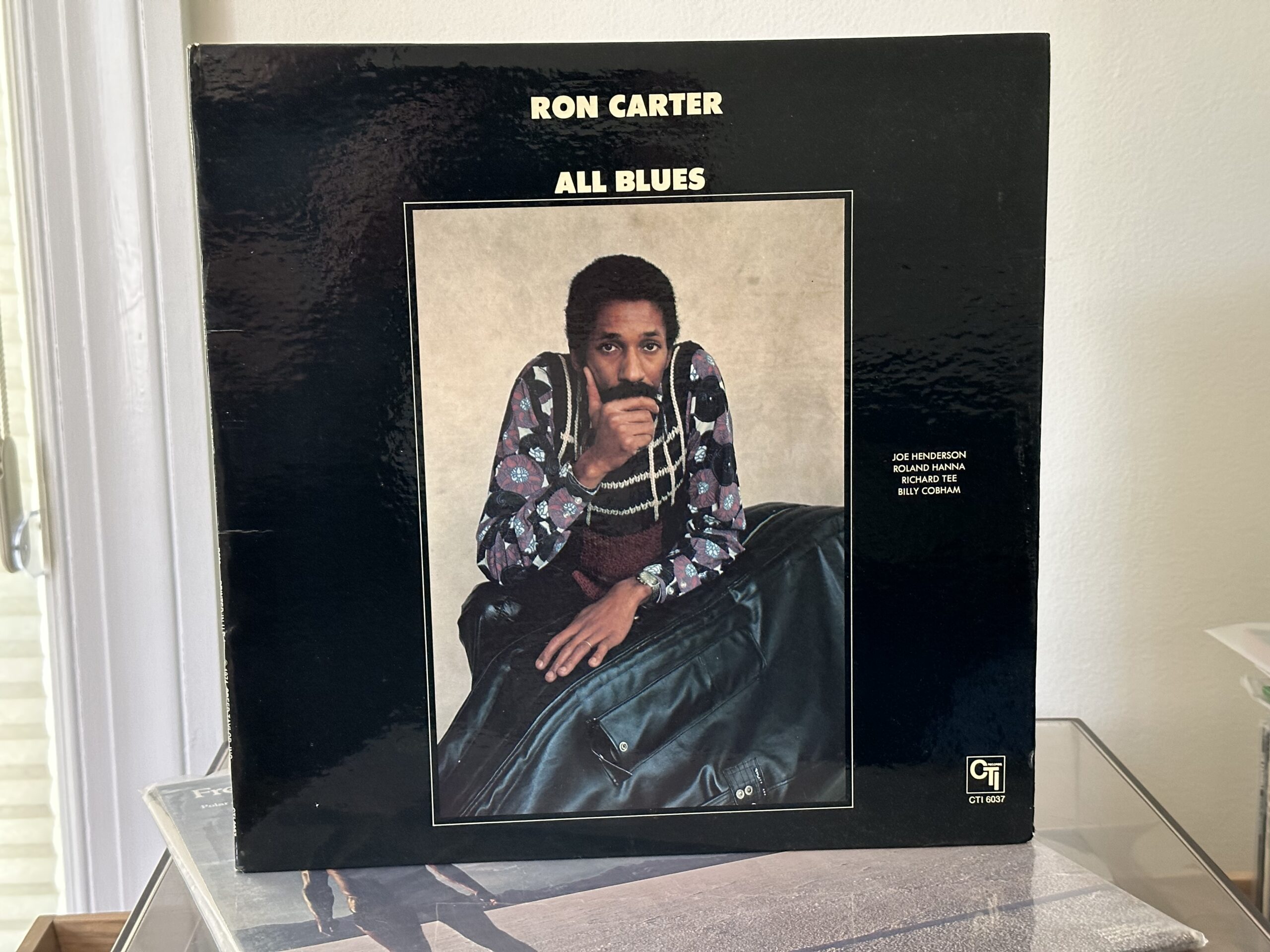
Ron Carter, All Blues

Album of the Week, August 5, 2023

CTI Records has a funny history, for a record label with such a distinct sound. Just when you think you have it all figured out, it throws you a curve ball. Take this week’s record, for instance. Where last week we had virtuosic reed player Joe Farrell go all in on the CTI jazz funk sound, this week Ron Carter, whose prior headlining album was a good representation of the label’s trademark sound, has taken a left turn into acoustic jazz—and first class acoustic jazz, at that.

Part of the switch-up might have been a reaction to the label’s sound. It’s noteworthy that much of Carter’s output as a leader in the 1970s was a more traditional approach, with classics like Third Plane sounding distinctly like a reunion of the rhythm section from the Second Great Quintet (as indeed it was). But part of the credit for the sound must accrue to the players. In addition to drummer Billy Cobham and Richard Tee, who appears on electric piano on one number, Carter brought saxophonist Joe Henderson, who we last heard on Freddie Hubbard’s Straight Life, and pianist Roland Hanna.

Henderson had been busy with a prolific stretch of great albums for Milestone Records, including Black is the Color (featuring Carter on bass) and The Elements (with Alice Coltrane and Charlie Haden, among others). The latter session finished recording in Los Angeles exactly a week before Henderson entered the Van Gelder studio in Englewood Cliffs, on October 24, 1973. He was coming in hot. And he was landing alongside Hanna (later Sir Roland), who was just coming off recording his first solo album in fifteen years, after a long stint in the Thad Jones/Mel Lewis Orchestra. Together the band deliver four Carter compositions and two covers as a single, quietly confident statement.

A Feeling” begins in a sprightly tone, with the band playing collectively into Carter’s composition. There’s a caesura at one turn of the melody, where the held chord allows Carter to slide from the tonic up to a major third. It’s the hook, a stop-time moment that comes back with each repetition of the chorus. Henderson has the melody here, and it’s briskly and concisely played as he alternates bars with Cobham and Carter. Roland Hanna’s solo (he plays acoustic piano throughout) is reminiscent of some of Herbie Hancock’s right hand soloing in the later years of the Miles Davis Quintet: angular, along the melody but not slavishly anchored to it.

Light Blue” is a Roland Hanna feature on a Carter-composed ballad. Hanna sensitively plays the melody and improvisations as Carter gently anchors him, quietly sliding from one tonality into another in the verse, taking a moment for a brisk flurry of notes under Hanna’s solo elsewhere. Cobham underpins the song with brushes on cymbals, understatedly accenting the beat throughout.

117 Special” is the one concession on the record to the traditional CTI sound, courtesy of Richard Tee’s work on the Fender Rhodes as well as Cobham’s backbeat and Carter’s blues-influenced bassline. Henderson states the melody on two repetitions of the chorus and then steps back for Carter’s solo, played on his trademark piccolo bass. Here Carter pulls out all his trademark techniques—the sliding pizzicato notes, the high solo line, the flurry of notes emphasizing the solo, the descending fifths—and welds them together into a brilliant solo that keeps on going into the final chorus and the fade-out.

Rufus” starts Side Two with a blues-influenced tune in sax and bass that moves through four or five different keys in its brief melody, with pauses for drum flourishes, before circling back to the tonic. Roland Hanna improvises his way through the key changes as though navigating a high wire, with a casually brilliant poise. He then yields the stage to Carter, who adroitly navigates the outlines of the melody in his solo with only occasional support from Cobham and Hanna. The band comes back in earnest behind Henderson’s solo. The saxophonist stretches out relatively infrequently on this record, and the brief two-chorus solo he takes here serves as a brilliant reminder of how inventively harmonic his approach is.

The familiar bass and piano opening of “All Blues” is followed by a statement of the melody in Carter’s piccolo bass, which sounds as though it were overdubbed as he continues on the low bassline on his regular double bass. A contemporary review claims he was playing both lines simultaneously—a feat of virtuosity indeed. Henderson takes the second statement of the melody and unfolds into a solo that stretches out over the modes and into sheets of notes before coming to a close. Carter’s piccolo bass returns for a solo, finding another counter rhythm inside the melody before returning to the chorus once more as Henderson plays it out, only to light up with a piccolo solo on the last reprise before dipping into an unexpected key change through which the band vamps in a slow fade-out.

Carter takes a true solo on Matt Dennis and Tom Adair’s “Will You Still Be Mine,” with a brisk romp on the melody anchored by his simultaneous scaffolding of the bassline. It’s merely the final demonstration of confident brilliance in an album full of them.

Carter’s embrace of more traditional small group jazz on All Blues seems to have been a harbinger of his direction through the rest of the decade; in addition to his trio album Third Plane, he also reunited with Wayne Shorter, Herbie Hancock, and Tony Williams, who would play alongside Freddie Hubbard in a very special band throughout the late 1970s and early 1980s. We’ll hear some of those records, too, another time. In the meantime, he had a few more solo albums across the next few years with CTI, and continued to perform as an in-demand sideman as well; we’ll hear him in that capacity several times in the next few weeks.

You can listen to the album here: