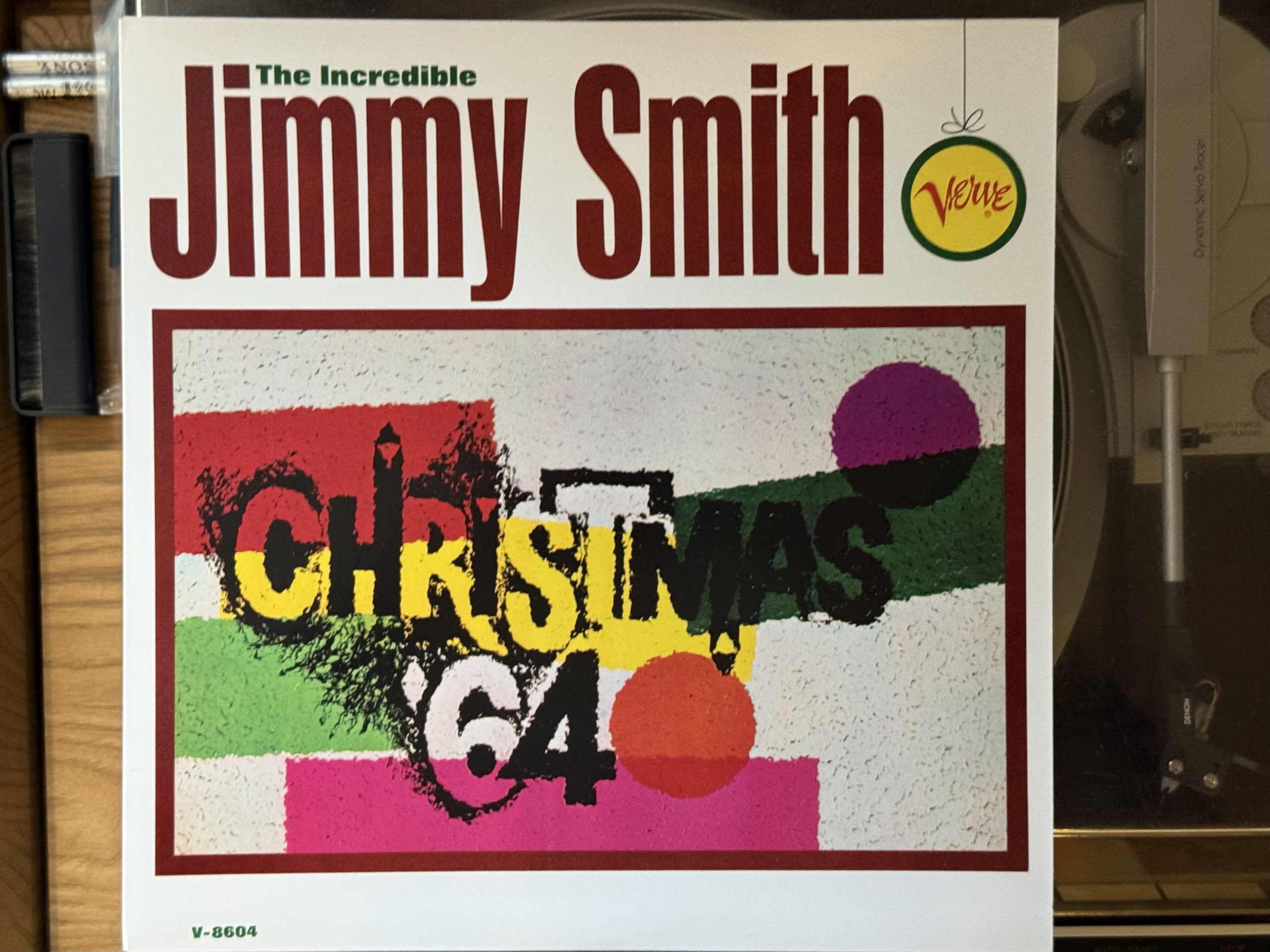
Jimmy Smith, Christmas ’64

One more organ record—maybe the best known of them all—brings us into this year’s holiday season.

November 29, 2025

Remember how I signed off last week saying we were going to “take a break for some seasonal music,” bringing this run of articles on the jazz organ to a close? Wanna know who our first purveyor of seasonal music is? (Squints) Oh yeah, Jimmy Smith. Had I planned better I could have set this up as a great segue from the organ combo articles into the holidays, but as it is you’ll have to settle for an absolutely spectacular album of both jazz organ and holiday music.

Jimmy Smith in 1964, on Verve, was at the height of both his musical powers and his bankability, and Creed Taylor was not the sort of producer who was above stretching the popularity of his artist for some additional revenue via the time-honored tradition of the Christmas album. Coming off his one-two punch of The Cat and Who’s Afraid of Virginia Woolf?, you’d be forgiven for expecting that Smith would take things easier on this holiday album. But with a band consisting of many of the musicians who made those great recordings, including Kenny Burrell (and Quentin Warren) on guitar, Art Davis on bass, Grady Tate (and Billy Hart) on drums—plus a whole orchestra that included Jimmy Cleveland on trombone and the elusive Margaret Ross on harp, among others—and charts by Billy Byers and Al Cohn, there was no room for slacking here. This is a seriously hot record, and a fantastic Christmas album to boot.

God Rest Ye Merry Gentlemen (Big Band version)” begins in big band fashion indeed, with a low-brass processional full of pomp and accompanied by the timpani, right up until “tidings of comfort and joy.” At which point the trumpets call a blue fanfare and Jimmy rolls in. The band continues with a “Slaughter on 10th Avenue” style take on the tune for one more verse, but then Jimmy takes the reins and plays a clean organ trio verse with Kenny Burrell and Grady Tate that is telepathically tight and funky. The horns rise up behind the trio like an incipient ambush until they take one more verse, but Jimmy gets the last word.

Jingle Bells” is a fine and mellow tune for the trio. Check Grady Tate’s subtle explosions behind the band as well as Jimmy’s understated organ part. The slow crescendos on the two held arpeggios are the only loud part of the arrangement, which fades out just as it gets going. It’s cool—something that can’t be said for the opening of “We Three Kings of Orient Are,” which sports a full symphonic brass arrangement that’s well-nigh Mahlerian, courtesy of saxophonist/arranger Al Cohn. But then it turns the corner into a gospel shouter and we’re really off and running. I would have been pleased to hear a side-long take on the middle bit of the arrangement, but here it’s bookended by an outro version of that opening.

The Christmas Song” is more swinging, with both Jimmy and the band in a laid back mood. The horns are swinging so hard they’re practically a beat behind, and Jimmy happily burbles bits of mood before playing a doggedly on-model melodic solo as the horns provide chromatically oracular pronouncements. A high chorus of trumpets brings us into a double-time solo wherein Jimmy stretches out over a frantic bit of Grady Tate drumming, then back to the chorus which slowly builds to a massive climax, punctuated by a chime before the final chorus.

The trumpets give us a “White Christmas” opening that could be played by the Boston Pops, key change and all, before Grady Tate takes us into bossa nova land. Jimmy’s solo is low key, in the baritone range, at least until the horns take it up a notch, at which point we get a little happy double time arpeggio, a final chorus, and a little “Jingle Bells” quote to wrap it up.

Santa Claus Is Coming to Town” is a trio number with Quentin Wells and Billy Hart, featuring Jimmy and Quentin trading off licks. The stereo separation (guitar in the left channel, organ in the right) is the only thing that helps to piece apart the players at the beginning, so close is the harmony, especially since Jimmy is soloing without much vibrato. Quentin Wells is a bluesier player than Kenny Burrell and he leans into that here, both in his solo and in the stabs of chords he plays under Jimmy’s solo. Jimmy starts out mellow but builds intensity through his usual tricks, particularly leaning on the tonic and playing bursts of arpeggios around the edges of his solo, all the way into the fade-out.

It’s another Pops-style arrangement for “Silent Night,” complete with bells and flugelhorn, then a handoff to Jimmy and the trio who do what they do best, a brisk, unsentimental swing through the tune. The horns make like “The Cat,” briefly, in the climax of their accompaniment to Jimmy’s solo—indeed, the only thing to criticize here is that they actually overwhelm the organ for the only time on record.

God Rest Ye Merry Gentlemen (Trio Version)” starts right in, sounding a bit like Jimmy’s version of “Greensleeves.” The trio with Quentin Warren and Billy Hart swings convincingly, with Billy’s snare work so powerful that it causes a secondary rattle somewhere between the snares and the ride cymbal. Jimmy spools off riff after riff in his solo, as Quentin Warren walks around the chords, keeping the rhythm going strong. At several points, it sounds as though the group will fade out, but the producers wisely keep rolling tape as the trio lands the hottest number on the whole record at the very end. Finally as the trio returns to the opening vamp, the engineers bring down the sliders and fade it out into the dark.
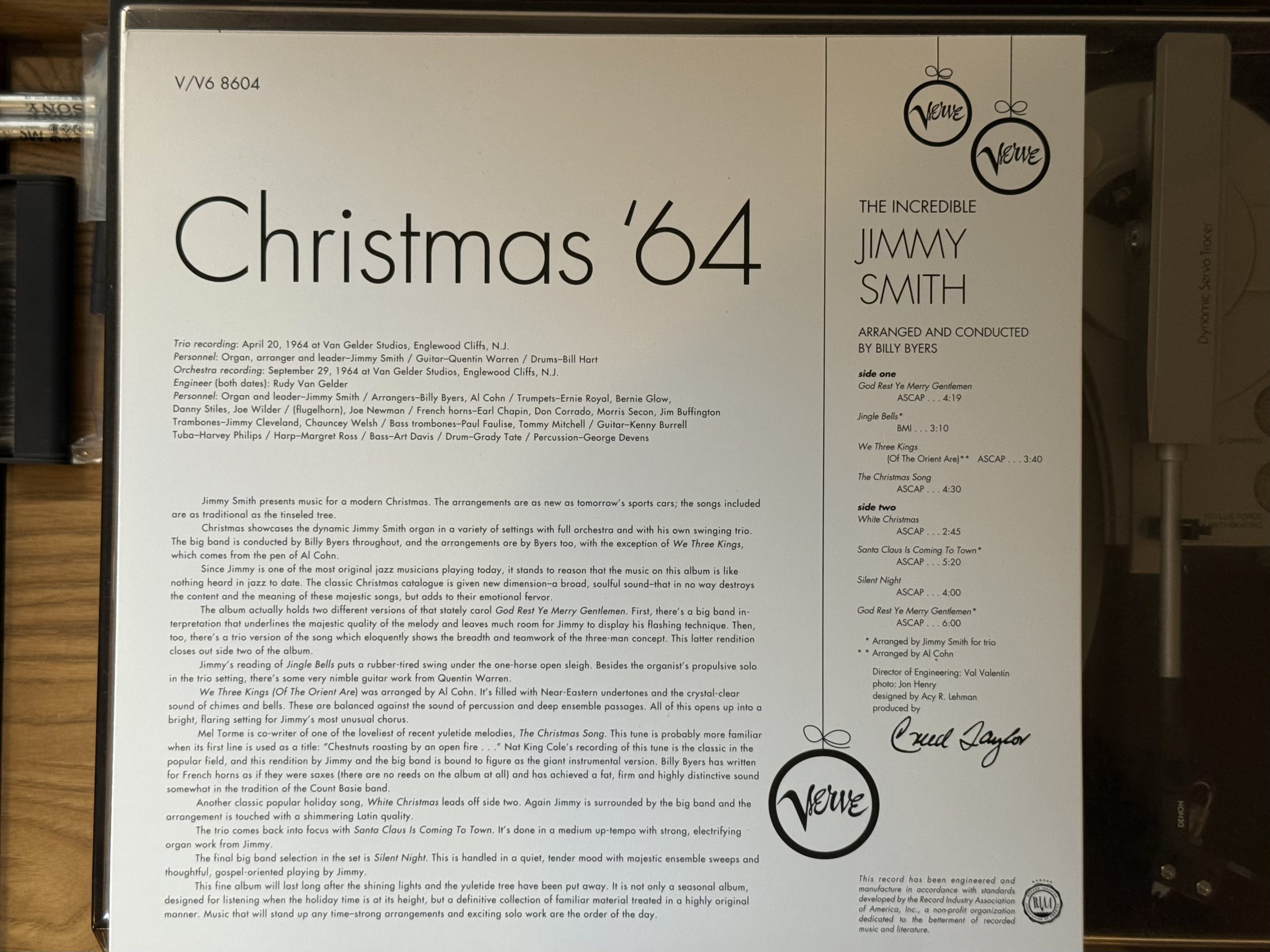
About the only thing wrong with Christmas ‘64 is the title; though it wasn’t the only Verve album to include the year in the title, it was clearly not a good choice for a title for a holiday album, which tend to sell between Thanksgiving and Christmas but can continue to rack up sales for many years. Retitled and with a new cover, the album had a long life under its new name, Christmas Cookin’, including in its CD reissue which included two other tracks, “Greensleeves” from Organ Grinder Swing and “Baby It’s Cold Outside” from Jimmy and Wes: The Dynamic Duo.

The better known cover and title for this week’s album as reissued in 1966, courtesy Discogs.

Next week we’ll stay in the jazz lane, with a holiday album by one of the players on this week’s set. You can listen to this week’s album here:

BONUS: This album and its related tracks cast a long shadow over holiday jazz records. The late great Joey DeFrancesco included a rearrangement of Jimmy’s “Greensleeves,” as “What Child is This,” on his superb 2014 album Home for the Holidays:
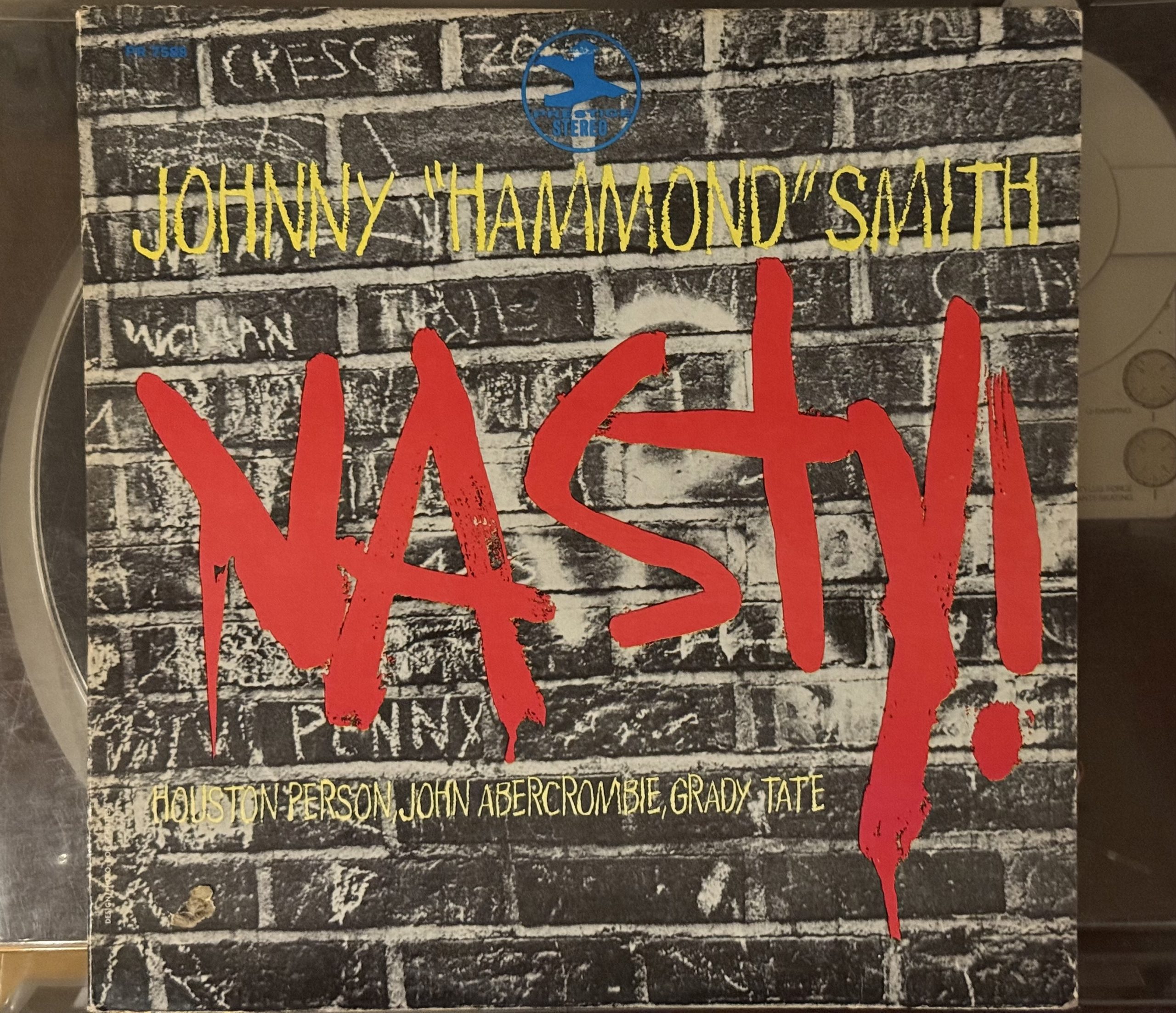
Johnny “Hammond” Smith, Nasty!

Another master of the jazz organ gives us a coolly simmering combo record, featuring John Abercrombie’s record debut.

Album of the Week, September 20, 2025

If you are a jazz performer, but there’s already another jazz performer with your name, giving yourself a stage name is a common practice. In the case of Johnny Smith from Louisville, Kentucky, he adopted his instrument of choice as part of his nickname, to avoid being confused with guitarist Johnny Smith from Alabama. His first album appeared in 1958 on small label Arrow Records, followed by two albums on the slightly less small New Jazz label in 1959. On the second New Jazz label, he was Johnny “Hammond” Smith. He moved to Prestige in 1961 and recorded a series of organ combo albums, leading up to today’s album.

For this 1968 session Smith was joined by an interesting group of musicians. We’re very familiar with Grady Tate from his work with Jimmy Smith; he had parted ways with Smith’s group following 1967’s Respect. Saxophonist Houston Person came from Florence, South Carolina, and had been recording as a leader for Prestige for much of the 1960s. And John Abercrombie was an American jazz guitarist who had just graduated from the Berklee School of Music in Boston, where he had played shows at Paul’s Mall, leading to his meeting Smith; this was his first non-student recording. Abercrombie would go on to have a long career as both sideman and leader, recording for ECM among other labels; we will get to one of those other recordings one of these days.

The opening track, Frank Loesser’s “If I Were a Bell,” is given a very different treatment from Miles Davis’ version on Relaxin’. Here Grady Tate’s syncopated drumming gives the tune a heavy swing feel as Smith outlines the opening “bells” and the melody on the Hammond, with a good amount of ornamentation around the edges. Smith’s opening statement is pretty “cool” and stays in the baritone range. Abercrombie takes the first solo and gives it a cool fire, with a swinging arpeggiated run at the tune. Smith keeps things relaxed and cool at first, but starts to lean into the blue notes at the end of his solo, which Person picks up with a straight-ahead blues. Smith brings things back to a simmer at the end; the listener is surprised to realize that in the relaxed session, a full eight and a half minutes go by.

Horace Silver’s “Song for My Father,” which we’ll hear again one of these days, is a classic of the post-bop jazz repertoire, with Brazilian rhythms and Cape Verdean Portuguese folk roots. Here Smith gives it a slower, deeper reading, with the melody down in the lower octave and leaning into the grace notes and turns of the descending tune. Tate’s drums and Abercrombie’s guitar provide a solid bed for Silver’s exploration. When Abercrombie’s solo enters, we get a bluesy hybrid between samba and boogie. Person’s solo is R&B flavored but played with great restraint throughout; overall the band keeps the lid on even as the pot nears the boil.

Speak Low,” Kurt Weill’s ballad to lyrics by Ogden Nash from the musical One Touch of Venus1, is here turbocharged with crashing drums from Tate and a ripping solo from Abercrombie, whose virtuosity is on full display. Smith takes the lid off here and gives us a rollicking turn through the tune. “Unchained Melody,” by contrast, is bright and laid-back, almost conversational, with none of the drama of the 1965 Righteous Brothers version. Weighing in at less than four minutes, the take still has a little room for Smith to be playful as he slips in a quote from Simon and Garfunkel’s “We’ve Got a Groovy Thing Goin’” (!).

Nasty,” one of two Smith originals on the album, is the standout tune, a forty bar blues (which relaxes into a more conventional twelve bar blues in the solos) featuring a rippling trill in the melody line. Each of the players in turn lean into the blues note hard, earning the name of the tune. Tate’s drums here are a thing to behold, a seamless combination of march rhythm and swing that shuffles along under the solos.

Four Bowls of Soul” is a more straightforward blues from Smith to close us out. Abercrombie’s solo has a few non-blue notes around the edges but otherwise delivers the promised soul. So does Smith, who sets aside reserve and gives us a solo that, if lacking some of the mojo of Jimmy Smith, still has plenty up its sleeve, including an eyebrow raising detour into waltz time. Person plays the blues, bringing his solo up into the high end of the tenor sax’s range with a satisfying wail. The tune fades out on Smith’s recapitulation, sounding as if he could play these coolly soulful blues forever.

Smith had a long recording career, with over forty albums to his credit as leader, most for Prestige. Later in his career, changing his stage name to Johnny Hammond, he recorded for Creed Taylor’s Kudu label (his album Breakout was the first release on the soul jazz label) and for Milestone, where he made a series of jazz-funk albums including the great Gears. At the core of all his recordings were an impeccable sense of harmony and rhythm. There haven’t been a lot of reissues of his work, so grab it if you find it—I feel lucky I was able to score a copy of Nasty from a used record store in Asheville.

The Hammond players we’ve heard so far have stuck pretty close to the organ combo formula as introduced and perfected by Jimmy Smith. One of the folks we’ve heard before is about to change that in a pretty big way. We’ll listen to that album next week.

You can listen to this week’s album here:

BONUS: I would bet money that Sly Stone was listening to this album when he was working on Stand!; just listen to the instrumental break following the opening chorus at about 0:56. (This part of the song shows up in a lot of hip-hop, including “Because I Got It Like That” by the Jungle Brothers.)

  1. It’s sentences like that one that make the history of popular music in the 20th century so great. ↩︎

Jimmy Smith, Respect

Even on an album that seeks to hitch a ride on Aretha Franklin’s rising star, Jimmy Smith brings the heat and some incredibly funky originals.

Album of the Week, September 13, 2025

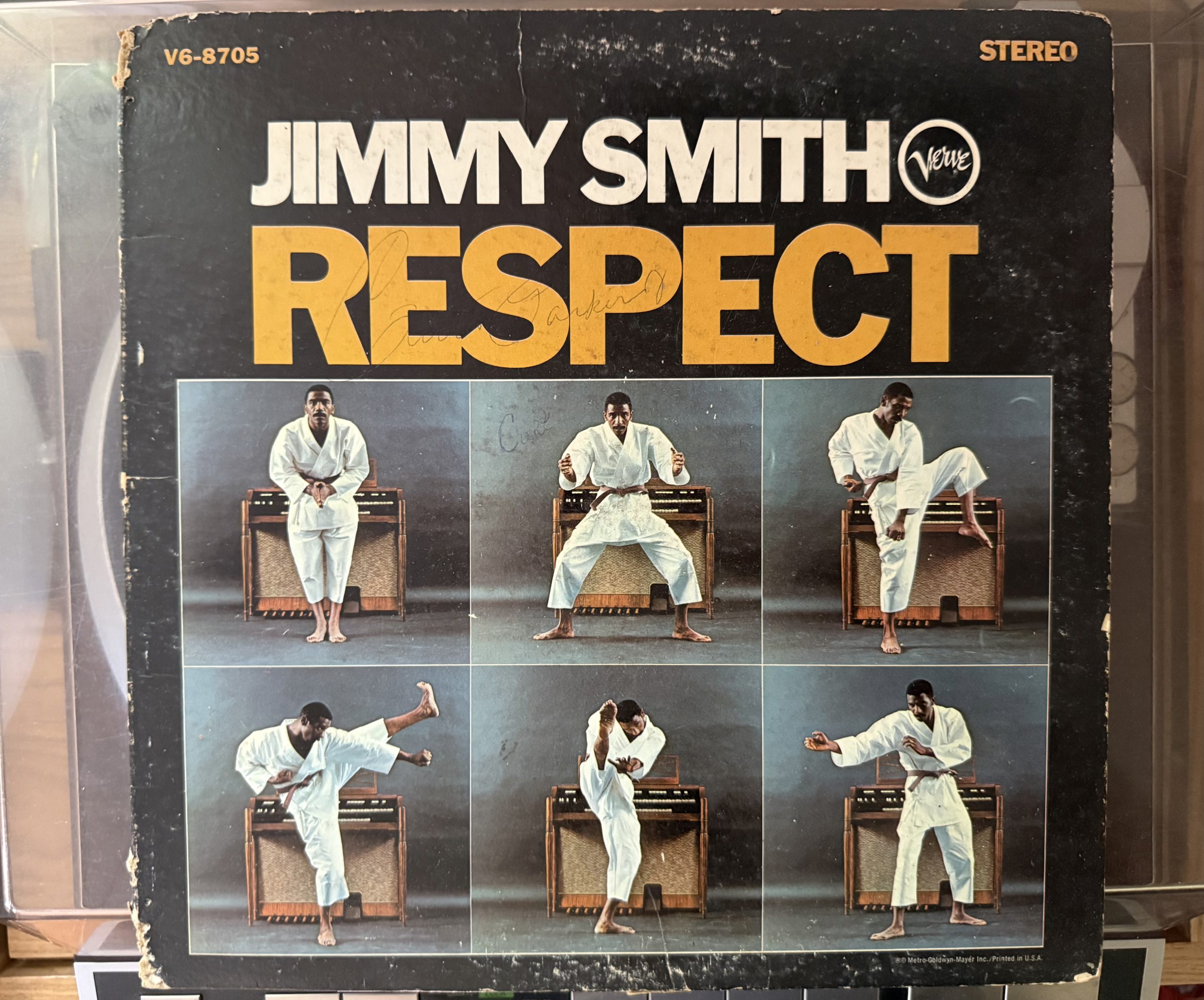
When you’re Jimmy Smith, making two or three albums a year, sometimes you make masterpieces, and sometimes you make a party album that doesn’t have a huge impact on the musical world, but is fun to listen to anyway. Respect follows two huge releases from Jimmy and guitarist Wes Montgomery (we’ve written about some of the latter’s later work before). With a title like Respect the motivation for the album is pretty clear, recorded as it was not two months after Aretha Franklin’s hit, but it also has some excellent Jimmy originals. It might not quite reach the heights of Organ Grinder Swing or The Cat, but Jimmy Smith was incapable of phoning in a record date, as this hot session shows.

The album was recorded on June 2 and June 14, 1967 at Rudy Van Gelder’s studio in Englewood Cliffs, New Jersey. One session featured Smith’s long-time drummer, Grady Tate, alongside Eric Gale on guitar and the redoubtable Ron Carter on bass. The other had funky drummer Bernard Purdie with Thornel Schwartz on guitar and Bob Bushnell on bass. Regarding the two guitarists, we’ve reviewed some of the work Gale did alongside George Benson, Yusef Lateef and Freddie Hubbard on CTI. Schwartz made a career out of playing in jazz organ combos, working alongside Johnny “Hammond” Smith, Jimmy McGriff, and “Groove” Holmes, about all of whom more later. And Bob Bushnell had a widely varied career, playing on many Verve and Impulse releases, as well as dubbing the bass part on the “electric” hit version of Simon and Garfunkel’s “The Sound of Silence.”

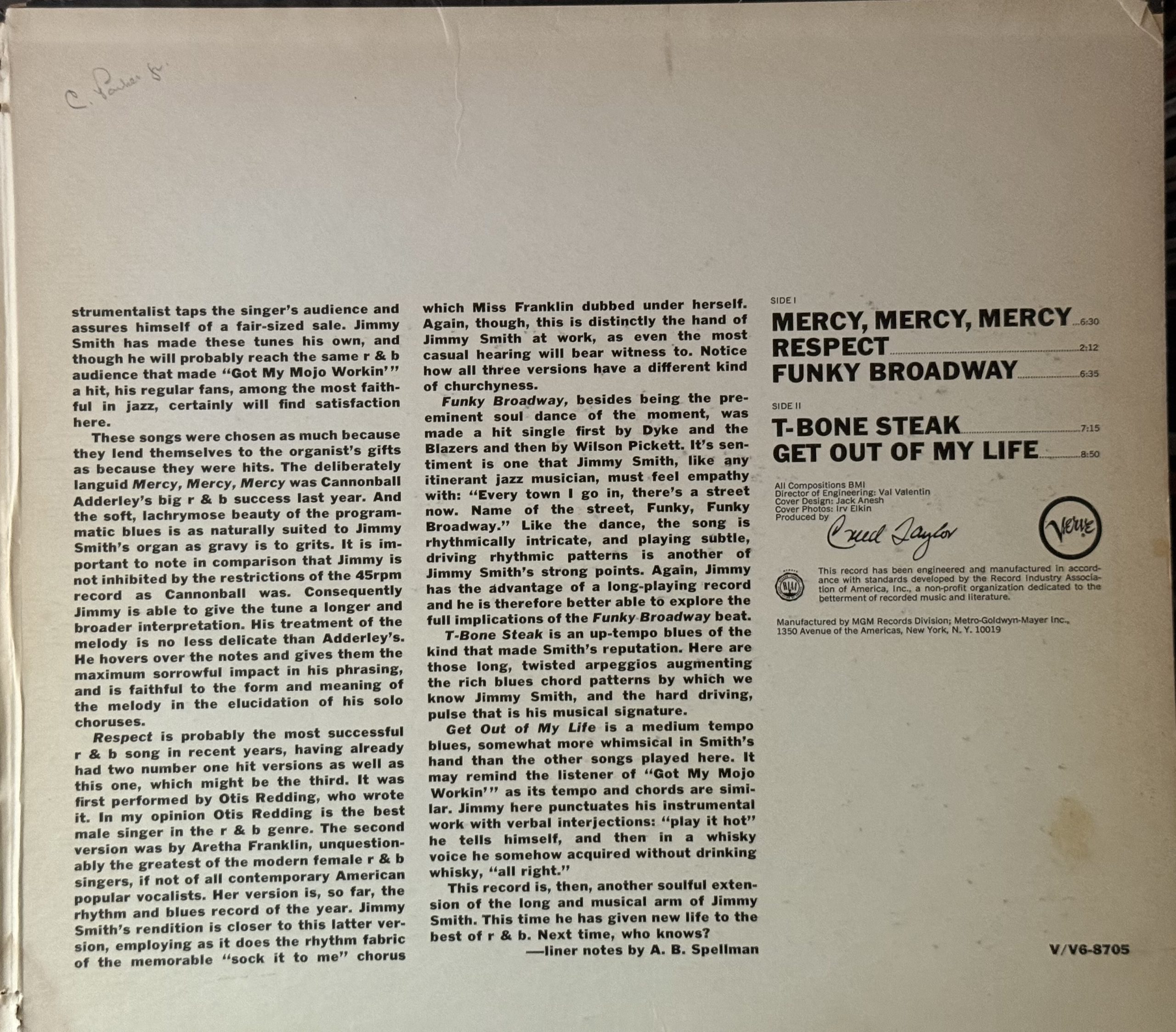
Mercy, Mercy, Mercy” is the song for which Joe Zawinul would have been known best, had he not gone on to work with Miles and to found Weather Report. The tune, which he wrote when he was in Cannonball Adderley’s band in 1966, was a hit, going to #2 on the Billboard Soul Chart and all the way to #11 on the Hot 100. Jimmy’s version grooves along in the same relaxed pocket as the original, coming off the simmer with the groove of Bernard Purdie’s funky drumming even before Jimmy starts his solo. Schwartz and Bushnell keep it in the soulful side of things as the band makes its relaxed way through the tune, accompanied by a fair amount of studio chatter from Jimmy.

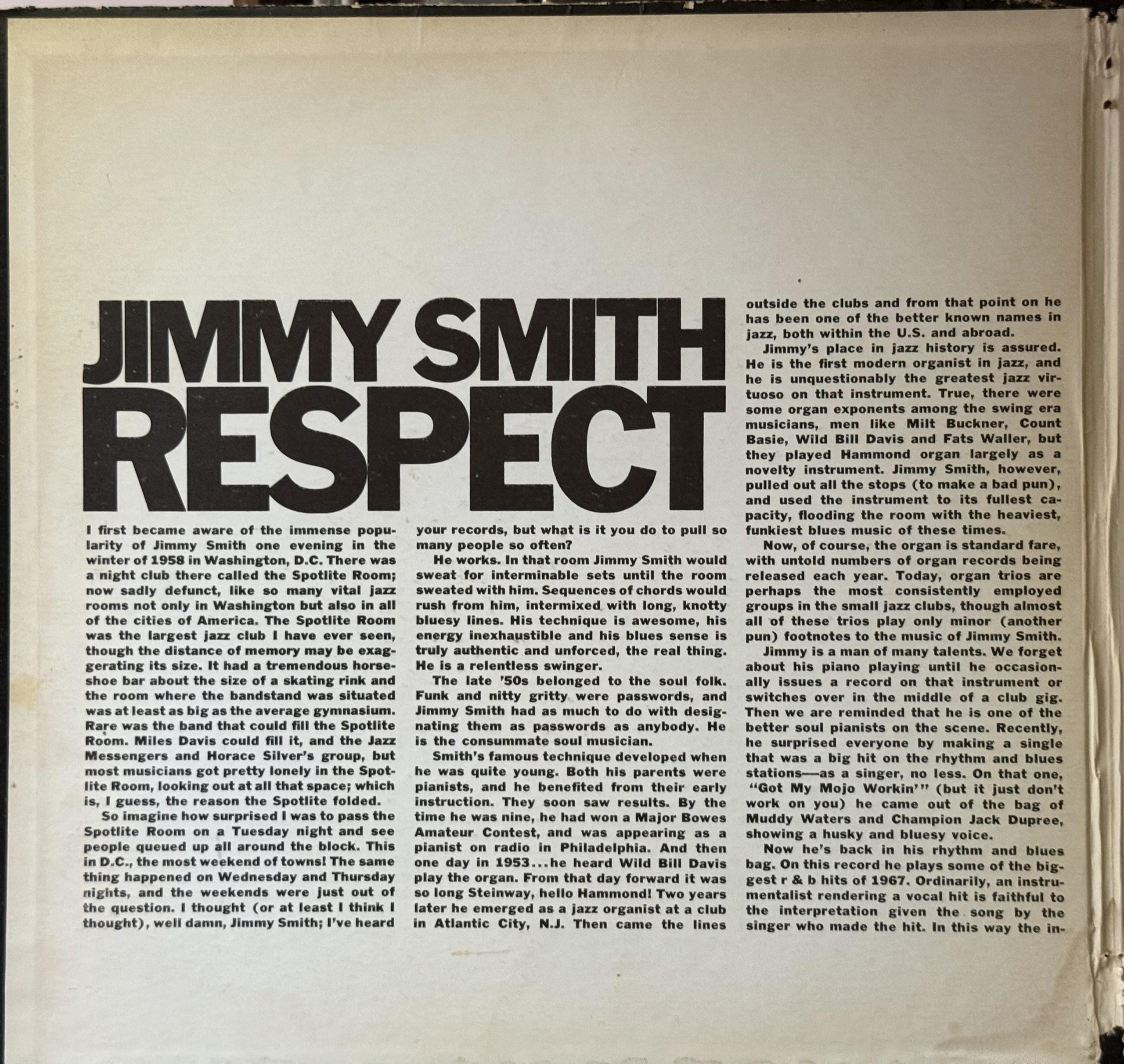
Respect” had burned up the charts just months before Smith went into the studio to record these sessions. The 1965 Otis Redding original had been gender-flipped in Aretha Franklin’s burning cover version, released on April 10, 1967, and had spent two weeks atop the Billboard Pop Singles Chart and 10 weeks on the Black Singles Chart. Schwartz and Purdie bring some of the insouciance of the Aretha version to the opening here, and Jimmy’s improvisation blends aspects of both Aretha’s blazing solo vocals and the backing vocals, so brilliantly sung by her sisters Emma and Carolyn that the liner notes for Smith’s album by A.B. Spellman incorrectly assume that Aretha had dubbed her own voice for the back-up part. “Respect” was clearly recorded for single release; it fades out after 2:12, just as Jimmy seems to be getting warmed up!

Funky Broadway,” a Smith original, is backed by the Carter/Tate/Gale combo, and is an interesting evolution in Smith’s writing. Where many of the originals we’ve heard from him so far have been blues or loose jams, “Funky Broadway” is a tight groove with a slinky guitar line over Ron Carter’s reliable heartbeat, with Eric Gale and Smith taking turns playing syncopated diminished seventh chords under each others’ solos. The whole thing is a pretty magnificent exercise in James Brown-style funk. Smith calls out “Funky Broadway” at the end, I suspect naming the seven-minute-long jam for posterity.

T-Bone Steak” is the second Jimmy original here, again with the Carter/Gale/Tate group, and we’re back in the twelve-bar blues. But it’s hard to complain about Jimmy returning to this particular well, since he jumps immediately into the deep end from the first notes of his solo. The double-speed runs followed by the hemiola, followed again by his leaning on the tonic for 36 bars or so as he rips improvisation after improvisation, might be some of the hottest, most concentrated brilliance he recorded. Grady Tate sounds a bit like Bernard Purdie here with the power of his hits on the tom, though not with his rhythmic approach.

Get Out of My Life, Woman” closes the record, with Jimmy yelling, “Ow! Get out my life!” at the top as the band begins the Allen Touissant/Lee Dorsey standard. Here they play it as a tight New Orleans blues—a blues with more than a hint of shuffle underneath. The guitarist (I think this is Schwartz, Purdie and Bushnell, though without credits it’s hard to tell) unreels a steady, controlled funk throughout his solo, leaving Smith to take the lid off the pot as it hits the boil. The track finishes with Smith and the guitarist exchanging ideas right into the fade-out, as if reluctant to let the jam end.

I haven’t talked about the album’s cover so far, mostly because it nonplussed me, but apparently Smith was, in fact, a karate aficionado. In an excerpt from Bill Milkowski’s Rockers, Jazzbos and Visionaries, Smith said he had been into karate for about 25 years and responded to Milkowski calling his gi a “kung fu outfit”: “Not kung fu, motherf–. That’s shotokan. And that means sho-kill-yo’-a–. I studied that particular method.” What is clear is that, even on a collection of mostly R&B covers designed to hit the charts, Jimmy’s playing remains as intense and vital as on the more significant albums in his discography. The commercial success of his work—the album hit Number 60 on the Billboard 200, spending 20 weeks on the chart—continued to attract others to the Hammond, and we’ll hear from another of those players next week.

You can listen to this week’s album here:

BONUS: Here’s a live rendition of “Mercy, Mercy, Mercy” in medley with “Country Preacher” by Cannonball Adderley’s band from 1970 , with Zawinul on the Fender Rhodes:

Jimmy Smith, Organ Grinder Swing

Taking the jazz organ combo back to its simplest, and most powerful, configuration, this trio album with Kenny Burrell and Grady Tate is a relaxed classic.

Album of the Week, August 23, 2025

After his first set of albums for Verve, including massive orchestral arrangements courtesy of Oliver Nelson and Claus Ogerman, as well as ’60s pop freakouts courtesy of the amazing Lalo Schifrin, it must have seemed like Jimmy Smith could do anything. What he did, in fact, was quietly subversive: he went back to basics.

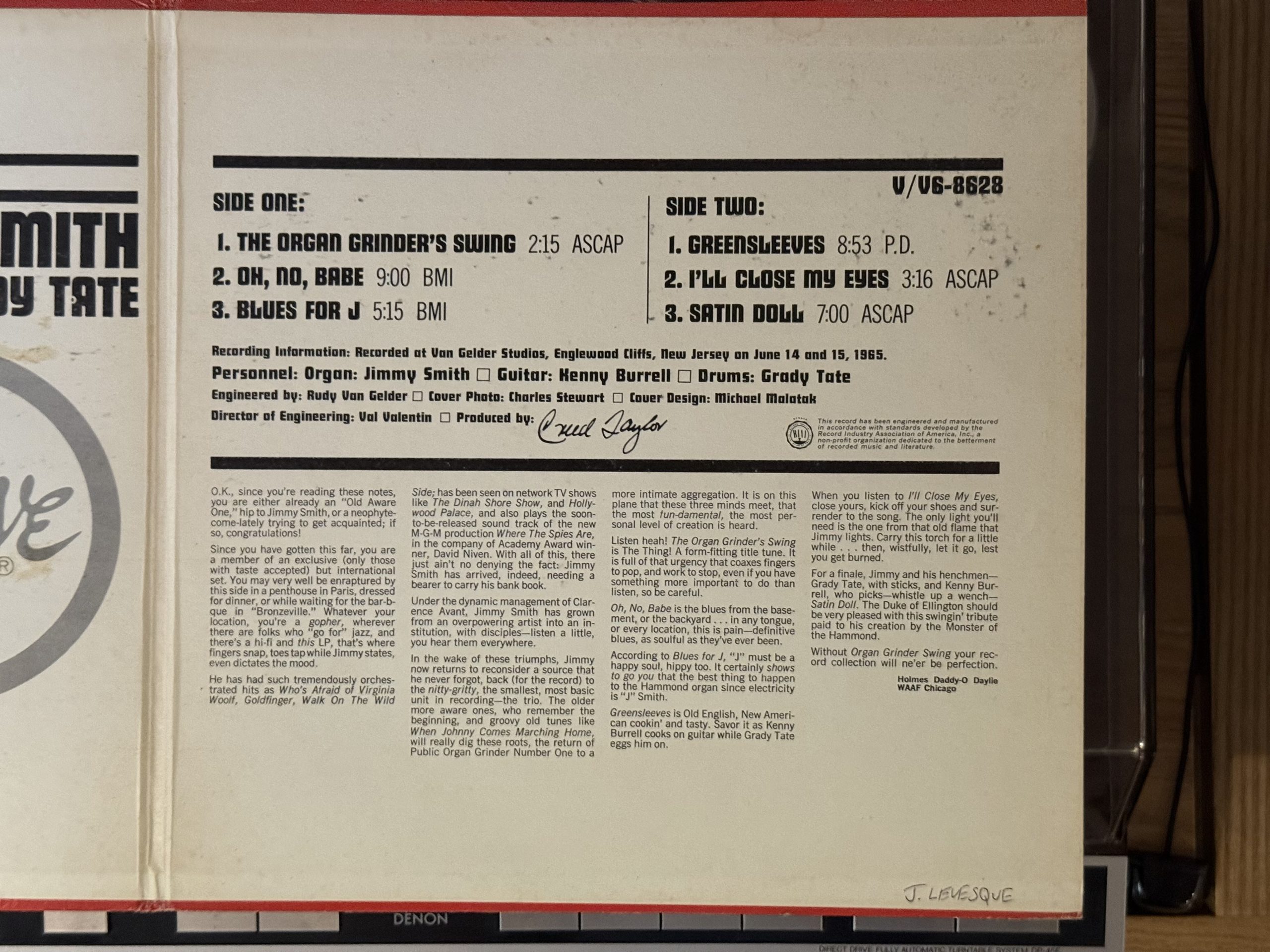
Recorded in June 1965, Organ Grinder Swing marked a return to the organ trio format, allowing us to hear Smith’s craft in a more intimate setting. Both Kenny Burrell and Grady Tate return from the 1964 recordings, so there’s a feeling of simpatico among the three players. They produced a set that was both more relaxed and more ambitious than the 1964 recordings, one that made a big impact on the jazz organ repertoire.

Organ Grinder’s Swing” seems to start mid-thought, with a snare hit and a bluesy organ riff that is already going full tilt over choogling guitar chords. Then: an organ hit, and what can only be described as a mumble. I’m pretty good at deciphering studio chatter, and I’ve replayed that mumble so many times that my 15 year old has started to give me side eye, and I still can’t figure out what Jimmy says. Someone online claims he was speaking the lyrics to the Organ Grinder’s song. Sure. We’ll go with that. What the mumble signifies is that we’re playing loose and relaxed, and that’s a good thing. Jimmy then plays the main melody, which bears a striking resemblance to “I Love Coffee, I Love Tea.” (Looking at you, songwriter Will Hudson.) Kenny Burrell rips a swinging solo and passes it over to Smith, who makes with some serious boogying. Then: more mumbling, one more run through the blues, a hit, and it’s over. The tune, released as a single, broke the Hot 100, topping out at 92; in a just world, it would have gotten higher.

More studio chatter starts off “Oh No, Babe,” as Jimmy calls out the take number, someone in the background yelps, and he hits a bluesy chord, then sings “Oh no, babe” before hitting a series of dark chords. He hollers a little, grunts a little, and eventually finds his way into a blues, with Kenny Burrell limning out the chords as Smith finds them. We get a melodic solo from Kenny that takes us deeper into the deeply funky waters, with Smith approvingly moaning “Oh yeah” behind him. There’s a simmering tremolo from Smith that stretches over eight long bars before erupting into a boil. He continues to build tension this way for three more verses before taking a step back and trading licks with Burrell, up to a triumphant final fanfare. For a studio jam, it’s also a masterclass in Smith’s improvisational style.

Blues for J” is another Jimmy Smith blues, but this one is more tightly composed, with some offbeat chords setting up a merry romp down the keys. Here Smith does a little grunting but a lot more dazzling keyboard work, taking it romping down the street with a happy little blues dance. It says something about this record that even a tossed off composition like this one feels tightly composed and arranged; Smith was having fun but he was also on fire.

That brings us to “Greensleeves,” and you’re well warned to buckle your seatbelt for this one. There had been other jazz arrangements of “Greensleeves” before, but Smith’s clear point of departure is John Coltrane’s 1961 adaptation from his great Africa/Brass, complete with the alternating suspended chords, here played by Smith himself as the introduction to the tune. Again we jump right into the swing of things, with Burrell sketching out the chords while Tate propels things from beneath. Jimmy plays the chorus a beat behind throughout, leading to some happily disorienting rhythmic fakeouts when the alternating chords return. Burrell sounds as though he had been waiting all week for someone to ask him to solo over modal chords, and he takes two runs before Jimmy steps in. Jimmy’s energy is infectious—no noodling around the blues here, he’s cranked up to 11 from the very beginning. At the same time, some of the improvisational gestures are familiar; he still leans on the chords across multiple bars to build tension, and from his work with the orchestras he’s learned the art of leaning into the higher octave to signal the climax. At the five-and-a-half minute mark, he reprises the theme, making us think we might be drawing to a close, but he explodes out of the recap with another swirling soul arpeggio, a tossed-off chromatic descending scale, and more. Ultimately Creed Taylor and Rudy Van Gelder have to fade out the jam; it shows every sign of continuing indefinitely into the present.

The Billy Reid/Buddy Kaye classic “I’ll Close My Eyes” here begins as a muted ballad, with Kenny Burrell taking the lead over Smith’s gentle chordal accompaniment and Grady Tate’s brushes. Smith’s solo continues in the same contemplative vein, though the organ’s timbre ensures a less wistful mood. Then it’s straight into Duke Ellington’s “Satin Doll,” which at first sounds like a straight read, until you hear the chord progression out of the A part of the chorus into Kenny Burrell’s B part. There’s a lot more going on in this arrangement, from Burrell’s slightly off-kilter, always virtuosic reading of the melody through his solo, through Smith’s increasingly crunchy chords and doggedly bluesy take on the melody. When he rolls his way through a verse, and takes another in a high tone that sounds like nothing so much like a skating rink solo, you just have to sit back, nod your head, and listen. To paraphrase another great artist, the funk is so fat you might gain weight … but that’s a different record for another time.

Though the standout here is clearly “Greensleeves”—other organists have taken his arrangement and made it a standard part of the Hammond repertoire—this whole album stands as a landmark of the jazz organ canon. At once relaxed and ambitious, and always deeply soulful, it’ll make a believer out of even the most skeptical listener.

Smith continued to record at a high rate for Verve through the end of the 1960s and into the early 1970s. There were a few other sessions released on other labels as well; next week’s represented an archival find when it was originally released in 1966.

You can listen to this week’s album here:

BONUS: Here’s Jimmy and the band playing the title cut live in 1965 from the Hollywood Palace:

Jimmy Smith, Who’s Afraid of Virginia Woolf?

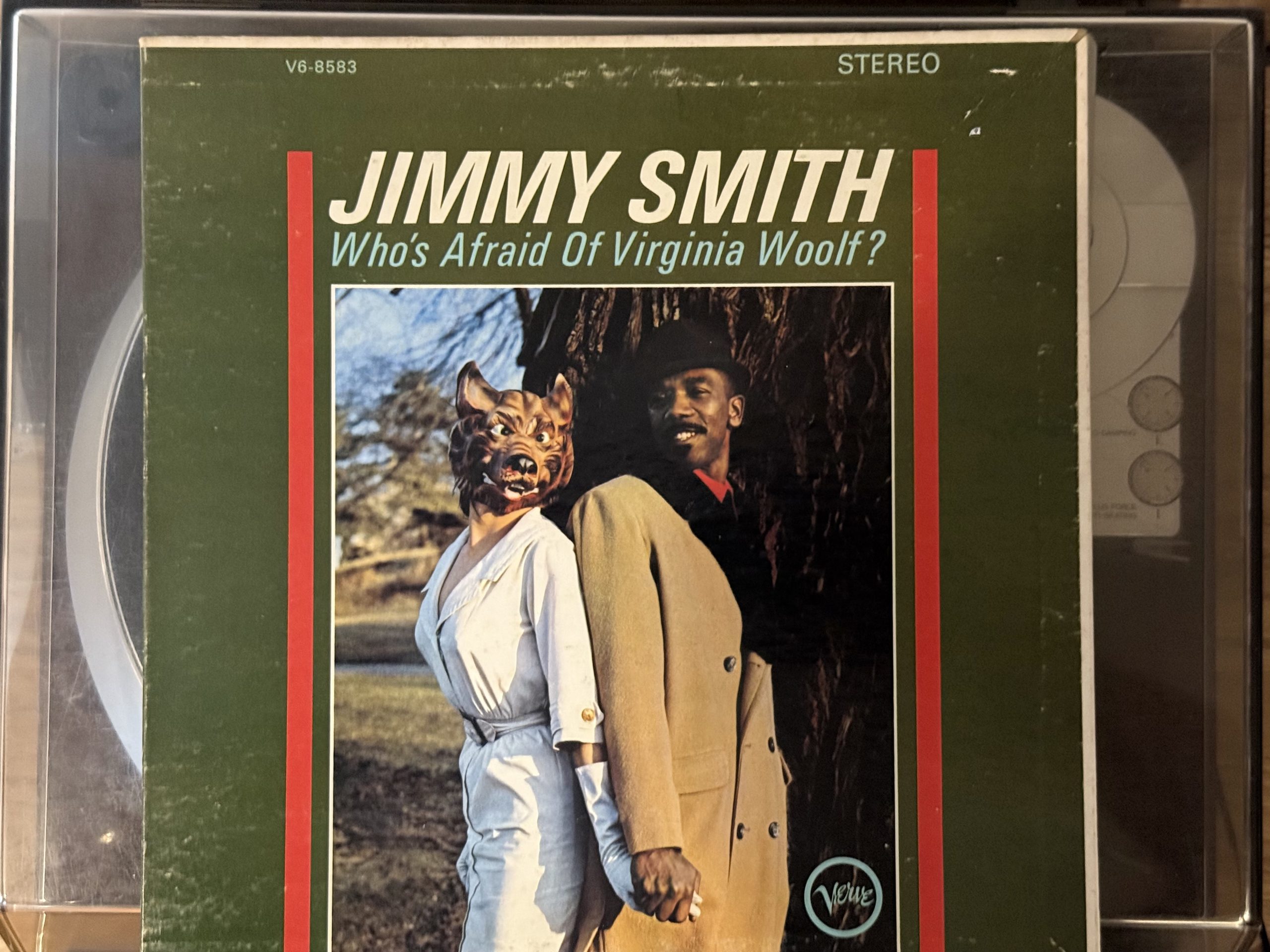
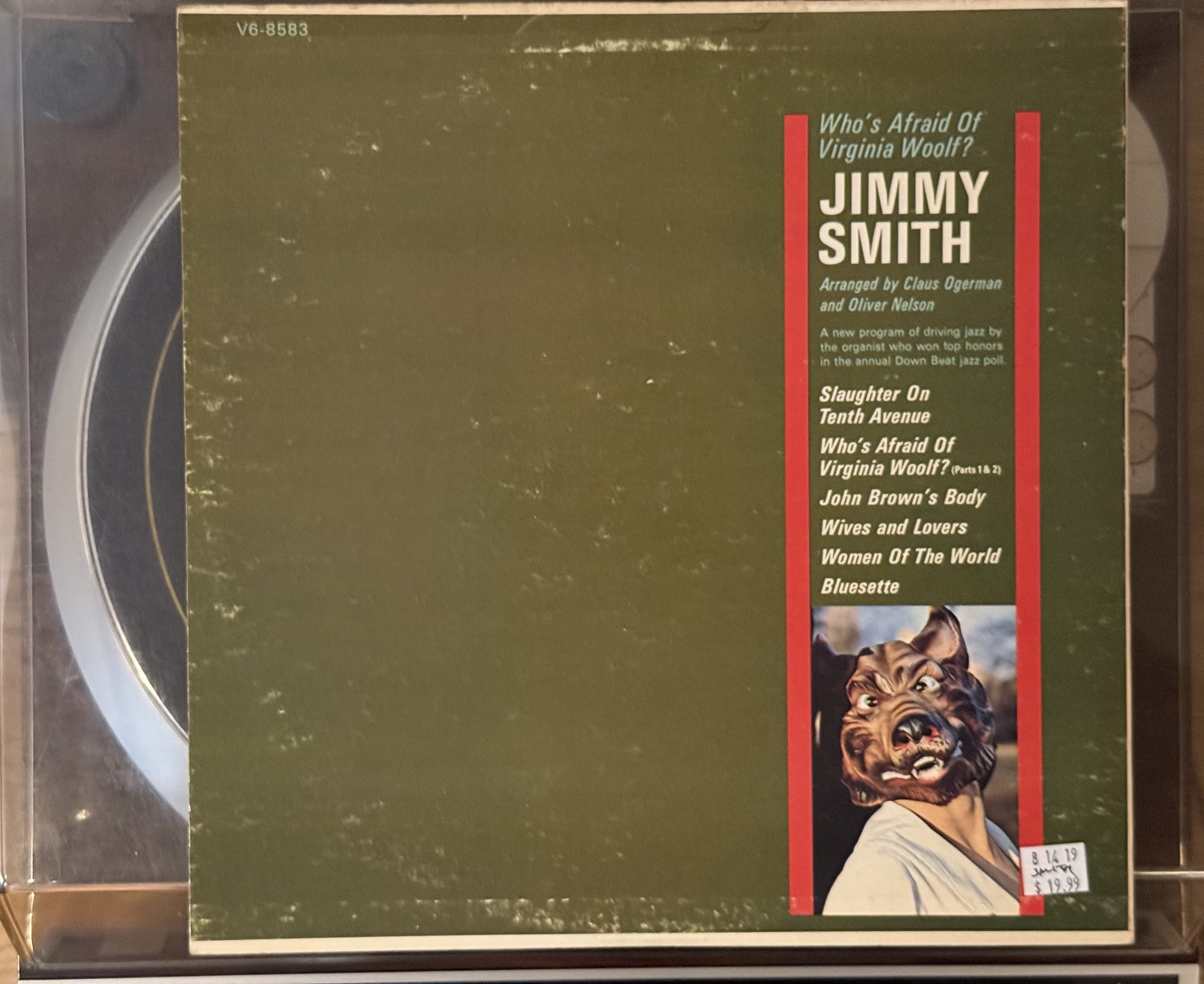
Behind the frankly weird cover photo lurks a brilliant Jimmy Smith classic, featuring arrangements by Oliver Nelson and Claus Ogerman.

Album of the Week, August 16, 2025

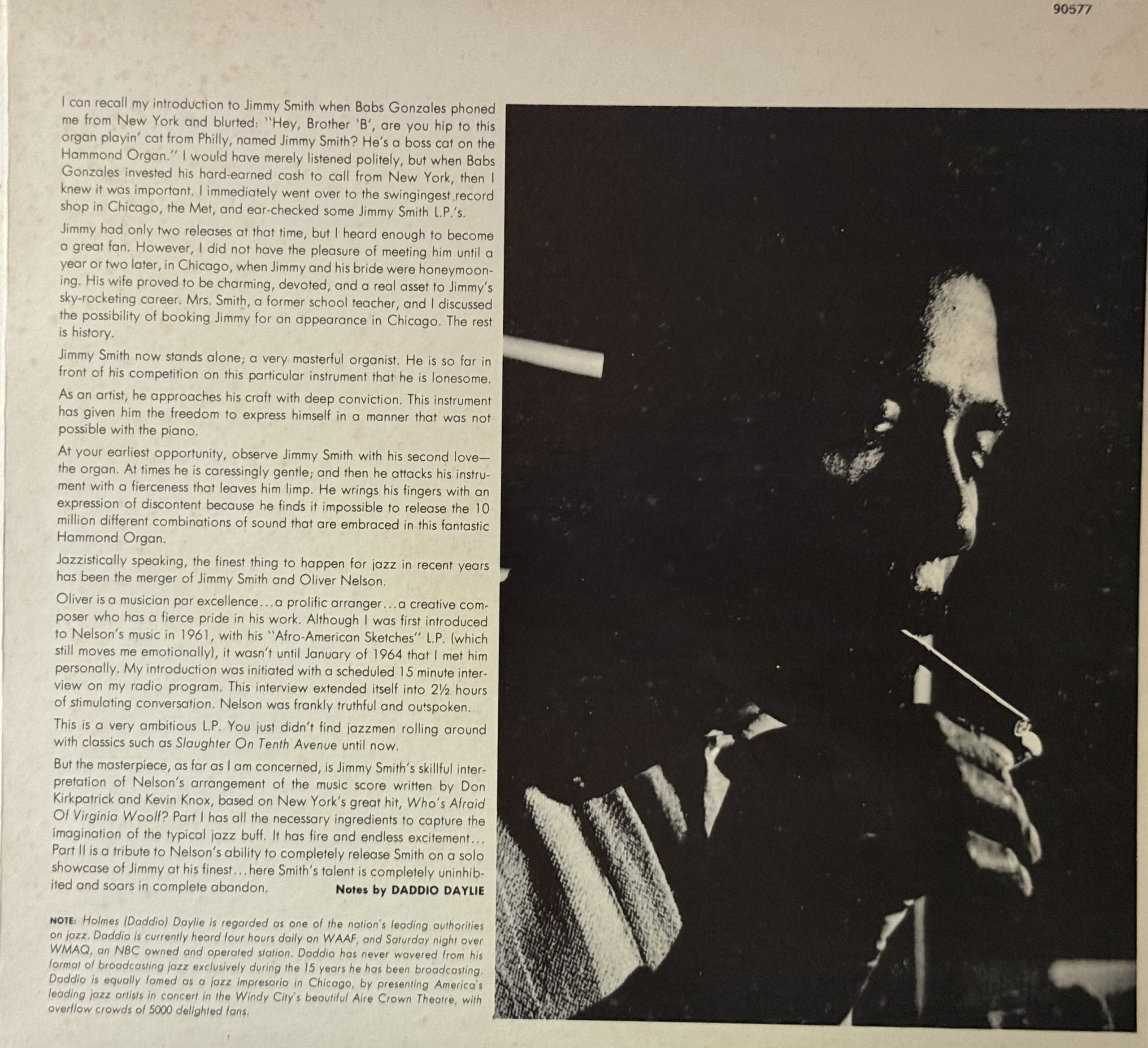
I mentioned when writing about The Cat, Jimmy Smith’s 1964 Verve album with Lalo Schifrin, that it wasn’t his only album released for Verve that year. That might understate the weirdness of Who’s Afraid of Virginia Woolf? just a little bit. Not only did the album come the same year, and not only did it also pair the great jazz organist with a renowned composer/arranger (or two!), but the title songs for both records bear a certain… relationship to one another. In fact, as the late lamented Professor Peter Schickele would say, “The name of that relationship is identity.”

I’m not quite sure how it is that “Who’s Afraid of Virginia Woolf” and “The Cat” got to have an identical orchestral arrangement, but in other ways the two records, conceptually similar on paper, are very different. To begin with, The Cat is still an organ trio album, albeit with lots and lots of horns. Who’s Afraid of Virginia Woolf is really an orchestral pop album with a jazz organ soloist. And it was arranged by two of the best. We’ve written about Claus Ogerman before, in his later work with Verve and Creed Taylor on Antônio Carlos Jobim’s Wave. And Oliver Nelson, who arranged the first side of the record, would be well known as a jazz composer and arranger even without a great 1961 album he cut with Creed Taylor on Impulse… but that’s a story for another time. Also joining, though not credited, were the same rhythm section as The Cat—George Duvivier on bass, Grady Tate on drums, and Kenny Burrell on guitar. Photographer Roy DeCarava is credited with the nightmarish cover; since he also photographed Miles’ version of Porgy and Bess, Bill Evans’ Conversations with Myself, and Branford Marsalis’ Renaissance, among other masterworks, we can only assume that someone put him up to it. The maker of the wolf’s head is uncredited.

Slaughter on Tenth Avenue” opens the record with an expansive Oliver Nelson arrangement of the Richard Rodgers ballet score. There’s a lot going on in the first few seconds—intelligent use of lower brass and woodwinds, a pointillistic xylophone, thundering timpani. The tuba and low trombone give us an ominous introduction to Jimmy Smith stating the theme on the Hammond. And the horns give us the great chorus hook, the syncopated III – V – III – V – VI – V – III melody that then sets up Smith’s solo. This is where the arrangement really takes off, as it swings into a fast 6/8 that climbs into the stratosphere, pushing Smith to high riffs and flourishes as the orchestra plays the theme slowly behind him. The end seems to dissolve in spreading rings of dissonance as the timpani and drums beat louder and louder, until the orchestra finally brings us to closure with a diminished seventh chord. It’s quite a transition…

…into a very familiar theme. “Who’s Afraid of Virginia Woolf?” (parts 1 and 2), composed by jazz pianist Don Kirkpatrick, opens with a version of the same flourish as “The Cat,” here treated with slightly more care and less mayhem than Lalo Schifrin’s arrangement. If Nelson’s arrangement and tempo takes some of the edge off the theme, Smith puts the edge right back. Indeed, though there are some fantastically crunchy chords from the orchestra, Part 1 seems at its best when it’s just the interchange between Smith, Burrell, and Tate. The orchestra seems invigorated by the long collective improvisation when they return, and Smith returns the favor, with a rippingly fast improvisation that takes it right up to the end. Part 2 is even more intriguing, with a bouncy drums and claves introduction leading into a trumpet statement of the theme, then a groovy solo turn by Smith that’s notable for how much space is left to appreciate that ongoing groove. Another wall of dissonance (one imagines Smith pulling out a bunch of stops and leaning on the keyboard) transitions into a more active solo with punctuation from the horns. As the second part draws to an end, it seems to circle back to something more like the Part 1 arrangement, closing with the full arrangement of the hook and one more high velocity solo, in a sort of ecstatic exhaustion.

John Brown’s Body” gets a throbbing introduction from the low brass before Smith gives us an offbeat statement of the famous theme. There’s a little more air in this Claus Ogerman arrangement, with enough room around the brass for Kenny Burrell to contribute the occasional stab of a chord to move things along, then to play alongside as a sort of persistent Greek chorus. Grady Tate’s unshowy timekeeping is an understated star here; it’s only as he sneaks an occasional cymbal hit in around the edges that you really hear his steady genius at work. Ogerman brings the jam to a slow fade-out; you can imagine the band going on here ad infinitum.

Wives and Lovers” returns us to a slow swing, with the melody stated in the winds, as Jimmy plays the Burt Bacharach melody down in the baritone range of the organ. This is a brief arrangement that is mostly about hearing Smith’s melodic imagination work its way around the brilliant Bacharach chords; Ogerman seems content to fade this one out, perhaps to get to “Women of the World” faster. This sixties pop groover by Riziero Ortolani is given a samba backbeat by Grady Tate, but seems to circle around the melody without much motion. Smith makes the most of the slim material, accelerating into a faster tempo in the midst of his solo and urging the percussionists and Tate to follow, before drawing it to a mantra-like close.

Bluesette” closes us out with a swinging rendition of the 1962 Toots Thielemans hit. Jimmy keeps the solo in a slightly higher register, perhaps to echo Thielemans’ whistling melody, as he rips into an extended solo following the brief orchestral introduction. Tate and Burrell cook right along with him through the improvisation. When the orchestra comes back in, they take us to a coda of sorts, staying suspended on a minor third to fourth riff as Jimmy heads right off into infinity.

There’s no disputing that the work Smith did with Nelson and Ogerman, as well as Lalo Schifrin, expanded his sound; there are some purists who would use a more pejorative verb in that sentence. But as we’ve heard, there are pleasures to be had from the combination of the well-crafted arrangements with Smith’s impeccable organ playing. Incredibly, this album and The Cats weren’t the only two albums the incredibly prolific Smith recorded in 1964; they were perhaps not even the best-known of those albums. But we’re going to save his last 1964 selection for another time. Next week will find us with an album from the following year that saw him returning to a more familiar configuration, with spectacular results.

You can listen to this week’s album here:

BONUS: Here’s Smith playing the title track live in 1965 with Quentin Warren on guitar and Billy Hart on drums:

BONUS BONUS: Following its release on this album, “Who’s Afraid of Virginia Woolf” was covered by a variety of artists, including this memorable instrumental cover by James Brown’s band, with none other than Brown himself at the keys:

Jimmy Smith, The Cat

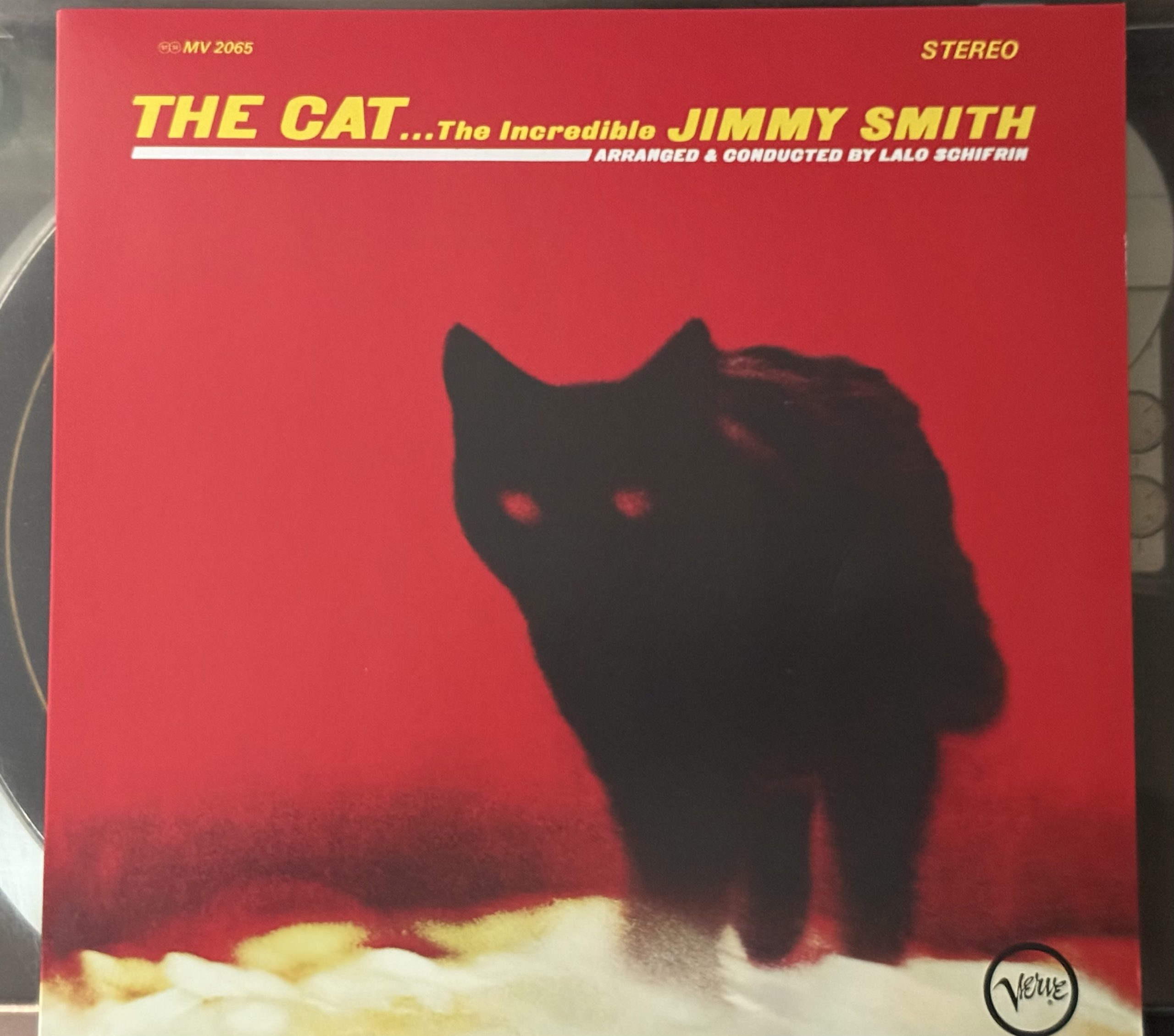
Jimmy Smith’s soulful Hammond B3 meets the ingenious arrangements of Lalo Schifrin in this hot album for Verve.

Album of the Week, August 9, 2025

There’s a world in which Jimmy Smith kept making cool, soulful organ trio and quartet albums like Prayer Meetin’ for his whole career. In that world, we’d be listening to a lot more laid back small combo jazz with Smith’s impeccable harmonic sense to lend a little excitement. But that’s not the world we live in. Shortly after he recorded last week’s session for Blue Note, Smith moved to Verve Records, and before long he began recording a series of records that dramatically broadened what the jazz organ could do, in collaboration with two mad geniuses of jazz… one of whom we’ve met before.

1962 was the prime of Creed Taylor’s years as jazz impresario at Verve. We’ve told the story of his post-Verve years in the history of his own label CTI, starting with his late-1960s collaboration with Antonio Carlos Jobim, Wave (and you can find the rest of that series, along with my other writings, in the Album of the Week archives). In the early 1960s, he was still experimenting with some of the ingredients that would come to define his CTI sound, especially the combination of jazz musicians with imaginative orchestral arrangements. In this case, the arrangements came courtesy of Argentine-American pianist/composer/arranger/conductor Lalo Schifrin.

Schifrin, who passed away earlier this year, had done some arranging for Dizzy Gillespie’s big band, and came to New York to join Dizzy’s small group; he went on to a notable career in film and television composing, including the themes for Mission: Impossible, Mannix, Cool Hand Luke, Dirty Harry, and Enter the Dragon. Taylor put Schifrin with Jimmy Smith, and Schifrin formed a jazz orchestra for the album that included the likes of Thad Jones and Snooky Young on trumpet, Urbie Green on trombone, Don Butterfield on tuba, and a rock solid trio of Grady Tate on drums, George Duvivier on bass, and Kenny Burrell on guitar. Thad Jones, the middle of the Jones brothers (elder brother Hank, younger brother Elvin), started his career with Count Basie, formed a long-running orchestra with Mel Lewis, and transformed the Danish Radio Big Band into one of the finest in the world before taking over leadership of the Count Basie band in 1985. Snooky Young had played in the Thad Jones/Mel Lewis band but was best known for his work in the Tonight Show band under Doc Severinson. Butterfield was a great session player who had performed with Dizzy, Sinatra, Mingus, and Rahsaan Roland Kirk. Duvivier worked with a Who’s Who of musicians including Bud Powell, Oliver Nelson, Sinatra, and a few others that we’ll come across in the weeks to come. And Kenny Burrell, who is still kicking at 94, played with everyone as well as leading his own great sessions on Blue Note, Prestige and Columbia.

Theme from Joy House” is the first of two Schifrin film soundtrack compositions on the album. The French thriller, starring Jane Fonda among others, has a bonkers plot, and Schifrin apparently responded with a bonkers score. The orchestration builds from bass and percussion, with a subdued organ part playing the main theme as the lower horns provide support. Then the trumpets blare and we’re truly off to the races. The second verse gives us the melody in the horns, with bursts of vibraphone providing punctuation. Smith’s solo, unlike his combo work, stays mostly in the upper ranges of the organ, the better to play against the wall of horns. But we still get some of his trademarks, like leaning on the tonic to build suspense—here echoed in Schifrin’s arrangement by the horns. The final repetition is a full on horn blast, with Smith’s high organ tone cutting through.

The title track, “The Cat” is the second Schifrin selection, also from Joy House. In form it’s a blues, but in spirit it belongs alongside Quincy Jones’ “Soul Bossa Nova” (aka the Austin Powers theme) as an exemplar of the most bonkers kind of ’60s instrumental pop. Schifrin doesn’t spend much time warming up to his theme; we get four syncopated eighth notes of introduction, blasted from the horns, and then the bass (and tuba?) and guitar are off to the races, with Smith’s easy statement of the melody soon yielding to high arpeggios. You could easily imagine this one soundtracking a manic chase scene, especially when the horns return to play the theme over some of Smith’s more wild improvisations. Smith takes the lead in the bridge, with bubbling tremolos building up to a reprise of the melody. The full band shuffles to the fade-out, led particularly by Grady Tate’s drumming, replete with well placed tom hits and cymbals. The tune clocks in a few seconds shy of 3:30, but packs quite a wallop; it’s deservingly the best-known cut from the album and I would have known it even if KEXP hadn’t regularly played it under their DJs reading concert calendar listings when I lived in the Seattle suburbs.

The classic “Basin Street Blues” is another one that starts deceptively coolly, before the horns burst over organ, bass, and low vibraphone like fireworks, but this track keeps its cool a little longer, and ultimately settles into a pocket, with the horns acting mostly as a high chorus that briefly kick Smith into a sort of higher orbit. Ultimately they draw him out into a more extroverted solo that leans into the higher range of the instrument and arpeggios up and down the keyboard, as the middle and low horns state the melody and finally the whole band blasts the chorus. Their part done, the horns retreat to providing emphatic punctuation at the edges of Smith’s final solo, before coming back for a wild climax, full of diminished sevenths and razzmatazz.

Main Title from the Carpetbaggers,” a theme by Elmer Bernstein and Ray Colcord for the 1964 drama starring George Peppard and Alan Ladd, starts with Latin percussion, then the double bass enters in triple meter before the tuba starts doubling. The horns state the theme with much growling from the trombones and tuba over a consistent pounding on the tom (or possibly even timpani). Finally, after two iterations of the melody, Smith enters on the organ, riffing on the blue notes in the melody as Phil Kraus’s congas and Grady Tate’s drums propel the melody forward. The horns provide accents over the top, but this is mostly Jimmy Smith and his rhythm section, smoking along the slow burn of the piece—at least until Schifrin’s magnificent French horn section (four horns, including Jimmy Buffington, who played on Miles Ahead and Sketches of Spain) blasts off. The work ends as it began with the horns playing through the melody, but this time Smith is wailing alongside the full band.

Chicago Serenade,” starting off the B side of the record, is by the great Eddie Harris, who also wrote “Freedom Jazz Dance,” later recorded by Miles on Miles Smiles. There’s little of the rhythmic complexity of the latter piece here, but some great pop sensibility in the tune, here stated in Kenny Burrell’s guitar with accents from Jimmy and the horns. Jimmy plays a high flourish on the organ to transition out from the horns but brings his solo down into the baritone range, providing a more intimate sound. There’s some great antiphonal writing for the horns throughout, and some magnificent French horn playing, but the crunchy organ arpeggio at the end is by itself worth the price of admission here.

W.C. Handy’s classic “St. Louis Blues” gets a swift intro from Jimmy, Tate and Duvivier that makes it sound like the band was already cooking when Rudy Van Gelder started rolling the tape. The horns can do little else than punch up the chorus; Jimmy is on fire, shifting meter and tonality and insinuating the melody under the band. The horns finally find their footing at the very end, giving a rousing send off, but Jimmy’s rolled chords get the last word, as always.

Delon’s Blues” is the one Jimmy Smith original on the record, and it’s much more relaxed, but still tightly arranged, with accents first from Burrell and then from the horns over Jimmy’s melody. The more spacious arrangement of the verse gives us an opportunity to hear what Grady Tate is doing to punch up the rhythm under everything, with syncopated punches and stumbling rolls on the snare for interest. Throughout Burrell drops little zingers to keep things lively.

The final blues, Harold Arlen and Johnny Mercer’s “Blues in the Night,” picks up with just guitar, drums and bass accompanying Smith’s introduction. When the horns come in, they lean on a weary suspension to emphasize the blue notes. Tate and Smith threaten to bring things to a boil on the introduction, but they keep the heat to a simmer, letting Burrell provide textural interest. Finally three pounded beats from Tate tip things over and the horns take a high screaming chorus. Smith lowers the temperature once more to a fast simmer, again racing his tremolo across a whole verse as the band vamps. The engineer sadly fades out just as Smith’s solo gets interesting, but we are left with the impression that the blues continue forever.

In the team from Verve, Smith had found collaborators who could take his basic brilliance and turn up the dials on all the arrangements without compromising the basic elegance of his vision for the organ’s role in jazz. As at Blue Note, he made a series of records in quick succession for Verve; unlike at Blue Note, these charted. His last Blue Note albums cracked the Billboard 200, but The Cat went all the way to Number 12 on the album chart, and “The Cat” cracked the Hot 100, finishing at # 67. His other 1964 release would also perform well, albeit with a very different collaborator; we’ll hear that one next time.

You can listen to this week’s album here:

BONUS: Jimmy would take this material on the road with a smaller combo. Here’s an undated performance for German TV with just drums and guitar (and a tenor sax player who sits this one out), burning on “The Cat”:

Wes Montgomery, Road Song

Album of the Week, April 1, 2023

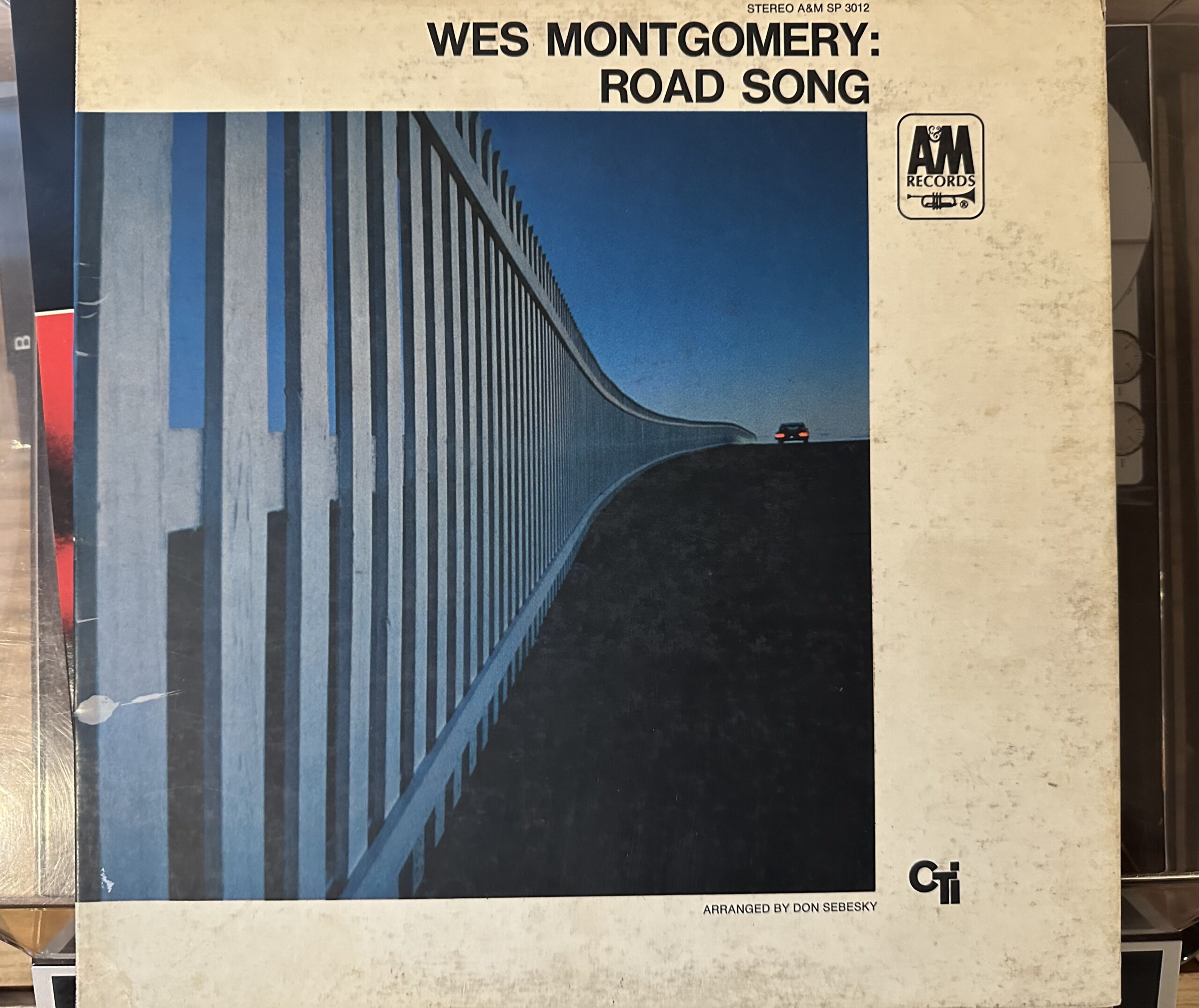
Though still technically under the banner of A&M Records, Creed Taylor’s CTI had already firmly established its visual identity by the late 1960s, as we saw with last week’s look at Wave. Today we explore some of the development of its sound by looking at the twelfth record in the catalog, a posthumous release from guitarist Wes Montgomery.

Montgomery had begun his career in the late 1940s with Lionel Hampton, having taught himself the guitar at night while working during the day for the milk company. When the big band gig didn’t pan out, he returned to working day jobs while forming a combo with his brothers and playing small clubs. He was discovered in 1958 by Cannonball Adderley, who recommended to Orrin Keepnews that he sign Montgomery to his Riverside Records label. Montgomery went on to record a well regarded string of albums on Riverside before leaving in 1963 for Verve to record with Creed Taylor.

Taylor saw the potential for Montgomery’s clean, melodic style to cross over into the instrumental pop market and recorded a series of albums that established him as a bankable star, beginning with Movin’ Wes and including the great Bumpin’, which featured the guitarist with one of the great over the top ‘60s pop string sections on the title track. The orchestra on this recording was arranged by Don Sebesky. We’ll hear a lot about Sebesky over the course of these reviews; for now I’ll just observe that this is the first name in this column that I first saw in a Boston Pops program.

So it was that, following a string of recordings for Verve that include some great small group sessions with Jimmy Smith and a lot of instrumental pop, Montgomery recorded several sessions for Taylor’s sub-label CTI, leading off the label’s discography with A Day in the Life and returning to Rudy Van Gelder’s Englewood Cliffs studio on May 7 and 8, 1968 to record this album. Just over a month later he was dead, having suffered a heart attack at home in Indianapolis at the age of 45. Was the final recording he made in his lifetime worthy of his legacy?

I think it kind of depends on how you look at it. A jazz session it’s not, and it’s not the best instrumental pop he ever recorded either. Sebesky’s arrangement on “Bumpin’” is so legendary that it led off a 1990s Verve compilation of “acid jazz.” The arrangements on Road Song, alas, are not quite so stunning. Montgomery’s guitar does not quite engage with the strings and horns and harpsichord(!) around him. But the band that Taylor assembled here is no group of slouches, with Herbie Hancock, drummer Grady Tate, pianist Hank Jones (that’s him on the harpsichord), and the great bassist Richard Davis joining the strings. The overall effect is pleasant enough, though it must be said that the main pleasures of the album are Montgomery’s legendary touch with the guitar and not the setting Taylor puts him in.

So far we’ve heard the more instrumental pop, almost easy listening side of the CTI label. We’ll hear a very different sound next time, one that would come to dominate the way the label was perceived—and change the course of jazz as it entered the 1970s.

You can listen to the album here:

Ella Fitzgerald and Duke Ellington, Ella & Duke at the Côte d’Azur

Album of the Week, November 26, 2022

Duke Ellington, in 1967, was in the prime of his post-peak creative years. Having spent some time between labels building his reputation as an elder statesman, as we saw last week with Duke Ellington & John Coltrane, he was shortlisted for a Pulitzer Prize in Music in 1965 (though ironically no award was given that year; he is said to have joked “Fate doesn’t want me to be famous too young”). He was still recording major works, including the Far East Suite in 1966. And he was touring and performing with dozens of other musicians. I’ve reviewed a record from that period, when he performed with the Boston Pops; see my write up of The Duke at Tanglewood, which I found ultimately dissatisfying due to the lack of simpatico between Ellington and his competent, yet square, stage-mates.

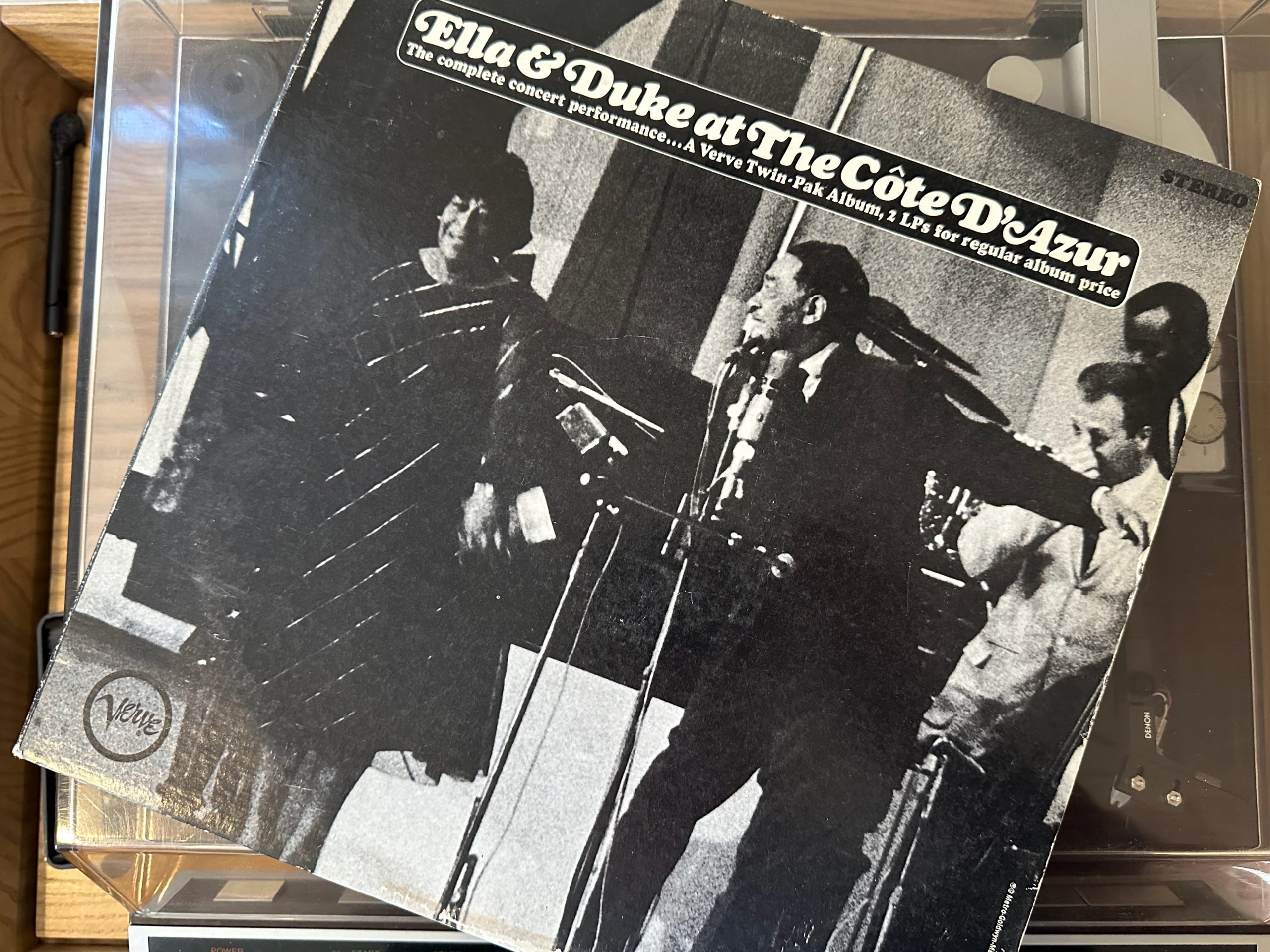
No such problem exists between the performers in today’s recording. Ella & Duke at the Côte d’Azur feels as though it ought to have been a bootleg due to the electricity of the crowd energy that’s captured and that clearly infects the performers. It is, in a word, jumpin’.

Ella and Duke had recorded several times together by the time this recording was made in 1966, starting in 1957 when she collaborated with Ellington on Ella Fitzgerald Sings the Duke Ellington Song Book. Part of her great Song Book series in which she elevated the work of American songwriters from Tin Pan Alley to canon, this was the only record in which she performed with the songwriter himself. She had also recorded Ella at Duke’s Place in the studio in 1965, and The Stockholm Concert, 1966 was cut earlier the same summer that the two met at the International Festival of Jazz for a series of concerts. The double LP here is apparently only a taste of the combined performances; together they recorded some 80-plus tracks, which eventually saw release in an 8 CD Verve set in 1998 as the Côte d’Azur Concerts.

What’s striking is how much fun Ella, in particular, seems to be having. She gets a full two choruses into “Mack the Knife” before she starts scatting and improvising over the band. According to the liner notes, there was no arrangement for the tune—they just started playing, and it’s audible in the music as it goes through multiple key changes. At one point, Ella sings “We’re making a record of the same old song… we swung old Mackie down for you people here at the Jazz Festival! We’re going to sing, we’re going to swing, we’re going to add one more chorus!” And she adds another two choruses, then a third, going up a half step in between each one. You can hear the socks of the crowd being blown off.

While Ella and Duke play together on the first track, many of the remaining numbers are played only by one group or the other, starting with Ellington’s usual group—Paul Gonsalves, Cat Anderson, Harry Carney, Ray Nance, Johnny Hodges, Mercer Ellington, Buster Cooper, Sam Woodyard, etc.— on “The Old Circus Train Turn-Around Blues.” The liner notes call out the tune’s similarity to “Night Train,” but it’s a fun enough romp nonetheless.

Ella’s group takes the stage next. She’s backed by the Jimmy Jones piano trio featuring Jim Hughart on bass and the mighty Grady Tate on drums. Her “Lullaby of Birdland” is not very lullaby-like, but it’s delightful nonetheless. This is followed by Ellington’s group, with Ellington announcing, “Buster Cooper will be the virtuosoist in ‘Trombonio-Bustiosso-Issimo.’” Cooper is hot indeed in the solo, with the band lighting a fire underneath him.

Ella’s group switches things up a bit with “Goin’ Out of My Head,” the newest composition on the record and a reminder of her late-sixties pop work on albums like her 1969 Ella. But if the tune sounds a little dated to modern ears, she gives it her all here. Ella never really belts on her records, but she certainly comes close on this one. Grady Tate provides a slightly samba-inflected beat behind the tune, swinging back into a rock beat in the chorus and keeping things lively throughout. She continues with “How Long Has This Been Going On?,” singing the Gershwin standard with nuance and subtlety and taking us into a different world for an all too brief moment.

Ellington’s band returns for a medley of “Diminuendo in Blue/Blow by Blow,” with Ellington growling and shouting encouragement to his players above the fray. Paul Gonsalves reprises an abbreviated version of his infinite solo from the famed Newport 1956 concerts. Next the band begins a performance of “It Don’t Mean a Thing (If It Ain’t Got That Swing” that has the crowd applauding from the first chords of the tune, and Ella joins them in, breaking up as Ellington shouts inaudible encouragement from the piano. After a few verses and some spectacular scatting from Ella, another from Ellington’s band steps up and trades scat bars with her. But Ella cannot be imitated or brushed off, and she carries the rest of the song, dropping in a reference to “A Hard Day’s Night” before driving the song to closure. The Ellington band concludes this set with “All Too Soon,” providing Ray Nance an opportunity to show off his violin playing together with Ben Webster and Buster Cooper. There’s no showboating here, just solid solos from all three protagonists.

Ella’s band returns with settings of “Misty” and “So Danço Samba,” called “Jazz Samba” on the original label but corrected on my copy. “Misty” is played straight and sensitively, with a closing straight out of the Sarah Vaughan playbook, but “So Danço Samba” is something else again. Combining a sensitive approach to the Brazilian original with interspersed scatting, a touch of “The Girl from Ipanema,” and ending with a whispered beat-box of a vocal solo that has her trading percussive licks with Grady Tate before she takes a resurgent and triumphant sung conclusion, she cracks up the band and takes the crowd by storm.

The Ellington band returns with a request, a “totally unprepared, unrehearsed, no arrangement” version of “Rose of the Rio Grande.” Buster Cooper takes the solo on his trombone, duetting with Sam Woodyard’s bass in a brief interlude and closing the whole work out in a roaring crescendo. Ella’s band then takes over with an achingly tender “The More I See You” before yielding again to Ellington for “The Matador (El Viti).” Ella rejoins Duke for a final performance of “Just Squeeze Me (But Please Don’t Tease Me),” where she trades scat syllables and bluesy growls with the great pianist and trades verses with Ben Webster, and finally addresses the audience, “You’ve made us sentimental, the way you received our show/We’d love to squeeze you, really don’t want to tease you.” The audience returns the expressed affection with a roar of applause, bringing the set to an end.

This brings our series on Duke Ellington to a fitting close, as I’ve run out of vinyl with his compositions. We’ve heard many different sides of the man: the innovative composer, the bandleader who played the orchestra like a piano, the sensitive, intuitive collaborator, and finally the master showman. There’s a lot more Ellington to explore, but the calendar is turning. Next week we’ll be exploring something very different.

You can listen to the album here: