
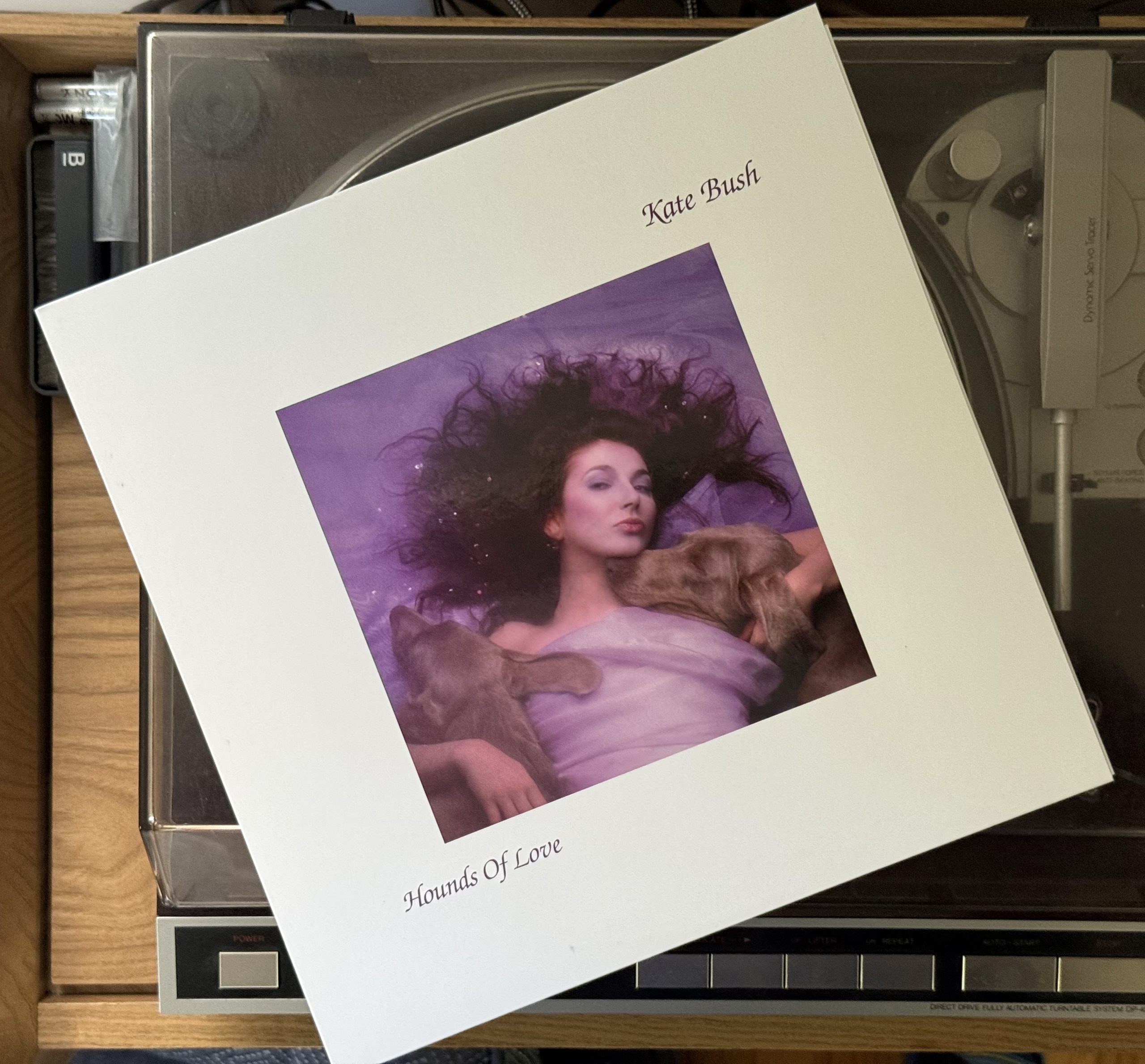
Album of the Week, May 9, 2026
We come at last to Kate Bush, whom we’ve heard as a backing vocalist on Peter Gabriel 3, but whose own body of solo work was already substantial by this time. At age 27 she was already on her fifth album, and having had a reasonably high level of success with the first four was able to record it with considerable artistic freedom. What she produced has few peers in pop music history: a record with both hits and a conceptual suite, self-produced, that seamlessly blends new wave influences with progressive rock and traditional music sounds, and still manages to sound new today.
Kate Bush grew up in Kent, with both parents harboring amateur musical talents. She taught herself piano at age 11 and was writing songs in grammar school. In the early 1970s she recorded a demo tape which found its way into the hands of Pink Floyd guitarist David Gilmour via a mutual friend. Gilmour sponsored a more professional demo recording; this led to Kate being signed to a recording contract with EMI at age 16. EMI, fearing Bush was too young, kept her on retainer for two years during which she studied interpretive dance with David Bowie’s dance instructor and finished her secondary education.
Her first album, The Kick Inside, was recorded when she was 19 years old and yielded a Number One UK single, “Wuthering Heights.”1 She set a Guinness World Record as the first woman artist to have written every track on a million-selling debut album. But she wanted more artistic control than she was able to exercise on The Kick Inside or her second album Lionheart. Starting with her third album, Never for Ever, she began co-producing her work, bringing a diversity of sounds to the songs and featuring heavy use of synthesizers for the first time, in particular the Fairlight CMI to which she had been introduced while working with Gabriel. This album and the follow-up, The Dreaming, were much more experimental, and the fourth album in particular was received with puzzlement. Undeterred, but noting the high price of studio time, she built her own private studio, allowing her to work at her own pace.
Much of the fifth album was written and performed by Kate on the Fairlight, the Linn drum machine, and piano, but there were a small host of other musicians present, including her longtime bass player and then-partner Del Palmer, bassist Eberhard Weber, percussionist Morris Pert (also on PG3), session guitarist Alan Murphy (Level 42, Mike and the Mechanics), bouzouki and bodhran player Dónal Lunny (Planxty, The Bothy Band), whistle and fiddle player John Sheahan (the Dubliners), Uillean piper Liam O’Flynn (Planxty), the Richard Hickox Singers, and her brother Paddy, who had played on all her prior albums, on balalaika, didgeridoo, violins, and vocals.
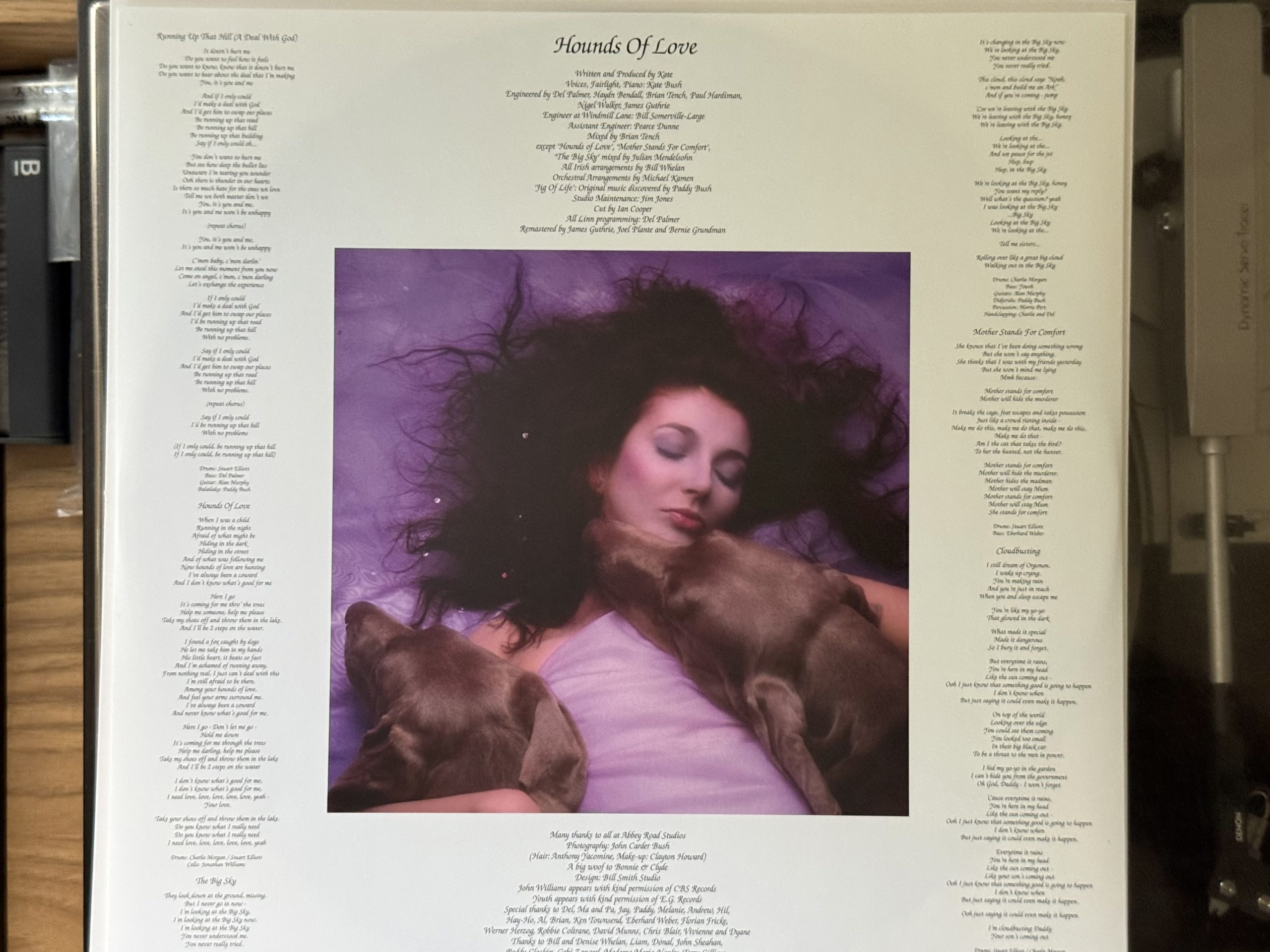
“Running Up That Hill” is by this point the best known song on the album, after its second life in Stranger Things. But it’s still a mesmerizing track, with the rhythmic drums (session player Steve Elliott and a healthy dose of Linn) underpinning Del Palmer’s bass and that synth vocal line playing the hook, all before Kate even sings her first lyric. But it is precisely the lyrics and Kate’s voice that are the heart of the song as she sings about the failure to communicate and the desperate wish for empathy: “If I only could, I’d make a deal with God/and I’d get him to swap our places.” Kate’s early albums had her vocals in her high soprano, which was mesmerizing but which could also be harsh depending on her choice of vowel production; here she embraces her lower register as a grounding and a dramatic accent (as on the famous “Yeah, yeah, yo” backing vocals, themselves an iconic hook).2
“Hounds of Love” is a more joyous song, somehow, as Kate sings about being afraid to fall in love over a woofing chorus: “I’ve always been a coward / And I don’t know what’s good for me / Oh here I go… Take my shoes off and throw them in the lake / And I’ll be / Two steps on the water.” The song is almost entirely Kate’s, with only the two drummers (Elliott and Charlie Morgan, who appeared on Wham!’s On the Edge of Heaven and Paul McCartney’s Flowers In the Dirt and who later played with Elton John for thirteen years—and a single cellist credited as joining her on the track. The melody is in a major key but relentlessly descends in thirds and fourths, giving a feeling of giddy instability. It’s a blast.
“The Big Sky” is another disorientingly happy song, with an edge on it, as Kate’s ragged vocal expresses her excitement at the clouds in the big sky while simultaneously accusing her past lover: “You never understood me/ You never really tried.” A chorus rises behind her as she proclaims, “This cloud/Says ‘Noah / Come on, build me an Ark / And if you’re coming, jump / ’Cause we’re leaving with the big sky.’” The ending chorus—“Rolling over like a great big cloud / Walking out in the big sky”—is as close to a gospel moment as Kate’s songs come, and her ecstatic melisma over it is one of her biggest highs.
“Mother Stands for Comfort” is the sole ballad on the album, but despite the title’s promise, not all is well: “Mother, hide the murderer… Mother hides the madman/ Mother will stay Mum.” Eberhard Weber’s jazz-inflected bass is the key to the track, along with Kate’s plaintive vocals and the periodic outbursts of breaking glass—a famous sample patch in the Fairlight which she had also used on her single “Babooshka.”
“Cloudbusting” seems to flow out of “Mother” naturally, but it’s an entirely different song, closer to “Running Up That Hill” in concept and writing. Indeed, the chorus “Every time it rains you’re here in my head/Like the Sun coming out” could be a continuation of the “Running Up That Hill” chorus, only here powered by a churning string section instead of the synthesizer. The song itself carries immense longing in the chorus, “I just know that something good is going to happen,” with only the chugging low strings hinting that there’s tragedy ahead. The song is based on the memoir of Peter Reich about his father Wilhelm’s experiments with attempting to tap “orgone energy” to create rain, but you don’t need to know that story3 to feel the hopeless sadness mixed with the sense that this time it just might work.
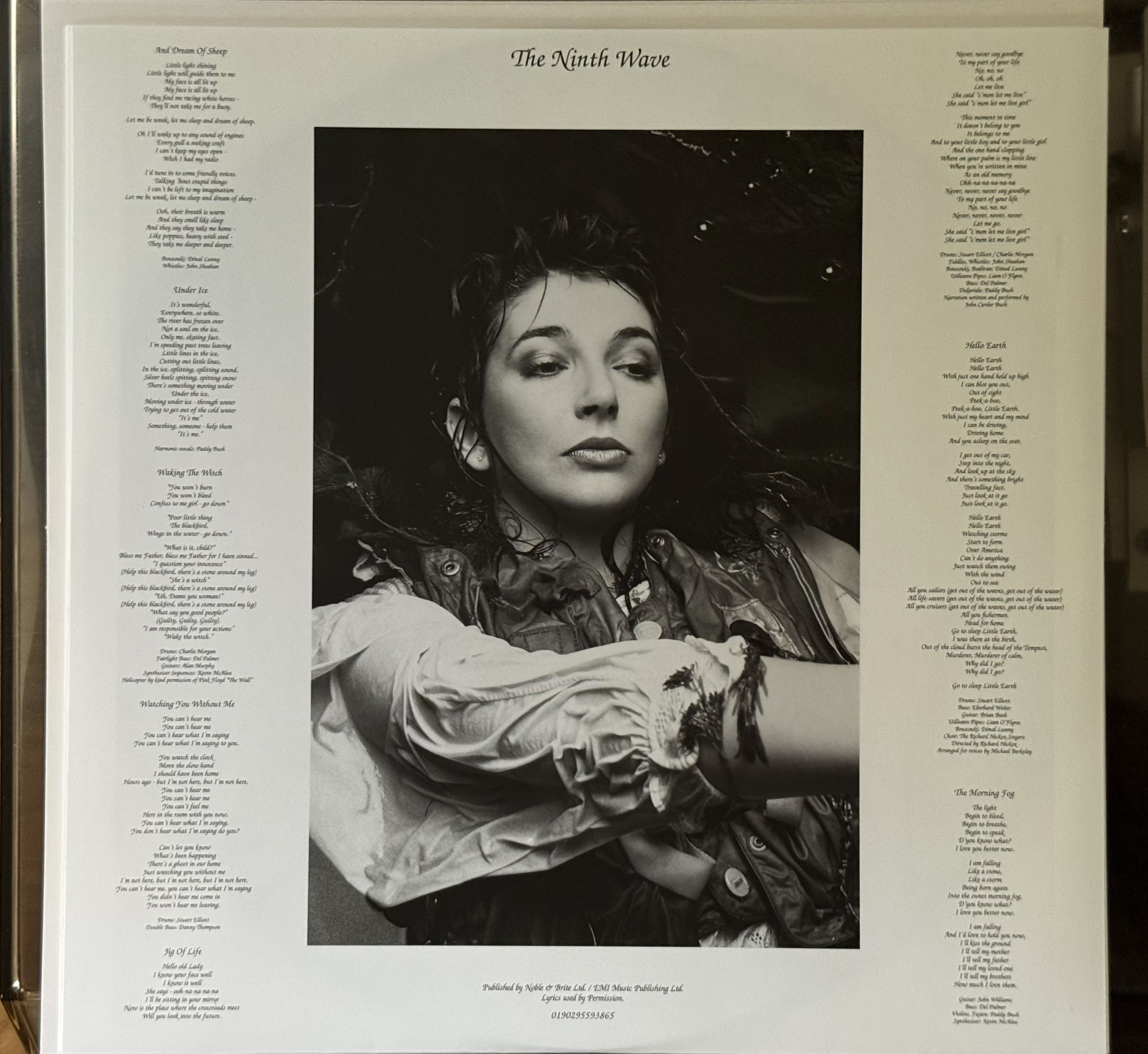
The seven songs on Side Two form a complete song cycle which is titled “The Ninth Wave” in the liner notes. “And Dream of Sheep” opens the cycle with Kate’s character in the water, kept afloat by a life vest, “Little light will guide them to me / My face is all lit up.” She tries to keep herself awake, to keep from drowning in the ocean, but she fails to keep her eyes open and enters a dream state, pulled under by her hallucinations.
We get those dreams in “Under Ice,” and they’re frozen; she skates over a frozen body of water, only to see “There’s something moving under/Under the ice… Something / Someone help them / It’s me…” With the realization that the narrator is watching herself drown she comes to herself, and the track hard cuts to “Waking the Witch,” where the narrator hallucinates voices telling her to wake up, alternating with an accusatory judge accusing her of witchcraft, fragmented voices spinning past in a vortex of sound, and even the sound of rescuers: “Can you not see that little light over there?” followed later by the sound of helicopters arriving and a voice yelling at her to “get out of the water.” There are layers upon layers in the sound; it replicates the disorientation of near-death convincingly.
She’s out of the water but not out of the woods. “Watching You Without Me” finds her at her house watching her lover but unable to interact with him; meanwhile he seems utterly unaware of anything that’s happened to her. The track is a ballad tempo, an ordinary major key loop that seems frozen in time, with only a prominent bass melody pushing at the edges to signal the narrator’s distress. There’s a section that appears to have been recorded backwards and played forward; the sound of seagulls drifts in, cutting through the hallucination, as “Jig Of Life” confronts the narrator with her future self, who insists that she bring herself back to life for the sake of her future and her children. As the emotional energy peaks, suddenly we’re in a jig, led by the violin and accompanied by the skirling of the Uillean pipes. Coming out of the jig, the narrator tries to unfragment her memory: “I put this moment here/I put this moment over here.” The song ends with Kate’s older brother John Carder Bush reciting a dramatic poem about her being one with the water.
The hallucinating victim seems in danger of losing all contact with life in “Hello Earth,” which seems to reprise the melodies of “And Dream of Sheep,” “Running Up That Hill” and “Cloudbusting” all at once. A men’s chorus anchored by deep bass voices (possibly pitch shifted) makes us wonder: has she died? The full chorus accuses her of being the “murderer” from “Waking the Witch” as Kate’s character asks “Why did I go?” The bass chorus returns again; is she being sung to rest? But there’s a beep as of a hospital machine, and through the whooshing sounds we hear a German voice: “Deeper, deeper… Somewhere there is a light.”
“The Morning Fog” returns to the “Hounds of Love” melody, this time tempered by gentle guitar melodies and played down a step, as the drowning victim gratefully regains her life: “Do you know/I love you better now/…I’ll kiss the ground/I’ll tell my mother/I’ll tell my father/I’ll tell my loved ones/I’ll tell my brothers/How much I love them.” At the end of the cycle, we’ve come full circle, only instead of seeking to bring empathy to her lover, she is filled with a desire to live and love in the present instead, changed by her near-death experience.
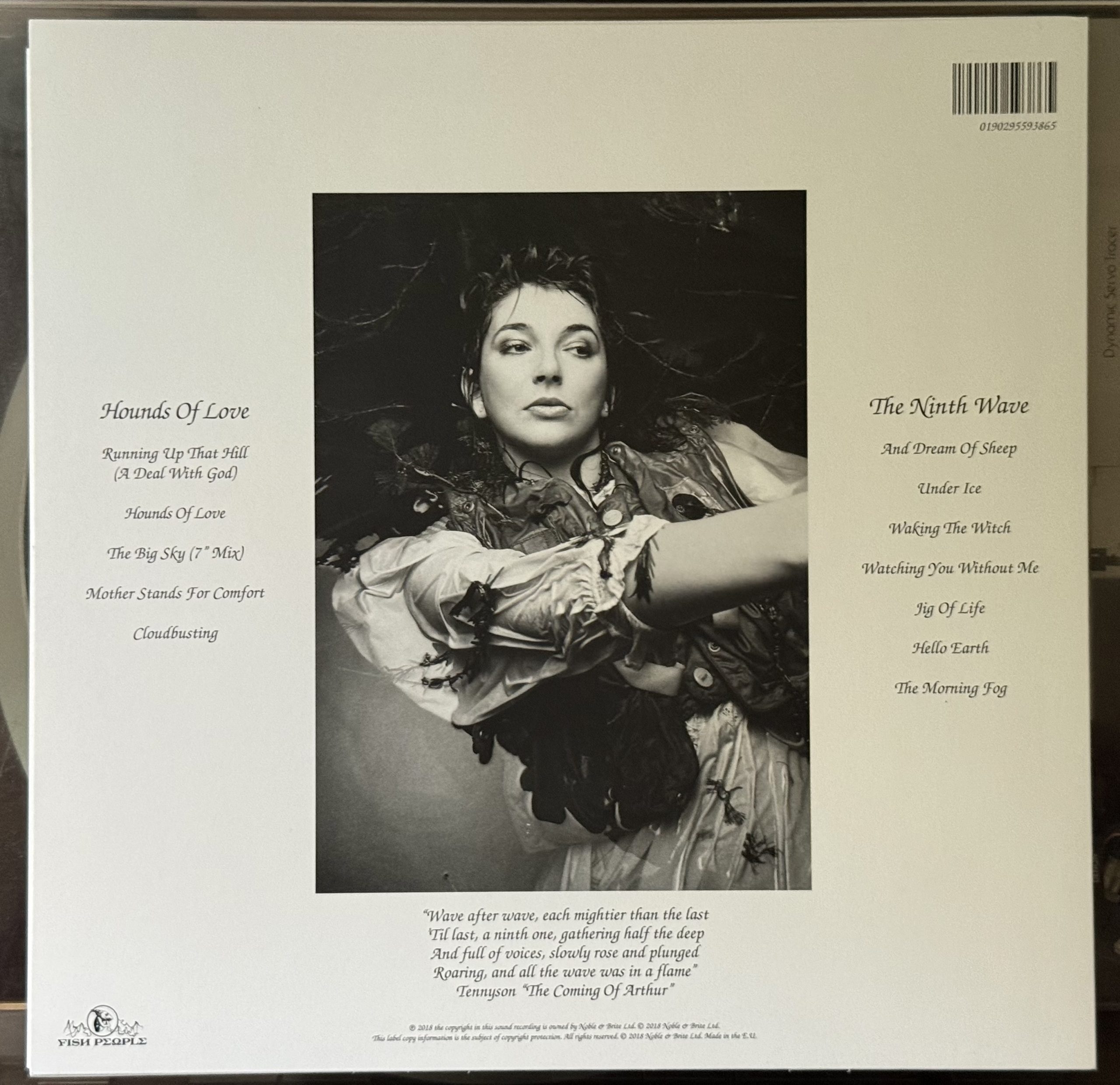
Hounds of Love is like that, a circular, endlessly self-referential album, full of depths and supporting many interpretations. (There are Kate fans who argue that “The Ninth Wave”’s drowning victim dies and is reborn, or that the drowning is symbolic of ego death and investigating the subconscious, or that Kate is the Ophelia to her own Hamlet).4 However you interpret it, the album is first rate, with a philosophically deep second side, a first side full of absolute killer songs, and an everything-goes approach to production. The album hit Number 1 in the UK in 1986, and when “Running Up That Hill” soundtracked an episode of the fourth season of Stranger Things in 2022, it rocketed up the UK charts, giving Kate her second career Number One and going all the way to Number Three in the US. There’s hope for the world still.
And speaking of Number Ones, we’re going to be talking about a few of them next time.
You can listen to this week’s album here:
BONUS: Here’s Kate performing “Running Up That Hill (A Deal With God)” at The Secret Policeman’s Third Ball, with none other than David Gilmour backing her up:
BONUS BONUS: Here’s Kate performing “Hounds of Love” at the 1986 Brit Awards:
BONUS BONUS BONUS: Here’s a 1985 interview with Kate on the BBC’s “Old Grey Whistle Test.” She talks about the building of her new studio and the making of the album.
BONUS X4: Kate didn’t tour behind this album; she famously played very few live shows, and most of the “live” performances I’ve linked to (except the Secret Policeman show) have her lip-syncing. But as a performer she was still electric even when lip-syncing. This appearance on Wogan from 1985 was the first time anyone had ever heard the music from the album, and the whole thing is completely electrifying.
Footnotes
- We’ve heard that song covered by Cécile McLorin Salvant. ↩︎
- There was a memorable karaoke outing in San Francisco while I was there for the RSA Security Conference one year, where a young man sang “Running Up That Hill” in the original key, and the entire bar sang along on the “yeah, yeah, yo”s, about five years before the song made its Stranger Things comeback. This song is wired into GenX’s brain. ↩︎
- Or that Willam S. Burroughs owned one of Reich’s orgone accumulator boxes, forerunner of the cloudbuster, but it’s a heck of a coincidence. ↩︎
- Gathered posts from rec.arts.gaffa, the Kate Bush USENET newsgroup. This is what discourse on the Internet really used to be like, in the days before memes and shitposting. ↩︎